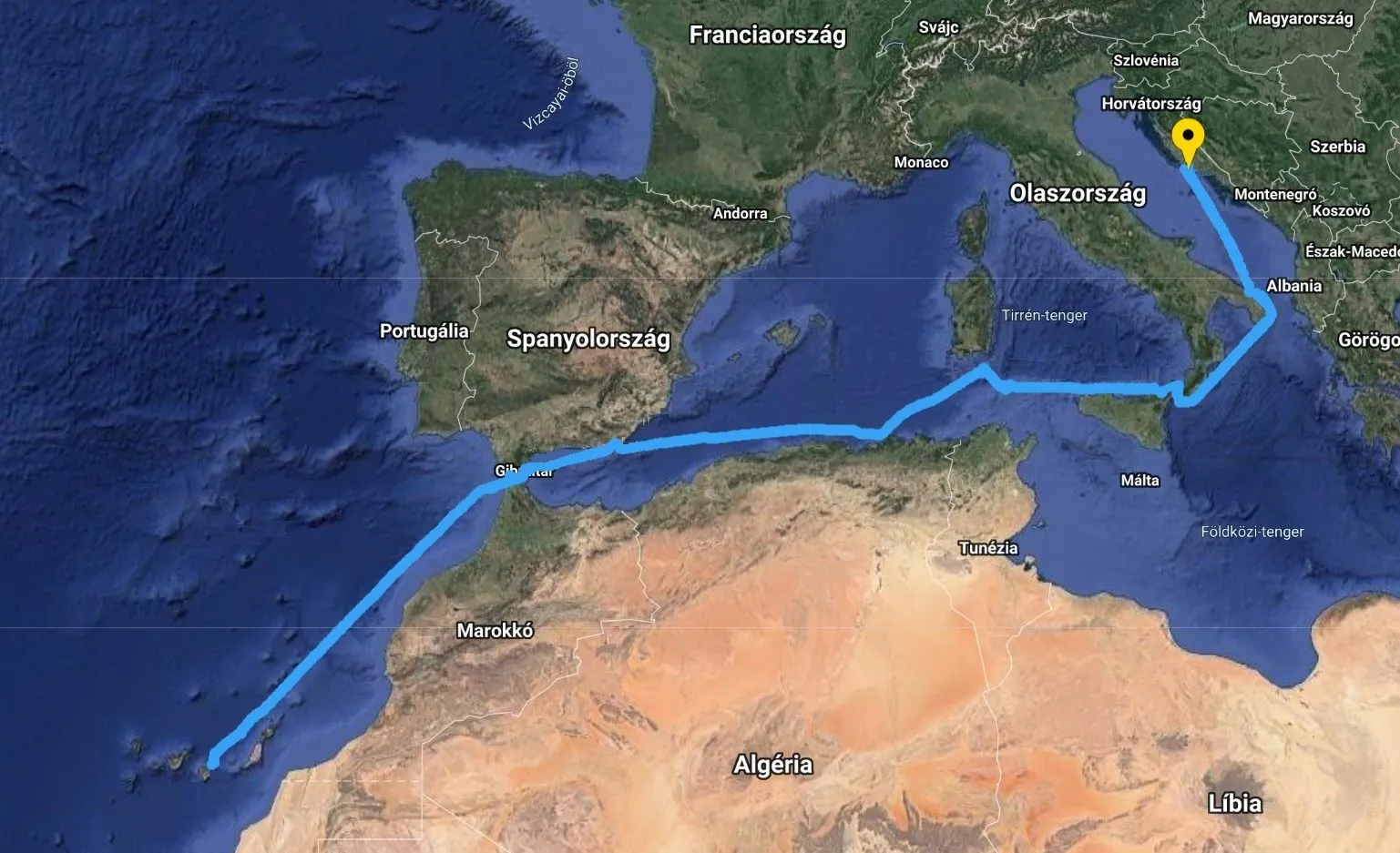
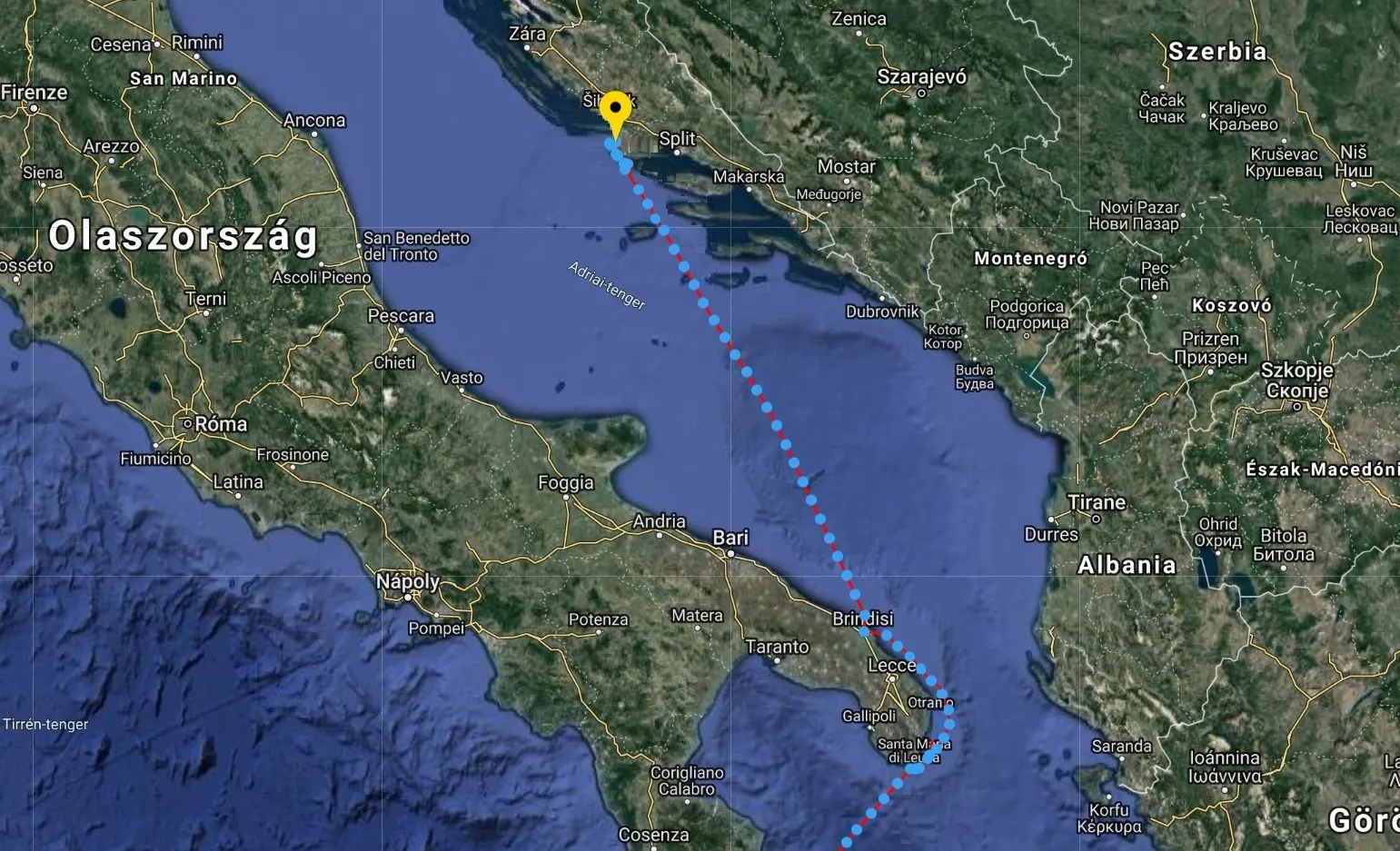
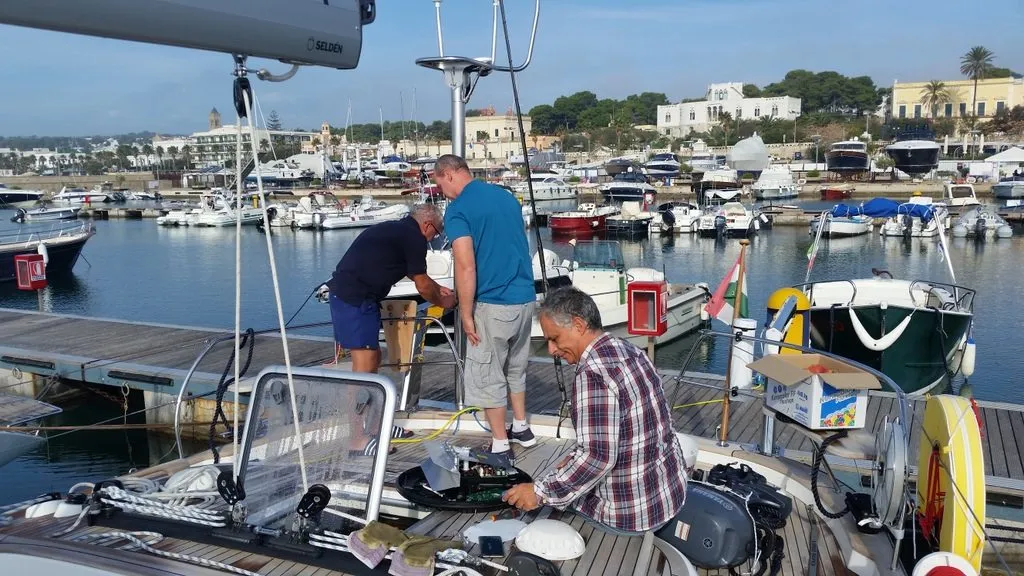
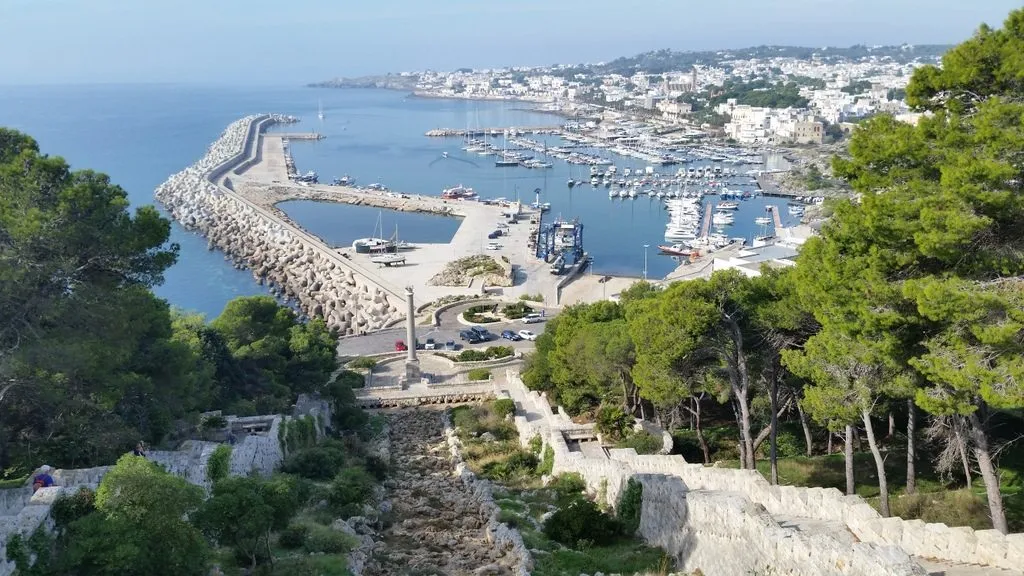
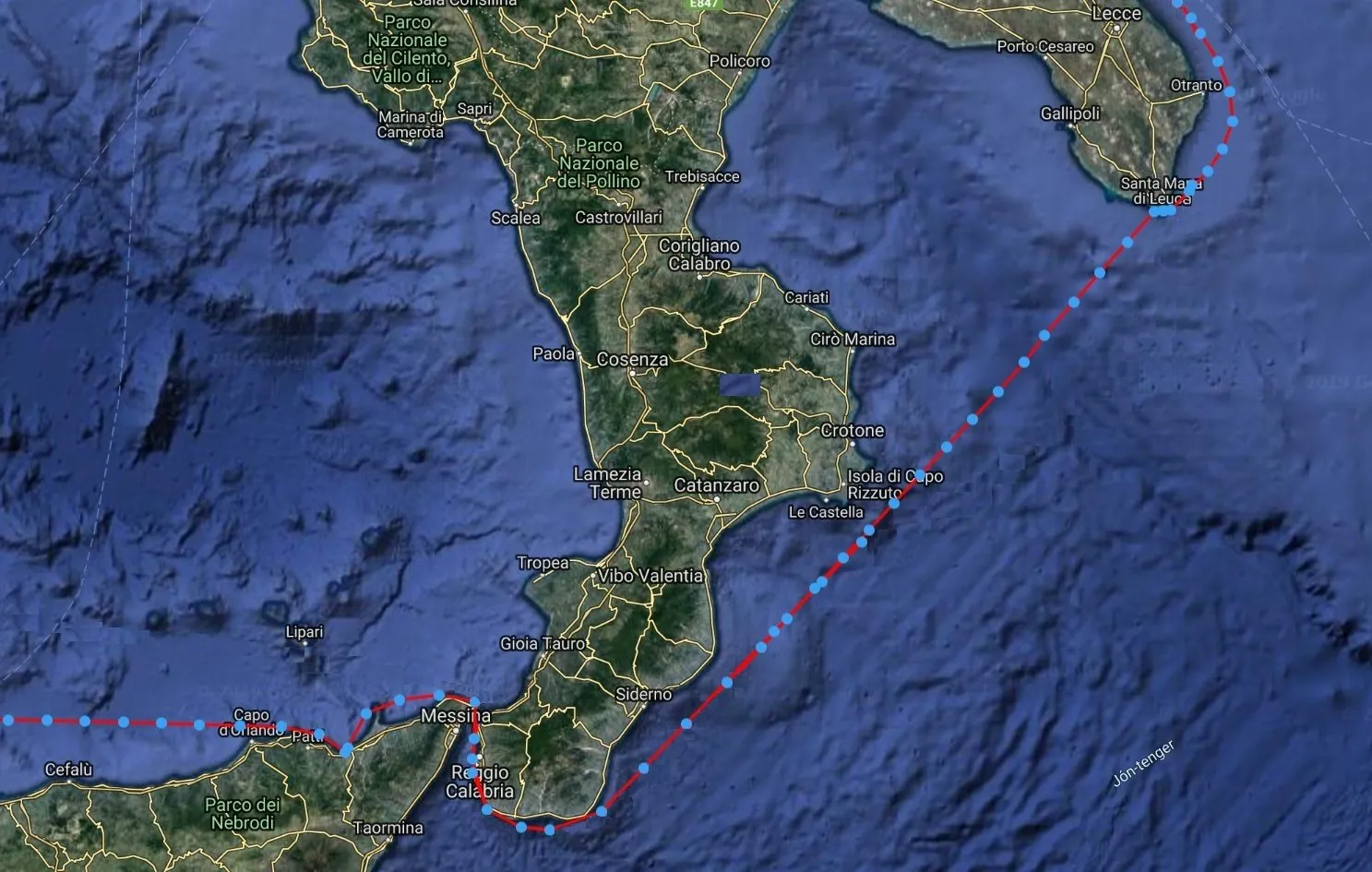
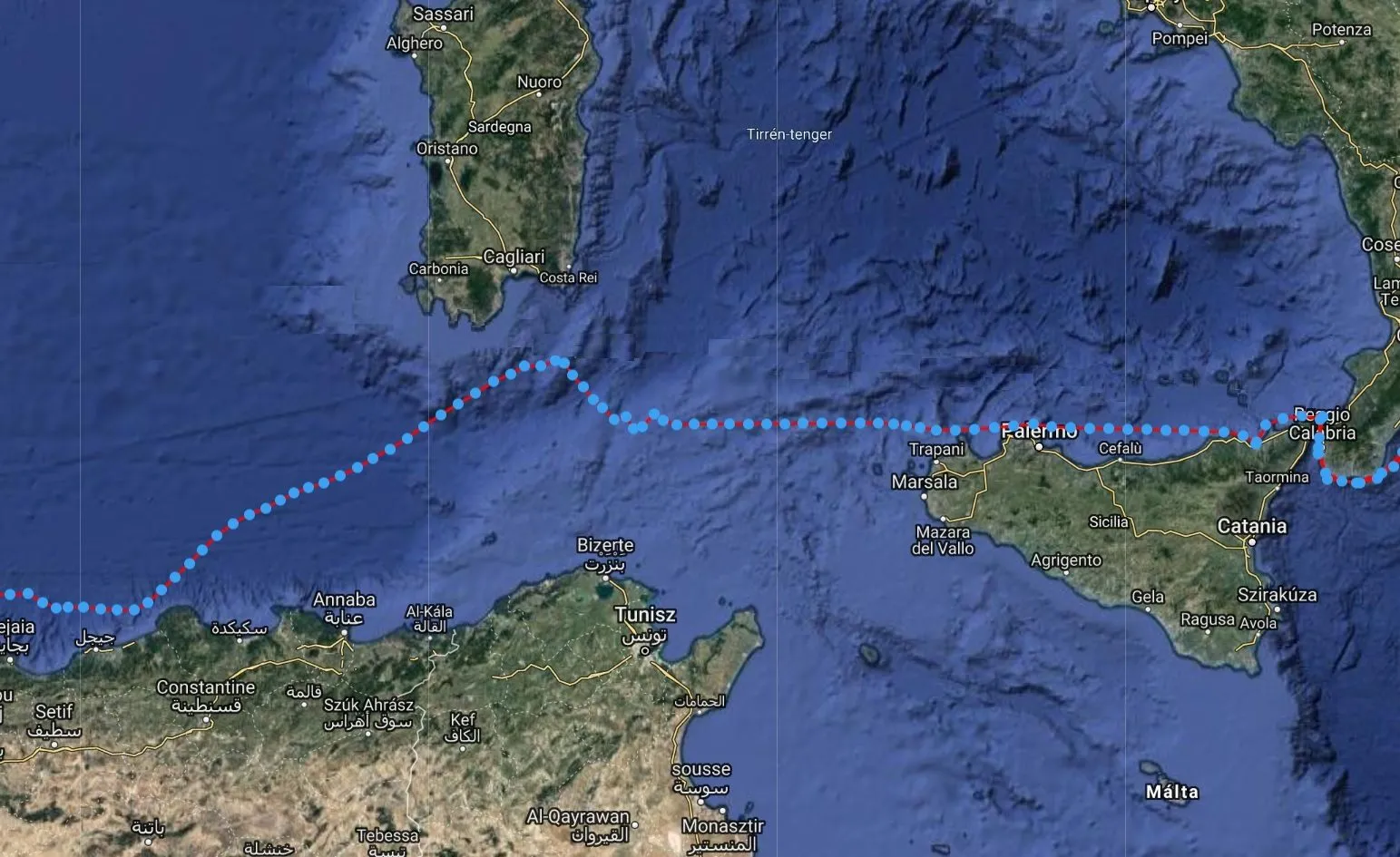
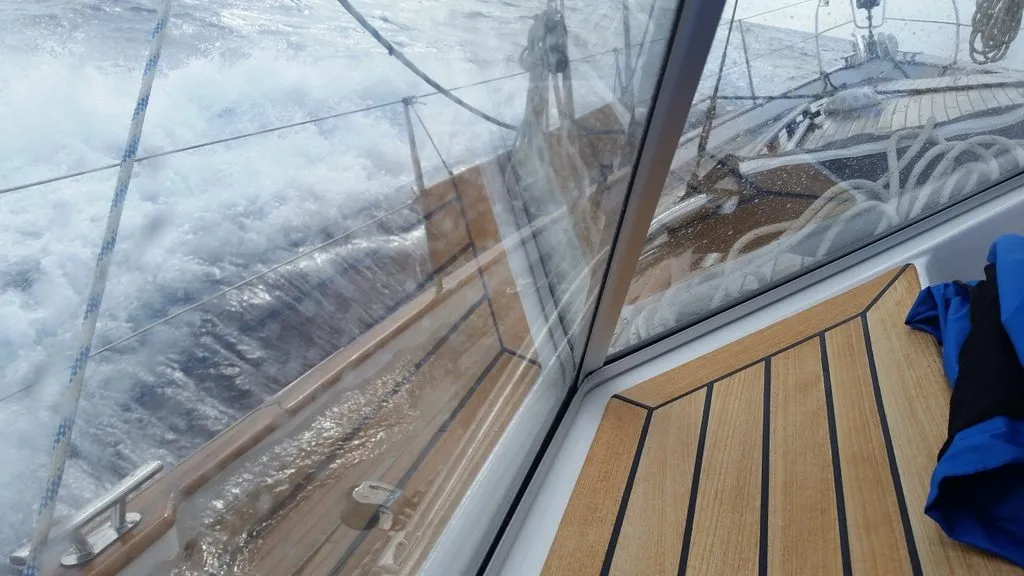
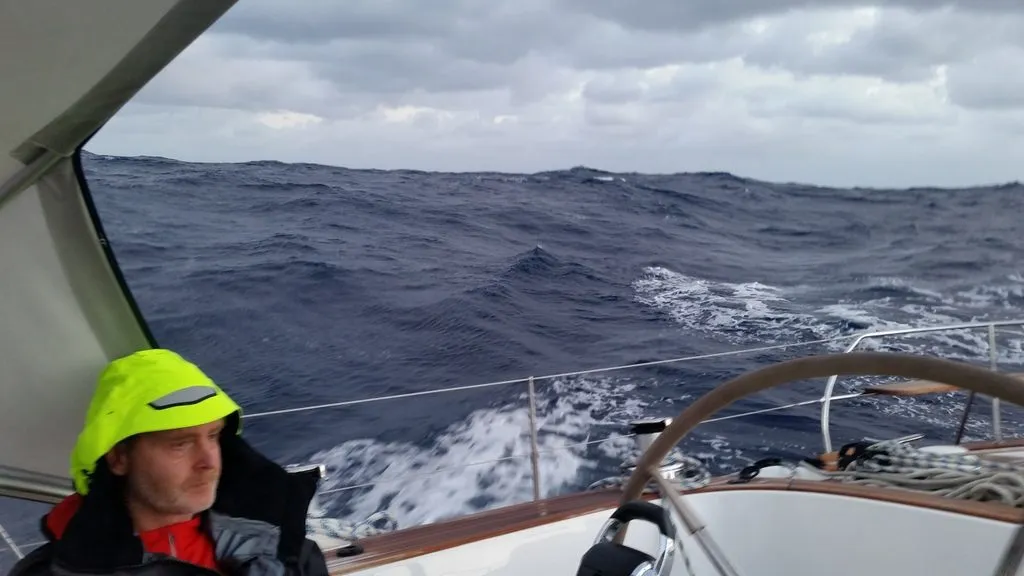
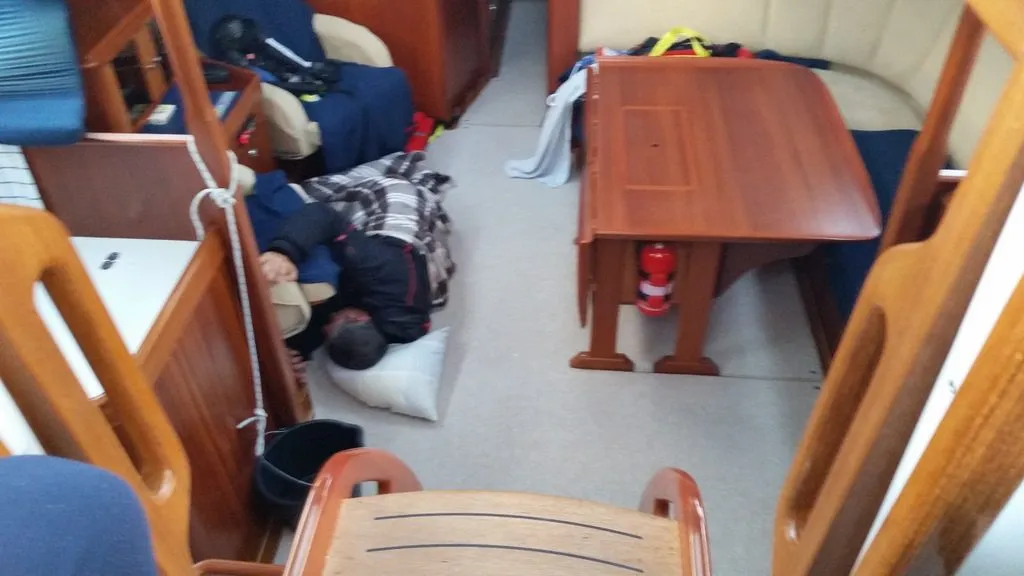
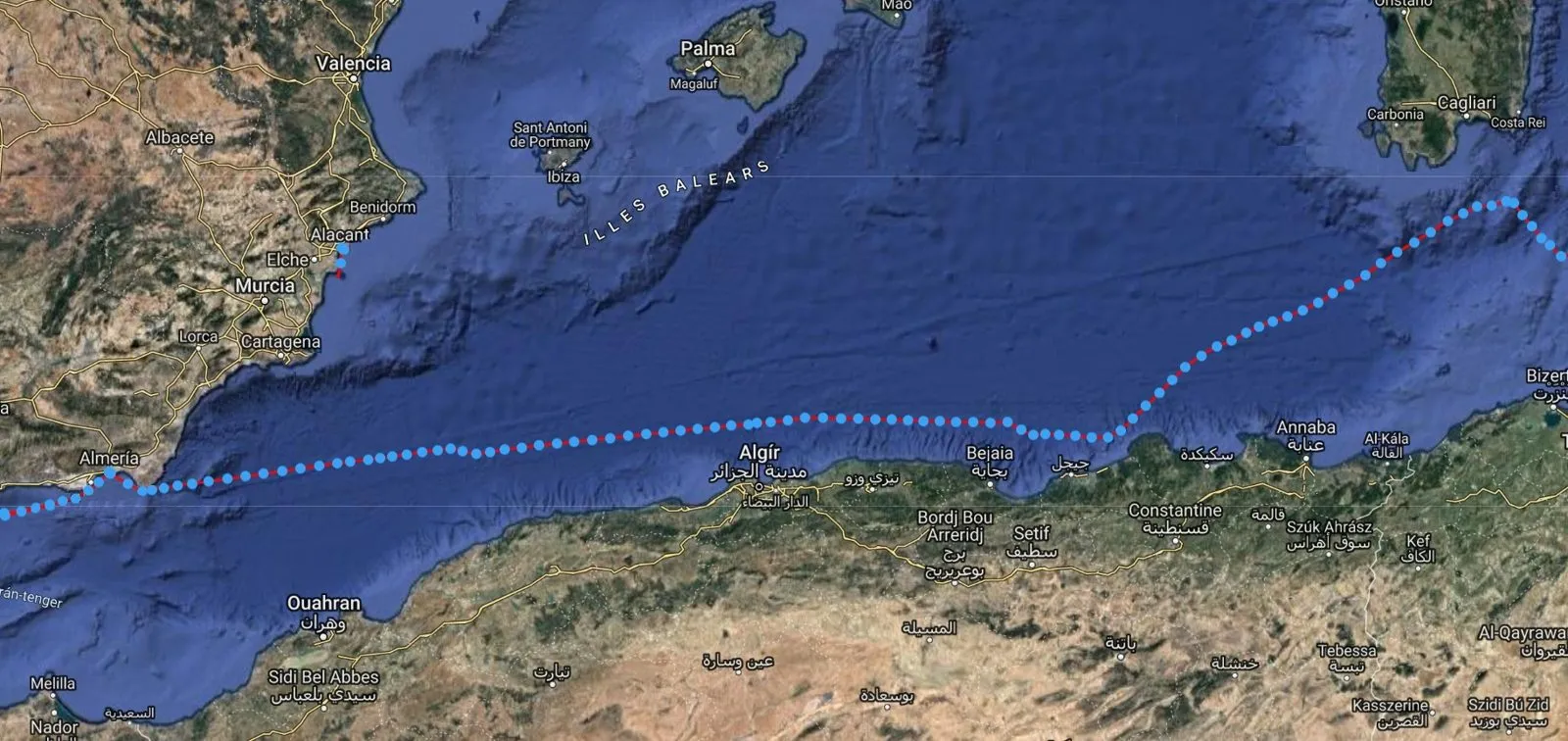
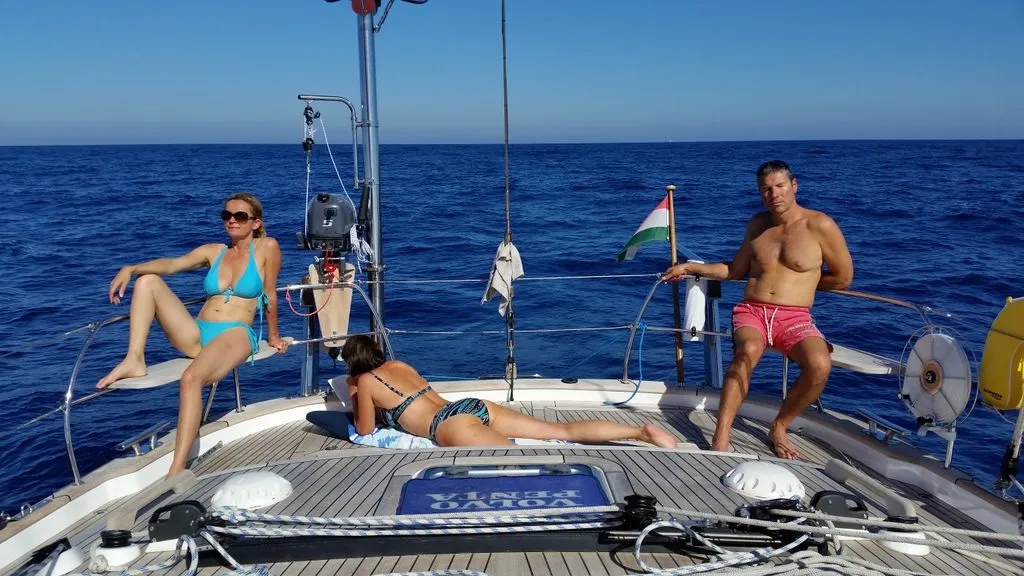
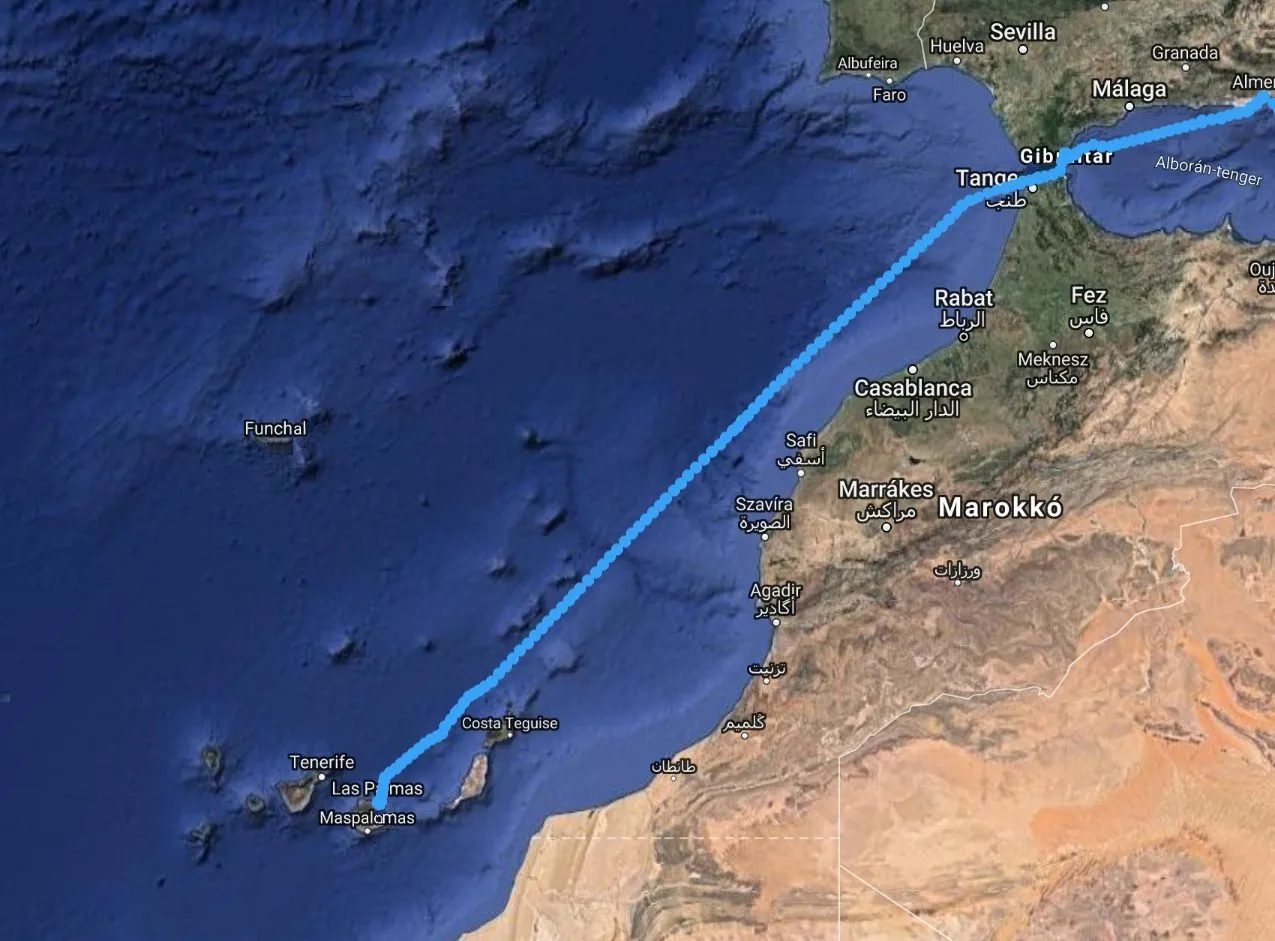
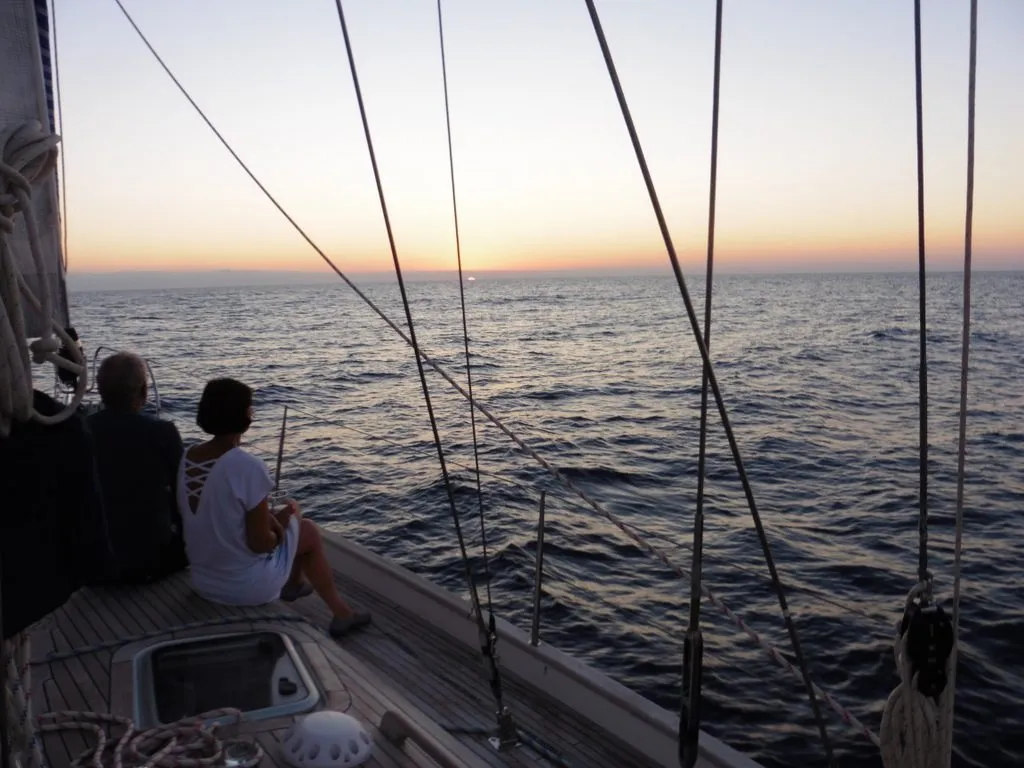
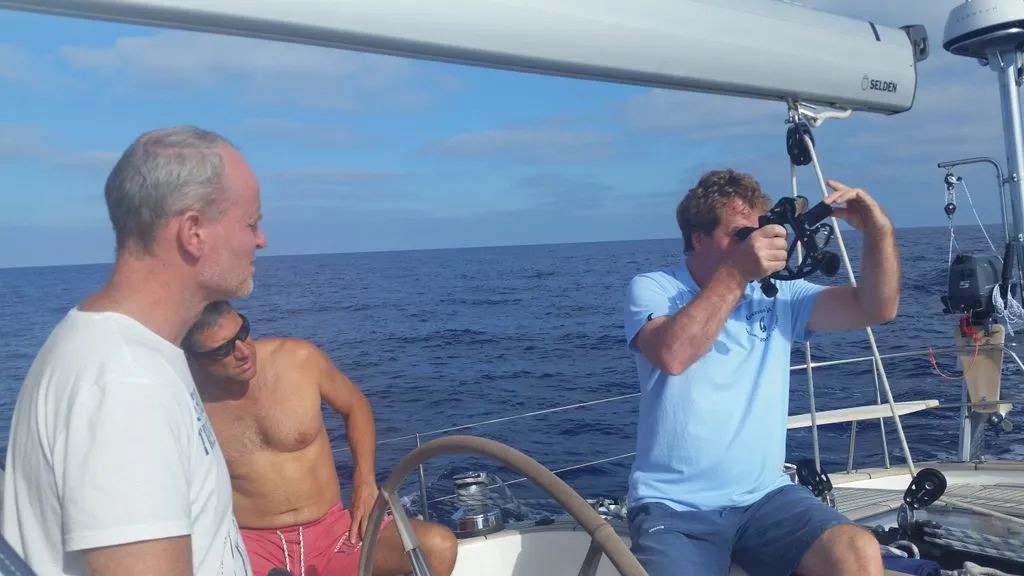
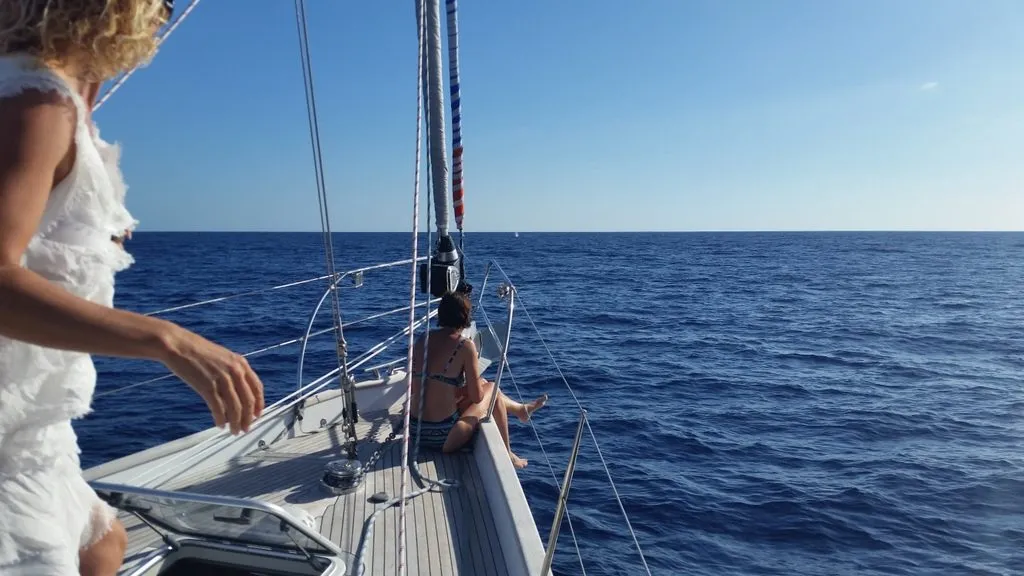
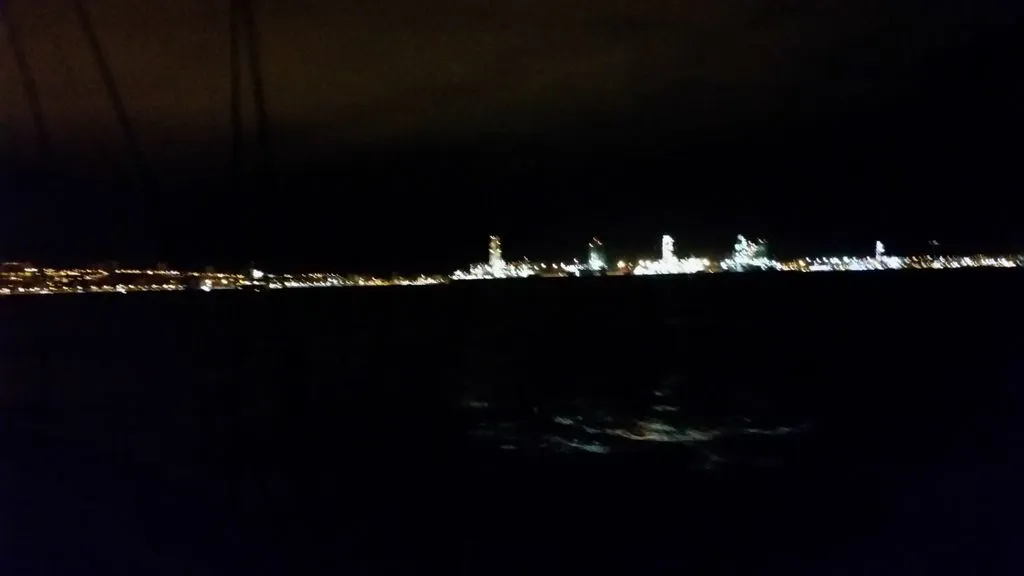
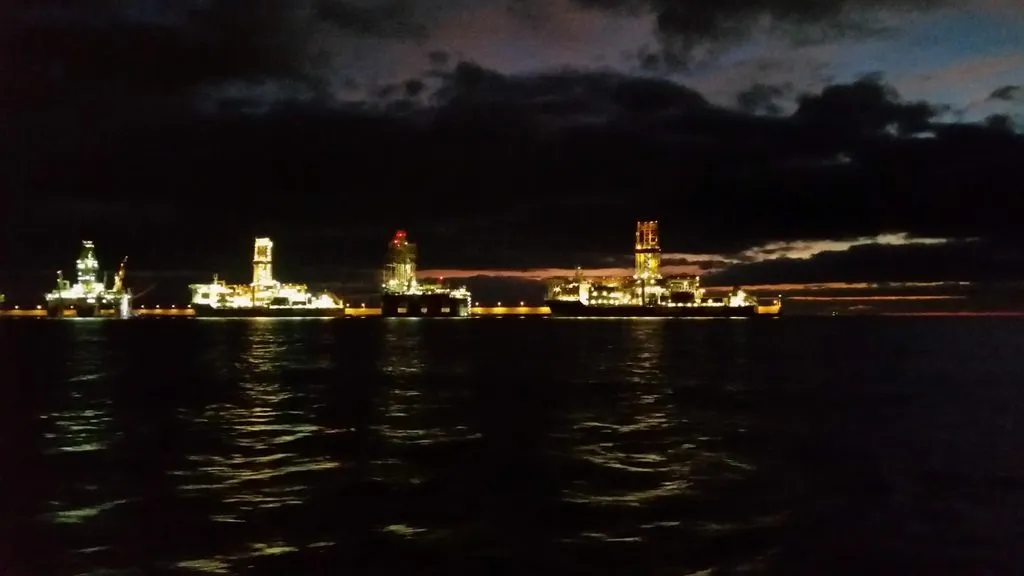
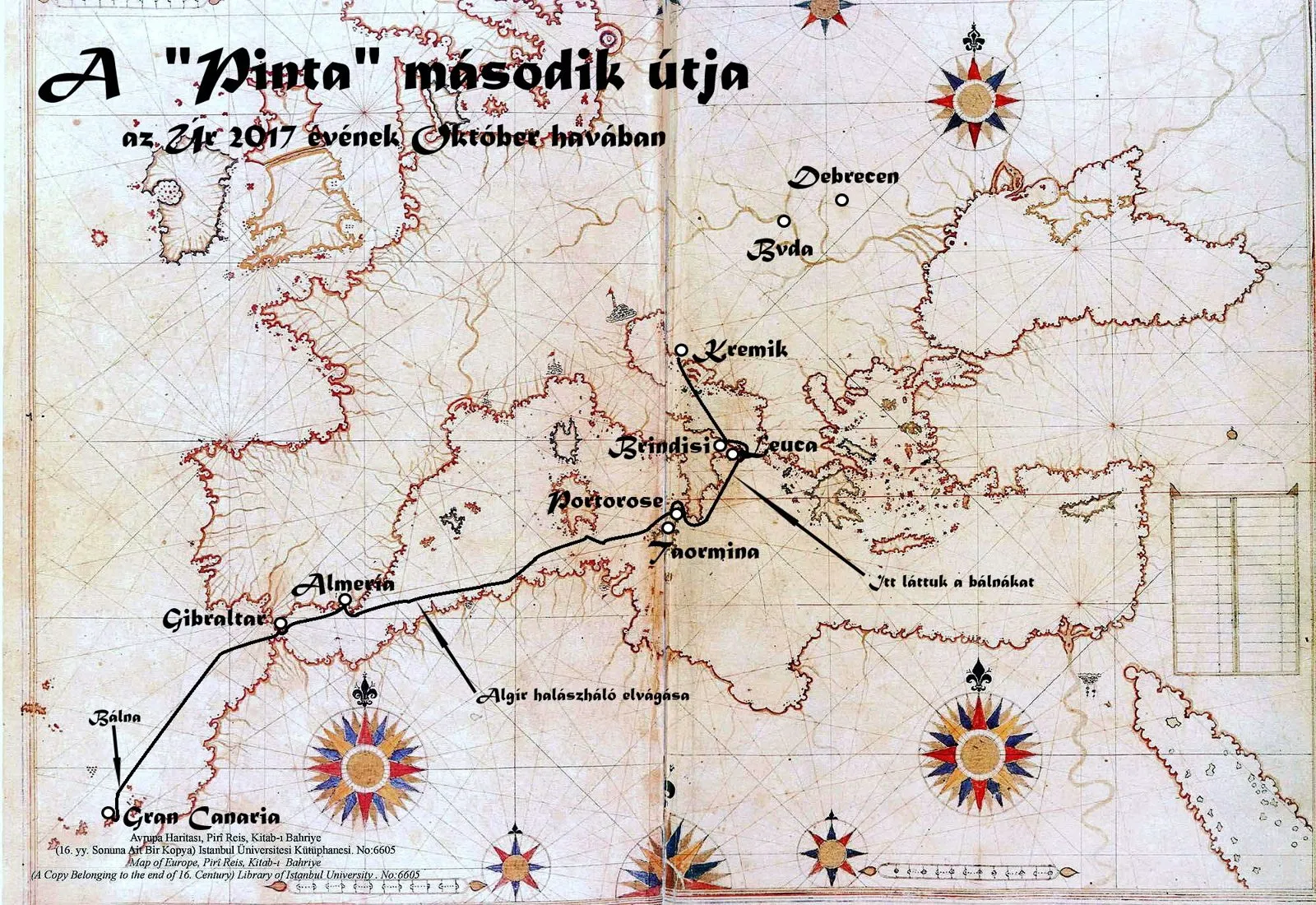
The first leg of the Pinta's circumnavigation, from Kremik to Las Palmas – source: balajaazoperencian2.blog.hu
· Kremik, Croatia
Even in my early youth I longed for the sea…
Even in my early youth I longed for the sea.
Like Robinson.
I too was born in the last millennium, but I grew up on the edge of the Hortobágy (the Hungarian puszta, about as far from any sea as you can get) and not in Hull, so I had minimal chance of stowing away on a ship when the opportunity arose – driven by a thirst for adventure – and so for a long time I could only prepare for the great voyages to come by reading sea stories. Still, I did manage to get aboard a sailing boat on Lake Balaton twice: first at about six, in Szántód, on the Kadet-type dinghy of the caretaker of the Postal Workers’ holiday camp, then at 13 on some big sailing boat with a star in its name at the Zánka pioneer camp. There was no wind, of course, but even so I held up very well without any seasickness, and it was already plain to see that, essentially, God had created me a sailor too, it’s just that at my “launching” he mixed up west longitude with north latitude…
To correct this, there was nothing for it but to set out on my own to acquire sailing knowledge, so in 1985, after my school-leaving exams, Andi and I passed the category B skipper’s licence for sailing boats in Balatonalmádi, then three years later the category A, and finally in 2004, moving in the direction of easier resistance, I got through the Croatian category B sea licence without too much trouble. After lots and lots of Adriatic charters and offshore races, as well as two circumnavigations of Mallorca, I finally got the chance to try myself out on longer sea passages too: in November (!) 2011 we took an Atlas 25 sailing boat across the Aegean from Lesbos to the island of Limnos, then in April 2012 I got to take part in delivering a new Lagoon 450 catamaran from Palermo in Sicily to the Adriatic, to Biograd.
In April 2017 Gyuri, the Hungarian owner of a new Hallberg-Rassy 48, was looking for sailing companions to take the boat from the factory in Sweden to the Adriatic. Luckily I got to be part of that voyage too, from Denmark through the Channel and across the Bay of Biscay as far as Lisbon.
I wrote about that voyage in the first blog of my life, which was made possible by our putting into port every 2–3 days.
Since I didn’t make it to Gibraltar that time, I told Gyuri that if he set off on his round-the-world voyage in the autumn, I’d be very happy if my wife, Andi, and I could accompany them as far as the Canary Islands.
And so the day of departure arrived, 16 October 2017.
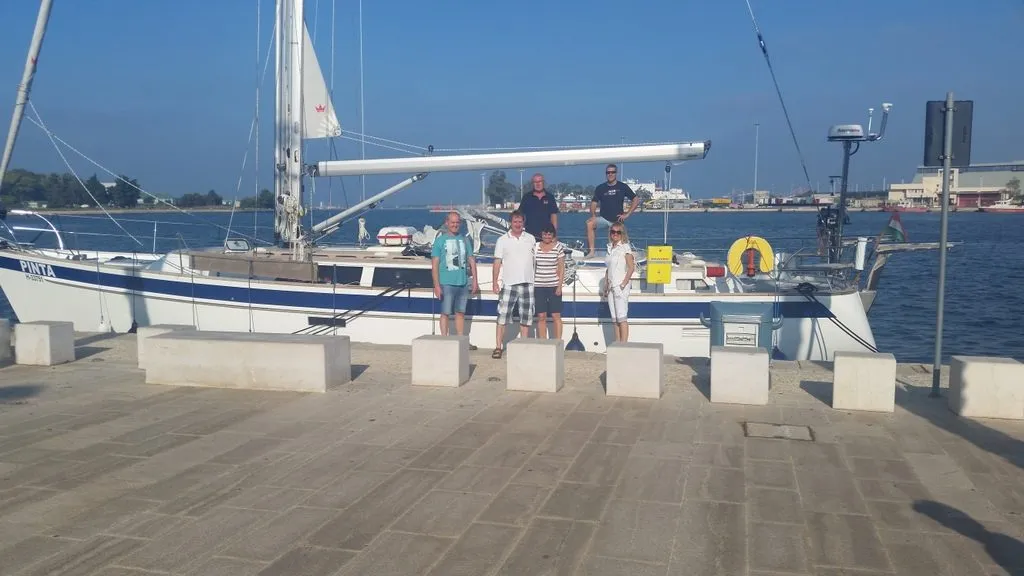
The day before, we travelled down from Hungary to the Adriatic with our future shipmates, Ricsi, Anikó and Szabolcs – whom we’ve only just met – to Marina Kremik, where “our boat”, the Pinta, was waiting for us. Gyuri arrived the day before; we set off tomorrow morning.
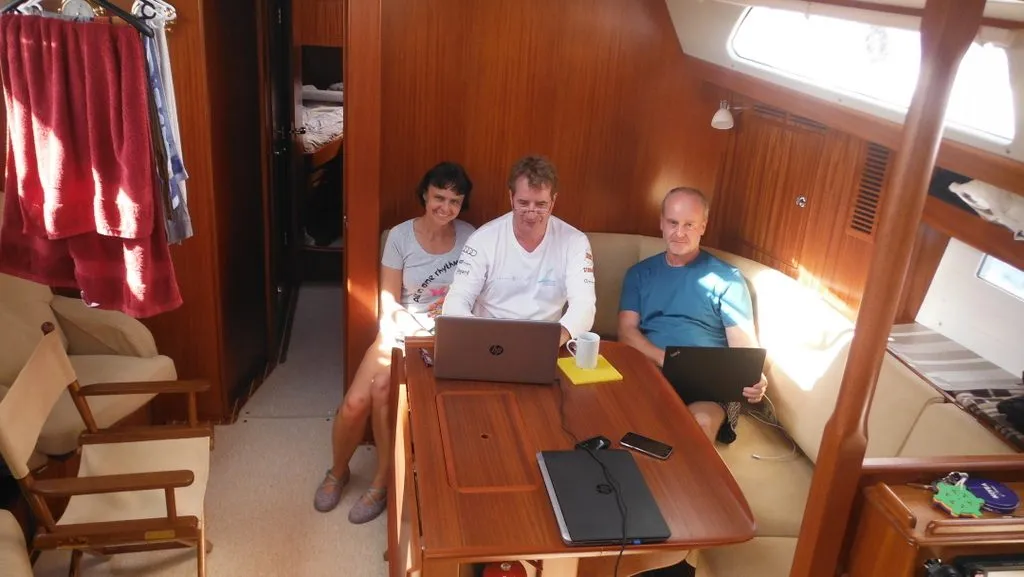
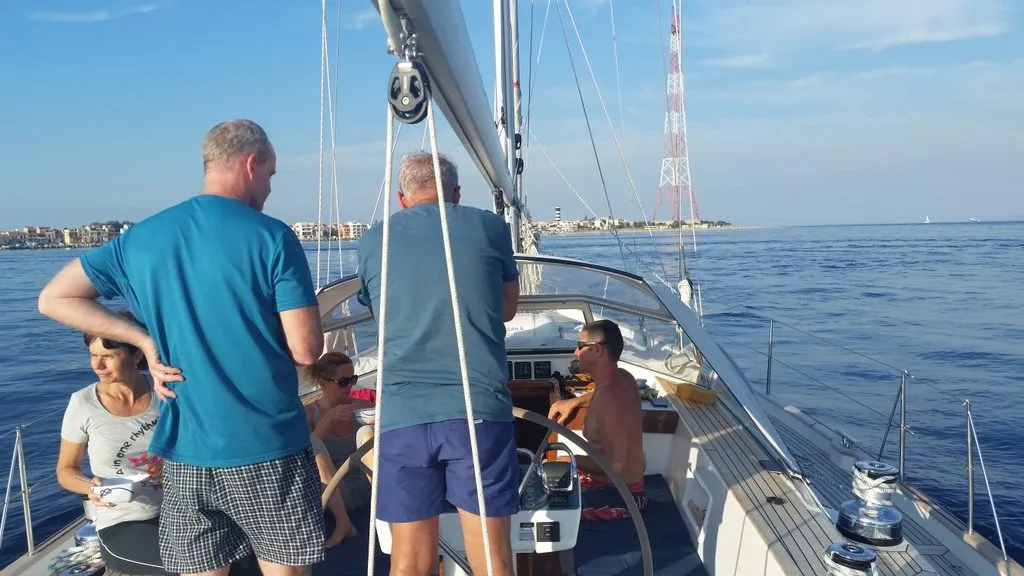
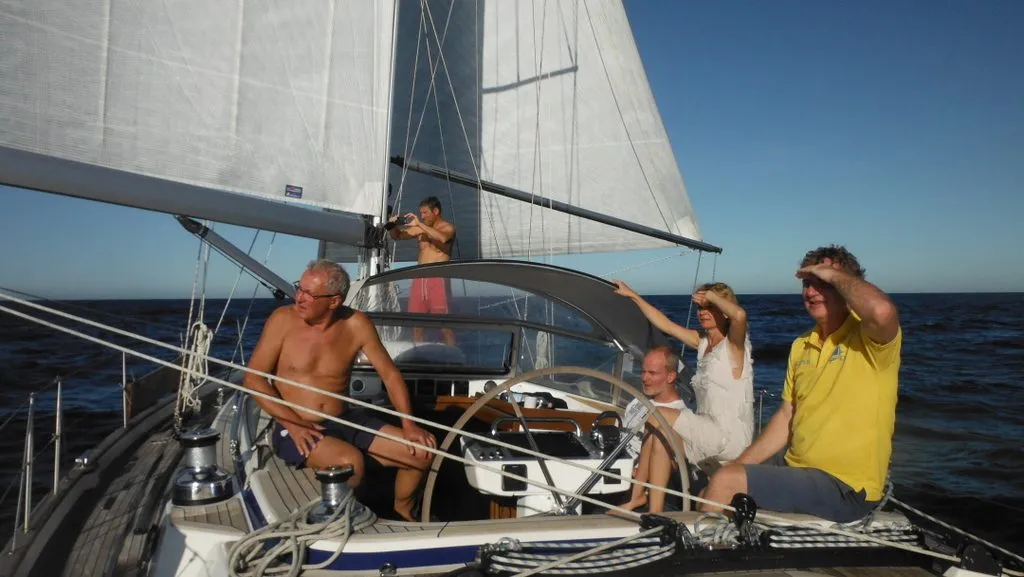
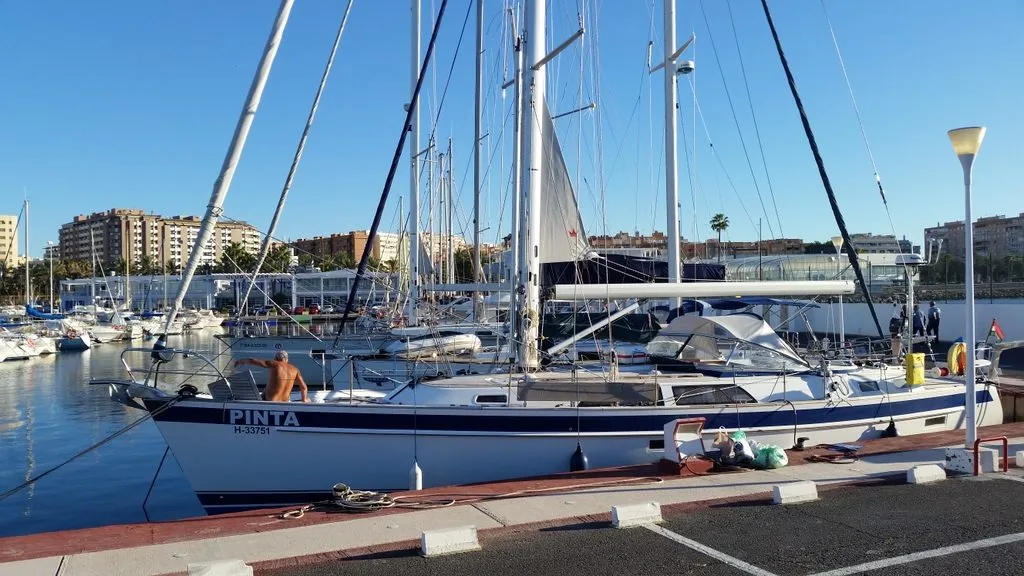
The Pinta is a new Swedish-built Hallberg-Rassy 48 MK-II sailing yacht. The crew will be 6: Gyuri the skipper/owner, Ricsi our chief meteorologist, Anikó and Szabi, plus Andi and yours truly, the chronicler…
Our planned route: Brindisi at the tip of the boot, Palermo, then the southern tip of Sardinia, Ibiza, Gibraltar and finally Las Palmas in the Canaries. From there Gyuri carries on in mid-November to sail around the world as part of the ARC World, after long preparations. So, off to adventure!
Machine translation (AI, Claude) of Balázs’s Hungarian original. Read the original →
· Kremik, Croatia
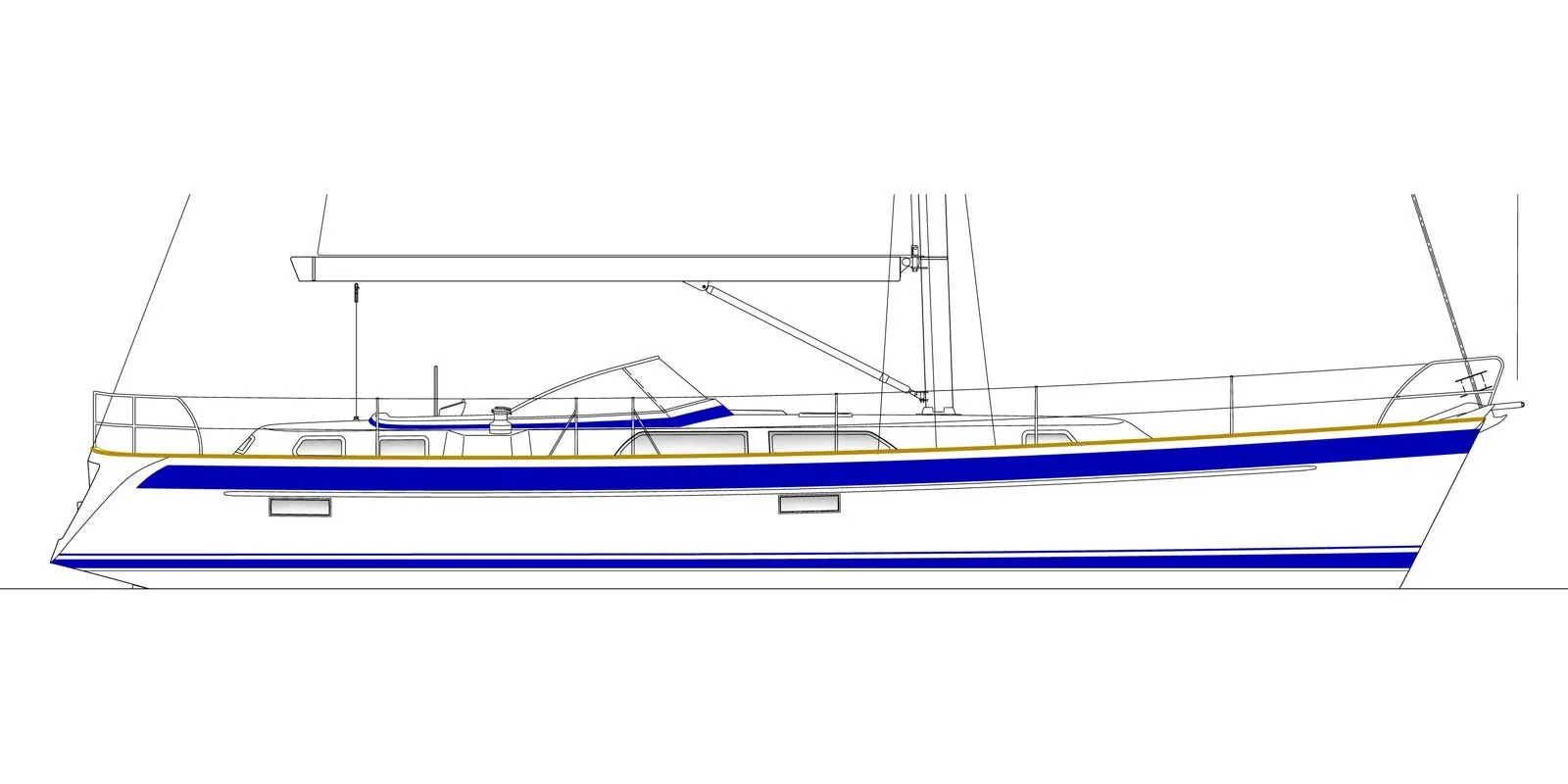
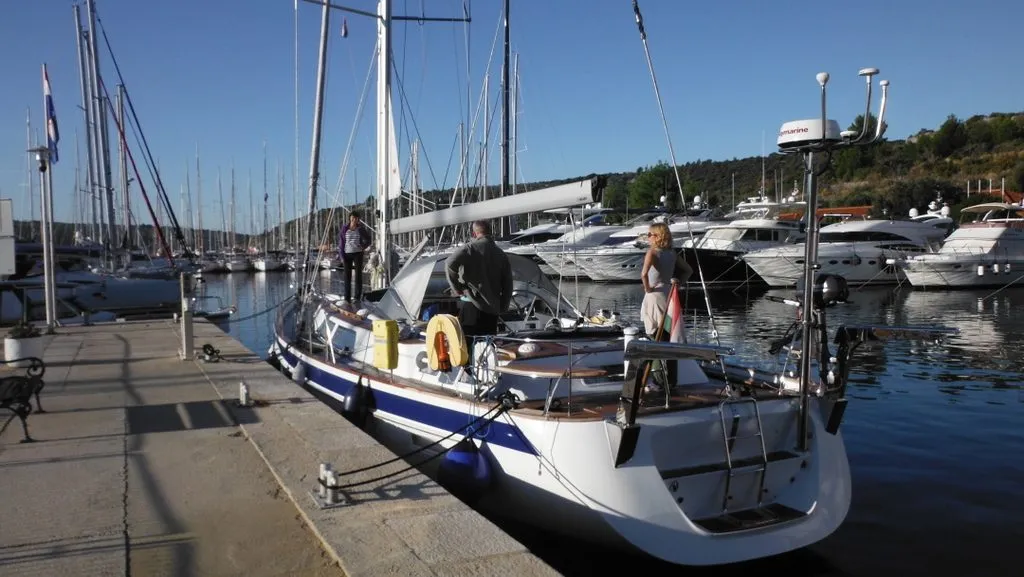
Our boat, the "Pinta"
The “Pinta” from the side
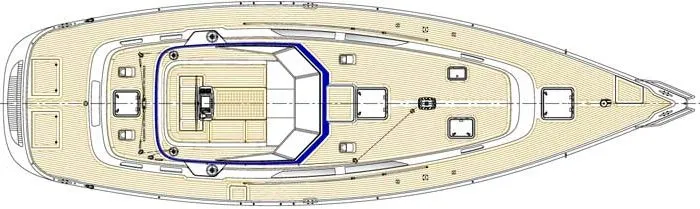
The deck
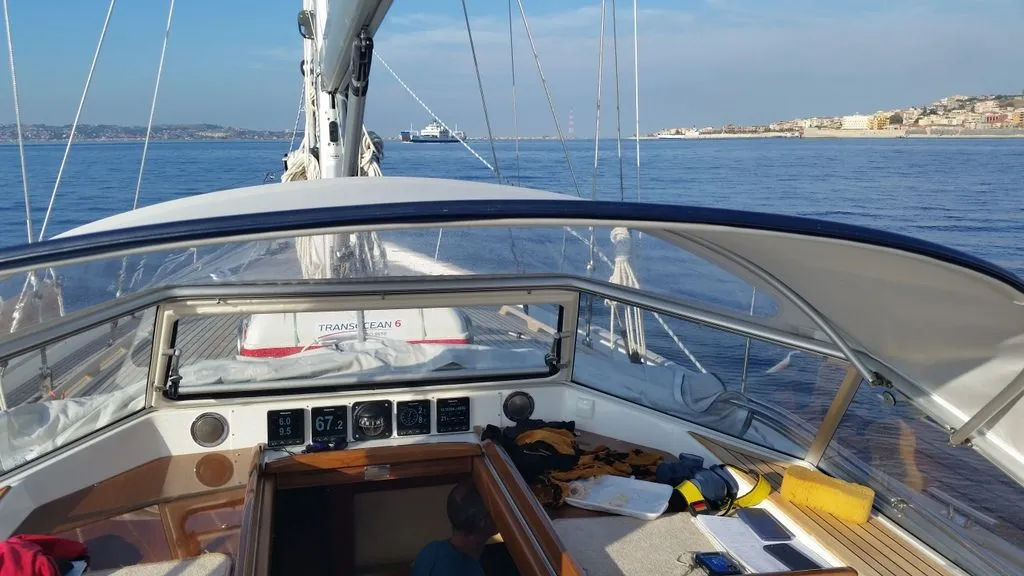
The area framed in dark blue is the steering position, the cockpit. From here you can go down into the boat.
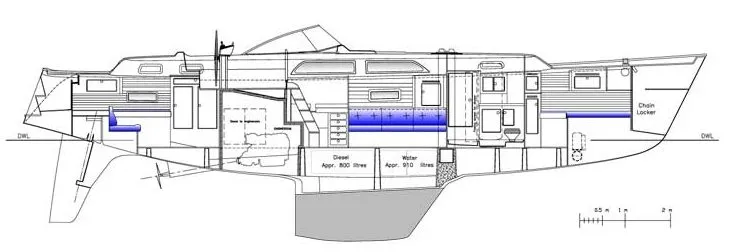
Cutaway drawing of the boat
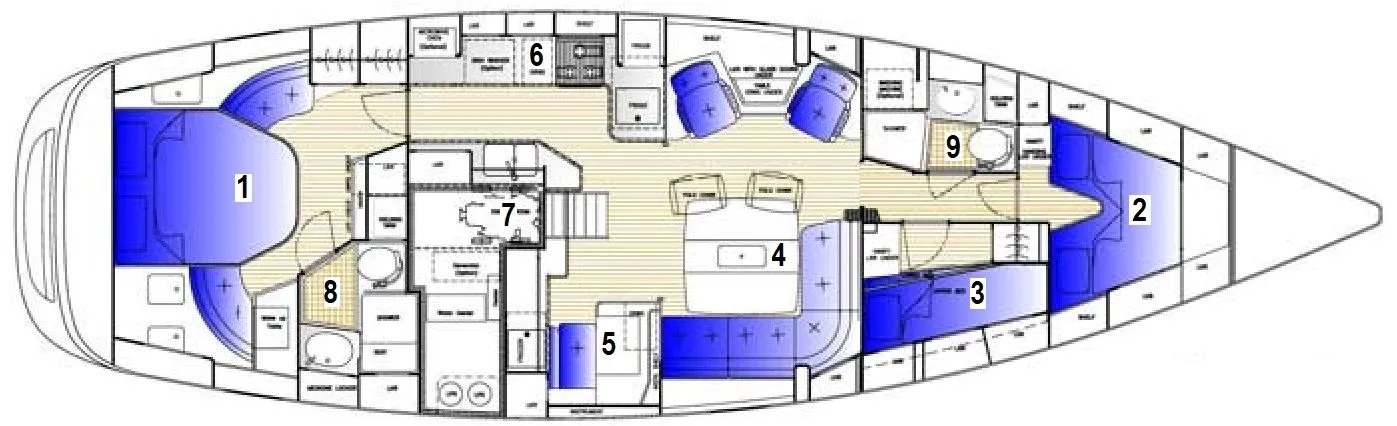
Interior layout plan
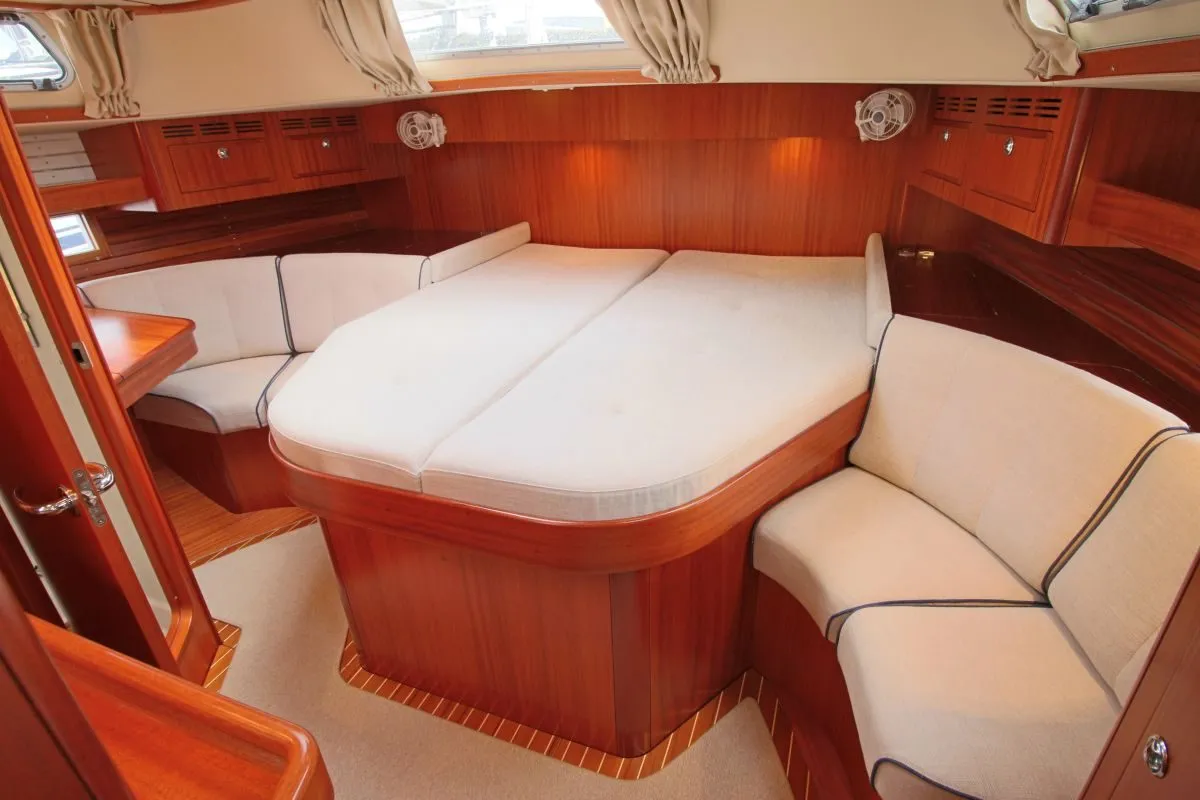
1 Owner’s cabin
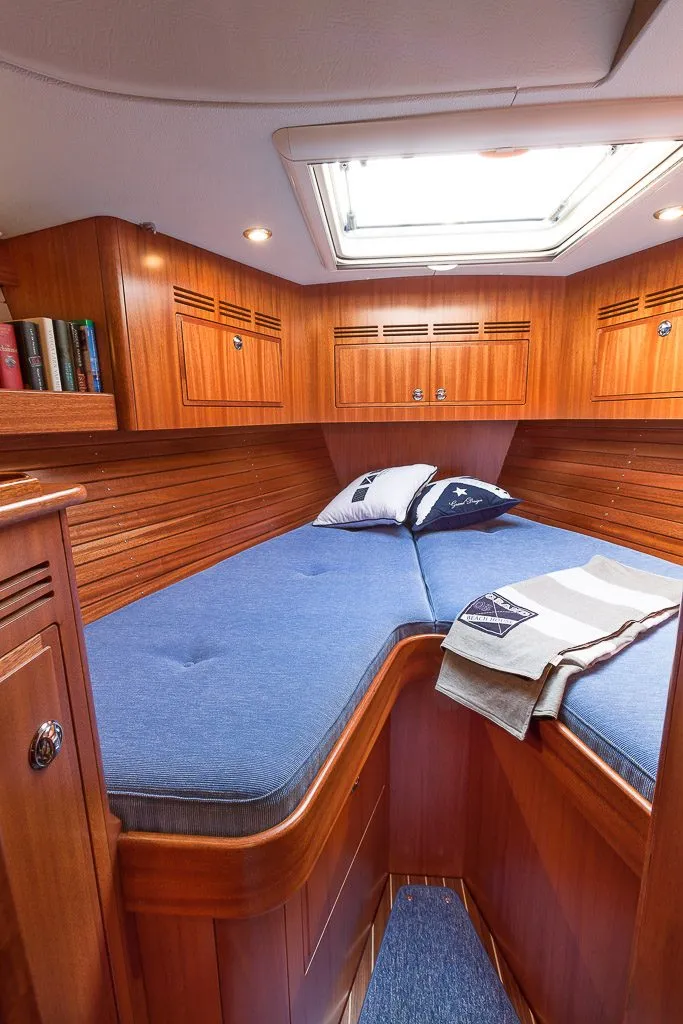
2 Double forward cabin
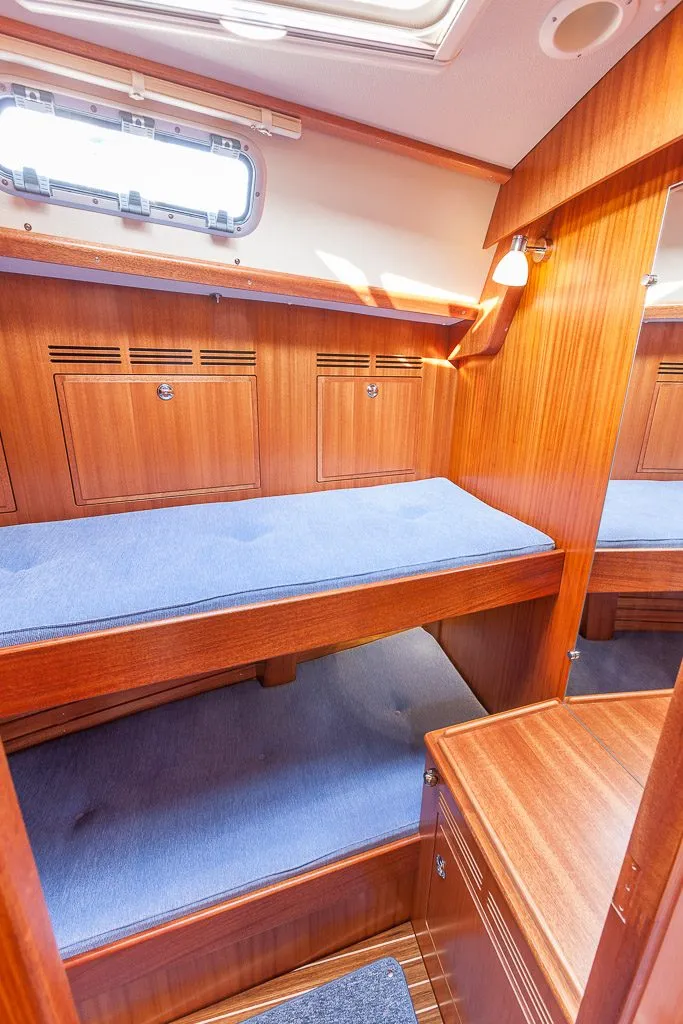
3 “Trotsky” cabin with bunk beds
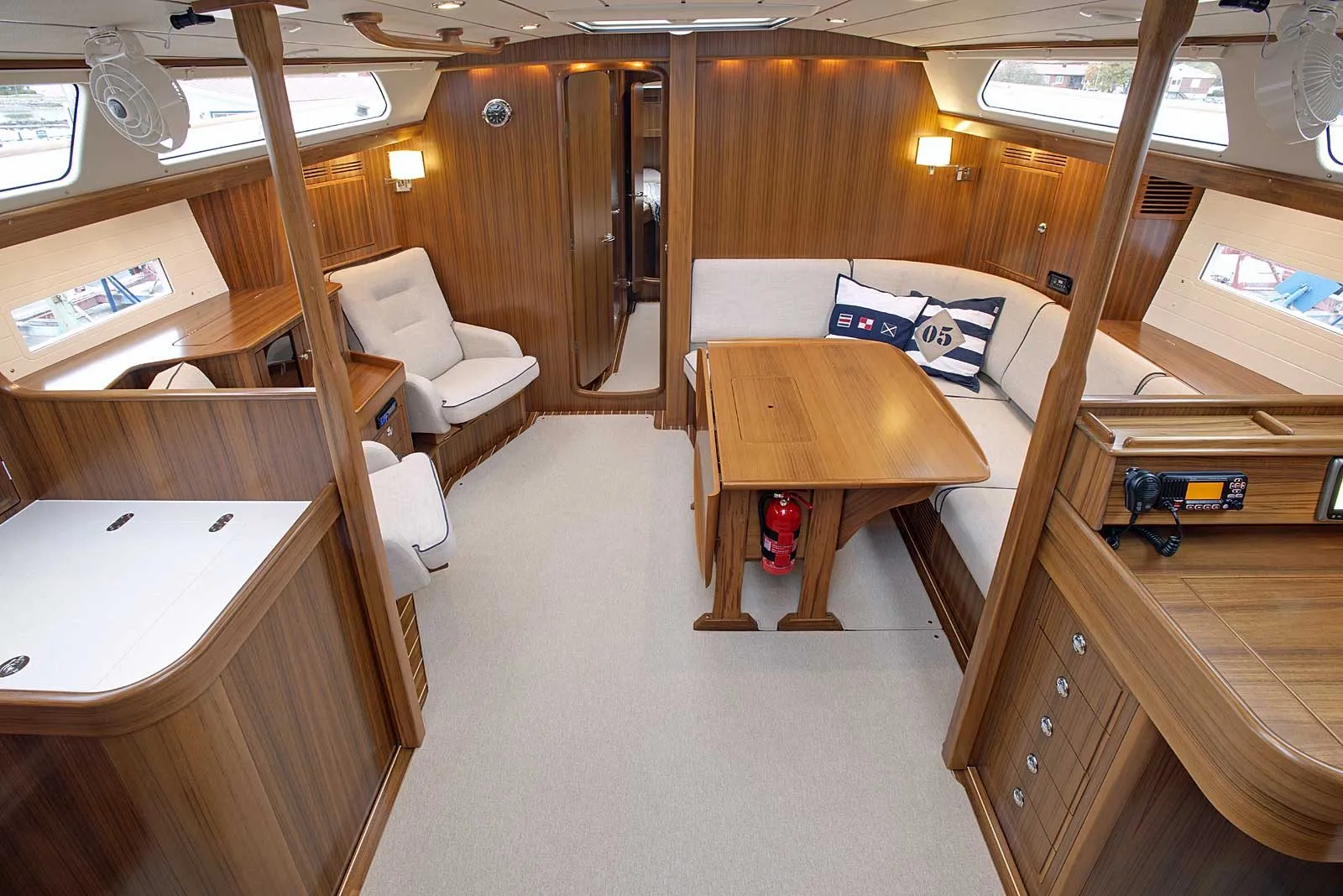
4 Saloon (living room)
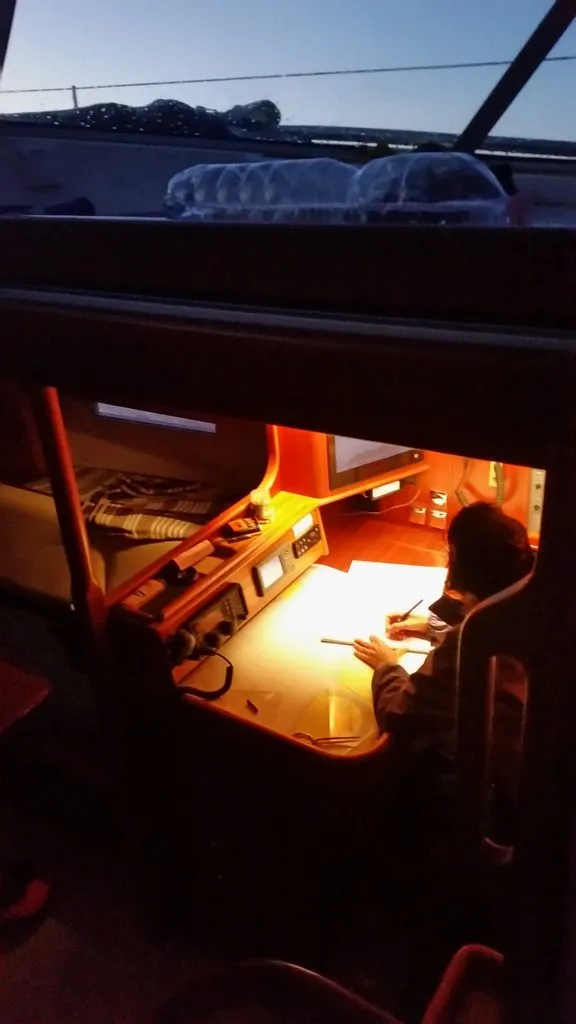
5 Chart table, navigation corner
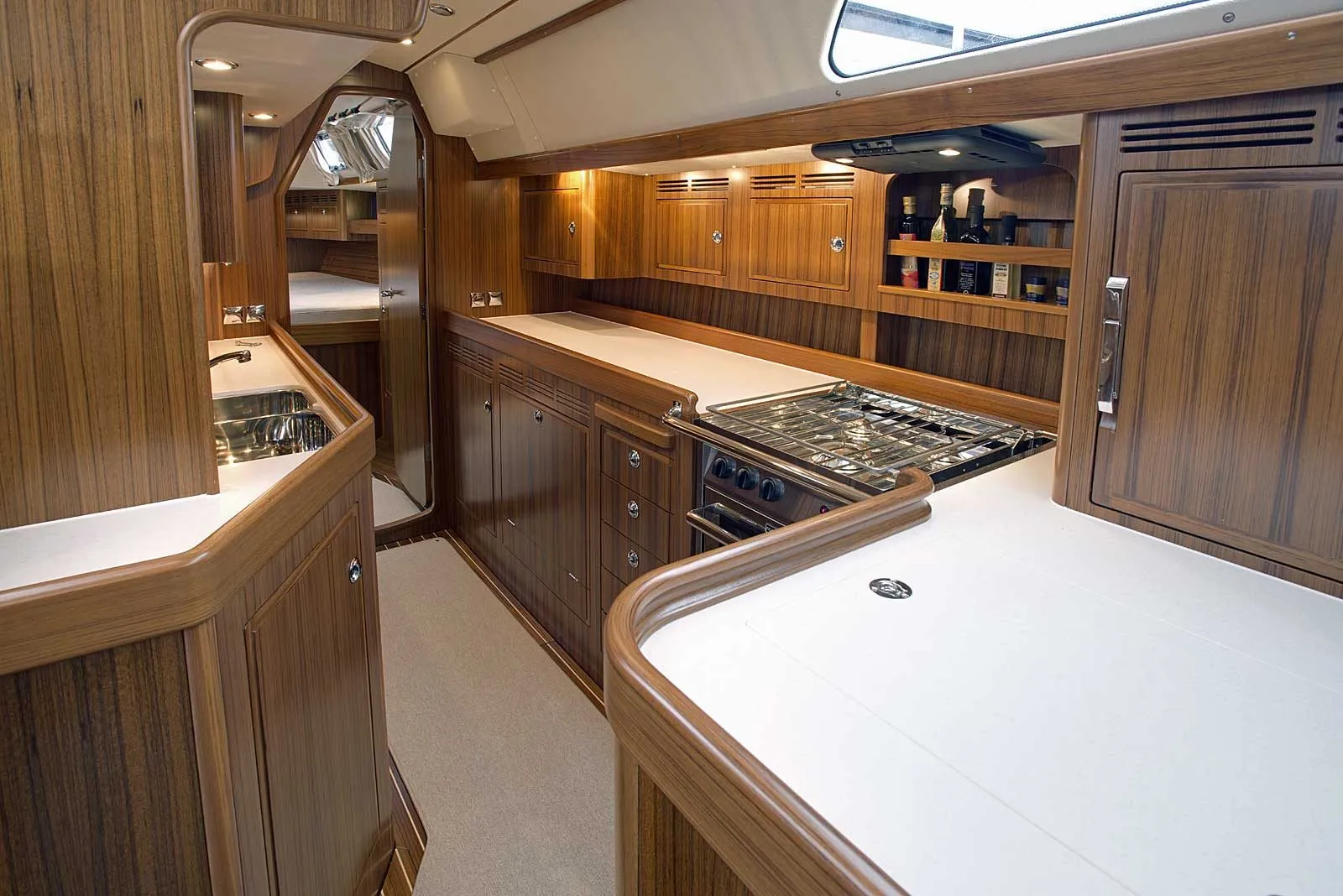
6 Galley
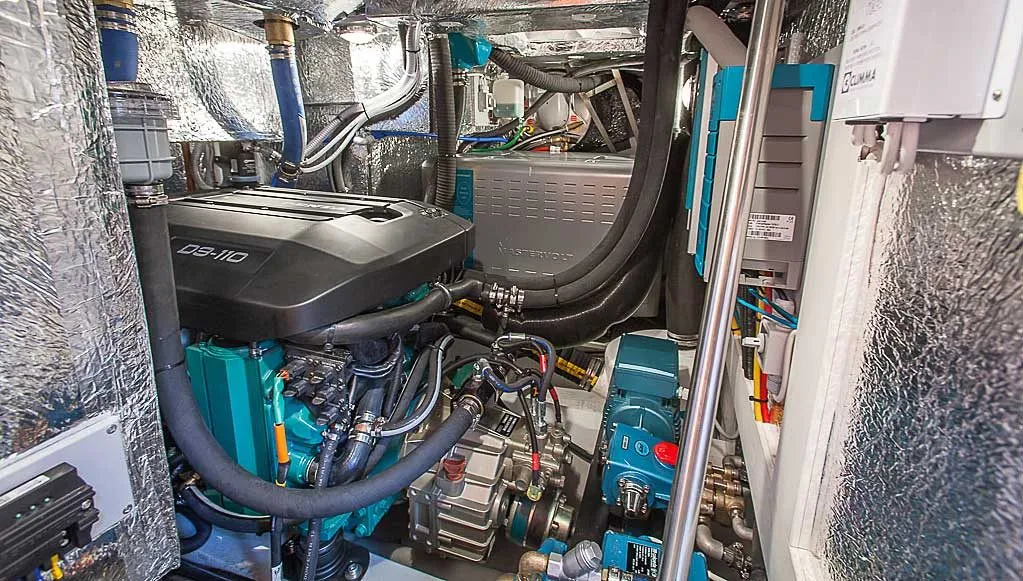
7 Engine space and engine room (under the cockpit)
8 Owner’s heads/shower
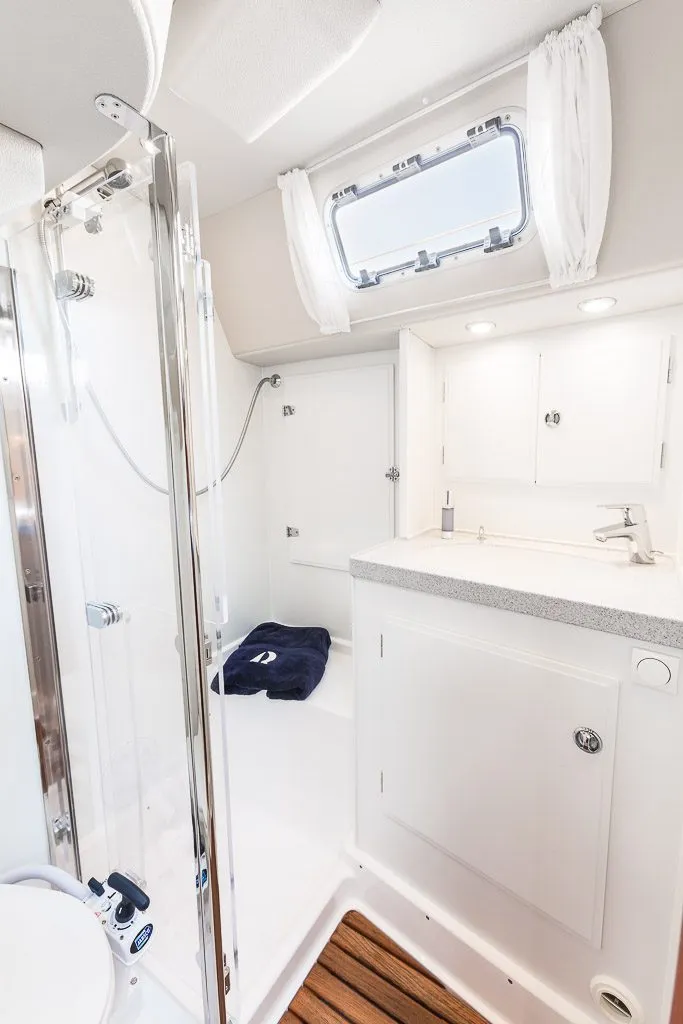
9 Crew heads/shower
1. Owner’s cabin (another boat, from the Hallberg-Rassy website)
2. Double forward cabin (another boat, from the Hallberg-Rassy website)
3. The “Trotsky” cabin, with bunk beds (another boat, from the Hallberg-Rassy website)
4. Saloon, living room (another boat, from the Hallberg-Rassy website)
5. Chart table, navigation corner
6. Galley (another boat, from the Hallberg-Rassy website)
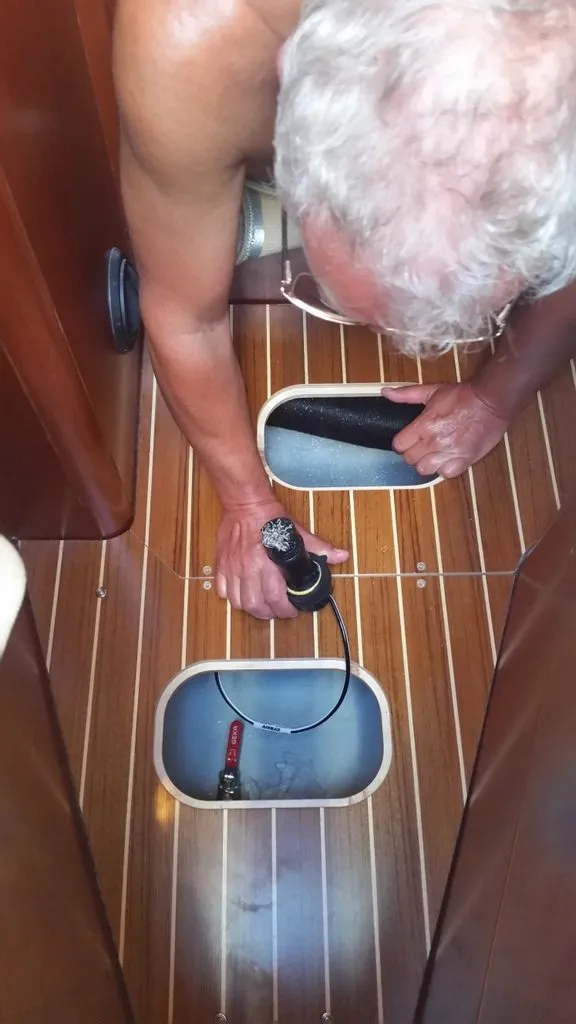
7. Engine space, the “engine room” (under the cockpit)
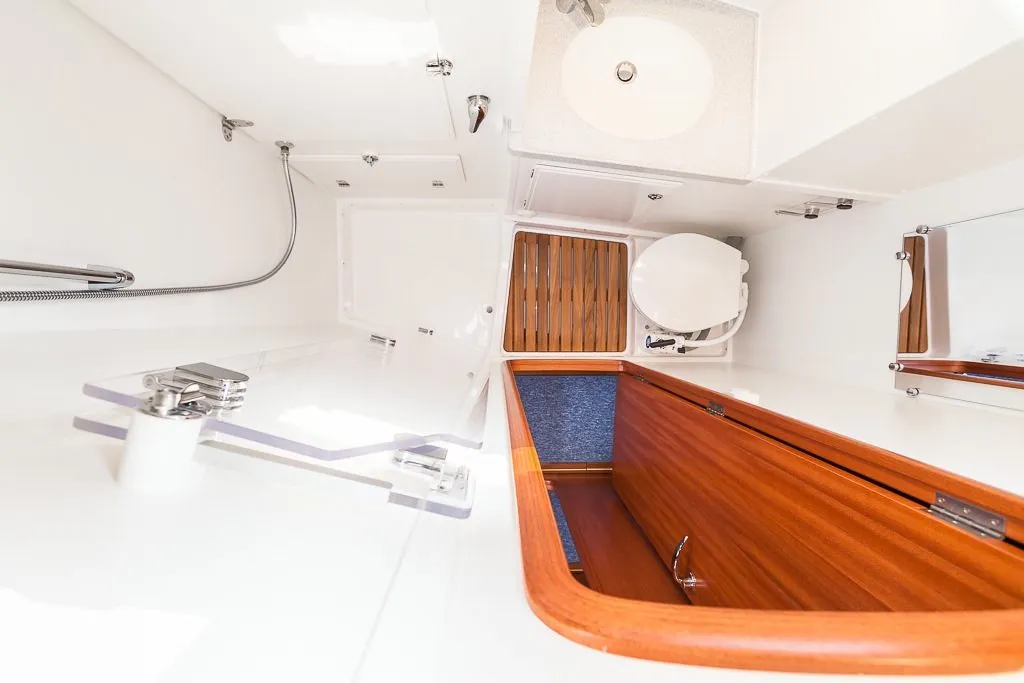
8. Owner’s heads/shower (another boat, from the Hallberg-Rassy website)
9. Crew heads/shower (another boat, from the Hallberg-Rassy website)
Machine translation (AI, Claude) of Balázs’s Hungarian original. Read the original →
· Adriatic Sea, off the Croatian islands
The Pinta sets off around the world: to infinity and beyond…
The first leg of the Pinta’s circumnavigation, from the Adriatic to the Canary Islands
Background
In April 2017 Gyuri, the Hungarian owner of a new Hallberg-Rassy 48, was looking for sailing companions to bring the boat down from the factory in Sweden to the Adriatic. Luckily I got to be part of that voyage too, from Denmark through the Channel and across the Bay of Biscay as far as Lisbon.
I wrote about that voyage in the first blog of my life https://balajaazoperencian1.blog.hu/, which I was able to upload thanks to our putting into port every 2–3 days:
Since I didn’t make it to Gibraltar that time, I told Gyuri that if he set off on his round-the-world voyage in the autumn, I’d be very happy if my wife, Andi, and I could accompany them as far as the Canary Islands.
And so the day of departure arrived, 16 October 2017.
The day before, we travelled down from Hungary to the Adriatic with our future shipmates, Ricsi, Anikó and Szabolcs – whom we’ve only just met – to Marina Kremik, where “our boat”, the Pinta, was waiting for us. Gyuri arrived the day before; we set off tomorrow morning.
Leaving Budapest
The Pinta is a new Swedish-built Hallberg-Rassy 48 MK-II sailing yacht. The crew will be 6: Gyuri the skipper/owner, Ricsi our chief meteorologist, Anikó and Szabi, plus Andi and yours truly, the chronicler…
Our planned route: Brindisi at the tip of the boot, Palermo, then the southern tip of Sardinia, Ibiza, Gibraltar and finally Las Palmas in the Canaries. From there Gyuri carries on in mid-November to sail around the world as part of the ARC World, after long preparations. So, off to adventure!
Monday, 16 October 2017
Day 1, we set off at 11… (Log 4313)
As agreed, at 9 in the morning we moored up at the clearance quay and waited for the Croatian authorities. An hour later, impatiently.
Waiting for the Croatian officials. Some wait like this…
Others like this…
Two hours later, by now,
well, they finally turned up, after much ado.
They didn’t even check how many of us there were, stamped the crew list, and dasvidaniya, off we could go! Well, with this lot we could have smuggled out a good 100 migrants…
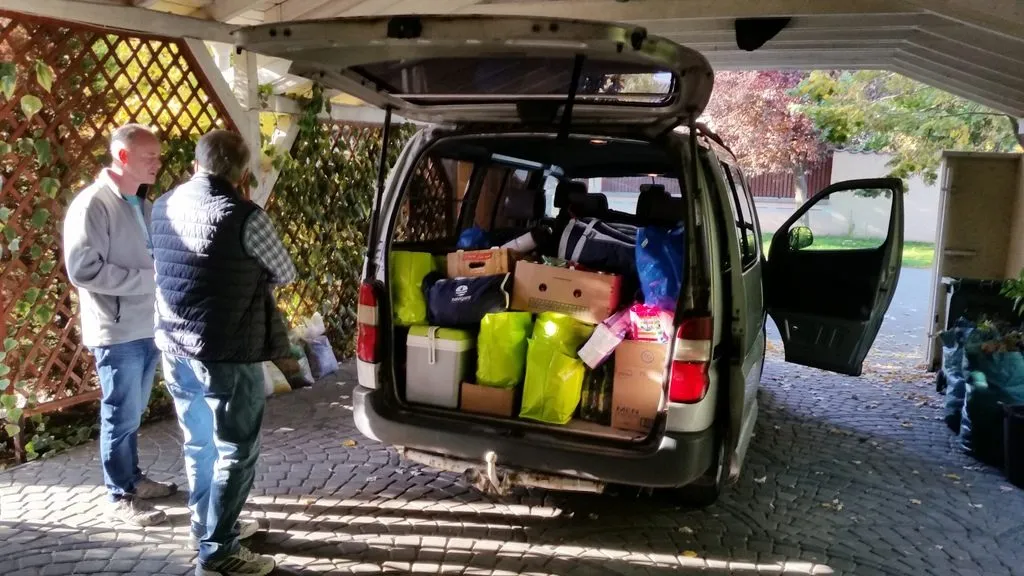
We didn’t stay a minute longer; we set off around the world without a brass band or the press, only Ricsi’s dad popped by for the shopping bags and to say goodbye.
Perhaps no Hungarian has ever set off around the world this quietly…
I switched on the satellite tracker so that you can follow where we are at any given moment too.
We’d barely reached open water when the skipper let rip with a good curse:
– Who broke the speed log? It isn’t even counting the distance we’ve covered!*
His annoyance was understandable, because two years from now, when he returns, who’s going to believe he rowed around the world if the log shows the same reading as when he set off…
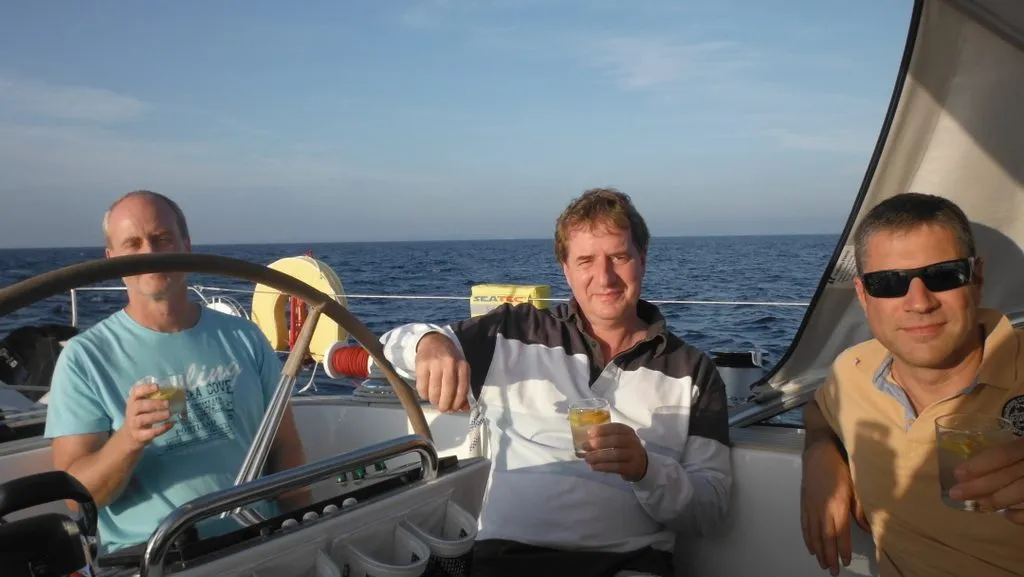
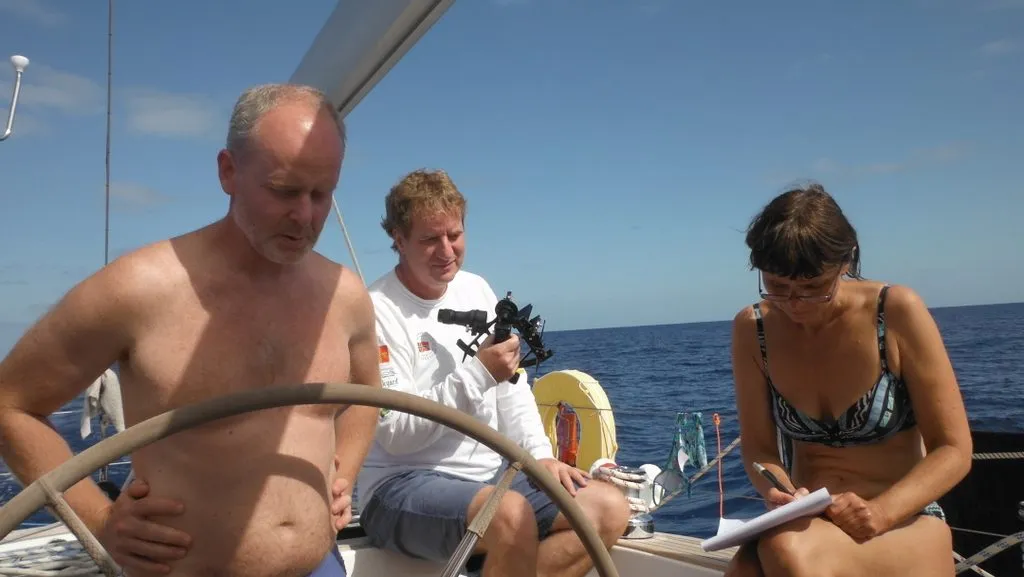
Szabi raised his hand to adjust his sunglasses and hide behind them a bit better…
So it was you! Break him on the wheel, keelhaul him!
Oh no, have mercy!!!
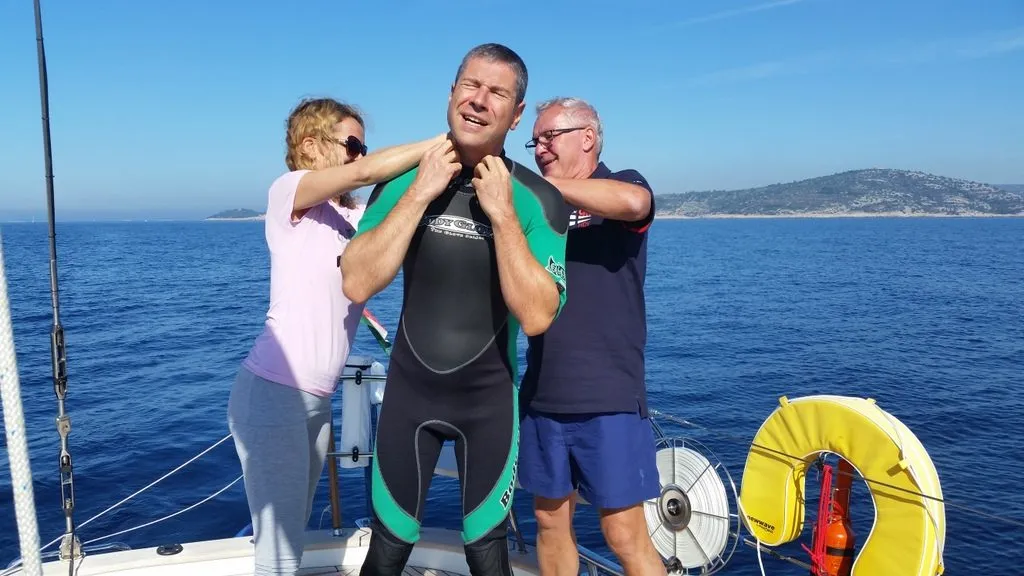
Since there’s only one wheel on the boat, the helm, Szabi had to squeeze into the skipper’s wetsuit from 20 years ago, two sizes too small. That was as good as being broken on the wheel one and a half times, because Szabi pressed himself into it back to front, and when his shoulders were already straining backwards and his face was turning purple from the zip done up at the front, Anikó spoke up that he shouldn’t force it any further, because the zip usually goes at the back… Szabi peeled the neoprene off himself dry – practically waxing 65 per cent of his back – whereupon Anikó kindly remarked that actually, you usually put them on and take them off wet…
With friends like these, who needs enemies…
The two amazons on our boat, Andi and Anikó, carried out the sentence mercilessly: they hauled Szabi under the boat from starboard to port, then from port to starboard, back and forth, until he hardly had any breath left in him.
Keelhauling
The only thing that saved his life was that the speed log suddenly started working again: Szabi had rubbed the log’s paddlewheel with his back or his palm and it started up, whereupon the skipper immediately called off the execution and we carried on….
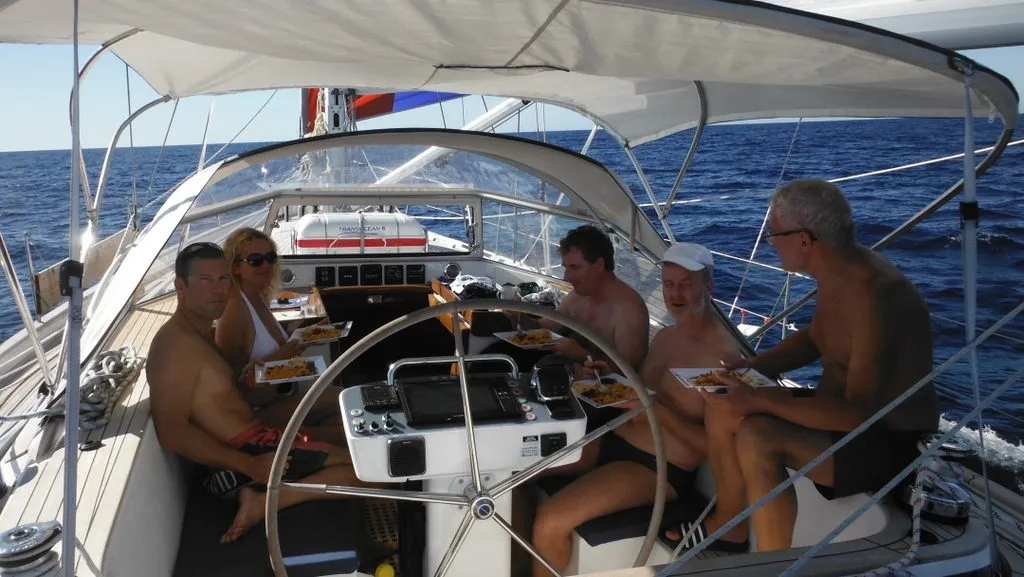
At noon we served home-made broth and spaghetti bolognese made at sea for lunch, which had only one problem: there wasn’t twice as much of it.
Late in the afternoon it turned out that the radar wasn’t working either… I quickly fled down to the galley to create a diversion with a snappy gin and tonic…
These girls are going to wind me up yet – right up the mast…
So, if the blog doesn’t continue tomorrow, the diversion didn’t work, and I’m dangling from the mast, at the end of the spreader…
The gin and tonics got made, but I’m still writing these lines with a trembling hand. I granted every wish, even the most bizarre ones. Anikó, for instance, asked for her gin and tonic without gin and without tonic… While we were going over the ingredients, I was musing that if she weren’t so picky and I could leave out the lemon and the lime, I could practically make it for her out of a glass of water…
Gin-Tonic, The Original….
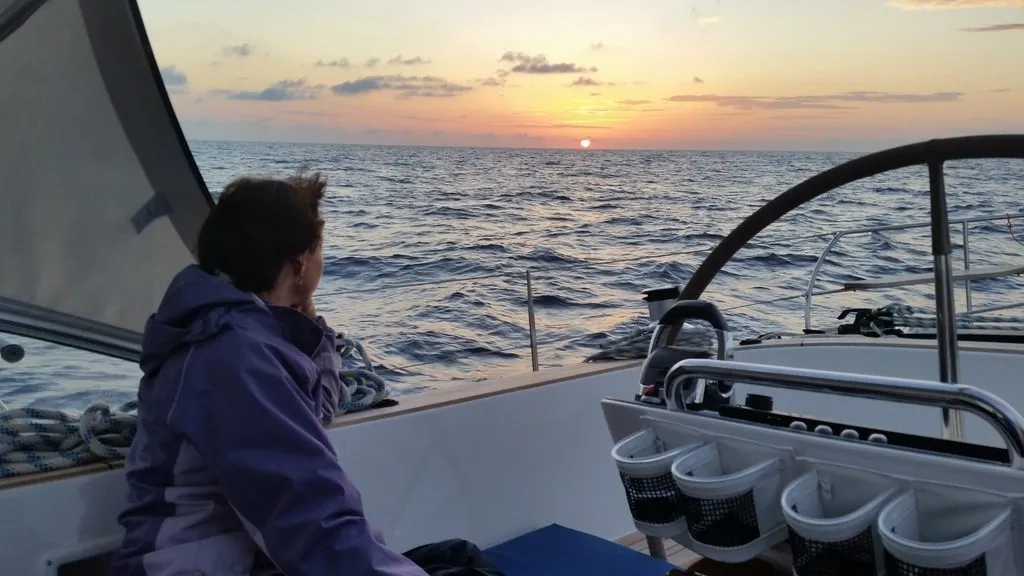
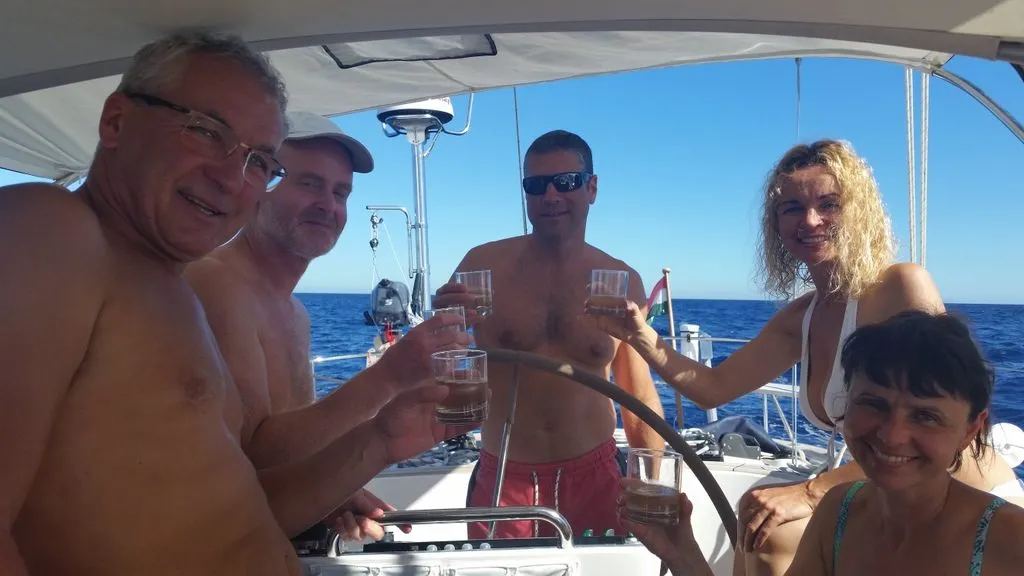
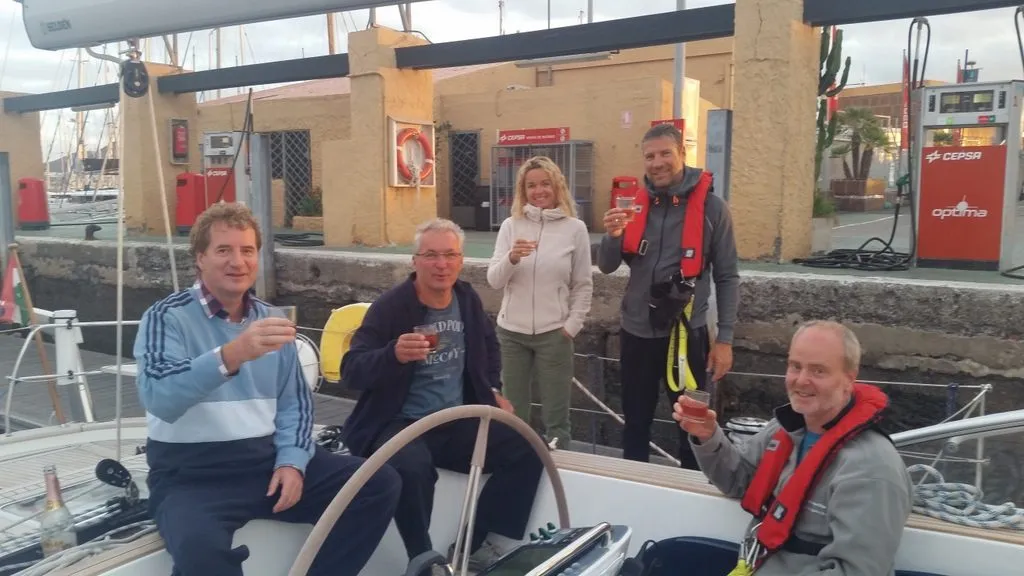
At sunset, with a sundowner rum, we toasted Gyuri, the skipper, at the end of his first day as a “pensioner”, and wished him fair winds and all the best for the circumnavigation.
During the night the depth sounder broke…
Where is this going to end…
*Footnote for landlubbers:
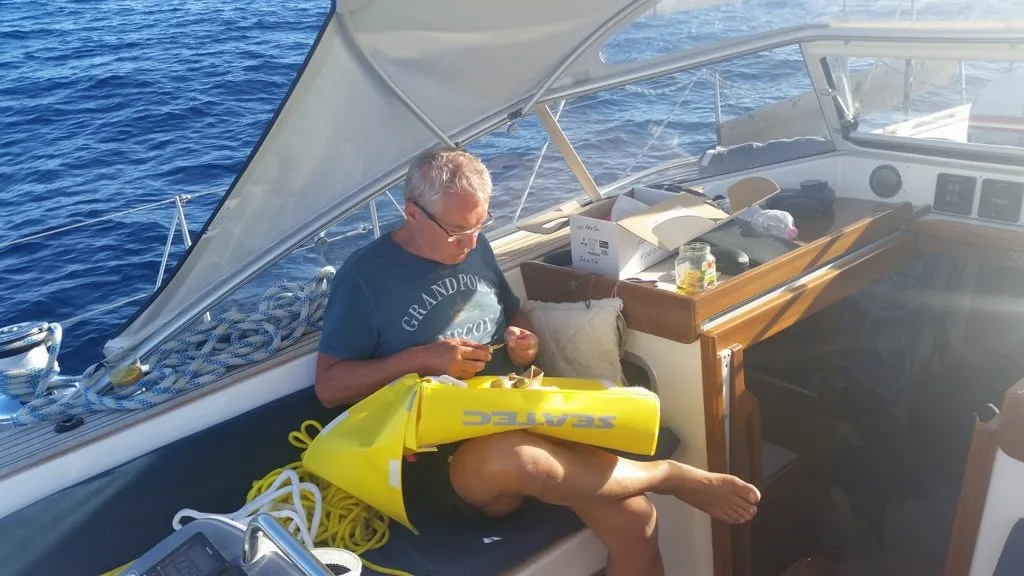
The little sensor paddlewheel of a sailing boat’s speed log – located on the bottom of the hull, in front of the keel – often gets stuck after the boat has been lying idle for a long time, from the little sea creatures and snails that settle on it. Then it can show neither the boat’s actual speed through the water nor the distance it has covered. This can usually be remedied by someone swimming down under the boat and wiggling the little paddlewheel free. Holding on to a rope run under the hull and held taut, the diver can get down more easily and quickly, and hold on down there.
All of this was written down on 17 October, the next day, in the breaks of the 4-to-8 a.m. watch…
Machine translation (AI, Claude) of Balázs’s Hungarian original. Read the original →
· Brindisi, Italy
In the footsteps – or rather the wake – of Hungarian crusaders
Tuesday, 17 October 2017
Day 2, 140 nm (Log 4456 nm)
Our first destination is Brindisi, then Santa Maria di Leuca, on the heel of the boot
For me this day began at half past one in the afternoon. The night before I couldn’t sleep, some at-sea sickness was lurking in me (it’s exactly like the landlubber kind, except it catches up with you at sea): your throat starts to hurt, you run a temperature, you might even have a fever, you can feel that your head isn’t empty for once, that sort of thing… So at 8 in the morning I went to bed, and best of all I actually fell asleep, trying to catch up on what I’d missed.
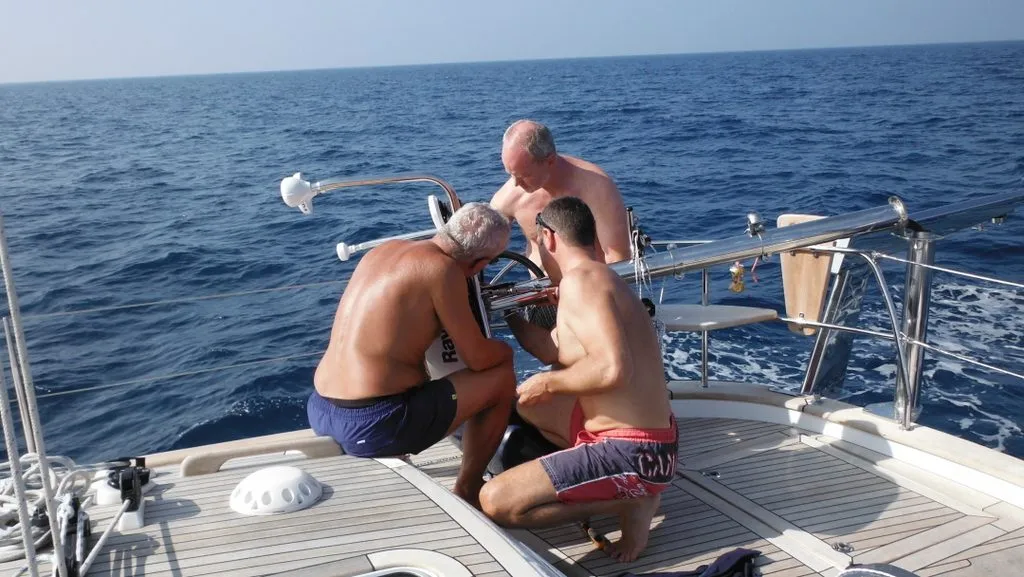
Meanwhile the others lowered the radar pole and tried to work out why it refused to start, but they couldn’t crack it.
Radar felling
And in my dreams I flew back to the Middle Ages and tried to picture the conditions under which the Hungarian crusading army might have sailed these very waters to the Holy Land exactly 800 years ago.
The facts are interesting too, but it’s when you think about what’s behind them that it really blows you away!
The story, in short, is that in 1217 King Andrew II of Hungary set off on a crusade to the Holy Land. What makes this Fifth Crusade special, especially for us, is that alongside the German, French and English rulers, King Andrew II of Hungary was the only one who led a crusade in person, financed it himself, and even brought his army home overland, having made the outward journey by ship. And this is where “we” seafaring folk come into the picture.
What we know for sure is that at the end of August 1217 the army boarded ships in Spalato, today’s Split in Croatia, onto galleys hired from the Venetians. In the absence of exact figures, it’s assumed that the Hungarian force consisted of 1500–2000 horsemen (and obviously horses) and roughly the same number of support staff. Sounds simple, right up until you think it through.
So. 1800 horses and 3600 people. How many galleys would that fit on?
I reckon each one could have taken at most 30 horses and 60 soldiers on top of the oarsmen (who were, of course, full-time galley slaves). Cortés, I think, took 7 or 13 horses with him from Cuba to conquer Mexico, and there can’t have been many more on Columbus’s ship either.
So the Venetians must have rented out 50–80 galleys to the Hungarians.
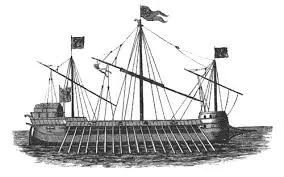
A Venetian galley in the 13th century
OK. But that had to be arranged by letter, or rather by courier, damn early, so that the Venetians could notify their galleys sailing all over the Mediterranean in time: listen up, everyone be in Spalato by early August, there’s a nice job on, a run to the Holy Land… And the Hungarians had to set off 2–3 months earlier too, because the Croatian motorway to Split wasn’t finished yet back then…
Let’s assume everyone got there on time. Time for loading.
How big could the harbour of Split have been back then? How many ships could load at once? Say they loaded 10–12 galleys in two or three days, that means it took 2–3 weeks to embark the whole Hungarian army. (And we haven’t even talked about how the provisions, booze, oats and water got there. One thing we know for sure, namely that the Croatian customs officers didn’t kick up a fuss about commercial quantities of Hungarian ham and wine…)
What did the ships loaded first do? Did they circle in front of the harbour in a rowing round-robin, like British bombers? Which one might King Andrew II of Hungary have travelled on? Did he leave Spalato last, like the good captain leaves a sinking ship, or on the first one, first, like the captain of the Costa Concordia? We can only guess…
That’s what I’m doing too: I reckon he went on the first one, and they set off in convoys of 5–10 ships as they finished loading, to then cover the distance in a medieval Kékszalag fleet (the Blue Ribbon, Lake Balaton’s big round-the-lake race) strung out over 2–300 miles, now bunching up when the wind died, now stretching out when it picked up again…
What might the Hungarian soldiers have been thinking about during the voyage? What’s it like when a horse gets seasick? All right, maybe I don’t want to picture that, although they say the hygiene and the smells left something to be desired, for example the galley slaves didn’t wash their hands… The seasick horses couldn’t have made it much worse…
One thing surely crossed the Hungarian passengers’ minds: just let me never be a galley slave…
So our good forebears sailed east right here, exactly 800 years, that is about 32 (and not 20,000*) generations ago, and saw these same shores, these same rocks… Strange to think about all this…
Luckily they woke me up saying lunch was ready (definitely better than the crusaders’), and around half past two we pulled into Brindisi, on the Italian coast.
Moored in Brindisi
We moored on the quay wall of the old town for a few hours to go for a walk. That’s the only reason we stopped here, because Raymarine’s radar technician had promised to be in Leuca at 9 the next day, and if we’d carried on in one go, we’d have been there by midnight. So instead we had a look at Brindisi and set off again at 6 in the evening.
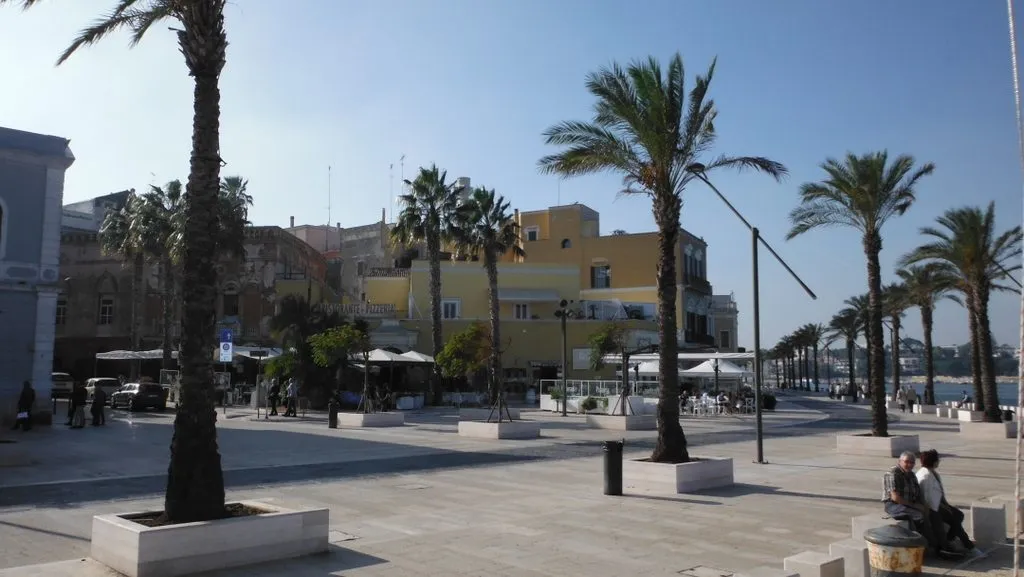
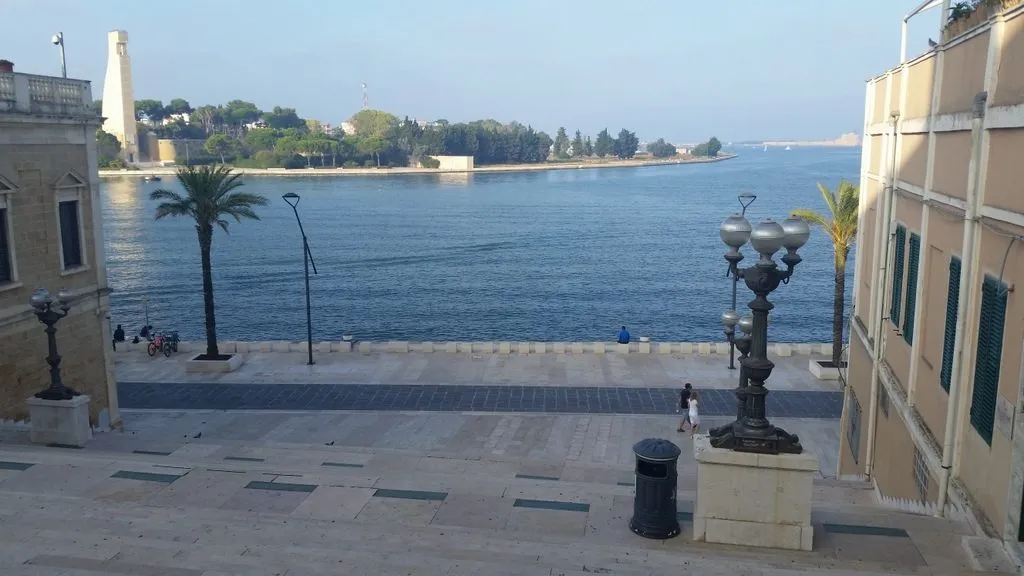
Seafront promenadeThe ancient steps
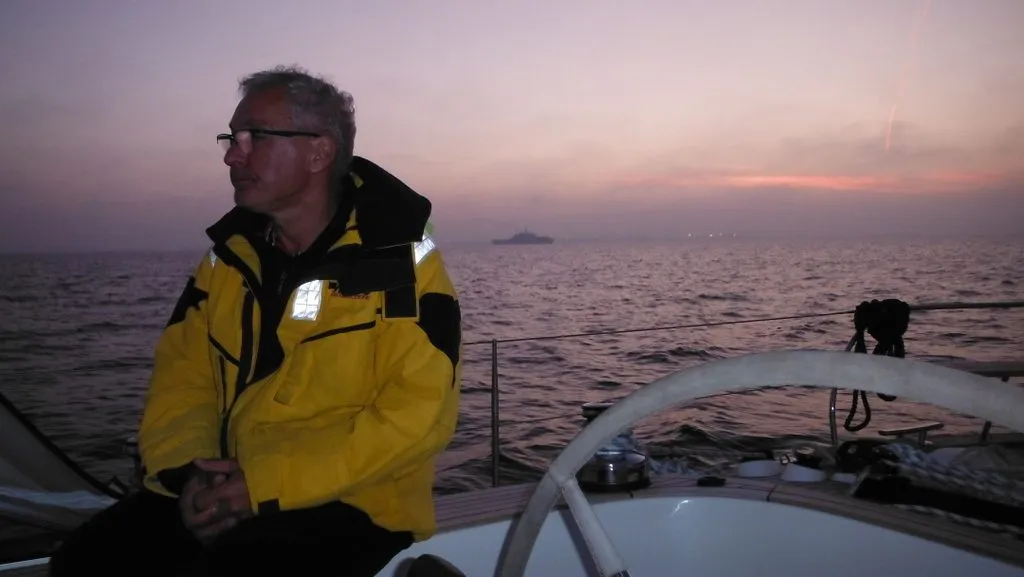
During our night watch I steered round a naval firing range, plus two freighters coming straight at us that refused to give way. I held my ground, held my ground, held out for quite a while, but then at the last moment it was me who yanked the wheel aside after all…
Leaving Brindisi, a warship in the background
*Footnote:
A kind, but above all sharp-eyed reader pointed out that 800 years can’t be 20,000 generations, only 2000. Indeed. I really got my sums wrong. I meant to divide 800 by 25, but for some reason I multiplied. I remember the result seemed suspiciously large to me too, so I even checked it, multiplied again, and lo and behold, 20,000 again. Well, if that’s what it is, that’s what it is, so I wrote it in. That’s what at-sea sickness and tiredness can do to you.
Machine translation (AI, Claude) of Balázs’s Hungarian original. Read the original →
· Gulf of Taranto
Whale scouting
Wednesday, 18 October 2017
Day 3, 93 nm (Log 4537 nm)
At 6 a.m. on the dot we moored in the heel of the boot, in Santa Maria di Leuca. We were expecting the radar technician at 9, so we had plenty of time for a nice long shower and a tasty scrambled-egg breakfast (unlike the galley slaves).
Shortly after 9 the service guy arrived, with great difficulty switched the language from German to Italian (so from then on we didn’t understand a thing about what he was poking at), then updated the radar software and established that it still didn’t work. Together with Gyuri and Ricsi they took the radar off its pole and set about taking it apart. At this point we left them to it and Andi and I went for a lighthouse-viewing walk, because however I looked at it, my radar-repair expertise wasn’t exactly needed here. If not, then not.
Oh, and here I must issue a correction: the depth sounder isn’t broken at all! I ended up like the traffic cop in the joke who has the driver switch on the indicator and says: it works, now it doesn’t, it works, it doesn’t…
I’d forgotten that the depth sounder can only measure down to about 100 metres, because the echoes coming back from deeper are so weak that it doesn’t pick them up, and then it shows this:---
At the start of the Adriatic, when I was at the helm, it was still showing 50–70 metres, and then the next time nothing at all. Of course by Brindisi it had “got fixed”, but by then I’d already trumpeted the bad news all over the airwaves, and it got back to our skipper’s ears faster than you can say knife.
On top of that, when we were mooring in Brindisi I warned Gyuri that, contrary to the chart, the depth was dropping alarmingly: 2.5 2.4 1.8 1.4 I reeled off (the Pinta draws 2.4 m)
Our skipper yanked the handbrake into rückwärts and stopped the boat, then says: you scared the living daylights out of me, it’s 11 metres deep here…. (we didn’t run aground anywhere, either…)
Dang, I’d been looking at the speed log… This wasn’t my depth-sounder day… Must have been my at-sea sickness…
Of course I could tell you about a good friend of ours, which I’d rather not do now, who spent hours praising the surprisingly steady 23.2-knot wind and our nicely running boat that was hardly heeling at all, until we smelled a rat. Because whenever we looked, the wind instrument only ever showed 12–15 knots, but he always spoke up at other moments, so it took us ages to work out that the good man had been watching the sea temperature the whole time. He had plenty to put up with that week, and sometimes ever since…
Let’s get back to di Leuca. Our radar man established that he couldn’t see any fault, but it really was broken, so he arranged with head office that we’d get a new scanner in Sicily on Friday, if we got there by then, and left. And he left half the navigation instruments switched to Greek… We wouldn’t have been any worse off with Chinese. Since none of us had read Homer in the original, we didn’t have the foggiest idea in which submenu of which menu page the word Language might be hiding in Greek squiggles, where you could switch back at least to Cyrillic… In the end Ricsi found the solution – hats off – and if you ask me, for good money I might even tell you how. This much I can let slip, though: it wasn’t his Greek that helped…
εγκατάσταση ραντάρ – Radar installation, in case you didn’t get it
At noon we had lunch at the only waterfront taverna still open in the off-season, where our elderly waiter spoke in such a hoarse, quiet voice – mixing every language – as if he’d spent two days straight shouting at the Oktoberfest… The lunch, however, was tasty and not expensive.
Leuca from the lighthouse
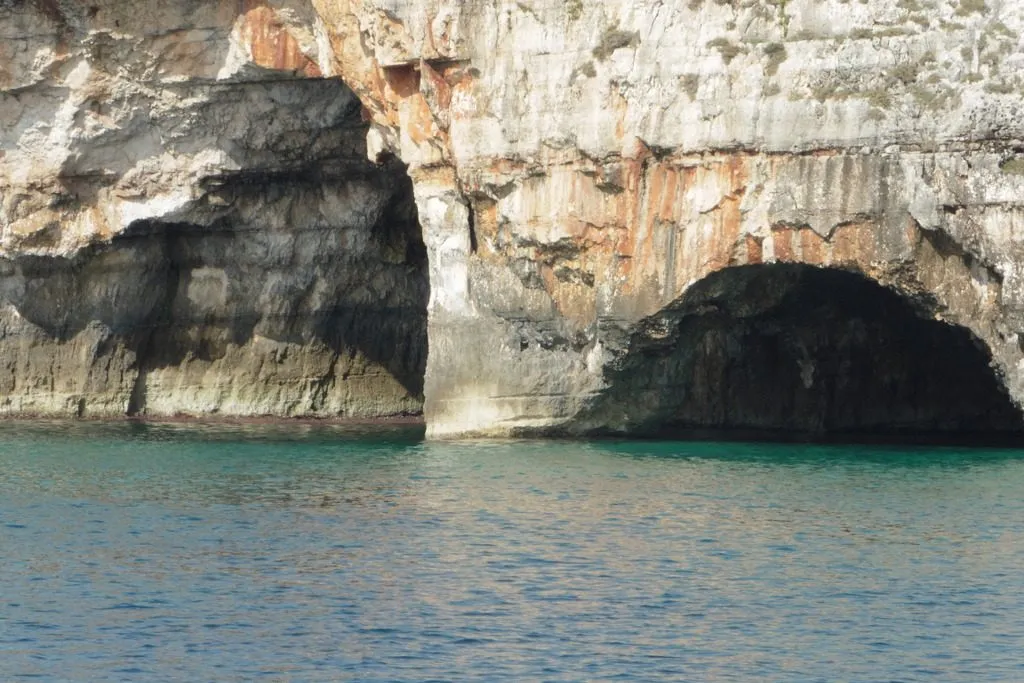
After setting off we motored past the caves carved by the sea into the coastal cliffs, where the local boatmen ferry the tourists, then turned south-west to cross the Gulf of Taranto. The wind is still very light, so we have to motor, but very nasty weather can suddenly blow up here, so if we can, we’d rather have it this way.
Maybe a bit of wind is coming tomorrow…
“The sole of the boot is wearing thin”
Sea caves near Leuca, Photo and text: Müller Richárd
17.00 found us with a gin and tonic in hand. This time I didn’t ask Anikó about the ingredients, but decided to make a proper sailor out of her by the end of the trip. For now she only got a third of the gin and tonic, a portion fit for four-year-olds, diluted with the usual water, and lo and behold, she almost liked it. Not a hopeless case. Especially if I let on that afterwards she knocked back a shot of pálinka too, purely for medicinal purposes…
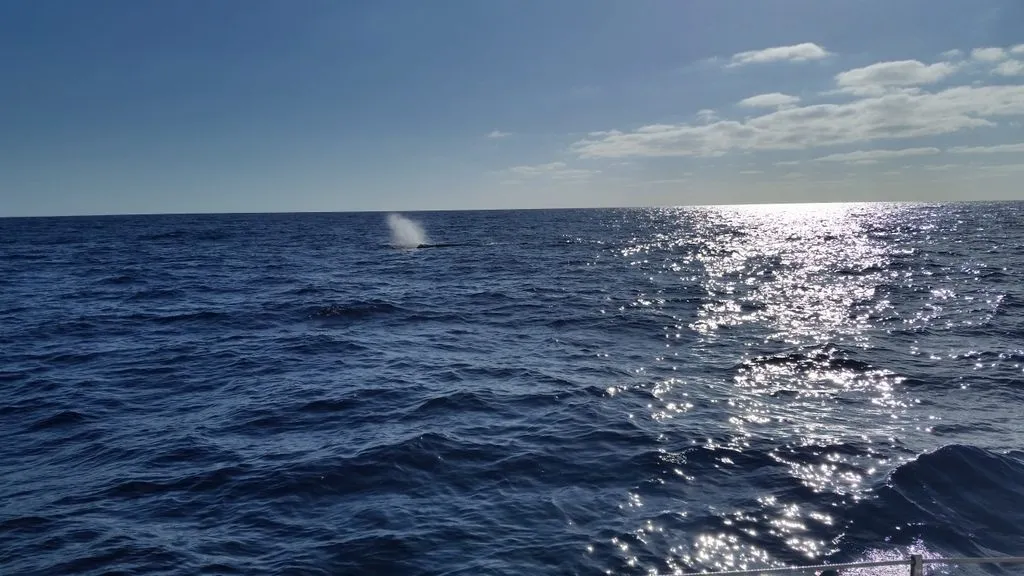
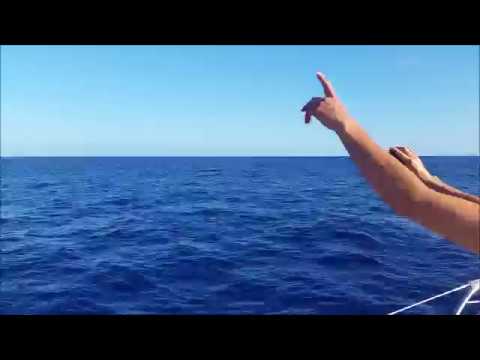
It would slowly have been time for the sundowner, the sunset drink, when Ricsi spotted some interesting floating logs in the distance, at about half past ten on the clock face.
Floating logs? No! That one moved!
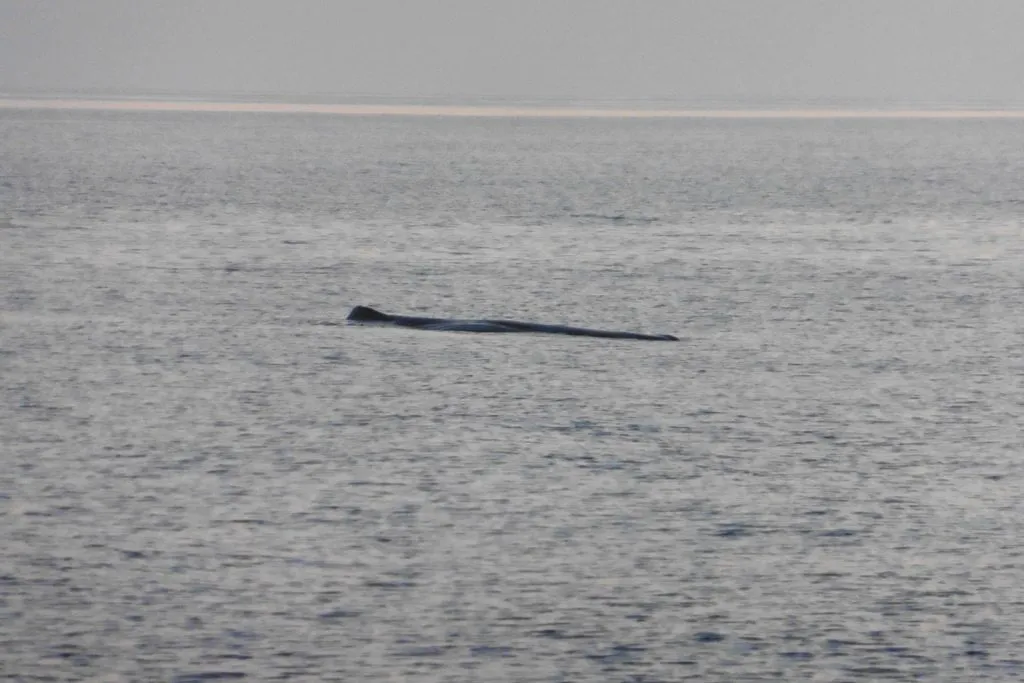
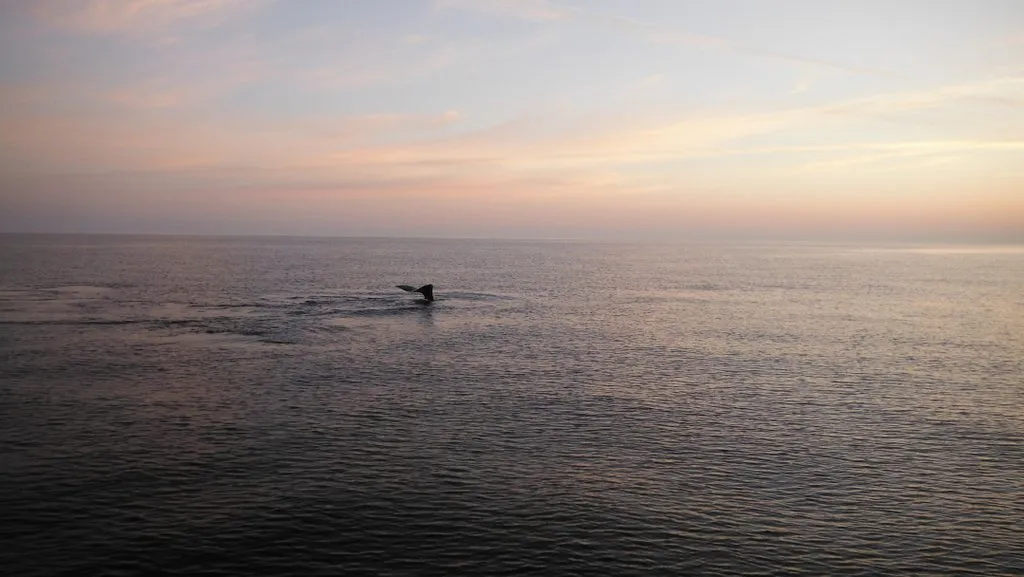
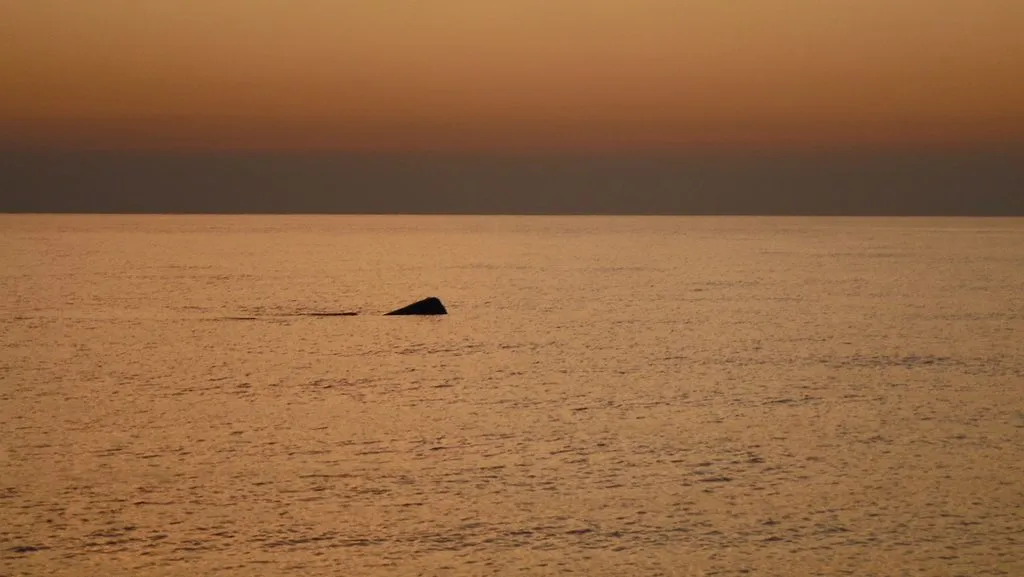
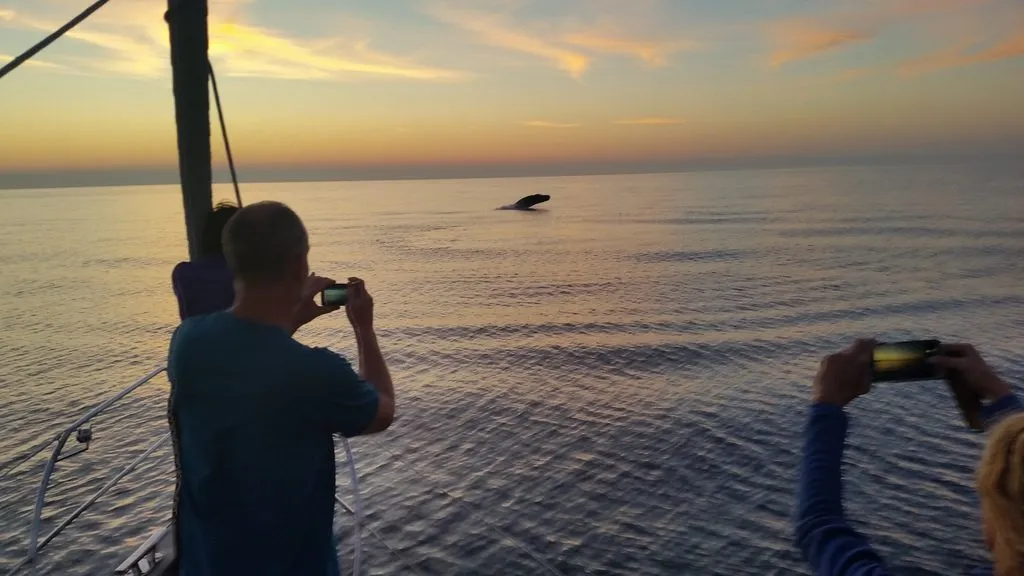
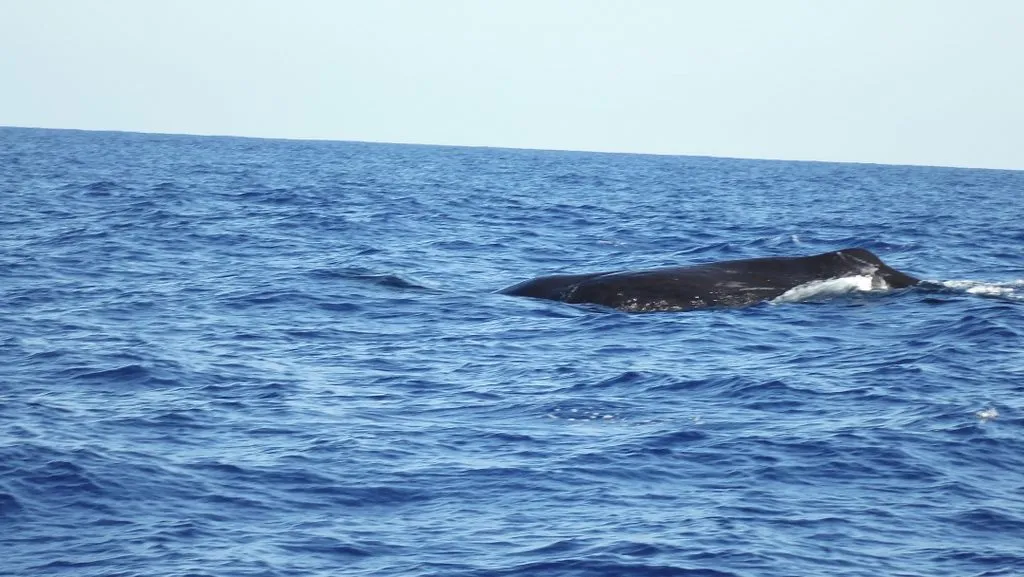
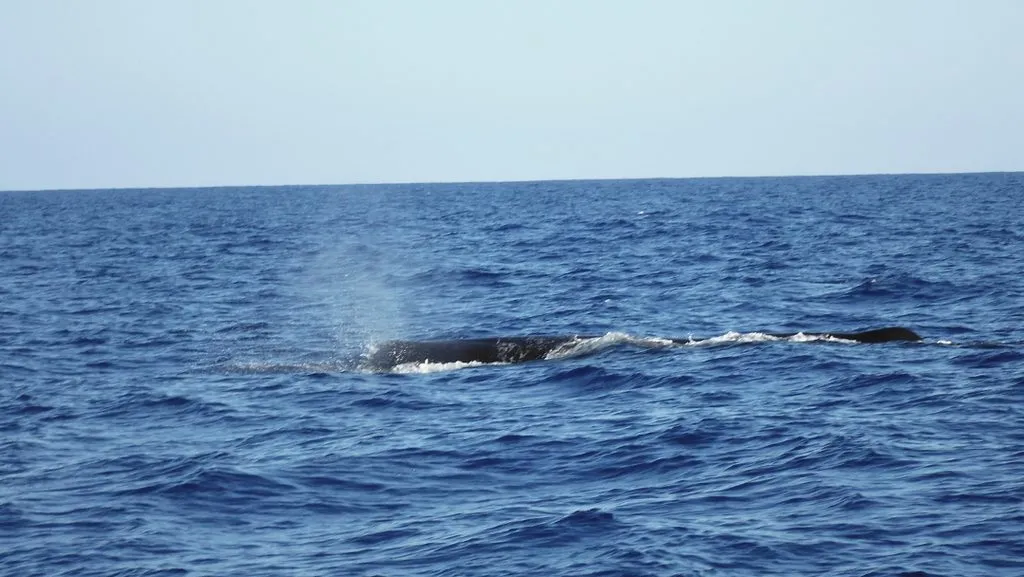
We headed that way, and noticed with excitement that these logs were actually whales resting on the surface. There were four or five whales in the area, which eventually dived when we got to about 20 metres from them, then surfaced a bit further off and lay out on the surface again.
We reckoned they might have been about 8 metres long, and they had tails too. Or tail flukes, or whatever. One of them even leapt out of the sea like a dolphin, but by the time we turned with the cameras, we’d already missed the shot. We were as excited as children (who’d had gin and tonics beforehand), because apart from Gyuri none of us had ever seen a whale live, up close.
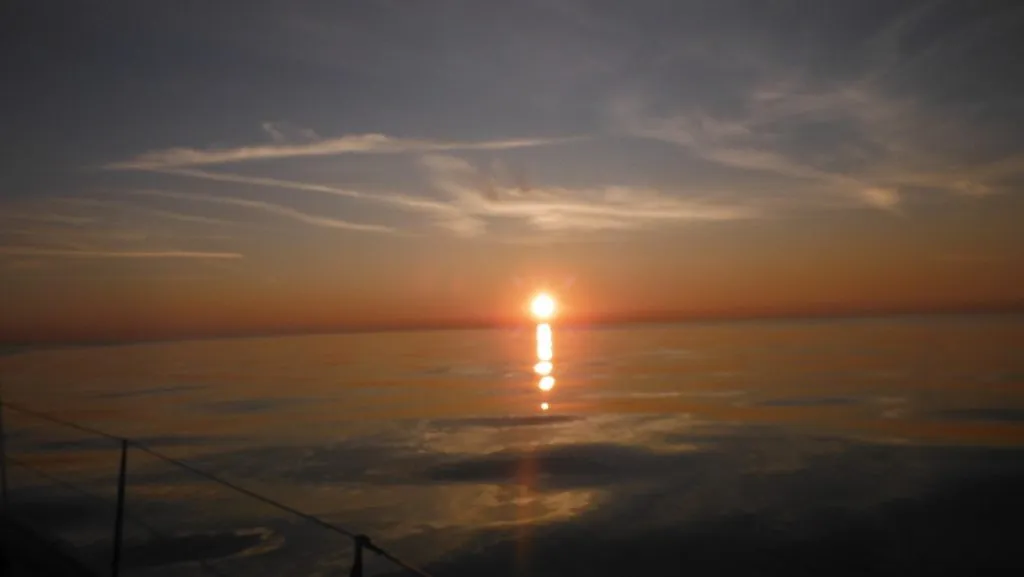
Is it going to attack now, or does it just want to get acquainted?Here goes the whale….The big splashSunset on the mirror-calm Gulf of Taranto
Machine translation (AI, Claude) of Balázs’s Hungarian original. Read the original →
· Portorosa, Sicily
Sailing through the Strait of Messina
Thursday, 19 October 2017
Day 4, 192 nm (Log 4672 nm, 4729 in Portorose)
From 11 at night to 3 in the morning, the graveyard watch, Andi and I were at the helm. We were just passing under the sole of the boot.
We cut across the Gulf of Taranto, then turn into the Strait of Messina
Windy forecast a dead-on-the-nose wind of around 10 knots for a few hours, which duly arrived on schedule and eventually built to 15–16 knots. We had two choices: either sail in the wrong direction for a long time, or motor through it. We went for the latter and got through it in two hours, but meanwhile the boat pitched hard over the closely spaced oncoming waves, and Szabi and co. couldn’t sleep at all in the forward cabin going up and down like a mad lift.
The blog in the making, sorting the whale photos
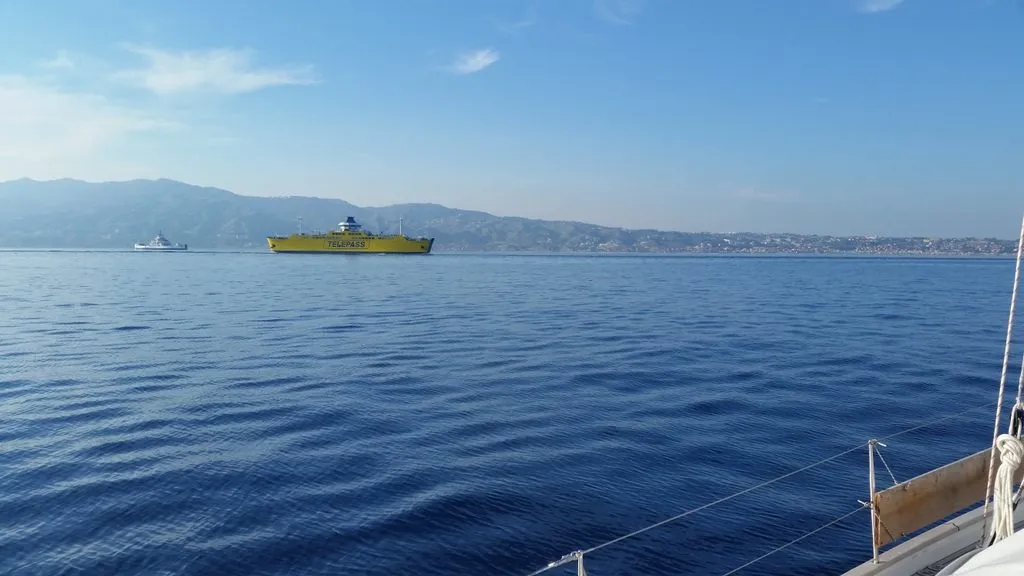
In the morning, in fine weather, we turned into the Strait of Messina. We thought we caught a glimpse of the 3323-metre Etna above the clouds once, but then it vanished as if it had never been there. The shipping traffic had already picked up earlier, but here the ferries joined in too, most of which weren’t running across, but lengthways! As if the Balaton ferries, instead of going from Szántód across to Tihany, ran all the way down to Badacsony. These were mainly freight ferries carrying trains and lorries, whose terminals they could obviously only build further apart, in the toe of the boot and in Sicily.
Here the ferries run lengthways
In the Strait of Messina the tidal changes can produce a current of up to 4 knots (against you) in the narrowing channel. We got there at just the right time, because the current added three and a half to our 7 knots, so we whizzed through at 10.5. If we’d had the current against us, the most that would have happened is that instead of 10.5 we’d have crawled through at 3.5, in two or three times as long.
A 3.5-knot current helps us through
It’s no accident that there were harbours at the entrances and exits of the channel as far back as antiquity, since sailing ships had to wait somewhere for the current and the wind to turn favourable.
Lunch in the middle of the Strait of Messina – curried chicken breast with peaches and steamed rice
Incidentally, I got to thinking about the ancient navigators too. Without a proper chart (on paper), compass or clock, they regularly sailed from one end of the Mediterranean to the other. The only way that’s possible is that the first explorers, who widened their range cape by cape, kept passing on their experience to the youngsters sailing with them, and after, say, the tenth Athens-Corfu run they too knew what each cape, mountain and island looked like, after which one you had to turn right or left, or even cut across for 2–3 days. They often sailed only by day and anchored for the night, but as their geographical and meteorological knowledge grew surer through experience, they could take on crossing open seas too, since they’d surely come out somewhere on the opposite side, recognise landmarks, and from there know whether to sail on to the right or the left. (Only Odysseus wandered around this “palm-sized” area for decades. Either his memory or his navigator was hopeless, or Homer liked to exaggerate things too, like I sometimes do…)
Just as we marvel at this chart-less knowledge, I reckon they would be just as amazed at us, homo facebookensis, at how in Hades we find our way with that stick-figure map (the Budapest public transport network map) from Kőbánya (“Quarry”) to Hűvösvölgy (“Cool Valley”)…
I don’t want to belittle the navigational knowledge of the ancient mariners, on the contrary, they have all my admiration, but it’s not rocket science. For example, I can now drive from Debrecen to Stuttgart too without using a satnav or watching the signs. Easy on the motorway, you might say, but I’d have found my way to Dresden thirty years ago too, even at night (and there weren’t many motorways there back then), we did that drive so often.
Sunset along the coast of Sicily
But, back to the seas. From the Adriatic, at the heel of the boot, at Leuca, we turned into the Ionian Sea, then, once we’d got through the Strait of Messina and come out into the Tyrrhenian Sea, we turned left and carried on along the coast of Sicily. In the distance the Stromboli volcano was smoking peacefully, and at half past nine in the evening we arrived at the harbour called Portorose, to get a good night’s sleep on a moored, non-rolling boat after four days under way.
Machine translation (AI, Claude) of Balázs’s Hungarian original. Read the original →
· Portorosa, Sicily
Taormina, optional excursion
Friday, 20 October 2017
Day 5, Log 4729, lying in Portorose
Raymarine had promised to replace the radar today, so our skipper gave us a day off to go on an excursion. Since we chose Taormina as our destination – where Gyuri had already been – he gave up on coming with us with a relatively light heart. We rented a Fiesta, which wasn’t too big for the five of us, but in return it didn’t beep when reversing to tell the scooter rider standing behind us that he was in the way. Mind you, he wouldn’t have had time to push his bike out of the way anyway, so he hit the jackpot in the end, and yet somehow his joy wasn’t unclouded. But that happened on the way back…
Etna is just not visible in the background.
And the Red Shirts are us, not Feri Áts’s gang from The Paul Street Boys.
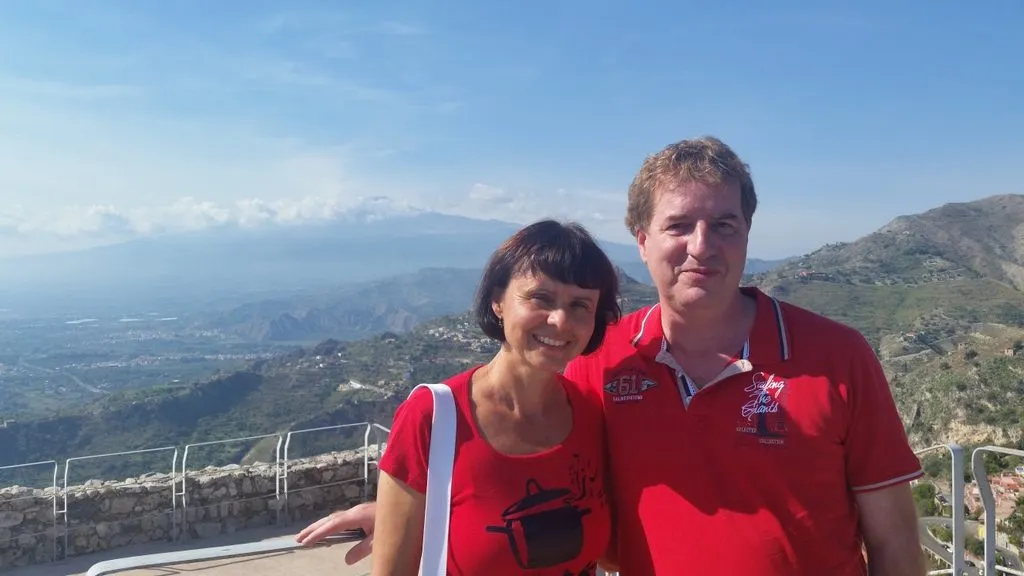
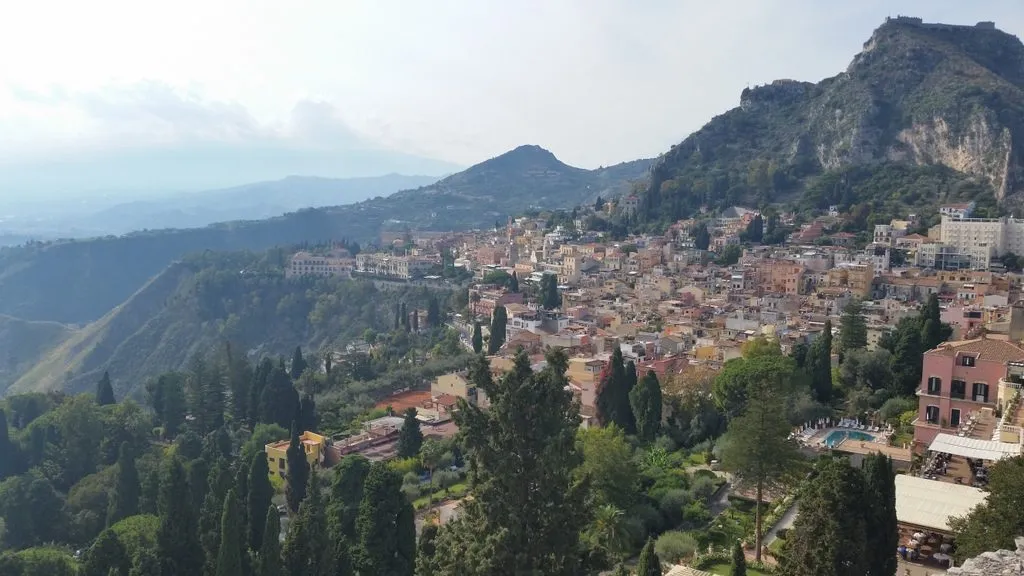
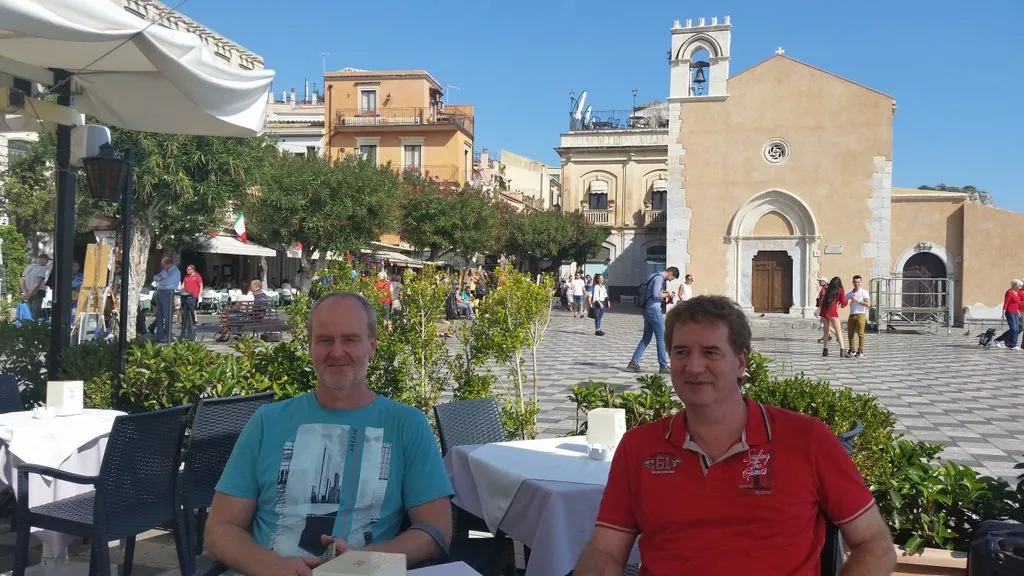
Taormina. A beautiful, charming little town, it was a good choice to come here today, you absolutely must come too if you’re around these parts. You can find pictures and descriptions on the internet, but if you’d also like to get to know it through Balaja’s glasses, I can tell you that we saw its two main sights.
Taormina – the town on the hillside and the citadel on the hilltop
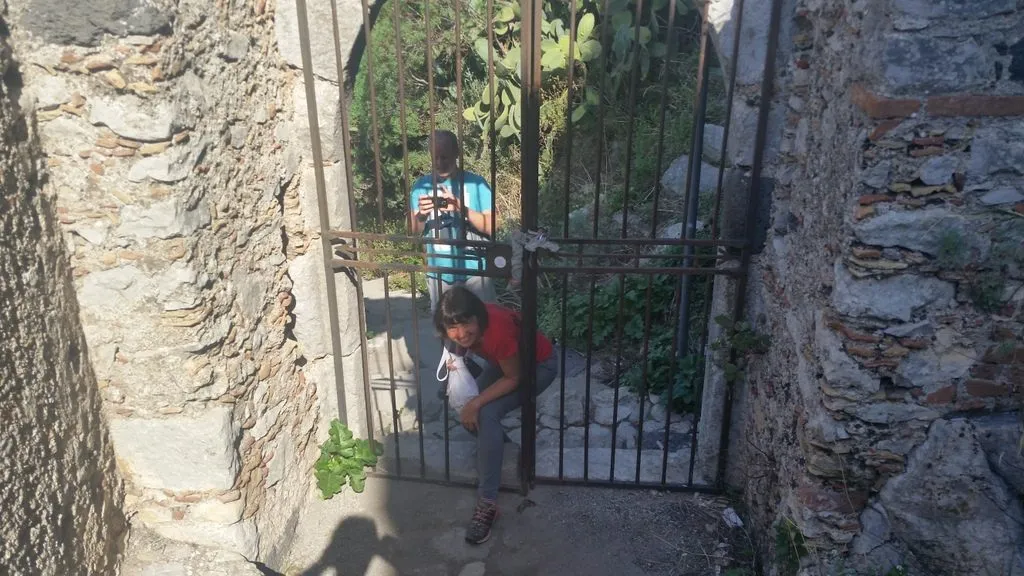
The first, at the entrance to the citadel, is a decades-old Italian access control system (see photo), which still works perfectly today, with no staff. Entry is free for children and adults of normal build, but the system filters out overweight people, who can’t get in even if they pay. True, this is hard-core discrimination, but that’s what we pay our human rights watchdogs for, to do something about this and similar violations.
Italian access control system to the citadel
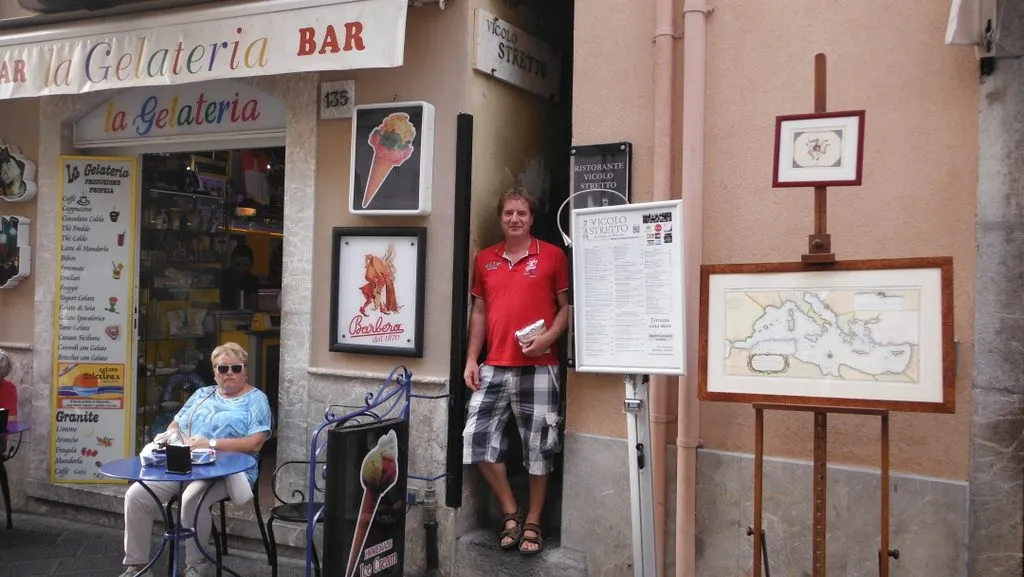
The other is the sway-free streets (see photo), where even drunks are guaranteed to walk dead straight, on both two legs and four, although they’ll be a bit rubbed the wrong way by the time they get home.
Taormina’s narrowest street
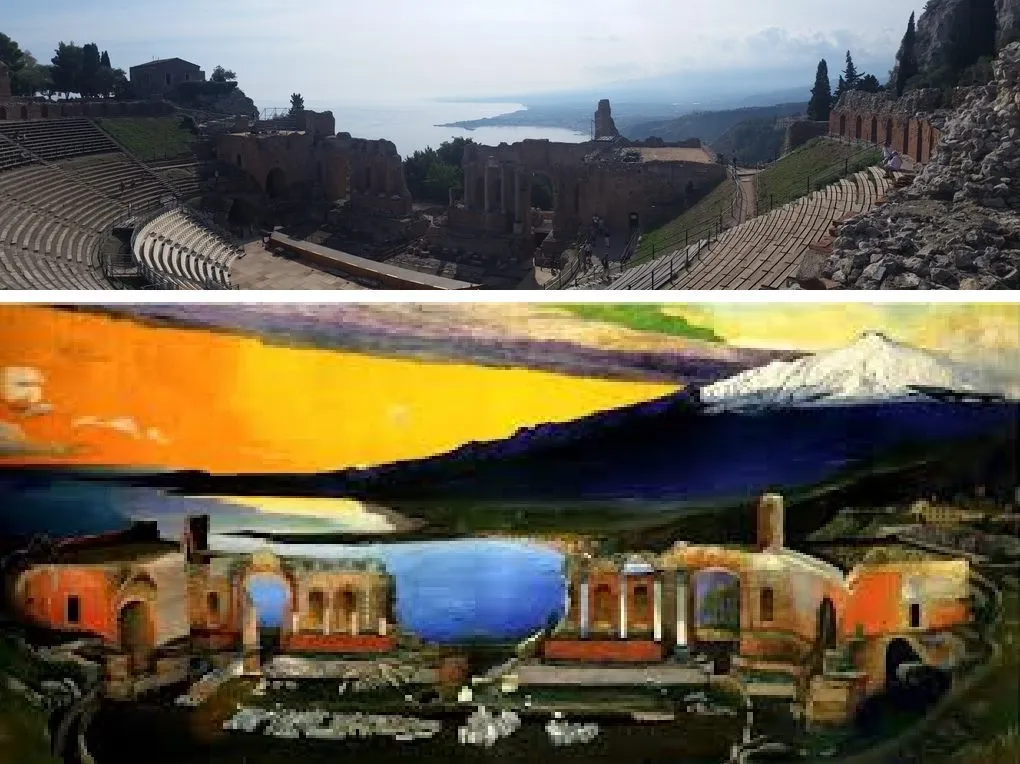
It also has a very old, run-down theatre, which the Greeks built back in the day. Zero stage technology, but the original sound system and ventilation still work perfectly today. It was a brilliant long-term investment some 2000 years ago, since the pigeons (like us) still flock in, paying 10 euros to get in even though there isn’t even a show on. A Hungarian bloke called Csontváry (the visionary painter Tivadar Csontváry Kosztka) made a colour condition-survey picture of it some 150 years ago. I’ve put a photo of the current situation next to it so you can see that nothing has happened in a century and a half; these Italians couldn’t knock together a single roof out of all that EU money. And they still have the cheek to show in a little video what a tip-top theatre this was back in antiquity, under Greek management.
Nothing has changed in 150 years
These southern peoples knew how to live, Andi remarked, as we sat on the terrace of the little old main square admiring the view and the colourful bustle. Of course – I replied – they didn’t have to heat, or make winter clothing; instead they could do art, go to the beach, go to the theatre. Have you ever heard of Viking theatre? Let alone an open-air one, I trumped it…
These southerners know how to live…
There was no time left to go up Etna – even though I’d brought long trousers, a jumper and a raincoat – but in the end we didn’t mind, because Taormina completely enchanted us, and the volcano was wrapped in cloud all day anyway.
While we were out on our excursion, Gyuri paid the harbour fee for our one-day stay, 100€ (that beats even Croatian prices, try not to come here) and cleaned, vacuumed and washed down our boat so beautifully that it was a joy to behold. A big Danke Bier to him!
We got back to the marina by half past six, where we refuelled the Pinta at a horror price (diesel was 1.68€, 515 forints a litre) and set off into the night, along the north side of Sicily towards Palermo.
Machine translation (AI, Claude) of Balázs’s Hungarian original. Read the original →
· Tyrrhenian Sea
On the Tyrrhenian Sea: which way now, and how?
Saturday, 21 October 2017
Day 6, 191 nm (Log 4890)
Last night around 7 we left Portorose heading west.
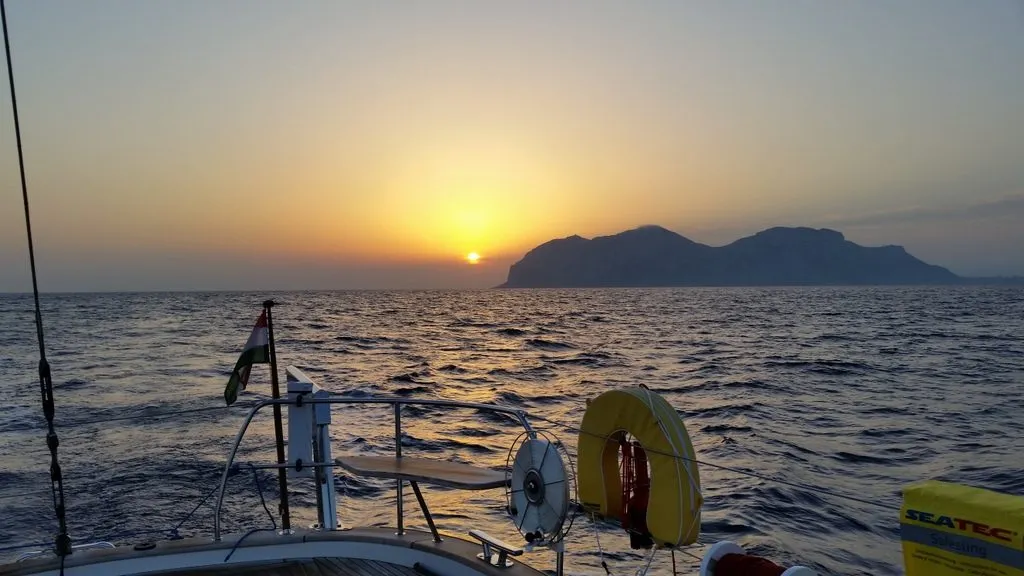
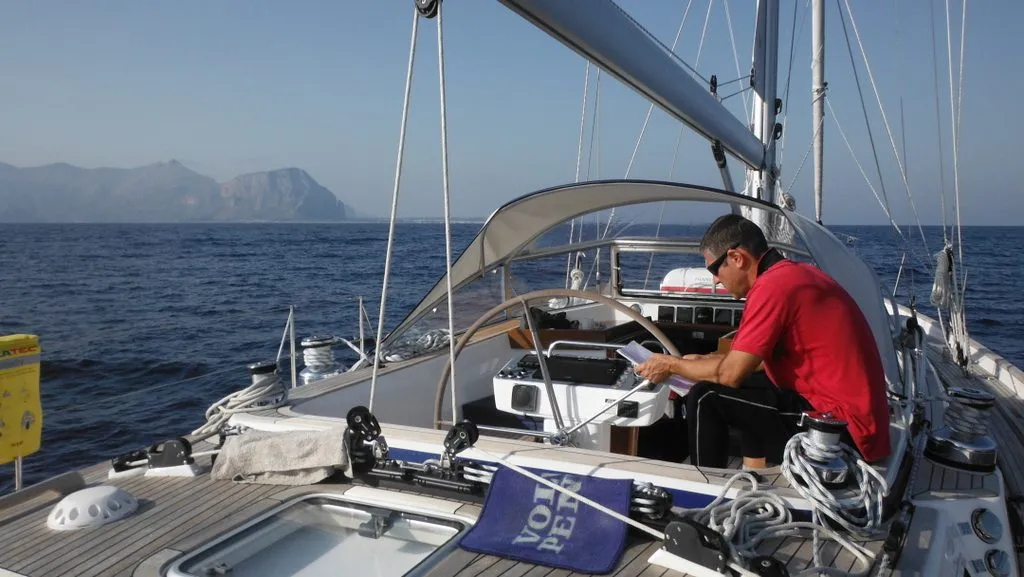
We were on watch from 4 to 8 in the morning. At 8 a.m. we sailed past Capo Gallo, above Palermo.
We’re skipping Palermo this time. Five years ago I spent two days here waiting for a boat, and for me it’s not a place I’m dying to go back to. Nor is it for Gyuri. A guidebook put it most cleverly: Palermo is like an uncut diamond… Now that one I’m keeping. So if one day someone asks your opinion of a dirty, mostly crumbling, litter-strewn city with chaotic traffic, that’s what you have to say. It might also be applied to uncouth people.
So, in 2012, together with the then president of the Hungarian Advertising Association, the two of us were waiting for a brand-new Lagoon 450 catamaran, to make the first longer sea passage of our lives on it, from Palermo to the Adriatic. Since a boat may not wait, but it sure can be late – by as much as 2–3 weeks – we were already rebooking our Wizz Air tickets to Catania for the third time. In the end we said we’d rather sleep there for a few nights and see Palermo, mafia, Cosa Nostra and all, than wait at home any longer. He arranged the hotel room, and he specifically booked one with two separate beds. Naturally, we got a double bed. He complained, he made arrangements, but since the Italians weren’t willing to saw the double bed in half in any of the rooms, he grudgingly accepted that he’d be snuggling into one bed with me. Since I knew the double berths in the cabin on the boat would be even narrower, I didn’t attach much importance to the fact that we’d be bedfellows for 7 or 8 nights. So he swallowed that one, but he finally snapped when I showed him that one big shared sheet and blanket were waiting for us… He shot off to the front desk and didn’t come back until he’d got an extra sheet and a blanket.
Mind you, if he hadn’t rushed off, I’d probably have trudged down to reception myself; he was a normal bloke, but we hadn’t got quite that cosy yet… So much for Palermo.
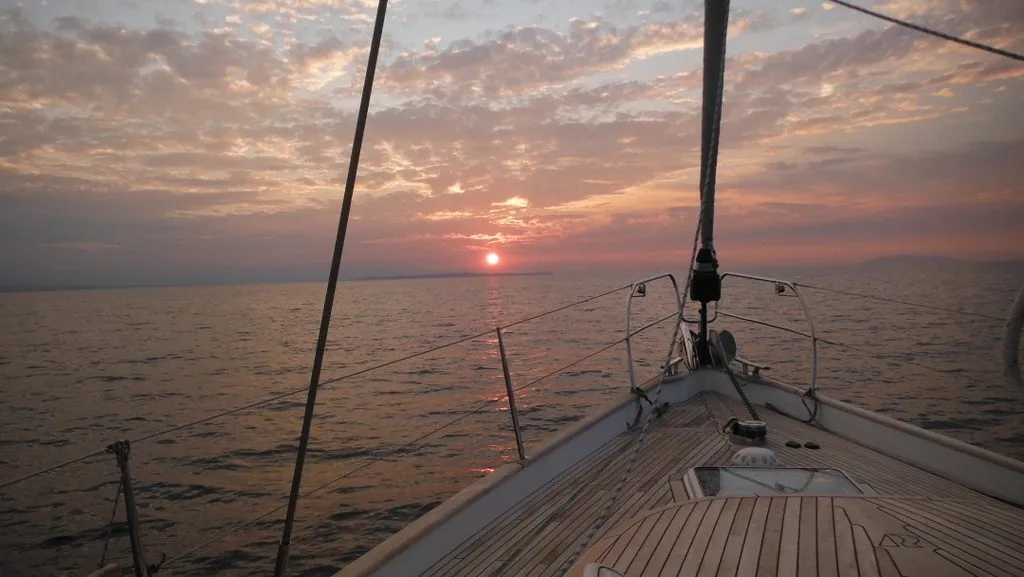
Sunrise off Palermo at Capo Gallo
We slowly left Sicily behind, along with the phone signal. I quickly uploaded the finished diary entries along with the pictures, we made a few more phone calls, and then the mists of distance swallowed us up.
Learning English in an Italian-speaking environment in Sicily, at Capo San Vito
We were heading for Sardinia, but strong wind was expected from Sunday afternoon, so we slowly had to decide whether to risk reaching Sardinia ahead of the front (and then get stuck there for at least two days until the storm dies down, after which there’d be no wind at all), or rather head for the African coast, towards Tunisia and Algeria, hoping we could slip away from the storm and sneak along the African coast riding the edge of the storm’s wind, the wind off the storm’s edge…
In the end we decided to head due west between Africa and Sardinia, towards Cartagena in Spain, and then we’ll see. In other words, we hadn’t decided anything yet.
Instead of Sardinia, in the end we sail towards Africa to slip away from the storm
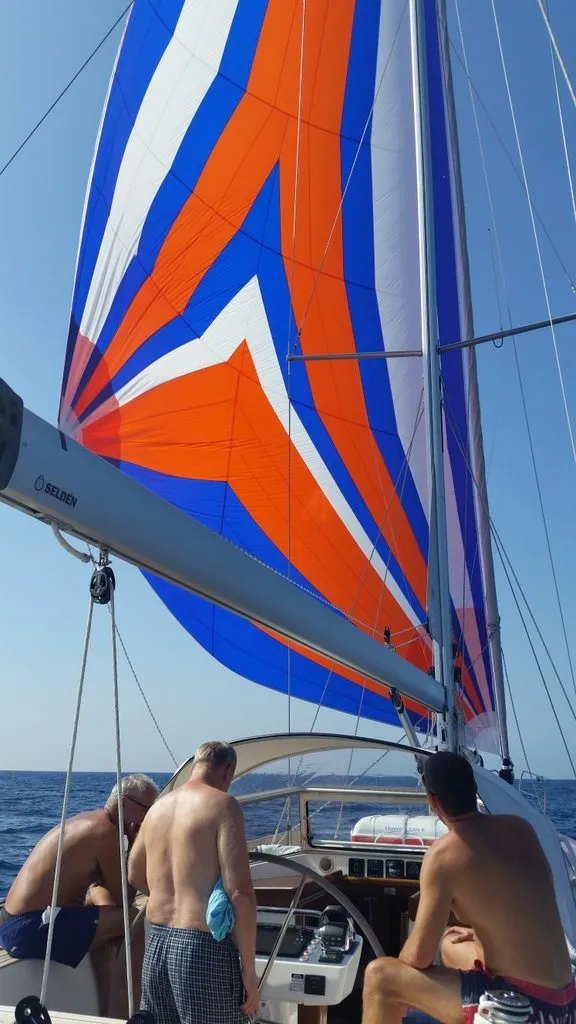
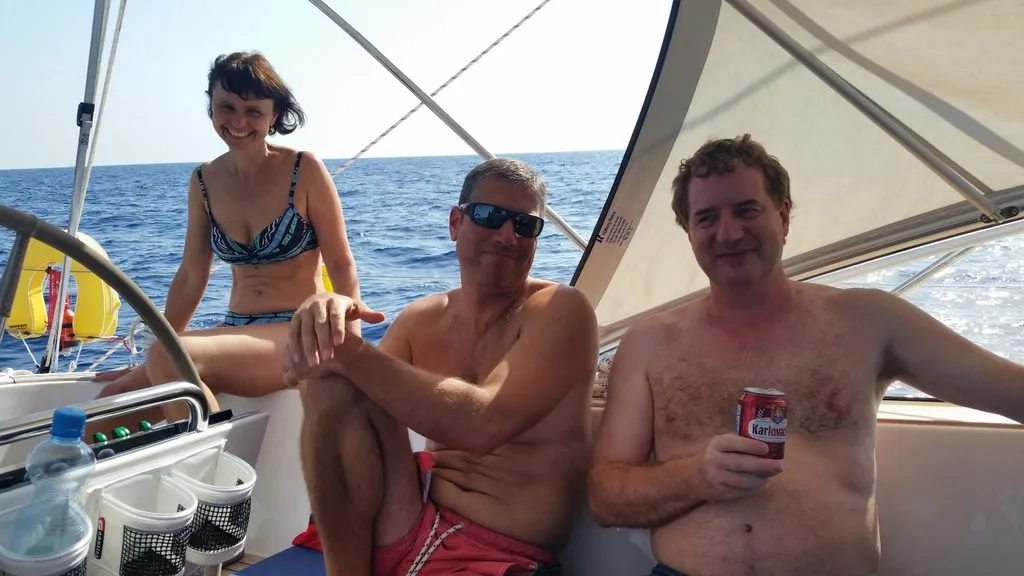
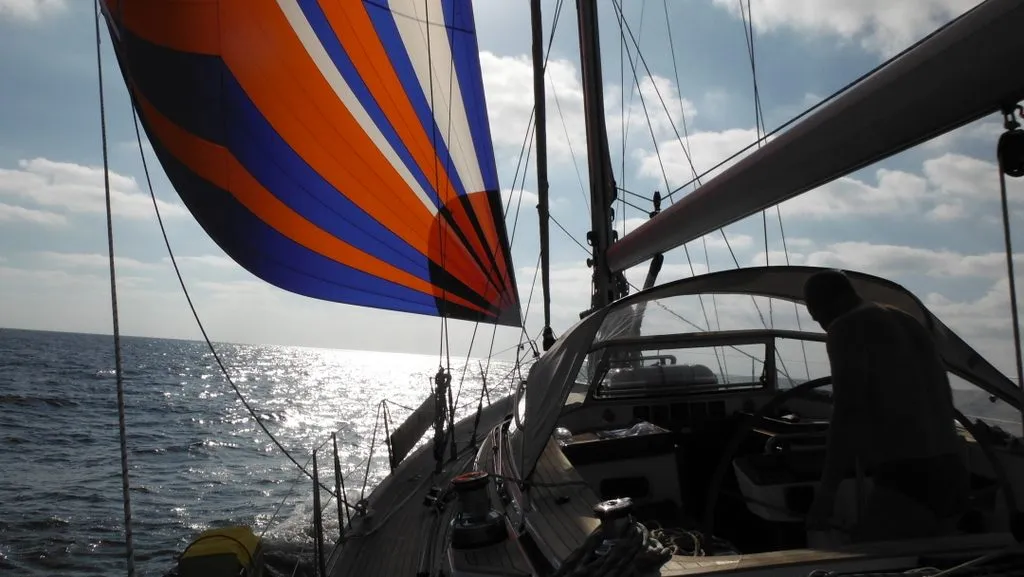
In the morning a favourable wind blew up, enough for us to hoist our blue-and-orange downwind sail, the gennaker. We rigged the bimini sunshade too, out came the summer togs and the cold beer, and an increasingly South Seas mood started to take over in the pleasant 28 degrees.
Gennaker up
Lunch was lecsó (Hungarian pepper-and-tomato stew), to use up the slowly tiring tomatoes and peppers. This is the first day at sea when we can’t see any coast at all, just the sea all around us.
16.00 : Meteorology course. Lecturer: Müller Richárd. Venue: the afterdeck.
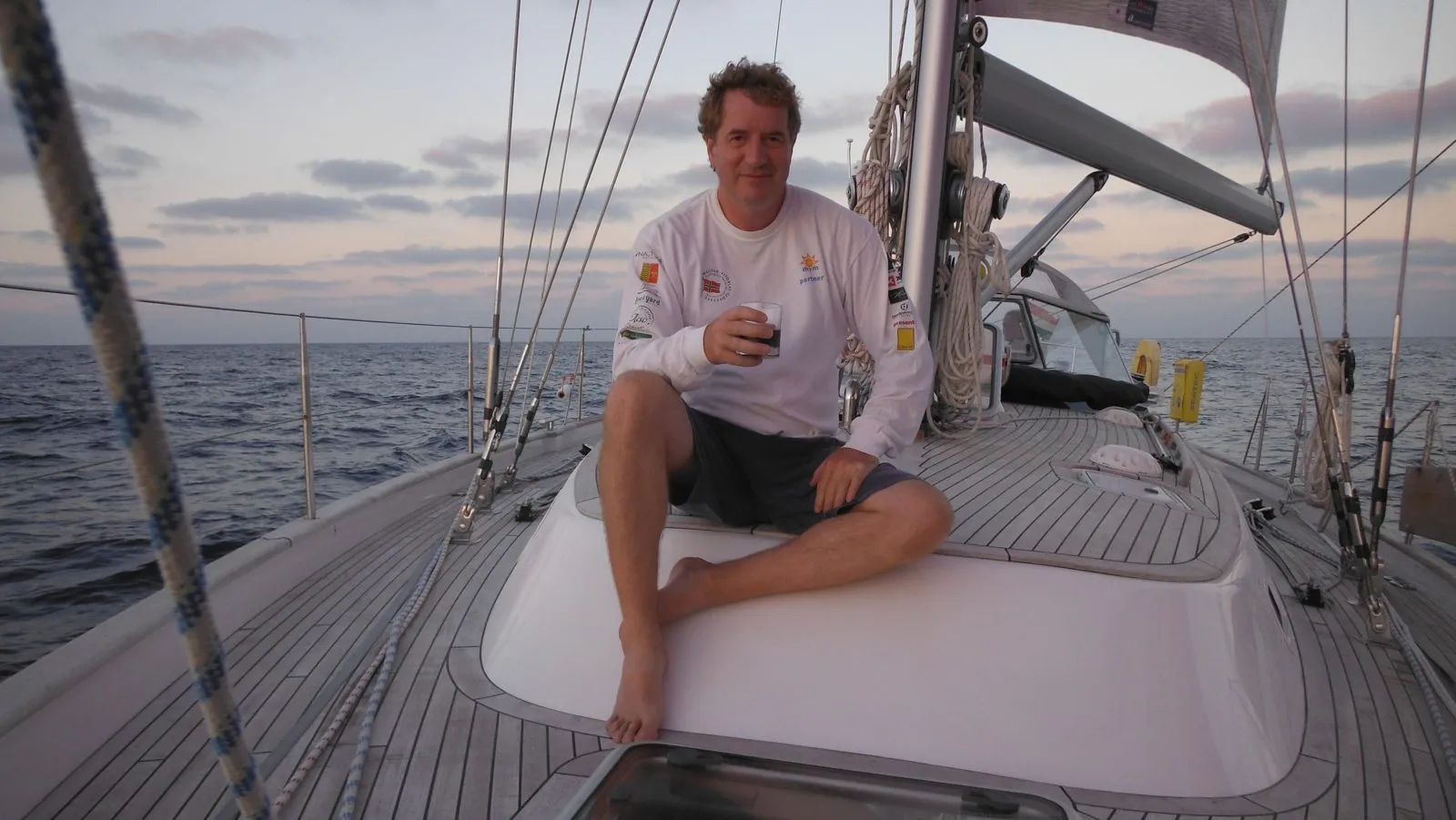
17.00 : The finer points of gin-tonic making: Presented from the galley, in glasses, by Balaja
Suffering here yet again…
Later the wind eased, the gennaker went back to its place, the locker under the bunk in the forward cabin, and we retired, according to the night rota, either to bed or to the helm.
Machine translation (AI, Claude) of Balázs’s Hungarian original. Read the original →
· Mediterranean Sea, south-west of Sardinia
We'd like to dodge the storm
Sunday, 22 October 2017
Day 7, 70 nm (Log 4960)
In the morning we were beating our way towards Sardinia against the westerly. While we were holding a council of war on meteorology and route planning below, the wind swung round in half a minute – just as forecast – and started whistling from the north-west.
The sun rose today too
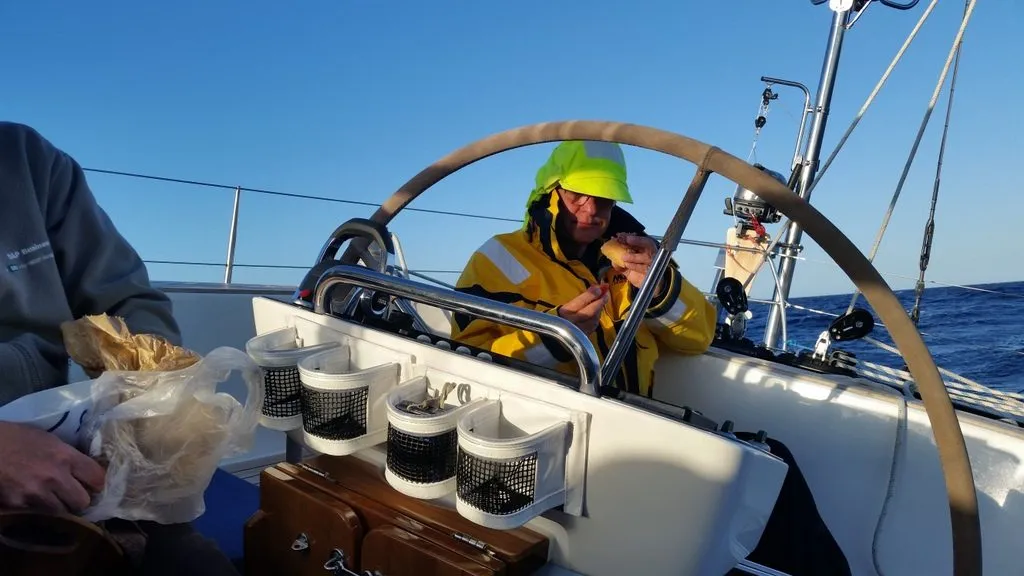
On the pitching boat nobody felt like cooking, so the Sunday family lunch was cancelled for lack of interest, and so very nearly was the 17.00 gin and tonic. It took forceful intervention from Gyuri: Oh yes, we need that! Before dark – whoever’s stomach could take it – grabbed a bit of bread and sausage, so with the wind steadily building we were preparing for a stormy night not only in spirit. Can we slip away from it? Or will the who-knows-how-strong-it’ll-be storm catch up with us?
A bit of bread ‘n’ sausidge. The first bite we’ve had since this morning. Naturally, the 17.00 gin and tonic wasn’t skipped.The sea drops in on deck more and more often
From 23.00 Andi and I are the watch on duty. In the end I go out to the helm alone; there’s no point in both of us shivering and hanging on outside in the more-or-less sheltered corner. Andi keeps an eye on me while dozing in the saloon armchair; at her feet on the floor our most poorly shipmate, knocked flat by seasickness, is trying to rest, in the company of a bucket, and Gyuri is standing by – lying down, asleep on the bench by the table…
The wind is 22–29 knots and starting to howl. It’s not a storm yet, but it smells a lot like one. 2-metre waves keep pelting the boat with water, the communicating vessels in the galley cupboards are banging on the doors, wanting to break out. The sails are well reefed – i.e. shortened – so there’s nothing for me to do but clip myself on properly so I can’t possibly fall into the sea, and watch the instruments, the wind, and whether another ship is coming our way.
Andi writes up the logbook. Instead of the class register…
Now and then you stick your head out to look around, then quickly yank it back so you don’t catch a good splash – a proper fröccs, as Hungarians call their wine spritzer. This one’s a 3/2 too: three parts Mediterranean, two parts Tyrrhenian seawater.
1 a.m. I just got half a bathtub of water down my neck. Lucky I had my hood up. I was just leaning over the plotter when the blessing arrived. The strange thing is that you don’t know, you can’t hear, when a wave is going to break over. Not when the bow slams into the waves, nor when the wind shrieks up or the boat heels over, but when you’re not expecting it. I’ve observed this.
The Pinta is coping very well. The autopilot steers our boat relative to the wind direction, very reliably. This boat is different from the ones I’ve sailed on before. On those, in the evening, in stronger wind, the situation sounds much worse from inside than it actually is. They creak, they crack, the wind howls outside, the ropes flog, it sounds as if the roof could be torn off any moment, as if the mast could snap, and then when you stick your head out, they smile at you casually, in a “whassup-can’t-sleep?” style, instead of having crapped themselves. And really, outside the weather is normal, the boat is manageable, no problem at all… Here on the Pinta, though, inside you feel the wind has eased, the boat is moving more quietly, and then when you stick your head out of the cabin, the howling wind nearly rips it off and you’re stunned by the waves charging at you. These Swedish boatbuilders know a thing or two…
My little handheld temperature and humidity meter, however, couldn’t take the half-bathtub shower with a straight face, and shows a temperature of 80, then 48, then 50 degrees. The weather’s not that good, surely…
At 3 o’clock I handed over the watch, then got into my pyjamas and into bed. The weather didn’t get any worse, only the waves got bigger.
Machine translation (AI, Claude) of Balázs’s Hungarian original. Read the original →
· Mediterranean Sea, off the Algerian coast
Africa on the horizon
Monday, 23 October 2017
Day 8, 155 nm (Log 5115)
All morning we still had a 22-27-knot beam wind.
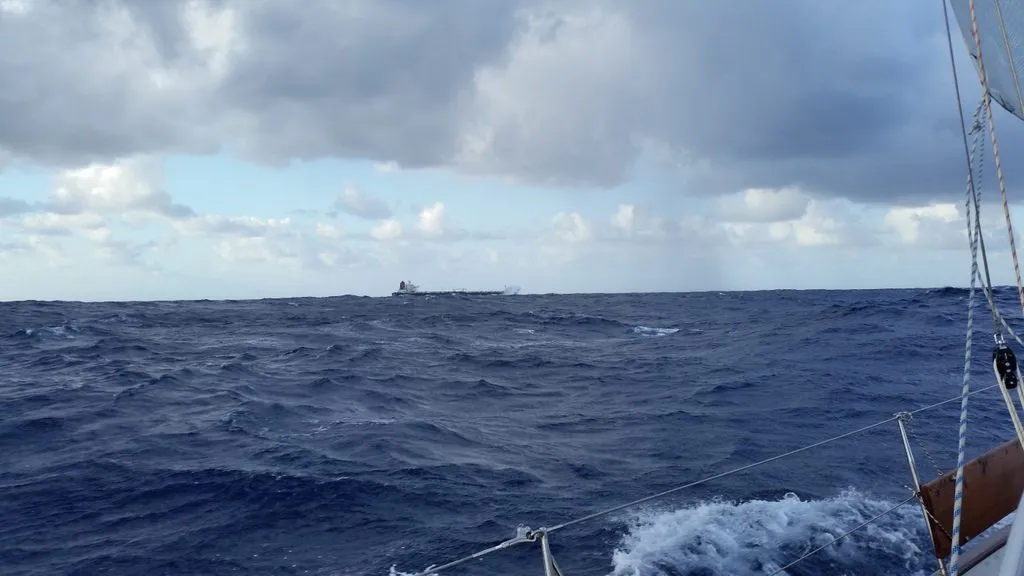
The waves built up nicely, to 5–6 metres high, so one moment we could see the container ships and tankers passing us, the next they’d vanished completely behind the towering waves. We’re over the worst of it – it seems – and yet seasickness is lurking around nearly everyone.
These are 5-6-metre waves now
Our eye level is about 2 metres above the boat’s waterline
Since our friend still felt least bad on the saloon floor, and nothing had stayed down for more than 24 hours, we picked out an Algerian harbour and headed that way, so that we could moor there, rest a little and recover.
This is the safest spot – You can’t fall off from here
After yesterday’s diet day Anikó cooked a vegetable soup, to which Gyuri and I each added a tin of ready-made layered cabbage (Hungarian rakott káposzta).
Around 15.00 Andi cried out: “Land on the horizon!”
The outlines of high mountains took shape in the distant haze. For some reason I’d imagined the whole North African coast as flat, from Egypt to the Atlas Mountains. Soon the Algerian coastguard called the Pinta on the radio, asking how many of us there were and who, where from and where to. After we kept very quiet about the fact that no NGO or aid organisation was backing us, they wished us a good onward voyage and signed off.
Eventually Gyuri managed to get information from home by satellite phone, and it turned out that the harbour we’d picked out was suitable neither for clearing in nor for taking our boat.
We turned the Pinta’s bow west again, so it’s Algiers, or sailing on to Spain, say Cartagena. Our wind eased further to 12–13 knots, so sailing with the wind on the quarter is more bearable now.
The spray flies right up to the top of the freighters’ bow masts,
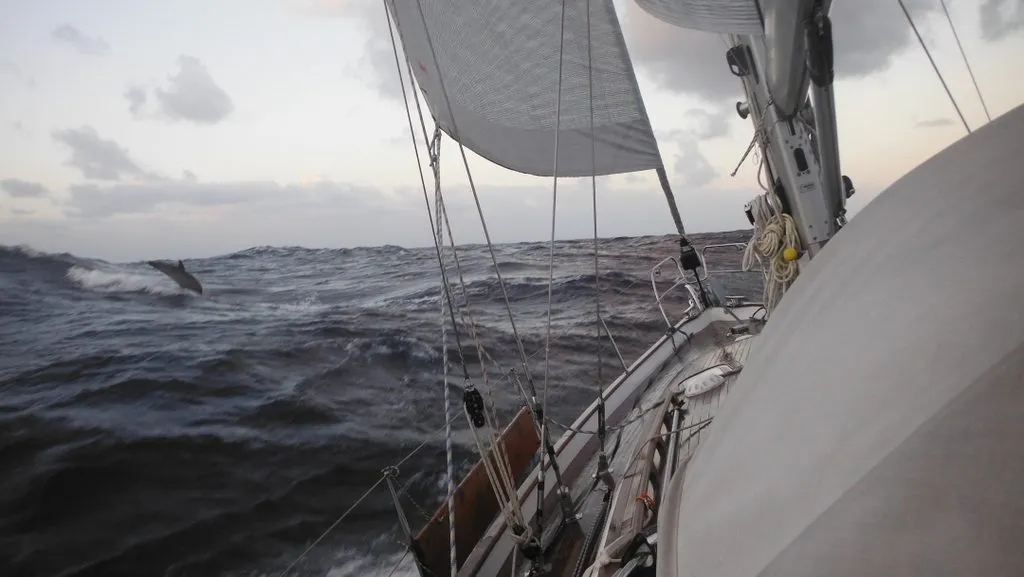
the dolphins, though, are having great fun at our expense…
Machine translation (AI, Claude) of Balázs’s Hungarian original. Read the original →
· Mediterranean Sea, off the Algerian coast
Cutting a fishing net off the Algerian coast in the night
Tuesday, 24 October 2017
Day 9, 154 nm (Log 5269)
Since last night we’d been sailing along the coast of Algeria within sight of it, about 30 miles off. I missed the morning entirely, because after the early watch I went to bed at 7 a.m. and slept like a hibernating hippo until half past one. For lunch Andi cooked paprika potatoes (paprikás krumpli), everyone had forgotten about seasickness by now, so we happily stuffed ourselves to bursting. (Me too – awake by then.)
The grey clouds slowly drift away
Shipping traffic was still heavy, because this is where merchant ships run between Gibraltar and the eastern basin of the Mediterranean. They’re very decent, they always get out of our way with a minimal change of course. We saw a brown satellite dish floating in the water, which, after it stuck its head out, turned out to be a real turtle.
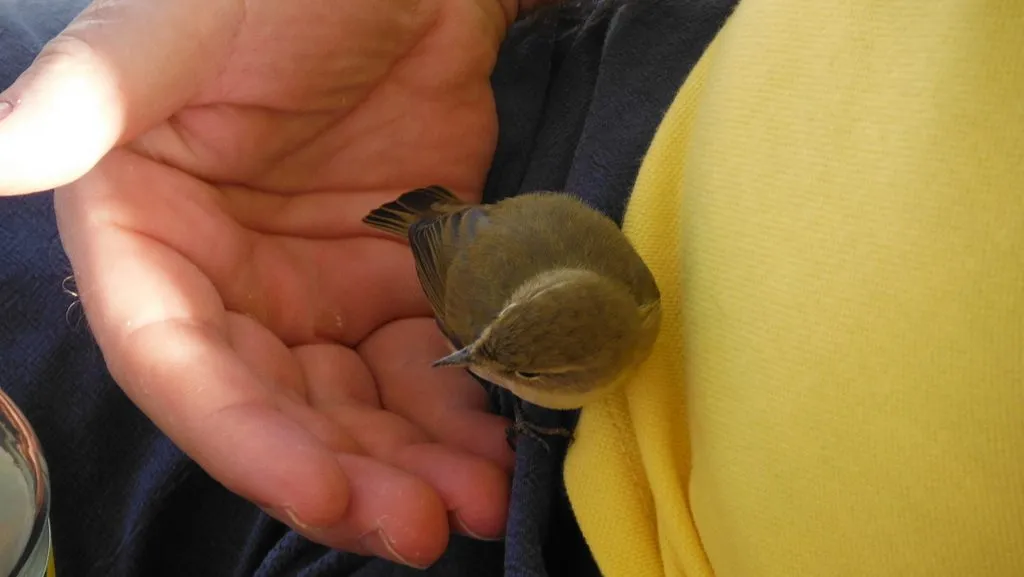
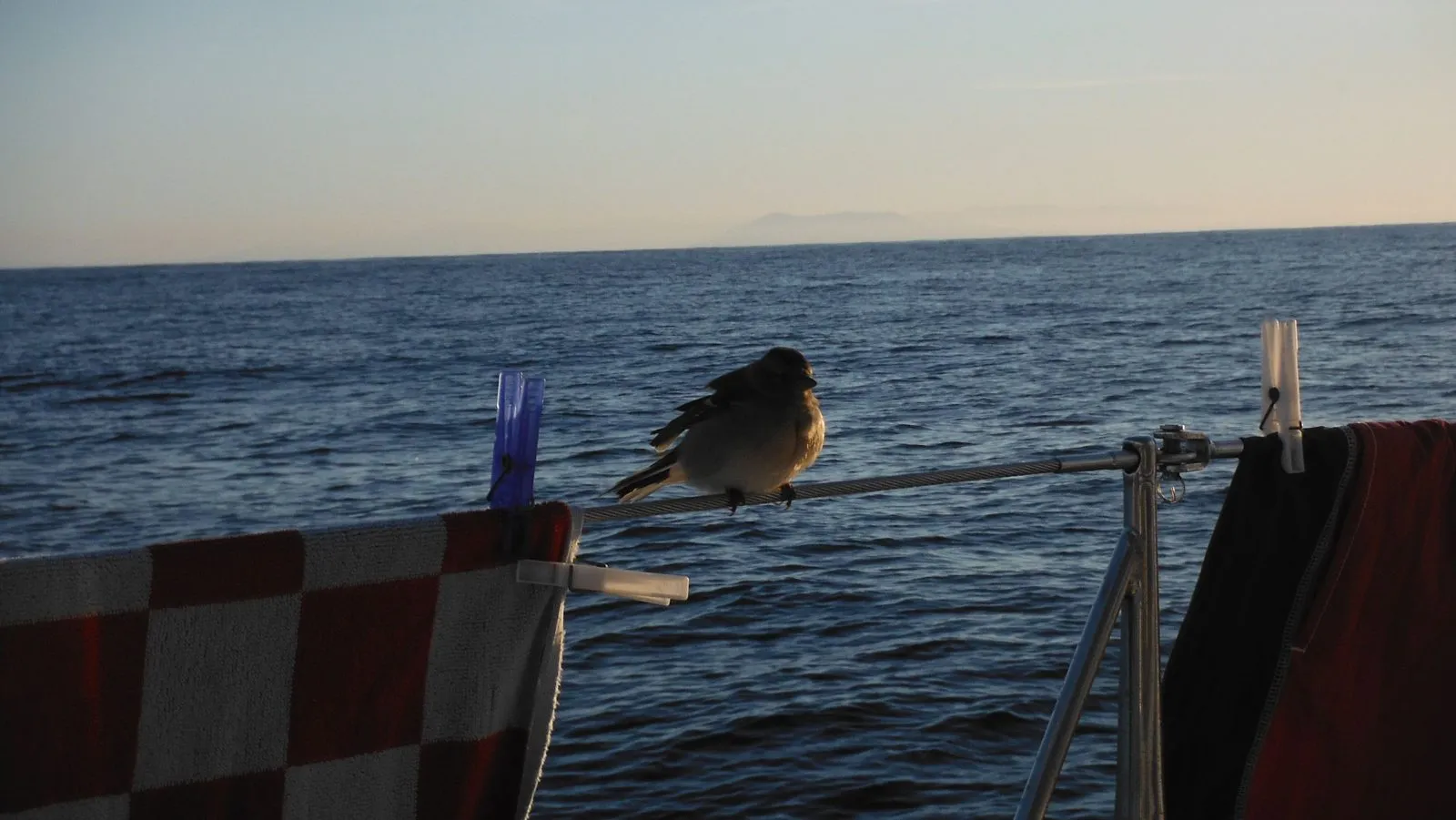
Two sparrow-sized little birds circled our boat for a long time, meanwhile, according to Ricsi, catching white butterflies (two of them, but how does a butterfly end up out here in the middle of the sea?), and they stopped to rest on the boat several times, now on deck, now in my lap, now on Anikó’s head:)).
Gombóc Artúr (the round little chocolate-mad bird of a Hungarian cartoon), and Africa
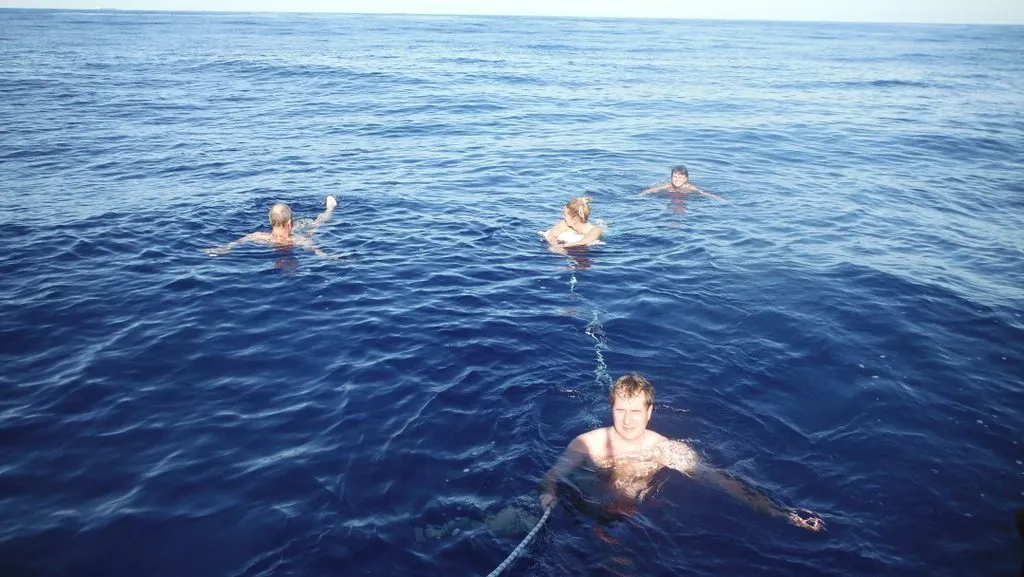
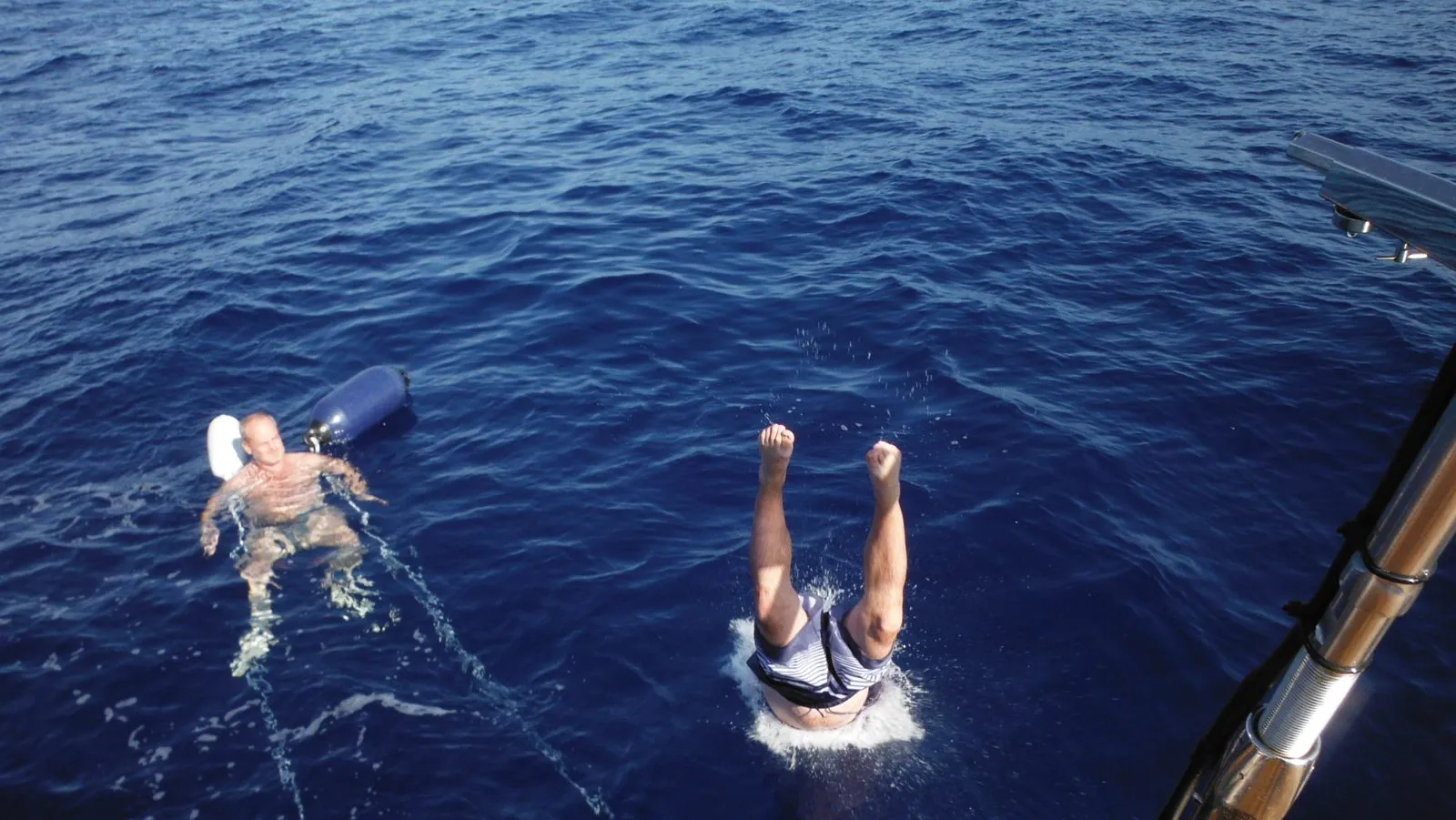
In the afternoon we stopped the boat for a bit, threw out two buoys on ropes and had a good swim in the middle of the Mediterranean, in the pleasant 25.4-degree water. We got the long evening shift, from 15.00 to 23.00. Meanwhile Anikó made delicious pancakes for dinner, which had just one big problem: there were only 2 each.
Splashing about in the middle of the Med.
Here I’m already a bit more subdued after the right hook, but I’ll tell you about that later
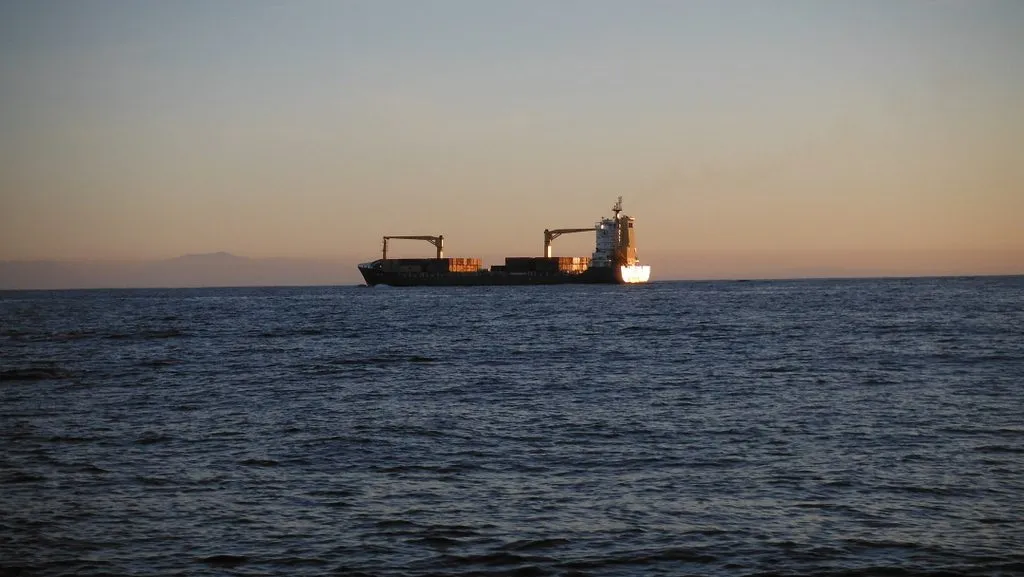
Container ship off the coast of Africa in the light of the setting sun
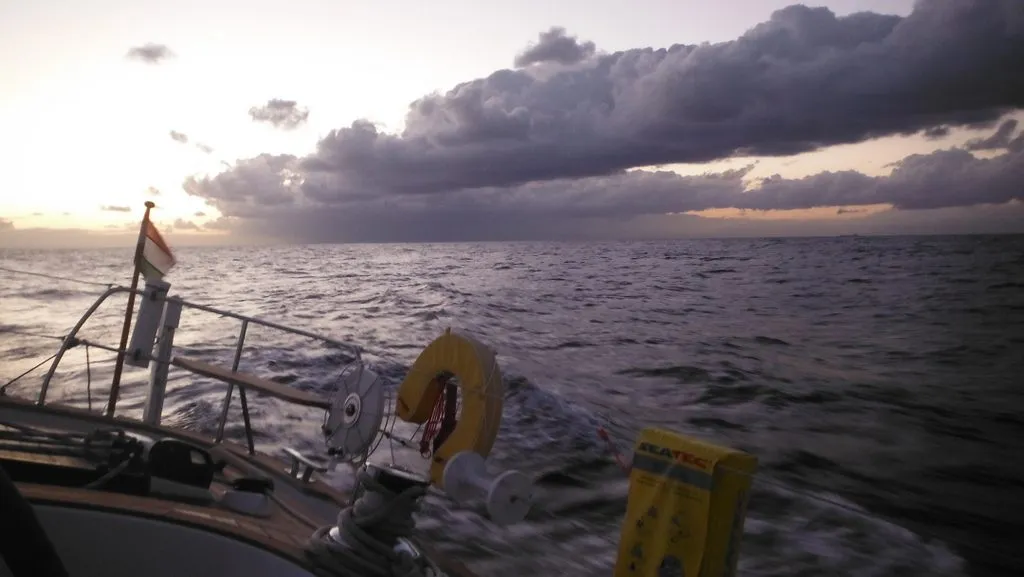
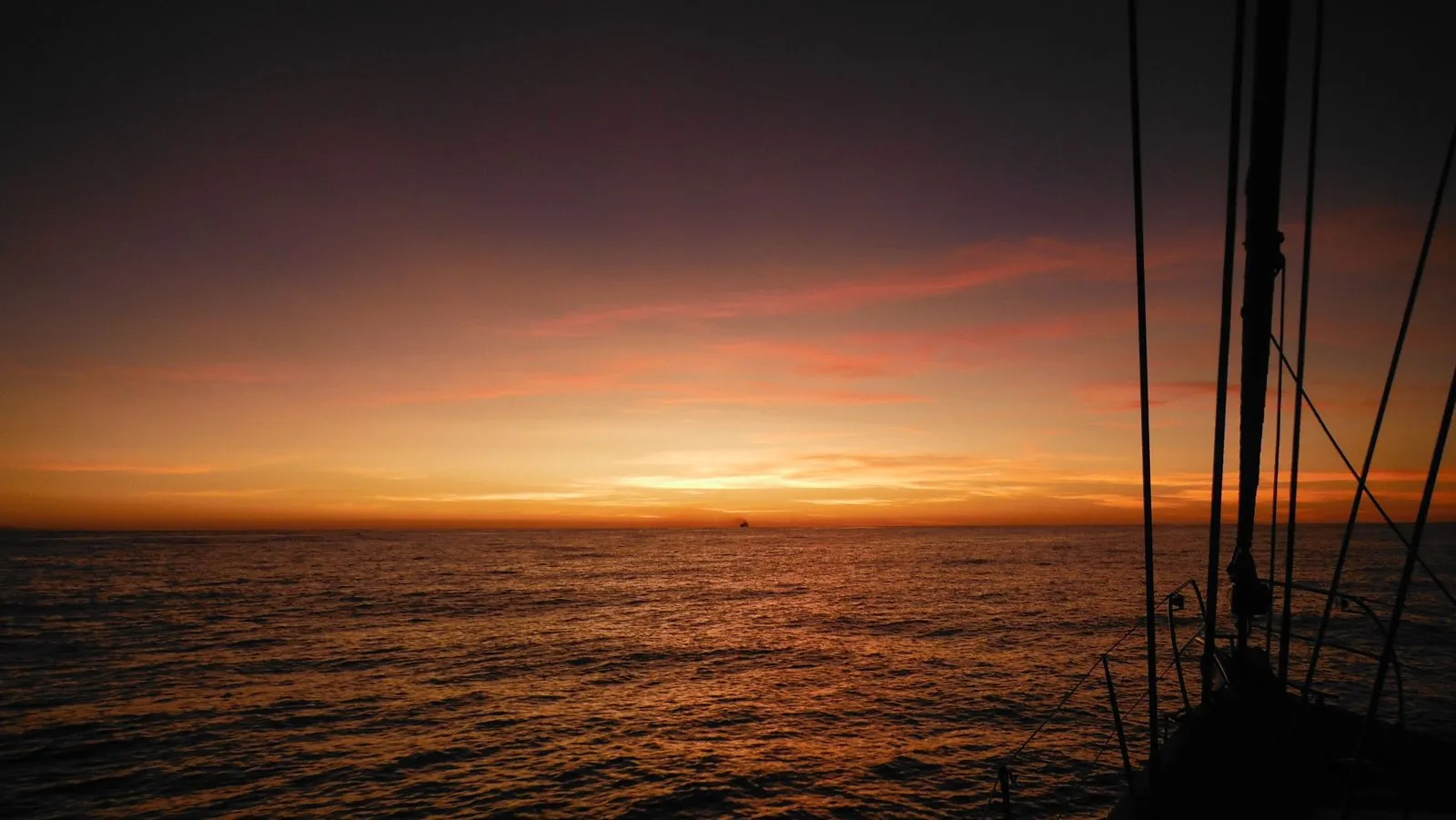
We had a very beautiful sunset. The unusual thing for me was that it shone so blindingly into our eyes that you couldn’t look at the sun even when it was already half down. But once it had set completely, the bottom of the sky turned as gloriously colourful as you only see in kitschy photos on the internet. The stars shone in the clear sky; only the lights of Algiers, 50 miles away, polluted the night sky. https://youtu.be/y24Mb5QHIK8
It really was like this…
Unfortunately we only have minimal wind (we’re pretty insatiable: if there’s a lot of wind that’s no good, and if there’s little, that’s no good either), so we have to help out with the engine to keep up the pace. The others have gone to bed, the sea is calm. On the radio, on channel 16, the distress channel, some people start jabbering away at each other unintelligibly. At first it sounds as if they’re cheering on a Champions League match, but it’s too early for that, and they’re gabbling not in Spanish but in Arabic. I turn the volume down, because I’m already fed up with the yapping that’s been going on for at least an hour, which, judging by the intonation, could just as well be haggling at a market.
Channel 16 is there so that distress calls can be made, and if you want to discuss something else with another vessel, you make contact on it and then you both switch to an agreed channel, so as not to keep tying up channel 16 from distress calls. Apart from that, mainly at night, jokey, presumably no-longer-thirsty sailors “entertain” the other mariners with all sorts of things, thereby blocking the possibility of putting out a distress call. In the middle of the Atlantic, fishermen from the Cape Verde Islands played Guantanamera at dawn; off Italy a couple having sex gave a live radio broadcast as they approached the climax, and then someone practised a Chopin piano piece for a quarter of an hour. Life goes on… And here Algerian fishermen are polluting the airwaves for hours on end.
We sail along off the African coast, within sight of it the whole way
As we went along, watching the merchant ships, all of a sudden I noticed a faint row of flickering lights on the surface of the sea, stretching across in front of us at right angles to our course. Or rather, to the left, towards the Algerian coast 20 miles away, there was a small gap, while to the right, towards the open sea, little lights blinked and flickered every two hundred metres or so, as far as the eye could see in the darkness. What could it be? A fishing net? But it’s so long, and there isn’t a single fishing boat to be seen anywhere around, nor its lights, nor an AIS or radar echo. On top of that, two ocean-going merchant ships are also making their way not far from us, in the same direction as us, parallel, on the landward side.
There was no more time to puzzle it over: if the freighters are running through here too, it can’t be a big deal, so I aimed for what looked like the last light, and motored past it on its apparently clear side, about 50 metres off. Nothing special happened – apart from a quiet little “ping” from the stern – and we were carrying on when, further away, a searchlight came on, fixed on us, and headed straight for us at high speed. I switched on the deck light that lights up the sail so they could see us better and wouldn’t run into us, and sent Andi down for Gyuri, since we had visitors at the door. Meanwhile the boat, of which we couldn’t see a thing because of the glare of the searchlight, came within about 30 metres of us, got behind us and started catching up with us from astern, closing in. Over the engine noise you could hear angry shouting; these guys weren’t looking to make friends after all… Meanwhile Gyuri and I worked out that he, in his aft cabin, had heard the “ping” from the propeller even more clearly, so in all likelihood our propeller’s rope cutter had passed its exam with flying colours – for the first time in its life – and we must have snipped through their net…
So that’s what they were yelling about! We turned the radio up again, in case anyone wanted to say something in some international language, say Hungarian, but only the gabbling carried on back and forth, maybe a bit angrier… Listening more closely, we even made out a few familiar words, like Atacion, or Please Captain, or Merci, or maybe Allah… Maybe they were speaking French with some incredible Arabic accent, the way the Swiss really twist the German language. Afterwards I guessed that maybe they’d been begging the captains of the freighters to change course and go round the net, but watching the ships’ AIS signals, they didn’t have much luck.
We did, however, see a gorgeous moonset before 11 at night. When the sickle of the huge orange quarter moon was half sunk into the sea, it looked as if the bow of a sinking, burning ancient galley were slowly going under in the waves painted copper-red by the moonlight. Now that’s something you don’t see on the Hortobágy…
We didn’t cut any more nets this evening; our watch ended at 11, nothing bad happened to us, so we can calmly crawl into our bunk beds, under the blanket.
Machine translation (AI, Claude) of Balázs’s Hungarian original. Read the original →
· Mediterranean Sea, between Spain and Algeria
We've crossed into the Western Hemisphere
Wednesday, 25 October 2017
Day 10, 138 nm (Log 5407)
By the time the sun came up, our wind had picked up a bit too, to about 11 knots, which is already enough to sail goose-winged downwind at 6 knots. A bit later we changed sails, hoisted the colourful gennaker, and on a broad reach headed straight for our destination, Almería in Spain.
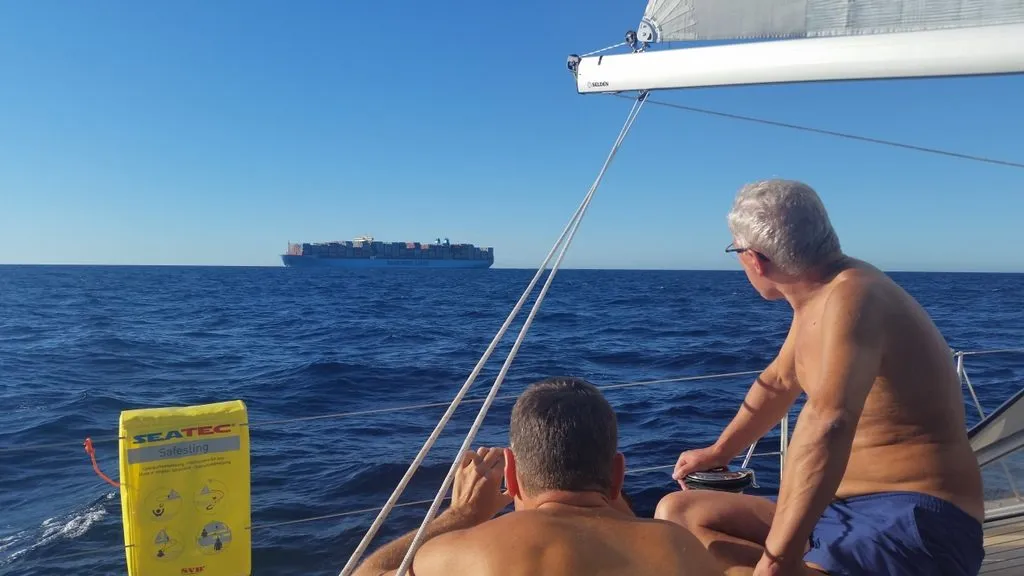
Blimey, how big is that ship over there…That container ship… 399 metres long, 50 metres wide, with a draught of 14 metres
(like a 4-storey underground car park)
A very pleasant ride, we’re doing five and a half knots in glittering sunshine. We put half the champagne in the fridge, because in a few hours we’ll cross the Greenwich zero meridian, which will also mean roughly the halfway point of our trip. For lunch Ricsi and I cooked shepherd’s tarhonya (Hungarian egg-barley pasta stewed with sausage – the sausage being the shepherd) Good-Sailor style – which reportedly turned out even better than in spring (and in sufficient quantity) – I didn’t dare wait any longer with it, because the sausage it needs was disappearing at an alarming rate, and in the end I’d have been left standing there with a heap of tarhonya and no shepherd…
This shepherd’s tarhonya came out better than the one I cooked on the Atlantic in spring
(this time I followed the order in the assembly instructions to the letter…)
At 14.33 we crossed into the western hemisphere of our planet, although we’re still sailing here in the Mediterranean. We popped a bottle of champagne and clinked glasses to the momentous occasion…
Woo-hoo, we’ve crossed into the Western Hemisphere…
In the afternoon we swapped cabins with Szabi. Since Andi and Anikó took part in the move too, we’re definitely not going to end up on Wife Swap. Before setting off we’d agreed that halfway we’d swap cabins, so that all of us could get to know the bunk-bedded Trotsky cabin more intimately. The cabin’s godfather, the very first resident of the top bunk, was Zoli – who, for reasons known only to himself – erected yet another eternal monument to Comrade Trotsky. Perhaps with this christening he wanted to convey the suite’s unique special features, such as: it’s impossible to fall over in it; or if both people stand up at the same time, neither of them can get out of the door; or that Venetian mirror on the wall; or perhaps the energy-saving automatic lighting control system (you walk in the door, switch on the light, turn round, stagger back against the wall and promptly switch the light off again with your backside. You do this another two times or so before changing tactics…) and of course that bunk bed, about 50 cm wide, which can enrich its occupants with unforgettable hanging-on-for-dear-life experiences (lee cloths notwithstanding) when the boat heels. And monohull sailing boats do heel when the wind blows.
For the first half of our trip fortune smiled on us with the pleasures of the Trotsky cabin, but there was no way round it, now we had to go. So with tears in our eyes we packed up and moved next door into the double-berth cabin in the bow.
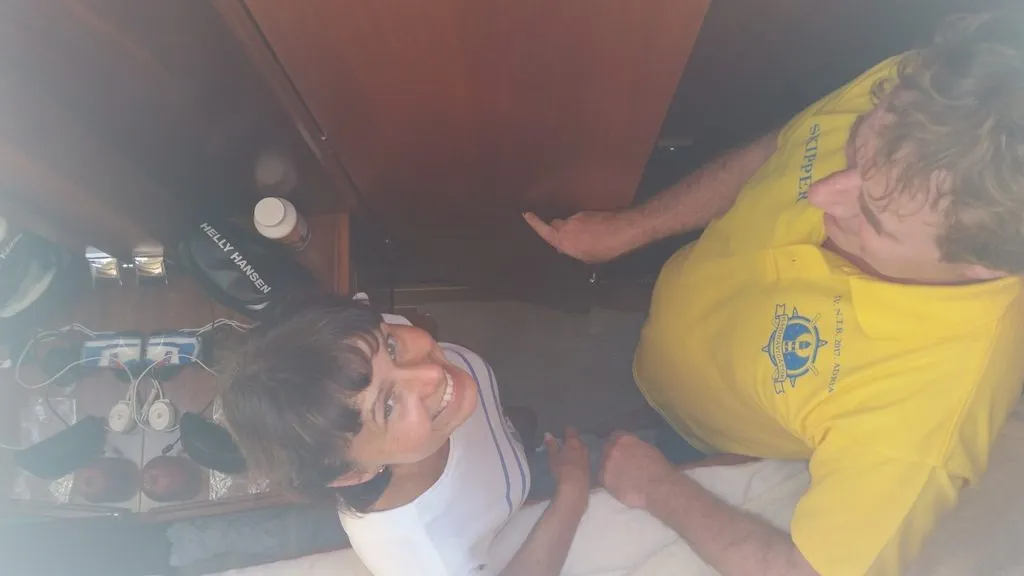
At 17.05 life on board almost came to a standstill. I was down in the cabin tidying up when the desperate news arrived that mutiny had nearly broken out on deck, because the gin-and-tonic ration was late. I quickly remedied the situation, though it did make me wonder what’ll become of this lot on the ocean without me…
We’ve been under way for ten days, and now we went for a swim for the second time on the trip, although there was someone who skipped even this one. I admit this is less newsworthy when I add that all this happened in the Mediterranean.
At 19.01 it was my turn to cry out: Land! Land! I was the first to spot the coast of Spain.
Tonight the graveyard watch is ours. And since the moon sets about 50 minutes later every day, around 23.20 Ricsi and I can once again admire last night’s galley-sinking moonset. The sky is clear and starry; to the north the lights of Cartagena brighten the bottom of the sky, and to the south, across the sea on the African coast, the lights of Oran, 80 miles away.
We’re planning to arrive in Almería at 7 tomorrow morning, and the day after we’ll carry on to Gibraltar.
Machine translation (AI, Claude) of Balázs’s Hungarian original. Read the original →
· Alboran Sea, after Almería
We too landed in Iberia, in the footsteps of the Moors
Thursday, 26 October 2017
Day 11, 114 nm (Log 5521)
Almost exactly as planned, we reached the port of Almería a good hour after daybreak.
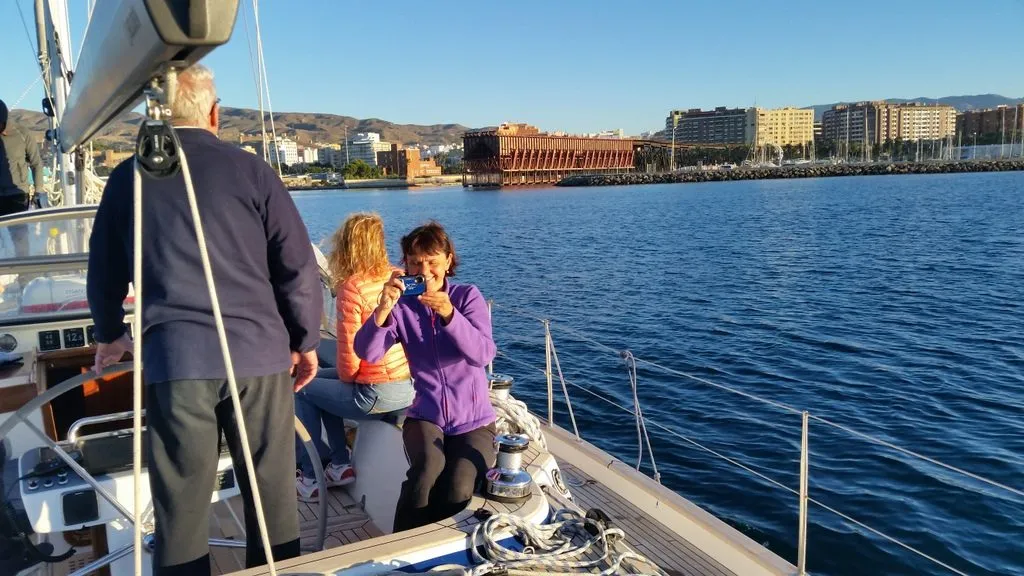
Sailing into the port of Almería
We passed a rusty steel monster (from which, in the old days, bulk goods were tipped from goods wagons down chutes into the bellies of ships) and turned into the marina, where they directed us into its far corner.
The Pinta, moored up
After mooring we went for a nice shore-side shower, where in enclosed spaces the floor (after five days at sea) swayed comically, like in a haunted castle.
While shaving I was surprised to feel that yesterday’s right hook still hurt – and I haven’t even bragged about it to anyone yet. At the beach – you know – kids love to ride inflatable dolphins or sharks and try to stay balanced on them for as long as possible. Yesterday, while we were swimming, the biggest fender, trailing on a line behind the boat, accidentally got caught between my legs. After a long and stubborn struggle I had almost wrestled the villain down and got the upper hand, when it slipped out of the iron grip of my thighs and shot like a rocket towards the surface. The biggest problem is that fender makers and designers don’t think about such dangerous situations, and they cast the ends of fenders out of rock-hard plastic, which catches unsuspecting passers-by on the chin with the force of an iron fist… With its unexpected right hook from below the belt our fender very nearly won by knockout, and all the others would have seen of it is me flying backwards, arms flung wide, thrown by the Coriolis force like a rodeo rider just finishing his round, then groping for the line while feeling my jaw and seeing stars… Naturally, like a brave Indian, I didn’t make a peep (I couldn’t have under water anyway) and just spluttered once I got back to the surface. So, it’s a tough sport, this sailing, no joke at all…
Luckily my teeth survived the almighty shock, although I still have to chew my tapas gingerly. Because that’s what lunch was.
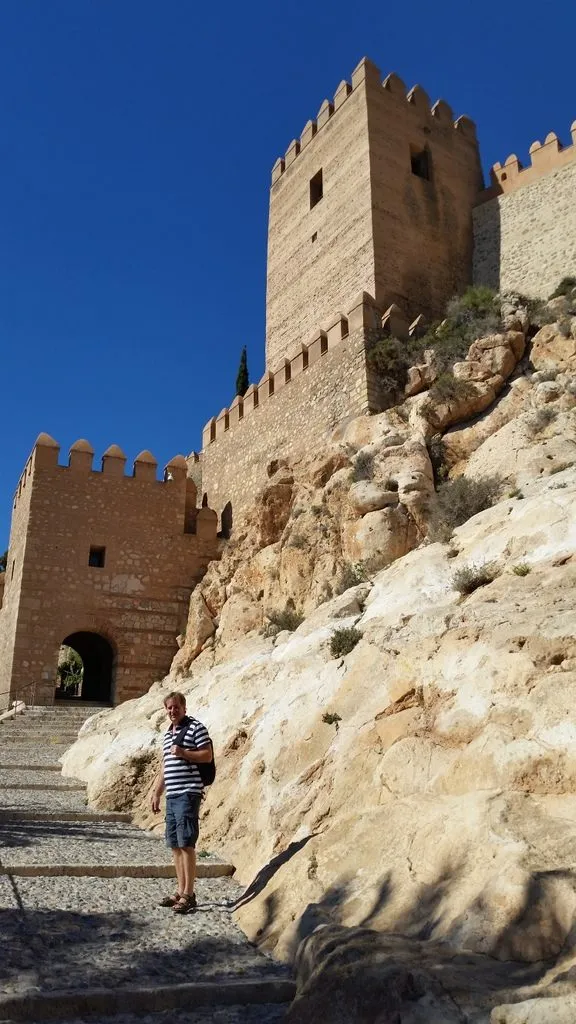
We looked for an American-style launderette on shore, because there is a washing machine on the boat, but either it hasn’t been commissioned yet, or it’s like the cupboard in the fairy tale where the lord of the castle tells the youngest tailor’s apprentice that he may look and go everywhere, only not in there, because I don’t even know what happens then. Actually nobody said anything of the sort, but luckily the launderette wasn’t far (10 kg of washing €4 + €2 for drying, detergent inclusive), and while we waited we got thoroughly plastered with tapas. On the way back to the boat we did some shopping, then dashed off to see a Moorish castle. We didn’t see any proper old town as such, not even near the fortress-like cathedral, whose only gate was being renovated, and we couldn’t find the others, however many times we walked round it, like the Israelites round the walls of Jericho.
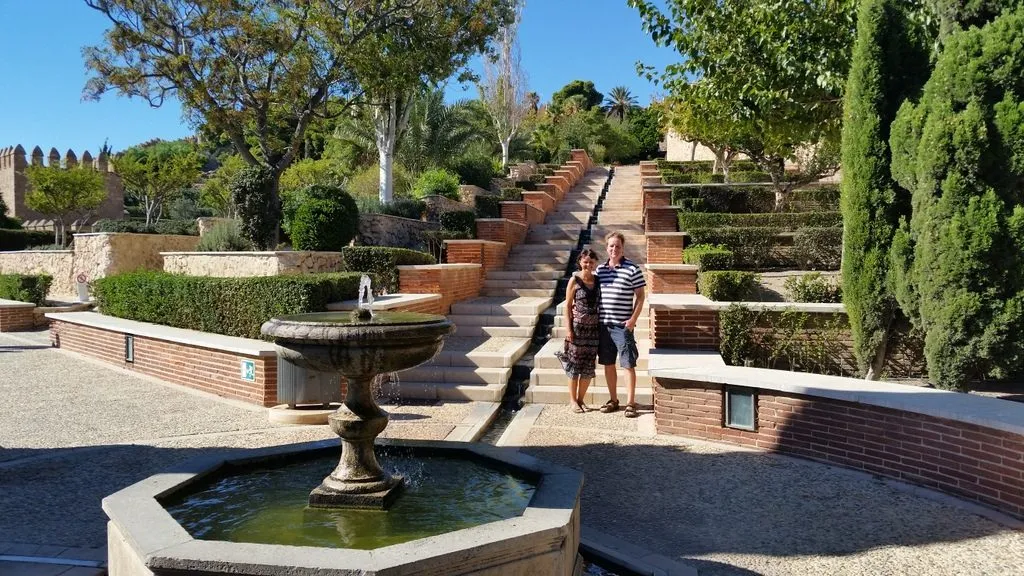
Up in the castle it turned out that the Moors knew how to live too. Of course they did, they’re southerners as well. After the third wall and gate a charming green oasis opened up before our eyes, with little fountains and babbling water features. From down in the town, below the walls, you can’t see any of this.
Taking the Moors’ fortressA green oasis on the barren hill, with charming water features and fountains
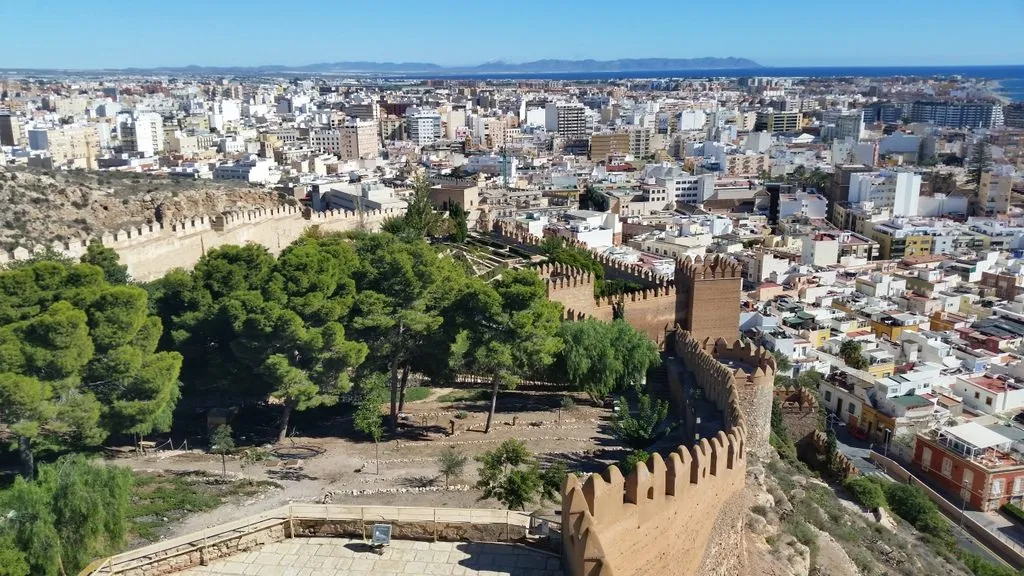
The panorama this time is forgettable: barren mountains on the landward side, a nondescript sea of flat-roofed houses down to the port, and from there a sea of water as far as the eye can see, plus a ferry terminal and warehouses.
We trotted back to the boat at a brisk jog, because if we sail out by about three, we don’t have to pay.
Not because the office is closed – some might think – but because the young lady at reception, like a true lady, suggested it.
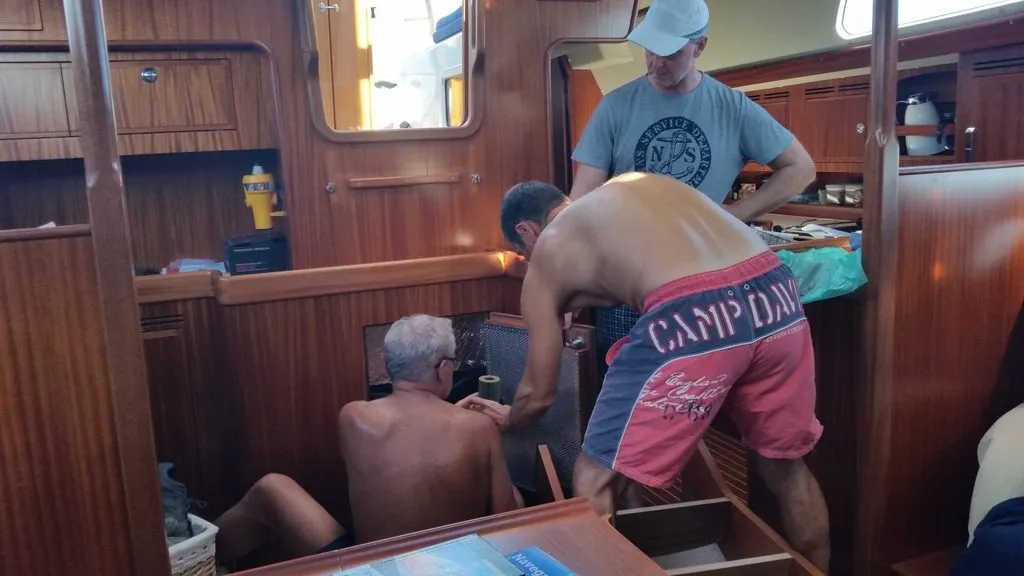
While we were out, Gyuri washed all the accumulated salt off the boat and changed the engine’s oil filter. The new seal looked completely different from the old one, and it dripped too. A good few phone calls and photo exchanges with Pala, the man who prepared the boat, and on his advice we greased the sealing ring a little, and it worked… No more dripping…
Oil filter de-dripping
Contrary to yesterday’s plan, we’re not sleeping here in Almería; instead at 15.45 we set off for Gibraltar, so that we can get there before tomorrow evening and have a bit more time left to see the Gibraltar apes. Now, I definitely didn’t mean the English here.
Machine translation (AI, Claude) of Balázs’s Hungarian original. Read the original →
· Gibraltar
Heading for the Pillars of Hercules across the Alboran Sea
Friday, 27 October 2017
Day 12, 151 nm (Log 5672)
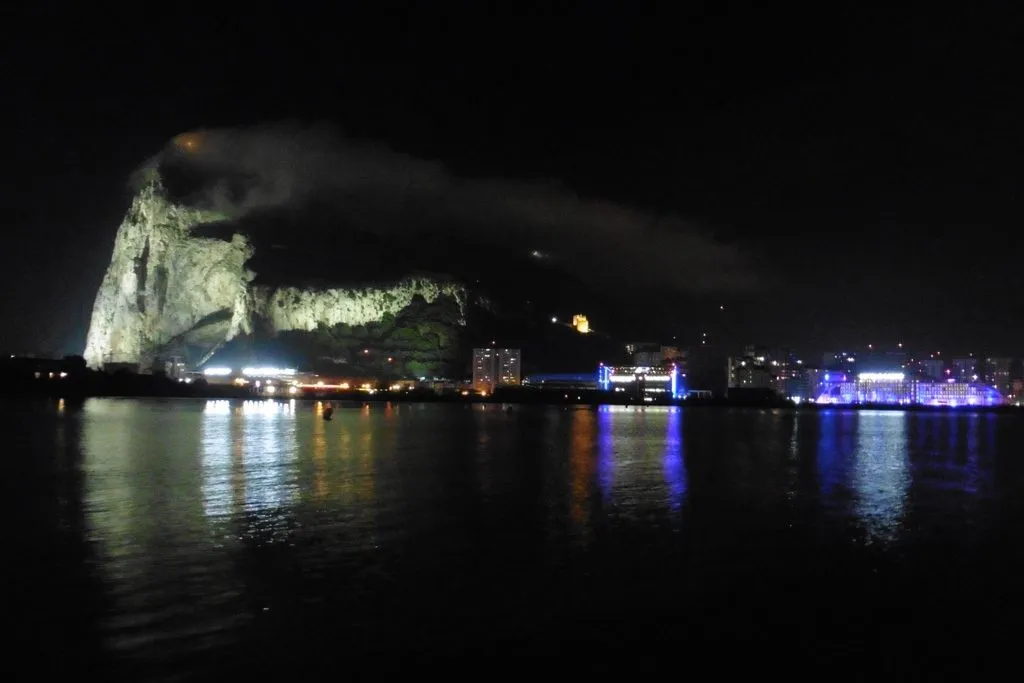
The dolphin show starts again. In the background “the” Rock is already faintly visible
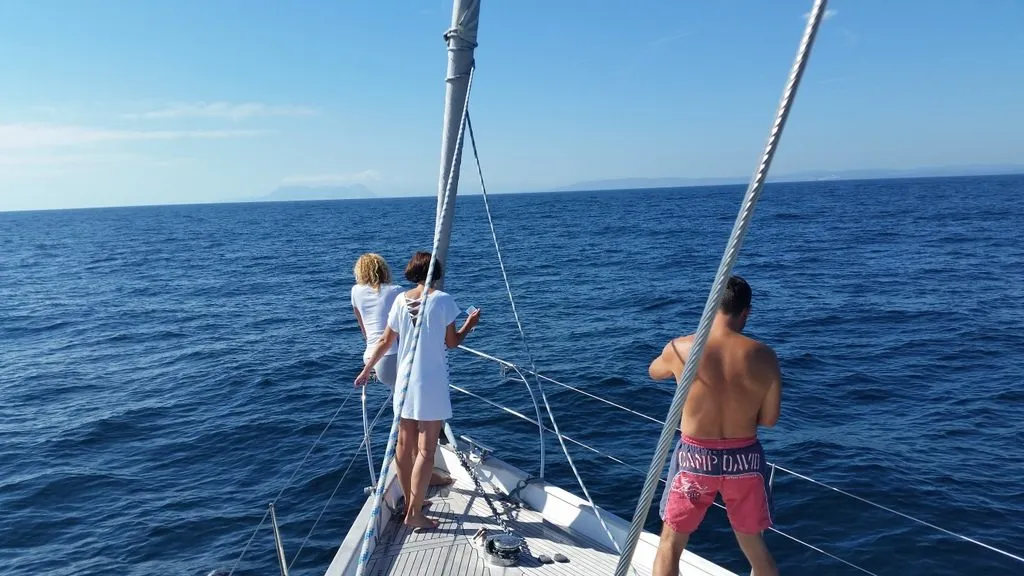
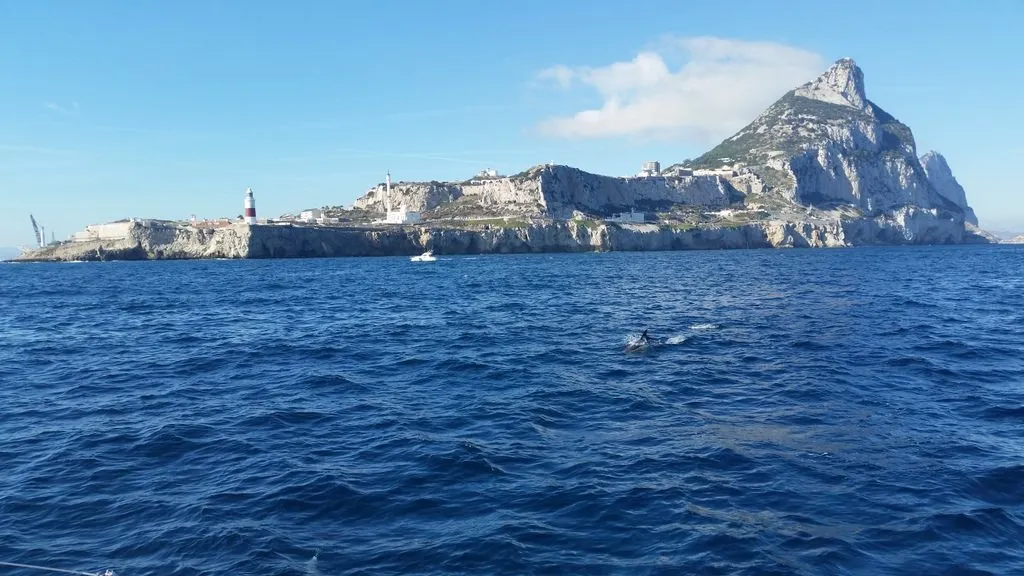
During our pre-dawn watch dolphins joined us in the darkness. At least 8 dolphins darted and frolicked in front of our bow, in the red and green glow of our navigation lights. We couldn’t count them exactly, because they’d obviously never heard of how to line up properly like in a PE lesson. At one point six of them shot out from under the boat at once, in a single line, and blasted off forwards at high speed. Their outlines glowed wonderfully fluorescent in the water as they swished past us under the bow. Andi and I stood in the bow clipped on with our safety harnesses for a good half hour, admiring the nocturnal nature show. My wife went back for another half hour of watching – at times like this, of course, she doesn’t feel the cold… I think it was the coloured navigation lights, she thinks it was the boat being slowed by the one-and-a-half-knot counter-current that drew the dolphins to us. Or both together. Or neither, and we were just in the right place at the right time…
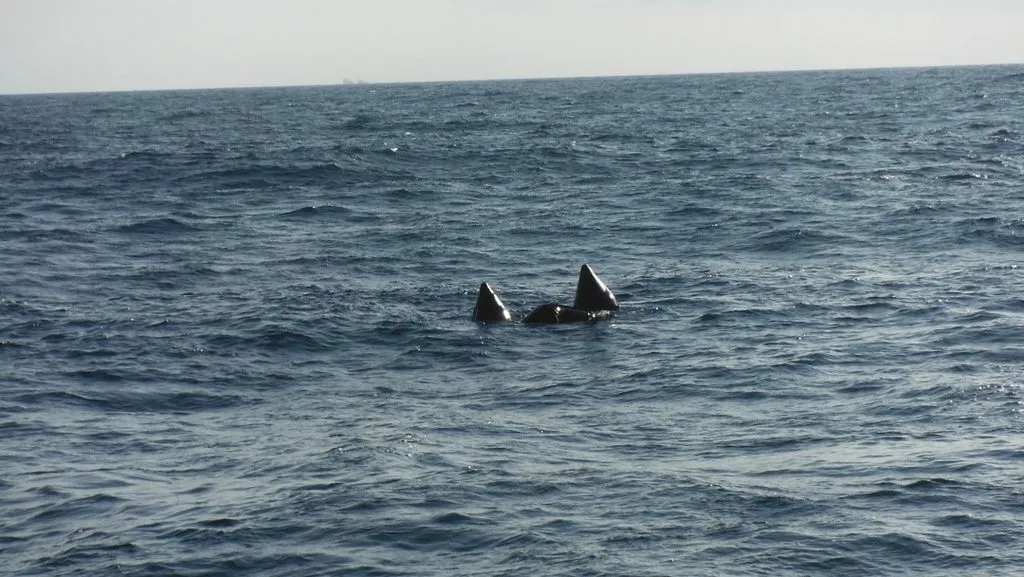
Around 10 in the morning Szabi spotted two little black horns sticking out of the water. To rule out that they were the devil’s horns, we turned towards them.
Is this the devil himself? Or Batman surfacing? No wonder our seafaring forebears were superstitious
It was the black end of a half-deflated, collapsed dinghy sticking out of the waves, with no engine and no corpse. Since none of us has any use for it – we can’t take it home on the plane, and there’s not enough room on the boat – we leave it there and carry on. We hope it wasn’t the chilling end of some migrants’ journey, though I’ve no better idea in these parts.
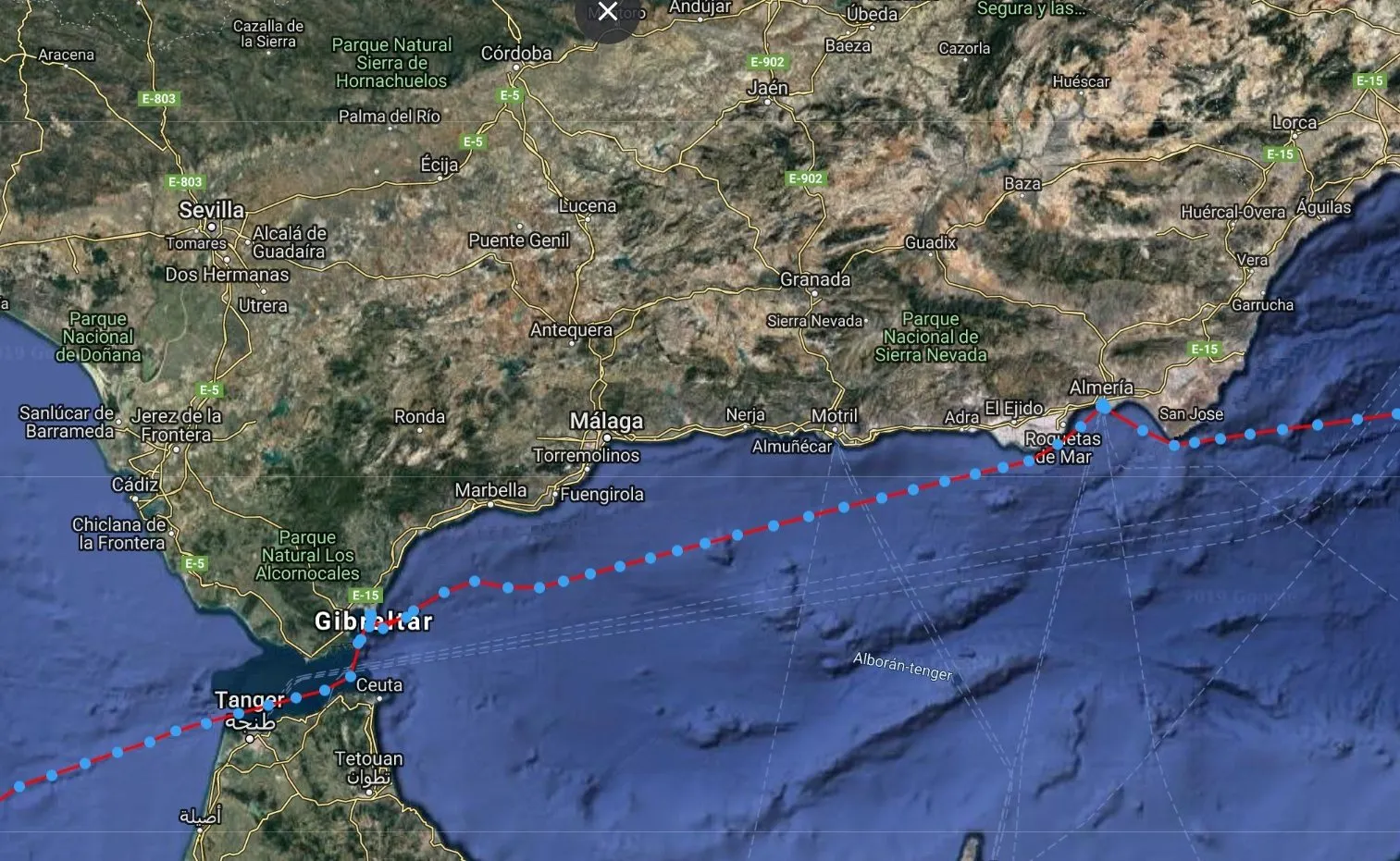
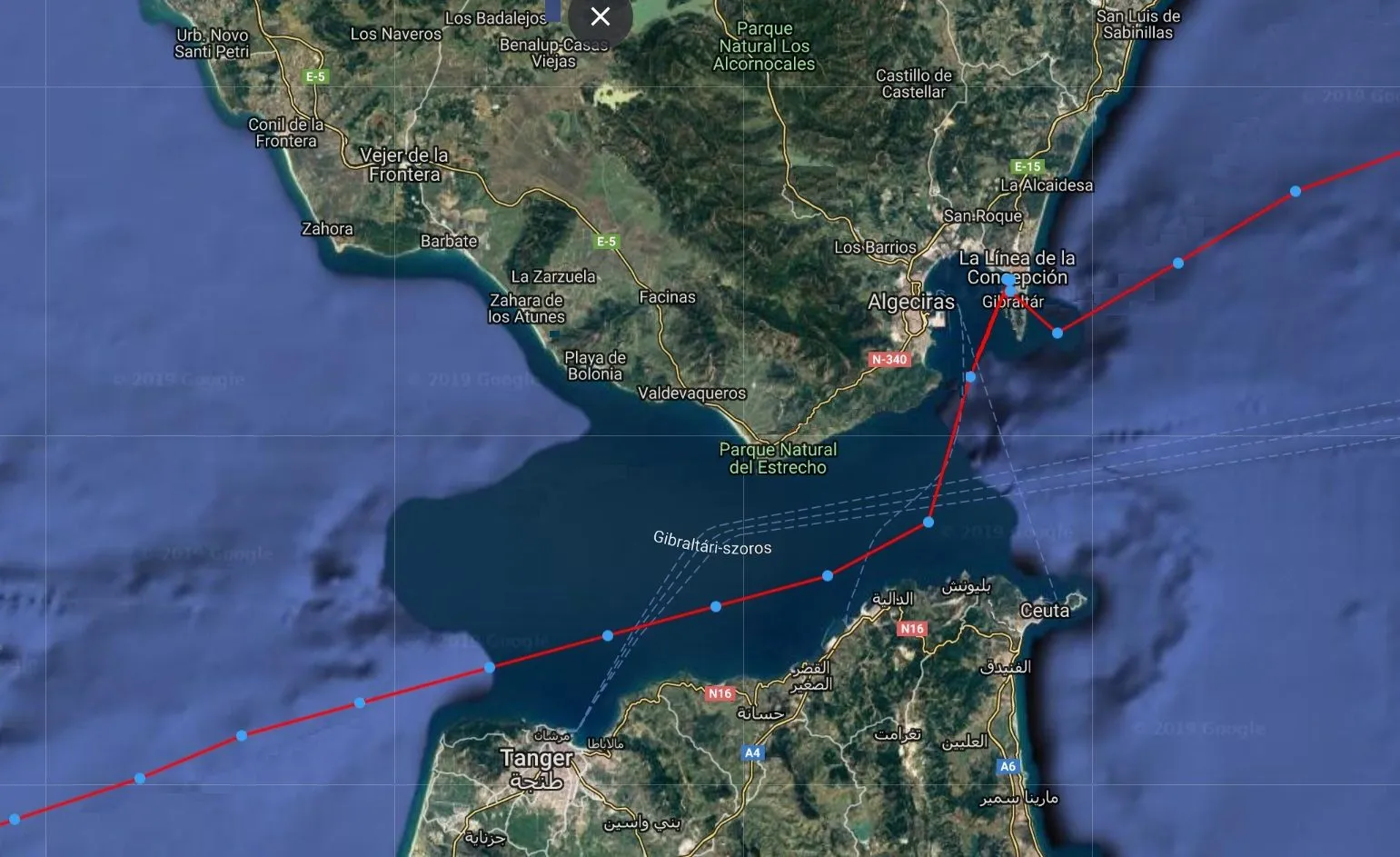
From Almería to Gibraltar across the Alboran Sea
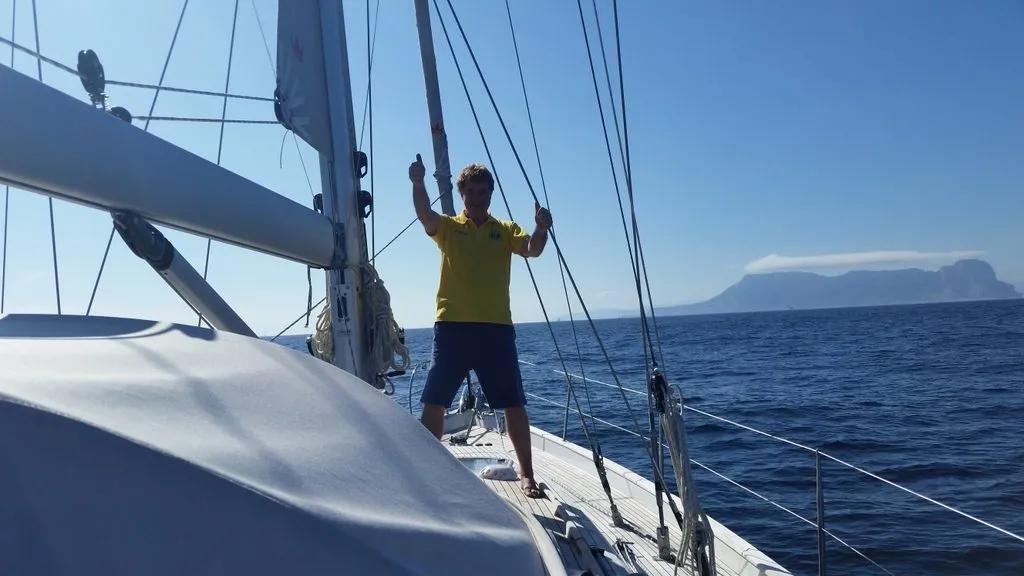
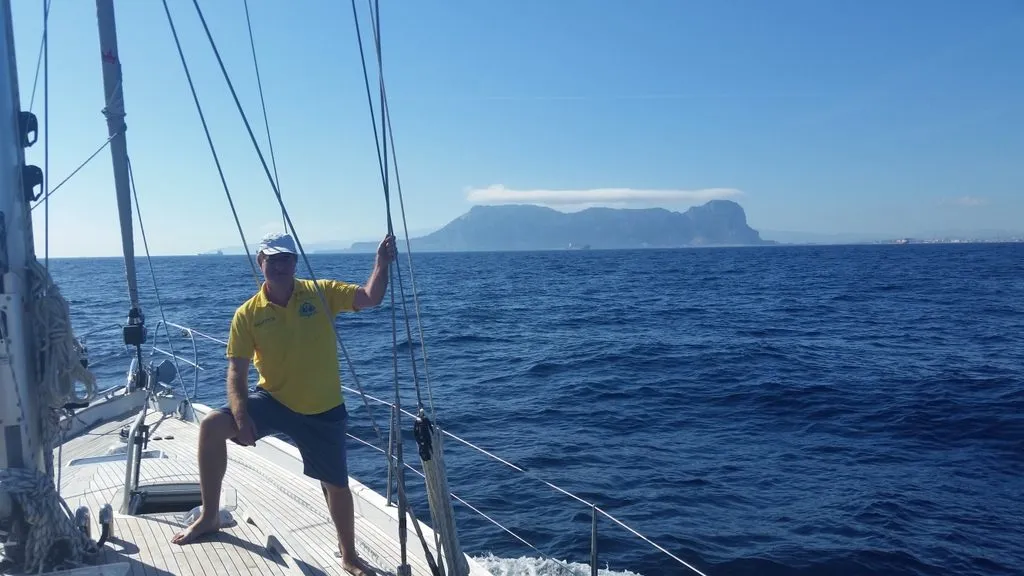
Today, for the first time on our trip, we see other sailing boats at sea, four of them at once, all heading west. At 13.00 “The Rock”, Gibraltar, appeared for the first time out of the haze, with a little puff of cloud on top. Half an hour later I appeared too, out of our cabin, where I’d been snoozing from 10 till 13.30.
One item on the bucket list ticked off: arriving in Gibraltar on a sailing boat and sailing on from thereThe Pillars of Hercules. One of them in a yellow T-shirt, but both with white caps
We rounded Gibraltar from the south at Europa Point, where the tower of a graceful minaret soars into the sky. What do you reckon the message is of a mosque standing at a place called Europa Point, at one of the gates of the Union? Or is it just a coincidence, and this is simply the spot as far away from the town as you can get? Or perhaps this one, or its predecessor, was built by the Moors, and regardless of that it’s perfectly normal for believers to want to build a house of prayer for themselves. You can look it up on the internet, and I’ll do so too.
The Muslims have retaken the gate of Europe, even the dolphins are fleeing. A mosque adorns Europa Point.
Just a coincidence?
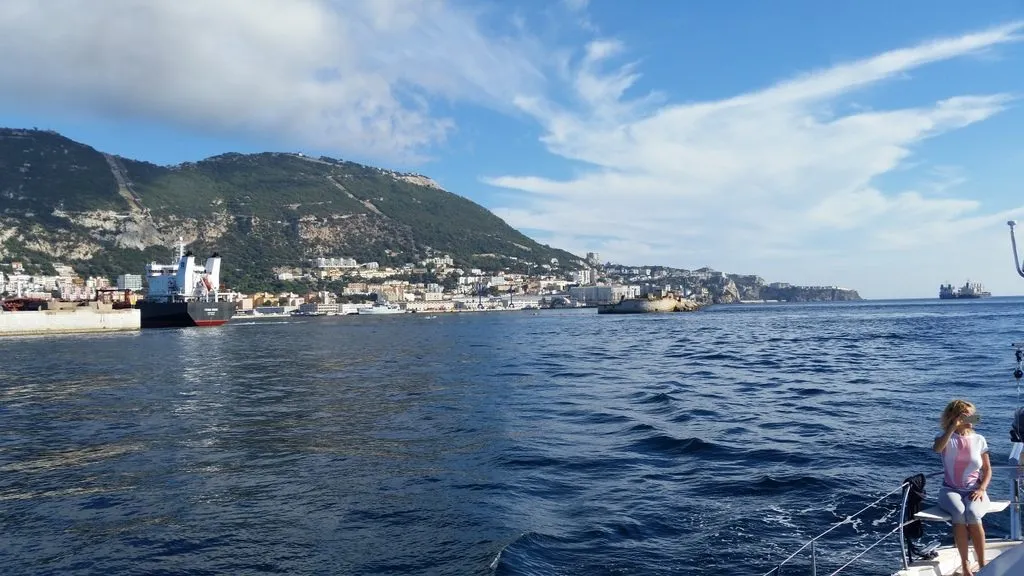
We don’t “fit” into the English marinas… We sail past them
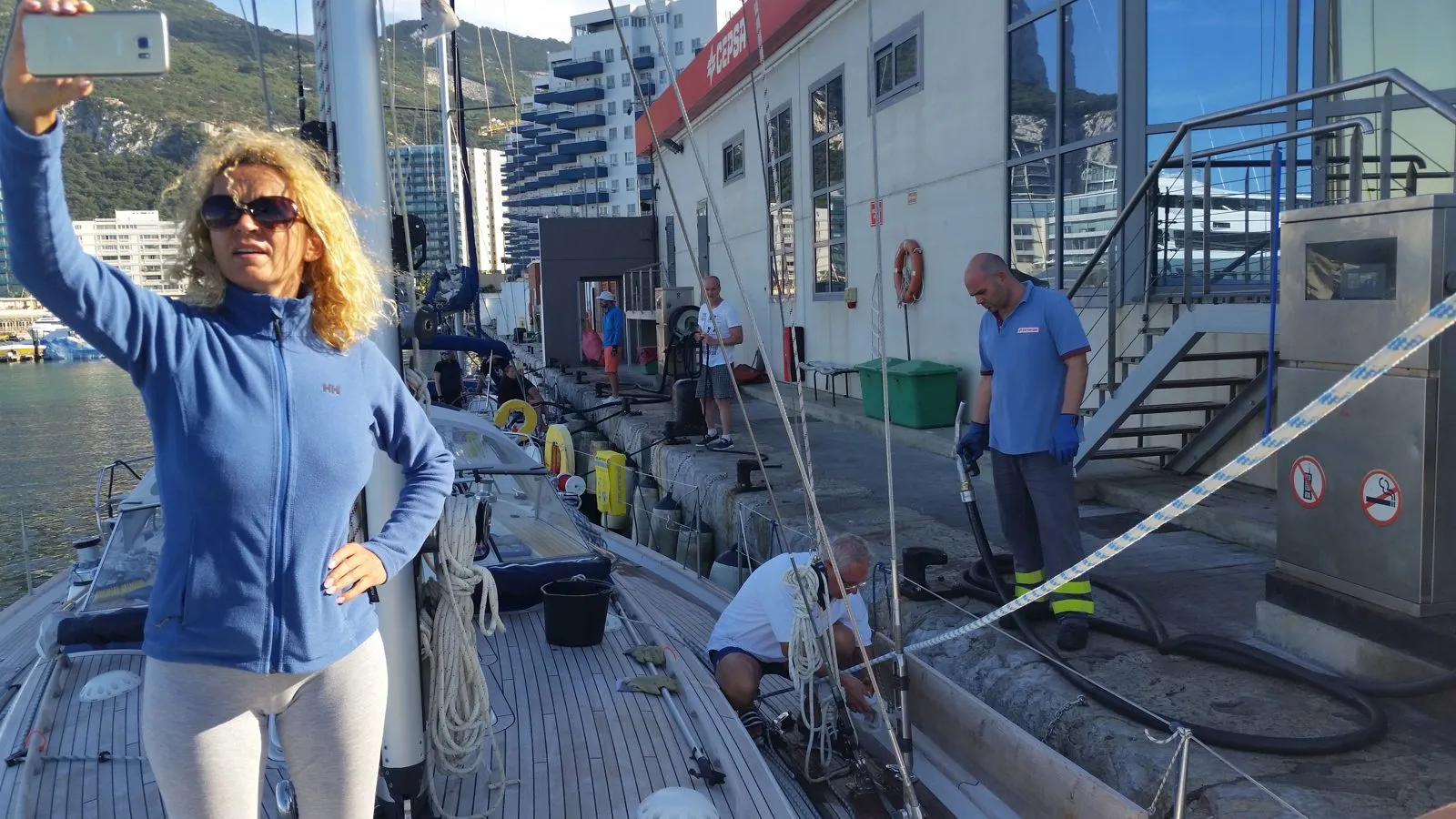
At half past five we tied up in Gibraltar at one of the three fuel berths next to the airport runway, near Ocean Village. In Gibraltar you can buy duty-free fuel for boats; for the 615 litres of diesel we took on we paid 324 euros, which worked out at 0.53 euros, i.e. 162 forints, a litre. If your route ever leads this way by boat, plan to arrive here with as empty a tank as possible (keeping safety in mind).
We asked both English marinas on the radio whether they could take us for one night, but they said sorry, our boat won’t fit. I reckon my teeny-weeny Hungarian accent weighed more in the balance than the Pinta’s length…
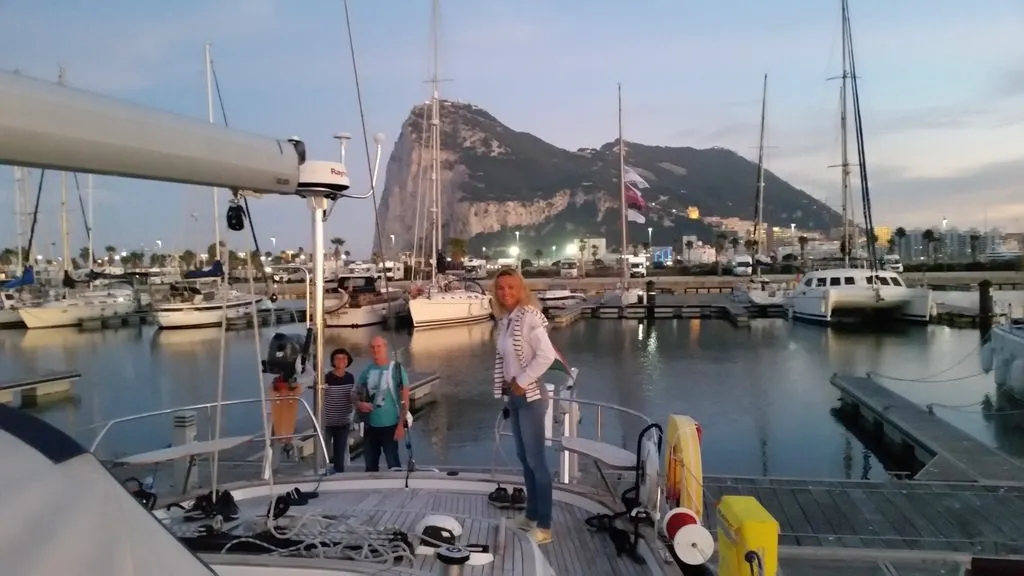
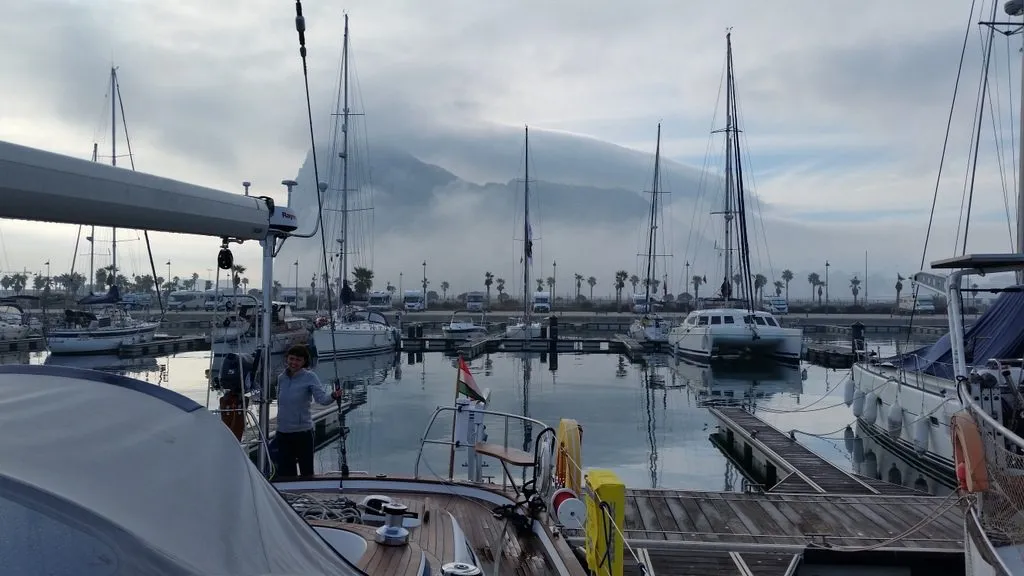
Never mind, we motored across to the other side of the runway, to the recently built Alcaidesa Marina on the Spanish side, where they welcomed us with open arms for one day at €35.47. There are laundry facilities here too.
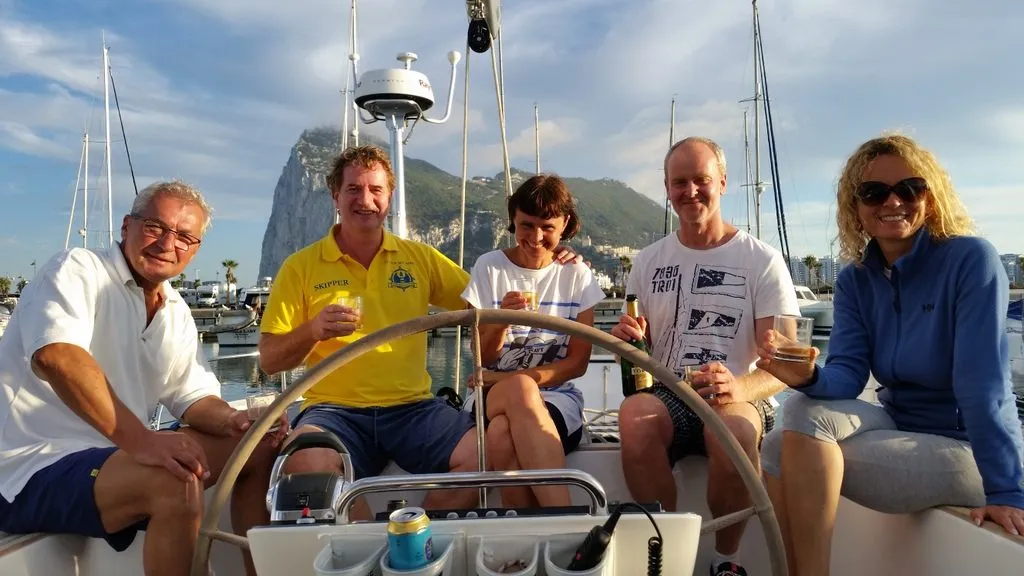
We moored up and popped the champagne: at last I’d made it to Gibraltar on a sailing boat.
Gibraltar, champagne, moored up
We spruced ourselves up and in the evening walked across the border into British territory to have a good dinner and a few beers.
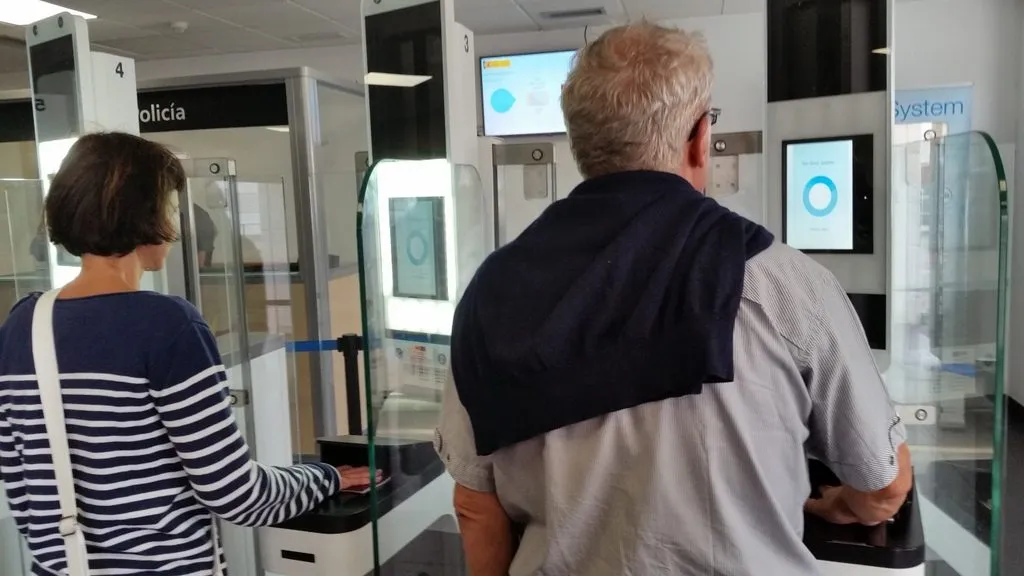
At the border crossing, passports were checked by an entry system a bit more modern than the Italian one, here too without any human intervention. You stepped up to a barrier machine like the ones at motorway service-station toilets, put the photo page of your passport on the scanner, it read it, then took a photo of you to compare with the ID photo in the passport. It buzzed to itself a little longer, and then greeted us on our entry into British territory with nothing more than: “Take your passport!” Well, even our car-park barriers are more polite than that…
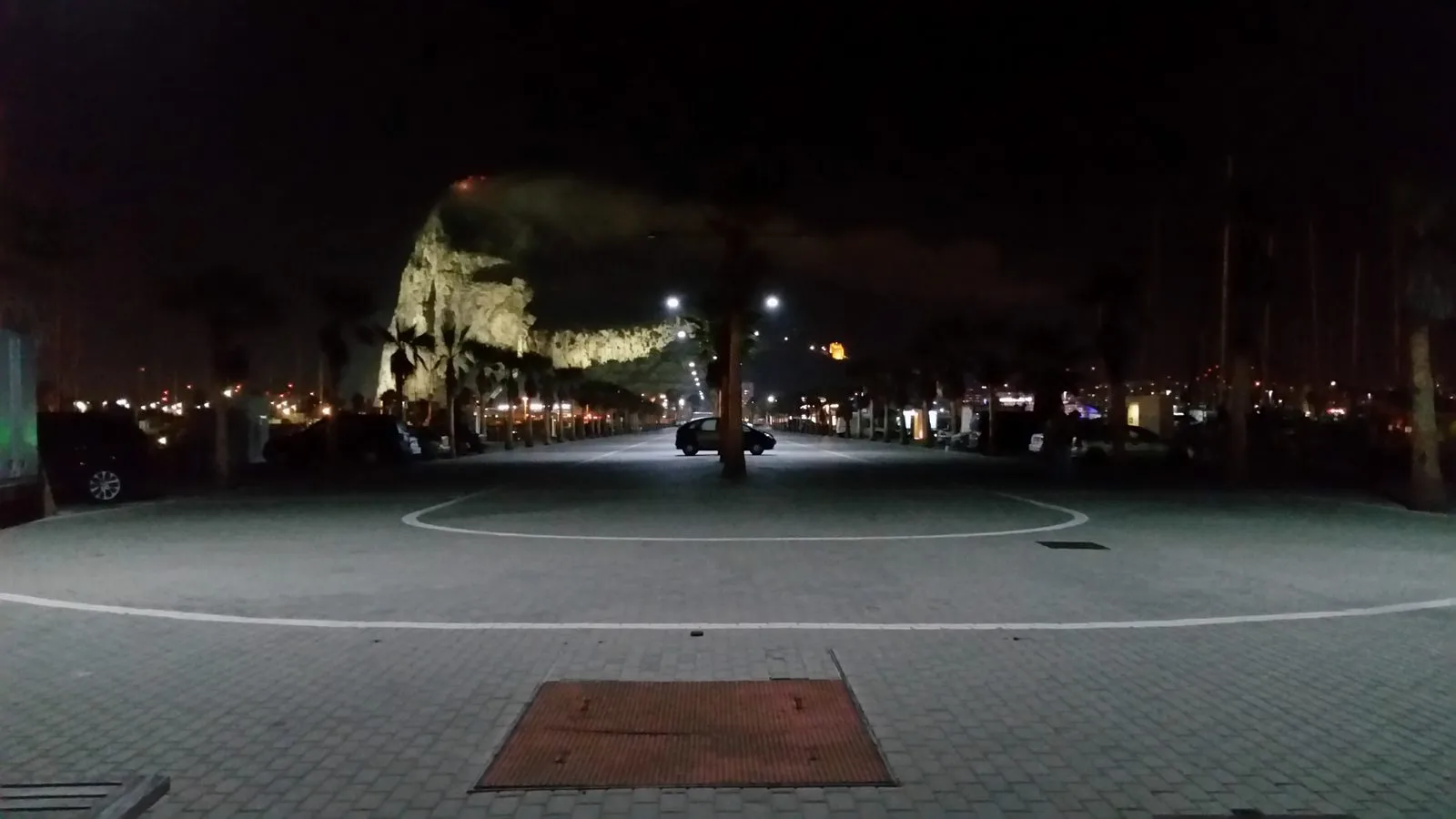
On Gibraltar’s main square we had some good beers on the terrace of a wine bar and ate some very tasty fish. On our return to the Spanish side, however, we learned that you’re not allowed to cut straight across the roundabout, not even on foot, and not even at night. And yet the space between the palm trees was strewn with such inviting white gravel that it couldn’t possibly count as vandalising the park. We looked around, not a soul (i.e. policeman) anywhere, set off, and before we’d got even halfway a police 4x4 was already honking behind us and they were shouting after us. We waved back that everything was OK, now straight on was the shortest way out (like the rabbit in the riddle: once you’re halfway into the wood, you’re running out of it), and said goodbye. They thought we hadn’t quite understood them, because they got to the other side before we did and were already waiting for us there. Well, back home this sort of thing doesn’t usually end well, I thought… In a somewhat raised voice they explained it again and showed us that there was a pavement all the way round for pedestrians, which by now we’d noticed too: Ahh, oh, yes, yes, so there is! I sorry-ed profusely for having overlooked that pavement like that, then we waved that everything was still OK, and let them go on their way… The FORCE was with us. They were decent about it, though.
After seven nights on the seven seas, we slept like logs, moored in a harbour once again.
Machine translation (AI, Claude) of Balázs’s Hungarian original. Read the original →
· Gibraltar
A day in Gibraltar, with the apes…
Saturday, 28 October 2017
Day 13 (Log 5671)
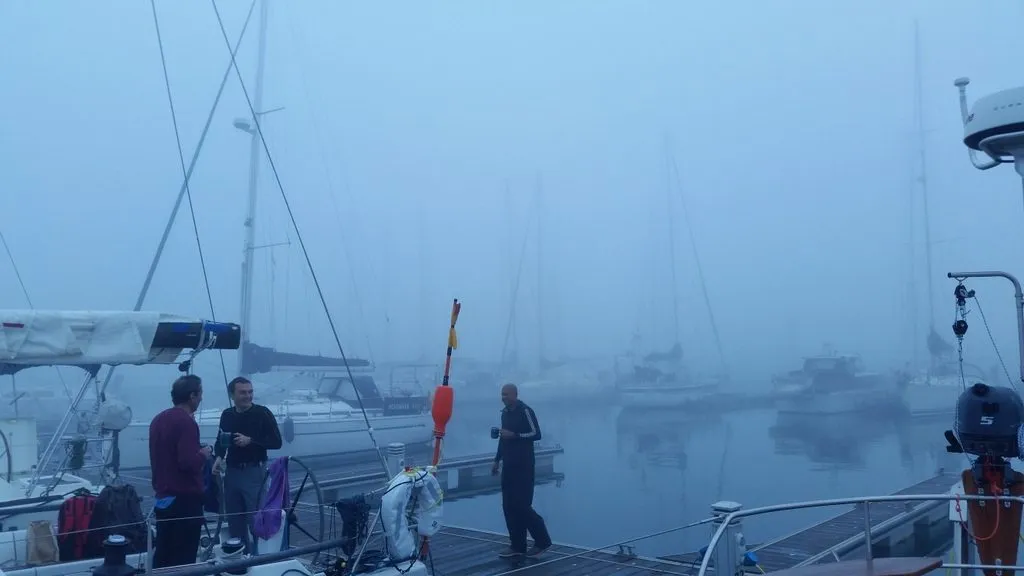
In the morning, when I looked out of our boat, I couldn’t believe my eyes. What’s this? Where’s my Rock gone??? With the fog we could barely see 50 metres. How on earth will there be a view from the lookout on top of the Rock???
Gibraltar by Fog…
If one more hidalgo tells me – like the snail-eaters next door – not to worry, because the Spanish rocks are just as pretty as the English one, I’ll sock him one…
In the morning a hitchhiking girl went round the boats on our pontoon asking who’d take her to the Canaries. Sadly I have to disappoint a few soppy – I mean, drooling – readers: once again I took no photo of the applicant, even though from a distance, in the fog, she didn’t look bad at all. Luckily the fog slowly lifted and we could set off on our walking tour to explore Gibraltar.
And then, slowly, the white smoke begins to rise…
We jogged over to the border crossing, I put my passport in the right place, the machine buzzed, hummed, took a photo, and then nothing. Finally it told me to insert a different passport. Very funny… At first I thought I hadn’t smiled sincerely enough, then that it was because yesterday I’d been wearing my striped jumper and today I’d come in navy blue, so it didn’t recognise me, and finally I noticed that this time, instead of the photo page, I’d put the inside of the cover on the scanner. I had to admit that this time the machine was right, because I don’t think even my own mother would have recognised me from the Chain Bridge (the Budapest landmark printed inside the Hungarian passport)…
The Spanish exit and entry system
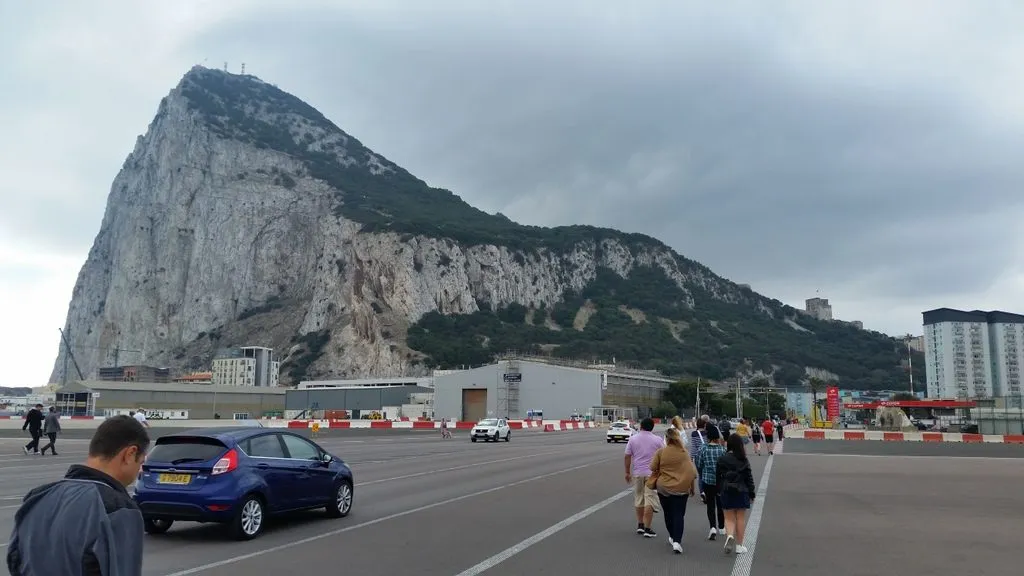
Then, with the right page in, the gate of the booth flew open and I too could sprint across into British territory. At the airport a green traffic light told pedestrians as well that we could stroll across the runway. As if you were just crossing the Grand Boulevard back home, and even if you’ve heard about it before, trudging across in person where a plane might land a few minutes later is a strange feeling… Especially when the bells start clanging behind you and they lower the barrier, and you’re craning your neck wondering which direction the intercity is coming in from, low… Luckily there are only 3–4 flights a day, so your chances of survival are pretty good, about 1 in 10,000… (I’ve just had that checked by our on-board mathematician…)
Walking across the runway at Gibraltar airport
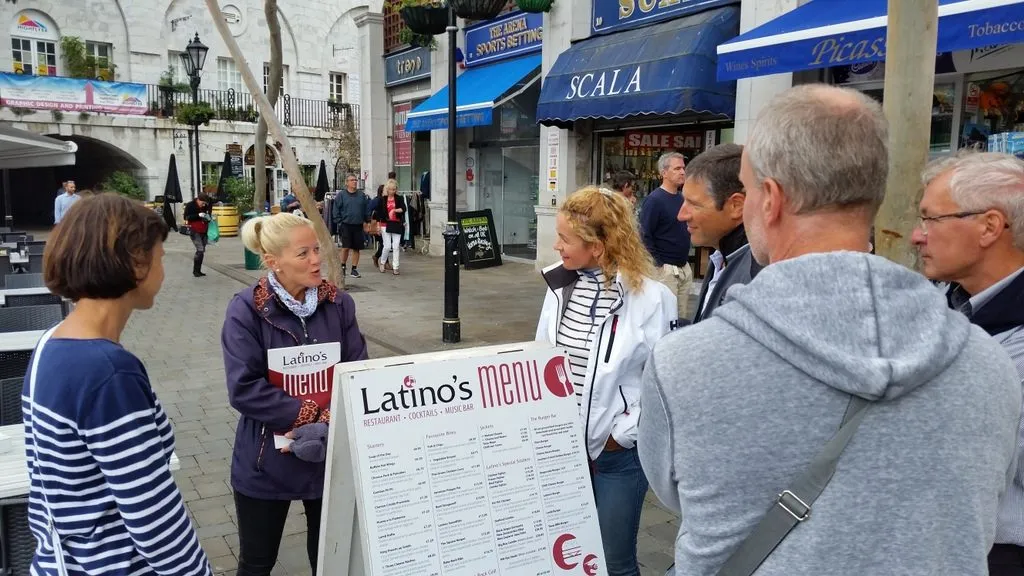
Through the tunnel in the city wall we reached the main square, and a daughter of our homeland – the girl touting for customers – standing outside the terrace of one of the restaurants, stopped us and very kindly told us lots of useful information and tips about Gibraltar. She encouraged us by saying that at this time of year, around 3–4 in the afternoon, the sky above the Rock usually clears, and that’s when it’s worth going up on the cable car.
A daughter of our homeland wises us up
From here everyone set off on their own voyage of discovery, but first we agreed who’d buy what to restock the boat. Ricsi’s route led first to a pharmacy to get something for his sore throat, and then we wandered on together.
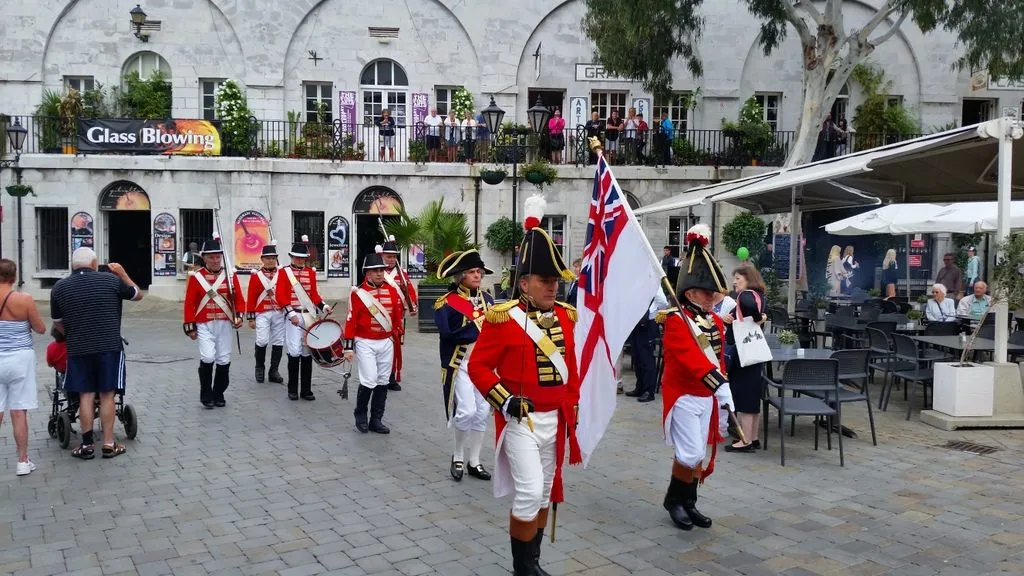
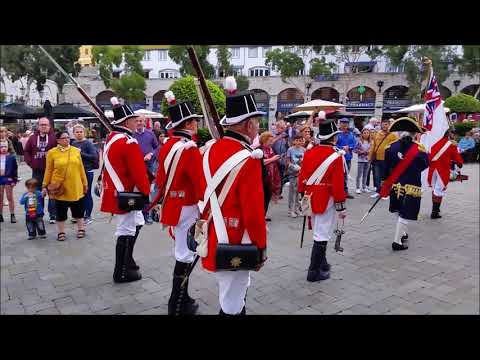
Changing of the guard. Judging by their age, I reckon they were the ones who took Gibraltar back in the day
A return ticket for the cable car up the Rock cost 14.5 pounds, one way 12. I found a taxi driver offering a round trip (not hard, since there are one or two on almost every square next to the advertising posters) who’d take us round Gibraltar’s main sights for 30 euros a head – entrance tickets inclusive – if we just brought one more person. Are these guys Fidesz too? (Hungary’s governing party, famous for always wanting you to bring one more.) I’m not basically a fan of this kind of sightseeing, but here and now it seemed ideal both in price and time. I talked Szabi and co. round over the phone, persuading them that this was in fact exactly what they longed for, they just didn’t know it yet, so our little gang met up again in the botanical garden, except for Gyuri. He wanted to go back to the boat in the afternoon to tidy up, clean, etc. This is beginning to sound as if the rest of us never clean, but that’s not true, Gyuri is simply quicker and always beats us to it…
We sat down in a pizzeria to kill time till three with a bite to eat, because it was becoming more and more clear that what the daughter of our homeland had said wasn’t hot air: the air kept clearing and we could see higher and higher up the Rock. I agreed with the taxi driver, William, that instead of the ruined Moorish castle we’d rather see the tunnel system drilled into the mountainside, from which the English defended the Rock with cannon. He found a Spanish couple to join us so the ride would be full; we’d have liked to drag things out a bit longer – so the top of the Rock could clear a bit more (no, not of tourists) – but then William said we’d better hurry, because the ticket office closes at four.
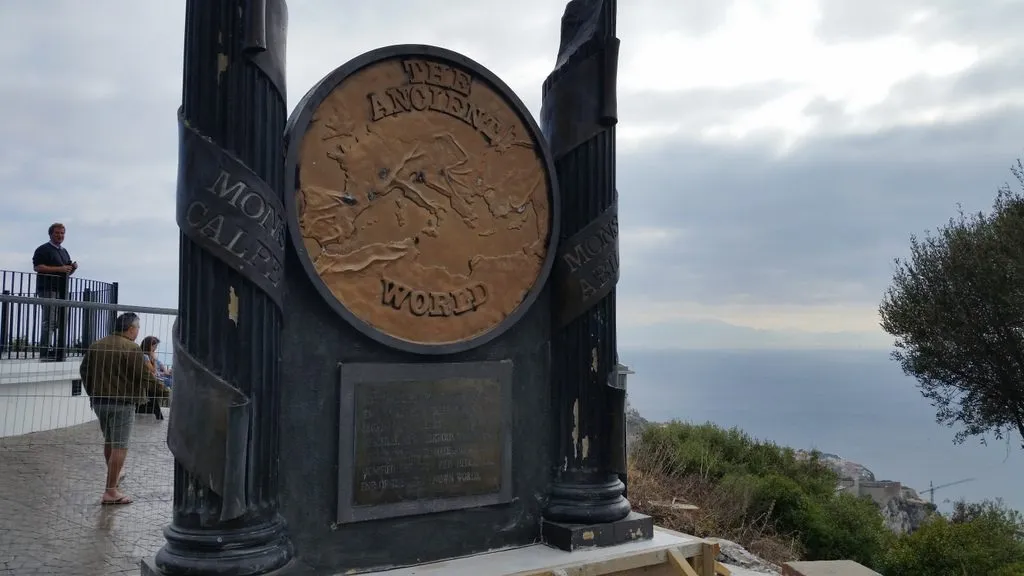
So we got into the Opel minibus and set off up and up the hairpins to the south side of the Rock, above Europa Point, where there’s a nice view, plus the ticket office for the nature reserve, and while they were at it they put up a little statue with the Pillars of Hercules too. The statue is utterly forgettable, artistic value 0.2, but this may be the place in all of Gibraltar with the best exchange rate for the euro. The telescopes work with either a pound or a euro. Let’s move on.
The Pillars of Hercules with the world as it was known then
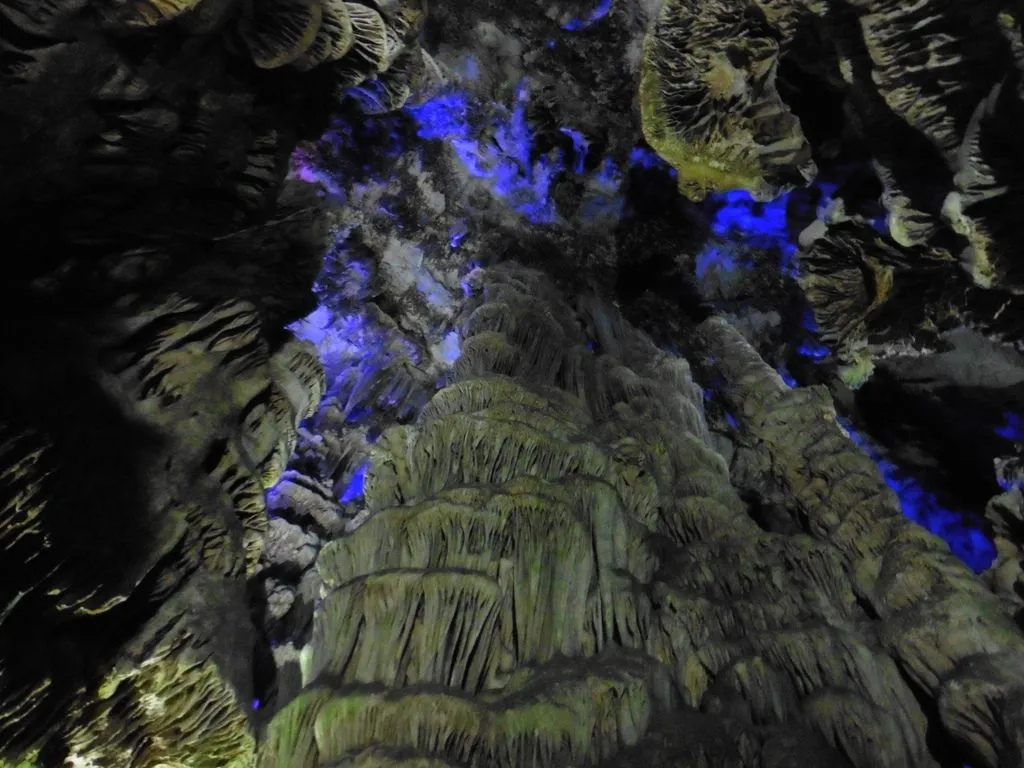
The next stop was St Michael’s Cave, for which we got 15–20 minutes. I can say that this one, on the other hand, exceeded all our expectations. A big concert cave at the start, atmospheric music to match, and a coloured light show synchronised with the beat. It’s not small either, well laid out, simply very beautiful! I recommend it to everyone. Since we spent a good 25 minutes here, William hurried us along, because between 4 and 5 the apes’ working day ends and they go home – and he clearly wasn’t joking, he meant the four-legged ones. I only thought of them second.
In St Michael’s Cave
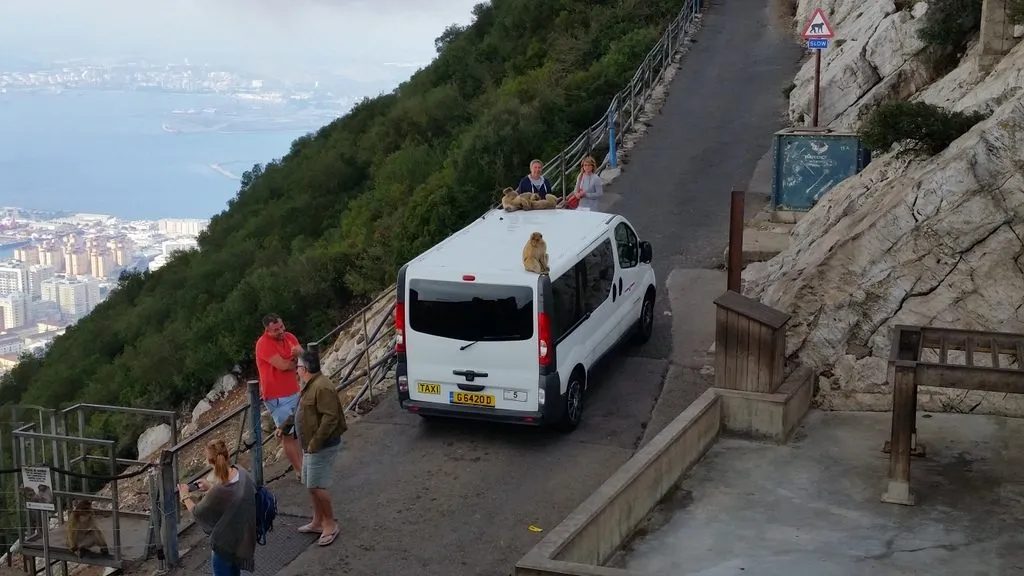
The next stop was on the ridge. There’s not even a car park here, the minibuses simply stop one after another (only these are allowed up this far). We got out and sure enough, a few apes were already starting to climb down the rocks. I can’t stress enough that this time too I mean the hairy apes. The ones with tails. Damn, that’s still open to misunderstanding – so, not the English…
Stopping on the ridge. Apes on the roof of our minibus, and William in a red T-shirtWhy won’t this kid listen???
The clouds coming from the east tumble over the ridge
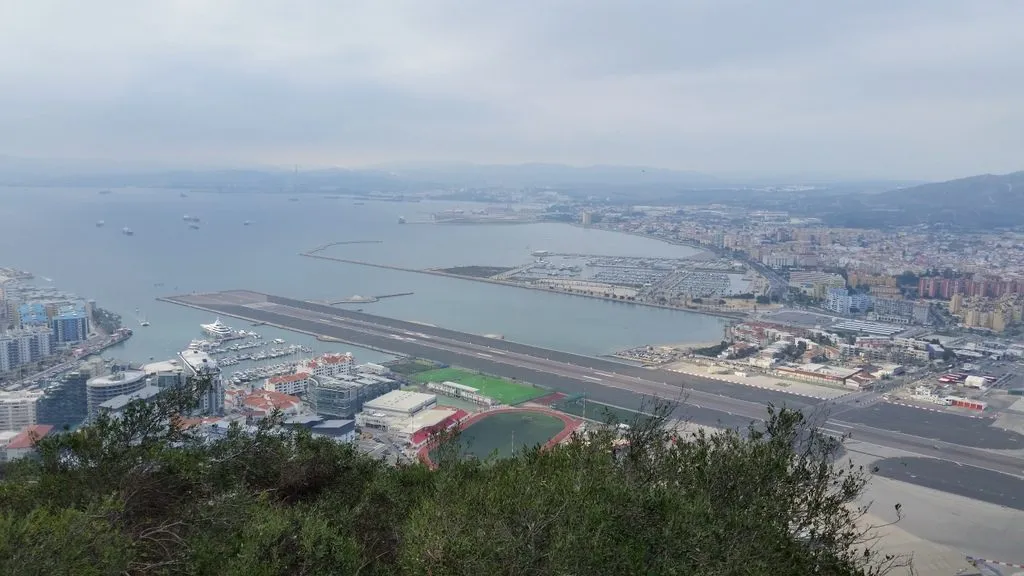
The view was very beautiful, you could clearly see how the clouds driven by the easterly wind are forced to rise above the ridge and then tumble over to the other side. Before long they were honking behind us, we got back in and went to the last scheduled stop, the entrance to the cannon tunnels. This is on the north side of the Rock, facing the isthmus that connects Gibraltar with the mainland, with Spain, where the English also built the airport.
Gibraltar airport. Bottom left is the Ocean Village district where we refuelled, and across the runway is Alcaidesa Marina, where our boat is moored
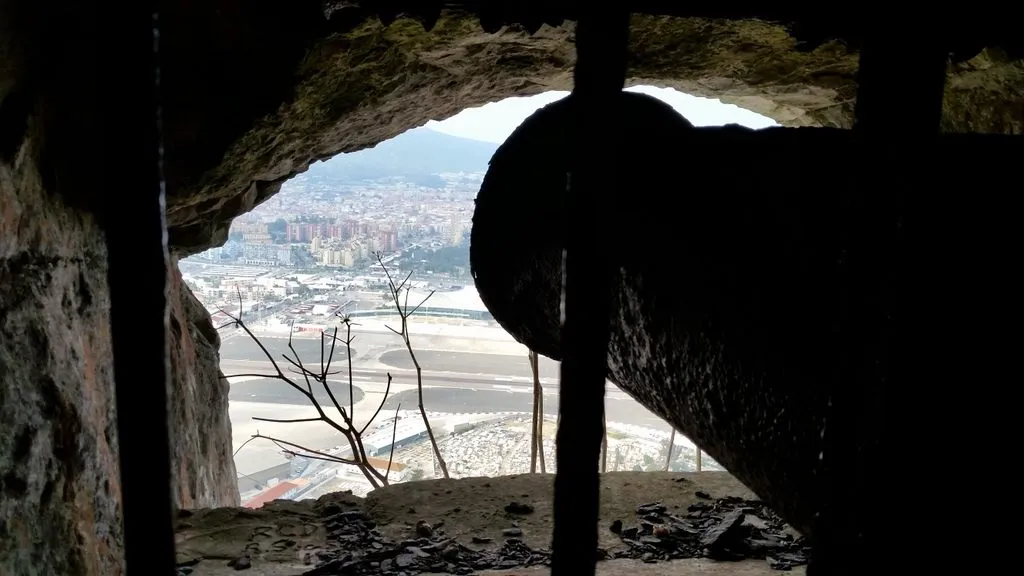
The tunnel is good and long, winding, and goes up and down (it took us about 8 minutes at a steady pace to get back to the entrance). Gun emplacements one after another with good views, mannequins in period uniforms, and on the walls information panels and paintings of the battles. The English took Gibraltar at the beginning of the seventeen-hundreds – if I remember rightly – and turned it into a fortress so impregnable with the military technology of the day that every Spanish attempt to retake it failed. Of course, this also required the British, as a naval superpower, to be able to keep it supplied continuously.
This is what Gibraltar’s defenders saw
The Spanish still demand Gibraltar back to this day, but they have about as much chance of that as the opposition has of setting up a committee of inquiry in the Hungarian parliament today. Besides, the Spanish have also grabbed a bridgehead – Ceuta – in Africa, on the other side of the Strait of Gibraltar, and they have plenty of headaches over how to protect it from illegal immigrants. Interestingly, the EU back then helped finance the building of the 6-metre-high fences, several rows deep – “soros” in Hungarian, George Soros, if you catch my drift.
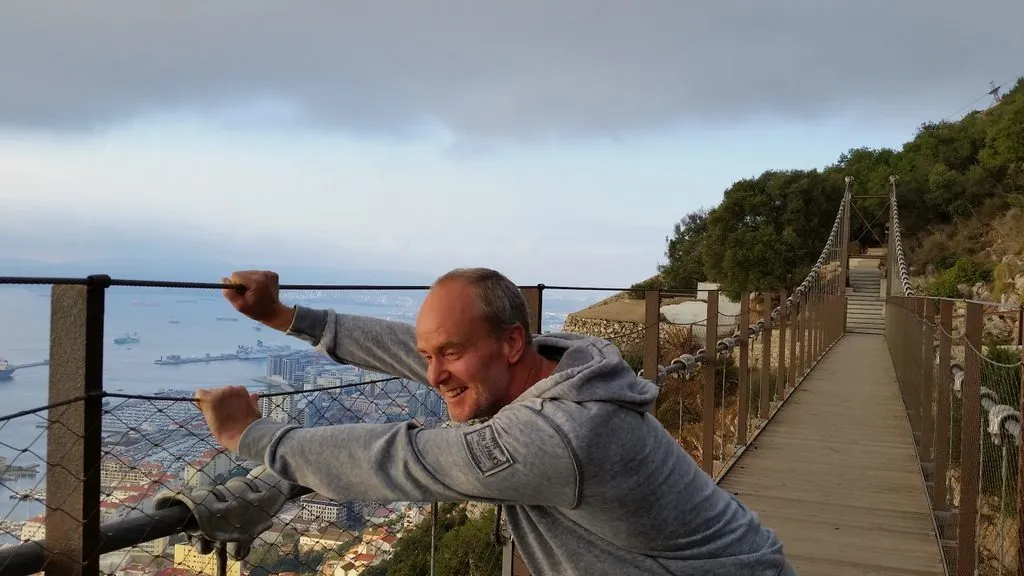
From here we were really keen to go to the suspension bridge our tout girl had recommended, and we asked William to show us which way to go. He just shook his head, saying it was very far on foot, and offered to take us there at the end of the tour. And sure enough, we’d understood him correctly: when our Spanish fellow passengers got out at the last stop, he took us round another loop of the one-way mountain road – showing our ticket to the nature-reserve staff and telling them we were just coming back for seconds – and dropped us near the suspension bridge. Super, William, thanks!
Load-testing the suspension bridge
The view over the town and the Bay of Gibraltar really is great. I counted a total of 37 ships at anchor in the water; some of them were being refuelled with the cheap fuel from smaller supply boats, the rest were waiting their turn or for a berth in the port. If most of the passing ships fill up here, then I understand why it pays to sell diesel so cheaply here. Alcohol and cigarettes are duty-free here in Gibraltar too, by the way, and smuggling towards Spain is going strong.
Together with the apes (you know, the Macacus Gibraltaricus… there, finally got it) we strolled down from the Rock, and after a church we sat down on a pub terrace. Here they had draught dark beer. Over there they didn’t. I agreed in English with the lady behind the bar that I couldn’t pay by card under 6 pounds, I had no pounds, but she’d give me a pint for 4 euros 20 cents. Then, chatting with the Moroccan owner, it turned out that Puskás was super, that he knows what “mismásolás” (Hungarian for faffing and fudging) means, and that, incidentally, the aforementioned lady is called Andrea and is also Hungarian. Andrea and I said hello to each other again and started getting acquainted from scratch. She came from Budapest, we came from the Adriatic by boat; she’s been working here for four years and lives on the Spanish side, walking across every day from there, like most people.
By the way, 35,000 people live in Gibraltar and 12,000 cross over from Spain to work. Among them are lots of Hungarians and Romanians, for whom learning Spanish is very easy. And that’s very important here, because the Gibraltarian language works like this: the conversation starts in English, then after a few sentences they switch to Spanish. Actually it’s enough to know half of each language, you just have to know the right half… Maybe I can manage half of Gibraltarian too. (because I know half of English)
Around 9 in the evening our little gang met up again on the main square – our legs about 10 centimetres shorter by now – and we headed home, walking through the Ocean Village party district. At the Eroski centre we bought the remaining things we needed (don’t anyone think of anything bad, only good things) and, crossing the border, dragged ourselves home. The passport machine registered that the Chain Bridge guy had left British waters, and at the roundabout this time we tested the pavement too. At half past ten in the evening we sailed out of Alcaidesa Marina and, navigating out between the ships anchored in the Bay of Gibraltar, set course for the nearest point of Africa, across the strait.
Sailing out of Gibraltar
Machine translation (AI, Claude) of Balázs’s Hungarian original. Read the original →
· Atlantic Ocean, off the Moroccan coast
We've made it out onto the Atlantic Ocean
Sunday, 29 October 2017
Day 14, 82 nm (Log 5754)
First we cut straight across the Strait of Gibraltar under engine (Gyuri didn’t want to be dodging the cargo ships, which have right of way in the strait, under sail in the current), then we hoisted the reefed main in the 25-knot following wind (gusting 30) and swept along towards the Atlantic in the dark, close to the Moroccan coast. There wasn’t much traffic in the Strait of Gibraltar, only 4–5 ships crossed our path. One of them, which we even had to give way to – since there’d have been a risk of collision if one of us hadn’t changed course – flashed its searchlight at us as a warning that it had right of way.
Sailing through the Strait of Gibraltar
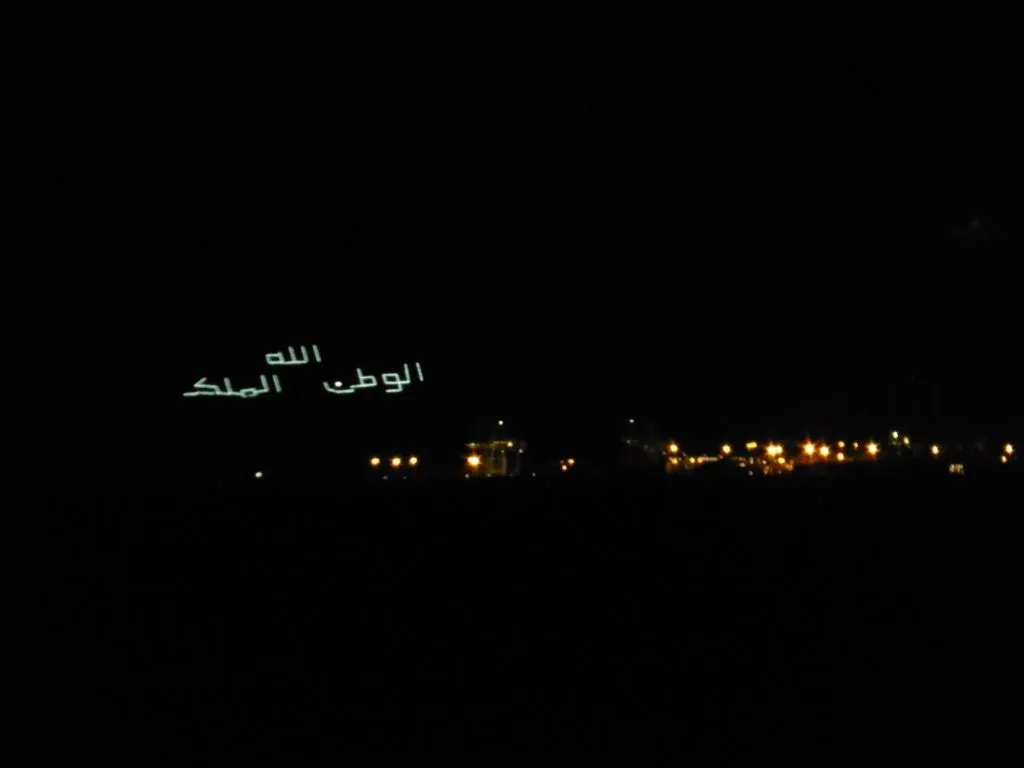
Once across on the Moroccan side, a huge white Arabic inscription was lit up on a mountain; it greets those arriving from the Atlantic. I don’t think it said Hollywood in Arabic letters.
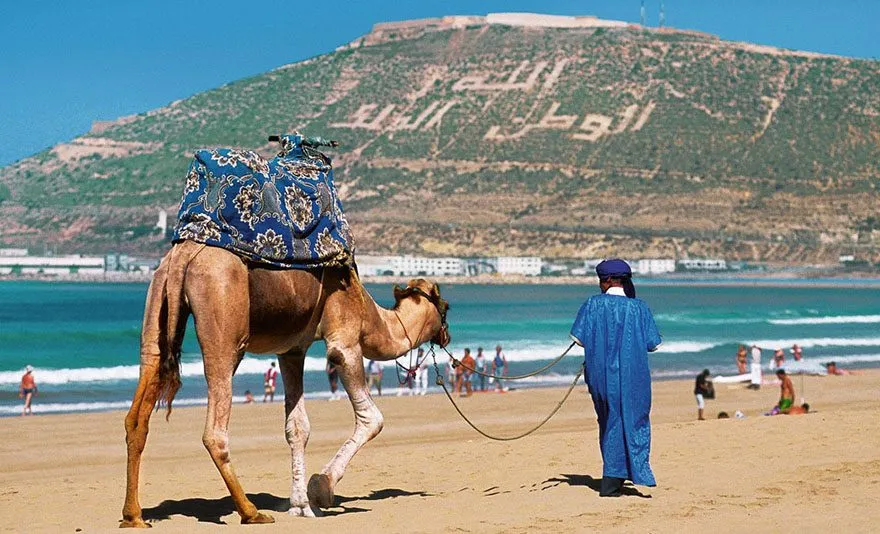
A giant inscription on the Moroccan hillside greets ships heading for the Mediterranean. “One God, one homeland, one king”
I almost feel at home…
All clear now. The Moroccan inscription in a travel agency’s advert
Szabi and co. took over from us for the graveyard watch; they had a steadily strengthening wind of over 30 knots – fortunately from behind – and that worried them a little.
It just goes to show that it’s not enough to watch the instruments (AIS, radar, chartplotter), you also have to look around often, especially to starboard, because they only noticed another sailing yacht, similar to ours, when it crossed our wake from the right about 100 metres behind us. It showed up neither on the AIS (not yet compulsory for sailing yachts) nor on the radar; they could only have spotted it with the naked eye.
A few nights earlier something similar happened to us on the graveyard watch: we only noticed a ferry once it had already crossed in front of us from left to right. True, we had right of way here, but it’s better to know whether they’re actually going to give it to you, and it’s unsettling that we hadn’t spotted this big brute either by eye or on the instruments, even though I mark every ship that’s going to cross our path ahead of us or behind us. It wasn’t dangerously close, about a mile away, and the AIS hadn’t sounded the alarm yet.
But back to Szabi and co. Later on, two speedboats with searchlights came towards them, probably belonging to the Moroccan coastguard, so they had an eventful watch too. On the other hand, they got to see a beautiful moonset as well.
By morning, as we moved away from the Strait of Gibraltar and its “Düseneffekt”, the wind steadily dropped, so first we shook out the reefs, then hoisted the gennaker too. In the end the wind died almost completely.
Sunbathing on the aft deck
We debated whether we should make our own wind, i.e. have lentil soup with baked beans for Sunday lunch, but since the green peas had already thawed and the pork had to be cooked too, this time Sunday lunch didn’t get skipped: Andi cooked a very tasty green pea soup, and I made the best pörkölt (Hungarian stew) of the day on the Atlantic Ocean.
Because of the tightly calculated schedule we had to start the engine (again), so we’re drawing a dead-straight line on the chart towards Las Palmas.
The Pinta’s route from Gibraltar to the Canary Islands
At sunset we sat out on the bow and, sipping a drink, watched the sun go down, peeking in and out from behind the clouds. We almost missed it – we still need to practise this, although we won’t have many more chances this time, but Gyuri will.
Sundowner – watching the sunset from the bow
Machine translation (AI, Claude) of Balázs’s Hungarian original. Read the original →
· Atlantic Ocean
Hunting the sun on the Atlantic
Monday, 30 October 2017
Day 15, 148 nm (Log 5902)
While still off the coast of Africa – having learned my lesson from the clock change in the Channel Islands back in spring – I switched off automatic network time zone on my phone. I was very proud of myself for being so far-sighted; they weren’t going to confuse me with this clock-changing business ever again. Or so I thought.
Yesterday morning – after the small-hours graveyard watch – we were due on again at 10 a.m., and luckily we woke up by ourselves, because I’d forgotten to set the alarm. I checked my phone: 8.41, plenty of time then… Andi checks hers: 7.41. Then we can sleep for another verse. Just to be safe I go out into the saloon to see which clock is right, and that’s where my jaw dropped, because the wall clock there said 9.41. Hang on a minute, how does this work? What’s going on here? Since 9.41 was ship’s time, we had just enough time to get dressed, and at 10 on the dot we took over the watch. So, how does this work? Slowly we worked it out:
Ship’s time, 9.41, hadn’t changed, because it’s UTC (formerly Greenwich time) +2 hours, on account of Hungarian summer time.
But why had my phone gone back an hour, when I’d disabled every interfering auto-adjustment? Got it: today happened to be the switch to winter time, and the winter/summer switch couldn’t be disabled on my very smart phone – it did that for me all by itself. So this phone may be waterproof, but it’s no ship’s chronometer…
And what happened to the clock on Andi’s mobile? We can only assume – with no internet – that it too switched to winter time, plus to local time off the Moroccan coast. By the way, winter time in Morocco? Sounds daft, but we’ve no better idea. Right, so now we know (we think we know) what time it is…. Or so we thought.
Yesterday Gyuri let slip that there’s a real sextant on board, which you can use to measure the height of the sun, and which ships practically navigated by right up until the ’90s. Ricsi and I were thrilled, because I’d never held one of these instruments in my hands (and maybe he hadn’t either, not on a boat), and I was dying to know how it works. Gyuri showed us, then we got to have a go too. I’d read that on a moving boat taking a sight is no simple trick, and I can only confirm it. My eyes were dazzled as the sun accidentally peeped in unfiltered from the other side a few times, and my right arm had gone half numb from holding it by the time I was done. So the first steps aren’t bad as a fitness workout either… For the half-blind.
Just don’t lose the sun while I fumble the filter into place…
We decided that tomorrow we’d measure the height of the sun again, right when it culminates. But when exactly will noon be??? We had a good argument about that. We’ll figure it out; if nothing else, we’ll measure when the sun is at its highest.
Here the wind is still filling the gennaker
Something else. I haven’t told you about my beer tankard yet. In spring I brought 5 plastic Campus Festival (a Hungarian summer music festival) pint mugs onto the boat, which I left here for Gyuri. I looked for them as soon as I came aboard, but he admitted he hadn’t used them, so he’d just chucked them out. The only problem with that was that I’d been counting on them and hadn’t brought new ones. I really like drinking beer from a tankard, and those half-litre glasses were perfect for gin and tonic too. I had to improvise, so I appointed a half-litre pickled-gherkin jar for the purpose. It fulfilled its function almost perfectly even without a handle; there was just a certain, rather serious problem with the optics.
It reminded EVERYONE of a urine-sample jar. And not an empty one. Sadly, me too. I won’t describe the strange looks at first when I took a swig from my “tankard”, but I can tell you they were anything but envious…
The disintegrating froth could only make this feeling worse, and however much the glass beaded with the pleasantly cold beer, even I found it very hard to start believing that: It’ll be fine…
It had one indisputable advantage: nobody coveted their neighbour’s beer… Later I switched to a sweetcorn jar. Here the unsuspecting onlooker might almost, almost have believed the label, but I could see in their eyes that nobody fell for the trick…
The lunch-cooking keeps getting pushed later and later. The main reason is that after the night watches, by the time everyone has had breakfast it’s about noon, and only around 2–3 in the afternoon does the first hungry person start wondering what we’re going to have for lunch. Today Gyuri cooked his spaghetti carbonara, which he’d been threatening us with ever since the Adriatic. It turned out very well, and every last bit was eaten. Right after that came, practically, the 5 o’clock gin and tonic, and soon after that the sundowner, the sunset drink.
Almost alone on the foredeck (the photographer was there too…)
The wind was very light all day; the long, flat Atlantic swells were slowly forming, but they hadn’t yet built up into proper, majestic ocean waves
During the night watch I got acquainted with the stars, using the Sky View Free and Star Tracker apps on my phone. Based on GPS and/or the mobile network, the program knows where you are on the earth’s surface and where each celestial body and constellation is at that moment, and if you point the phone at it, it shows you its name.
After a while I wanted to find something relative to the moon, when I couldn’t find the moon on my phone’s screen. I turned it all the way round several times, searched everywhere, but it was nowhere. That can’t be, the real one is right up there in front of my nose. It’s always been in its place so far. In the end, resigned, I lowered the hand holding the phone, when by chance I caught sight of the Moon: according to the screen it should have been deep below the horizon.
So now even my stargazing program, or rather my very smart phone, doesn’t know what time it is… Looks like we’re not the only ones on this boat. Although I think it should know the exact UTC time from the GPS signal.
Once I wanted to set the clock on my car satnav so it wouldn’t show a different time from the car’s. I searched the whole menu, but it was nowhere. It couldn’t be set (not on that one, at any rate), because obviously it gets its clock signal from the satellite. In the end I had to set the car’s clock to match it…
I tried to outwit the stargazing app by setting the phone’s clock to every possible time zone, but it refused to be swayed. As far as it was concerned the moon was in the sea, and it hadn’t the foggiest what was shining – brighter than anything – up there in the sky…
Nothing is perfect.
Machine translation (AI, Claude) of Balázs’s Hungarian original. Read the original →
· Atlantic Ocean
My first radio chat
Tuesday, 31 October 2017
Day 16, 140 nm (Log 6042)
The wind is still light; we’re waiting for it to finally veer north and strengthen a bit, as the forecast promises. Until then we have to run the engine alongside the sails so we get to Las Palmas in time. Our boat has a long-wave radio set too, which, with an add-on system called Pactor, lets Gyuri send and receive e-mails and lets us request weather charts for our area for the next 3 days. It’s a big help: it’s good to know what you’re in for, and you stand a better chance of steering clear of the big nasty weather tantrums.
Yesterday the weakened wind could no longer keep our colourful reaching sail filled, and with the mast rocked left and right by the waves, the “canvas”, now taut, now collapsing, alternately yanked tight or loosely swung the gennaker furling line, so that it tore one of the fastenings of the lifebuoy’s yellow case off the guardrail. So that we don’t lose it, today Gyuri dug out the sail repair kit and, with Andi’s help, sewed the Velcro back onto the case.
Trying out the sail repair kit, and my “Sample” tankard, handy by the companionway.
For lunch Anikó cooked beetroot risotto with chicken breast. It came out pretty purple, but it was delicious and several of us went back for seconds, even if according to Anikó it’s much tastier with slow rice. (there was only quick-cook rice left on board)
In the evening we had the first watch, from 8 till midnight. It’s almost full moon, visibility is very good. The sea is calm, the wind light, and alongside the sails the engine is purring away too. On the AIS I notice that the vessel running parallel to us 3.5 miles to the west, the Challenge, is also a sailing boat. 13 metres long, and we can see her masthead lights too.
I’ve tried several times to talk to other sailing boats on the radio, but so far none of them has been willing to talk to me. In spring, in the middle of the Bay of Biscay, we saw another yacht in the distance, and even though I called them three times, they didn’t answer. This afternoon the same thing happened: I called the sailing boat going in the opposite direction – her name was some tongue-twister along the lines of Konger Cuantanamer – but either their radio was turned down, or they weren’t listening on channel 16, or they didn’t recognise their boat’s name the way I tried to stammer it out, because they didn’t answer. Should I call them or not? But what do I say? Ask them what they had for lunch, or what time it is? Ricsi was curious about the radio too, but I dithered so long that by the time I’d plucked up the courage to call, he’d gone to bed. Oh, what the heck, what can happen? At worst, if we don’t understand each other, I’ll tell them off for not speaking Hungarian…
“Challenge, Challenge, Challange, this is sailing yacht Pinta, Pinta, Pinta, come in” I finally call them in English on channel 16.
Nothing the first time. Same the second. Still nothing after the third. Looks like this just isn’t my thing…
“This is Challenge, calling Pinta, over”
A woman’s voice pipes up on the radio shortly afterwards. We switch to channel 17, and I ask whether she speaks German.
“Yes, I speak German” she replies, to my great delight, and starts rattling away in Spanish…
Any chance of that in Germaner?
“Doch, natürlich!” Aha, this is going to work! A weight the size of half the Rock of Gibraltar fell off my heart… and we started to natter away.
I found out that they can’t see us (with the sea glittering in the moonlight they couldn’t have, or else they hadn’t taken their sunglasses off yet), there are four of them plus a dog (like Four Tankmen and a Dog, the Polish TV series we all grew up on), and they’re heading for Lanzarote.
I told them about us too, then we wished each other a good trip and said goodbye. Well, I can do this after all!
The evening watch is much more pleasant now. It’s not as chilly as in the Med, and the damp no longer condenses on the deck. I folded down the sprayhood, the windscreen canopy, so now you could watch the stars lying down. I now know where Sirius is, and I could even make out the V-shaped bull’s head with its horns in the constellation of Taurus.
Yesterday evening we noticed that small, autumnally sluggish flies had somehow got onto the boat. Africa is 60 miles away, so it seems out of the question that they migrated to us from there, and if they hatched here on the boat, then the situation isn’t very encouraging. At noon Andi and Ricsi held a clean-up competition, which must have been effective, because tonight there’s no more buzzing round the lights in the saloon…
Szabi and co. are on after us; we can sleep till 8 in the morning.
Machine translation (AI, Claude) of Balázs’s Hungarian original. Read the original →
· Atlantic Ocean, off Las Palmas
Our last day on the ocean + 1 whale
Wednesday, 1 November 2017
Day 17, 147 nm (Log 6189)
By 9 in the morning there was enough wind for us to hoist the gennaker again instead of running the engine. Maybe that’s what the dolphins liked too, because they joined us again, for the umpteenth time on this trip. Whoever could went out to the bow and, legs dangling over the side, we admired their romping. No wonder their behaviour captivated ancient sailors and people in general too; they immortalised them on fountains, mosaics and floors – after all, there’s no other creature so friendly and intelligent that so often joins us – people who travel on water – on our sea voyages.
For lunch Anikó made lentils – they turned out delicious – but even that didn’t help us: our wind died and we had to start the engine again. This time we revved it at 2600 rpm for an hour instead of the usual 1600–1800, because every so often this engine also needs to be given a good run (Volvo owner’s manual – a bit like cars only ever driven in town), so that…, so that… what, do I know. So that it clears out, burns off the deposits, or something like that. I don’t want to write anything even sillier.
If there’s wind, we’re not keen to stop and take in the sails just to have a swim, but the engine is easy to switch off, so we did just that to take one last plunge in the “middle” of the ocean, in our 3,000-metre-deep pool.
At times like this we always let out two fenders on a line behind the boat, which you can hold on to and, with great caution, even ride (careful, knockout hazard!), and someone keeps watch on deck the whole time to see if there are any sharks. I don’t know if that’s enough, but in films this predator always comes with its dorsal fin sticking out, and only dives below the surface in the last few metres, to attack. I hope the sharks know that too…
Oops, forgot to keep my legs together…
Ricsi inspected the hull underwater, and thought he saw rope chafe marks in the antifouling paint on the leading edge of the keel, which could have been caused by the Algerian fishing net we’d cut loose.
Yesterday for some reason we missed the noon sun sight, but today we remembered in time, dug out the sextant again, and one after another measured the height of the sun above the horizon. At the moment of each sight we photographed the chartplotter screen, which shows our exact coordinates and the time to the second. We’re hoping that back home, on the “long winter evenings”, we’ll be able to work out whether at that moment we really were where we were. Looking at the results afterwards, we established that the sun culminated – i.e. it was noon at our longitude – exactly when Gyuri was taking his sight. Just before and just after, we measured a lower sun.
Taking a sun sight, with data loggingWhale! Thar she blows!
We’d barely put the sextant away when the cry came from the direction of the masthead: “Whale!”. Szabi had spotted the little puff of spray far ahead of us from the bow. We slowed down and glided towards it with the engine idling, but it sensed us and paddled away at a leisurely pace, swerving now right, now left. It was alone. We couldn’t get as close to it as to the whales we’d seen in the Med, it didn’t swim past us, so we didn’t really see its size, but we all agreed it must have been somewhat bigger and longer than those, around 10–12 metres. As for the species, we certainly didn’t recognise it; it didn’t have it written on its back, like for example: “AMBRA’S 11.8 ”. Because, having looked it up afterwards, I think this one, like the ones in the Gulf of Taranto, must have been sperm whales (in Hungarian, “ambergris whales”). They didn’t have a shark- or dolphin-like dorsal fin, but further back a blunt hump, as you can see in the picture.
We never saw their mouths; they just pushed their chubby foreheads out of the water a little when they surfaced to breathe.
Reading whaling books, I always imagined that the spray the whales trumpet out had to be a good fountain’s worth, if whalers could spot it from far away. Our cetacean, however, only puffed out about a metre and a half – mind you, we spotted it even so – but then it wasn’t Moby-Dick-sized either, just a smaller, Hungarian-sized one, but ours.
After the gin and tonic our wind picked up enough again for us to unroll the gennaker and switch off the engine.
We admired our last ocean sunset from the bow, while trying to work out what time it was here and what it might be in Las Palmas. We didn’t want to arrive in the dark and wait outside the harbour, but the longer we talked about time zones, winter/summer time changes and UTC, the more we confused each other, until in the end we weren’t even sure whether we’d drunk our gin and tonic at 5 o’clock. In the end we settled on trying to arrive at the Enlightenment – first light, that is – whatever time that might be.
Tonight will be our last night watch; we’re on from midnight till 4. Las Palmas was still 40 miles away, but you could already tell which way it was, because its lights made the bottom of the sky a little brighter in that direction. We dared to leave the gennaker up for the night, because we’d set the autopilot to the wind direction. We’d used this function for the first time a few days earlier – something I’d been looking for for ages, and nobody could show me. Even at the Budapest boat show, the salesman on the Garmin stand claimed to know nothing of such a function. Wind Vane, or whatever it’s called, and the point is that it doesn’t steer the boat on a fixed heading, but watches the wind direction, i.e. which side and at how many degrees the wind should keep coming from, and steers the boat accordingly. Using this, it can’t happen that if the wind shifts the sail gybes across, or that turning from a run to a beam reach knocks the boat flat. However, if the wind direction changes, the boat turns with it, adapts to it, and goes in a completely different direction from the one we originally wanted, but nothing worse happens. You still have to keep an eye on it, though.
I’m glad I found out how to switch it on; now I’m curious whether there’s a gadget that warns you if, say, the boat strays 10 degrees from a desired course…
Since there was no need to rush (presumably), we preferred to let ourselves be safely steered by the wind. At times like this, son and daughter of man alike can really zone out, when all you basically have to do is look around. It was the radio that jerked me out of this pleasant idleness: someone was going Pinta, Pinta very insistently through the speaker.
Who’s that, and what do they want? I called back that I could hear them, Over, and waited to hear which channel we’d switch to. He launched into his spiel, but I couldn’t make out any channel number in it. Only, for example, “Klipper”, and he kept repeating “Portside”. What’s wrong with this guy? What clipper is there round here? Is it him, or is he calling me that? (clippers were the fastest cargo sailing ships, back in the days of The Onedin Line) Or is he calling from a ship called “Portside”? In radio procedure you always have to repeat a ship’s name three times, and this was only twice, of course.
By the way, in the past I seriously toyed with the idea that if I ever had a sailing boat, I’d christen her “Na, mi újság Wagner úr” (“So, what’s new, Mr Wagner?”), but recently I realised that would be a load of nonsense. Would be. By the time I’d rattled off my boat’s name three times in an emergency, I might well have sunk already…
Anyway, back to the Portside…
Let’s have another run at it, and I asked the announcer to repeat the riddle. I wasn’t much wiser from that either, at most to the extent that it was SOME kind of clipper, that he’s a ship, and maybe wants to give way, and more precisely, that he said “Portside to Portside”.
Meanwhile I glanced at the AIS, and sure enough a ship was coming straight at us: “Yes, OK!” I replied, then I added that I could see them and that we were under sail. (sailing boats generally have right of way – that’s what I was bluffing on – but only if they give it to you, of course…) Now that I was straining my eyes harder in the direction where I should have been seeing it, I hissed through my teeth: whoa, crikey, this thing really is coming right at us! And how big it is! It was coming straight from Las Palmas, where the bottom of the sky was brighter, and that’s why its red and green lights hadn’t caught my eye when I’d looked around earlier. I clicked on the ship on the AIS to see its details and when it would get here, and then everything made sense.
The ship’s name was “NS Clipper” (now that one I remembered), so it was him calling, and beneath it a 240-metre-long, 42-metre-wide tanker with a 12-metre draught was barrelling towards us, slightly from the left, at 13 knots. It would be here in 10 minutes. Exactly the kind of skiddy, nimble rig that changes course at the drop of a hat…
But if the ship’s name is “NS Clipper”, then “Portside to Portside” means both on the left, i.e. he was proposing – and wanted to make sure that I thought so too – that we’d pass each other in such a manner that we’d each see the other ship on our left.
And he’d already turned a little. Very good…
So, actually, I’d solved the task flawlessly, answered perfectly… It just took me a little while to realise it…
The problem was that he didn’t switch channels. And he refused to speak Hungarian…
We’d have passed each other anyway; he was just a bit of a worrywart…
Afterwards, with half an ear, we heard two other ships coordinating; they passed each other Starboard to Starboard.
Easy enough, if that’s what they tell me too, and don’t go clippering on…
There was no other excitement during our watch.
*Footnote:
Portside: the left-hand side of a ship, facing forward. In Hungarian simply the “harbour side” (and Backbord in German). Ships have been moored to the quay on this side ever since the Vikings, because their steering oar was on the other side of the ship. Look it up in The Onedin Line…
Starboardside: the right-hand side of a ship (the “starry side”, meaning the side facing the sea or the water). In German Steuerbord, i.e. the steering side. And why was the steering on the right-hand side? Because most people are right-handed, and that way they could steer the ship standing facing the direction of travel.
Why do we always board aircraft on the left?: Because people are right-handed.
Explanation of the footnote:
People are right-handed -> the steering oar was on the right-hand side -> so ships were moored on their left-hand side -> out of habit, it stayed that way with aircraft too. That’s also why the captain sits on the left (so it’s easier to pull up to the jet bridge), why the boarding door is bigger on the left, and why the plane is refuelled and the baggage loaded on the right (so they don’t get mixed up with the passengers)
Machine translation (AI, Claude) of Balázs’s Hungarian original. Read the original →
· Las Palmas, Gran Canaria
We've arrived in Las Palmas
Thursday, 2 November 2017
Day 18, 100 nm (Log 6289)
At four in the morning the change of watch came. With Szabi and co. we furled the gennaker, because in the dropping wind it kept collapsing and was just flogging, and with the main and the genoa we tried to find a course that suited the sails and us too. We went over the handover notes, then we went to bed. That left us another 3 hours to sleep (same as between 8 p.m. and midnight). You can live with this sleeping in two instalments – especially if you can catch up on sleep afterwards – but it’s still good that the graveyard watch only comes round every three days. Half asleep, I can still hear Szabi and co. rolling in the sails over our heads and starting the engine. Looks like that was all the wind for today…
Right after that – or at least so it seemed to me – Gyuri wakes us up to get up, because we’re off Las Palmas. Outside it’s still dark, but the city lights were already wonderfully visible. On the shore, glittering, flashing tower blocks rose into the sky at regular intervals; I didn’t remember there being such huge buildings on the shore next to the port.
Only as we got closer did it turn out that what we’d first taken for skyscrapers were actually offshore drilling rigs, neatly moored in a row along the outermost breakwater.
It was still properly dark – goodness knows what time it is here – and dawn was breaking only very slowly. It wouldn’t have been good to wait around here, among the big brutes at anchor and sailing in and out. We let a hulking container ship go ahead of us, chugging in far too confidently. We had a bit of time to spare anyway.
Supposedly you’re not allowed to enter our marina, where our berth is booked, in the dark. Or rather, let me put it this way: you can only go into a berth that the receptionists assign to you. And they don’t work at night. So there’s no such thing as just pulling in, tying up somewhere, and then sorting it out with the marinero, saying, for example, that we’d only stay one night. On the chartplotter we found the marina entrance, and we were approaching it in real life too; the only confusing thing was that there was only a red light on the right-hand side of the entrance, and nothing at all on the other side. Even so, we found our way safely into the marina, and it was starting to get light too.
If you’re arriving in this marina for the first time, you have to stop in front of reception. Of course the pontoon there was already occupied, but led by a bright idea, we pulled up at the only free spot on the fuel dock. From here Gyuri could also do the check-in, and as soon as the pump opened we filled the fuel tanks to the brim too. So there’s no need to come back over here a second time. Of course before that we opened the champagne, which I’d looked for in vain at half past midnight to put in the fridge – even though I’d climbed out of bed half asleep specially – but Gyuri had beaten me to it. We clinked glasses once again, and mentally gave ourselves an appreciative pat on the back (the others’ a bit more heartily) for a job well done.
We’ve arrived! Champagne in the light of the rising sun and the shadow of the diesel pump
Admittedly, this is a bit like teachers opening a bottle of champagne with the headmaster every Friday – “Well, we’ve survived another week, that was awful!” – or librarians celebrating after every 1000th book returned (not lent out). They could learn from us, although it’s true that it’s relatively rare for someone in the staff room to get half a bathtub of water dumped over their head, or to have to lie hunched on the floor in the middle of the library for a day and a half with nothing to eat or drink…
But neither is compulsory… Only sailing is: “Navigare necesse est”
After refuelling, the marineros in their motorboat showed us our berth. We had to squeeze the 4-metre-wide Pinta into a 3.8-metre-wide slot between two sailing boats. The way this works is that you stick your bottom into the gap (the boat’s, of course – don’t try it with your own) and on each side two competitors with steel thigh muscles like mine sit out, and as you reverse in they push the whole row of boats apart and along a little, just enough for us to fit. We hardly needed to tie the boat up, we were wedged in so tight by the end.
We did tie up the Pinta properly, though.
We’ve arrived. Safely, on time. Although it came at a price… But it was worth it.
Thanks to Neptune for being kind to us, so that all of us reached our final destination, Las Palmas, safe and sound.
Thanks to those back home – my father, our children, Andi’s parents, my colleagues and everyone who helped, held the fort, and didn’t let anything sink.
Thanks to our dear readers too – although I’d point out (as my father does to me) that they’ve been pretty stingy with public praise in the comments… Then again, that can still be remedied.
Reportedly Gyuri was satisfied with us – the crew – as well, but he was only willing to admit it in answer to a very pointed, almost menacing question of mine.
But even if the Pinta has stopped, life hasn’t. Before going off to see the town, we decided to have a look at the log, our speed instrument. I’ve already written that on the first day, right after departure, Szabi, putting Kund the Diver (the Hungarian legend who sank an enemy fleet by drilling holes in its hulls) to shame, dived under our boat and freed the little paddlewheel, and after its liberation it did show some speed, but always less than the GPS measured. In other words, a lot of fouling must have still been on it, so we had a cheating log all the way, which supplied false data while under way – unlike the Volkswagen cheat software, which measures lower emissions when stationary, on the test bench.
The solution is very simple – you may not even believe it – you have to take out the log and clean it. Which, as you know, is on the bottom of the boat, outside, in the water. For a very long time I too was convinced that this was obviously only possible when the boat is lifted out of the water, or run aground…
Fortunately, clever people who were curious about their exact speed found a neat solution: they drilled through the bottom of the boat and screwed the speed sensor in watertight, so that it hangs down into the seawater, and the water flowing past turns the counter. You can take it out at any time, clean it and put it back. Genius. There’s just one small detail worth paying attention to, namely that when you unscrew the log, seawater starts pouring into the hull, right up until you put it back. And, well, almost everyone has experienced a thread that just won’t catch…
No need to shit yourself over it – says the person who doesn’t own a boat – but when you’re holing your life’s work, unscrewing the plug standing on your head with the water gushing in, it’s not out of the question that your hand might tremble while plugging it back up…
We knew the operation is actually very simple; we’d talked several times with Gyuri at sea about how we ought to take it out and clean it, but in the end we resisted the temptation and decided to wait with the operation until the boat was somewhere where, in case of half-success (I call it half-success when you manage to unscrew the log but not to screw it back in), at least the top of the mast would still be sticking out of the water…
Well, that moment had come. We got ready.
This is what a log looks like when you take it out
We lifted the two small boards in the forecabin floor, Gyuri lay down flat on his stomach holding the cleaning rag and the blanking plug – which can be screwed in temporarily in place of the log – and I held the torch in one hand and the camera in the other, thinking that in case of half-success I’d boost my blog with a few exclusive disaster shots… In my head I was preparing a few bits of good advice for that particular eventuality, for example that he should prop himself on the floor with his forehead, so he could press his other hand over the hole as well while we ran off, or if he was holding up well, I’d have to serve him his gin and tonic through a straw down there on the floor in a few hours’ time… I got no further, because blooop, he’d pulled out the log, the blanking plug’s thread caught with cool composure, and it was already in. Only about a bucketful of seawater came in, which drained into the bilge, from where the automatic bilge pump presumably slowly pumped it out. That was it. No action…
Well, I won’t be buying my first boat with the advertising revenue from this blog of mine…
I photo-documented the removed, sea-snail-encrusted log, and we left the cleaning for later.
Nothing to see here… Off to the old town…
Our trip in numbers
First of all, I put on 1.5 kilos.
According to the log we covered 1976 nautical miles. But that’s not the real distance, even though I diligently note down the log reading every day at noon.
According to the GPS we sailed 2278 miles, (6591–4314); that’s what I consider authoritative.
With that we’d have crossed the Atlantic too.
Our trip lasted 17 days (406 hours).
Of that, we spent two and a half days on land (Sicily, Almería and Gibraltar) and 2 nights (Sicily and Gibraltar)
The longest stretch we covered non-stop at sea was five and a half days between Sicily and Spain (approx. 790 nm), and four and a half days between Gibraltar and the Canary Islands (approx. 700 nm)
In total we were at sea for 344 hours, which means an average speed of 6.6 miles/hour.
Of that, the engine was running for 241 hours too. Sometimes alongside the sails, sometimes on its own. That’s a lot, we know, but without it we couldn’t have kept to the tight schedule.
In that time we used 1505 litres of diesel, which corresponds to a consumption of 6.2 litres/hour, or about 1 litre/mile.
How much I consumed in that time, I don’t know, but I put on 1.5 kg, which is still within limits; I can correct it.
In this amount of time, the trip could only be done with this much motoring, and we also needed (even) worse weather not to hold us up.
Our pace would do credit to any boat delivery. They only reckon with an average speed of 5 miles.
If we’d wanted to do most of the trip under sail, we’d have needed to set aside 1–2 weeks more.
If we’d wanted to look around in more places (Sardinia, Ibiza, maybe Madeira), then at least another 1–2 weeks on top.
So this trip can be done comfortably, with time for sightseeing, in 6–7 weeks. And of course anyone with time on their hands can spend even longer on it…
Unfortunately we didn’t have that much time; we had to get the job done in 3 weeks, none of us could have got away for longer.
We’re sorry we couldn’t see more, but at the same time we wouldn’t give this experience up for anything; we’d do it again, just the same.
Once again, thank you to Gyuri for the opportunity to sail with him, and we wish them fair winds for their round-the-world voyage!
I made this map in a previous life – around 1520 – as Piri Reis, Turkish admiral and cartographer in the Ottoman Empire. Looking at the satellite images, it turned out pretty well…
Although the Tisza (Hungary’s second river) rises a bit further north, but how the heck could I have known that back then…
Dear Reader!
One way or another, you’ve reached the end of this story. If you liked it, please click the blue like button at the top/start of the page (I switched it on on 7 January 2020); I’ll be delighted with every bit of feedback.
Balaja
Machine translation (AI, Claude) of Balázs’s Hungarian original. Read the original →
· Las Palmas, Gran Canaria
The second voyage of the "Pinta"
In the month of October, in the Year of Our Lord 2017
I made this map in a previous life – around 1520 – as Piri Reis, Turkish admiral and cartographer in the Ottoman Empire. Looking at the satellite images, it turned out pretty well…
Although the Tisza (Hungary’s second river) rises a bit further north, but how the heck could I have known that back then…
Machine translation (AI, Claude) of Balázs’s Hungarian original. Read the original →
· Las Palmas, Gran Canaria
Our trip in numbers
First of all, I put on 1.5 kilos.
According to the log we covered 1976 nautical miles. But that’s not the real distance, even though I diligently note down the log reading every day at noon.
According to the GPS we sailed 2278 miles, (6591–4314); that’s what I consider authoritative.
With that we’d have crossed the Atlantic too.
Our trip lasted 17 days (406 hours).
Of that, we spent two and a half days on land (Sicily, Almería and Gibraltar) and 2 nights (Sicily and Gibraltar)
The longest stretch we covered non-stop at sea was five and a half days between Sicily and Spain (approx. 790 nm), and four and a half days between Gibraltar and the Canary Islands (approx. 700 nm)
In total we were at sea for 344 hours, which means an average speed of 6.6 miles/hour.
Of that, the engine was running for 241 hours too. Sometimes alongside the sails, sometimes on its own. That’s a lot, we know, but without it we couldn’t have kept to the tight schedule.
In that time we used 1505 litres of diesel, which corresponds to a consumption of 6.2 litres/hour, or about 1 litre/mile.
How much I consumed in that time, I don’t know, but I put on 1.5 kg, which is still within limits; I can correct it.
In this amount of time, the trip could only be done with this much motoring, and we also needed (even) worse weather not to hold us up.
Our pace would do credit to any boat delivery. They only reckon with an average speed of 5 miles.
If we’d wanted to do most of the trip under sail, we’d have needed to set aside 1–2 weeks more.
If we’d wanted to look around in more places (Sardinia, Ibiza, maybe Madeira), then at least another 1–2 weeks on top.
So this trip can be done comfortably, with time for sightseeing, in 6–7 weeks. And of course anyone with time on their hands can spend even longer on it…
Unfortunately we didn’t have that much time; we had to get the job done in 3 weeks, none of us could have got away for longer.
We’re sorry we couldn’t see more, but at the same time we wouldn’t give this experience up for anything; we’d do it again, just the same.
Once again, thank you to Gyuri for the opportunity to sail with him, and we wish them fair winds for their round-the-world voyage!
Balaja
Machine translation (AI, Claude) of Balázs’s Hungarian original. Read the original →
· Las Palmas, Gran Canaria
A sailing glossary
Day 2, 140 nm (Log 4456 nm)
where Day 2 = the day after the first one,
140 nm = the distance covered from noon the previous day to noon that day, in nautical miles –> 1 nm = 1852 metres
(Log 4456 nm) = the boat’s “odometer”; it measures the total distance covered, in nautical miles (nm = nautical miles)
AIS
the biggest help since the invention of GPS; it shows the tracks of other ships within a 50-100-mile radius and warns of collision risk. In more detail, and more clearly, by Tibor Vass (in Hungarian): http://www.mja.hu/dokumentumok/vitorla_105.pdf
autopilot
electric automatic steering. It steers the boat on a preset course and corrects if wind, current or waves push the boat off. Nobody has to stand at the wheel all the time – but you still have to keep watch!
Balaja
that’s me, in person.
Barfuß-Route
= barefoot route. The route on which you can sail round the world most comfortably in a sailing yacht. It runs through the trade-wind belt, not far from the equator, via the Panama and Suez Canals. Sailing it in the right season, the risk of storms is lowest. People say of it, dismissively, that here the wind would blow even a turd round the globe.
backing, backed sail
the sail flapping back when it gets the wind from the “wrong” side.
bimini
a sun and rain awning stretched over the cockpit on deck.
boom
Boom – the spar holding the foot of the mainsail (“Baum” in German); if you don’t duck, it can give you a nasty knock on the head. Then it’s called the boom-boom.
cockpit
the “pilot’s cabin”, the steering position; from here on deck the boat can be controlled, the wheel is here, the lines lead here, you can sit here and stay for long periods – the most sheltered spot on deck from wind, rain and sea.
Coriolis force
an inertial force named after Gaspard-Gustave Coriolis; among other things, it deflects the winds. If you read up on it, you’ll realise it has nothing to do with my rodeo performance, but it sounds good
knot
the unit of a boat’s speed. 1 knot = 1 nm/hour. See: log
fender
an air-filled cushion hung over the side of the hull when moored, to protect the moored boat from bumping or chafing against the quay or other boats.
gennaker
a colourful, lightweight, large asymmetric headsail. The Pinta’s is blue and orange. Usable in moderate winds of 9–16 knots. Below 9 the wind can’t fill it and it collapses; above 16 there’s a risk of tearing it.
genoa
a large headsail that reaches back beyond the mast.
main (grósz)
= big (from German “groß”). The mainsail. Its vertical edge is fixed to the mast and its foot to the boom.
Hallberg-Rassy 48
a 48-foot Swedish monohull sailing yacht
gybe, gybing (Halse)
a change of course downwind combined with trimming the sails. When sailing downwind, certain course changes require swinging the fully eased mainsail over from one side to the other (otherwise it slams across uncontrolled and can do a lot of damage, see: accidental gybe). Needs a lot of attention.
kreuzing (beating)
there’s no good Hungarian word for it. You could call it zigzagging – or “lavírozás”, as Ferenc Herczeg called it in his book On the Wings of the Winds, written 100 years ago – but neither is quite right. Since sailing boats can’t sail straight into the wind, only approach it at about 45 degrees (close-hauled), in such cases you reach your destination by getting the wind from ahead and to the right for a while, then tacking (changing tack) to get it from ahead and to the left, and by alternating course like this, sailing in a zigzag, you reach your destination. Of course this means covering a longer distance, and the waves come from ahead too, but there’s no other way.
You can also zigzag downwind, kreuzing before the wind. In that case, despite the longer distance, the sailing boat can reach its destination sooner, because on a broad reach (Raum) it goes much faster than dead downwind, and it rolls less, i.e. sways and rocks less from side to side.
graveyard watch (in Hungarian: “dog watch”)
the name of the watch from midnight to 4 in the morning. Fit for a dog… The least pleasant one: it splits your night’s sleep in two. The term was used in the British and German navies, and most certainly in the navy of the Austro-Hungarian Monarchy too.
Lagoon 450
a 45-foot French sailing catamaran, a twin-hulled boat.
battens
little plastic stiffening strips that can be slid into the mainsail along its outer edge, to give the main a better profile.
log
the boat’s “odometer”; it measures the total distance covered in nautical miles (nm in English). In the old days this was the name of the instrument for measuring a ship’s speed: a small wooden board tied to a line, thrown into the water, and they counted the number of knots on the line as it ran out. However many knots ran out, that’s how many knots the ship was doing. See: knot.
MAN OVER BORD!!!
= man outside the boat = MOB alarm = MAN IN THE WATER!!!. Both the chartplotter and the radio have a MOB button which, when pressed, records the boat’s position where the person fell into the water. Helps the rescue.
navi
that’s what I call our combined navigation instrument. Officially it’s called a GPS plotter. Its screen can display electronic nautical charts, as well as the AIS and radar signals of ships.
accidental gybe (Patenthalse)
the uncontrolled slamming across of the boom, i.e. the mainsail. Very dangerous, because it can snap the shrouds that stay the mast, and with that bring the mast down too.
preventer
a securing line that prevents the uncontrolled slamming across of the boom, i.e. the mainsail (accidental gybe) – a “preventive” line, so to speak
provisions
the food and drink supplies for the voyage
RADAR
the device can detect the position of other ships and objects by sensing the reflections of the radio waves it emits, and display them on a screen
reach, Raum wind
also called a three-quarter wind. It blows from the range between dead downwind and the beam wind coming straight from the side. Usually the boat is fastest on this.
guardrail (reeling)
a light wire-rope rail along the edge of the boat. It’s more of a hint not to go any further; it’s not designed to catch a heavy falling body. Still better than nothing.
reefing, putting in a reef, shaking out a reef
reefing, putting in a reef: reducing the sail area when the wind strengthens. The headsail is usually rolled up around the forestay, and on the Pinta the mainsail can be rolled up onto a vertical spindle inside the mast, furled into the mast.
shaking out a reef: letting out the reduced/furled sail area fully or partially
skipper
the person in charge of a sailing or motor yacht, its “captain”
spinnaker
a large downwind sail made of colourful, lightweight cloth. It pulls the boat well even in a lighter following wind, but if the wind really picks up, it’s quite a hassle for one or two people to get it down.
sundowner
sunset drink. A drink sipped while admiring the sunset, typically on the bow. It can be rum, brandy, Campari or anything else; the main thing is that it’s alcoholic.
sextant
a precision optical instrument for measuring the “height”, i.e. the angle above the horizon, of typically the sun, but also of other celestial bodies. With it, and the help of tables, you can determine your latitude.
shrouds
strong wire ropes for securing and staying the mast.
Windytv
wind and weather forecast website. They’ve since changed their name to Windy.com
Machine translation (AI, Claude) of Balázs’s Hungarian original. Read the original →