Crossing the Atlantic Ocean
Machine translation (AI, Claude) of Balázs’s Hungarian original. Read the original →
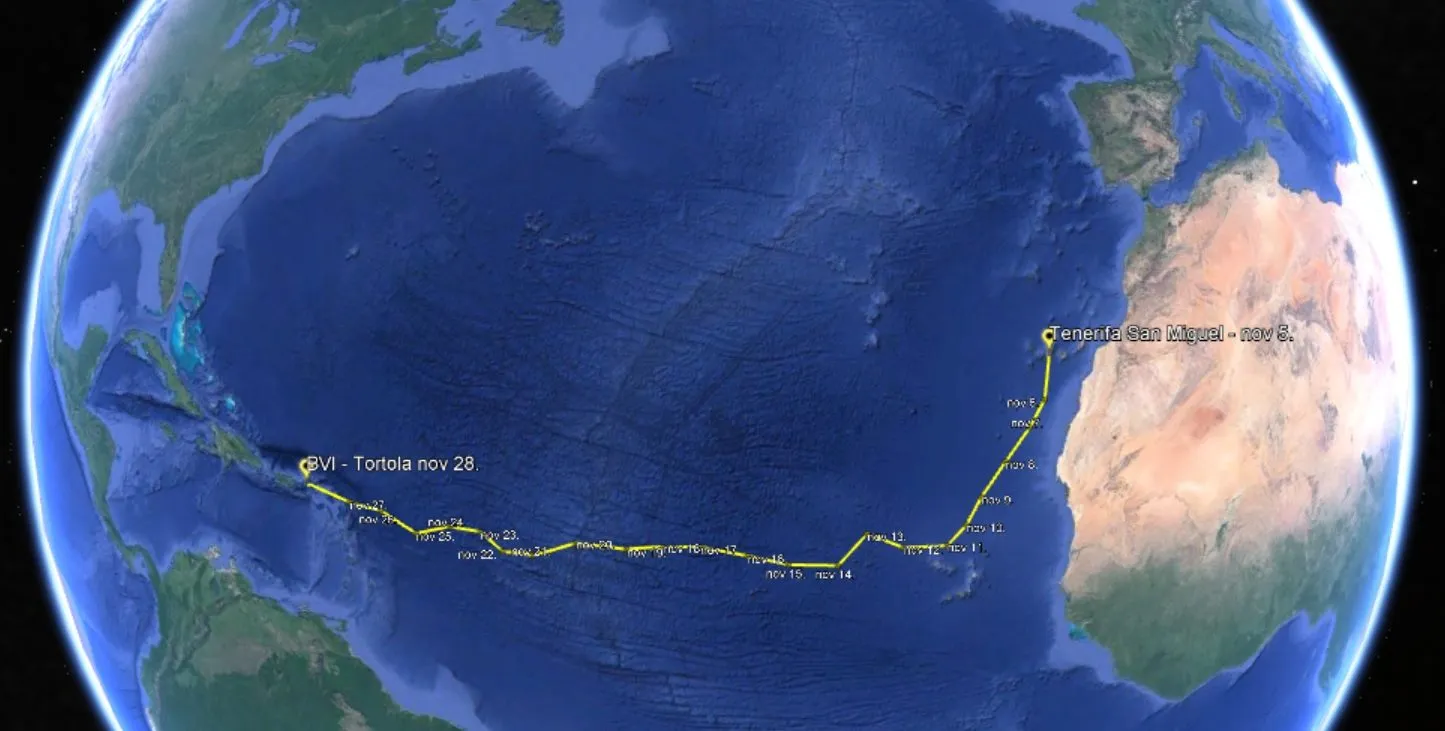
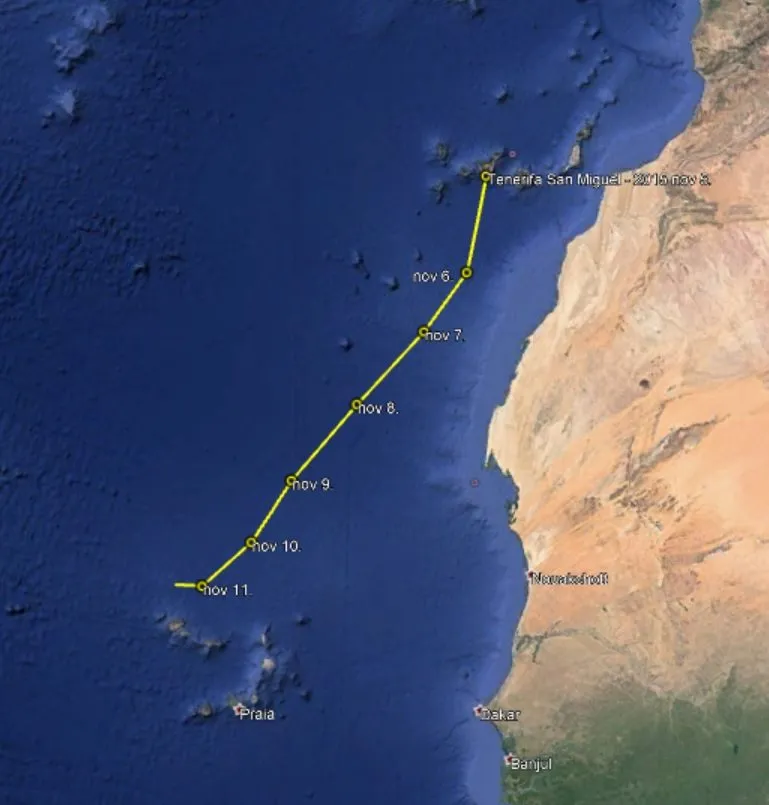
The voyage of the Alice – source: balajaazoperencian.blog.hu
Machine translation (AI, Claude) of Balázs’s Hungarian original. Read the original →
Monday, 2 November 2015
Hi everyone!
In Budapest the pilot announced that the expected flight time to Tenerife was 5 hours 10 minutes, but he knew a shorter route, he just didn’t want to jinx it yet…
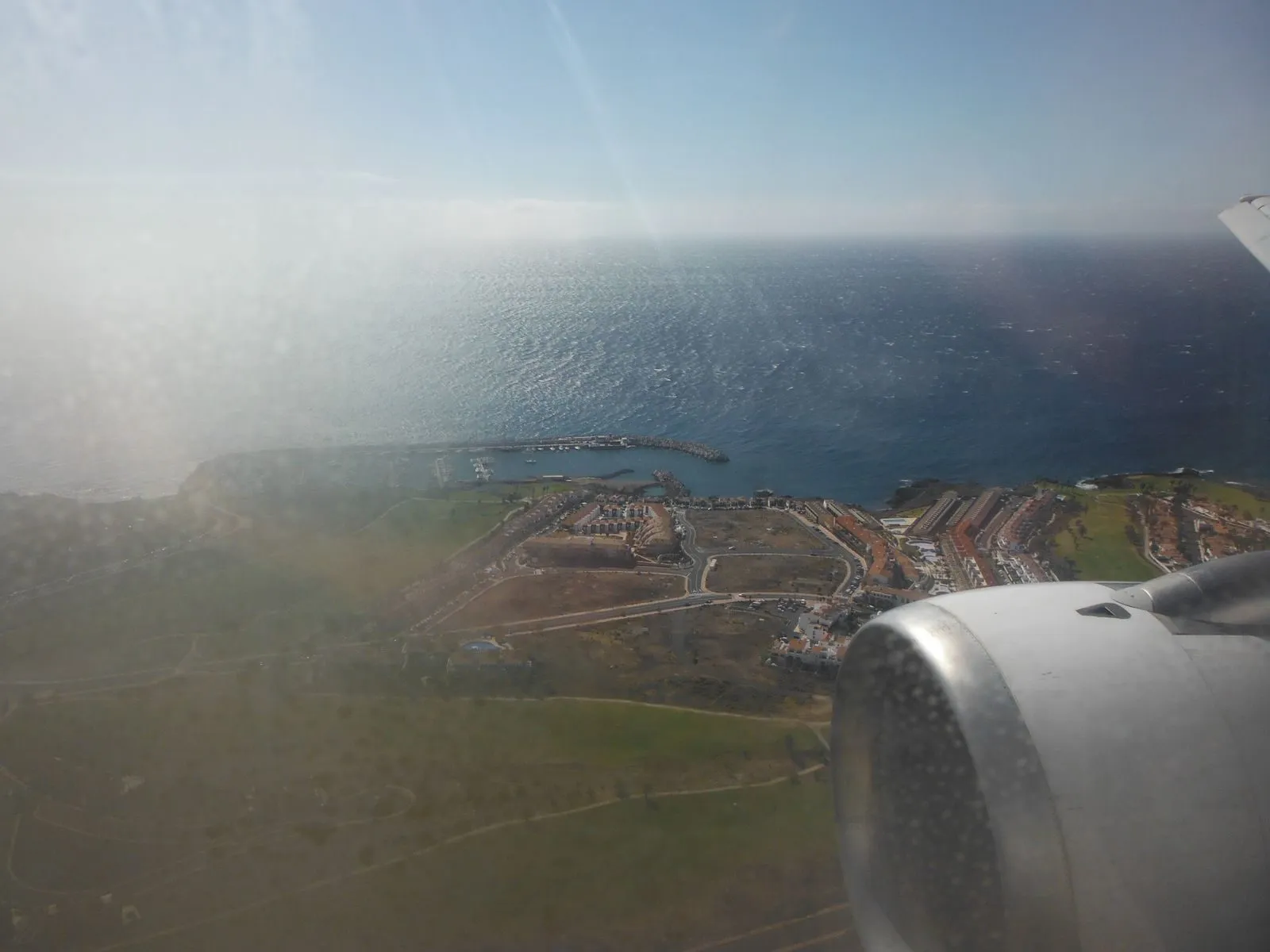
And sure enough, we took off a quarter of an hour late and landed ten minutes early. Somewhere over the Iberian Peninsula there must have been that famous revolving door – the one a Hungarian, as the old joke goes, goes into behind you and comes out of ahead of you – and our Hungarian pilot went in second and came out first…
Our boat is already here. That matters, because a few boats are still on their way here from France. They could (dared to) set off only later because of the “nice” weather…
But ALICE is here, and so is our crew, minus one.
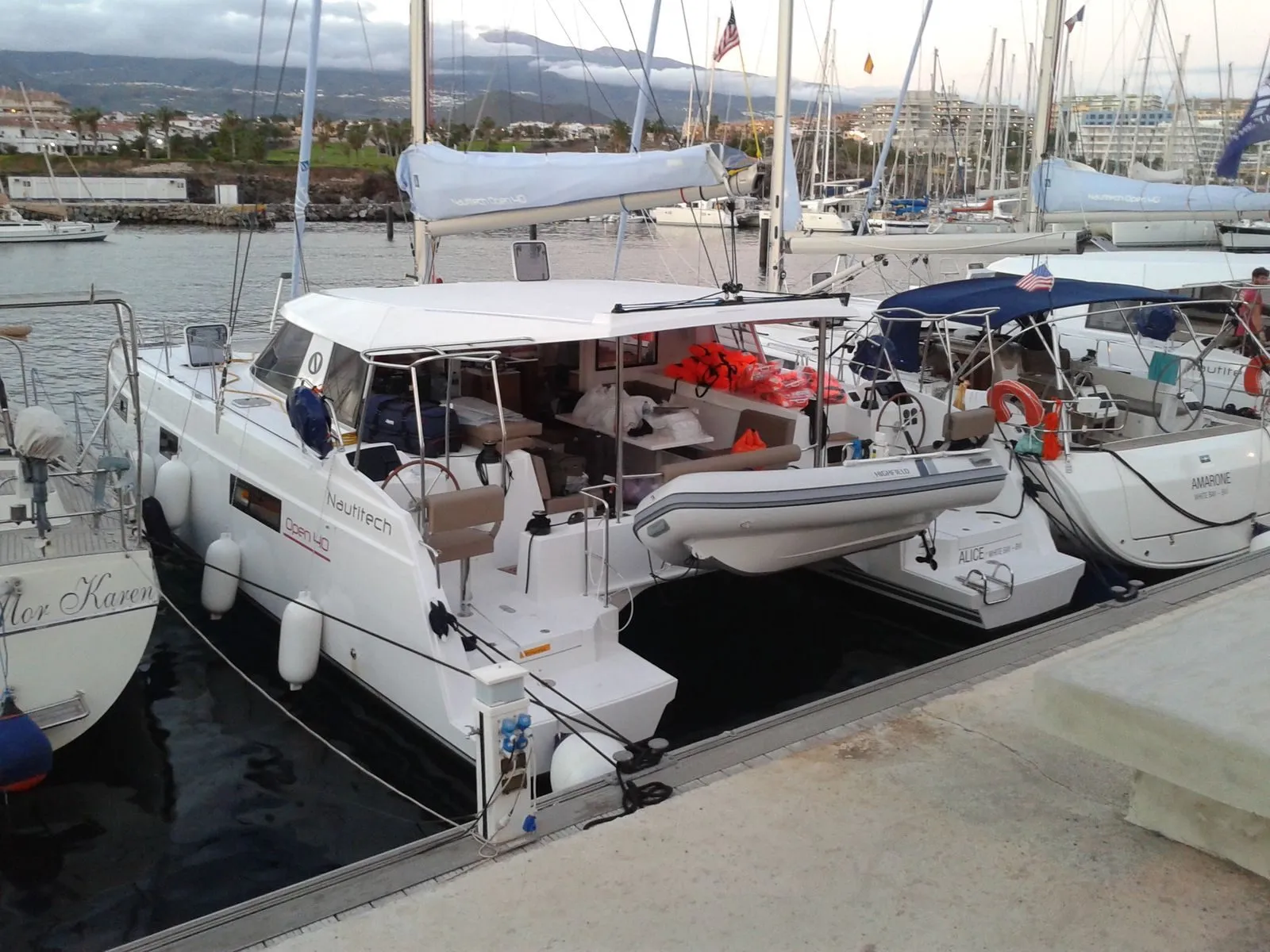
ALICE our home for the next month
Gregor, 23, Slovenian, a skipper with plenty of experience,
Igor, a Croatian lad not much older, the other skipper,
Willi Serba, my cabin mate, a fit 68-year-old retired teacher from Frankfurt who taught politics, economics and PE. His ancestors were French Huguenots, which is where his Germanised name comes from.
Bijan Hatam and Simon Bohnacker, both 23, mechanical engineering students at the university in Munich. Bijan’s father is Persian, Simon’s is Egyptian.
And finally yours truly, who can only boast one ancestor who allegedly fought under Napoleon.
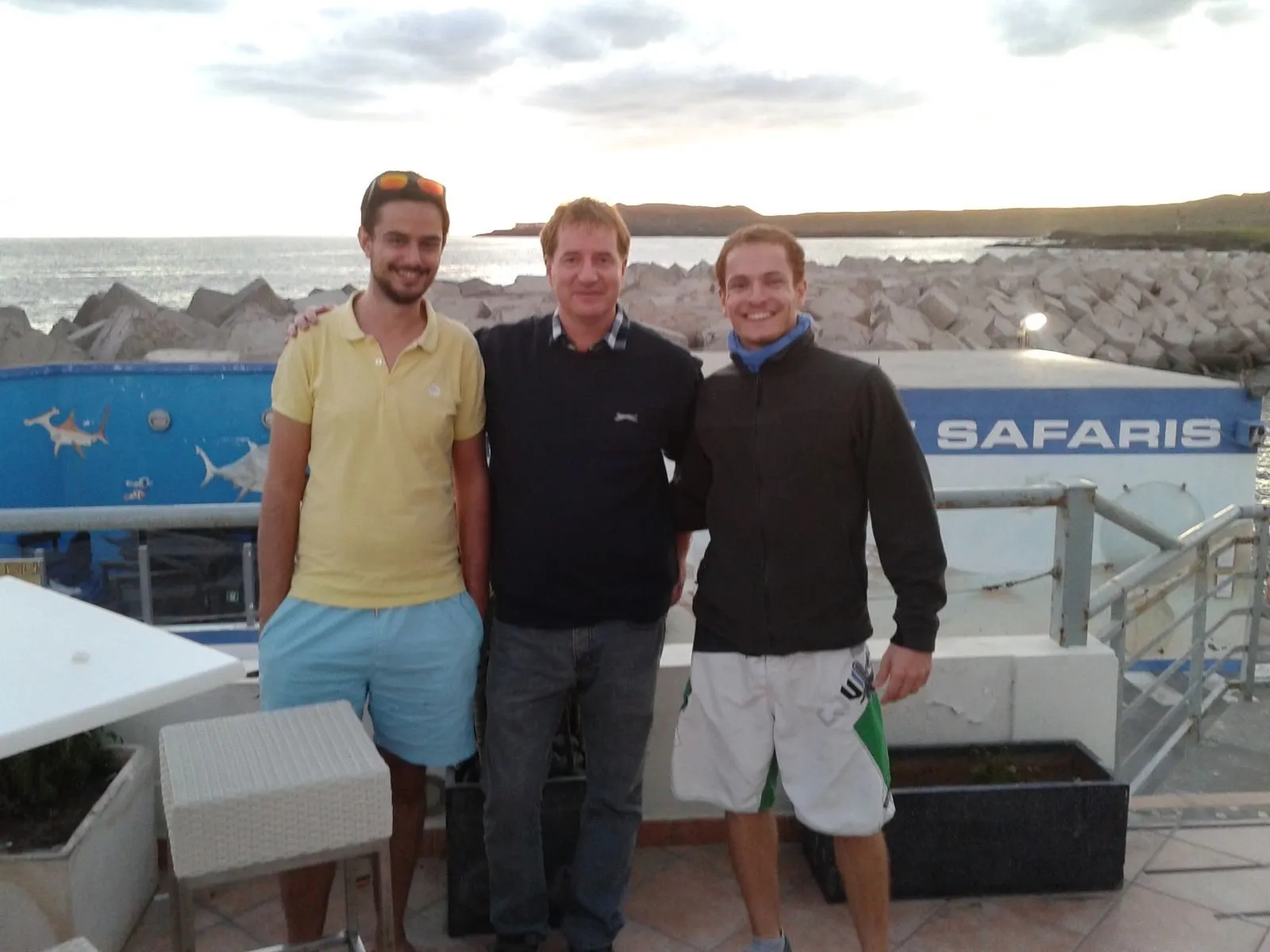
Jiri, the Czech, is maybe coming tomorrow; nobody knows exactly.
So there’ll be seven of us – seven at one blow, like the Brave Little Tailor.
A few things have already come to light – namely – that, unlike Columbus, none of us has ever crossed the Atlantic under sail…
OK, fine, everybody has to start sometime, that’s a fact, but not necessarily all at the same time…
And now it’s going to be all at the same time, unless Jiri happens to have this as a hobby.
The whole reason I chose this option was so that my first Atlantic crossing would be with people who had some experience of it…
The other little surprise is that our boat has no spinnaker, no gennaker, no genoa, just a smallish self-tacking jib (Selbstwendefock).
And there I was, planning to spend Christmas at home…
On the other hand, there is fishing tackle, since we can’t load that much food anyway.
There’s only 300 litres of water on board too, so for bathing they recommended we make use of the regular tropical showers.
The boat, by the way, is brand new; it came off the slipway in La Rochelle just a few weeks ago.
Tomorrow the skips are going off to buy spare parts, and in the meantime our homework is to put together the shopping list.
Whatever we leave off, we’ll buy in America.
Then in the afternoon we do the shopping, and even later in the afternoon we stow it all on the boat.
We’ll probably leave on Wednesday morning.
The plan is to sail close to the other boats, so I’m curious how that’s going to work out.
Unfortunately I won’t be able to send emails on the way – they’re not set up for that – so I’ll collect everything and send it to you from the other side.
Thanks for the good wishes, I’ll do just that, and all the best to you too!
The others say I brought the good weather here with me, by the way (no idea where from).
It’s 23 degrees in the shade.
It had been a long day, lots had happened, so I put on my pyjamas and slipped into bed. It was pleasant inside too, no need for a blanket, so I just covered myself with a sheet. Then in came Wili, my German cabin mate, leisurely stripped down stark naked, and then, to my utter astonishment – without putting on any pyjamas – wearing nothing but…. nothing, he slipped in next to me in the roughly 130 cm narrow bed…
Waaaaah!!! – I think the sound I let out inside was something like Roman Polanski’s in The Fearless Vampire Killers…

And I’m going to be locked up in one bed with this guy for three weeks???
Instinctively I rolled myself up in the sheet like a pancake, wriggled 5 centimetres over to the very edge of the bed, and lay there facing the wall, eyes wide open, on high alert, ready to bolt at any moment.
Blimey, what have I got myself into…
Machine translation (AI, Claude) of Balázs’s Hungarian original. Read the original →
Tuesday, 3 November 2015
Day -1
In the end the night passed without any incident; it was just a bit of a struggle in the morning to peel off the sheet I’d wrapped round myself three times, but safety first – after all, we’re about to cross the Atlantic Ocean, aren’t we?
This was the planned day of departure, but it didn’t turn out that way – mañana, then…
In the morning we wrote up the provisions list, while the Volvo technicians serviced the two engines, changing the filters and the oil. Our two skippers finally set off for Santa Cruz at around 2 p.m. to buy parts. We had lunch too, and then I thought I’d have a little siesta until they got back.
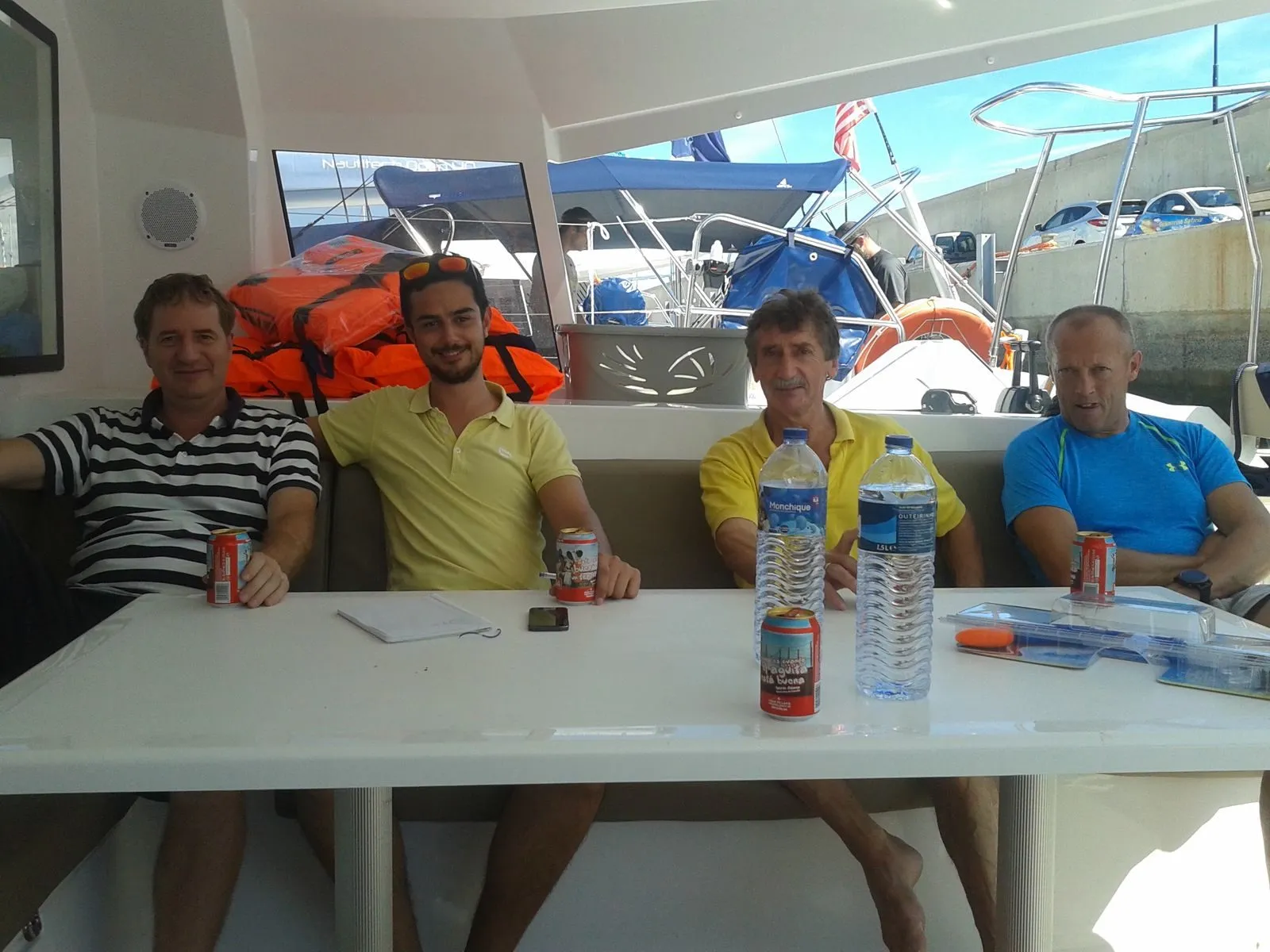
They got back at 7 in the evening, and on top of that they hadn’t even got everything, so the shopping was off for today; I, on the other hand, had a really good sleep…
On the way here from Lisbon they’d pulled off a textbook crash gybe, and the boom, with no preventer, came across and yanked on the sheets so hard that it ripped the sheet block clean out of the boom. That’s what we still have to get hold of and fit.
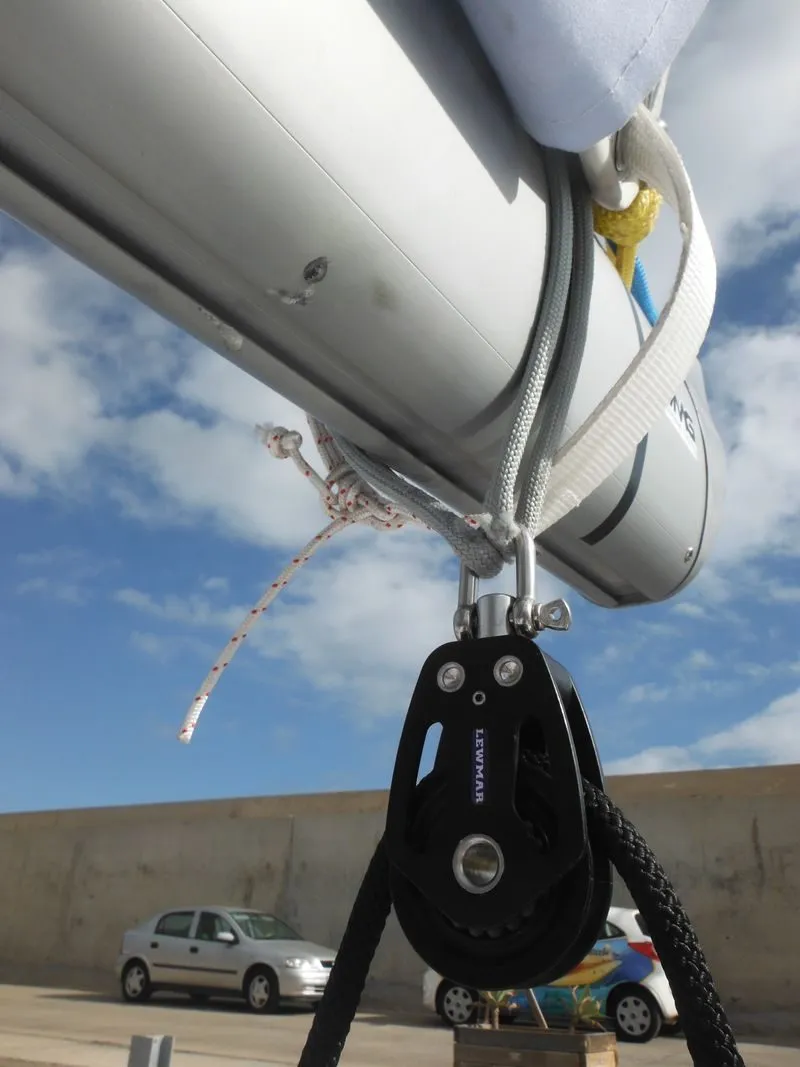
We’ll be sailing under the American flag – I only noticed today.
Funnily enough, we can’t plug into shore power here, because the boat’s electrical system is already set up for the Caribbean 110 volts. But we do have a diesel generator, so our power supply is covered by that for now.
Tomorrow morning we go shopping, then stowing, and in the afternoon Leine los…
That’s the plan; tomorrow we’ll see how it turns out…
After dinner we had an informative chat about the migrant situation on the terrace of an Irish pub. Well, we’re going to have plenty more to talk about on the way…
And we haven’t even heard the Slovenian, Croatian and Czech opinions yet, though we have heard the Merkel-following and the Hungarian positions.
Right, good night everyone!
Machine translation (AI, Claude) of Balázs’s Hungarian original. Read the original →
Wednesday, 4 November 2015,
Day 0.
I’m sitting in the cockpit, and Vivaldi’s Winter is playing, very stylishly, to go with the sunset.
So, as I wrote yesterday, we’re leaving tomorrow…
That hasn’t changed. In the old days they waited for the wind; now we wait for (spare) parts. Which either arrive or they don’t. Like the wind. Which is slowly becoming the more predictable of the two.
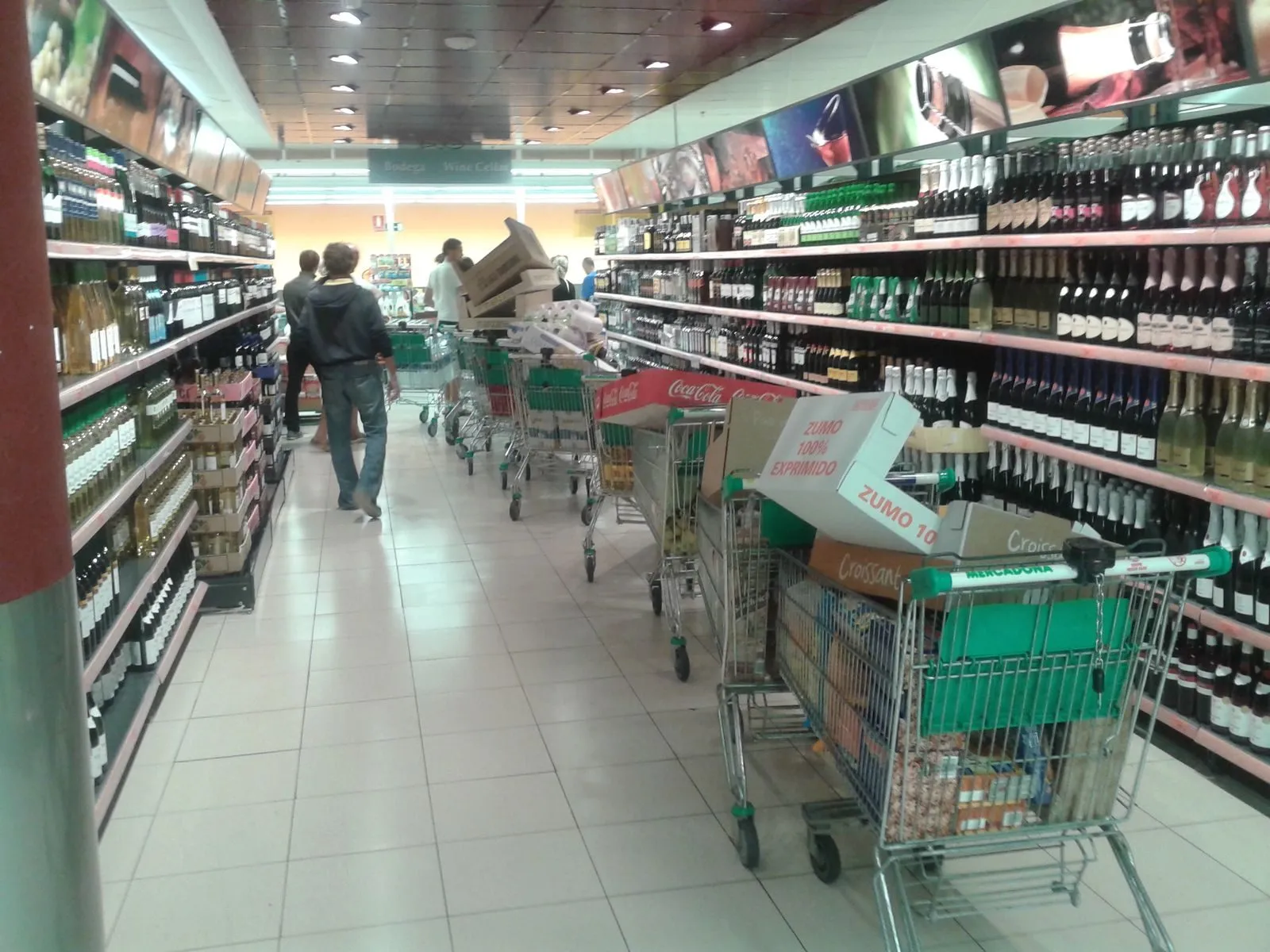
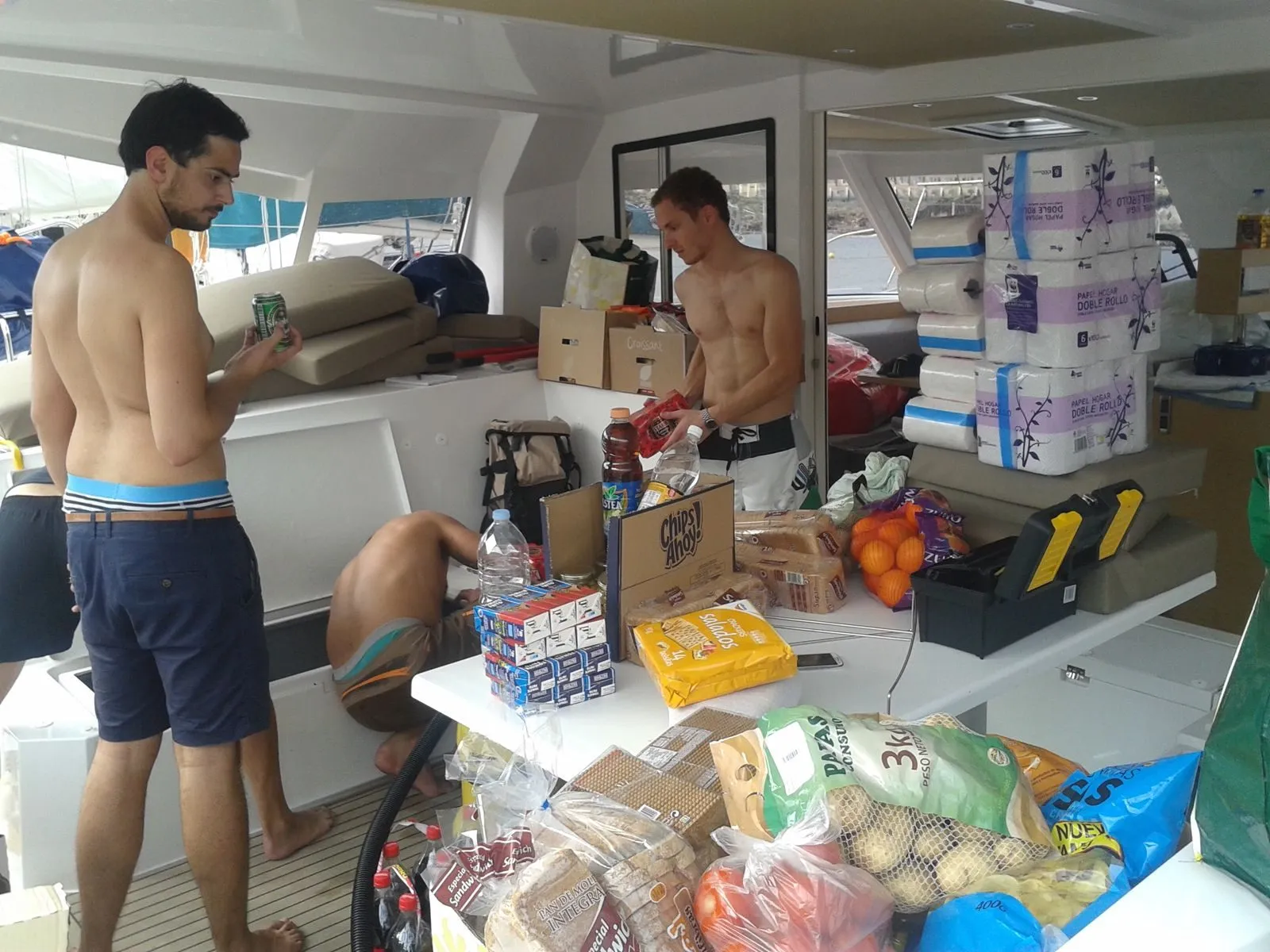
In the morning we went shopping. We filled 13 shopping trolleys and got back to the marina in 3 minibus taxis. I had the feeling we’d bought so much stuff it would do for the return trip as well… Well, we’ll see. About 1,500 euros all told.
In a couple of hours we’d stowed everything nicely on the boat and found a place for it all, but then the chief chief skip came back – bringing a gorgeous big smoked leg of ham, too – and made us clear out one of the lockers under a bench – saying – that’s where he wanted to keep the spare diesel cans, the tools and the parts.
Never mind, we’ve got time; at worst we’ll play twenty questions later about what we stashed where.
Oh, I didn’t mention it: Jiri arrived yesterday too.
He’s 50, owns an amusement park near Liberec, and he too has only ever crossed the English Channel.
If all goes well, you’ll be able to follow where we’re sailing.
Bijan and Simon brought a GPS tracker that sends our position via satellite every 10 minutes, and you can see it on a website. They’ll only switch it on once a day for half an hour, to make the battery last as long as possible.
They were kind enough to give me the address and the password, and they agreed that you can check where we are too, if you’re interested:
https://share.findmespot.com/shared/faces/viewspots.jsp?glId=1DqGxDTQ8bhNMSYmNpz47gTNMzaiYeNTG
Password: gowest
If tomorrow the signal is still coming from an Irish pub, don’t be too surprised…
But later on, during the passage, if the signal stops for a while, there could be lots of reasons for that – no need to start worrying at the drop of a hat – or even two hats.
As for what wind we’ve got wherever we are, you can check that on https://www.windy.com/.
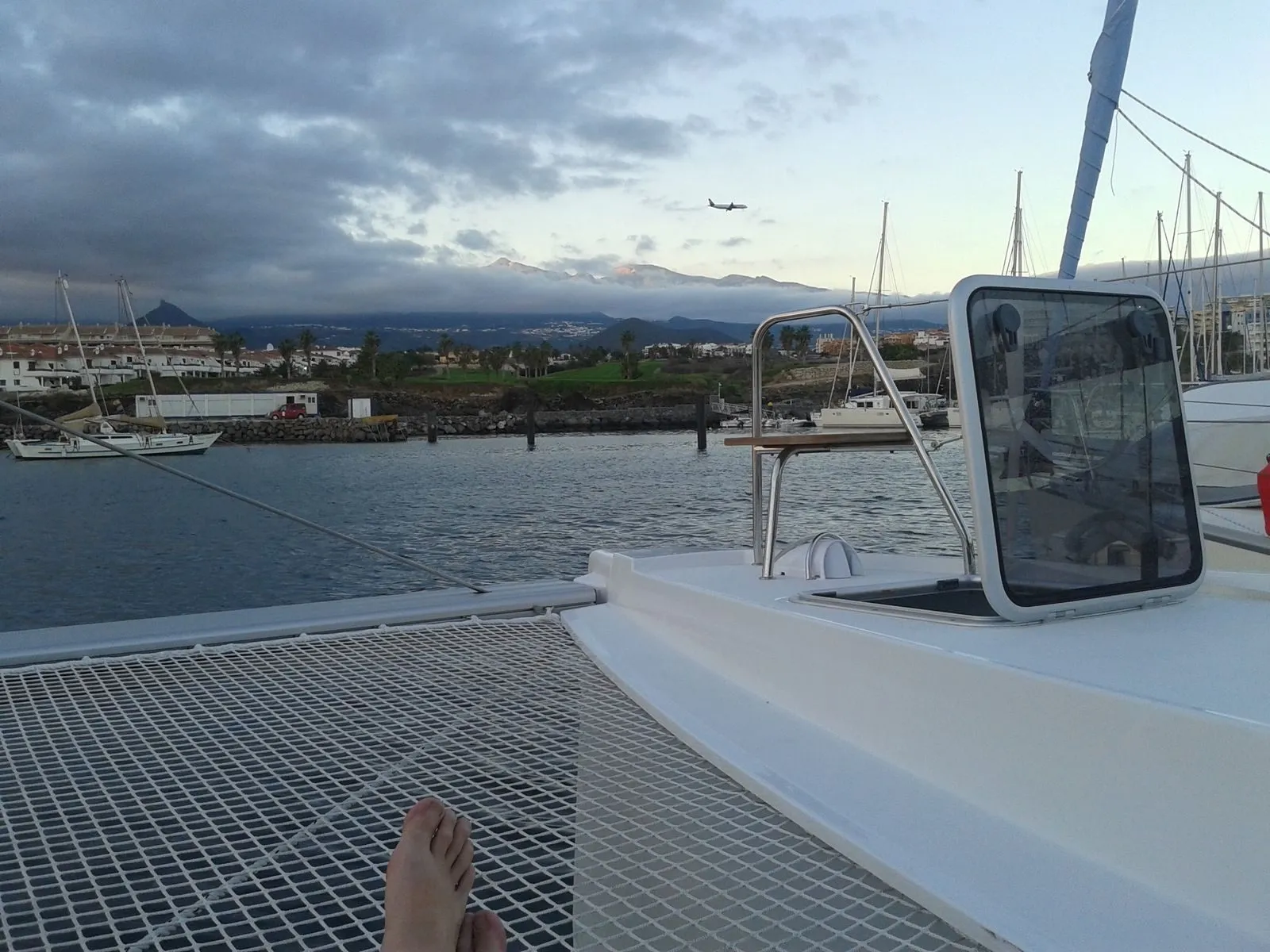
In theory the weather will still be favourable tomorrow; here the sea is completely flat, not a wave in sight.
If we really do leave tomorrow, which isn’t out of the question, I won’t really be able to write at any length any more.
All the best to you too!
Machine translation (AI, Claude) of Balázs’s Hungarian original. Read the original →
Thursday, 5 November 2015.
Day 1
As we used to say in the building trade, there’s always some dog crapping on something…
The plan for this morning: fill up with water, refuel, leave.
Reality:
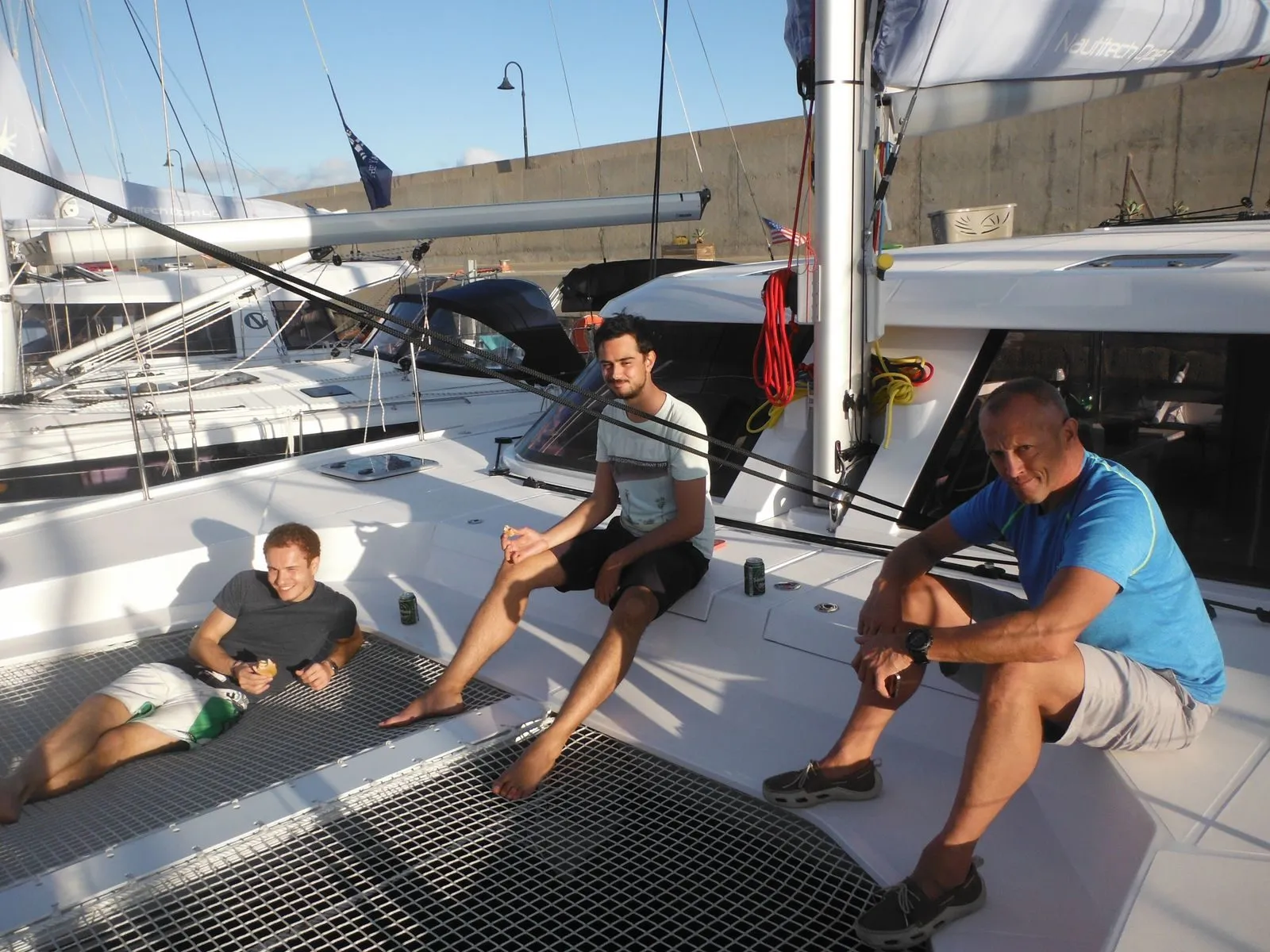
There is, however, plenty of cold beer…
Of course it would have been better to spend these days over on the other side, but so far nobody has asked our opinion on the matter.
Two have already given up. From the Bavaria 46 next door, AMARON, an English father and his twenty-something daughter packed up and flew home this morning.
Simon duly remarked that women on board only bring bad luck anyway…. :))
So says the old sailors’ superstition.
Of course it may also have played a part that their skipper had been spotted first thing in the morning with a hefty joint in his hand. Come again?
– What were they fixing that needed such a big joint? – I asked.
– That’s what they call a marijuana cigarette… – they said, looking at me and patting me on the shoulder.
Ohhh… So, stress relief, for all the rushing about. They’ve been ready for two days and are waiting for us, the rest of the fleet.
Only three of them now. The two skips and a Danish guy.
Here we stand.
Literally.
9:33.
The water is back in the pipes, and Gregor is back too, with a filled tooth.
Miracles do still happen.
At noon they even found a 4th passenger for the Bavaria. A young girl – who had helped us yesterday carry the provisions from the quay to the pontoon – got on board their boat with a small backpack, and they cast off straight away.
First AMARON, the Bavaria 46, refuelled, then us. Quickly a team photo or two on everybody’s camera and phone, and off we went, because the next boat, the Nautitech 40 catamaran MAYA, was already circling right beside us, waiting for us so she could refuel too.
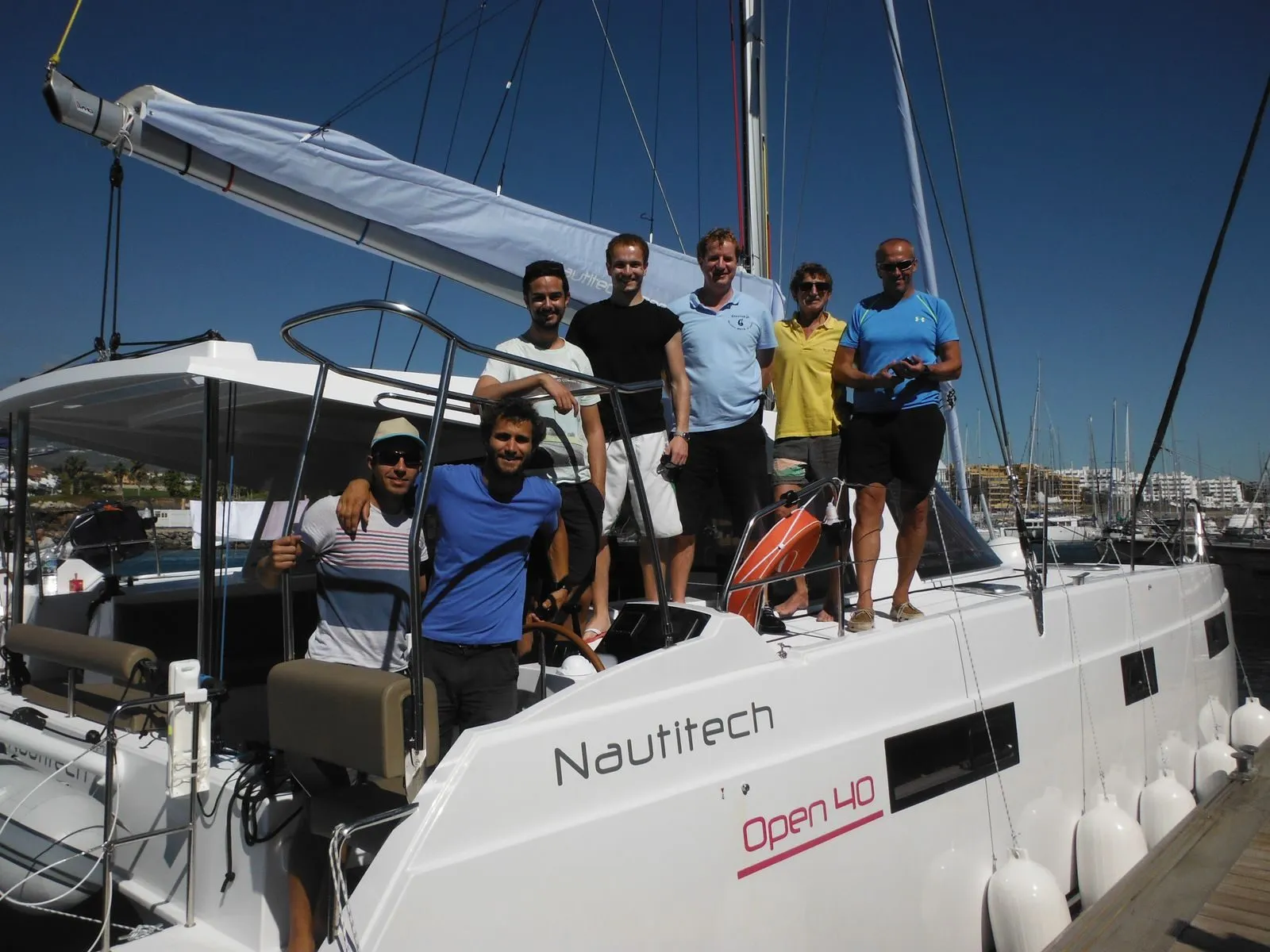
And so, two days late, we finally set off.
In a favourable 15–17 knot breeze on a broad reach, we averaged 7 knots in lovely weather.
Luckily the waves were small and didn’t put our stomachs to too much of a test, but everybody could still feel that something was going on in there. We took turns at the helm to take our minds off our bellies, which more or less worked.
Around half past six we “sundowned” our first sunset with a shot of rum; it was a nice one, but because of the clouds in the way we had to start sipping by feel.
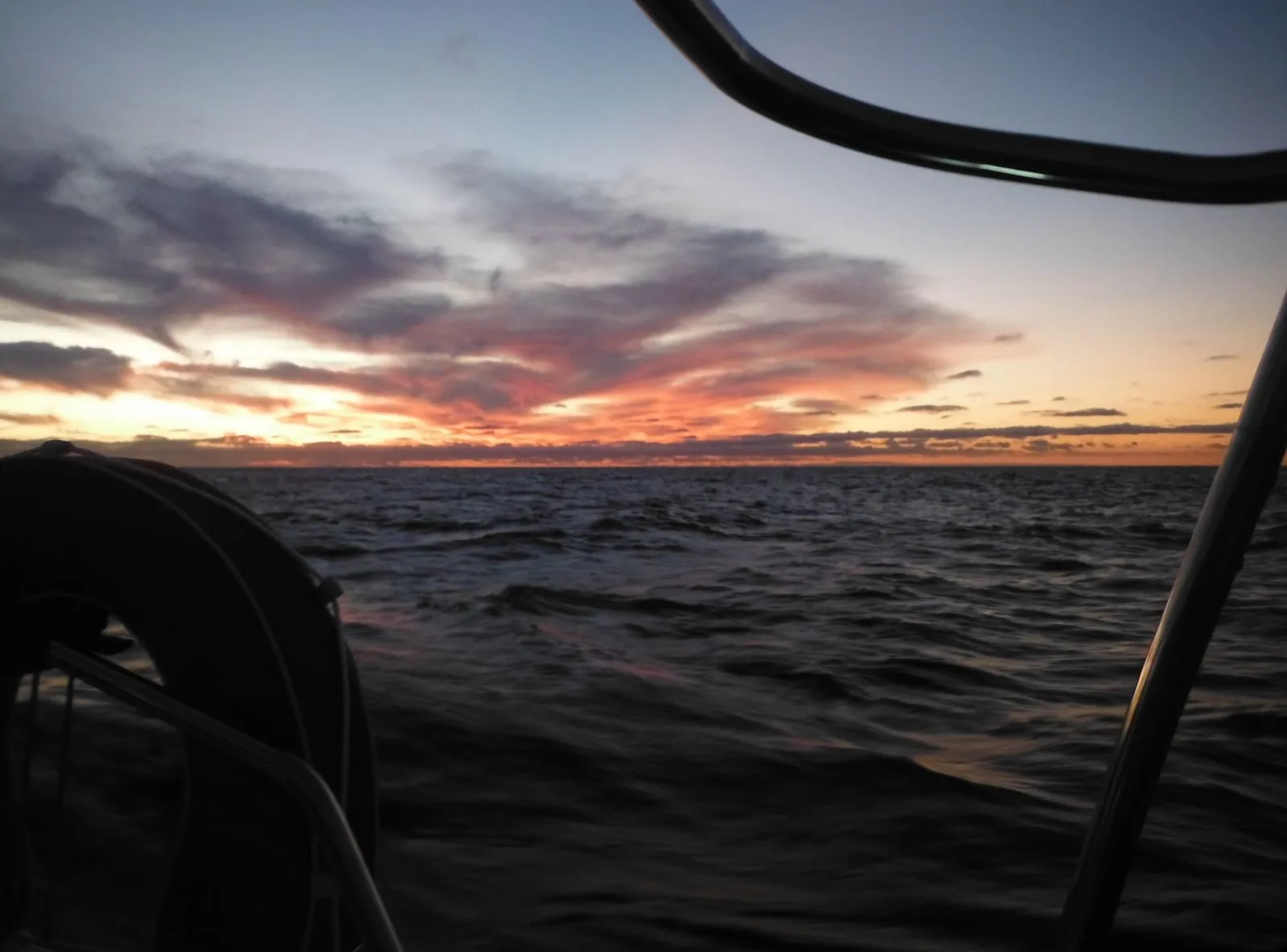
Bijan and Simon sat this round out, just to be on the safe side. Then they pulled themselves together and cooked the first dinner on board: couscous. As couscous goes it was fine, but it’s not what I’ll be dreaming about.
From 8 p.m. till midnight I was up on watch with the skips.
For the first time I saw glowing plankton. They got stirred up in the boat’s wake, and it was as if we were dragging a sparkler through the water: the plankton flickered in the sea in a trail 3–4 metres long.
A really beautiful sight.
The first catch happened that evening too: Gregor caught a 30 cm octopus.
When I went to bed I couldn’t fall asleep for a while, my stomach was busy down there and I kept wondering whether I’d make it through without a dash outside, but in the end I did fall asleep.
Machine translation (AI, Claude) of Balázs’s Hungarian original. Read the original →
Friday, 6 November 2015
Day 2, 142 nm
At dawn I stuffed my ears with tissue in bed, because the swish of the waves and the noises of the boat seemed so loud. That way I managed to squeeze in another round of sleep.
In the morning Gregor gave a safety briefing: what to watch out for, what to do if someone goes overboard, and what to do if you’re that someone. (And what to do so you’re not that someone…)
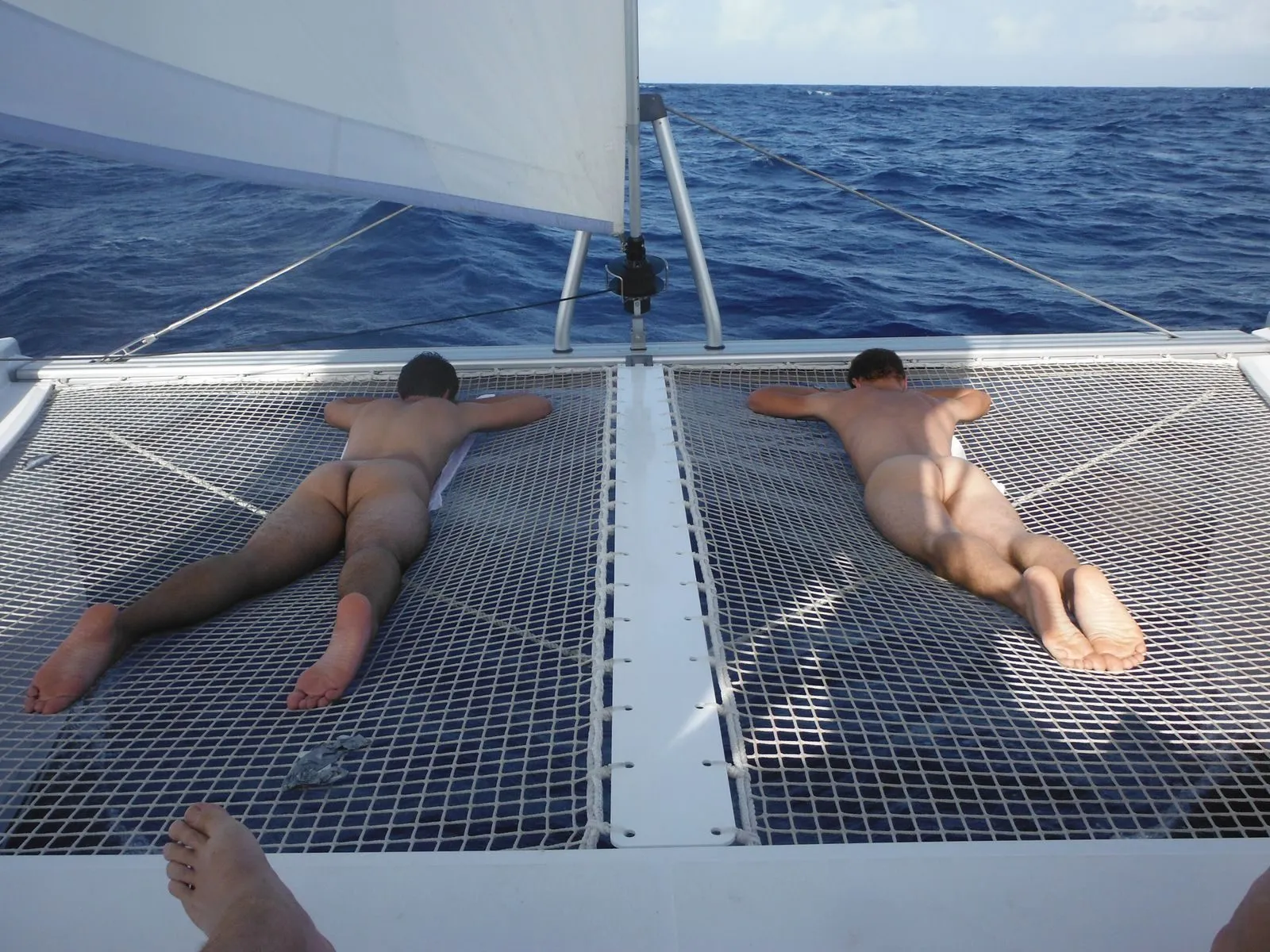
Then all of a sudden a pod of dolphins surprised us. About 20 dolphins followed us for a quarter of an hour, in front of the boat, alongside, and between the hulls. We lay on our bellies on the trampoline at the bow – like kids – and watched the dolphins leaping about…
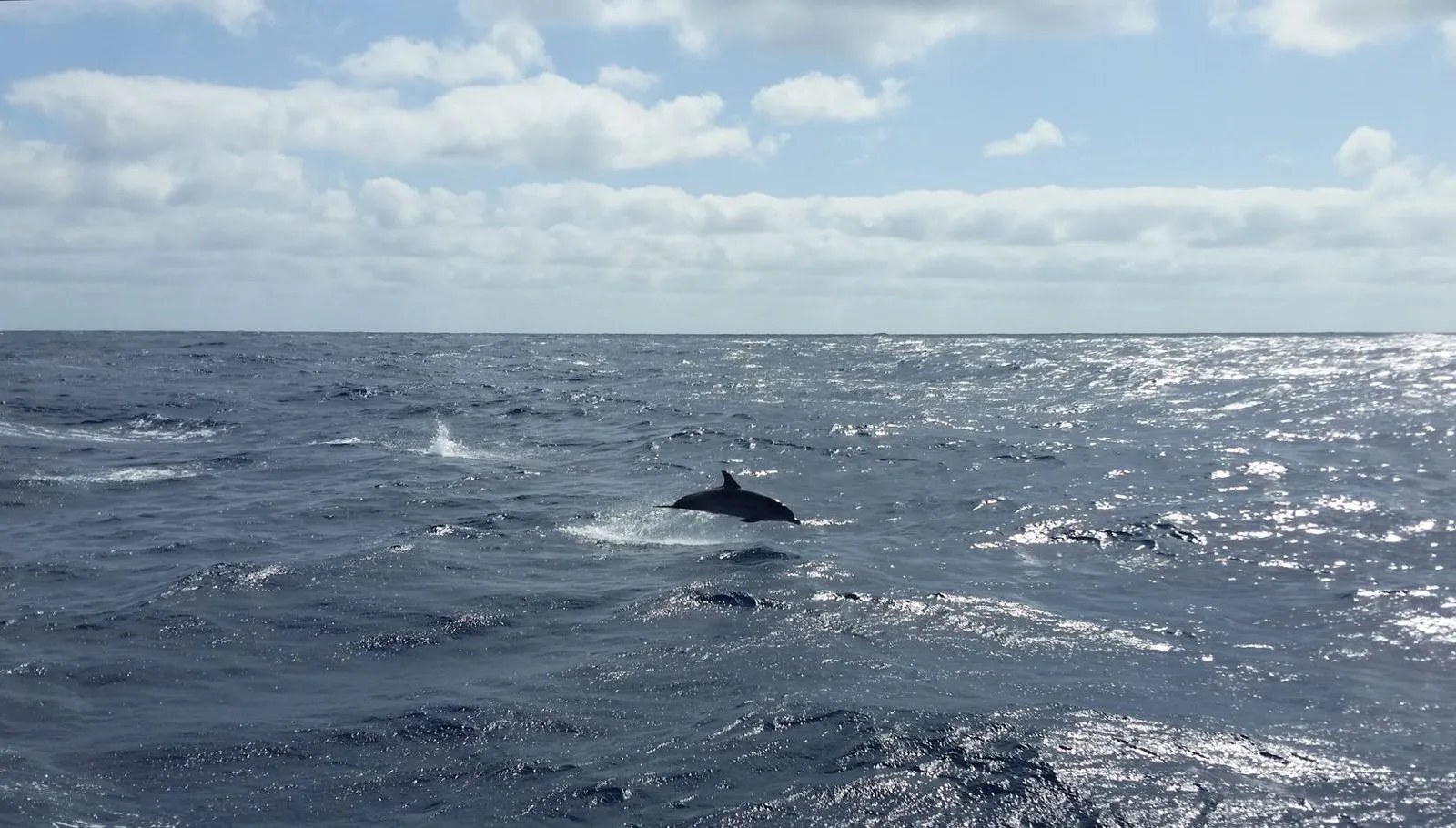
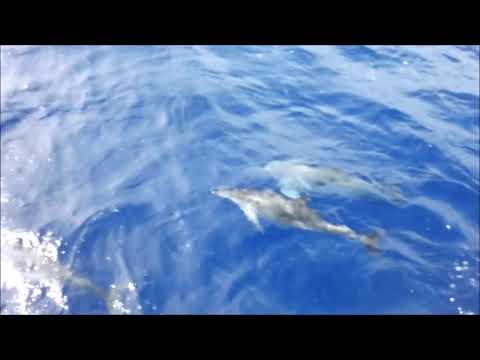
Meanwhile Igor cooked the octopus from the night before in a frying pan, and it made an excellent starter.
I cooked the first lunch – a proper pörkölt, Hungarian stew – with Willy as my assistant. While we were at it, we tested the red wine diligently to make absolutely sure it would be good enough for the stew. My appetite-whetting pear pálinka before lunch moved everybody deeply; one after another they tried to get their breath back with tears in their eyes…:)
They remarked that they’d never have thought they’d eat real Hungarian goulash for the first time in their lives on the Atlantic Ocean, off the coast of Africa… They liked it, and went back for seconds in a big way.
The weather is pleasant today too, with small, half-metre waves, clouds sailing across the sky and a friendly 25 degrees. We covered 142 nm in 24 hours since we set off yesterday. We measure the daily run from noon to noon.
AMARON is 18 miles ahead of us; MAYA, behind us, we can no longer hear on the VHF.
I think we’re lucky with this pleasant weather and gentle swell, and we’ll all get away without seasickness…
No sooner had I written this and put my laptop away than the first disaster on board struck.
My phone fell into the ocean…
Don’t even ask why the… «three-syllable beep» ,
anyone would carry a phone around in the middle of the ocean! OK, fine, on the edge of it…
A lovely little chain of coincidences. I hadn’t brought a watch (because I’ve got the phone), I’d been checking the time on it while cooking, and it stayed with me in the belt holster, whose side seam had come about 20% undone. As I went aft to the helm, the holster on my hip caught slightly on one of the posts. Not much, just enough that I felt a tiny bit of resistance, then I heard a clunk on the deck, and as I looked round I could still see my phone do two somersaults down the steps and dive headfirst into the foam… In the boat’s wake, as if waving goodbye, its side flashed once more in the sunlight – like a predatory fish – and then, adieu, it vanished from my sight for ever.
Bloody … «very long beep»
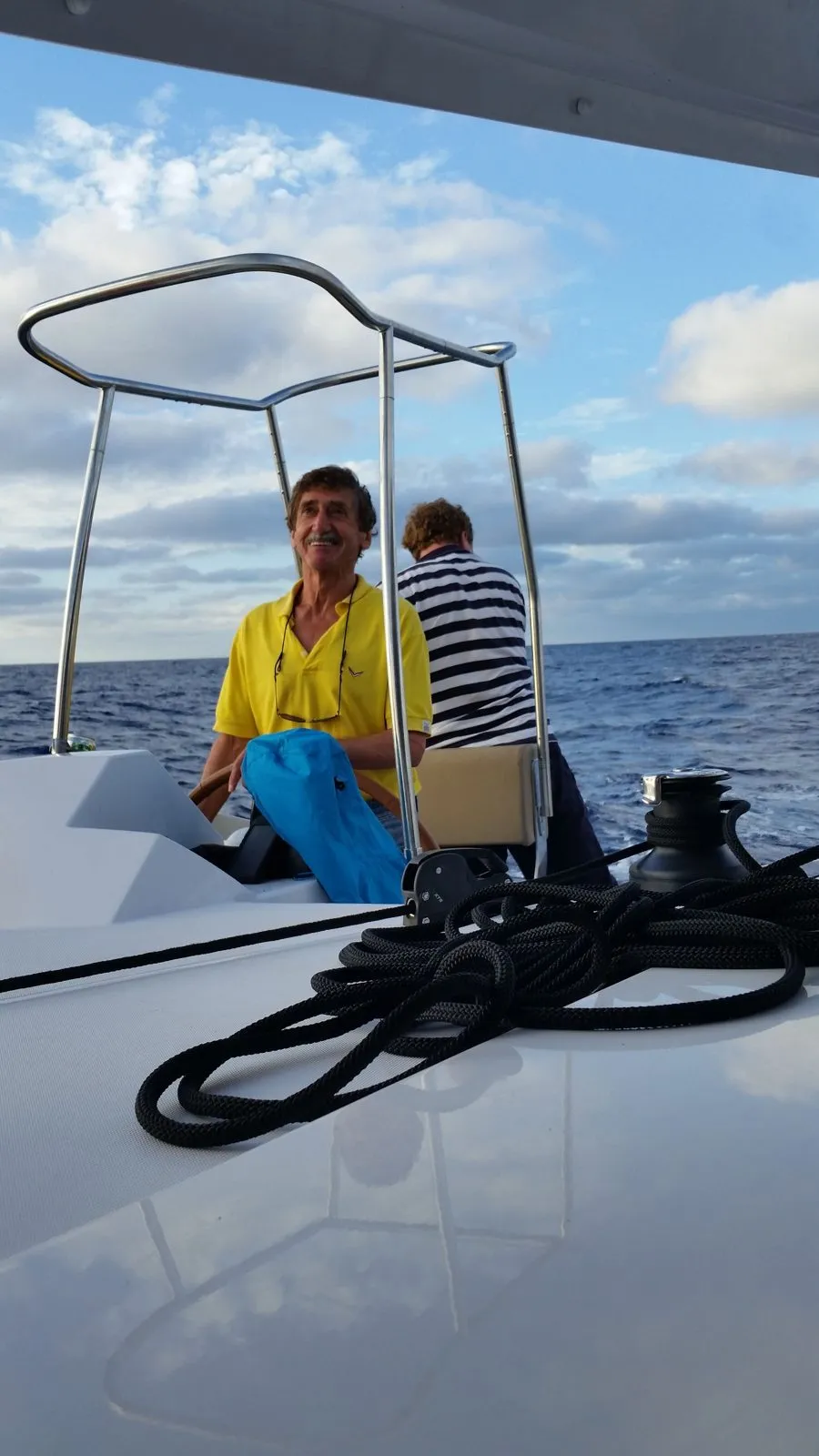
Bijan asked:
– Was it waterproof at least? – grinning sympathetically all the while…
– No, dammit…
Well, I’ll be getting a new phone. But at that moment I couldn’t exactly be happy about it…
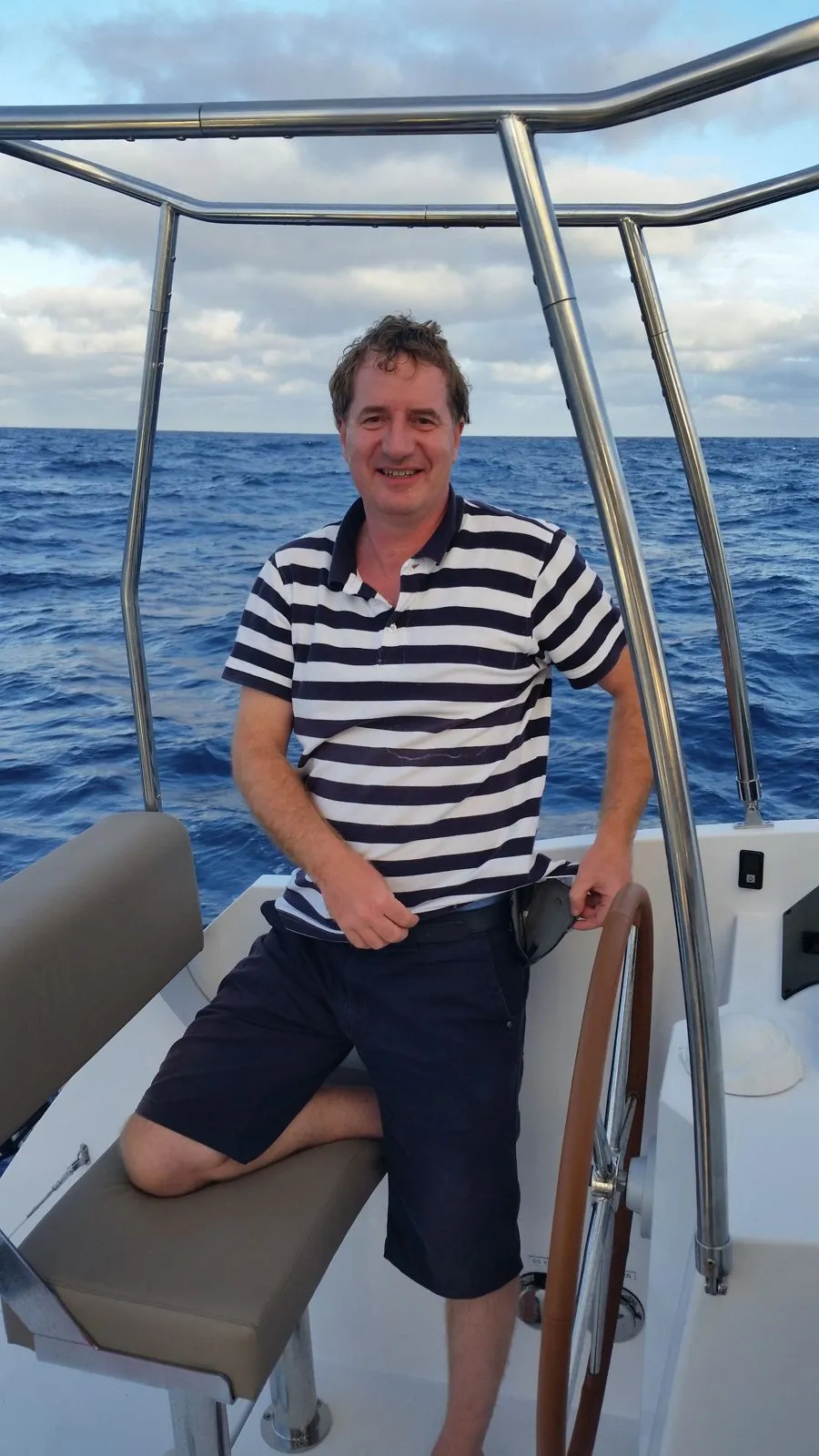
As if I were happy about it, but I’m not
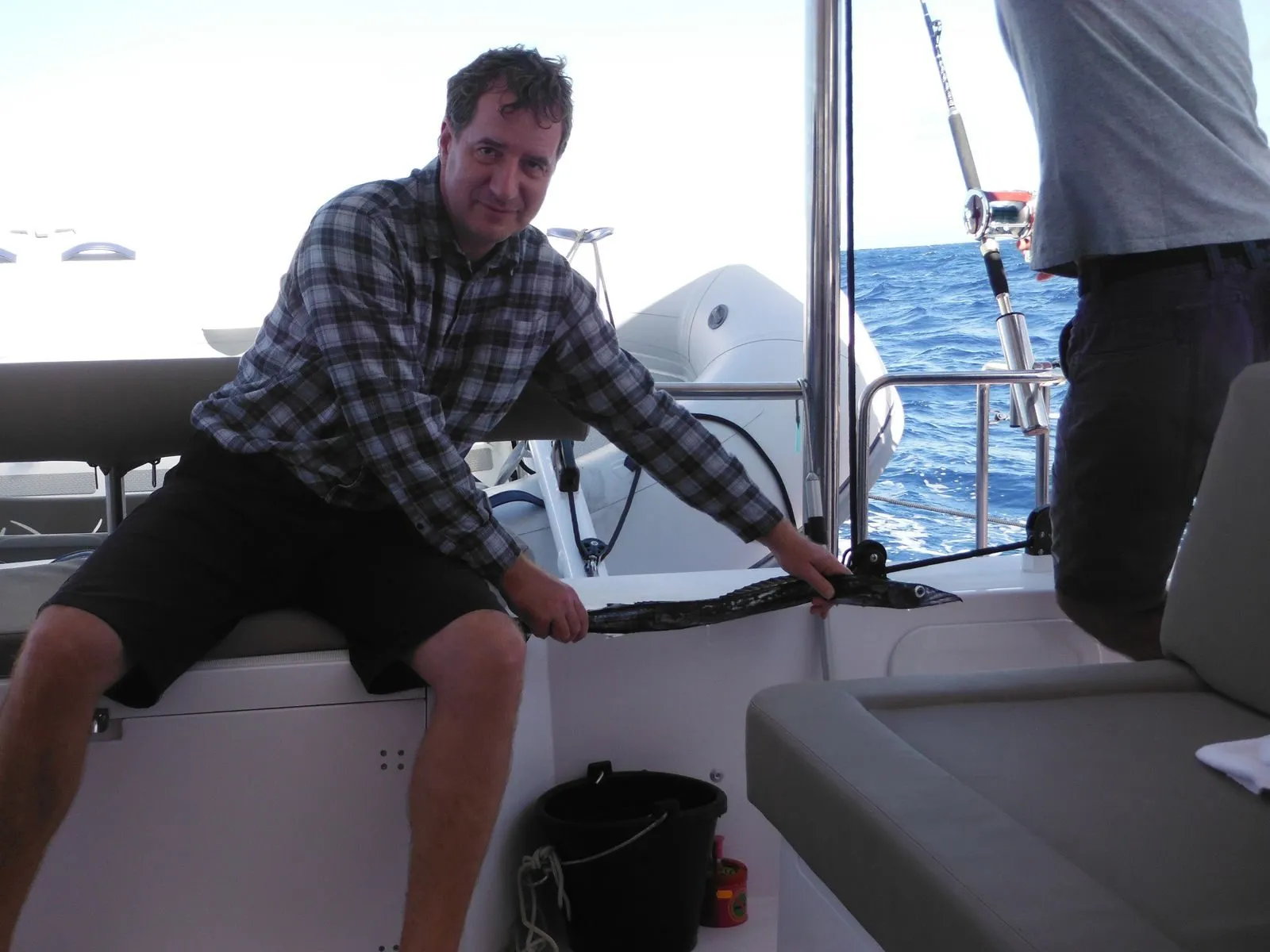
On the bright side, Igor caught a thin, long, ugly-headed fish.
At dawn, from 4 to 8, I was on watch with Jiri and Igor.
For the first time I found the Plough and the Pole Star. They’re only just above the northern horizon, and the clouds over the horizon had always hidden part of the Plough so far, which is why I hadn’t recognised them. We saw a few comets, and the thin, sickle-shaped waning moon gave enough light that it even cast a bit of a shadow on the deck.
Machine translation (AI, Claude) of Balázs’s Hungarian original. Read the original →
Saturday, 7 November 2015
Day 3, 140 nm

When the watch ended at 8, we had breakfast. Somehow everyone went for the sandwiches with goulash paste, even though I’d left a few without, but in the end I had to spread those too.
After that I read and had a sleep. I’d held off reading until now, partly because there was plenty to do, and partly because reading with a queasy stomach on a rolling boat isn’t a good idea. Better not to give Ralph and Huey any ideas.
For lunch Bijan and Jiri made rice with broccoli and veg. I missed the meat in it, so I got out a bit of Vegeta (the stock powder every Hungarian kitchen swears by) to improve the overall picture a little.
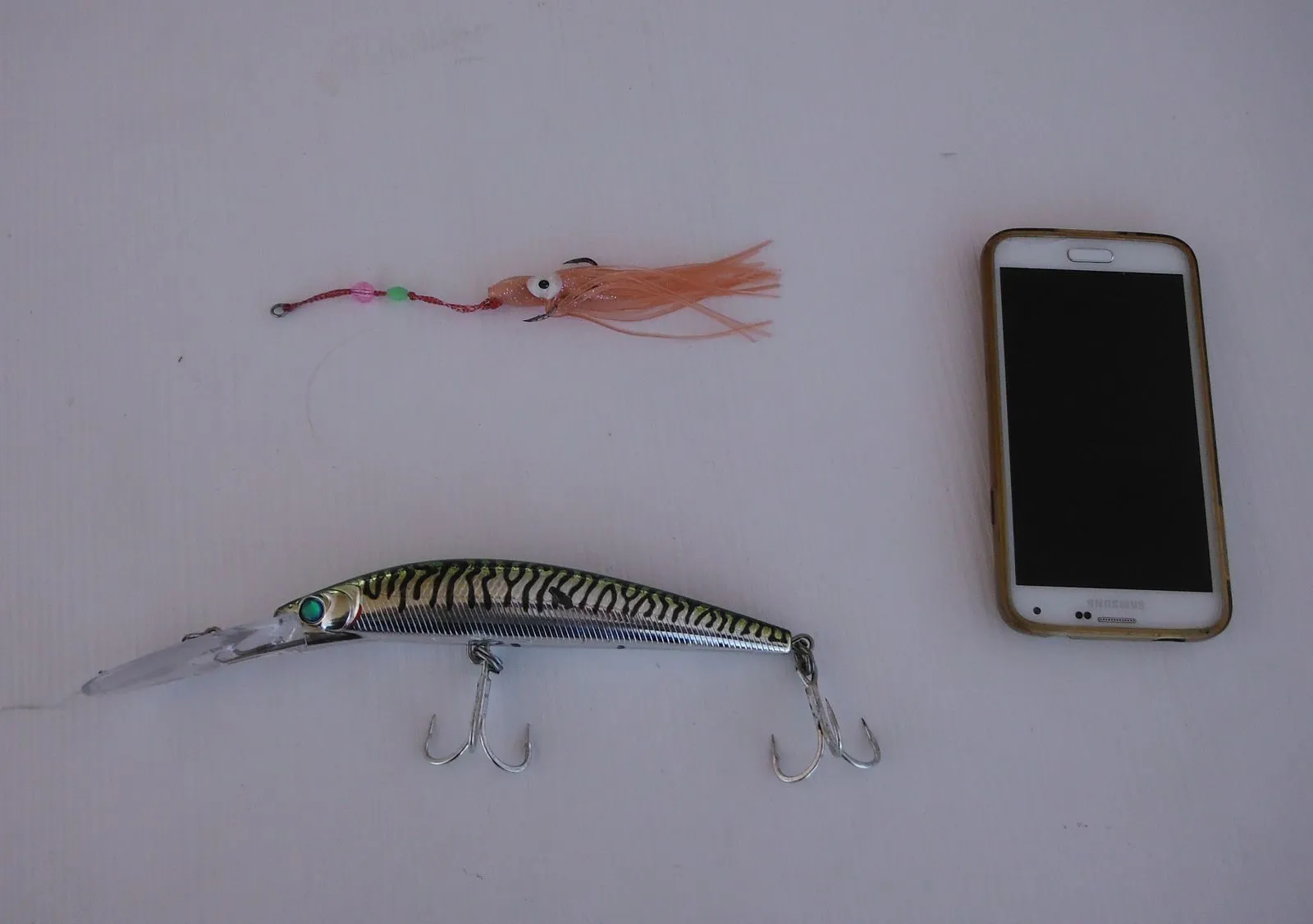
After lunch a fish made off with the middle, octopus-like lure and the lead weight, so I quickly took a photo of our two remaining lures, so I’d know what we used on the trip.
In the afternoon we sorted out the order of the night watches. To the skips it doesn’t really matter who of us does what and how, but they’re happy to have someone beside them. Willy drew up a rota for the five of us. Two people are in charge of cooking each day, always a different pair. During the day there’s no fixed rota for now; whoever feels like it stands at the helm.
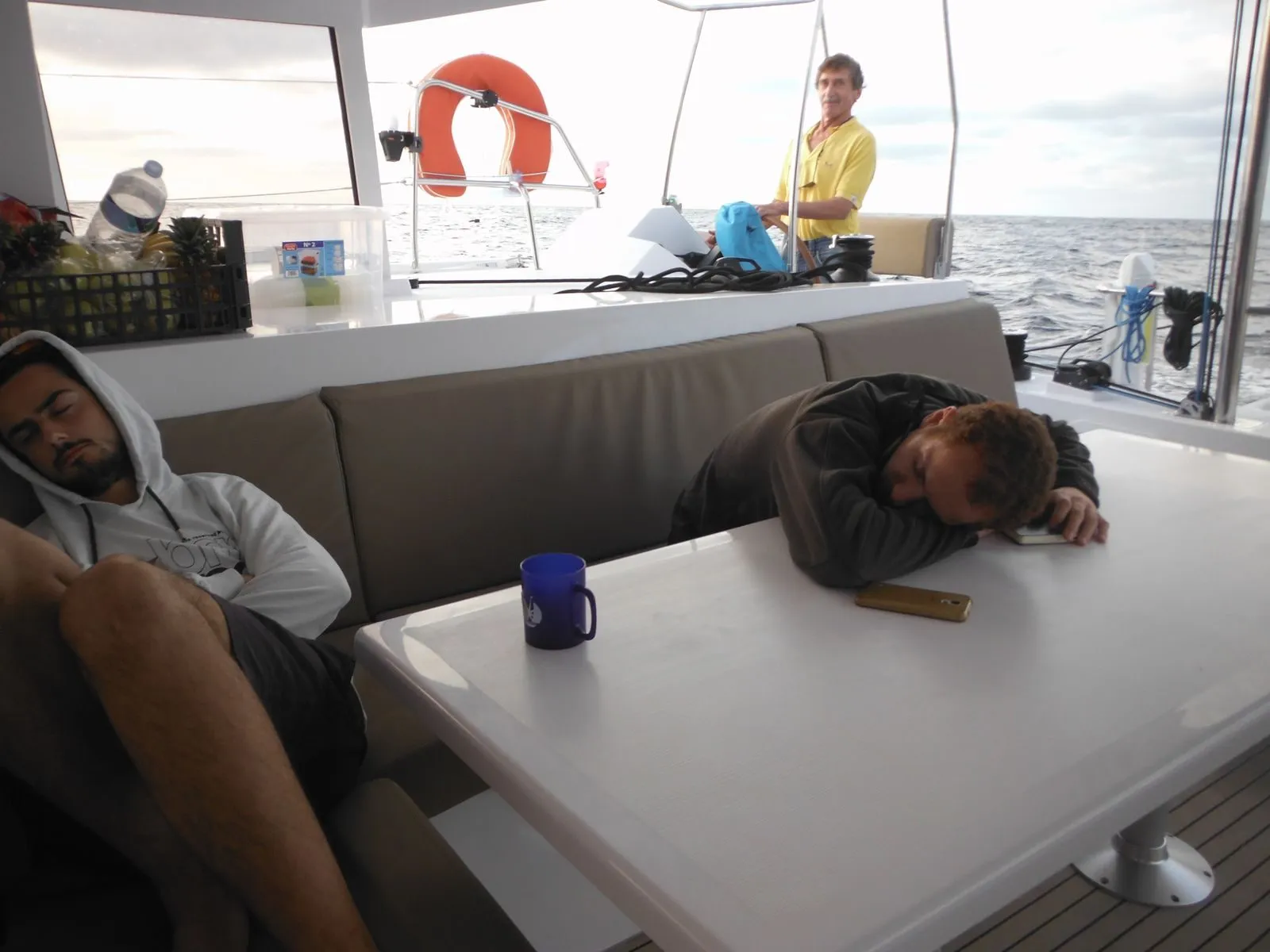
From 8 p.m. to midnight one of the five of us is up there next to one of the skips; from midnight to 4 and from 4 to 8 it’s two people each, preferably arranged so that the two who sleep in the same cabin are on different watches. That way whoever is asleep can sprawl out comfortably across the double bed.
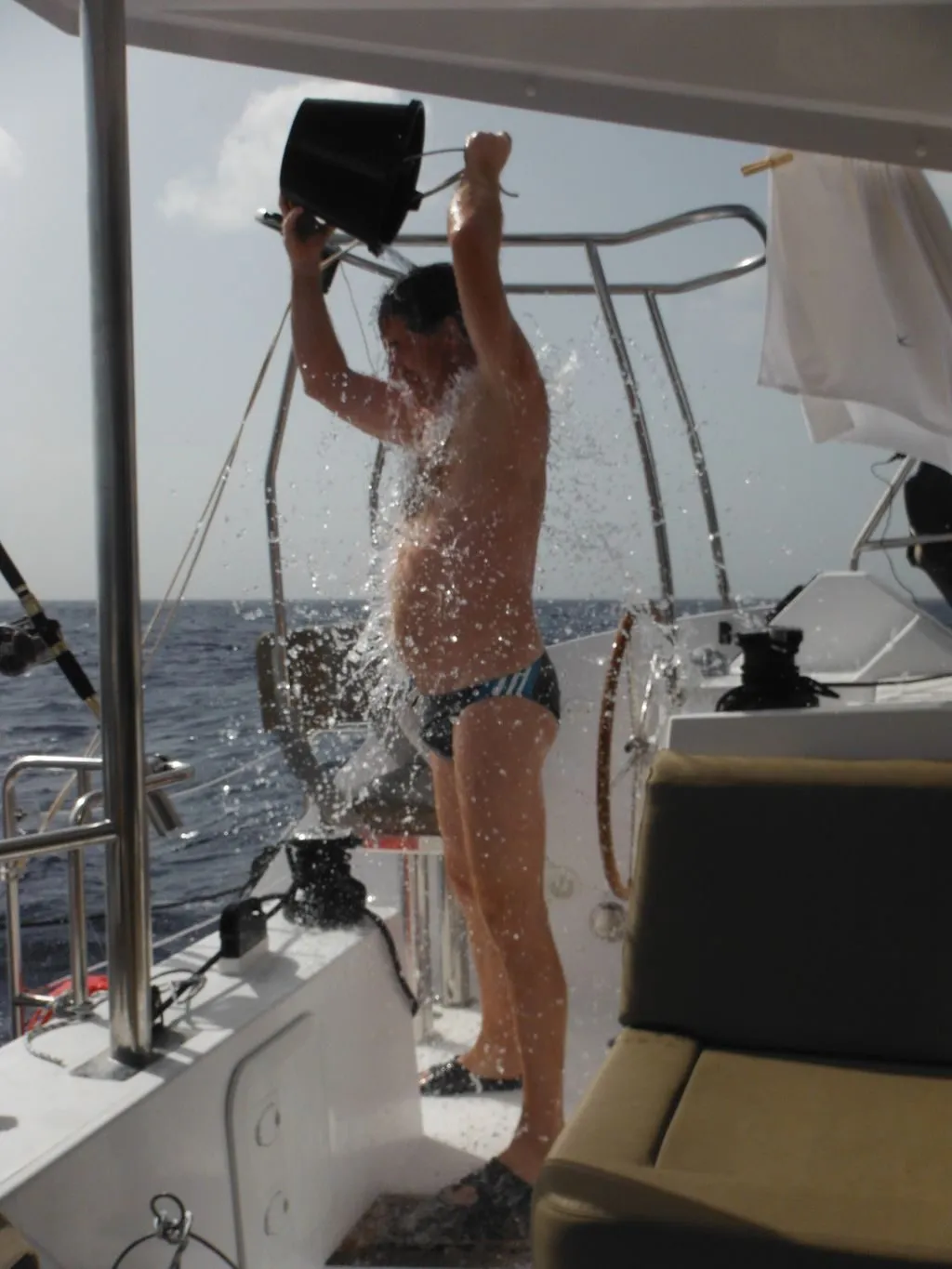
In the afternoon, after the others, I had a wash at the stern too. Tie the bucket on, haul up ocean water without falling in, tip it over your head, shower gel, and the same all over again. The water isn’t yet warm enough for it to feel really good.
Later Igor got going and wanted to make fish soup from last night’s catch. He asked me, the chef (after the stew), whether the ingredients he had in mind would work. Since there’s nothing else on board, I nodded. He was doing quite well with the soup, when at the end a big burst of swearing was heard. The 3 litres of soup had turned into boiled rice in no time at all. He’d poured in “a little rice” – about half a kilo – which soaked up all the liquid… So instead of soup – by the next stir – it became fish-flavoured rice, with a million little bones. It didn’t exactly fly off the plate…
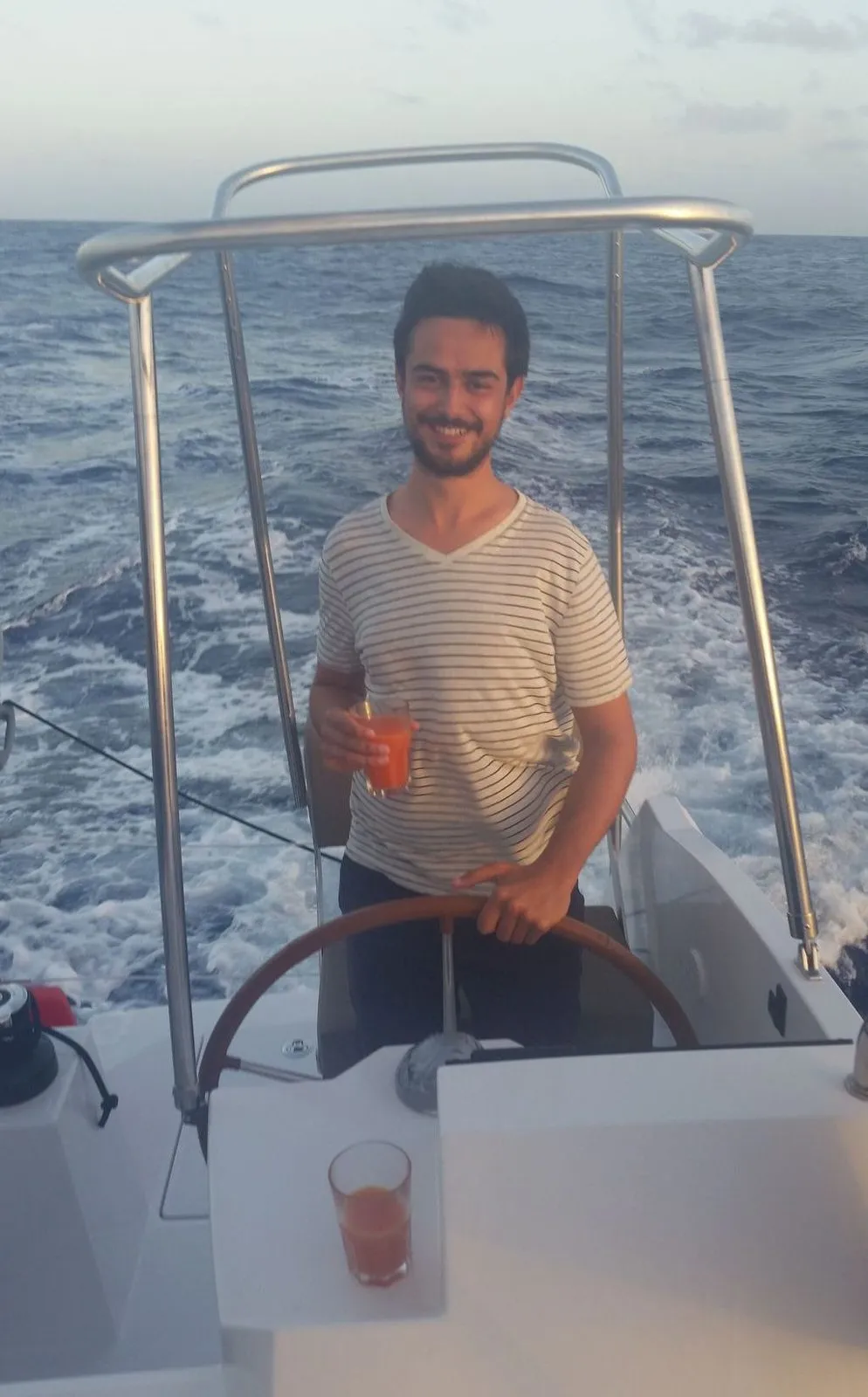
From midnight to 4 I was on watch with Bijan. He’s 23, studying mechanical engineering in Munich. His paternal grandparents, Shia Muslims, came from Iran to Germany in 1960, still under the Shah, hoping for a better life. His father was 6 at the time, and only recently, after 50 years, did he visit his homeland again for the first time. Bijan is already a Lutheran, like his German mother.
After we arrive, he and Simon will sail for 2 weeks on St. Martin with their friends, and then spend 30 days seeing the still “old” Cuba, since they’re over there anyway. They’re paying for the trip themselves; Bijan works 2 days a week at BMW, in the engine development department.
I watched the starry sky turn around the Pole Star, and the handle of the Plough rise up out of the sea. We saw a few shooting stars, aeroplanes, and the lights of AMARON to starboard, far ahead of us. Then some cheerful fisherman played us Guantanamera and another Spanish hit on channel 16, the distress channel, so we wouldn’t get bored…
Machine translation (AI, Claude) of Balázs’s Hungarian original. Read the original →
Sunday, 8 November 2015
Day 4, 157 nm
In the morning I did a bit more reading, then sent a big text home. (1,000 characters.)
Well, not from my phone, obviously, but from the boat’s satellite phone.
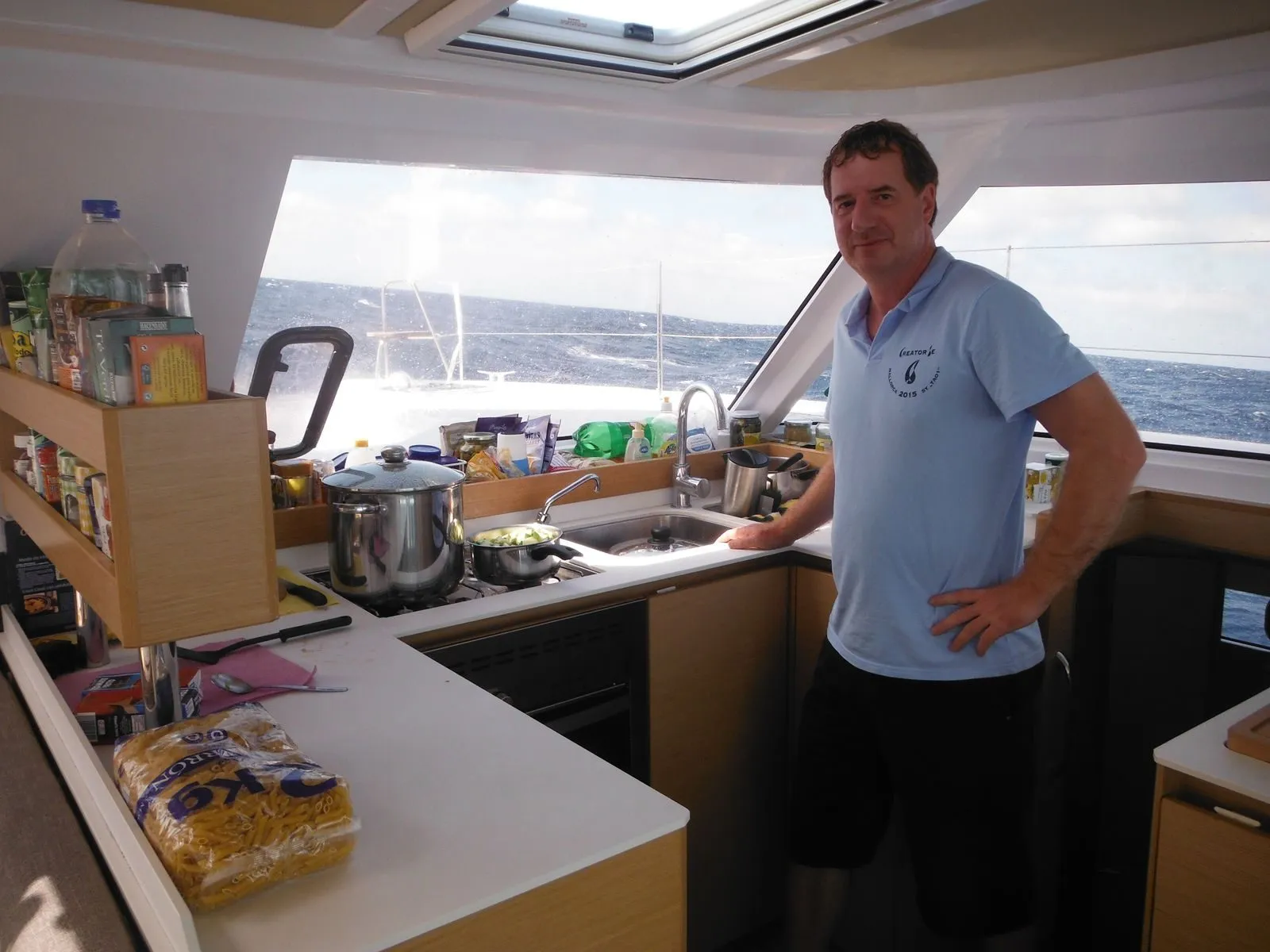
Today I cooked lunch with Simon. On the menu: vegetable soup (to use up the carrots before they go off), bolognese sauce made with tinned beef, penne, and steamed courgette and green pepper. Almost all of it got eaten, and they even remarked that maybe I should cook every day. Yeah, right, I thought, you’d get bored of my not exactly vast repertoire pretty quickly, that’s for sure.
We’re halfway to the Cape Verde Islands. We’ve got a steady 20–24 knot north-easterly, with 1–2, sometimes 4-metre waves. On one of them the boat went surfing and for 10–15 seconds we galloped along at 15.2 knots. It’s 25–27 °C, sunny, with a few clouds. We’re zigzagging on a broad reach, just shy of dead downwind – away from the African coast – at an average of 7–8 knots, sometimes even 9.

At dusk Igor floated the idea that he could really go for some pancakes.
– So could we – we told him in chorus.
And he got down to it. By the time he started frying them it was completely dark.
Well, there’s a certain atmosphere to it: you’re lit up like a Christmas tree, so you can’t see a thing beyond the boat’s guardrail, just the great big pitch-black nothing out there, and now and then the white crests of the waves behind the boat, and you’re charging into the night at 8 knots while munching on Nutella pancakes…
And this from Igor, who at the start of the trip told us to finish dinner before dark so we wouldn’t have to sail blind…
From 4 to 8 in the morning I was up, watching the waning moon and the stars moving, and chatting with Gregor. He told me that in the marina on Tenerife 3 or 4 people a day asked whether we’d take them to the Caribbean. They fly in from Europe to the Canaries and from here they try to hitch a ride onwards. Towards the end of November the ARC leaves from Las Palmas, when hundreds of yachts cross the ocean at the same time, and lots of boats are looking for people to help out. Hitchhikers usually pay their share of the food, but nothing more.
Machine translation (AI, Claude) of Balázs’s Hungarian original. Read the original →
Monday, 9 November 2015
Day 5, 169 nm
In the morning I fried up the leftover pancake batter from the night before, then mixed some more, and by the time that was gone too it was 11 o’clock. Meanwhile a Cape Verdean radio station entertained us with Frank Sinatra hits…
All of a sudden the reel on the fishing rod started spinning like mad – fish on.
After a good long fight Gregor landed the fish, a mahi-mahi of about 50 cm. I think its proper name is dorado, and mahi-mahi is the name borrowed from the Polynesians.
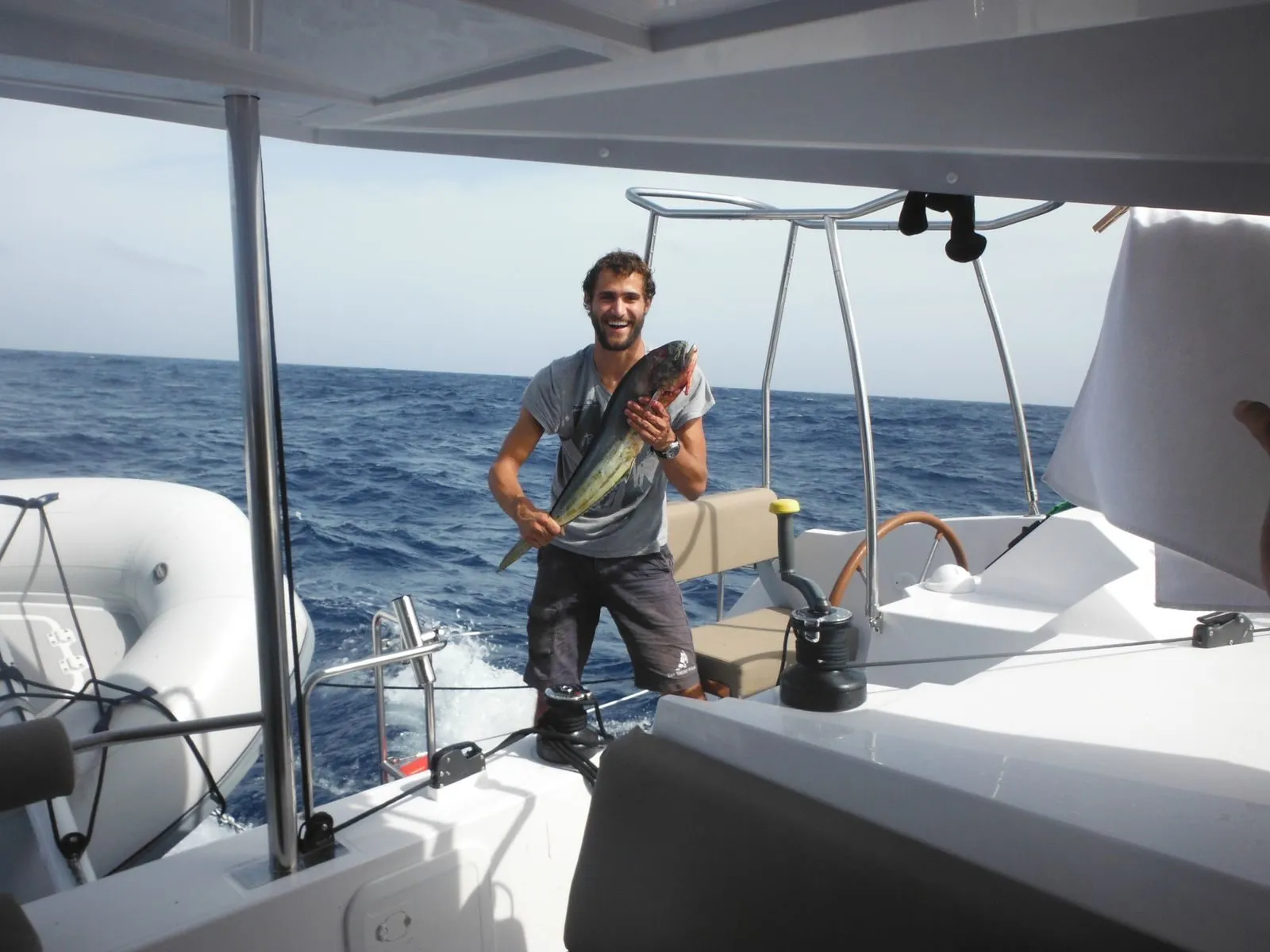
Gregor cleaned the fish, and Igor and I made a Croatian fish soup out of its head and its tail (the fish’s, not Igor’s!) with a drop of white wine. And rice, which this time I portioned in myself, very carefully… It turned out really yummy, every last drop went. The fillets we put in the freezer.
In the afternoon the wind dropped a bit and the waves calmed right down, so I had another bucket bath at the stern. There was only one thing to watch out for: not to end up like my phone. OK, I’m waterproof and I don’t sink straight away, “but this must not tempt us into recklessness”. (As it really did say back in the day in the owner’s manual of the Trabant – the East German two-stroke cardboard car – referring to the vehicle’s great acceleration and excellent road-holding….:)
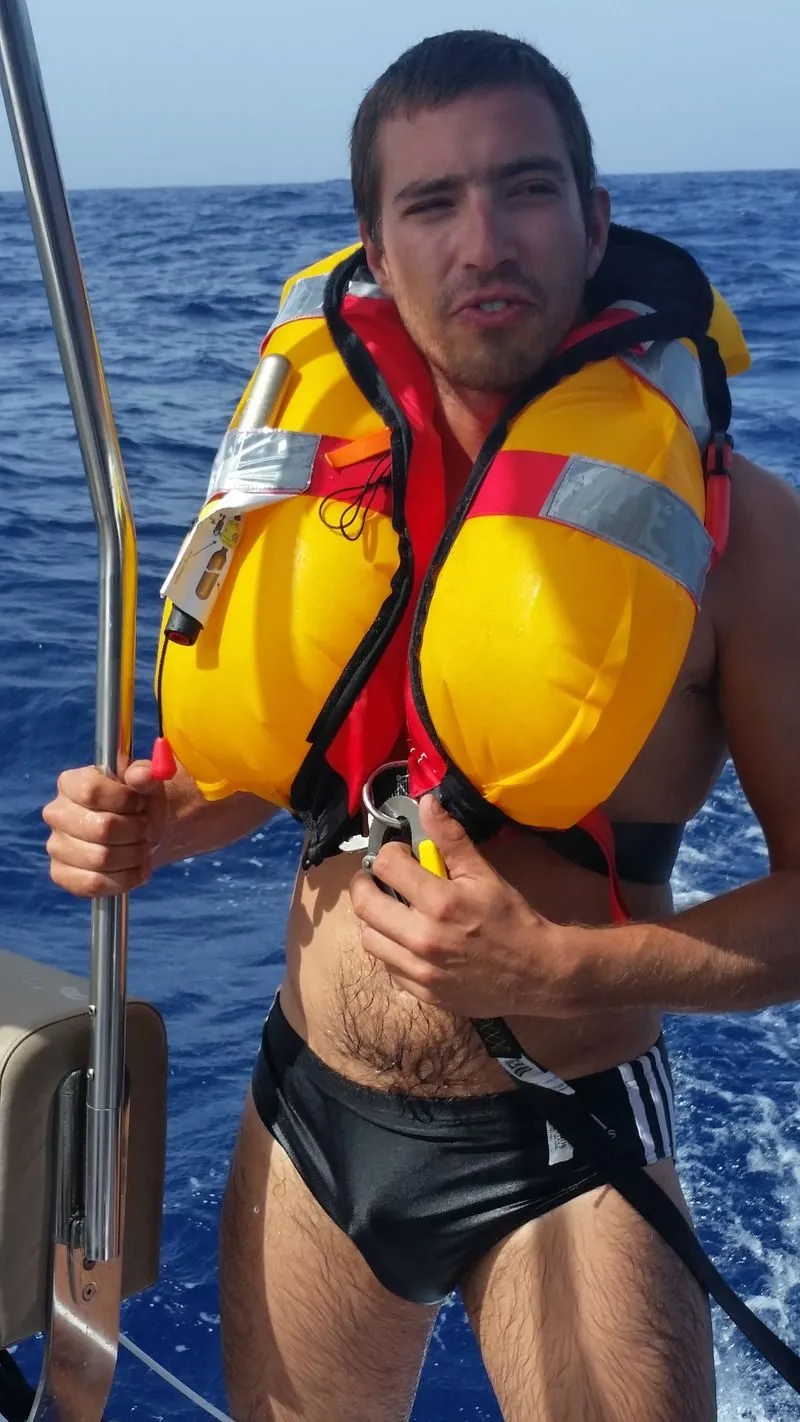
Igor must have got the urge too, because he put on his automatic life jacket, clipped himself on at the stern and climbed down the swim ladder into the water. It wasn’t easy for him, because we were still doing 4–5 knots, but he did manage to dunk himself up to his neck.
The rest of us couldn’t quite work out what he was up to, because, you see, an automatic life jacket is called automatic, and is so flat, because when it hits the water it inflates by itself with a bang, from a biggish “soda-siphon cartridge”.
The surprise we were all waiting for duly arrived: on Igor, clinging on in the rushing water, the life jacket went off with a pop and blew up in his face in a split second, so now he had to wrestle not only with the water, the tether and the ladder, but with the life jacket getting in his way as well…
Spluttering and f-wording non-stop, he finally scrambled out with great difficulty, while we – like true gentlemen – nearly split our sides laughing…
As it turned out afterwards, he’d thought his life jacket was just a harness he could clip himself to the boat with in rougher weather. (So much for the experienced skipper.)
On the other hand, now he also knows that in an emergency he’ll have to blow it up himself, because the cartridge is well and truly empty…
Not long after that, the reel started spinning again. This was a longer fight: sails down one after the other, engine in forward, then reverse, then forward again. Now and then we caught sight of the big fish under the water as it tried to escape sideways or by diving. Gregor ran right round the boat twice, following the fish with the rod, but in the end he managed to land the catch with the gaff. (Or whatever that thing is called?)
This one was a mahi-mahi just like the first.
Gregor flopped down next to his catch grinning from ear to ear, but then when we asked him: – So what’s going to happen with this one? – he realised, a bit grumpily, that all he’d caught himself was more work, and he could start gutting fish all over again. It went quicker this time, and the whole fish ended up in the freezer. We didn’t cast the hook out again…
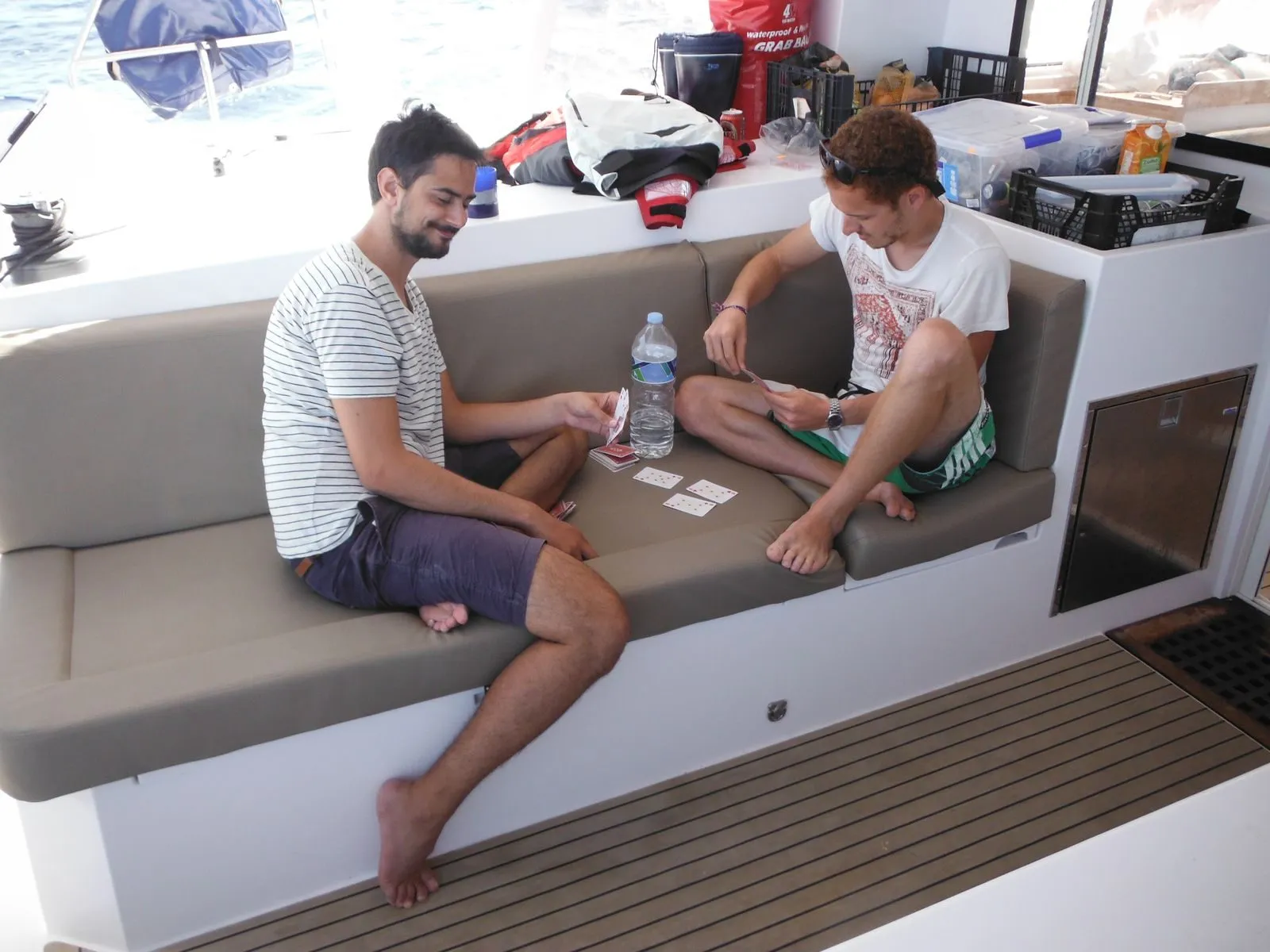
In the afternoon I taught Simon and Bijan to play rikiki (a Hungarian trick-taking card game, a cousin of Oh Hell), and the three of us played a game. Up to the 7th deal I was dead last the whole time, but then at the end (we went up to 17 cards) I won easily. On a monohull you couldn’t have played so calmly, because of the boat’s rolling.
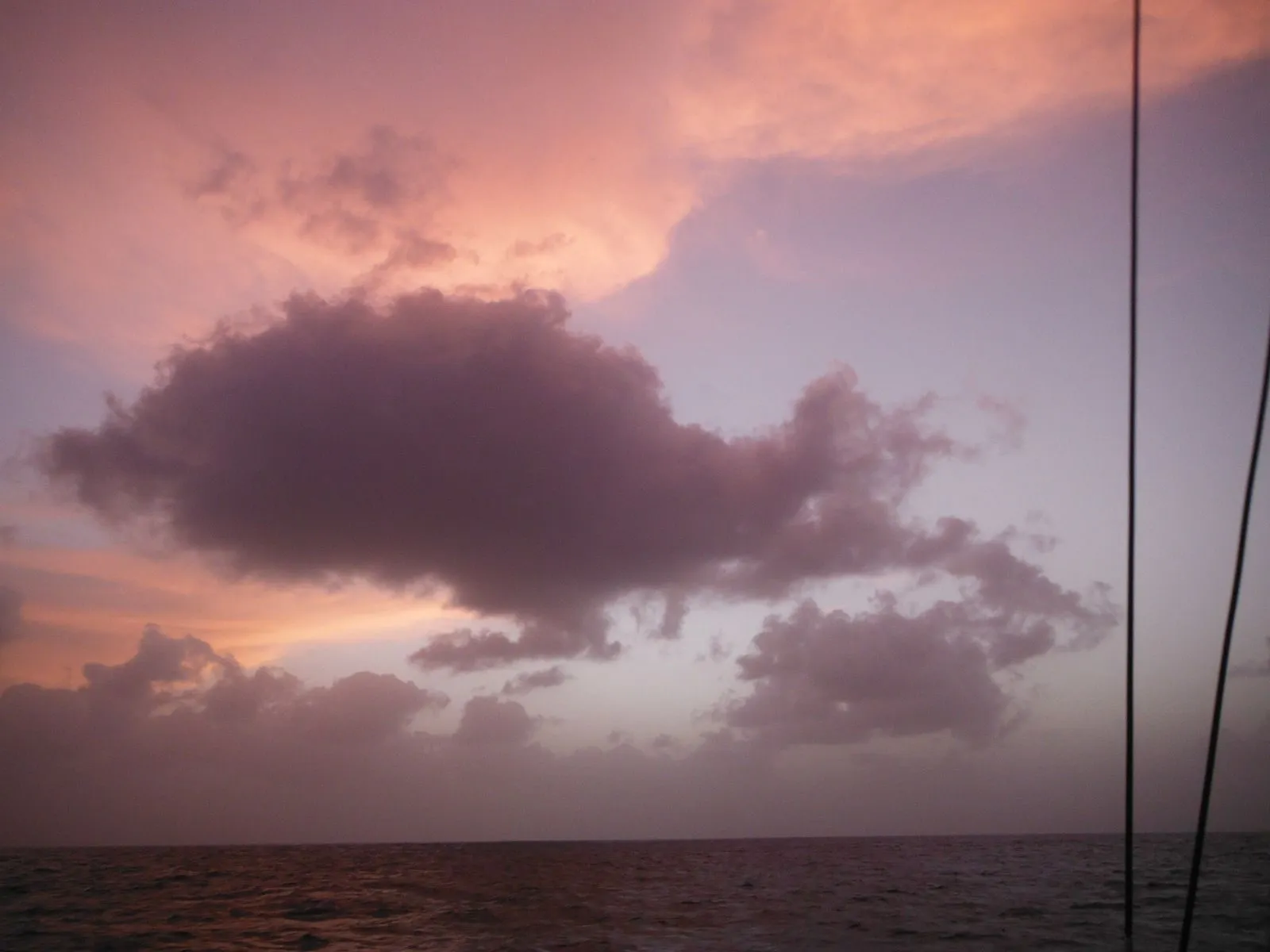
In the evening I was up with Simon from midnight to 4 a.m. The sky was cloudy, you couldn’t see the stars, only one would peep out now and then. Steering purely by the instruments is pretty boring, so since the waves were small and the autopilot could just about cope with them, I switched on the robot helmsman and we had a good long chat. I told him about the things they don’t know about Hungary in the West, and he told me what the German media didn’t report about Egypt. About the reasons for Morsi’s overthrow, and that after the military takeover Egypt has a freely elected government again.
Machine translation (AI, Claude) of Balázs’s Hungarian original. Read the original →
Tuesday, 10 November 2015
Day 6, 132 nm
This morning I was the last one up, around 10. A tasty-looking flying fish was waiting on my plate for breakfast. Raw, naturally…
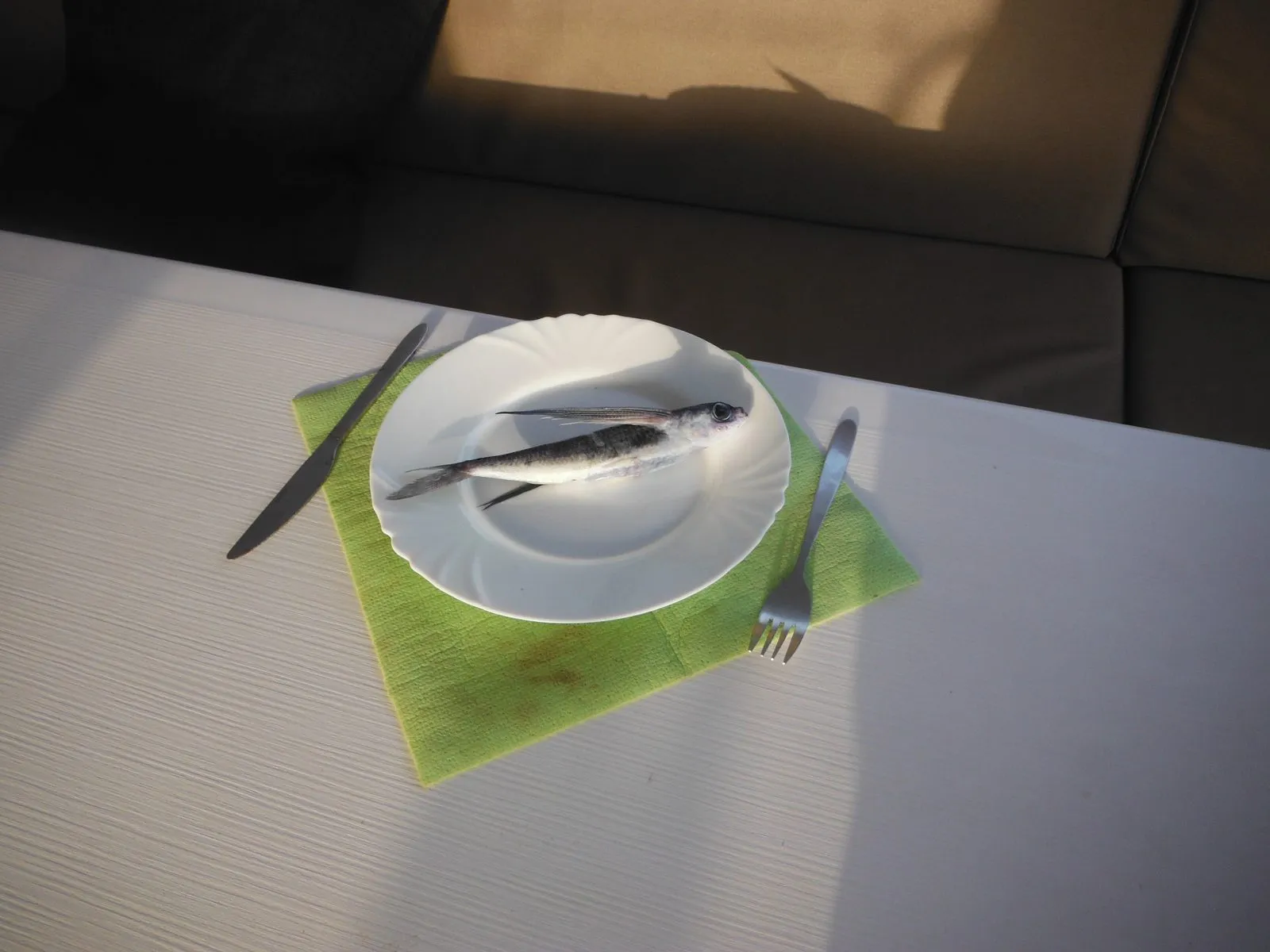
Áron Méder (the Hungarian solo round-the-world sailor) would have made a fine breakfast of it, but it would have been a bit thin for the 7 of us. So the lads left it for me, and I gave it up in favour of the dolphins…
We’re only a day’s sail from the Cape Verde Islands now, and if we kept heading that way, we could even catch sight of them tomorrow…
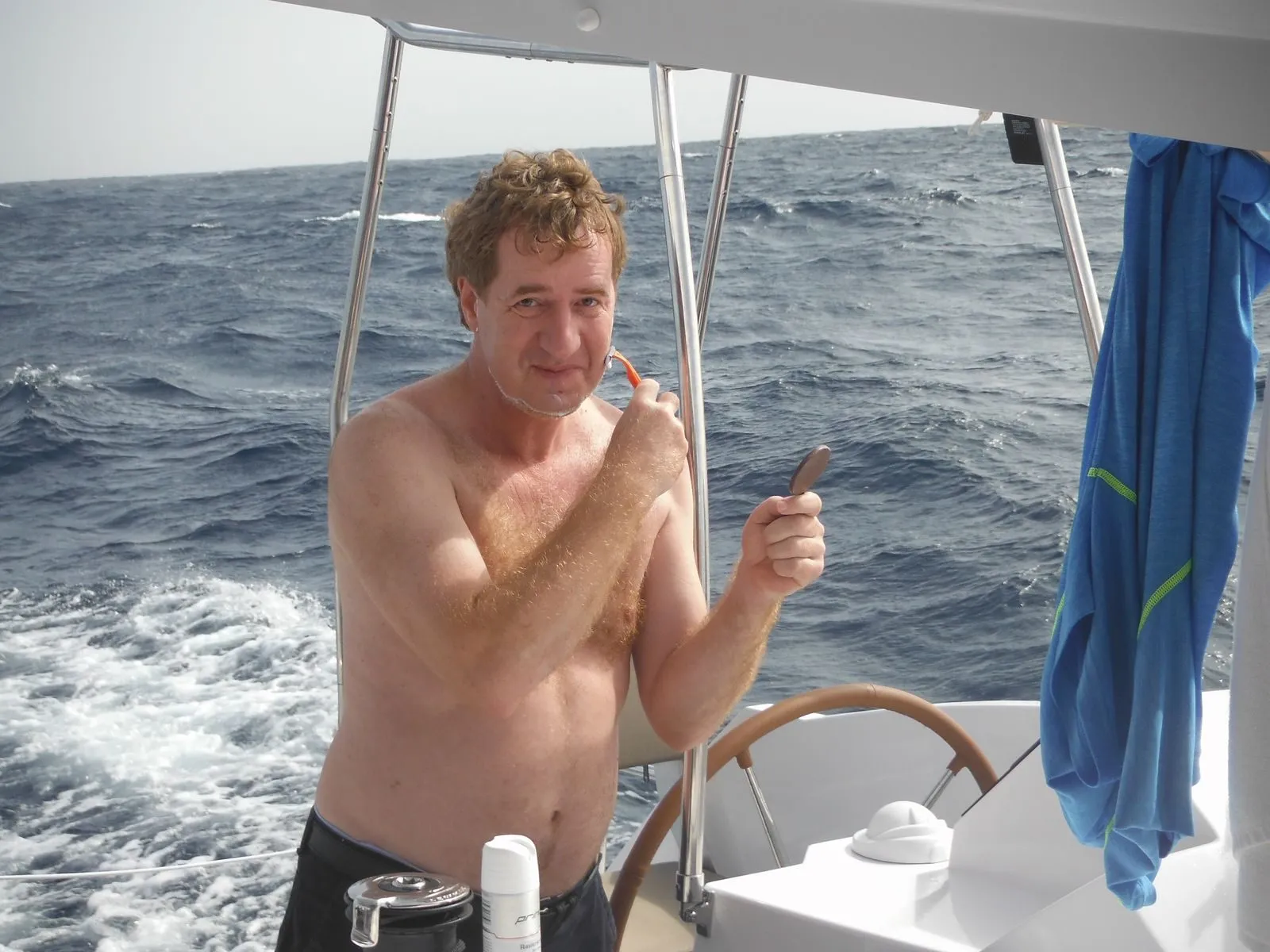
In the morning I had a shave at the stern. I had toyed with the idea of not shaving until we got to the far side of the ocean, but, I said to myself, if some night a mermaid happened to surprise me while I’m sitting alone at the helm, and she saw me this hairy, she’d slip straight back into the ocean before I’d even had time to think about what to do with her…
In the evening Gregor decided to make the mahi-mahi fillets for dinner.
Take 4 handfuls of cornflakes.
What on earth is this going to be?
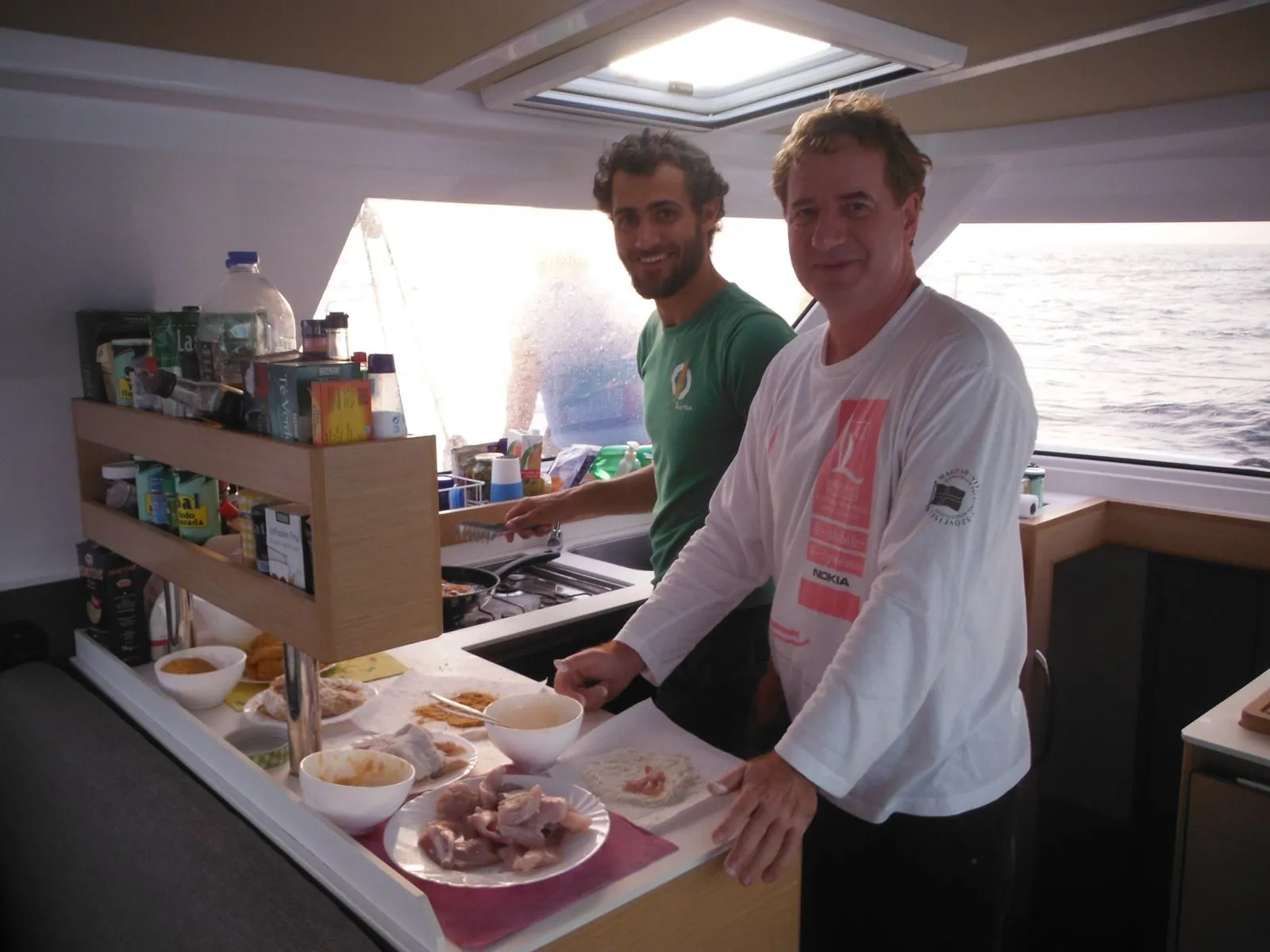
He put them in a plastic bag and crushed them nicely into pieces, then into powder. That was the breadcrumbs. He says it works with crisps too. I helped him with the breading, because he was going painfully slowly and his fingers had doubled in size under a crust of flour, egg and crumbs. He was very grateful for the breading method I suggested, and with Simon roped in, the breaded mahi-mahi fillets with steamed rice were ready in no time. We licked all ten fingers.
Machine translation (AI, Claude) of Balázs’s Hungarian original. Read the original →
Wednesday, 11 November 2015
Day 7, 135 nm
It’s Carnival.
In Germany, at least. It kicks off on the 11th of the 11th at 11:11.
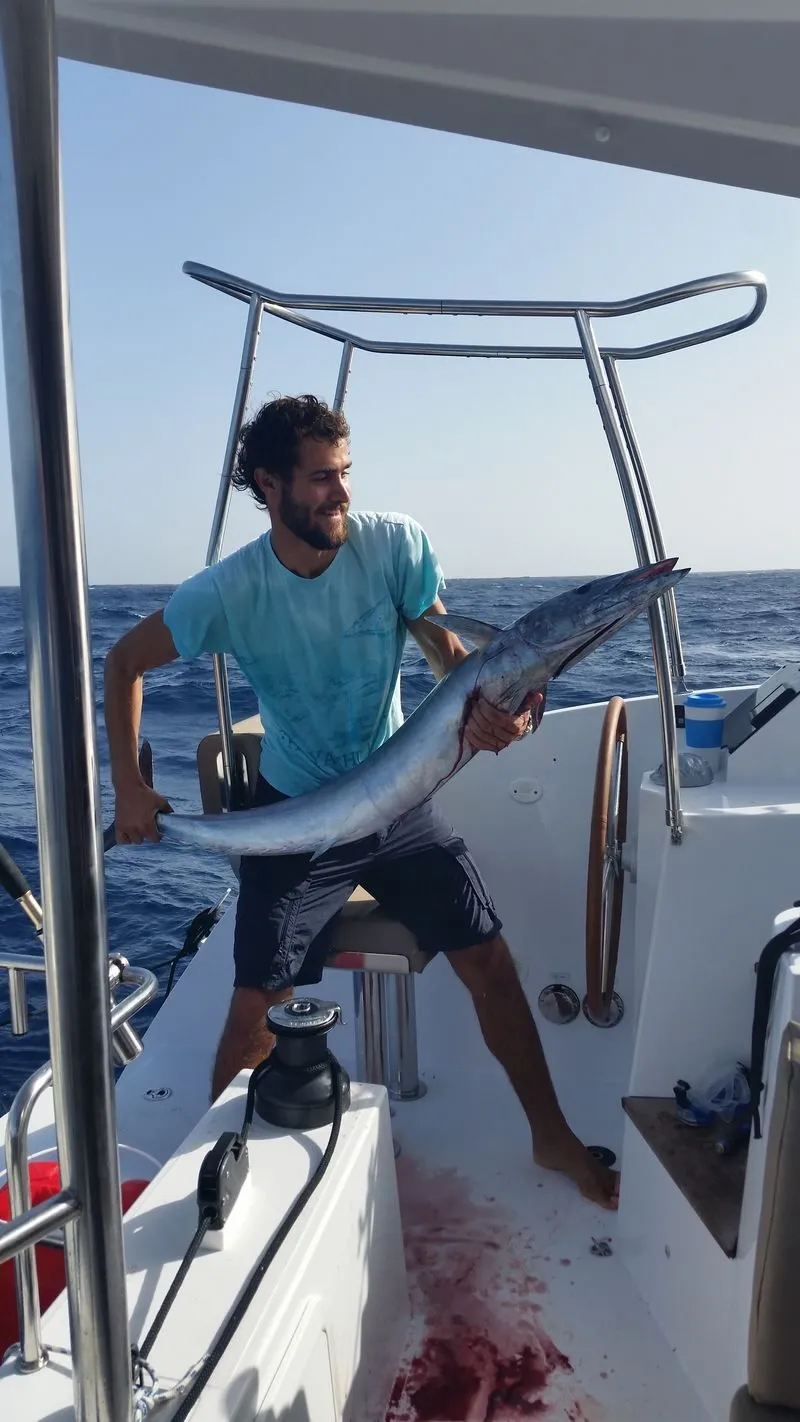
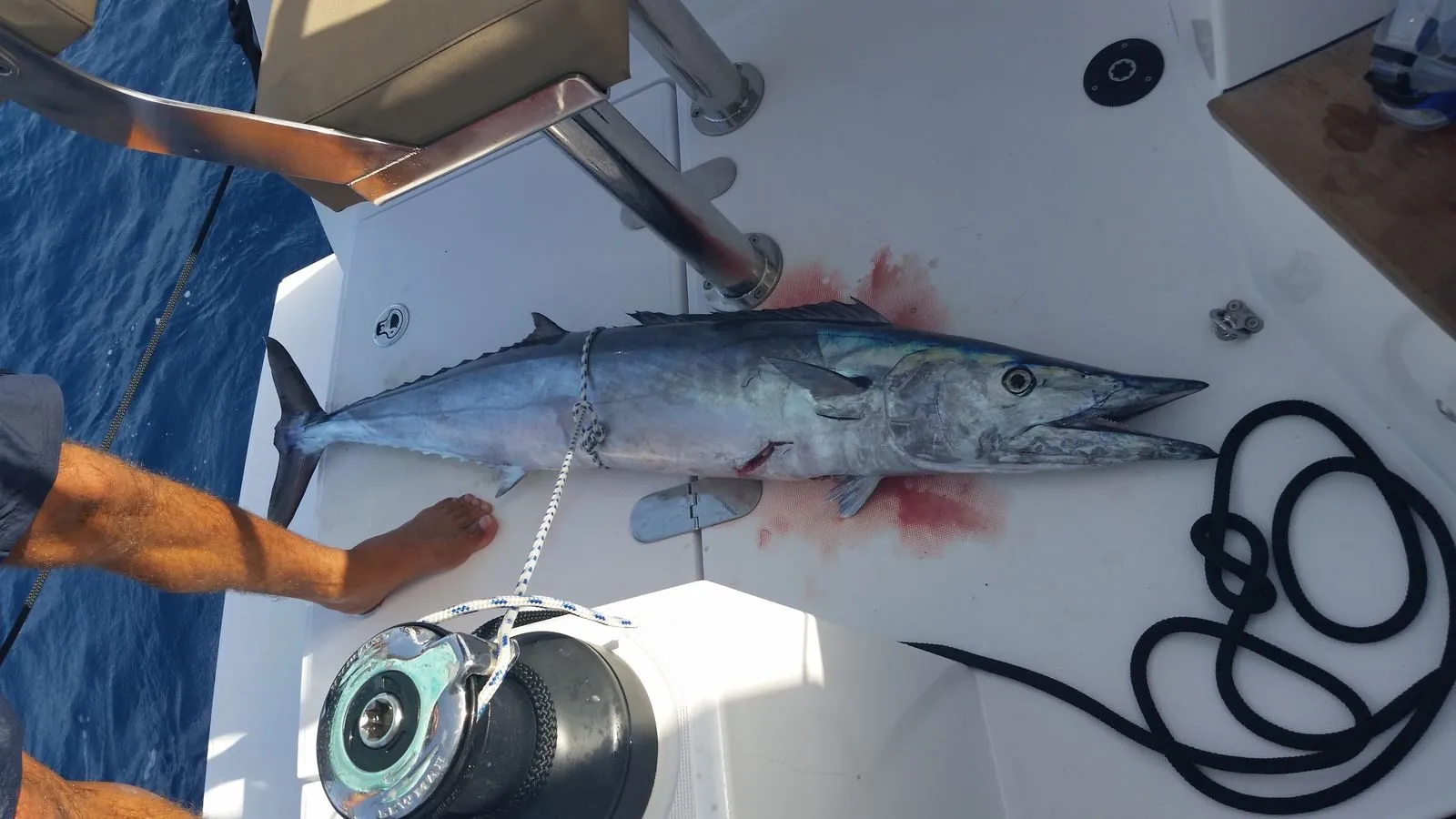
We, on the other hand, caught the biggest fish of the trip so far. We don’t know what kind of beast it is – tuna, maybe? – but it fought cunningly for its freedom, and in the process wound the line round the propeller as well. While we were gaffing it, it made off with the gaff, so in the end we could only haul it out, with great difficulty, with a rope looped round its body.
Then Igor dived under the boat with his mask and luckily freed our propeller from the line wrapped round it.
When we opened up the fish’s stomach we found a few little fish inside, whole – some of them 10–15 cm long.
– Aaaah, baby fish! – Simon cried happily.
– No, no, Simon, that was just its breakfast… – did you maybe miss that biology lesson???
Today, for the first time since we left, we saw a ship, passing to the east, on the very edge of the horizon. It was only 7 miles from us, but you could barely make it out.

The skips decided we were far enough south now – at 19 degrees latitude – and it was time to turn west. I begged them in vain to carry on south for just a few more hours, until we could see the mountains, but they were unbending:
– New course 270°, we’re turning! – :((
Sadly we won’t see the Cape Verde Islands, even though we could have spotted them before dark. So we’ll just have to take the GPS plotter’s word for it that they really are out there somewhere, 60 miles away, below the horizon.
In the afternoon I made Hungarian fish soup, halászlé, à la Cape-Verder Art. At first we put the fish’s head in the pot too, but then I chucked it out, because the broth was turning bluer and bluer from the flavours leaching out of the fish skin, and also because its beak was sticking way out of the pot. In the end it came out pretty well, even if it ended up an angry bluish-reddish colour – but I have to admit – it was a long way from the one back home. Very.
At least 2,000 miles.
This diary is slowly turning into a cookbook…
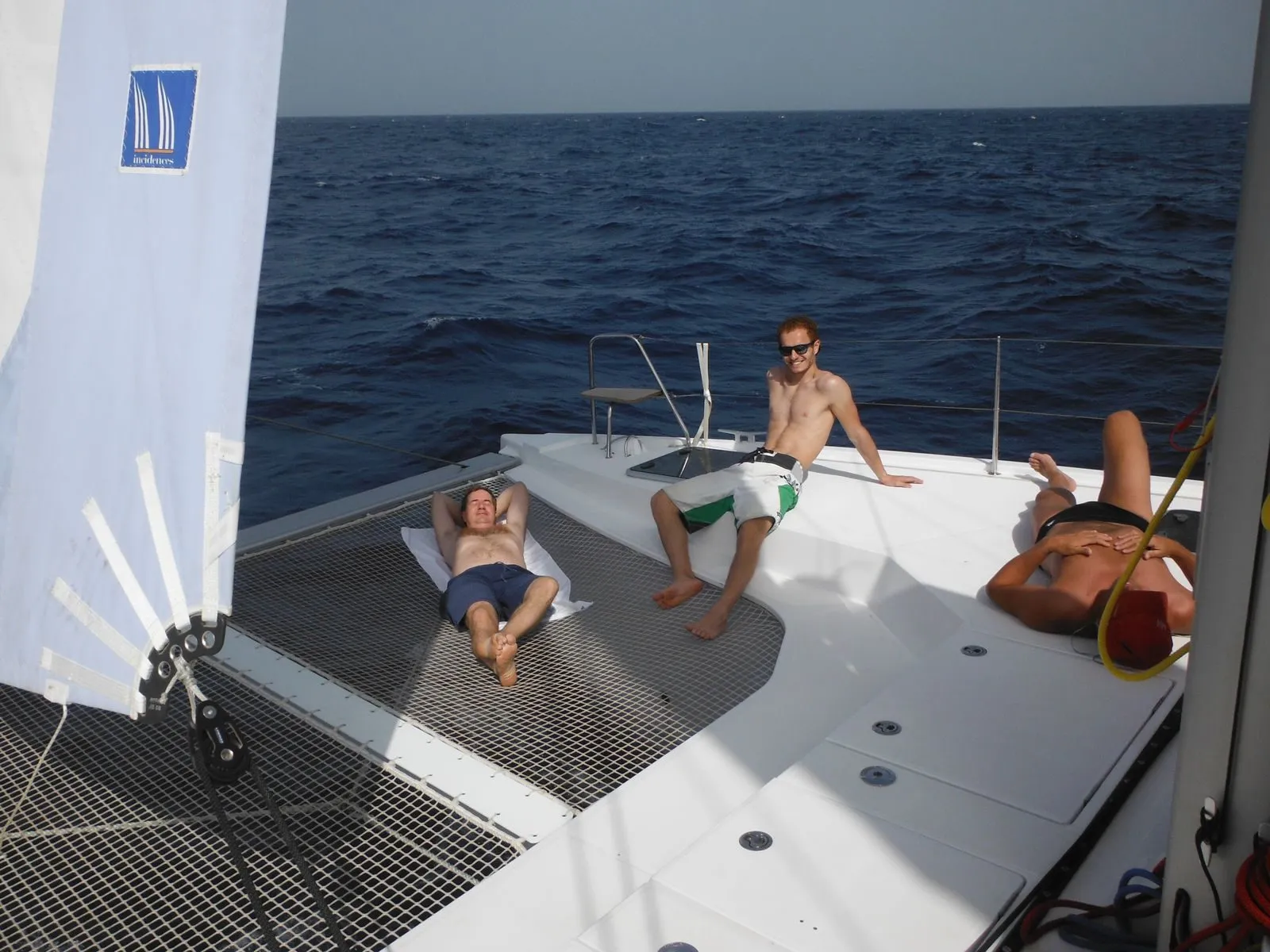
In the evening the sky was gloriously starry. On the navigation screen we kept an eye on the AIS signals of two vessels. One was MADRIGAL V., probably a catamaran as well, since she’s 13 x 7 m. She’s running parallel to us, heading west just like us, but a bit slower, about 5 miles north of us. We can’t see her lights; maybe she hasn’t switched them on, or they’re too low. The other was a 300-metre cargo ship called BOSTON, which in the end crossed our path 4 miles astern of us. We could see her lights clearly, and she really was a long one, because there were a good 2 centimetres between her bow and stern lights… (between the fingers of my outstretched hand…)
Machine translation (AI, Claude) of Balázs’s Hungarian original. Read the original →
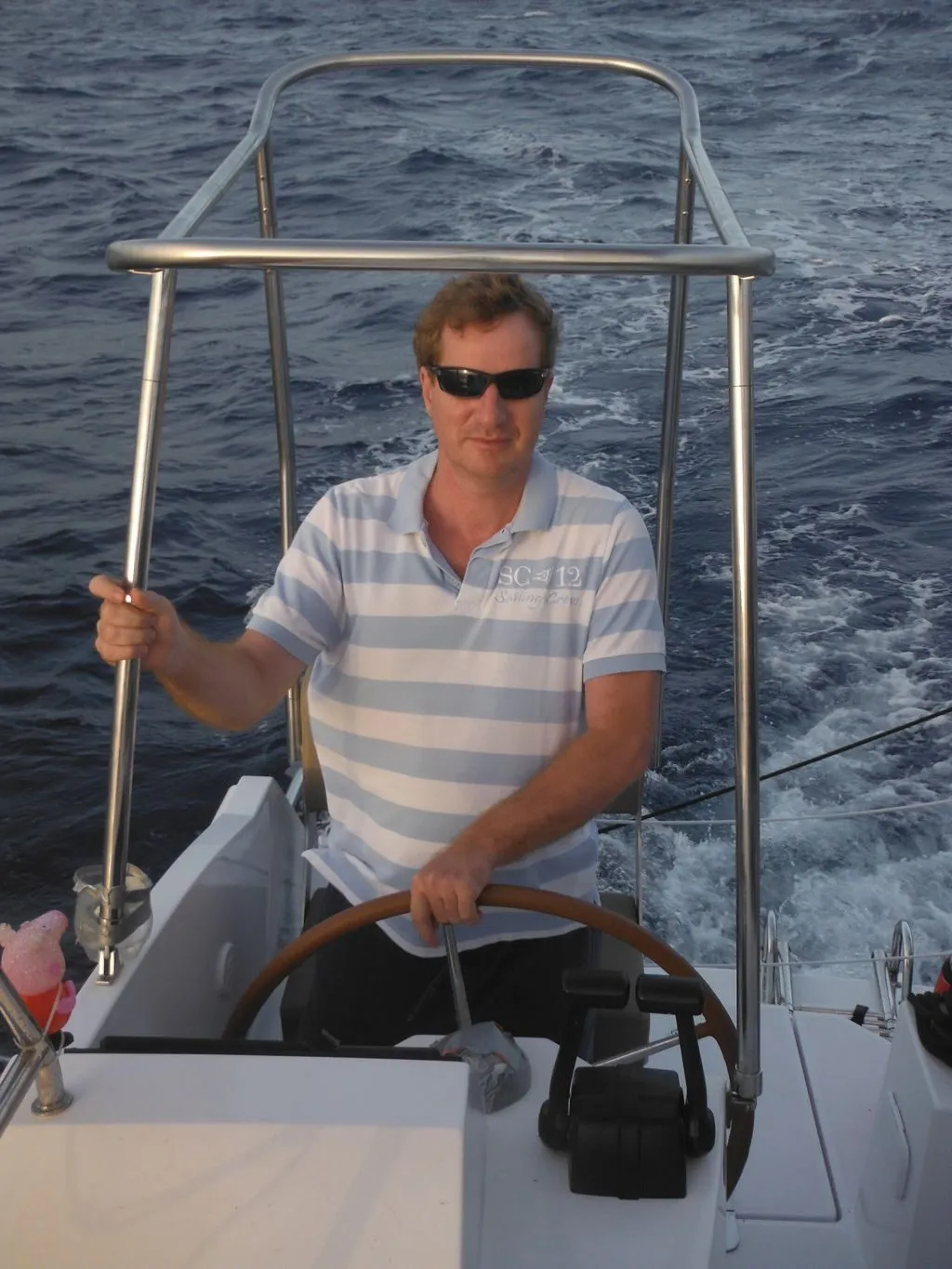
Thursday, 12 November 2015
Day 8, 148 nm
Man Over Board!
Well, this could only happen to me…
It’s night. Pitch dark, the moon has the day off today, and the stars are hidden by clouds too. Our boat is charging along at 7–8 knots; you can only steer by the instruments.
I’m alone at the helm, properly clipped on; Gregor and Bijan are asleep right next to me, an arm’s length away.
I usually check a few things on the touchscreen of the Garmin plotter, AIS info for instance, but this time I accidentally touched it in a spot that brought up something like 7 buttons to choose from.
Whatever I did, I just couldn’t get back to the chart. I tried 6 of the buttons; each one took me into a different menu – not what I need.
That left the 7th button, which had red lettering on it, and for that very reason I couldn’t read it.
I’ll try this one too; if it’s not the right one, I’ll just get back here the same way as before.
So I pressed it as well.
MAN OVER BORD!!!
MAN OVER BORD!!!
MAN OVER BORD!!!
That’s what was flashing on all three instruments.
How the blazes do you switch this off?
Have I just raised the alarm for everyone in the area?
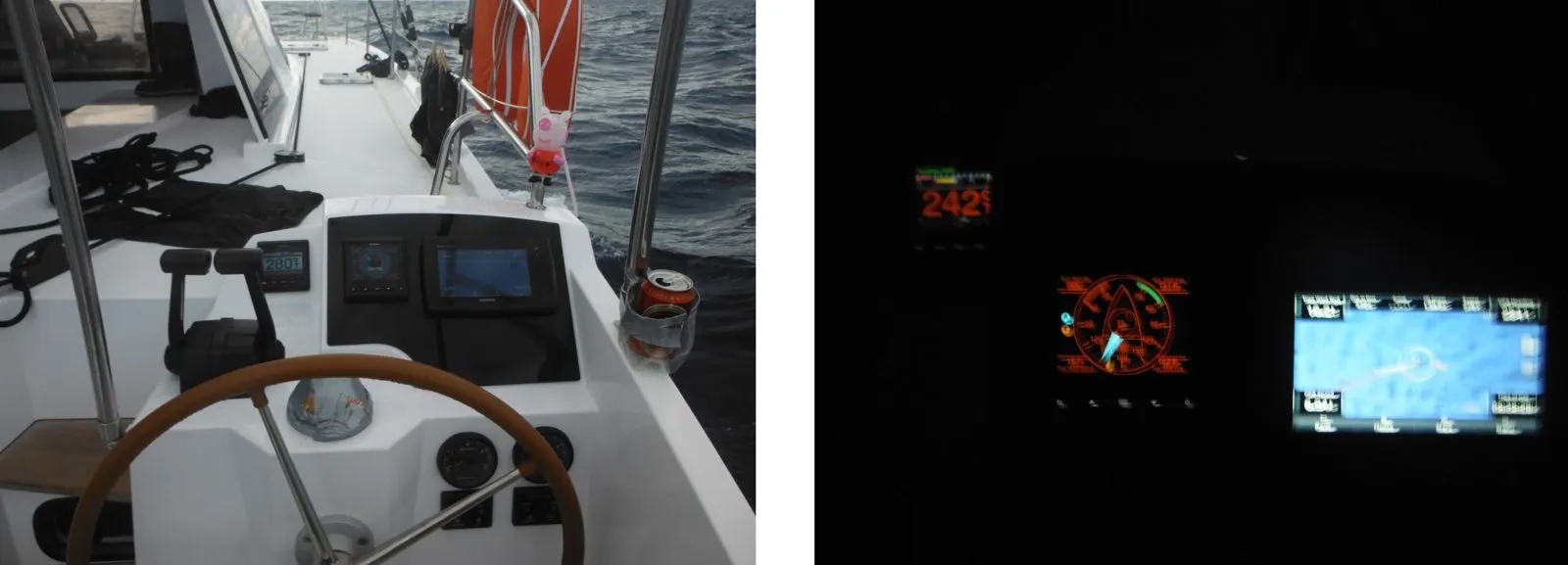
Holy mackerel!
What are you supposed to do now? Jump into the water?
They didn’t cover this at the safety briefing!
Then ARE YOU SURE, MAN OVERBOARD??? flashed up on every display at once, and all I could see was a YES answer.
Well, that’s just stupid. If I really do fall in now, who the devil is going to press the YES button for me?
Then it began to dawn on me that these people think in terms of at least two characters: one falls in, and the other diligently presses buttons and answers the questions.
While this program was running in the background in my little noggin, on the surface I was fighting like a lion to find the NO button, or to make the whole flipping nonsense disappear so I could finally see where we were going…
I could try any combination I liked: the system had been designed to be Little-Tailor-proof (foolproof, tested on the Brave Little Tailor himself), and for somebody to just fall in the water already, FOR SURE!
And then, all of a sudden:
WHOOMPH! came from above, discreetly, but brooking no argument.
The mainsail flopped across to the other side – it gybed! It didn’t have to try very hard, because, as I said, we can only let the boom out to 40° instead of the usual 70–80. Lucky the boom itself stayed put, because it’s held tight with the preventer, lashed down permanently.
Confound it!
That’s the helmsman’s greatest shame: not paying enough attention, and letting the mainsail slam across on your watch. And it’s dangerous as hell, of course.
While I was trying to decode the instruments and pressing one button after another to finally see where we were heading and where the wind was coming from – even though I hadn’t moved the wheel at all – the waves and the wind had quietly turned the boat in the dark – and of course, why not – in the wrong direction!
If she’d turned the other way, nothing would have happened, because the boat would slowly have come up into the wind and the sails would have started flapping.
But no, dear ALICE turned the wrong way on me, the mainsail flopped over in a flash, and I could crank the wheel the other way all I liked, right up to the stop: the little darling had no intention whatsoever of turning back.
Why on earth would she do that for me?
No wonder, since all I had on my side were the 1 square metre rudders, while the wind had the 62 m² mainsail… Of course it won the argument.
Damn! She just won’t turn back! Even with the wheel wound right round to the stop…
No two ways about it: there’s no phone-a-friend (no phone at all, for a while now), so I’ll have to ask the audience.
So I tugged at the sleeping skip’s leg:
– Gergoréé! – (which in Slovenian means: Hey, Gregor old mate, listen up!) – We have here a small little bit problem! Actually everything’s fine, no worries, the sail is set nicely too, it’s just that the wind is blowing from the other side, and the other thing is that this idiot Garmin thinks I’m in the water, but I’m not, as you can see…
You could tell he’d really have liked to understand the connection between the crash gybe and the MOB alarm, but then he decided to start bashing the buttons on the instruments himself instead – a bit more purposefully than me, because not only could he read what was written there, he understood it too – and soon he’d made the man overboard alarm go away. (I reckoned that if I’d had about twice as much time again, I might have managed it too, with the remaining combinations…)
The instruments were working again, and now we could see that in the meantime the boat had nearly done an about-turn underneath us.
Engine on. At which everybody woke.
Up.
Well, naturally.
Boat turned back, and as if nothing had happened, on we swooshed.
Gregor offered to stay at the helm himself for now.
All right, – OK – I replied. (You’re right, I’d do the same in your shoes.)
So that was the true story of “The Poor Little Tailor and the Pesky Little Red Button”.
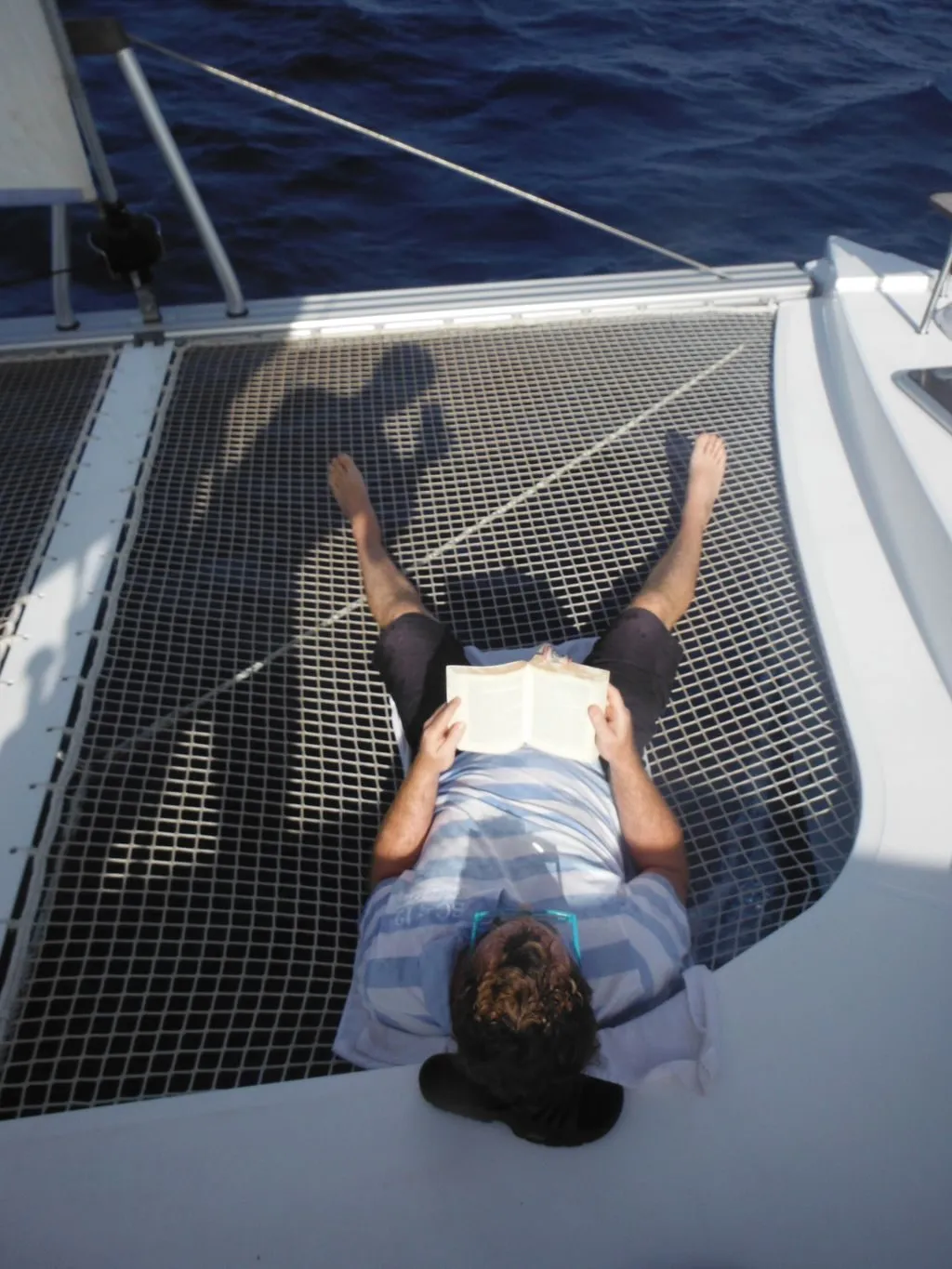
And now back to everyday matters.
We’ve been under way for a week
We’ve covered 1,000 nautical miles, almost a third of the way. I hope you can follow us on that website. So far the trip is practically exactly what I’d imagined. We’re having really good weather: 27–28 °C during the day, 24–26 in the evening. The water is 27 degrees. The sun is shining, just a few clouds now and then, no rain so far. The wind blows steadily at 15–20 knots, now from the east, so this must be the trade wind belt. We eat and drink well, read, play cards now and then, listen to good music and steer day and night.
The boat – apart from a few naughty little habits – works well and gives the seven of us enough living space. In this wind and at a boat speed of 6–8 knots, our catamaran “sails standing up”: it doesn’t heel the way a monohull does. Glasses and bottles don’t topple over, and the soup doesn’t spill out of the plate. Of course the boat has a rocking motion as the waves coming from astern roll under us, but we managed to get used to that in the first two days.
We haven’t put the hook out again since the big fish, for the time being, because fish is coming out of our ears. This evening – for a bit of variety – I fried garlic fish steaks.
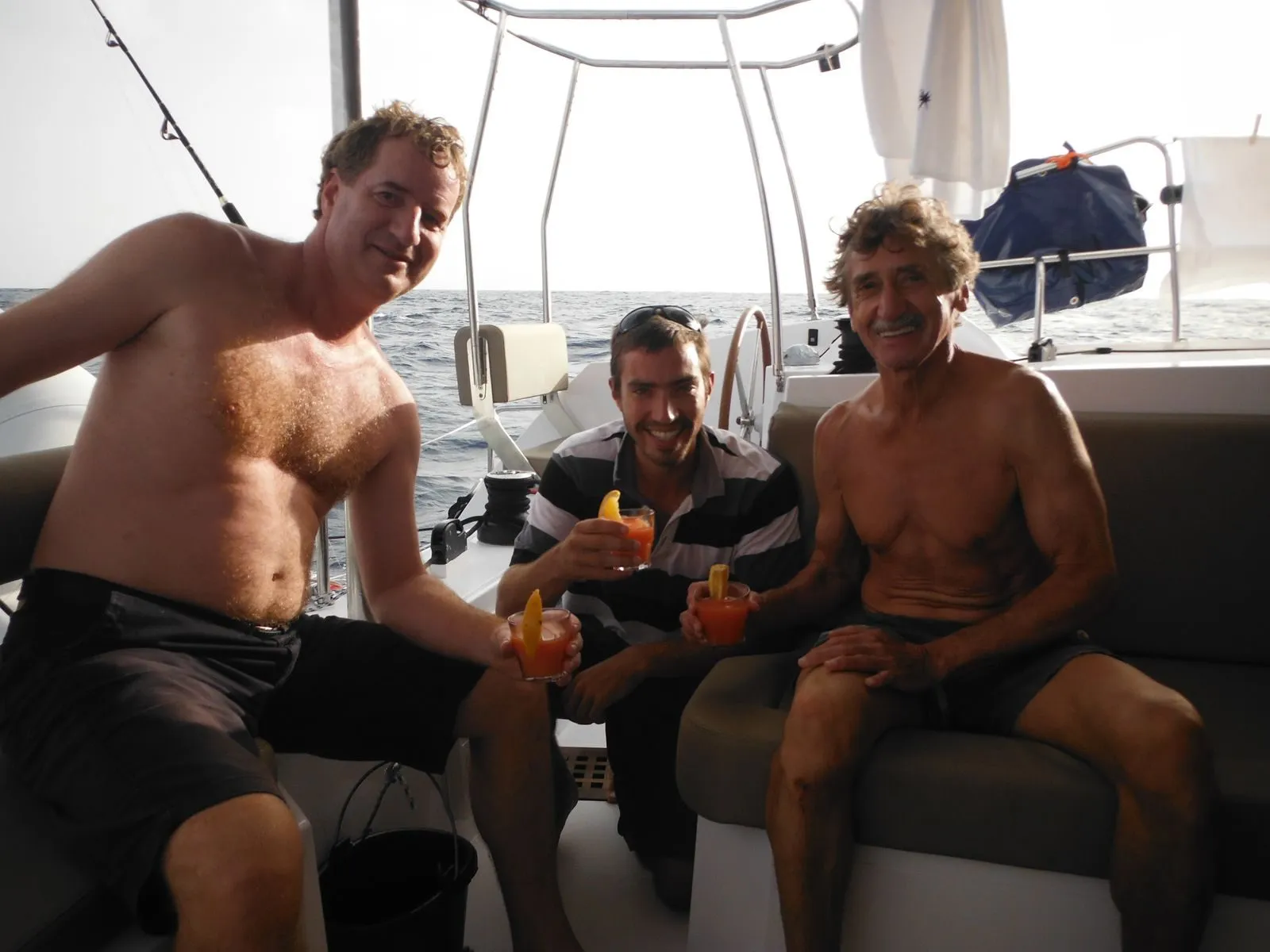
The “sundowner”, the sunset drink – sometimes rum, sometimes Campari, like today – somehow keeps creeping earlier and earlier. These days Bijan starts fidgeting (not me!) about an hour before sunset over what we’re going to drink today. So far nobody has objected that it’s a bit early yet, sonny. Somehow, not me either.
Tonight only the stars were shining – but they did it beautifully – whenever the clouds weren’t covering them. If I ever came again, I’d definitely bring a star atlas with me. And a cookbook. Gregor did show me a really neat app, though, Night Sky. Hold the phone (well, not mine any more) up to the stars, and it draws the constellation and shows its name. It even shows the stars below the horizon, and even the ones underneath the bottom of our boat, that people can see on the other side of the Earth.
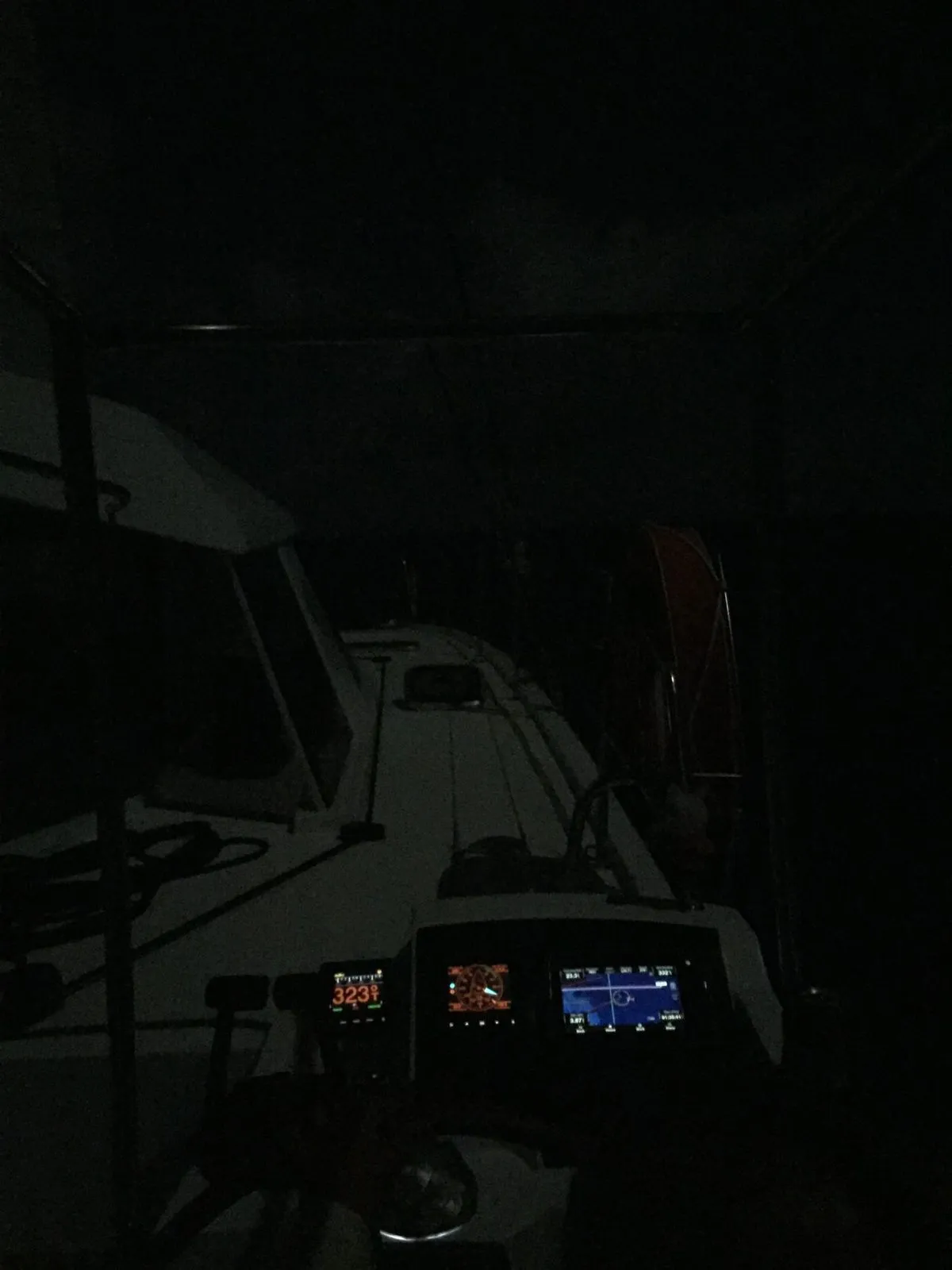
Around three in the morning I noticed a vessel’s light on our Port Said (port side, Backbord, i.e. the left-hand side of the boat). It wasn’t sending any AIS signal, so we don’t know what it could have been. We must have passed fairly close, a few hundred metres away, because we’d left it behind within 2–3 minutes and its light disappeared into the dark astern. We suspected a small Cape Verdean fishing boat. However big this ocean is, it doesn’t hurt to keep a lookout here too.
I first came across AIS 3 years ago. Every big ocean-going ship is required to have it these days, and more and more yachts have it too. Every 10–20 seconds AIS broadcasts the most important data about the vessel’s passage (name, exact position, speed, heading, dimensions, cargo, where from and where to, etc.) on one of the VHF radio channels, which can be picked up within a 20–30 mile radius, and it warns you if two vessels’ courses cross dangerously.
Our boat, ALICE, only has an AIS receiver (I’d never heard of receive-only before), but even that is a very useful bit of kit, because we can spot ships while they’re still below the horizon, or not yet visible in the dark. And if they come closer than 2 miles, the gadget sounds an alarm too. There are now even life jackets fitted with AIS transmitters, which could be genuinely useful in that particular case where you fall into the sea while actually wearing the thing.
Machine translation (AI, Claude) of Balázs’s Hungarian original. Read the original →
13 November 2015, and a Friday to boot
Day 10, 149 nm
In the morning I dug out my summer T-shirts, which until now had stayed in my big sports bag, in the locker under our bed. In the cramped, stuffy cabin I managed to work up a decent sweat while I excavated everything and packed the warm clothes and my dirty laundry back in there. The bath at the stern felt good afterwards, although you have to keep your balance the whole time.
Lately brown stripes have appeared on all our white towels. No, not the “tiger stripe” kind that Lance Corporal Sörös (his name means “Beery”) left on one of our sheets back in the army, when before his shower he sat down on somebody’s bed wearing nothing but…, hmm, how shall I put it, himself – these are much longer. Fine Saharan dust was responsible – as I established – which had coated the guardrail wires (where we hang our towels to dry) and the damp white cabin roof as well. And we’re 700 miles from Africa – 1,300 km!
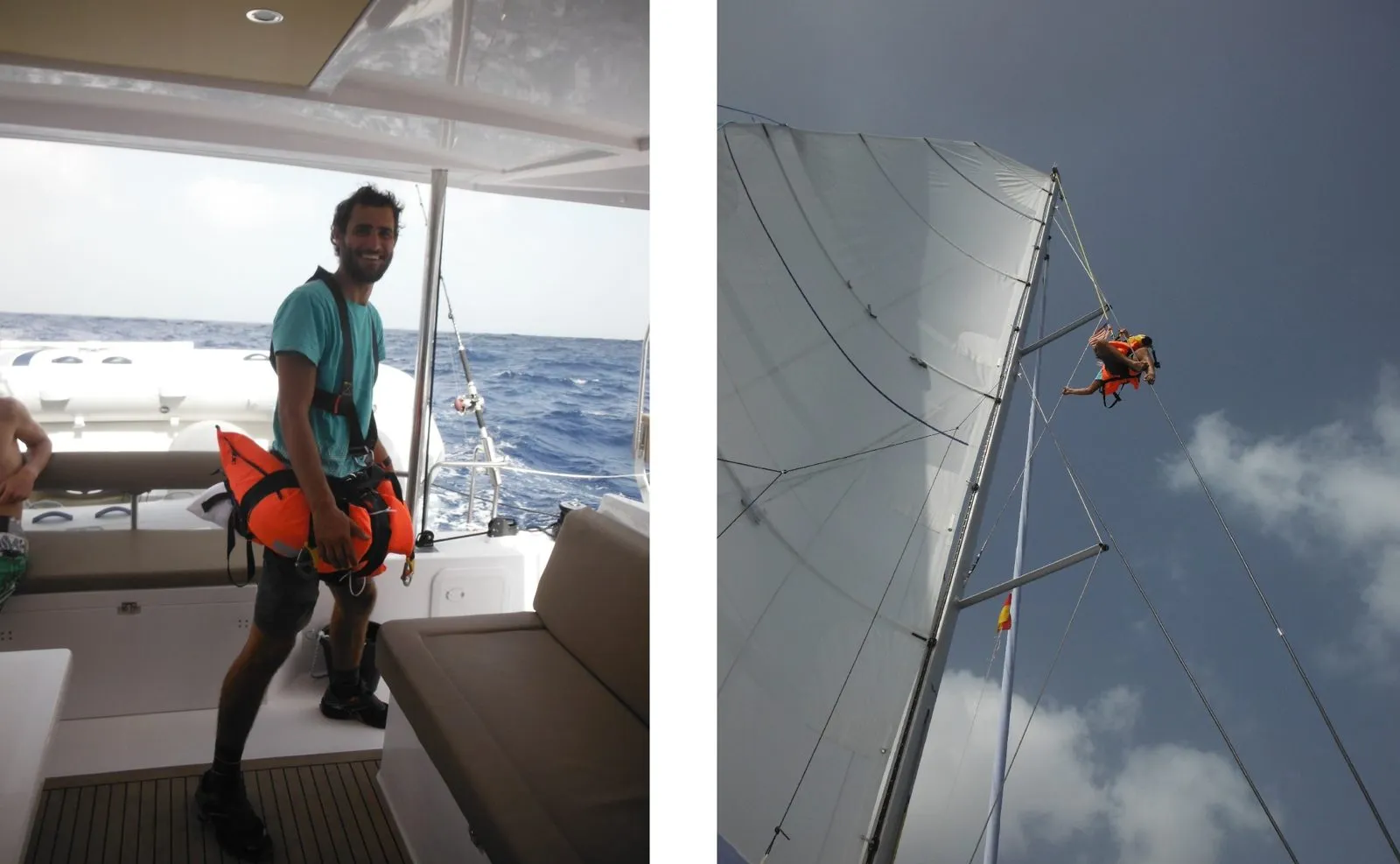
At noon Gregor rigged himself up a seat out of the safety harnesses, a Bootsmannstuhl, a bosun’s chair (because there isn’t one of those on board either), and we hoisted him up the mast in it. Our mainsail keeps bumping against the shroud that braces the mast sideways and aft (which even has a plastic protective tube on it), even though we don’t let it out as far as 45 degrees, i.e. a beam reach, and it has already chafed the mainsail in several places at the batten pockets. So far we’d tried sticking protective patches on the damaged spots of the mainsail – with the sail lowered – but after a short while they all came off. This time Gregor stuck a protective sleeve up high on the shroud itself, the wire that braces the mast. We hope this will finally save our mainsail from further damage.
Tonight we have a new moon. It became visible in the western sky a couple of hours after sunset, but not long afterwards there was a moonset too. At dawn Venus shone so brightly that a proper silver bridge led to it across the water, like the one to the moon on Lake Balaton back home.
During the night watch I had a good long chat with Igor. He’s 26 and has been skippering for six years already, mostly in the Adriatic, on sailing yachts and sometimes on a 60-foot motor yacht. He likes sailboats much better. He and a mate brought one of the Bavaria 46s to Tenerife from a Navigare base in Turkey in 22 days. They came through the Corinth Canal, past Zakynthos, calling at Palermo and Mallorca, and out through Gibraltar. In the Ionian Sea they saw refugee boats as well, and once a submarine surfaced right next to them. They asked, and checked through binoculars, whether there were any Syrians on board, then submerged again and vanished. He was paid 1,200 euros for that trip, and he’ll get the same for crossing the Atlantic with us. He thinks it’s too little, but that’s the going rate at the moment. A few years ago they’d have paid only 600 for exactly the same crossing. He’s planning to stay in the Caribbean for a few months and work as a skipper. You can get 120–150 euros a day there too, if green-behind-the-ears charter tourists hire you as captain. Of course you’d have to pay tax on that somewhere too… Then he’ll see how things pan out.
Machine translation (AI, Claude) of Balázs’s Hungarian original. Read the original →
Saturday, 14 November 2015
Day 10, 143 nm
Since I’d been at the helm with Bijan from 4 to 8 in the morning, I went to bed afterwards. At 10 they woke me to say breakfast was ready – rice pudding with fruit and cinnamon – did I want some? You bet.
Full service: they brought it to me in bed… Now that’s something! And it was delicious, too.
In the morning I shaved, the second time on our trip.
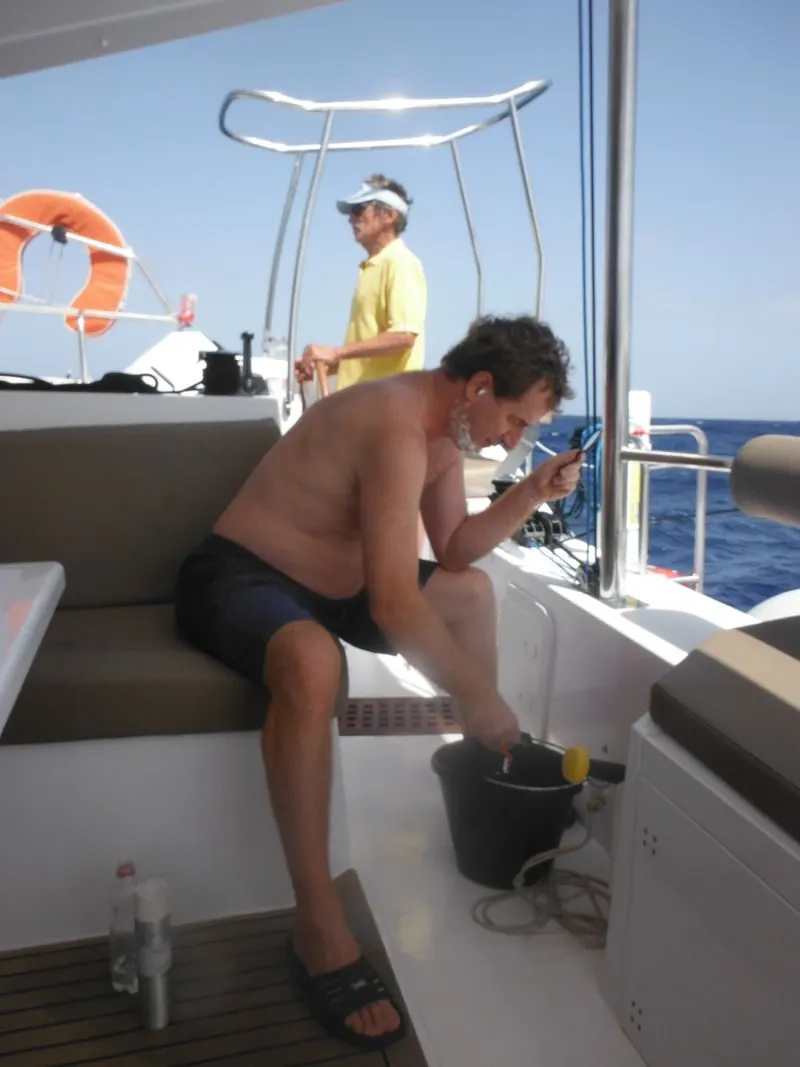
I wouldn’t mention it if it hadn’t ended with a funny little scene. When I’d finished shaving, I splashed my face with fresh water from a small half-litre mineral water bottle to rinse off the rest of the foam. Jiri leaps over to me, eyes like saucers, snatches the bottle out of my hand, pours a little onto his fingers too and sniffs it in disbelief:
– Slugovica??? – he asks, looking stunned.
– No, of course not, but why do you ask?
Then the penny dropped. I’d brought the Hungarian pear pálinka – which they find horrendous, and which had them spluttering no end – in exactly the same kind of little half-litre bottle. Our good friend Jiri couldn’t believe his eyes: either Hungarian pálinka is so versatile that it doubles as aftershave, or Hungarians are so daft that they even use pálinka as aftershave. Well, spirit is spirit, isn’t it? (In Hungarian aftershave is literally “face spirit”: arcszesz.) :)) Then he had a good laugh about the whole thing too. That pálinka isn’t so bad, honestly, just a little bit strong…
There’s the “flask”, behind the shaving foam
In the morning I tried doing the laundry by hand, in a bucket, with seawater. It works. If I’d used actual detergent instead of hand soap, maybe the T-shirts would even have smelt nice and clean… Which they didn’t. But at least now they no longer stood up on their own when I threw them into the corner…
Oh, it wasn’t that bad, they really just needed a bit of a wash, honestly…
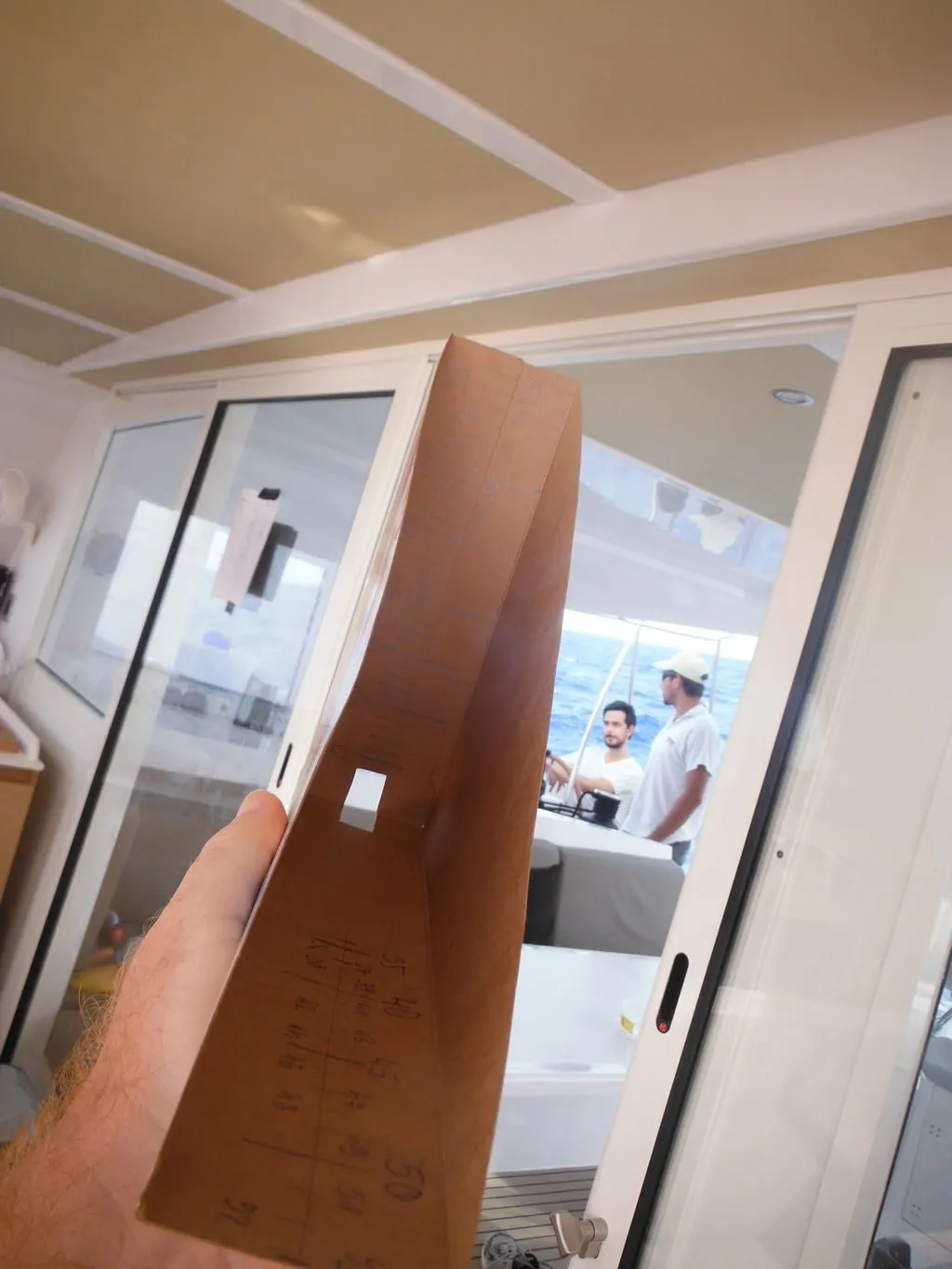
After the midday salad I set about making a sextant – a sun-height meter – out of the cardboard biscuit box. Looking through the little hole, you aim it at the horizon, keeping the bottom level, and then a second observer can read off the scale on the bottom the angle at which the vertical side casts its shadow, i.e. the angle between the sun and the horizon. Tomorrow, when the sun is at its highest, we’ll find out where we really are. Actually here, as Gregor claims, or maybe in Greenland…
Our eating habits have slowly settled down. In the morning we have breakfast in 2–3 sittings, depending on who gets up when after the night watch. At noon we have a light salad (to use up the fresh veg) with salami or ham, or maybe tinned tuna and bread.
And in the evening comes the dinner cooking and the sundowner. There’s still one last portion of the very last big fish, but we’re slowly running out of variations. Yesterday the boys did breaded fish again; today I’m going to have a go at some sort of curried fish with rice.
They still trust me… :))
In the afternoon I watched the flying fish from the trampoline at our bow. They leap out of the water to escape the predatory fish chasing them (or our boat), and from up in the air the seabirds swoop down on them. Not exactly a relaxing life… As they leap out of the ocean, after a few “wingbeats” they glide – for 30–40 metres even – just above the surface, weaving between the troughs, then with a belly flop – like penguins – they splash back into the water. This morning we found three of them on the foredeck. It seems they jump higher at night than during the day, and they can’t see our boat very well either, because none has landed in daylight so far.
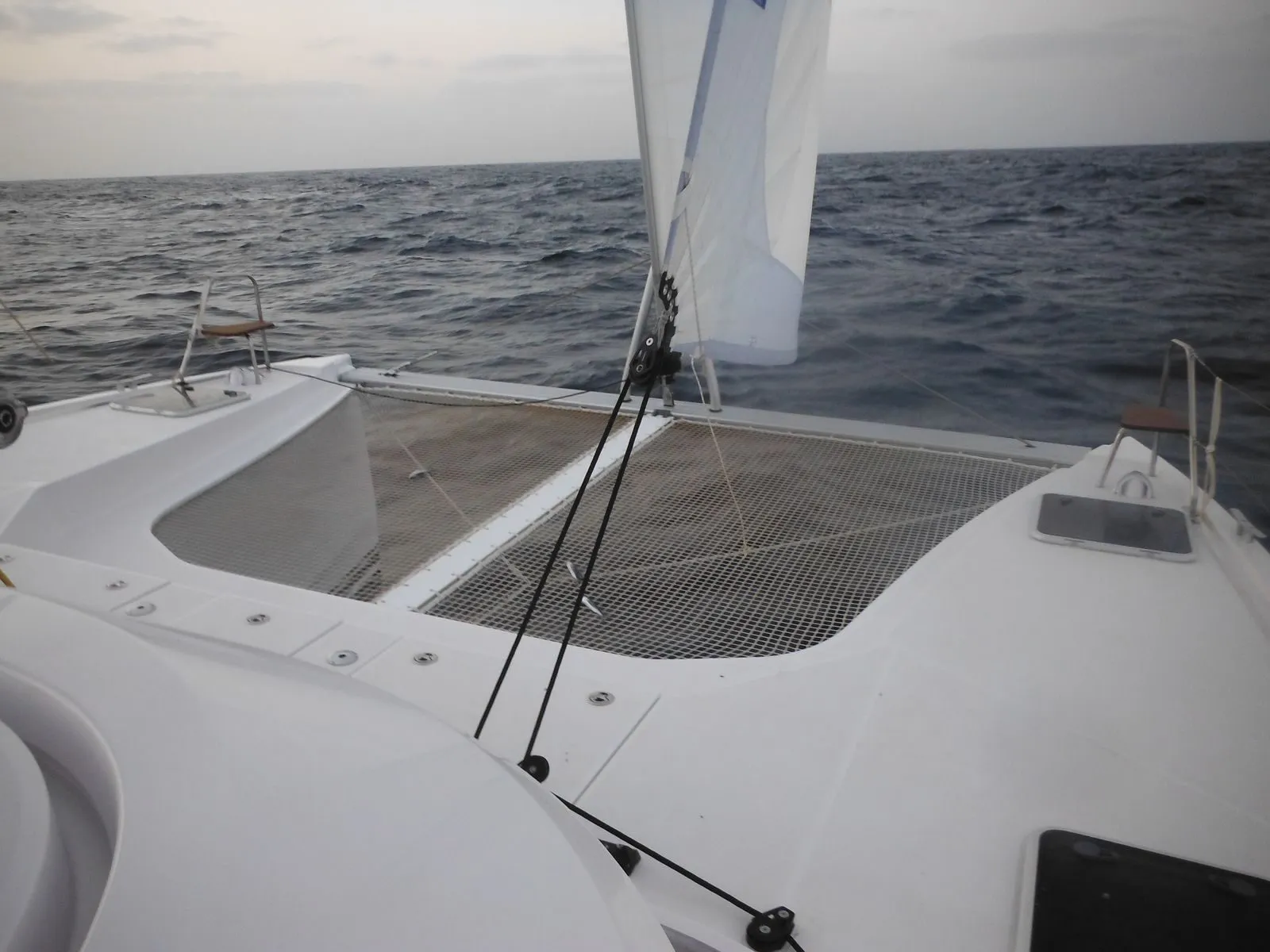
At dawn today I managed to save the life of one of their lucky mates: it landed right in front of the helm station and was flapping about there, so I spotted it in time and was able to toss it back into the sea. Sadly it didn’t ask whether I had three wishes, and after 10 days I’d have had a few good ideas…

From 3 to 4 in the morning I stood alone at the helm. Igor and Simon were sawing logs on the bench by the table (as I had been from midnight to two). The wind had picked up to 20–24 knots, and we were tearing through the night at over 10 knots the whole time. The top speed was 12.3. Anyone who has sailed knows that on a boat even 8 knots feels like hurtling along, let alone at night. You have to pay close attention, because the waves coming constantly from astern and from the side can throw the boat’s stern as much as 10 degrees off the course you’re trying to hold.
Machine translation (AI, Claude) of Balázs’s Hungarian original. Read the original →
Sunday, 15 November 2015
Day 11, 170 nm
Worst case, we’d sail all the way to Mexico if we didn’t manage to hit a single Caribbean island.
But seriously. What would we do if the plotter didn’t show our position, for lack of a GPS signal? (What would aeroplanes do, for that matter?) There’s no sextant on our boat; perhaps the only thing we know roughly is the exact Greenwich UTC time. Because that’s our ship’s time.
Well, that’s why I knocked together a little sun-height meter yesterday, a “sextant”, to try out what sort of accuracy we’d get without modern technology.
We took a few measurements before and after the sun’s noon. Naturally, a couple of times a little cloud covered the sun at exactly the wrong moment, so we also got to experience what the old navigators must have felt in a similar situation. It isn’t easy to hold the “instrument” steady on the horizon for even a few seconds on a rolling boat, but every time we measured about 37° from the vertical. Subtracting the 14.08° I’d calculated – which is how far south of the equator I reckon the sun is today, 15 November – we got that we’re at 23 degrees latitude. According to the GPS, we’re at the 18th. A 5° difference doesn’t sound like much at first, but when you consider that it’s 300 miles, i.e. about 560 km, then it’s a very good thing we’re in the middle of the Atlantic Ocean right now and not in the Adriatic…
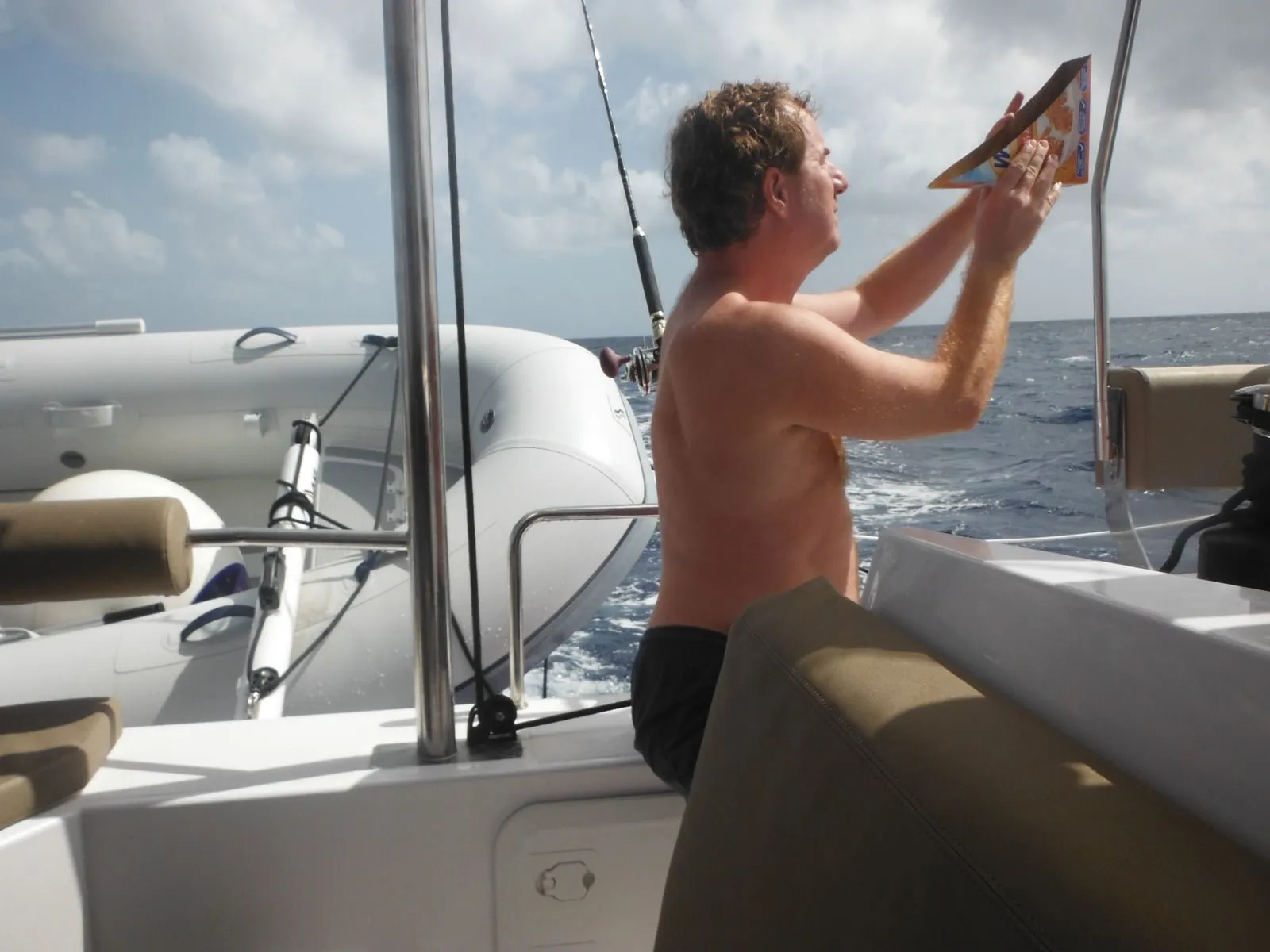
In the afternoon Jiri spotted a sail in the distance. It wasn’t sending AIS, so all we could make out through the binoculars was a two-masted yacht heading the same way as us, to the north of us. It only had a headsail up in the broad-reaching breeze, so it was going much slower than us, and an hour later it had disappeared astern. Strange: who on earth would trundle along in a two-master under one headsail at 3–4 knots when they could be doing 5–6? According to Bijan it’s definitely a pirate ship, and once it gets dark it’ll hoist every sail and come after us to grapple us. Guaranteed.
We’ll be on our guard; it won’t catch us by surprise!
Later I realised that the two-master must surely have been flying a trade-wind rig, i.e. two headsails at once, one poled out to port and the other to starboard. From that distance you couldn’t make out the other headsail even with binoculars, because the near one completely hid it.
Not long after, a shark swam past us the other way on starboard (Steuerbord, i.e. the right-hand side of the boat looking forward), but by the time I’d run up on deck I couldn’t see it any more, so I can neither confirm nor deny the report. In the evening Igor made Nutella pancakes with the last of the eggs. The fish diet is over. Finally. Gregor threatened us that he’d go fishing again tomorrow. Out of the question – on that we were in complete agreement.
Machine translation (AI, Claude) of Balázs’s Hungarian original. Read the original →
Monday, 16 November 2015
Day 12, 154 nm
The depressing result of yesterday’s measurement was really bugging me, so today I got to the bottom of the discrepancy. First I “recalibrated” my instrument, checked the degrees I’d drawn on it, and found half a degree of error. That still doesn’t explain it; it only brings it down to a 4.5° difference. Then Willy helped out: the atmosphere also refracts light, which you have to take into account when using a sextant, and that can mean half a degree or 1–2 degrees. But in which direction? You know how, when the sun is setting and just touches the horizon, it’s actually already below it, and we only still see it up there because of refraction. So the error then is probably about 2°, but at noon, when the sun is high, it can only be half a degree at most. OK. So that still leaves a 4° error, or 5.
I ruled out bad readings caused by the boat’s rolling, because the readings differed from one another by only half a degree. So the difference has to lie in the fact that at noon on 15 November the sun isn’t 14.08 degrees south of the equator, as I’d calculated, but about 18.5°. But why?
Then it came to me. I’d worked out the difference in proportion to the number of days (on 21 September the sun stands over the equator, at 0°, and on 21 December over the Tropic of Capricorn, at 23.5°. The 91 days split in a 36/55 ratio, and that’s how I’d got 14.08° for 15 November.)
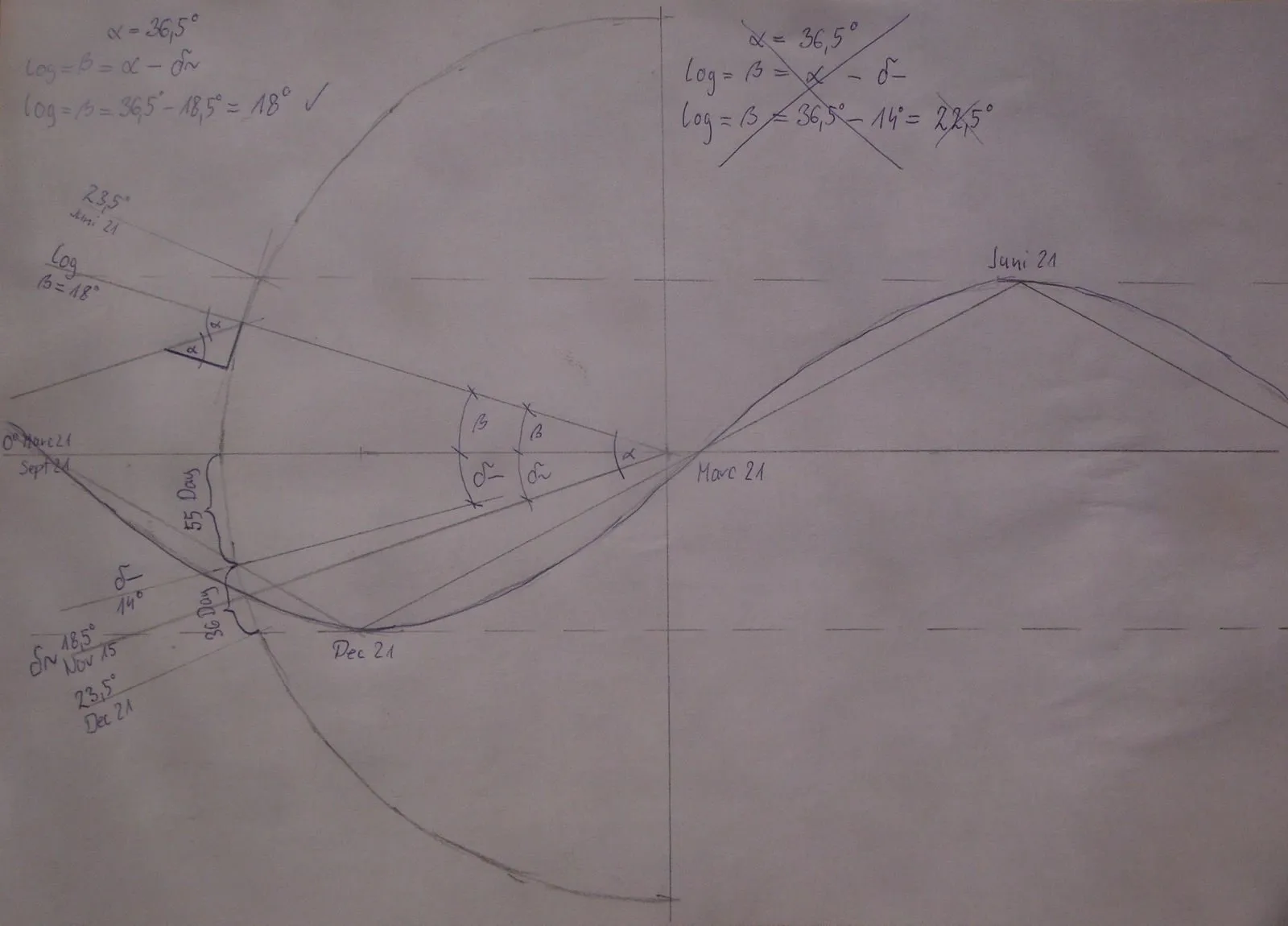
Yes, but that would mean the sun moves linearly, in a straight line, and turns back sharply at the end points, on 21 December and 21 June. I’d calculated it as if the Earth were flat, or at least a cube. Damn!
But that’s not how it is – we’ve known for a few years now that the Earth is round, and in that case the sun’s movement is best described by a sine curve.
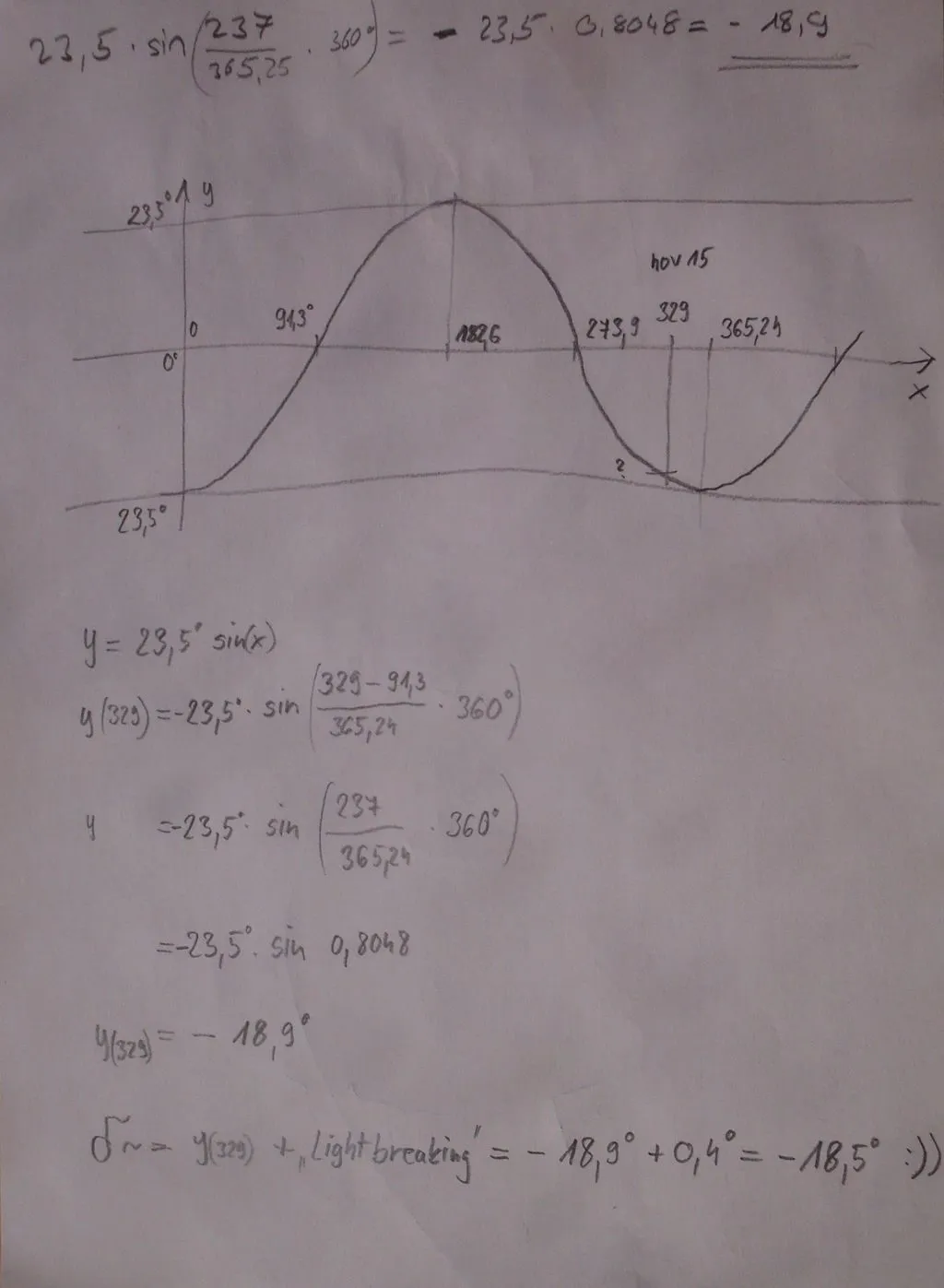
So I wrote out the problem: on the y axis the two end points, 23.5 and -23.5°, and on the x axis the days of the year (21 Dec: -23.5°, 21 Mar: 0°, 21 Jun: +23.5°, 21 Sep: 0°), and I asked Bijan whether he could work out how many degrees belong to 15 November, day 329 on the sine curve. He said yes, but did I have a calculator on my phone?
– Of course I do, but are you winding me up? – I asked.
– No, whatever gives you that idea?
– You do know my phone has been with Neptune on the bottom of the sea since day two…
– Ohhh, right, sorry.
I told him not to get up until the result came out at 18.5°. To our great delight, the very first attempt gave 18.9°, so we quickly agreed that the remaining 0.4° difference was caused by the refraction of the sun…. :))
Gregor and Igor had been watching the instrument-making, the measuring and the debugging with great interest, and they loved the whole project; they even photographed the sketches and calculations along with the paper sextant.
I considered the task solved; or, as we used to put it back in the army: “Comrades, mission accomplished, we’ve royally screwed up the day!” (In Hungarian “day” and “sun” are the same word, nap – so we’d royally screwed up the sun as well.)
To celebrate, and for the first time on our trip, at 17:00 ship’s time we marked our gin-tonic-time – a well-established ritual back in the Adriatic – with gin and tonic.
Speaking of ship’s time. On board our clocks (except mine) run on Greenwich UTC time, i.e. one hour behind Hungary. Time zones change by one hour every 15 degrees of longitude (that’s how 360° gives you 24 hours), and since we’re already at 37 degrees west, in theory there’s a 3-hour difference between home and local time, and two hours compared with Greenwich. Not adjusting to local time just means that the sun doesn’t set at 18:00 local time but at 20:00 ship’s time, and doesn’t rise at 6 but at 8. Big deal… So what?
Nothing – at most it’s tropical time instead of winter time or summer time.
The chart revealed that in a certain sense we’ve already reached America. We’ve crossed the 35th meridian, where Brazil begins – albeit “a little” further south.
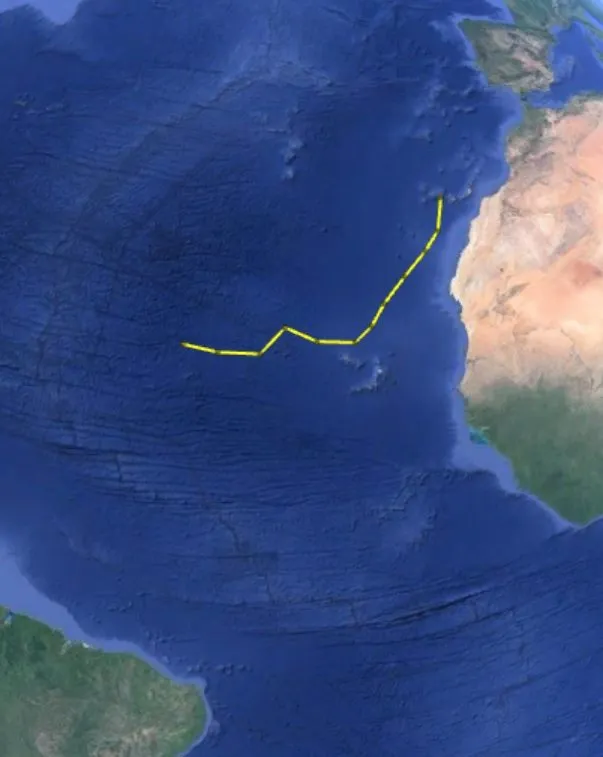
Today I finally managed to phone home. There is a satellite phone on board, and we could even use it for a fee, if its card were topped up.
But there are only a few units on it, enough for 2 texts each. Each of those can be up to 1,000 characters, though. I sent one home about a week ago, but as it turned out today, they never got it. So I asked Gregor to ask them by text (that’s the only way he communicates too, and it works for him) to top up the phone with 50 euros so I could make a call. That evidently happened, because today I did manage to call. But how much they actually topped it up with, and what it costs per minute, we still don’t know.
To celebrate, in the evening Jiri and I made pásztortarhonya – shepherd’s-style Hungarian egg-barley pasta – from ingredients brought from home.
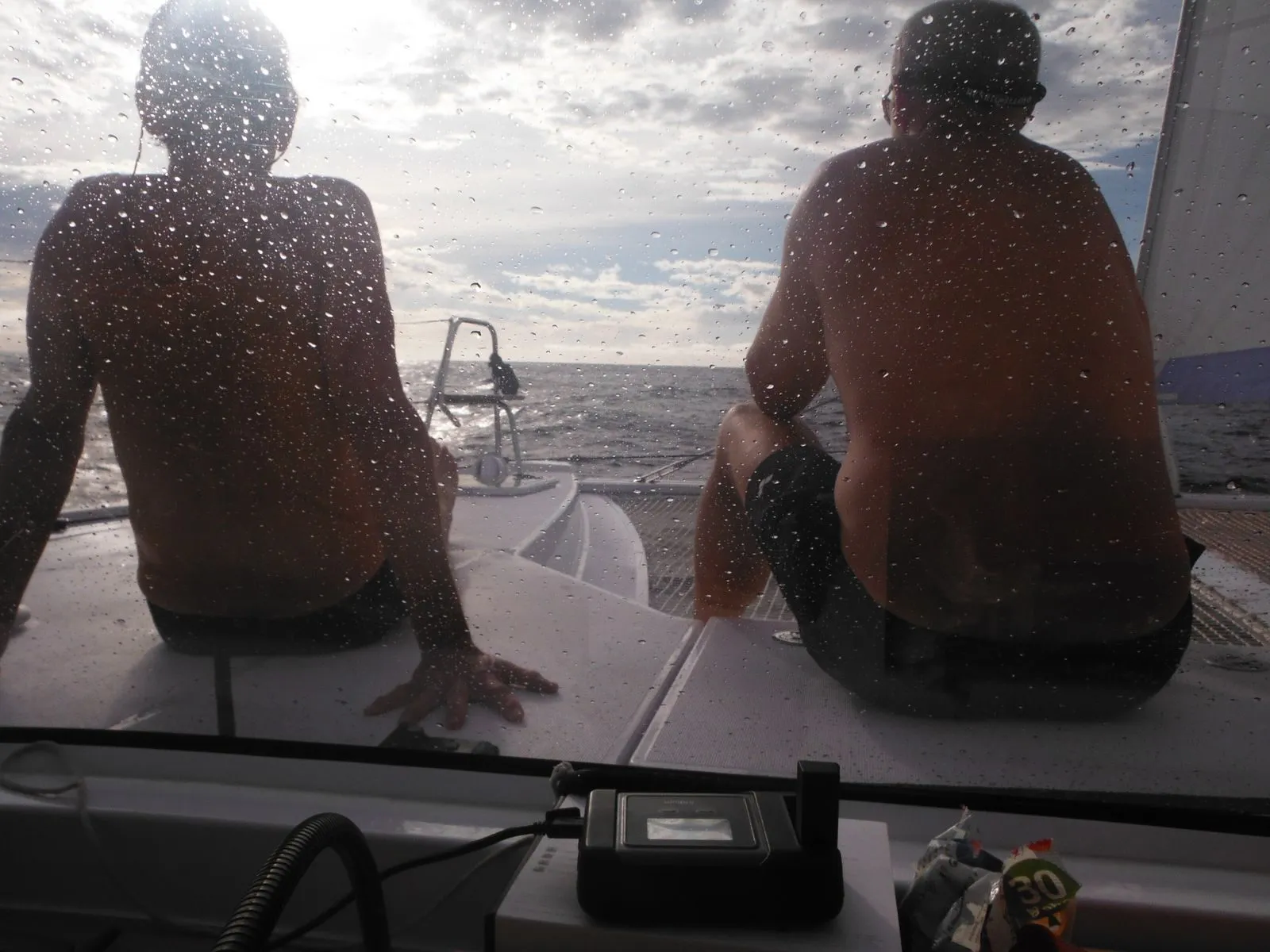
Machine translation (AI, Claude) of Balázs’s Hungarian original. Read the original →
Tuesday, 17 November 2015
Day 13, 159 nm
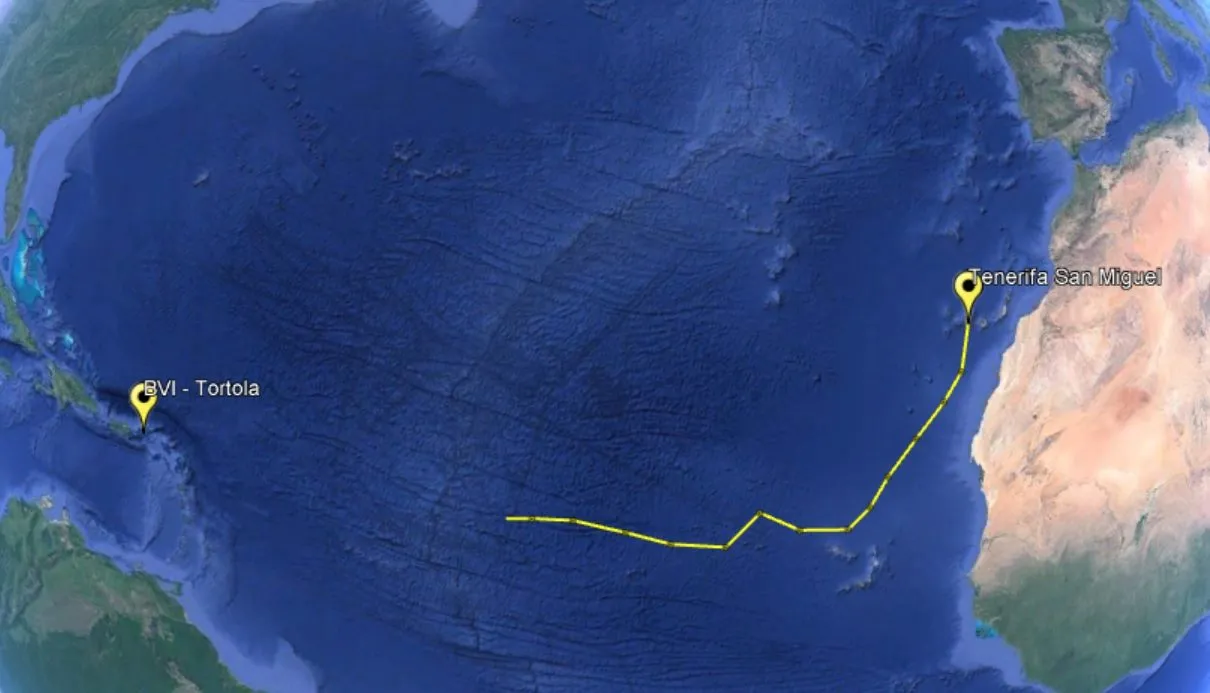
Since we set off we’ve covered 1,800 nm. Our destination, the British Virgin Islands (BVI), is still 1,400 miles away from here as the crow flies. Since we don’t know a shorter way through the woods, and we have to tack downwind even with the wind behind us, the remaining 1,400 will turn into something like 1,600–1,700 nm. Assuming that, we’re already past halfway. The official party, however, to which we’re all invited, will only happen when we cross the Rum Line, which is drawn on our chart at longitude 40°36.512. We’ll probably cross it tonight. The Rum Line is the halfway line between the meridians of our starting point, Tenerife – San Miguel (16°36.926), and BVI – Tortola (64°36.099).
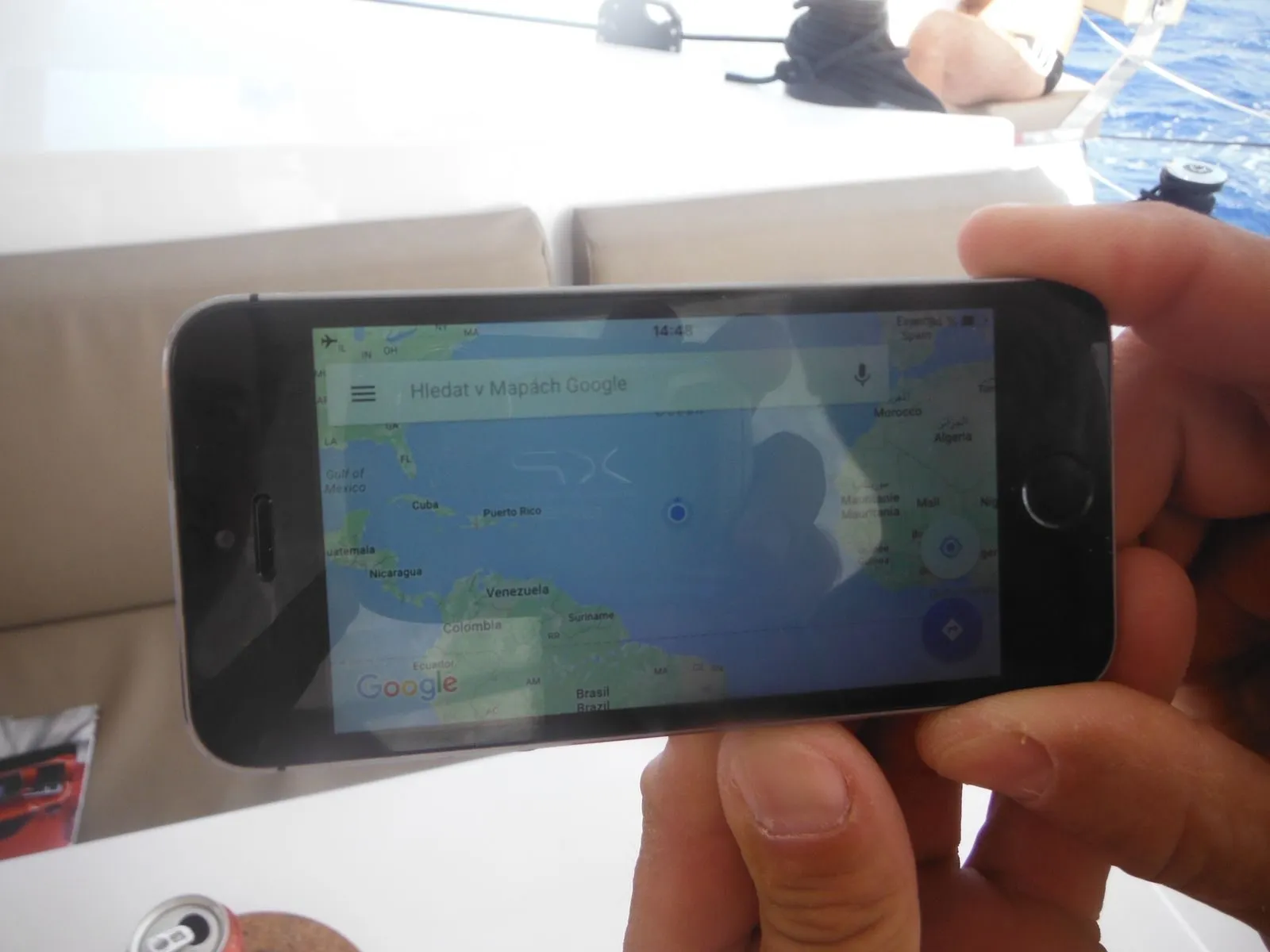
There are several reasons why, instead of running dead downwind, we’re zigzagging west on a “raum” reach, as the Germans call it (no, that’s not a typo for rum), or, as it’s also called, with the wind on the quarter.
One is that so far, since the Cape Verde Islands, the wind has almost never blown from dead astern, i.e. exactly from the east. (So is this a trade wind or isn’t it?)
The second is that with this rig we couldn’t really sail dead downwind anyway, or only much more slowly, because we can only let the mainsail out to about 40° instead of the usual 70–80°, since even like this, up top, it already touches the – now padded – shrouds.
The third is that we have no spinnaker (not even a halyard for one!), which would be really handy downwind and almost downwind. Then again, it’s also true that a spinnaker, at 110 square metres – much bigger than the current main and headsail put together (62+26 m²) – would be too much in 20–24 knots of wind.
So we tack downwind, which means that because of the zigzagging we sail a longer route, but presumably in less time, or at most about the same, as if we were sailing straight and struggling dead downwind with this rig.
Machine translation (AI, Claude) of Balázs’s Hungarian original. Read the original →
Wednesday, 18 November 2015
Day 14, 154 nm
My fingers are still trembling over the keyboard as I recall the events of the night. The dog watch, from midnight to four in the morning, was Willy and Bijan’s, while the rest of us slept down below, me dreaming of palm trees, naturally, and the others of dark-skinned beauties…
It must have been around one in the morning, perhaps just as we crossed our Rum Line, when the pirates struck. Bijan had been so right about that two-master two days earlier. Willy was at the helm, blinded by the moonlight, so he didn’t notice the pirates boarding our boat from the other side. They promptly tied Willy to the wheel, trussed Bijan up like a chicken, and started hunting for the rest of us, stylishly, to the booming soundtrack of Pirates of the Caribbean. I locked myself in my cabin, but in two seconds flat they’d smashed the door in with an axe and dragged me up on deck, just like the others.
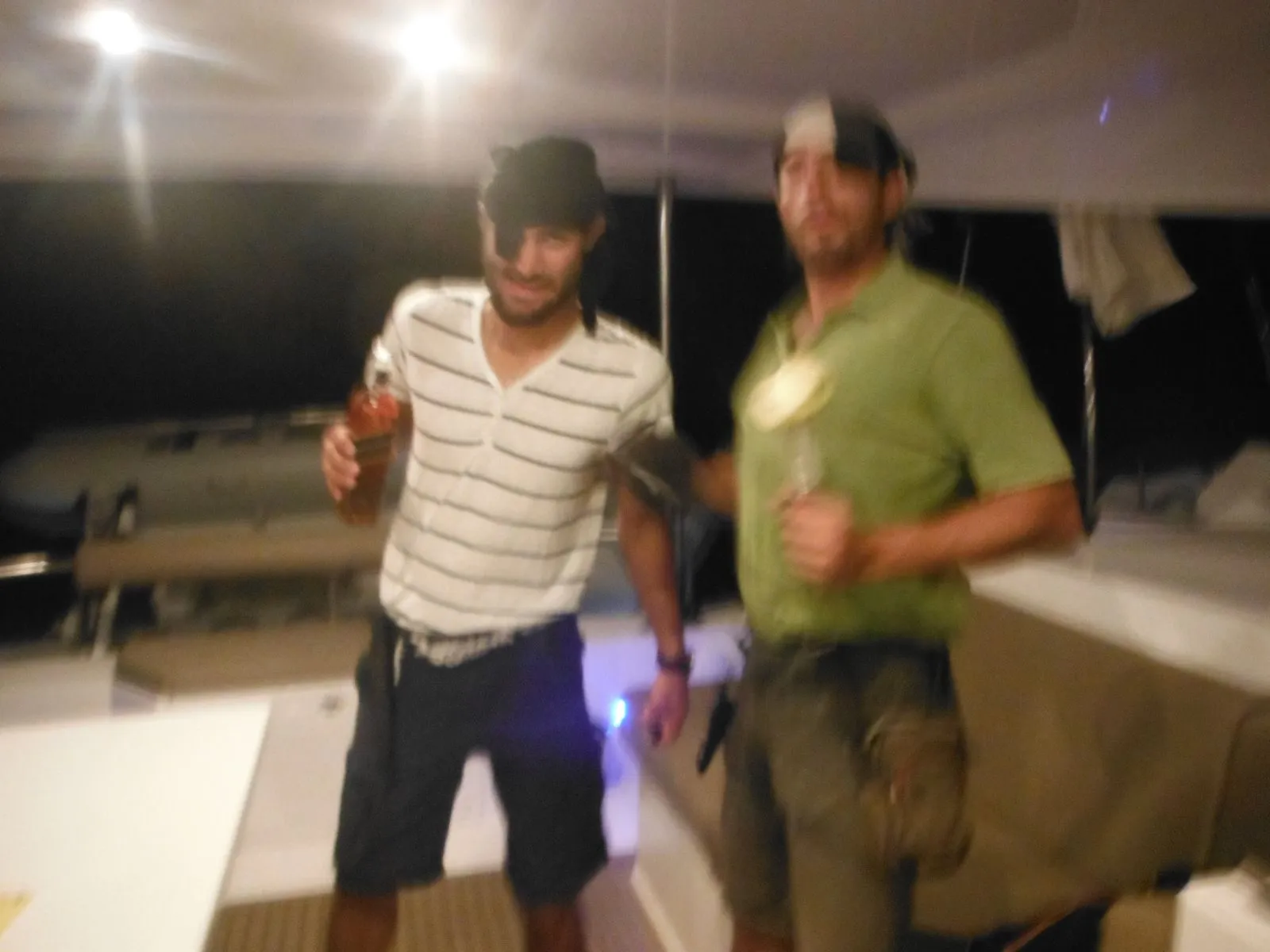
They found the last barrel of rum too, tapped it, and tried to get us drunk so we’d spill where the treasure was hidden, but we held our ground honourably for a very long time. After a while Simon and Bijan couldn’t take the ordeal any longer and, to save their lives, handed over their most treasured possession: the latest issue of Playboy. (Which, allegedly, gives an authentic and extremely detailed account of the lives of the prettiest German female university students. As a point of interest they told me – I’M ONLY SAYING WHAT I HEARD! – that one of the young ladies is a second-year physics-theology student. I’m slowly starting not to understand the world either…)
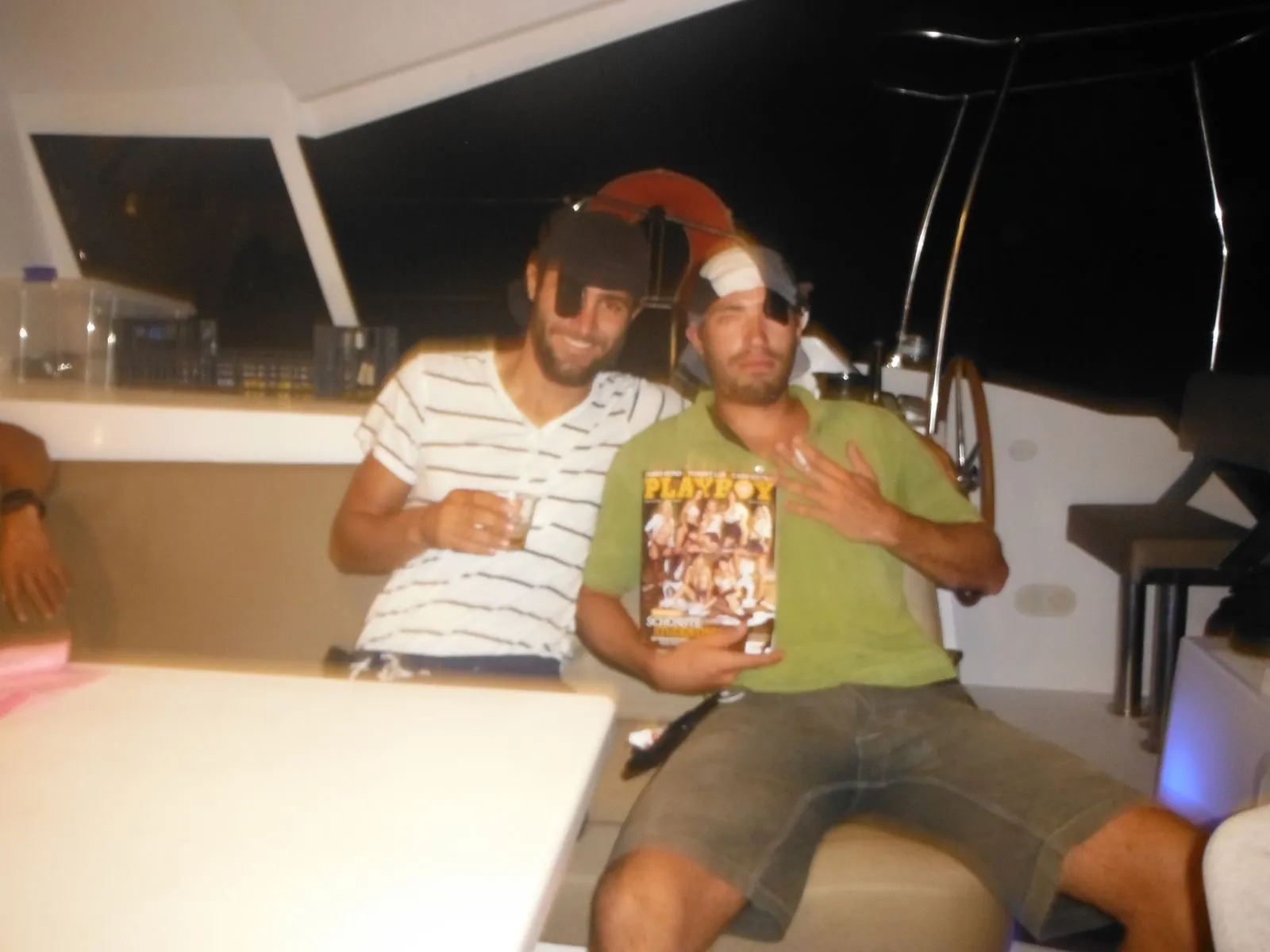
This worked spectacularly, because two of our pirates, Greg Sperrow and Igor Hook (hook and all), softened towards us considerably – they let Willy and me go as well – and to celebrate the precious booty they put on a fireworks display in the night.

In the end we became thick as thieves, and decided that we’d turn south together with them and sail to the South Seas along the Rum Line – crossing it and recrossing it every day.
In the morning we wake up sprawled out on deck, and only the sight of rum bottles rolling to and fro convinces us that all this wasn’t just a dream…
OK, fine, that last bit was just a little Gulliver-style exaggeration so I could end the story believably, but the rest is the honest-to-goodness truth – I even found pictures of it on my camera. Even if, rum-soaked as they are, the pictures are a little blurry.
All the same, this morning passed somehow a little subdued.
Maybe that’s why we decided a bit of refreshment wouldn’t hurt, and we went for a swim in the middle of the ocean. Sails down, buoy on a line thrown out, and off we go. Igor dived in headfirst from the cabin roof, next to the boom; I had no wish to accidentally land in the liferaft, so I simply picked the stern as my starting block. It paid to be careful, because although the sails were down, the wind was gripping the boat’s big topsides and we were drifting at a knot. And because of the waves, the stern and the swim ladder rose and fell by at least a metre, so you had to get there at the right moment and grab hold, so it would lift you out rather than whack you on the head….

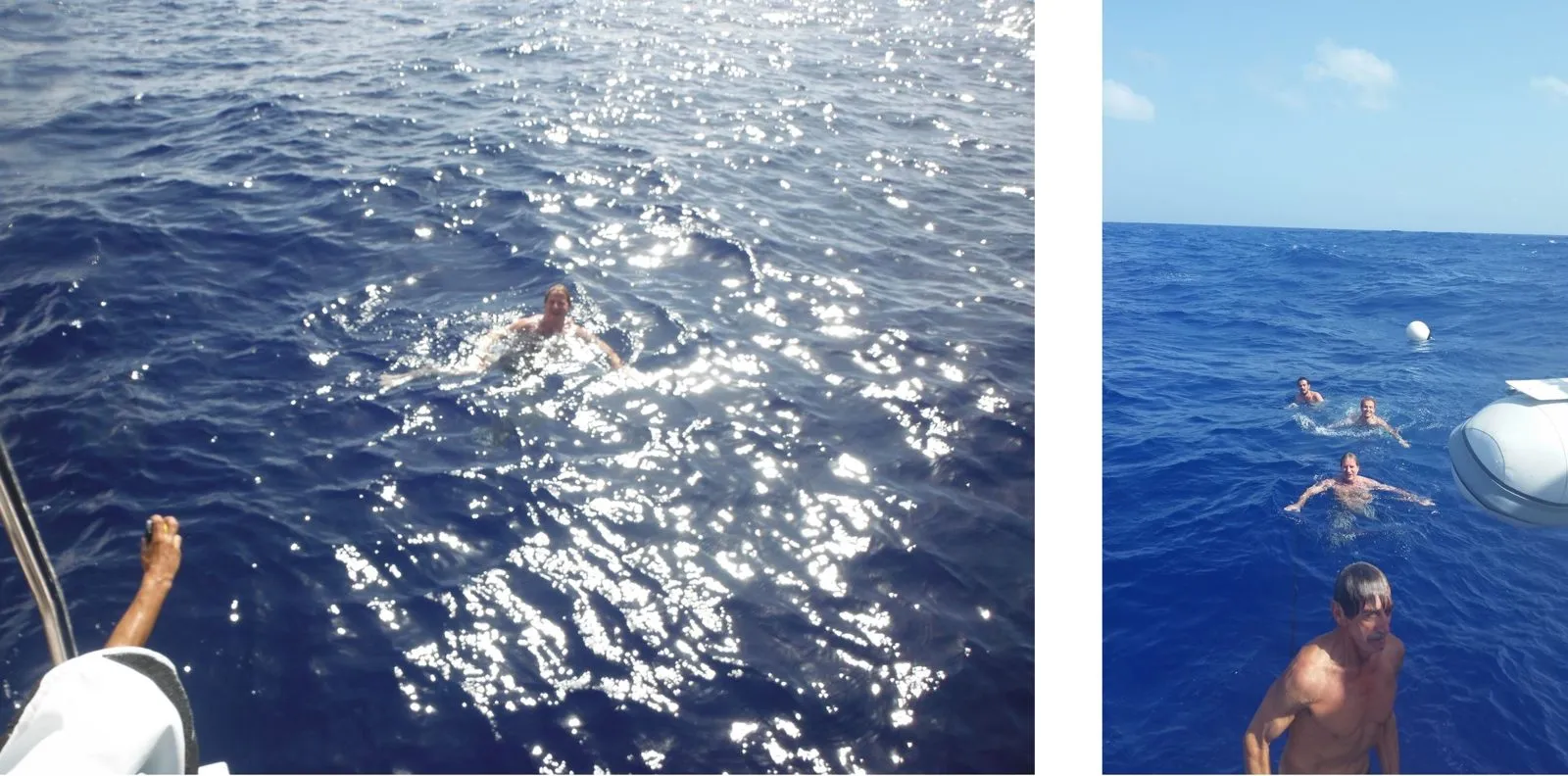
We weren’t worried about sharks, because we’d seen one three days ago, 400 miles from here….:)
Still, I didn’t dare swim right round the boat.
All the same, swimming in the middle of the ocean is a one-of-a-kind experience.
In the evening we went to the open-air cinema on the stern. Widescreen picture from the laptop, cinema sound from the boat’s multimedia sound system.
As a topical choice, we watched the first part of the Back to the Future series in the original language with English subtitles. I understood every word.
Because I’ve seen it quite a few times. Still, you keep marvelling at some new little detail you’d never noticed before.
About this, too, I can only say what I’d say about other otherwise everyday things – like making pancakes – that experiencing it in the middle of the ocean, on a boat swishing through a moonlit night, is something else entirely from doing it at home in your flat.
Machine translation (AI, Claude) of Balázs’s Hungarian original. Read the original →
Thursday, 19 November 2015
Day 15, 140 nm
Not in mine, mind you…
For the night watch we usually wrap up in long trousers and a foul-weather jacket, because although
it never gets colder than 24 °C, the constant wind quickly “blows right through” you. This morning, instead of my tracksuit bottoms, I tried out the waterproof trousers too. They worked well: they breathed just enough, but the wind didn’t get through them. I put on a hat against the wind as well, and in the morning I looked like a:
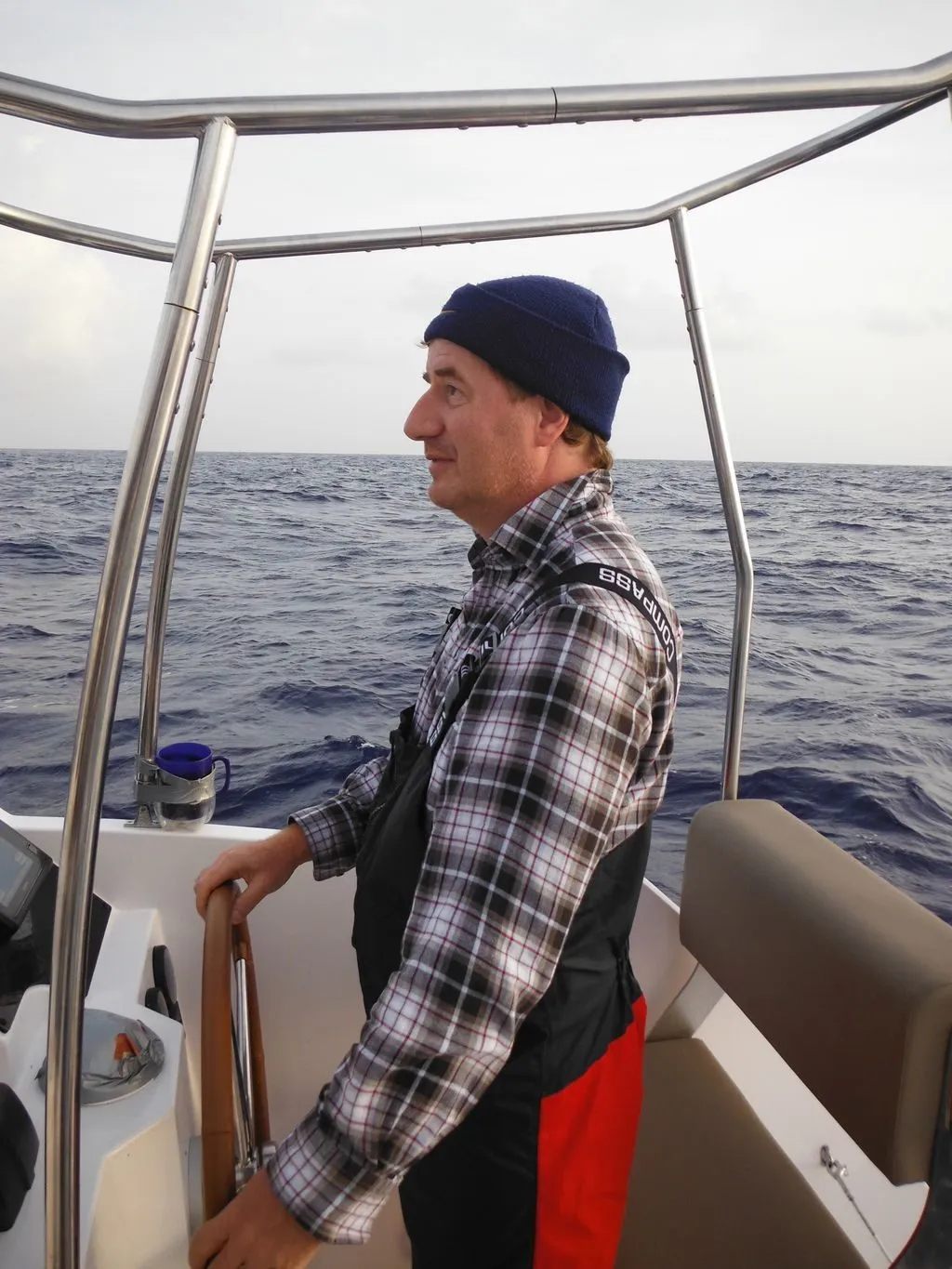
According to Bijan, at least.
We’ve been under way for two weeks. So far we’re holding up well. With each other, too. There hasn’t been a single row yet, maybe not even any “brow-furrowing”. The 3–4 hours of helming a day each isn’t a strain yet either; it takes your mind off things a bit.
The fact that we’re still enjoying ourselves doesn’t mean we’d go round again if we arrived today; we’d very much like to tie up somewhere, and then a few days later we could carry on.
If it were up to me, I’d stop at the Cape Verde Islands for a week or so, and then I’d choose the nearest Barbados or Saint Lucia as the next destination, where, with the distance we’ve covered so far – in 14 days – we’d easily be there already.
Yesterday we did a little stocktake on the food front.
Most of the fruit and veg is gone; there’s only onions, lemons and a few potatoes left.
There are still two loaves of long-life bread, but Igor is going to try baking bread today regardless.
On the other hand there’s plenty of tinned food, pasta and drinking water. Me, for instance: of the 28 litres of water allotted to me for 14 days, I’ve only drunk 8 so far. The rest has been tea, beer, soft drinks, juice, Nestea and soup.
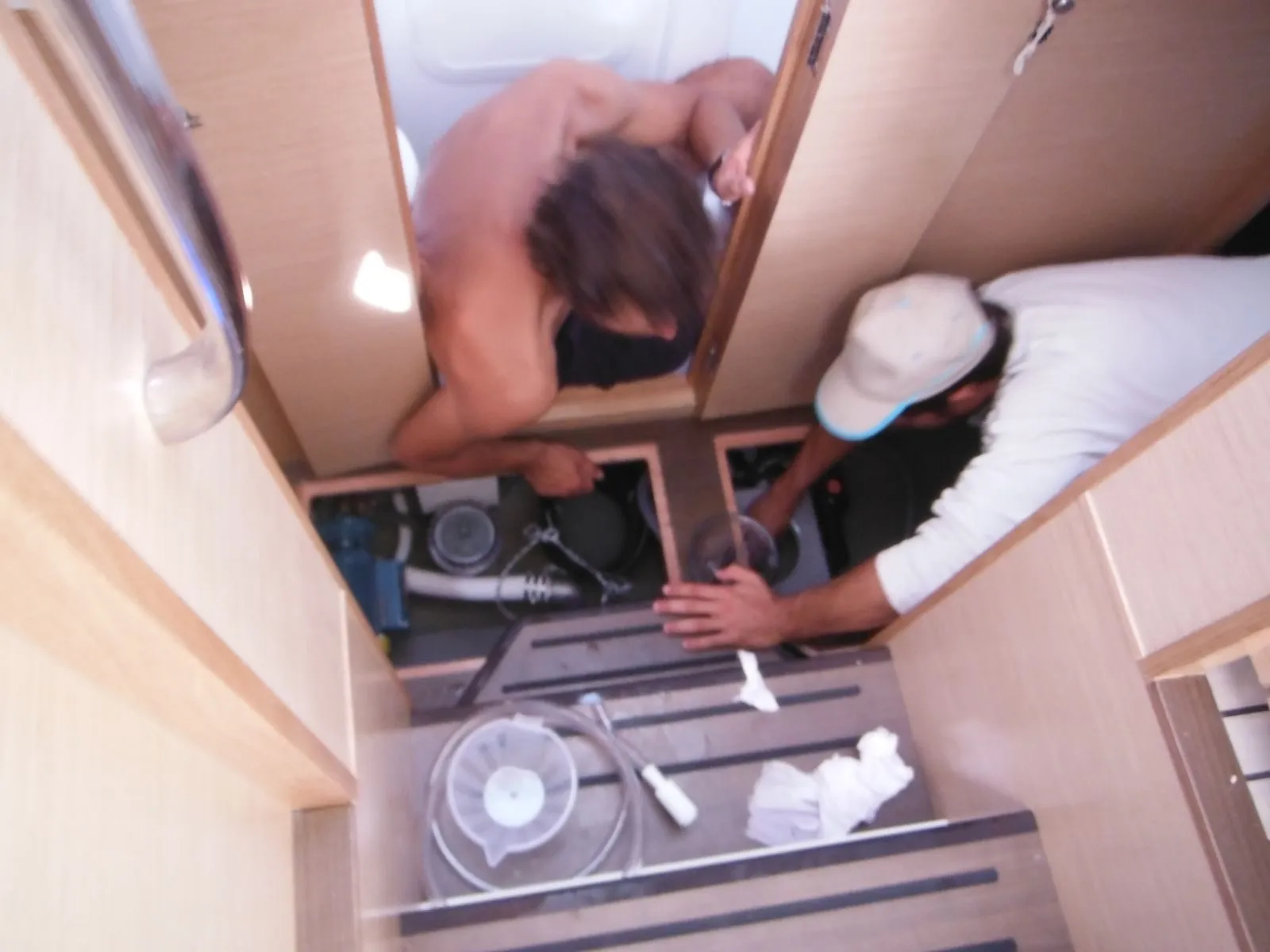
In the afternoon we checked the bilges of both hulls, and found water in ours. It quickly turned out that we hadn’t sprung a leak; it wasn’t seawater, or sewage either: our shower (which we don’t use) and our washbasin share a small grey-water tank of about 20 litres, which had filled up, and since its lid isn’t watertight, the waste water from hand-washing and tooth-brushing had overflowed into the bilge.
An automatic pump was supposed to empty the tank, but for some reason it doesn’t work. And the bilge pump, whose job is to keep the bilge dry, doesn’t kick in for such a small amount of water (3–4 buckets’ worth). We bailed the bottom of the boat dry, and now we don’t use this washbasin (either).
In the evening they screened part two of “Back to the Future”, and today I got a front-row ticket.
Machine translation (AI, Claude) of Balázs’s Hungarian original. Read the original →
Friday, 20 November 2015
Day 16, 171 nm, a new record so far
This morning before dawn the wind freshened to 22–24 knots. There were gusts of 30 too – good thing we’d put two reefs in the main beforehand and rolled up a bit of the headsail as well.
It rained all morning, the sky was cloudy, the wind didn’t ease off either, but luckily the waves didn’t grow; they’re just coming more from the side, from a more uncomfortable direction. Sadly it doesn’t look like “just a short tropical shower” – it could last as long as three days, if the forecast about the size of the front is right. Even though, according to Willy, the barometer is rising. We don’t know how far the storm zone extends to either side, so speculating about which way we could get out of it faster is pure guesswork. So we’re heading straight west, towards our destination, Tortola, and hoping this front passes over us as soon as possible.
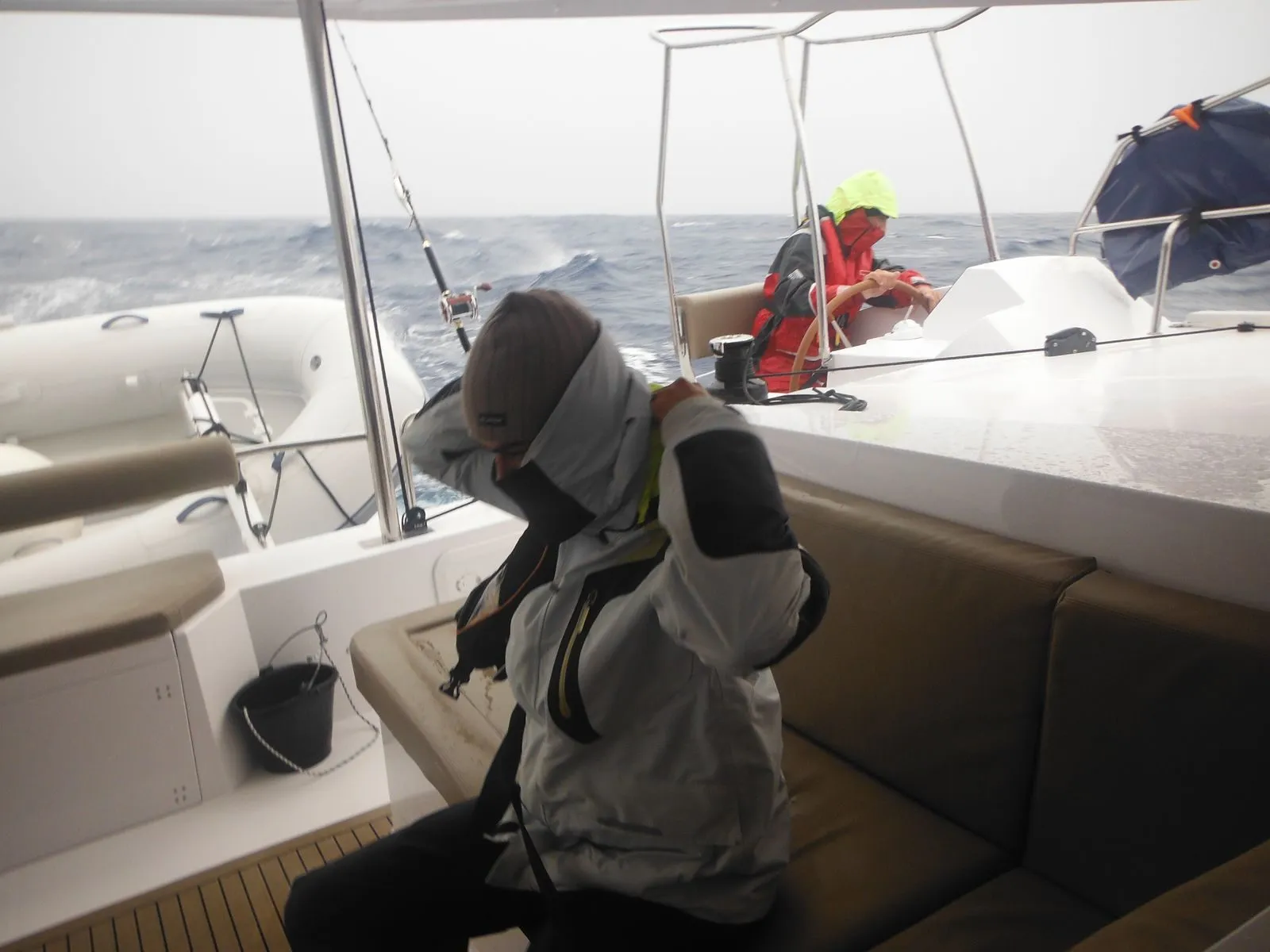
The helmsman is out there getting soaked in his oilskins, and the rest of us are cooped up inside the boat. You can still sit in the “covered back terrace”, the rain doesn’t get in there; you can still sit around in the saloon, at the chart table – that’s where I’m writing now, at least you can see out properly from here – and you can try to sleep down in the cabin, where it’s still very noisy. I’ve already mentioned that there were times I even stuffed my ears because of it. The noise is made up of several sources:

And so it goes, on a continuous round-the-clock shift. Sometimes loud, sometimes even louder.
The hum of the engine or generator, switched on only now and then during the day, is just a lullaby drone as the icing on the cake.
So if anyone wants to rest, or heaven forbid sleep, they have to be very serious about it…
Because the boat also rocks, you see…
True, you don’t roll from side to side in your bed, but if you want to fall asleep on your side, you have to rhythmically tense your arm and thigh muscles so you don’t flip over like a turtle. And if you lie on your back, it’s like riding a roller coaster: at the top of the wave you practically take off, you lift up, and in the trough you get pressed down into the mattress.
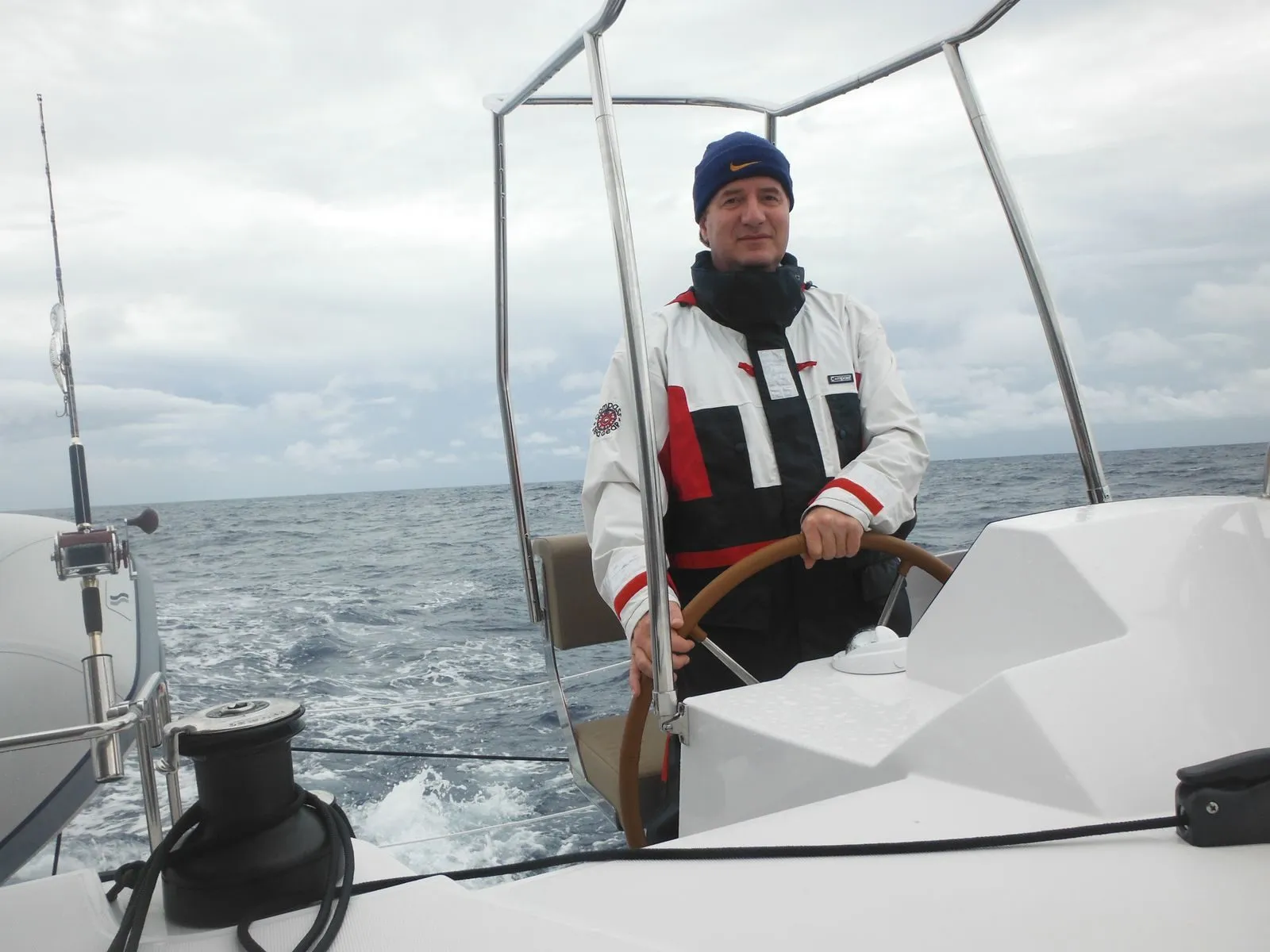
Outside isn’t much quieter: if you’re steering, on the one hand the wind howls past your ears, and on the other, since the two helm stations are right at the very back of the boat, there’s the constant rush of the water racing past beneath and behind you. These same two noises get trapped under the covered terrace all the time too, so the silence of the “wilderness” can probably only be experienced here in a flat calm. I never thought an Atlantic crossing could be this constantly loud.
After lunch we headed a bit further south, hoping to reach the edge of the front sooner. So far it’s worked, because the rain stopped, first the blue sky started peeking out, then slowly the clouds began to break up too, and now the sun is even shining. One after the other we shook both reefs out of the sails, and we’re carrying on in a friendlier mood, drying out our rain jackets and sipping gin and tonic.
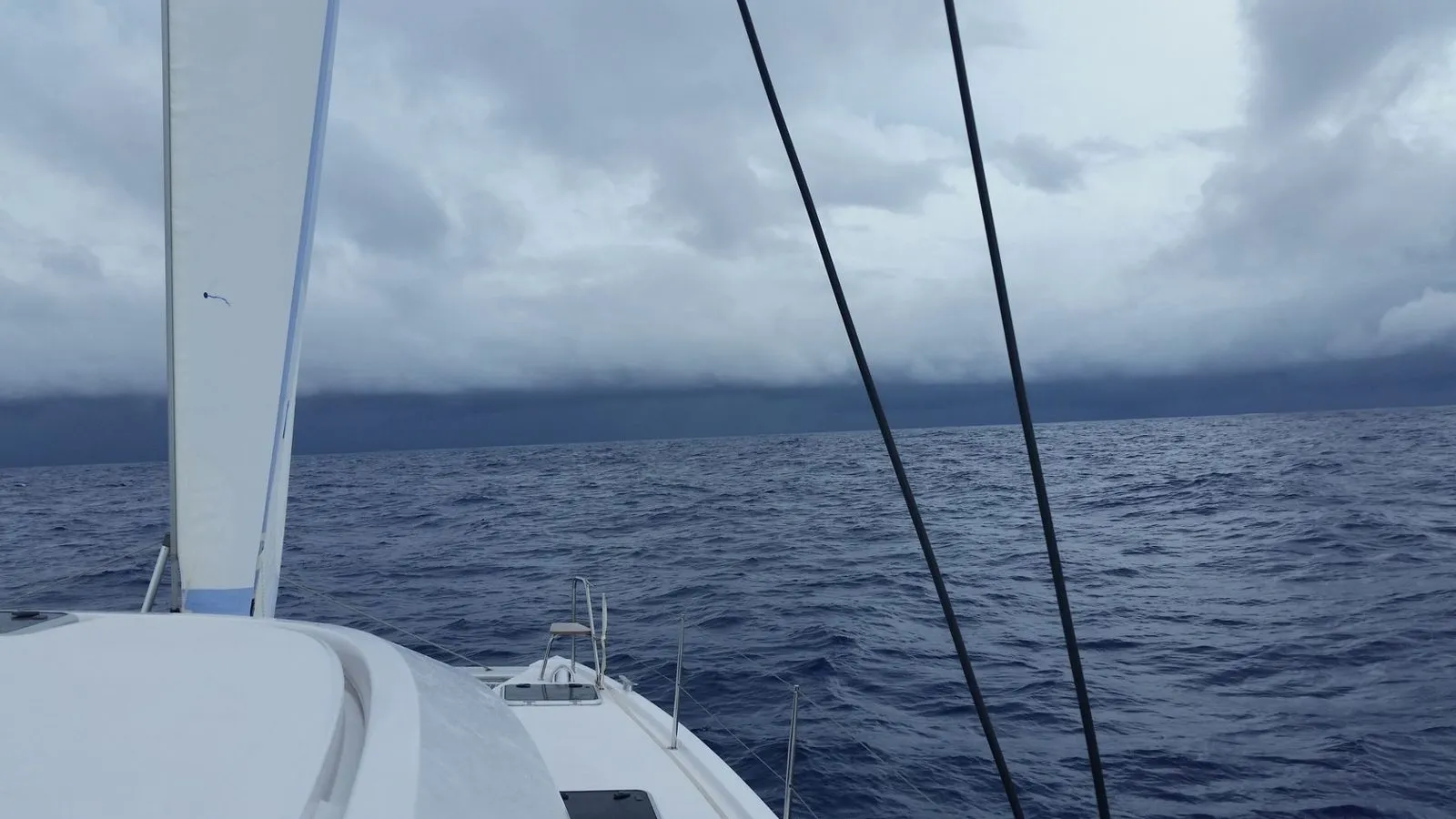
All evening we sailed with one reef in, and now and then it rained too, so the evening film screening was cancelled due to bad weather.
Machine translation (AI, Claude) of Balázs’s Hungarian original. Read the original →
Saturday, 21 November 2015
Day 17, 150 nm
During the morning we carried on heading south, to make sure we’d steer clear of the storm zone. Last night Gregor spoke to his father, who was able to check the weather forecast, and he advised us to keep this course a while longer. AMARON, sailing behind us and 180 miles to the north, got a proper taste of the storm: they had winds of up to 50 knots.

We, on the other hand, had rather lighter winds all morning; we went slower, and above all quieter, so I took the opportunity and had a good long sleep.
After lunch we turned west again, so we’re getting closer to our destination once more.
Today, for the first time, I saw plants floating in the sea, like Columbus and his crew did. That’s what made them believe land must be close, when the nearest island is still at least 800 miles away.
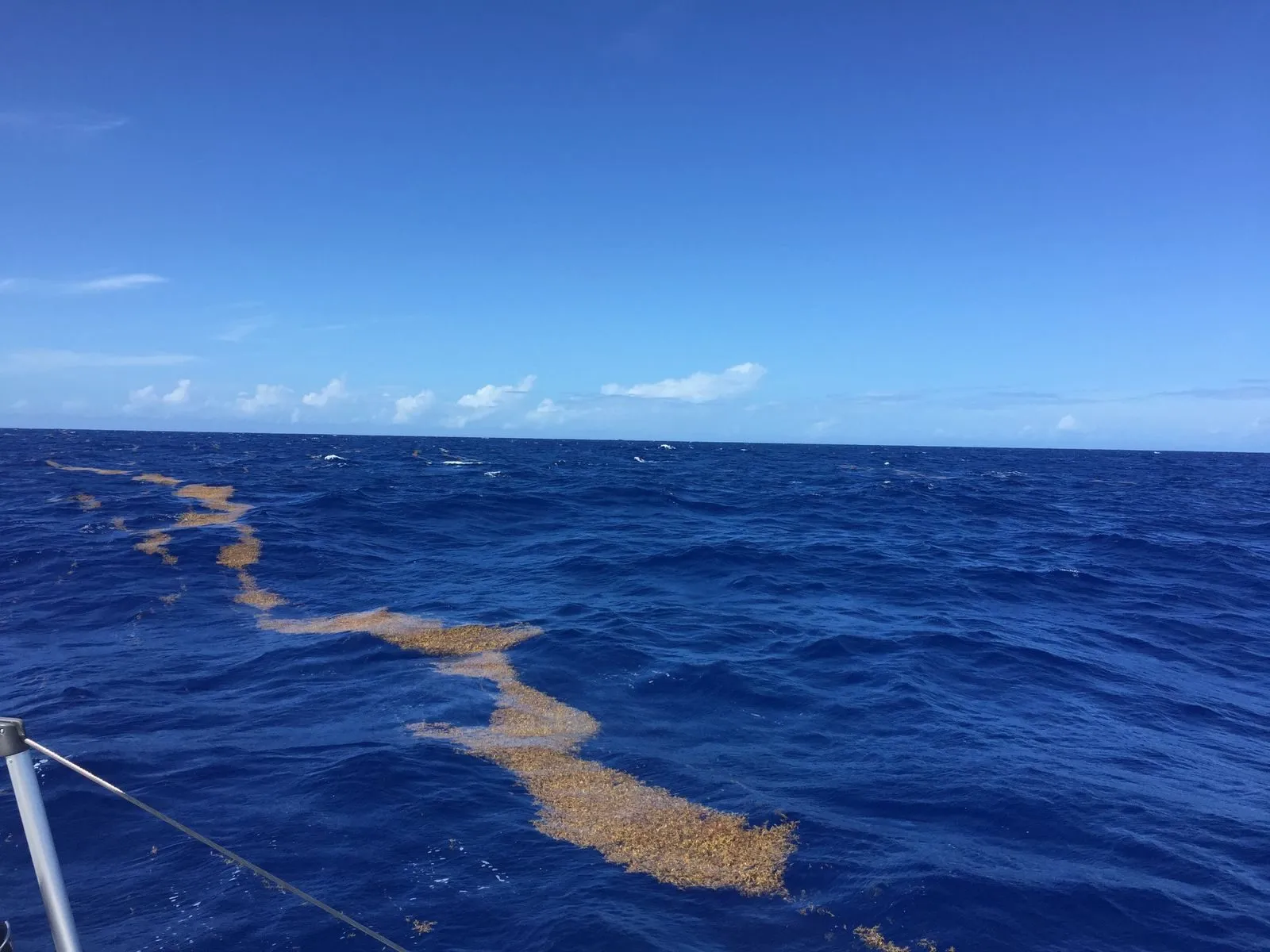
We’re sailing under clouds, in occasional drizzle. For 24 hours the wind has been blowing from the south-south-west; this cyclone has properly knocked our trade wind off course. The waves, however, are still coming from half astern, from the south-east, though more quietly as well. Even so, Jiri got a good bucketful of seawater on his bed when he left the hatch of his front port cabin open – for a bit of ventilation. A wave had never come in there before, but Neptune decided that he’s the one who blows the trade wind, and however he pleases… He dropped in to say hello, in his own way – and Easter, when Hungarian lads traditionally douse people with buckets of water, is still months away…
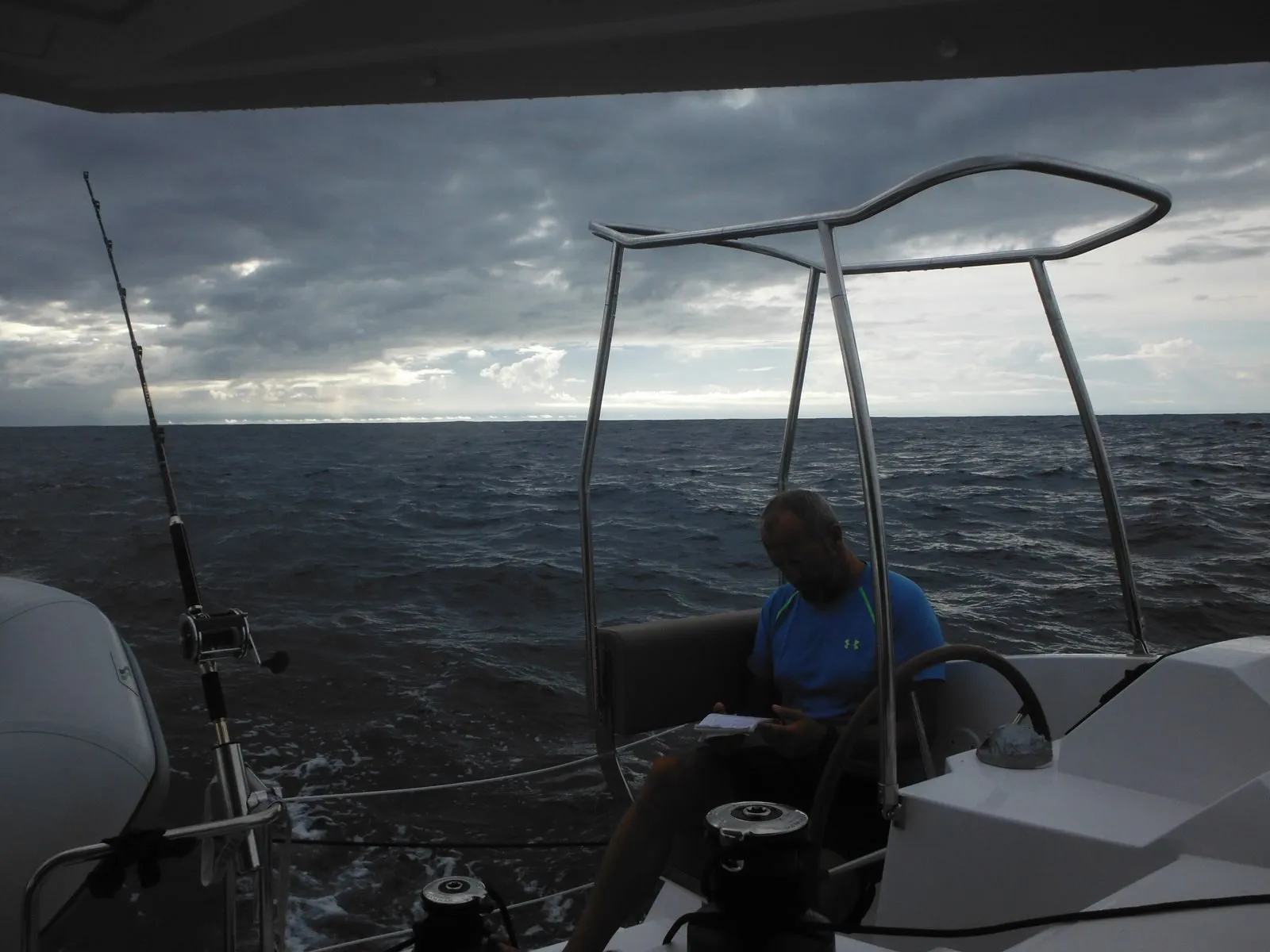
Funnily enough, rust spots have been appearing on all our cutlery and pots ever since we set off. Every cooking session starts with scrubbing most of it off. Yet it says stainless on them – though, admittedly, not how much less.
I don’t know whether the cutlery on the charter boats in the Adriatic and Mallorca is made of better stuff, or whether for some reason the environment there just isn’t as corrosive as it is here on the ocean.
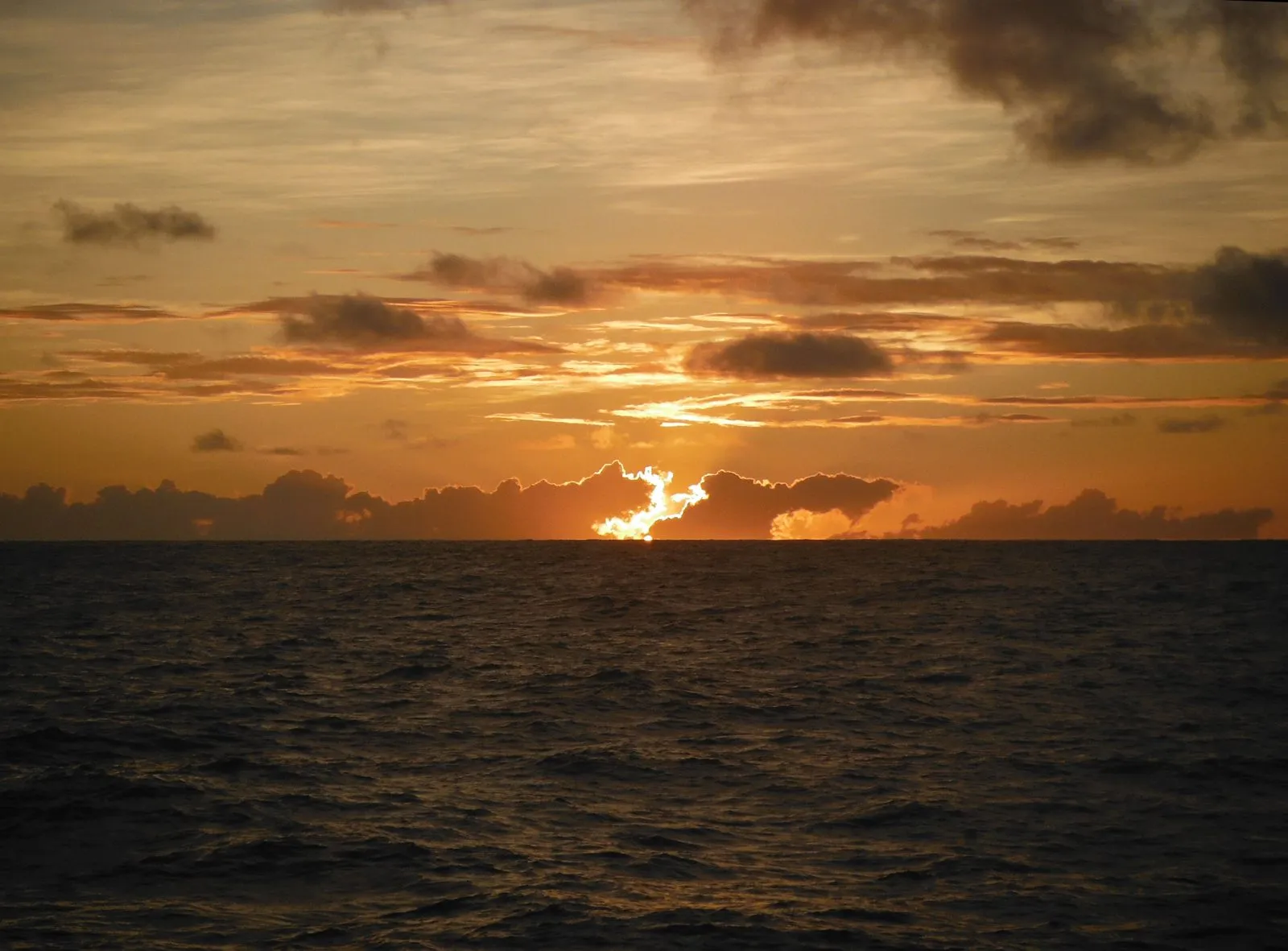
Today was perhaps the first time we got to enjoy a really beautiful sunset. Until now either the clouds hid the sun, or the sky was overcast, or… I can’t think of the third reason right now… :)
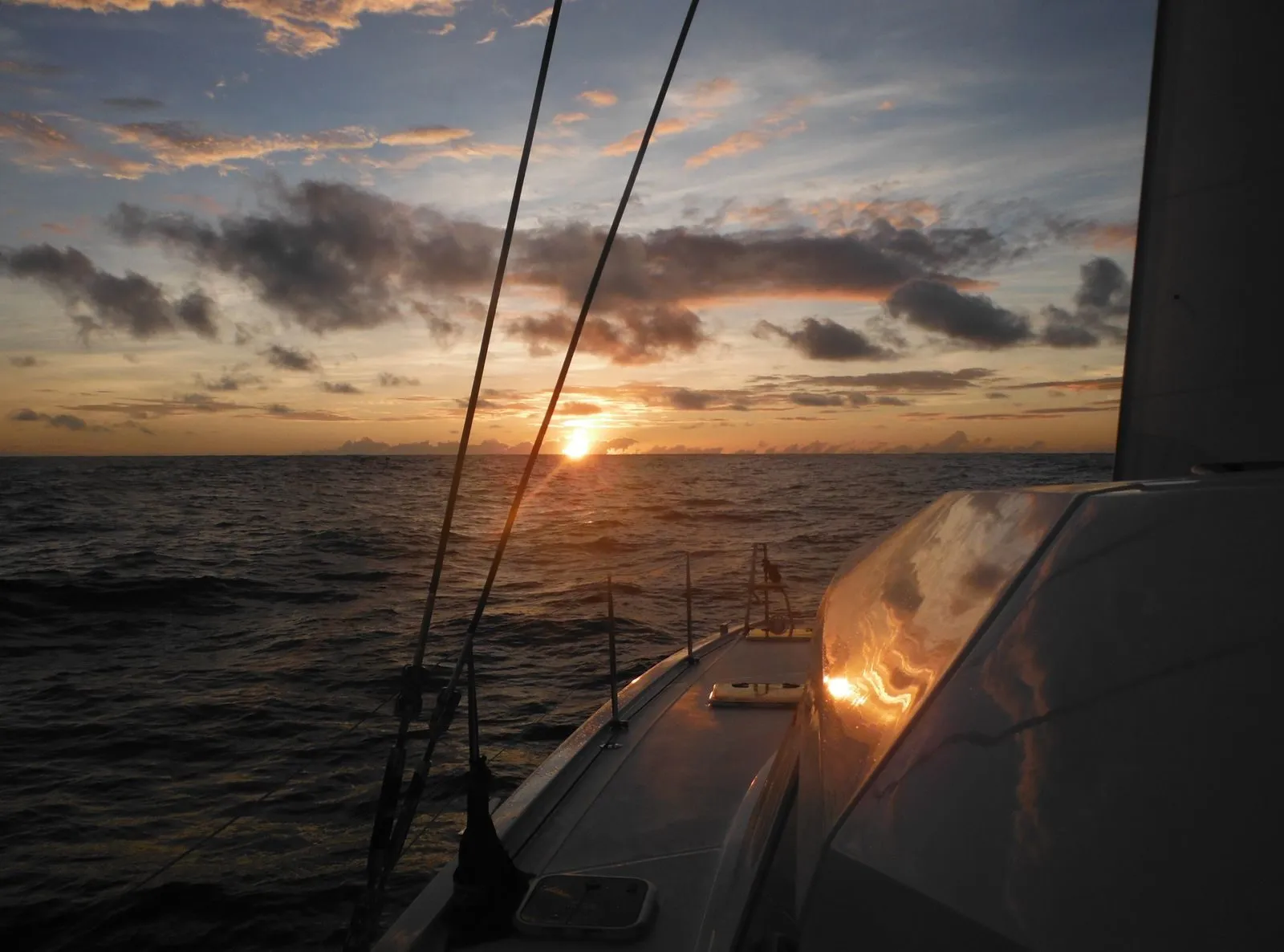
By evening the wind had died away completely and turned southerly, which is totally unusual here in the easterly trade wind belt. Probably the aftermath of the cyclone we dodged. So we had a laid-back evening, pottering along at 2 knots in the moonlit night. We watched part 3, the Wild West one, which we’d missed yesterday – me from beside the helm – munching popcorn and sipping Coke, as befits a cinema…
Machine translation (AI, Claude) of Balázs’s Hungarian original. Read the original →
Sunday, 22 November 2015
Day 18, 112 nm
After the quiet night the easterly trade wind came back, but only a feeble little one so far. All day it blew at just 9–10 knots, so we only made 2–3 nautical miles an hour. The white horses vanished from the surface; the swell didn’t stop altogether, but it calmed down too, and changed. I wouldn’t really call it swell, more breathing – the breathing of the ocean. Here and there it slowly rises, elsewhere it sinks. The difference sometimes reaches 4–5 metres, but it lifts the boat onto its back and lets it go so gently that you hardly notice.
Now this is when a spinnaker would come in handy – the big colourful downwind sail, all 110 square metres of it.
The sun goes its own way, the high trade-wind clouds catch up with us unnoticed and then leave us behind, and the seabirds are back too. Ideal, calm weather for reading and writing. I’m reading the second volume of Master and Commander in German, because it never came out in Hungarian.
It’s interesting to compare our conditions with those of the Royal Navy in Nelson’s day, where, for example, each hammock got 14 inches (35 cm) of space, and they only fitted in at sleeping time because a half or a third of the crew was always on watch. Two or three hundred men served on a 50-metre warship – true, those had 2–3 decks – while here on our 12 metres there are only seven of us, like the dwarfs. There, each man got half a litre of rum a day; here, well… I’m not telling, that’s a military secret. No wonder there were so many broken arms, legs and ribs there even in peacetime, with men just dropping off the rigging. Whereas on our boat, on the whole trip, the only injury is my middle toe, grazed on the swim ladder the other day when I fled from the water to escape the sharks. I only wrote this for the sake of comparison, and it in no way means that I’m the biggest boozer on board…
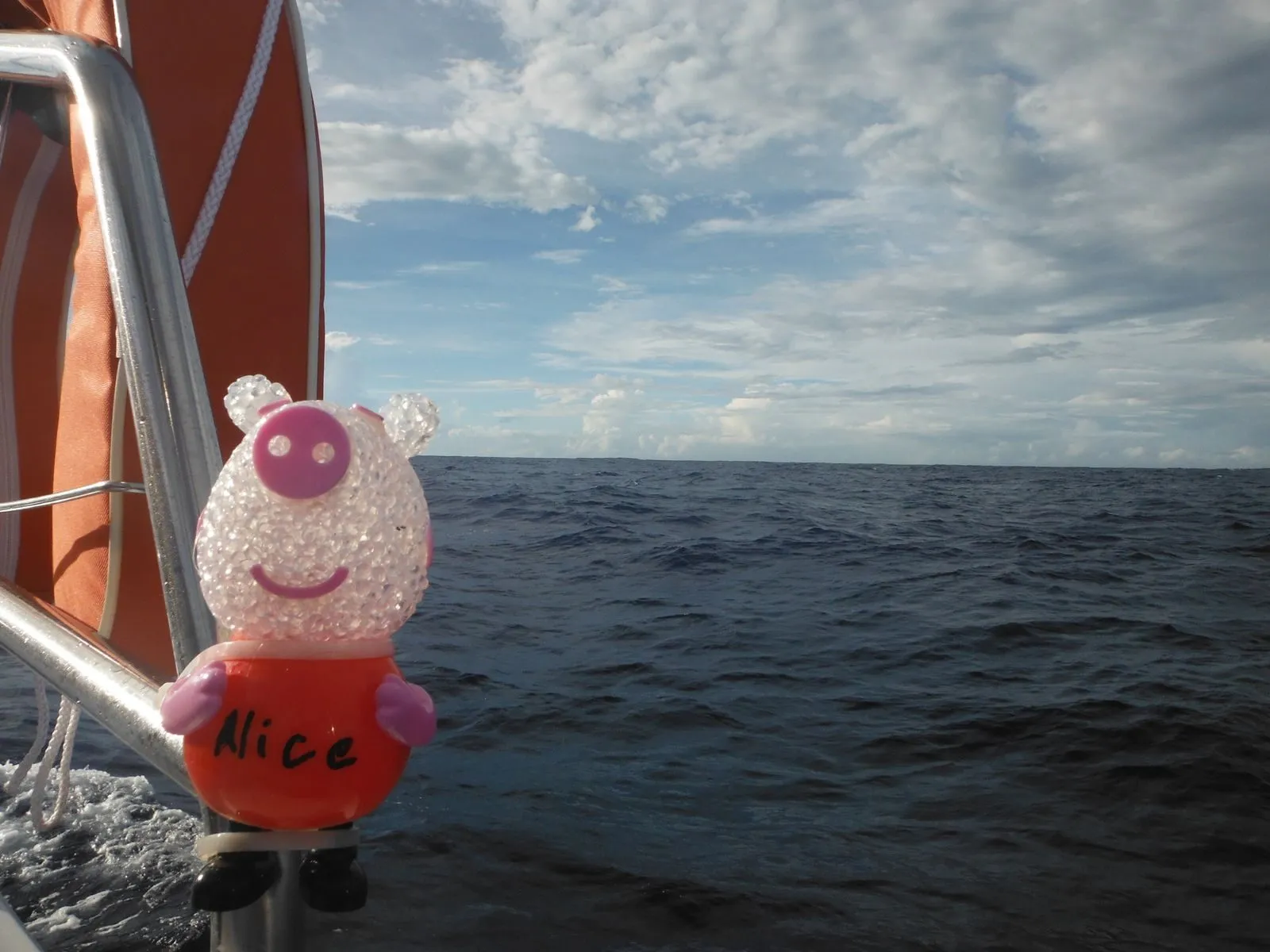
Our boat has a figurehead too (I think that’s what that bust is called), although not on the bow as in the Middle Ages – since we have two of those – but on the rail in front of the helmsman.
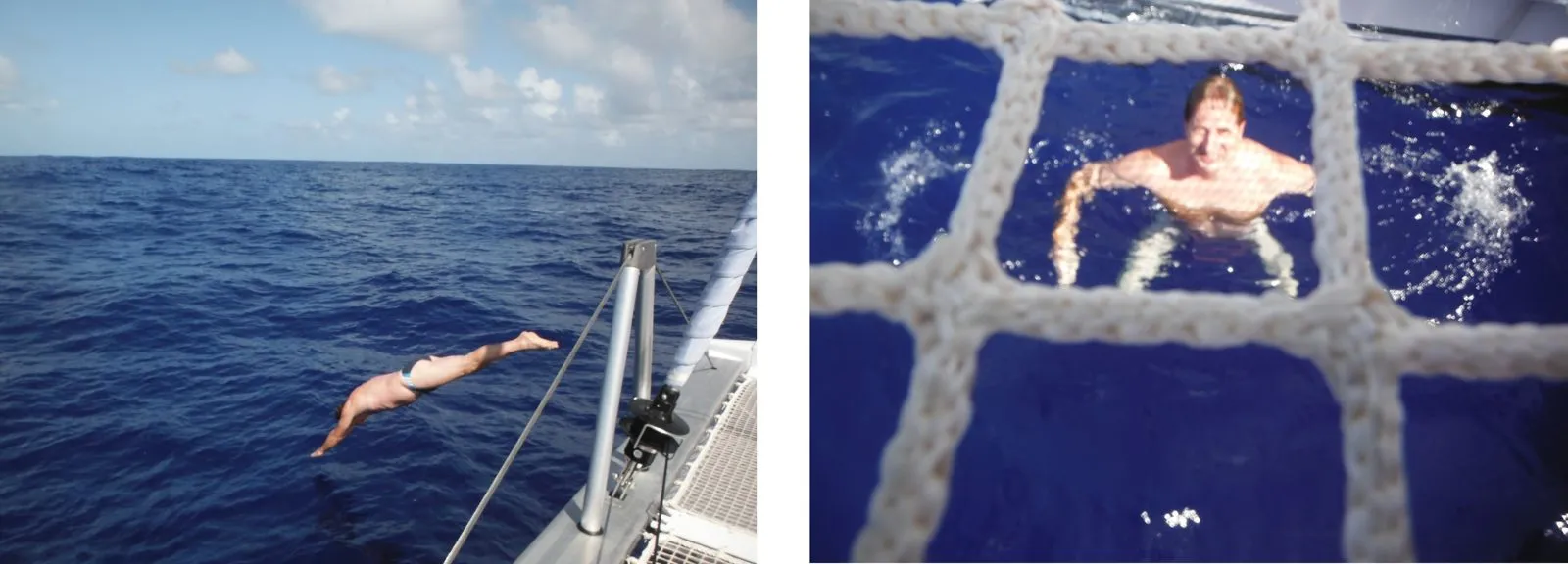
How about a little swim, seeing as the ocean is so nice and calm? – I asked the others in the afternoon. Everyone liked the idea, so we went to the nearest beach and furled the sails. We couldn’t anchor, because there were 5,000 metres of water under us – I got dizzy just looking down – but there was no need anyway, because the shore was still a little way off, some 777 miles. This time we were braver (the shark is even further away now, after all), and I even swam under the boat – and in for a penny, in for a pound – lengthways, of course.
By now everyone has noticed that I write on my laptop every day. I have the time.
– What’s this going to be, a book? – they asked.
– No, just a sort of travel diary, full of nuts and sea cucumbers. I promised Lilla, my daughter, that I’d write down what it was like.
– And what’s the title going to be? – good question, what should it be?
Tonight Pirates of the Caribbean was showing on the aft deck. The music sounded very familiar from somewhere….
Machine translation (AI, Claude) of Balázs’s Hungarian original. Read the original →
Monday, 23 November 2015
Day 19, 128 nm
Before sunrise you could see three planets above the eastern horizon: Venus, Mars and Jupiter. They were one above the other, in the plane of the ecliptic, where the planets orbit the Sun. Venus is the brightest, and once the moon had set, she too could conjure up a silver bridge on the sea. Mars is pretty faint, and its light really is a bit orangey, but Jupiter is at least as bright as the Pole Star. Now I understand why sailors and natural scientists were so taken with the stars.
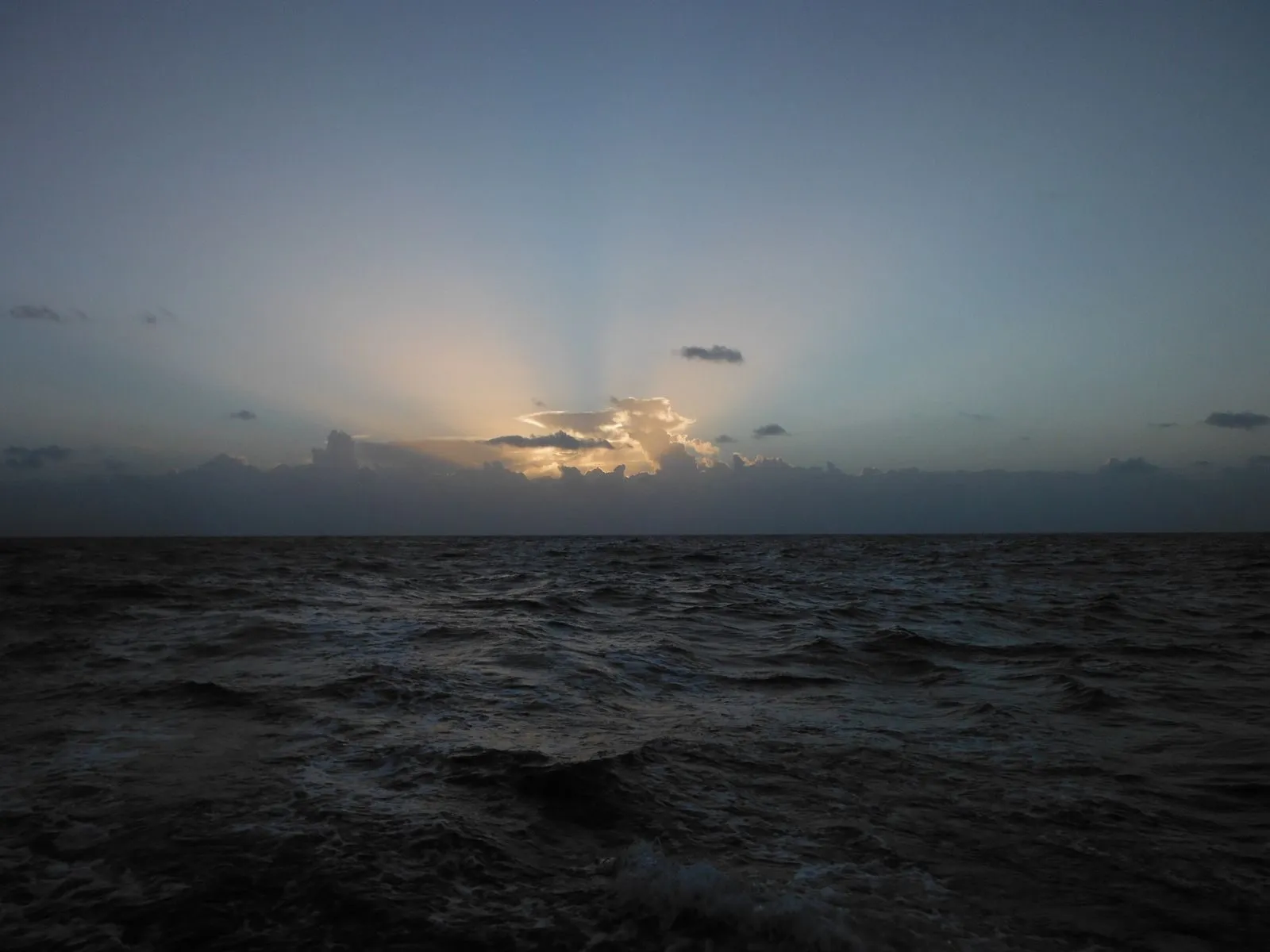
Since yesterday – since the weather turned nice – the hook has been out again, but only the seaweed is biting. Quite diligently. We could slowly imagine fish on the menu again.
Today one engine ran all day so we’d do better than 2–3 knots; we bought plenty of fuel anyway. But even so someone has to stand at the helm, because this autopilot is so impotent that even in such a light breeze it can’t steer the boat anywhere near a straight line.
The whole point of an autopilot is that you don’t have to stand at the helm all the time. You tell it the boat should go, say, 270°, and it steers so that she always heads west, and if the wind or a wave knocks her a bit off the set course, it corrects immediately and brings her back onto the original heading. On other boats they don’t usually wander more than 5 degrees either way.
This …… one of ours wanders off by as much as 25 degrees in both directions. It’s as if you set it to take you from Debrecen to, say, Győr – right across Hungary from east to west – and it takes a detour via Miskolc, then Szeged, then Vác and Kaposvár, and in the end you wind up in Zagreb.
In practice it’s good for everything except what it was designed for.
And yet, Liszi, you guessed right: the first thing I asked our skip, the very first time I’d been standing at the helm for all of 5 minutes, was:
-Hey, Gregor, where do you switch this autopilot on, then?
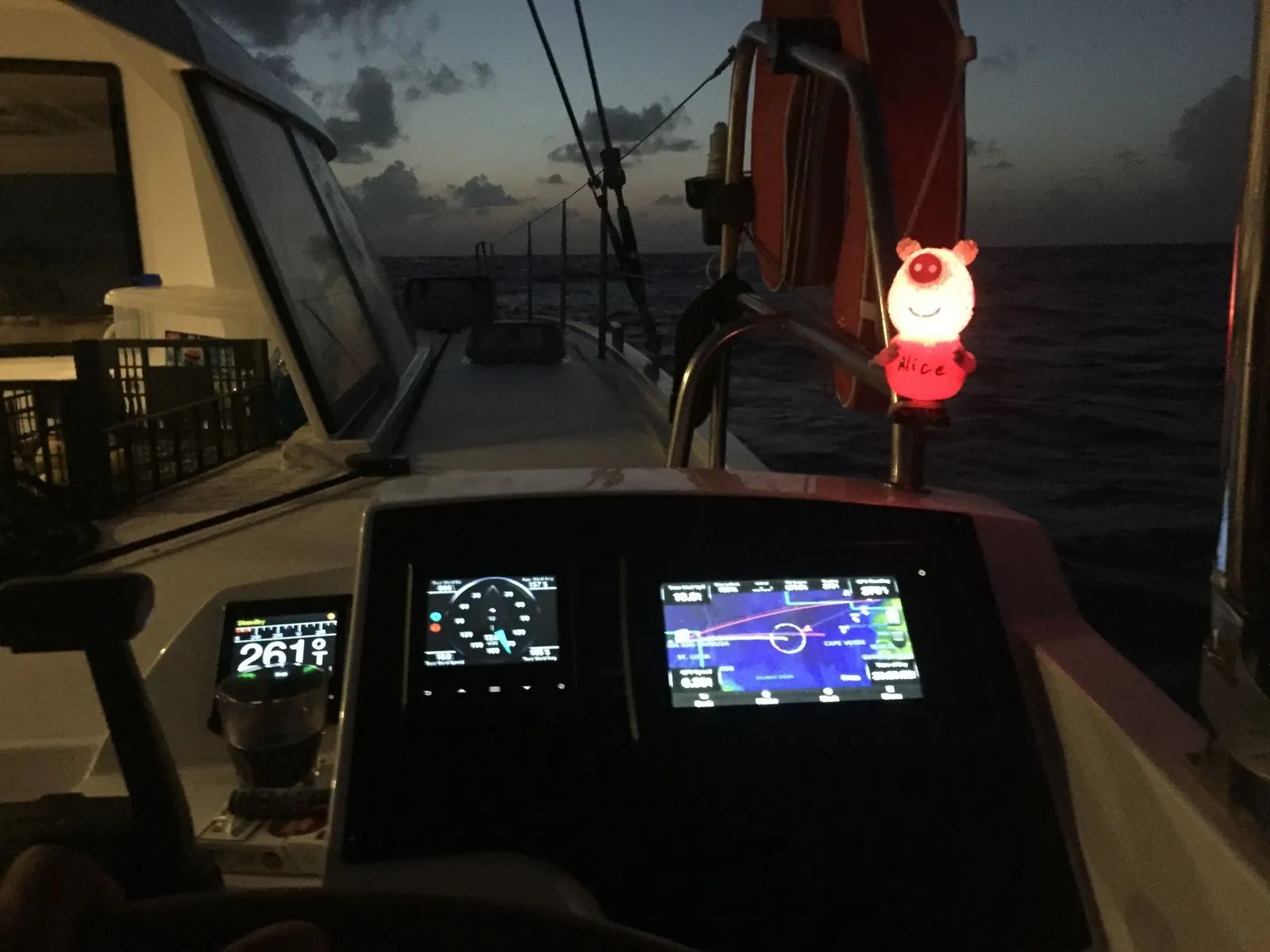
He showed me, but there was no joy in it. If you set it for a broad reach – the way we usually sail – it either shoots up to a beam reach and charges off like a wild boar, or it falls off to dead downwind, where the headsail flogs and bangs and it keeps threatening a crash gybe, with the mainsail slamming across…
Because of the big deviations the boat sails a much longer route, and the sail trim is hardly ever right.
That’s why we don’t use it, except maybe sometimes for as long as it takes the helmsman to go and get a glass of water.
And that’s why we take turns at the helm, which is just about OK with 7 people, but when I imagine that on EBBA, an identical catamaran with an identically crap autopilot, there are only the two skippers, well, I don’t envy them…
The navigation system (GPS plotter, wind instruments, autopilot, etc.) is all Garmin, and with an app you can steer the boat from the loo with your smartphone, but who the hell cares about that if it keeps trying to take you into the jungle whenever you’re not paying attention…
Well, that’s how it is. Nothing is perfect, as the poet says…:)
In the afternoon I was on the phone for a good 2 minutes or so – at least that worked – but I’m the only one who’s such a chatterbox every week; the others are happy enough that the folks back home know where we are at the moment, and basta.
Machine translation (AI, Claude) of Balázs’s Hungarian original. Read the original →
Tuesday, 24 November 2015
Day 20, 124 nm
The fish won. That was the final score of the second round.
Yesterday they very cleverly hung some weed on the hook, which started spinning, and by the time we noticed it had twisted the line up so badly that it took Gregor two hours to untangle it.
And today a big fish took the lure, skilfully played Gregor and the line for half an hour, then got bored, snapped the line, grabbed the lure and, hey presto, off it went with it.
And our skip sadly dismantled the fishing rod and its holder from the rail.
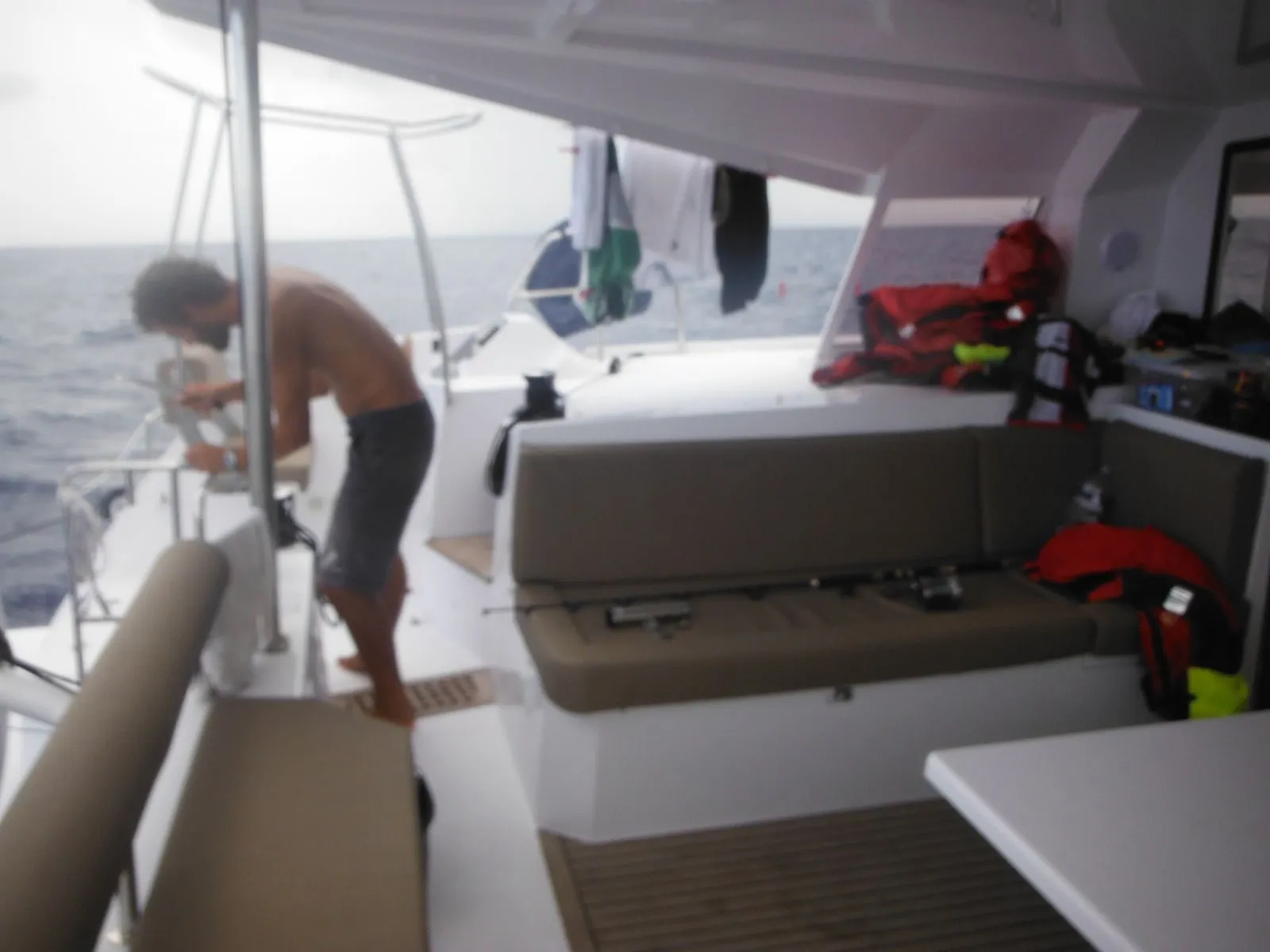
Gregor, by the way, is 23 and studying architecture in Ljubljana. He’s done three years already and is taking a year out now. After we arrive in Tortola, he’s flying to Australia via Los Angeles for a month of travelling. In January he’s skippering for a few weeks in Brazil for an American crew he met in the Adriatic. He doesn’t know yet what it’s going to be, architect or sailor, but the latter seems more interesting to him right now.
On both sides of the boat there’s the guardrail, the wire railing, which is of course first and foremost for hanging out your washing. But, as it turned out, it isn’t entirely fit for that either, because the top wire on the port side snapped under the weight of the wet clothes… On a brand-new boat.
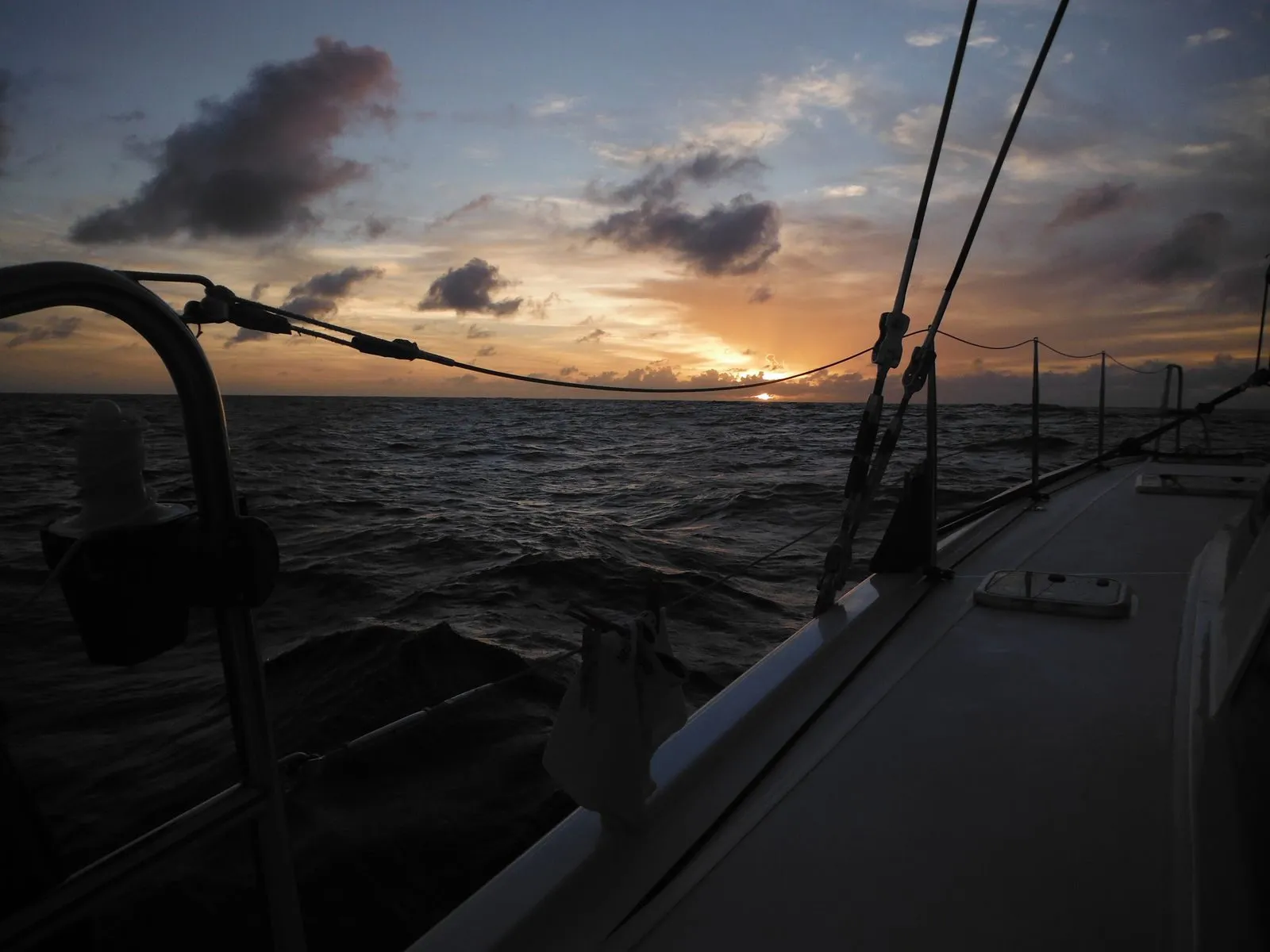
When I think that its secondary function would be to hold, if need be, a person losing their balance – in wet clothes – well, it’s not quite the real deal yet…
In the afternoon we were mulling over when we’d get to Tortola, and whether we might be able to squeeze in a stop on St. Martin beforehand. The lads would get off there, because they’re hardly going to make their flight on the morning of the 29th – the one they were going to take to get there.
I’d be glad of a bit more “seeing the world” myself; I’ve got plenty of time until the 5th, when my flight leaves.
Machine translation (AI, Claude) of Balázs’s Hungarian original. Read the original →
Wednesday, 25 November 2015
Day 21, 141 nm
I was on the dog watch with Simon. That’s what they call the stretch from midnight to 4 a.m. I can’t for the life of me imagine why they named it that. Maybe because it’s only fit for a dog – it’s my least favourite too. It’s full moon, and the moonlight is so strong that even the stars look paler. Apart from the moon there’s no other light pollution out here. We did, however, see the AIS signal of another westbound sailing boat, by the name of CROCODILE DADDY. They were sailing 12 miles from us, so their lights weren’t visible.
Ever since we left Tenerife, every hour we’ve written our position, speed, heading and the wind data into the “Log-Buch”, a notepad. We don’t have a logbook – well, Gregor writes the data into a thick exercise book. He probably didn’t buy one in La Rochelle, and in Tenerife he couldn’t get one any more.
Our radio’s MMSI code isn’t registered either – as it turned out in the middle of the Atlantic – because for some reason they couldn’t get it sorted before departure. You can talk on it, we just can’t send a distress call with our position data. OK, the radio’s range is only 25–30 miles anyway, but in an emergency what good is another boat within that range if for some reason we can’t tell them where we are, because, say, the power has failed or our boat has capsized. And the satellite phone isn’t topped up for calls – well, now it is, with my money.
I’ve got a good dose of empathy when it comes to understanding difficulties, but I have to say that sending a boat off on an Atlantic crossing like this is no small piece of irresponsibility.
The weather, on the other hand, is very pleasant. After the calmer days the trade wind has gone back to work and is carrying us west at a good clip.
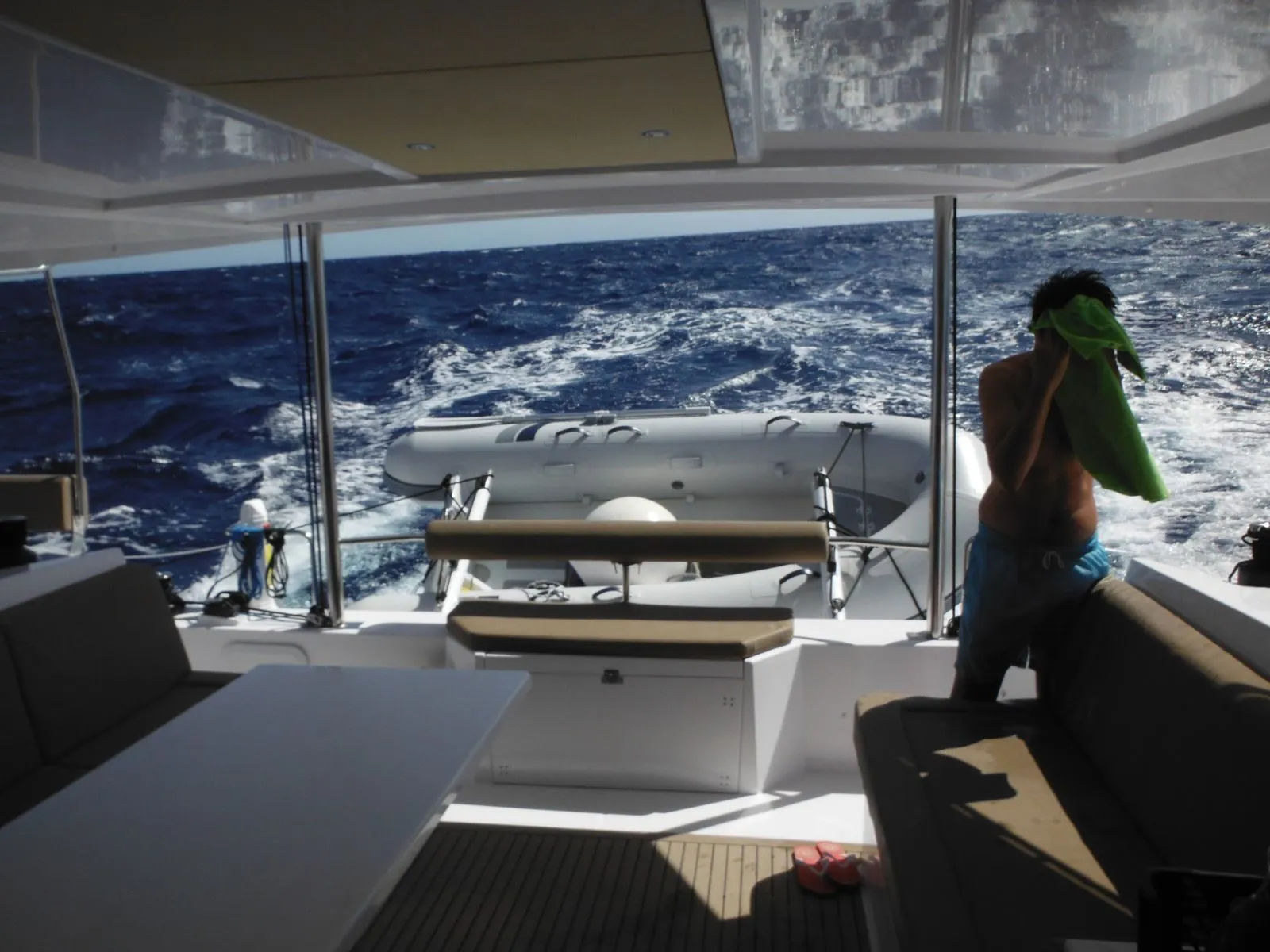
In the evening Simon made lentil stew with the leftover macaroni.
I praised his cooking. He said that although it’s a Swabian national dish, this was the first time in his life he’d cooked it, and he’d got the recipe from Playboy. Now I know why they brought that magazine along…
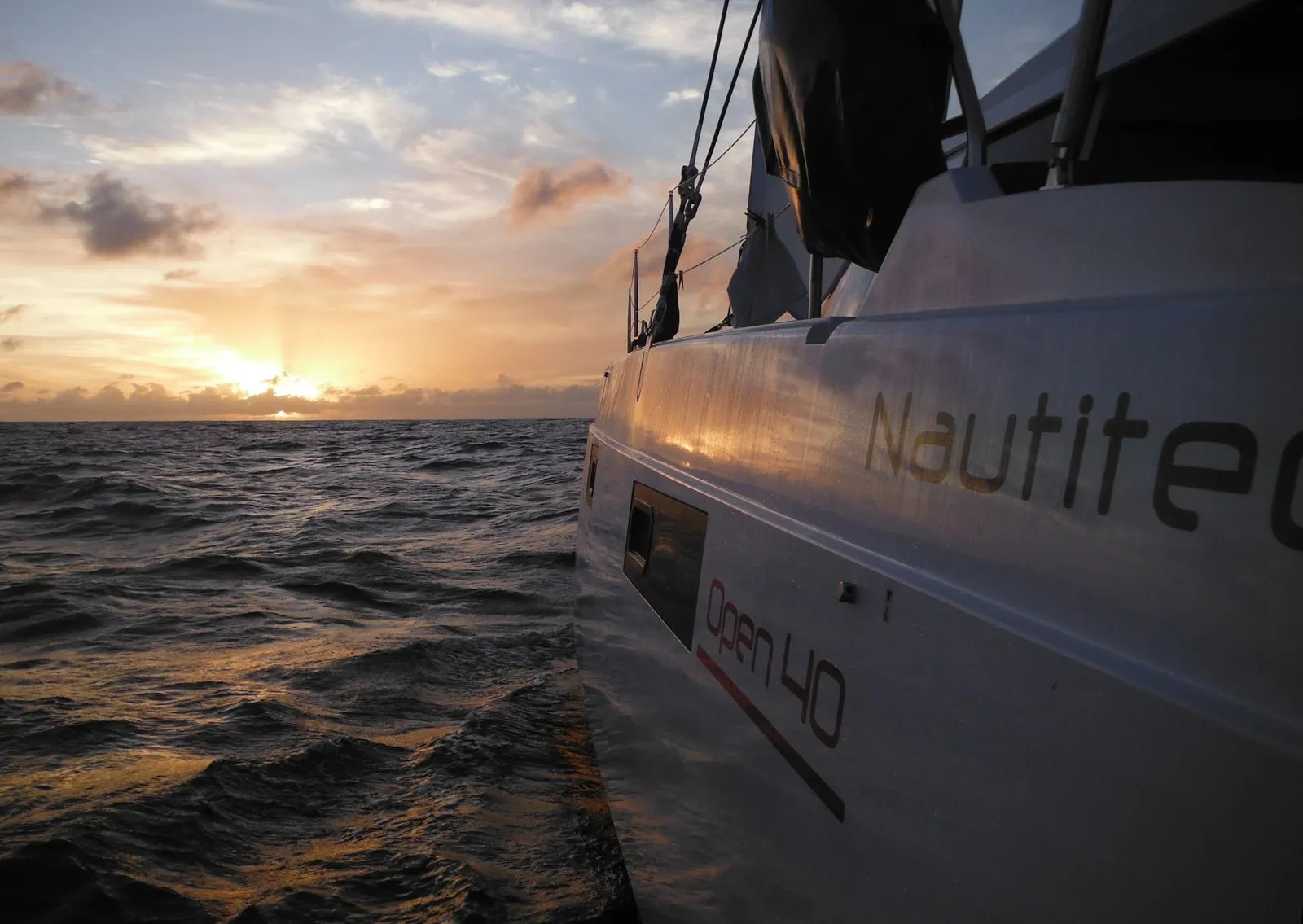
In the evening we reached the 3000th nautical mile of our voyage, which took us 3 weeks. Looking back from here it doesn’t seem that much, and yet from now on it’s the countdown we keep our eyes on, which still shows 333 miles to the finish. By Saturday morning we could be there on St. Martin.
Machine translation (AI, Claude) of Balázs’s Hungarian original. Read the original →
Thursday, 26 November 2015
Day 22, 149 nm
In the morning Willy offered to make me a cup of tea. (It still surprises me how salty that first sip tastes from the rim of the mug – we wash up with seawater, you see.) He’s a very kind man to begin with, but maybe this good habit has stayed with him from his youth, when after his military service he worked for 3 years as a steward on various German cargo ships and travelled the world. Instead of tankers and container ships he deliberately chose smaller freighters, which roamed the world and often stayed moored in port for days, giving him the chance to get to know lots of countries.
Later, when he was working as a secondary-school teacher, he organised one- or two-week sailing trips on the Nord-See for students several times, using EU grant money. The 17-18-year-old students were “pen-pal-ed” and pulled together from schools in several EU countries, and it was a good chance for them to practise languages and get to know each other. Everyone brought their history textbook, and they compared how each nation wrote about the European Union. The “Bordsprache” was English, and you could nicely observe on a small scale what goes on on a large scale in the Union, namely that as long as everything’s going well we’re Europeans, but when there’s a snag, we’re French or German, or Greek and Polish. They usually went in September, but several times he also went on a class trip in April with his own class.
They sailed on at least hundred-year-old, period two-masted wooden sailing ships, schooners or brigs, just like in the old days. The kids loved it, which I can very well imagine. What’s more, I can also imagine how great it would be to go on a period sailing trip like that with a good crowd.
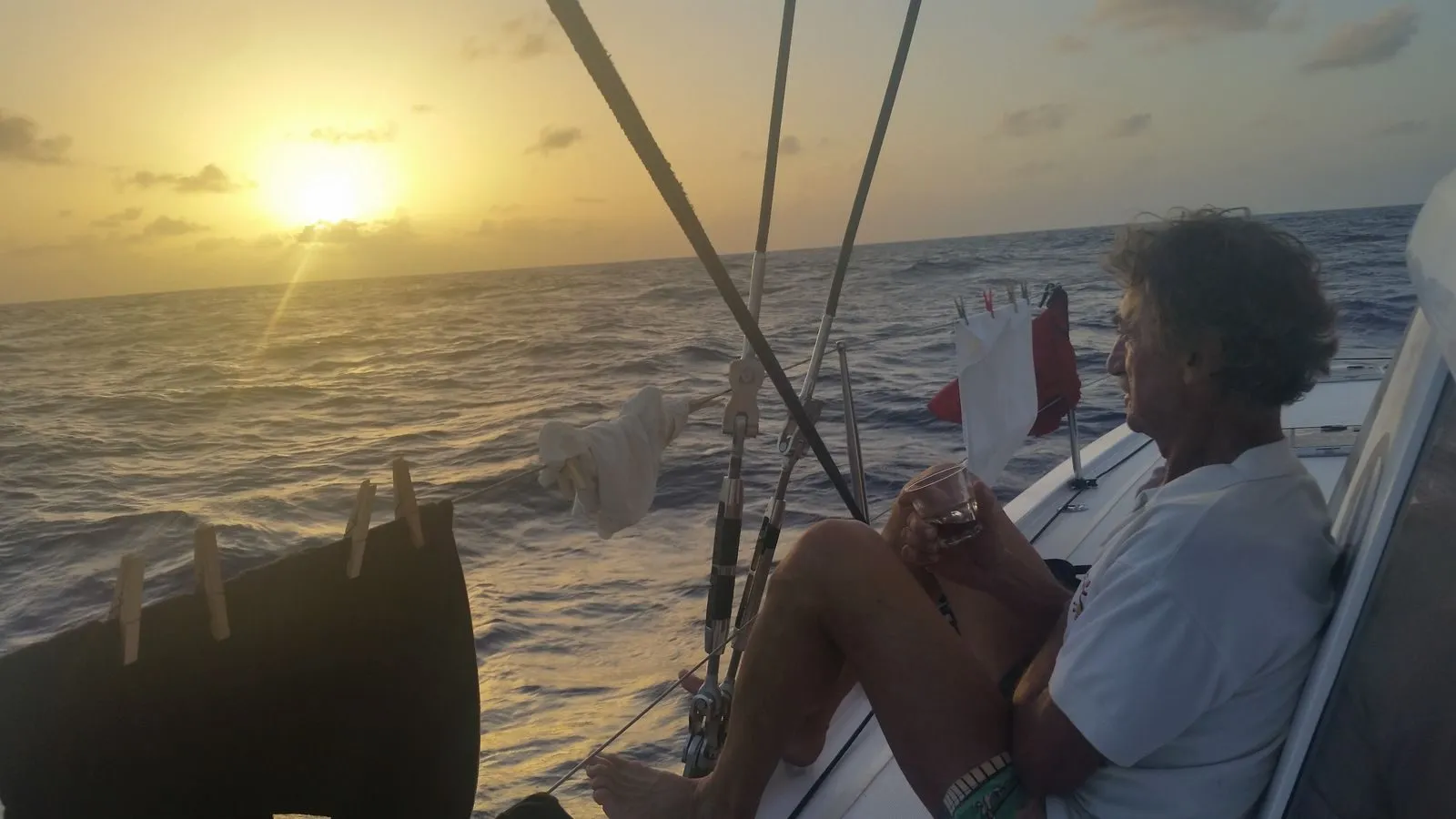
Five years ago, at 63, he took early retirement, preferring to accept a 15 or 20% smaller pension, although even so that’s in a different league from a Hungarian teacher’s pension.
Willy is 68 and has been sailing for 30 years, since 1986. At first he went to Turkey with his friends, on the cheap charter flights of the guest workers. Back then they didn’t have any kind of skipper’s licence, but they still got boats rented to them by the small German charter companies that were just starting up.
Since then they’ve been to the Caribbean something like 10 times, to the South Seas, the Pacific islands, maybe 6 times, a couple of times to the Scyhelles (how the heck do you spell that correctly? I can’t look it up anywhere!) and to Thailand.
– And could you finance all that from a teacher’s salary and pension? – I asked him.
According to him, yes, it’s their hobby and they don’t really spend on anything else.
In the morning, around 9 o’clock – after 10 days – we saw a real live ship again. It was a tanker that passed 5 miles from us, heading for Europe.
Slowly I’ve managed to reprogram my brain. As a driver, if we see a cloudburst ahead of us, we know: whoa, watch out, we’re about to drive into it and the heavens will open. Here, if we see a squall ahead of us, it’s not dangerous, we can calmly give ourselves the order “at ease, carry on”, because the wind coming from behind blows the cloud with its rain forward faster than we’re going. And if we see the rain cloud directly behind us, that’s no big deal either, because the wind coming at a slant from behind doesn’t push the rain onto us but past us.
However, the one we see behind us, from where the wind is blowing – well, that one’s not dangerous either, you just might get wet. Although these still aren’t somehow those abundant tropical rains the fairy tales talk about, just the low-suds variety. That is, you go out to take a sweet shower – like I did this morning – and you lather yourself up with shower gel from head to toe, hair and all, and your eyes with shampoo so you can’t see a thing, then you spread your arms to receive the blessing from above, and then somebody up there thinks, right, that’s enough for today, and turns off the tap. And there you stand, all washed – or rather washed up – wondering where you saw (back when you could still see) that empty bucket you didn’t fill with water.
Guaranteed to wake you up, even without water.
Igor set about baking bread today. We still have just one Toast-Brot left, but that’s the last one. He’d never baked bread before, but this first attempt turned out quite decent, and together with the leftover ham it vanished in a flash, so he quickly kneaded two more.
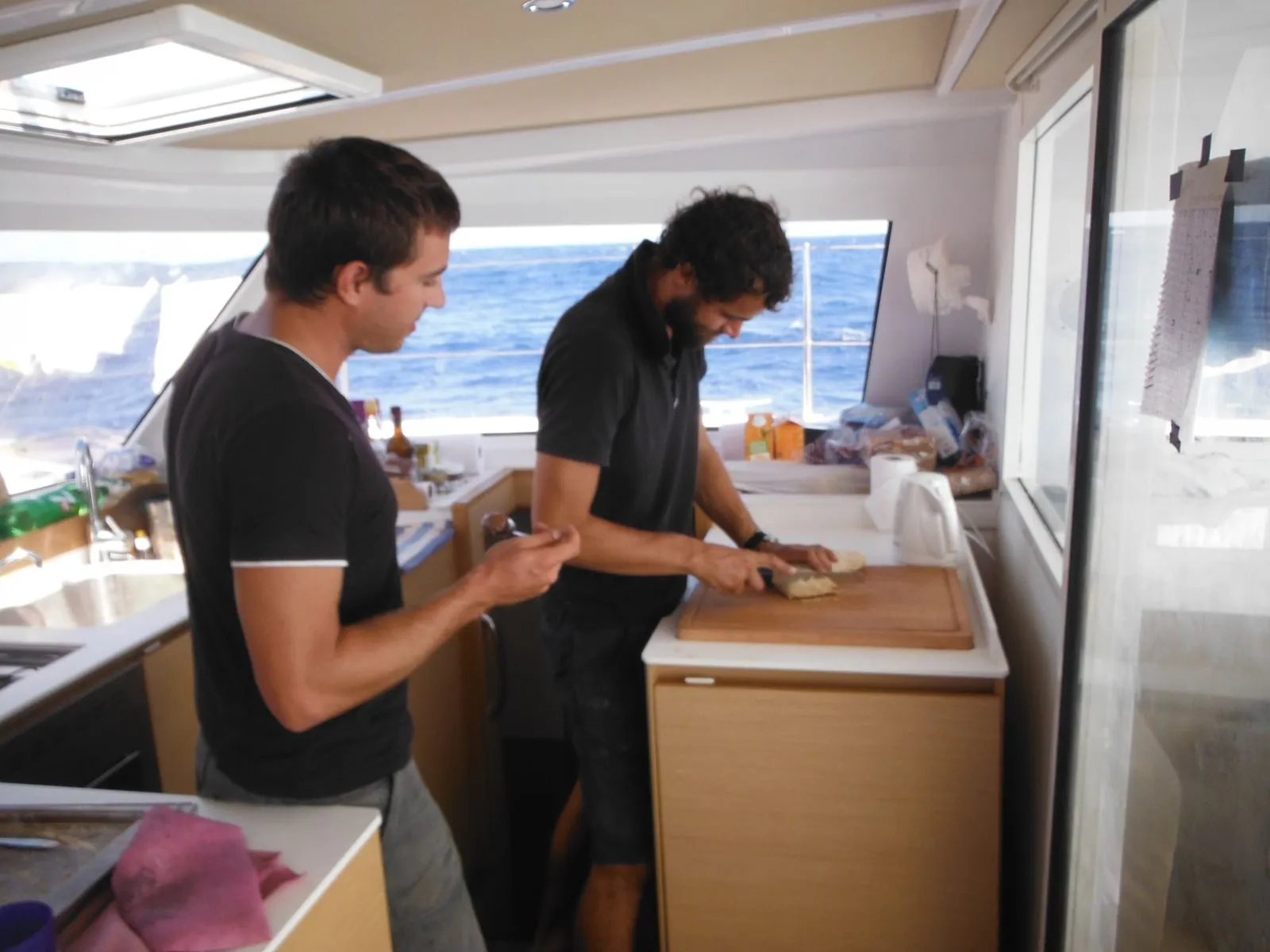

Around 10 in the evening, in the moonlit night, we spotted the lights of AMARON. After 3 weeks and 3000 miles there’s about half an hour between us. So it seems the Bavaria 46 and the Nautitech 40 catamaran are roughly equally fast boats.
For the first time in a long while we again saw the lights of a plane, heading towards Europe…
Machine translation (AI, Claude) of Balázs’s Hungarian original. Read the original →
Friday, 27 November 2015
Day 23, 149 nm
Tortola is still 220 miles away. We could get there by Saturday afternoon or evening. Bijan and Simon are less and less hopeful that we’ll stop at St. Martin and they can get off there, because the skippers are afraid the official check-out and check-in might drag on for ages and we’d reach Tortola late.
Seabirds haven’t come our way since the bad weather. But this morning Willy saw an albatross. Supposedly it doesn’t catch its fish from the sea; it shakes the half-swallowed fish out of the seagulls’ necks and pinches it.
Jiri is today’s duty cook. I can’t tell you much about him, because his German and English vocabulary is like my English, that is, not entirely suited to long chats.
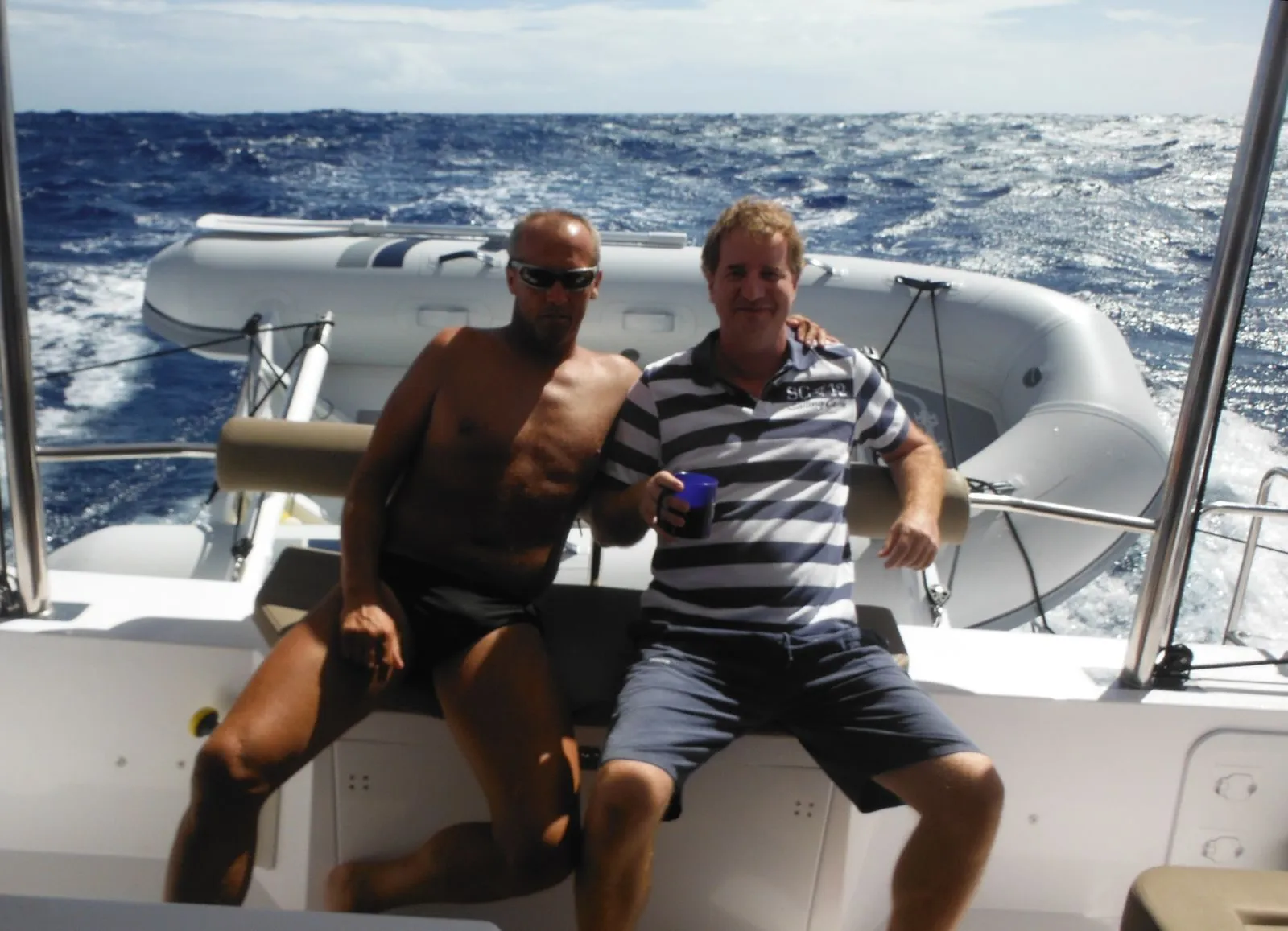
For a 50% surcharge he rented a cabin on his own; the front port one is his. In December he’s going skiing, and in April to Mallorca for a bike race.
So far he’s sailed mainly around the British islands and in the English Channel – a friendly, helpful guy.
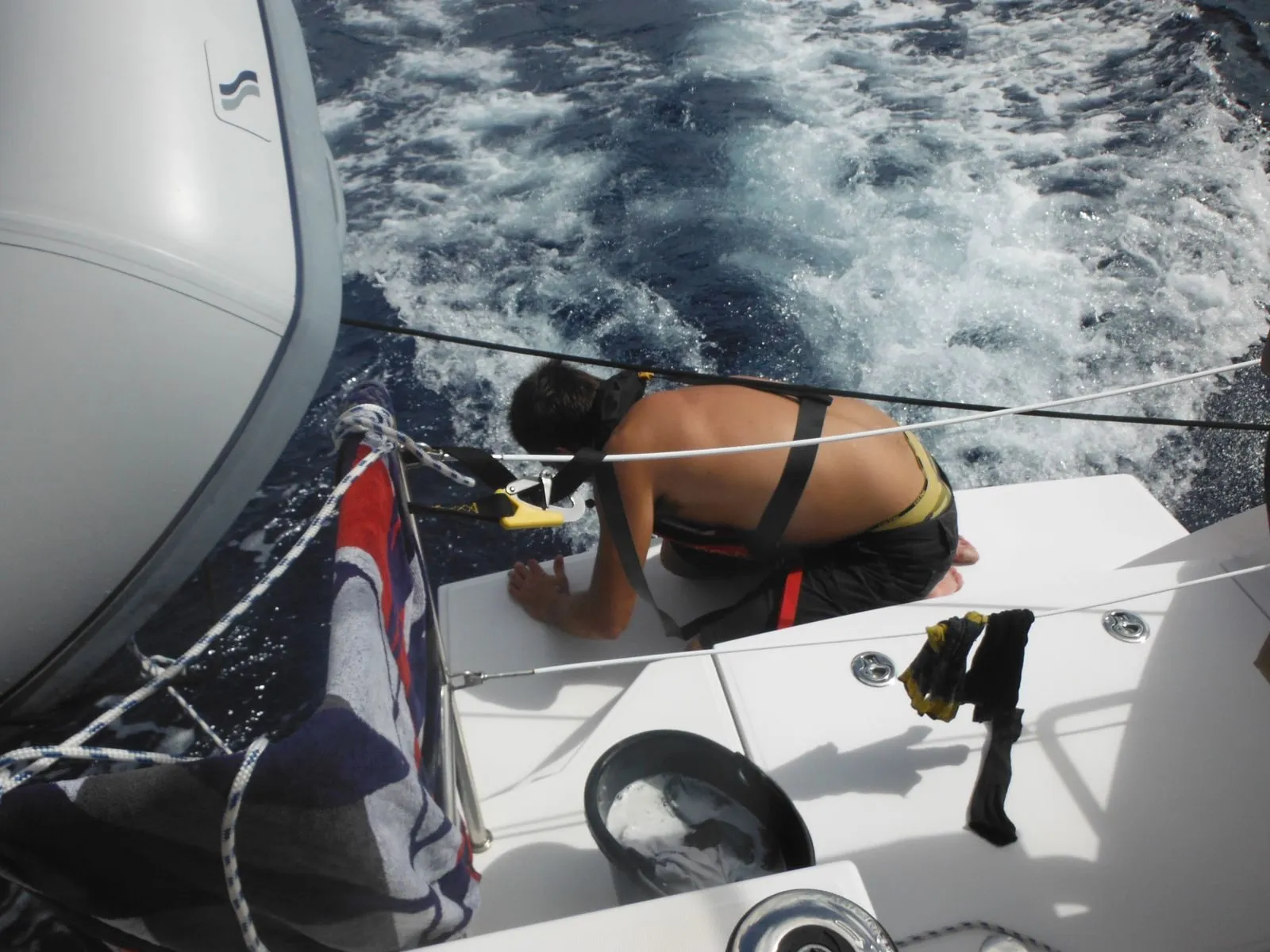
Igor at the back of the boat, washing the clothes we got soaked in the midday cloudburst
Well, today we got rain good and proper. In the afternoon another nice little downpour came along, this time a real tropical storm. The wind picked up to as much as 45 knots, which is 83 km/h. We quickly furled the headsail, because that’s the quickest thing to do, but even so at times we were galloping along at 15.5 knots. Luckily it didn’t last more than 15 minutes, then the sun came out as if nothing had happened…

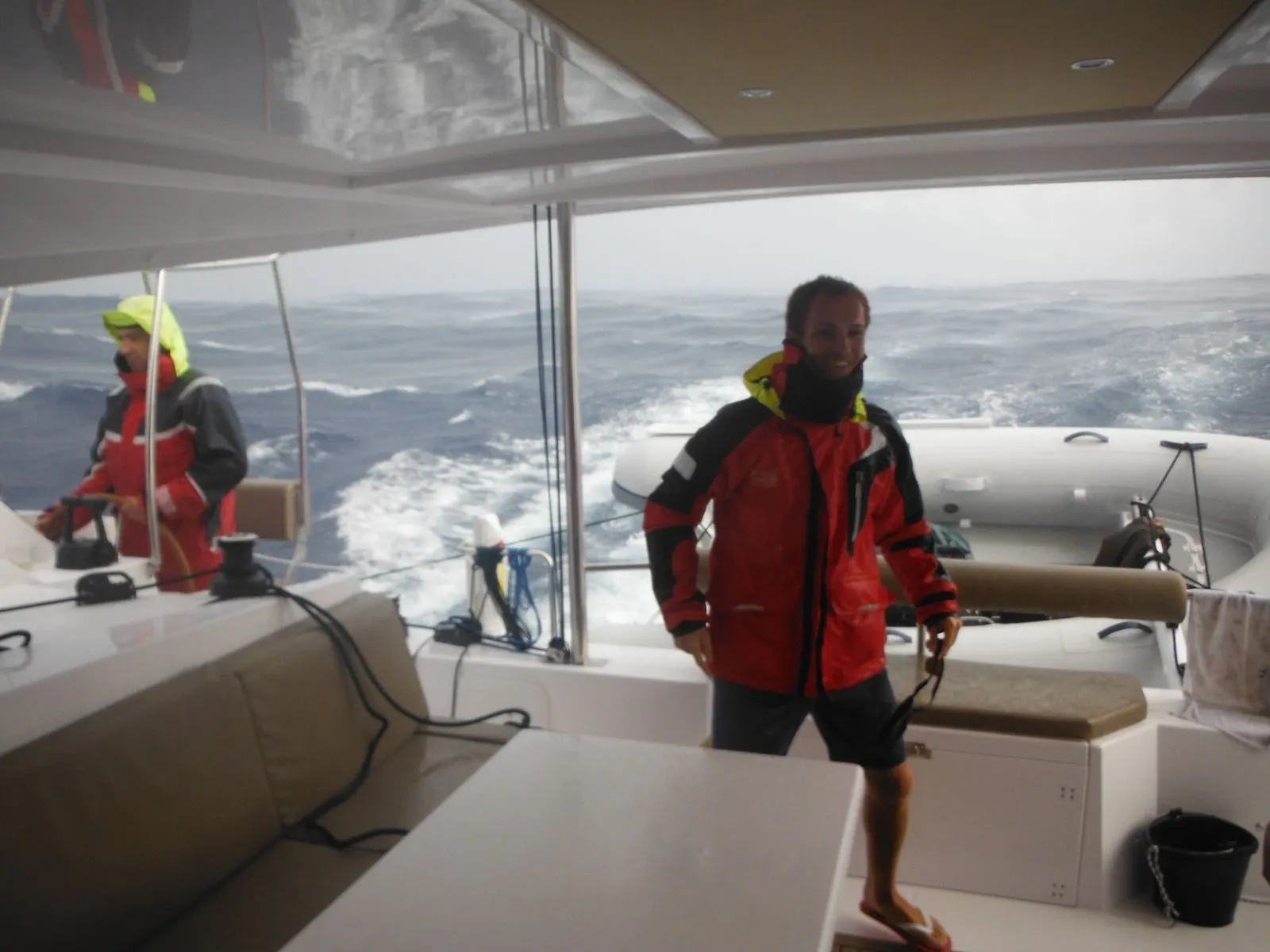
Simon happened to be at the helm – hanging on for dear life – but before he had time to get scared, the whole thing was already over.
By the way, he’s from Baden-Württemberg, from the Black Forest area. His mother is German, his father Egyptian, who spends a lot of time in Egypt for business reasons. It’s surely no coincidence that he and Bijan became such friends. Simon travels to Egypt once a year, he can speak a bit of Arabic, but not write it any more. His girlfriend, Shara, is also from an Egyptian-German marriage, and he’s learning Arabic from her. Like Bijan, he studies mechanical engineering in Munich, and is now waiting for the result of his bachelor’s exam.
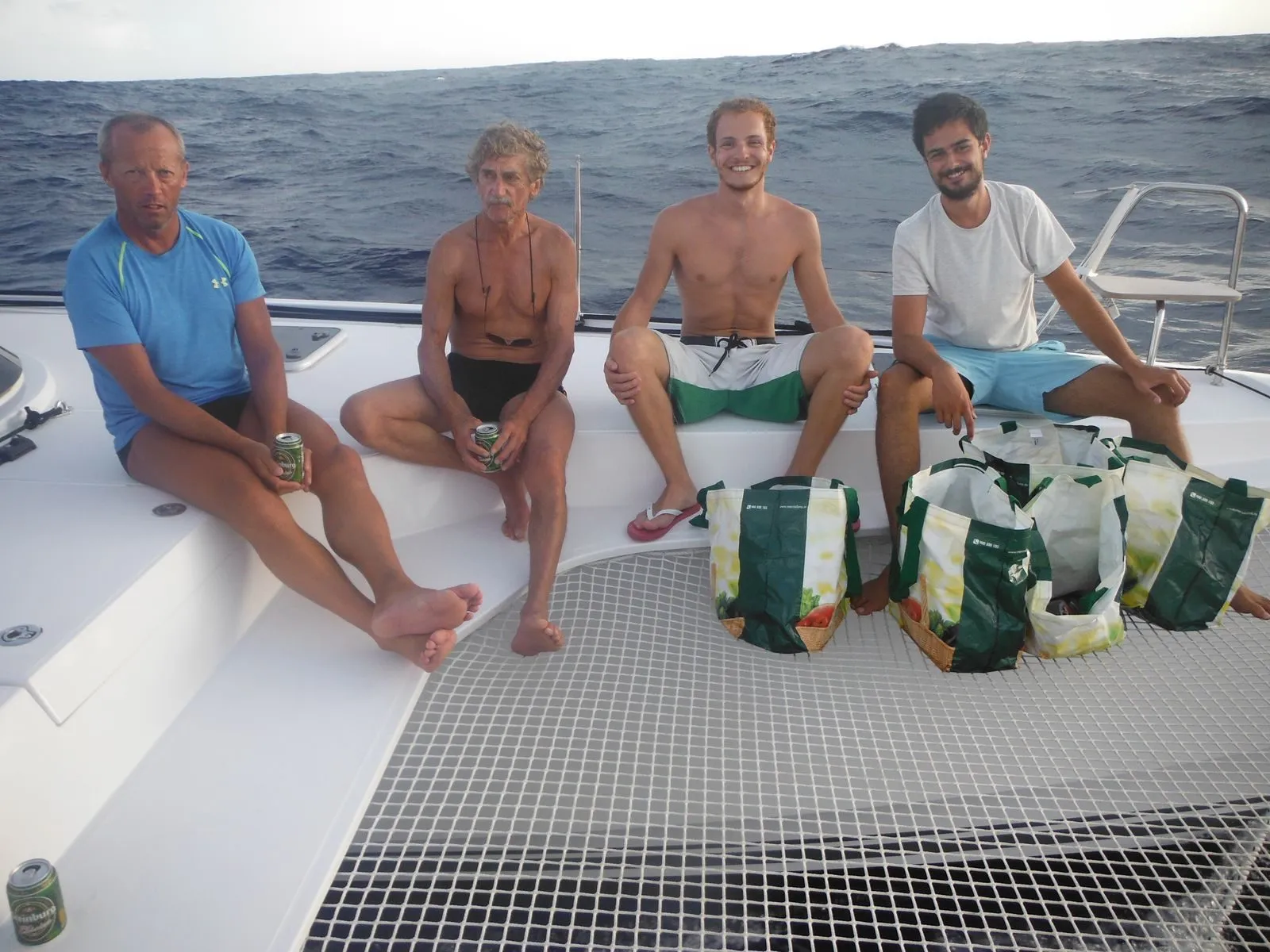
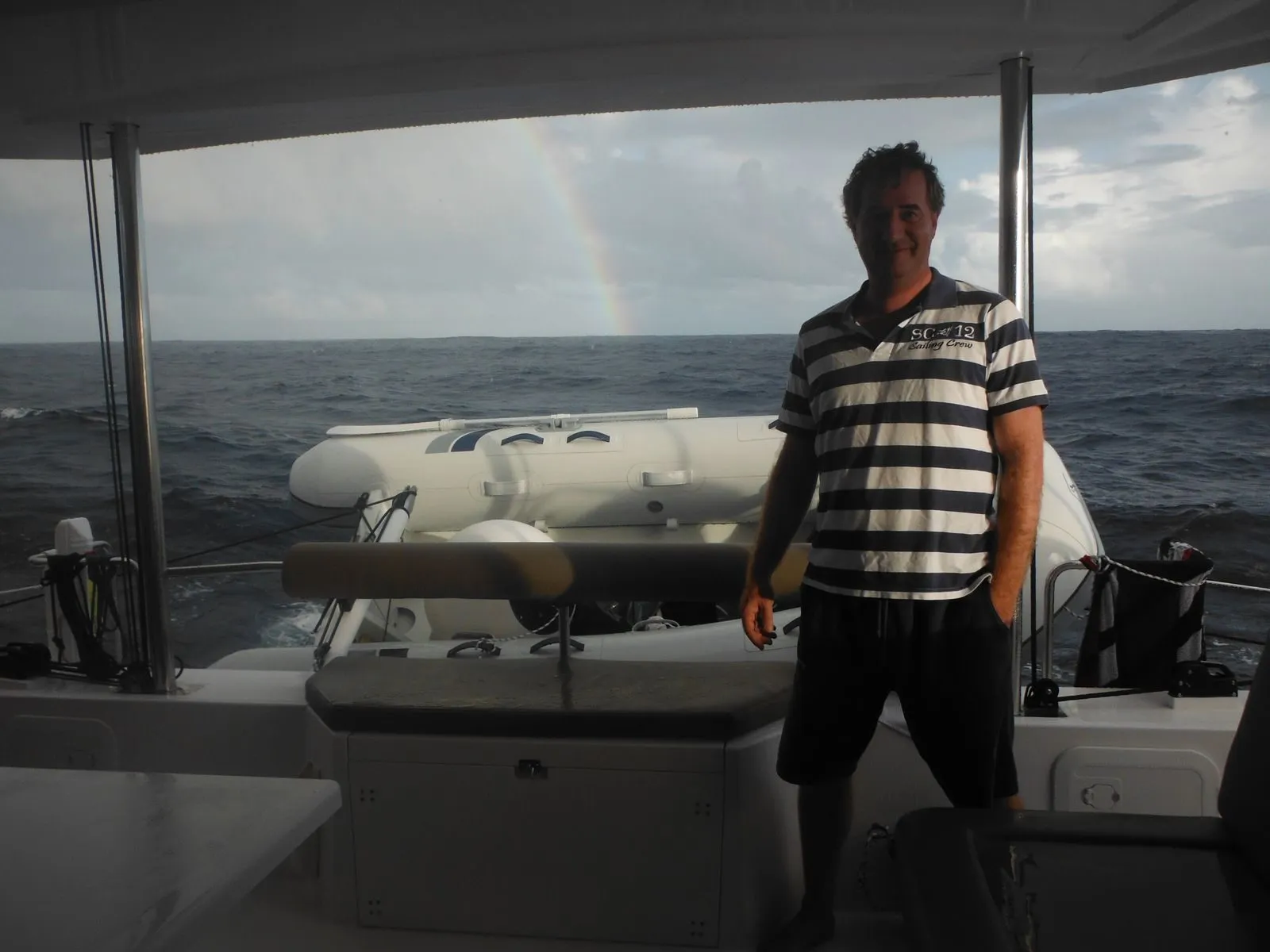
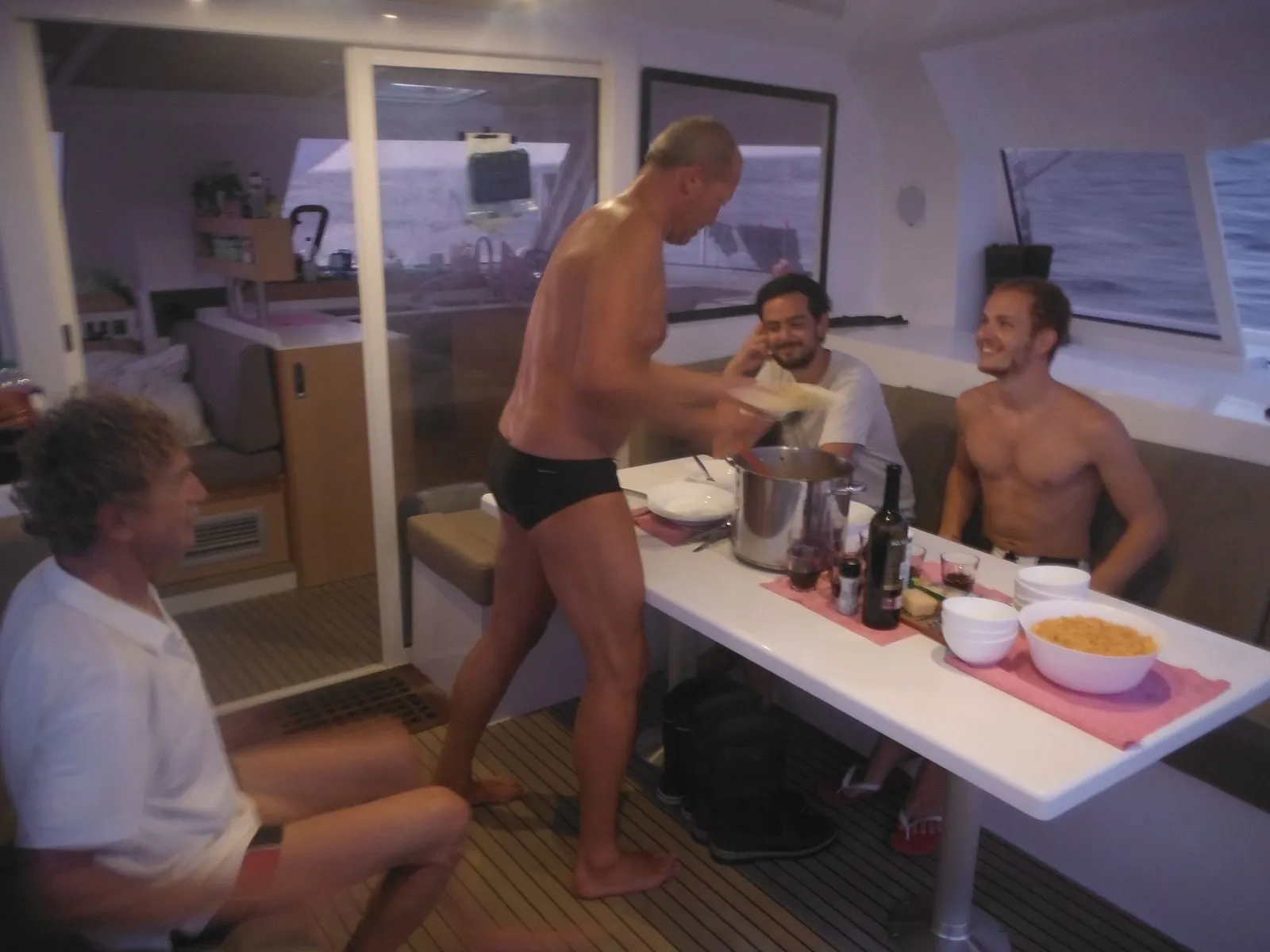
Machine translation (AI, Claude) of Balázs’s Hungarian original. Read the original →
Saturday, 28 November 2015
Day 24, 157 nm to UTC noon +22 nm to the finish
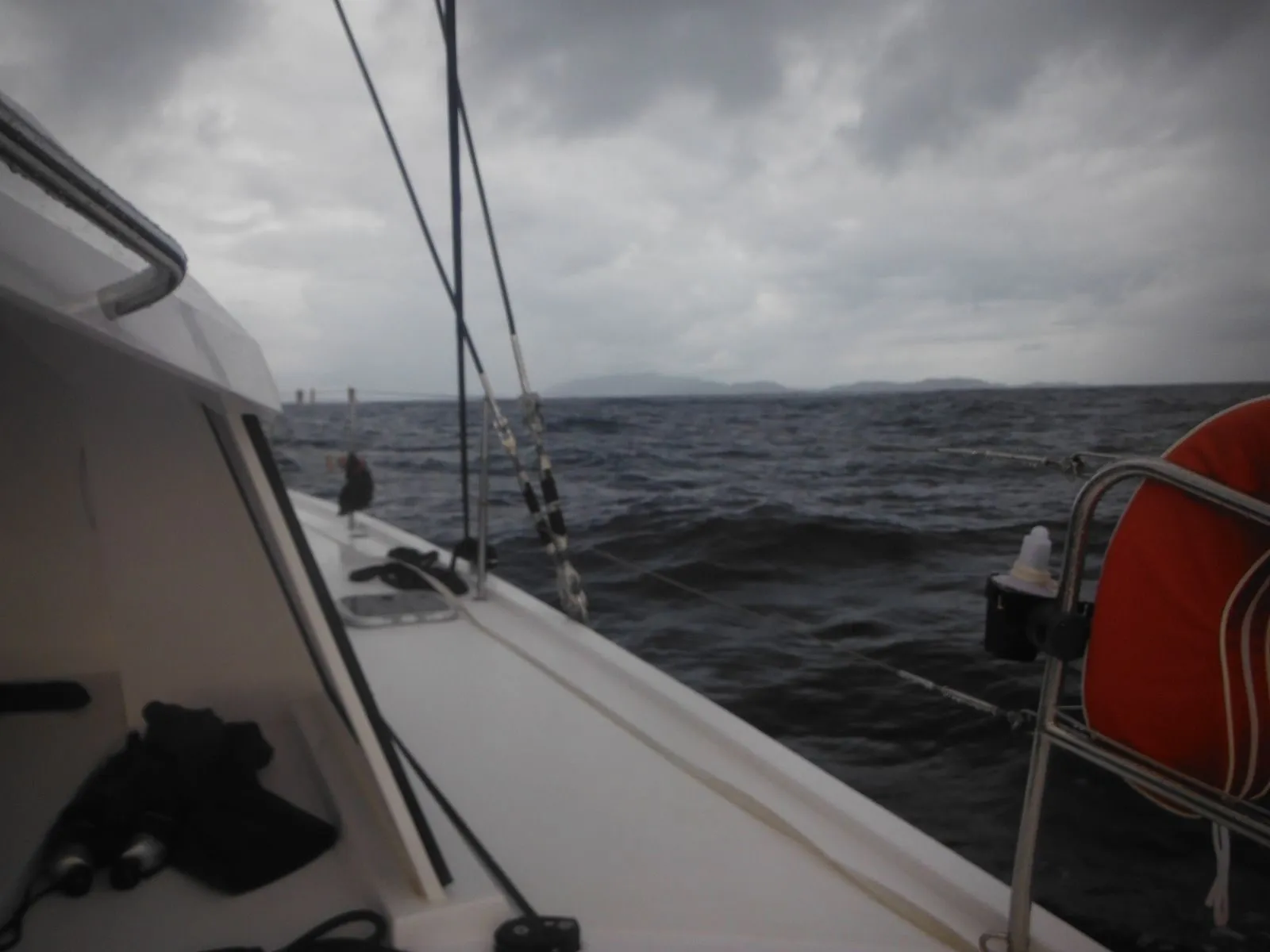
than the Caribbean. The sky was overcast all morning, it was raining – is this any way to welcome us?

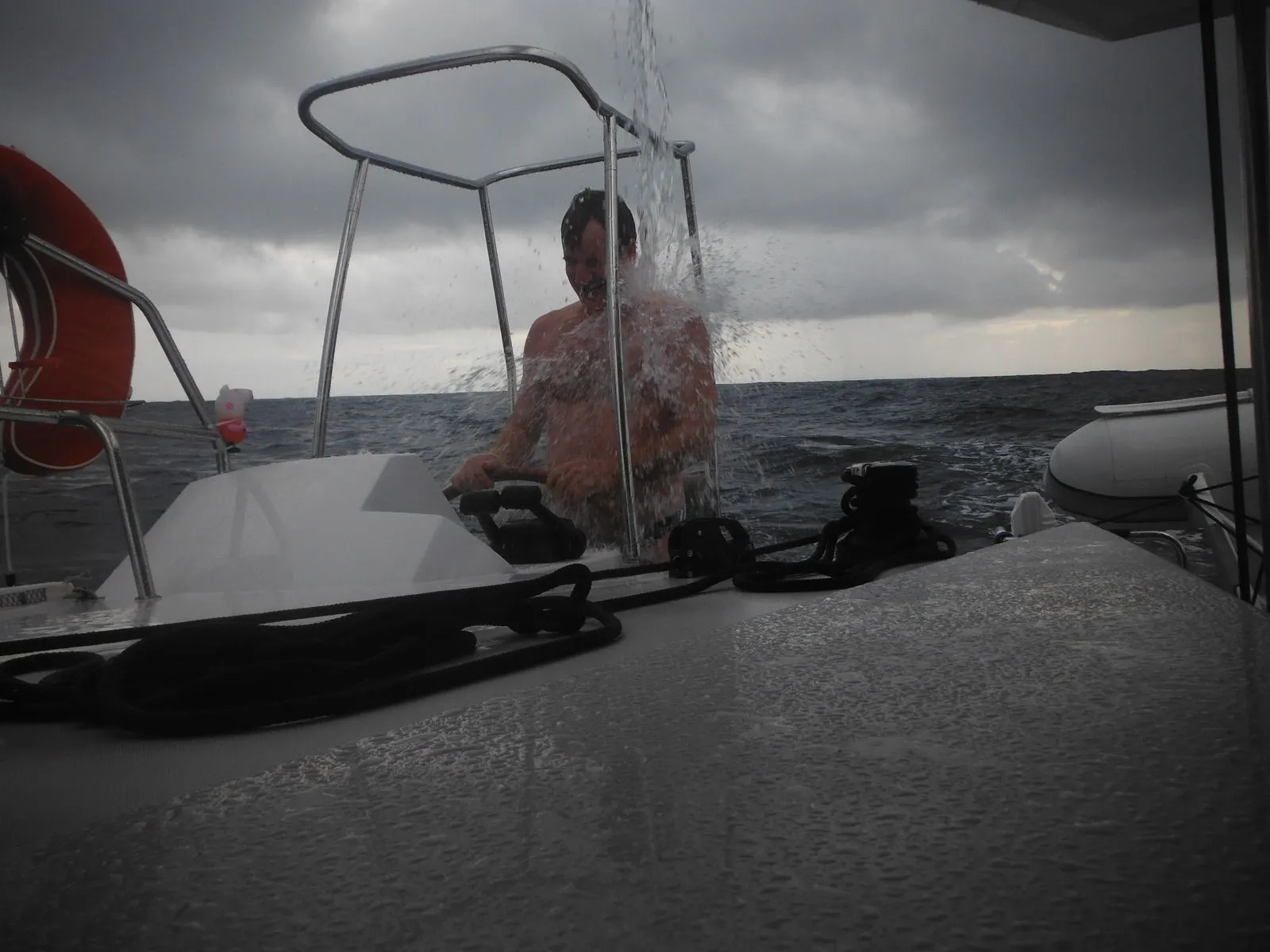
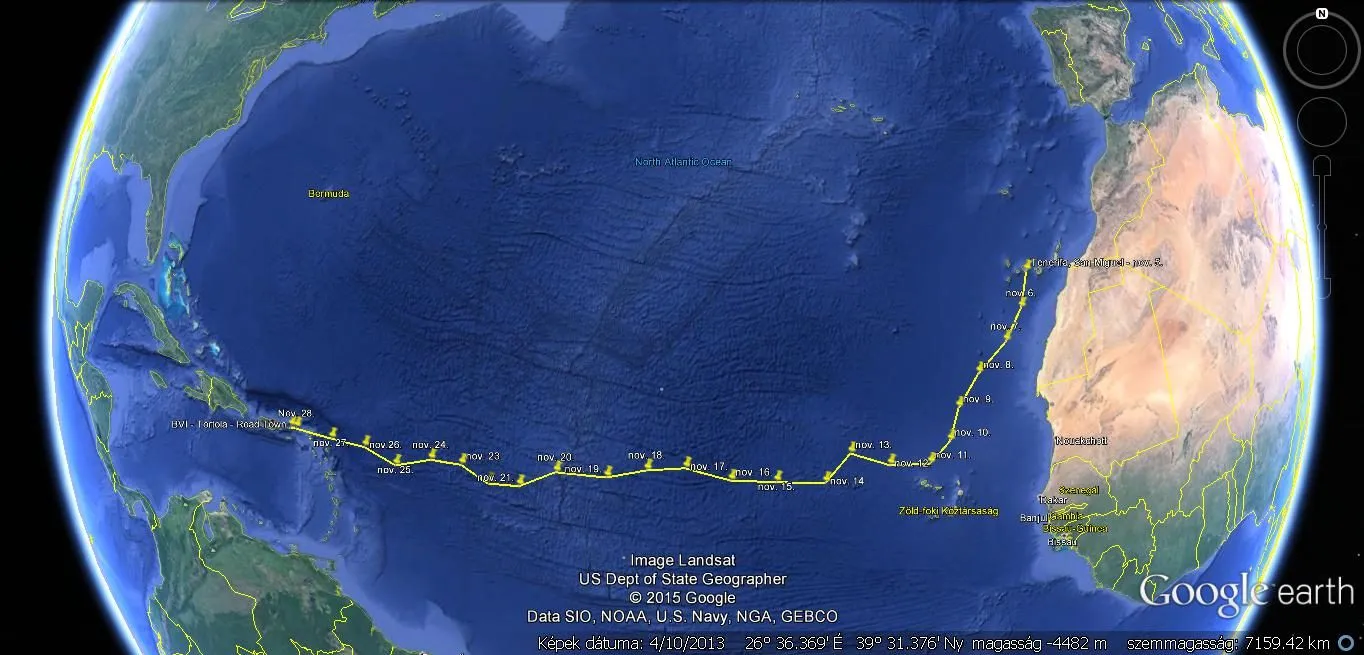
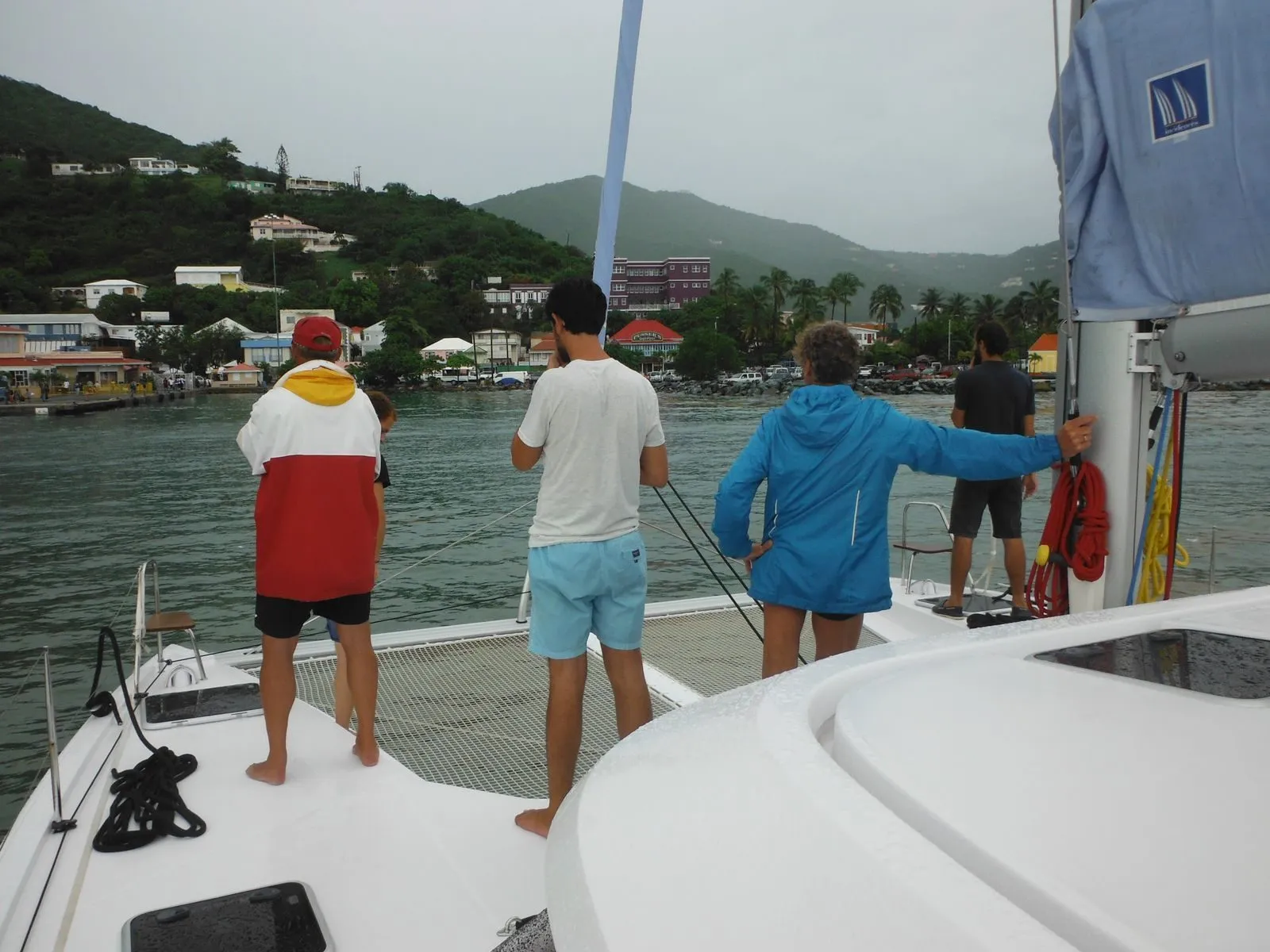
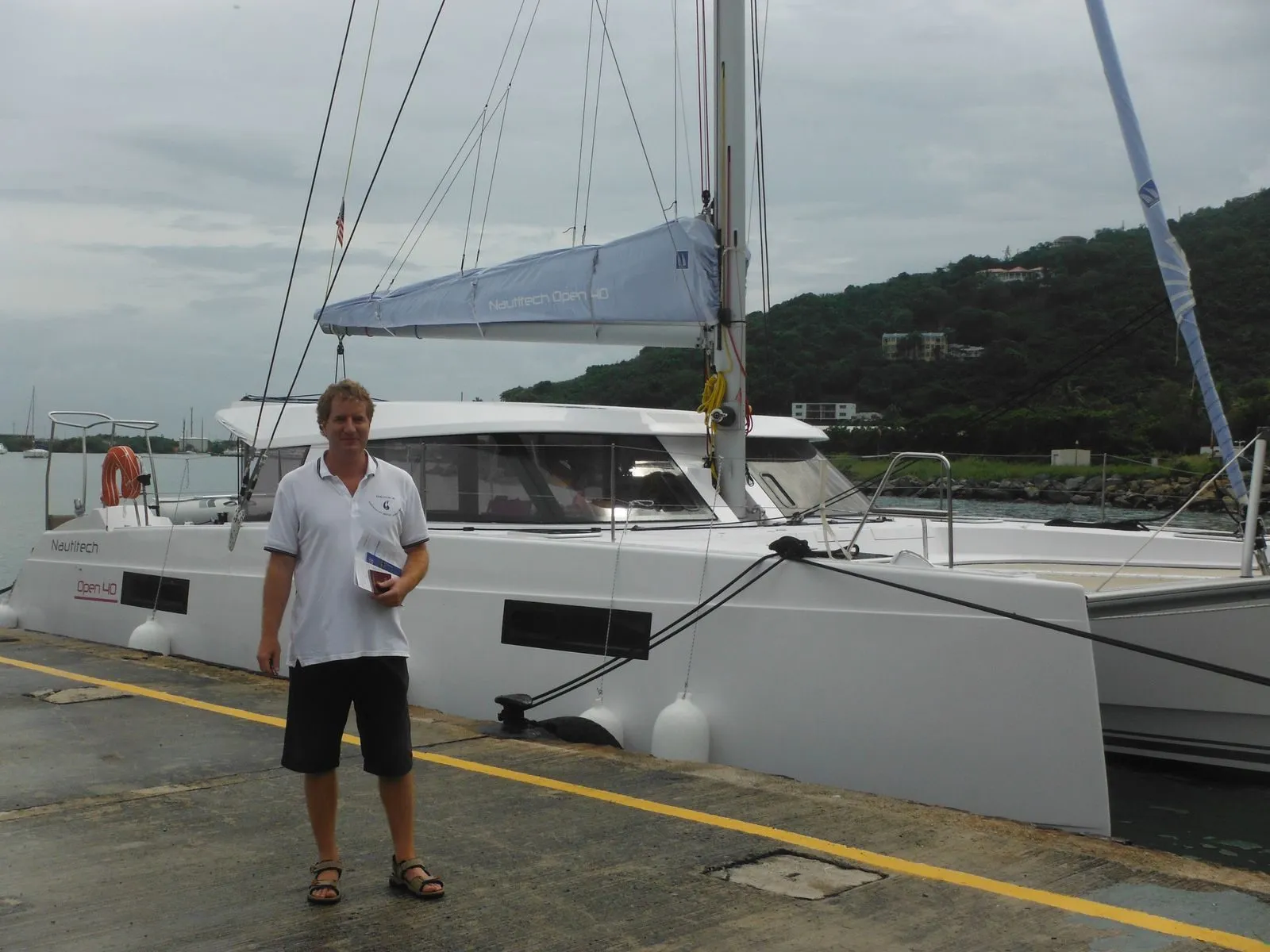
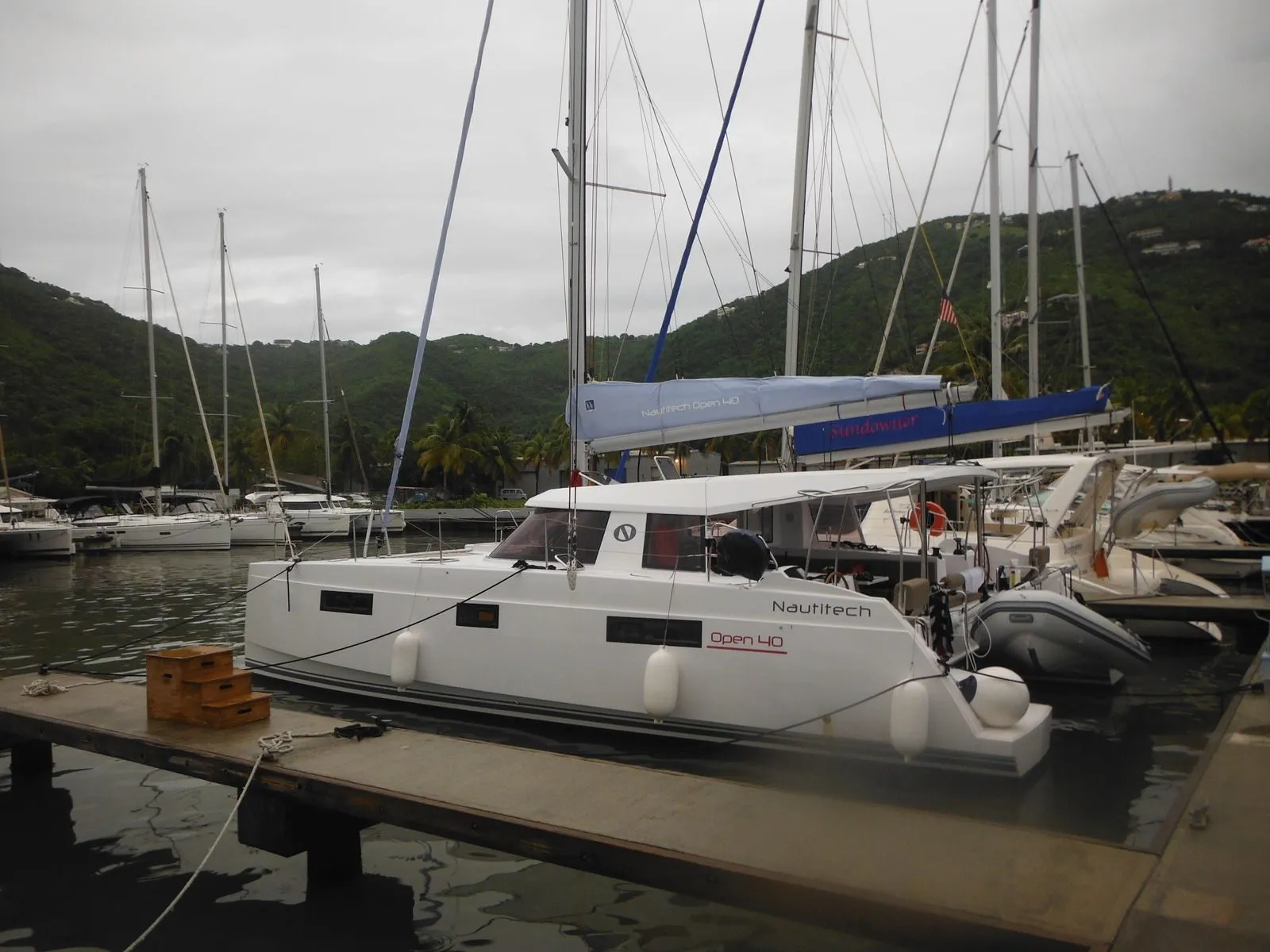
Three cheers for our skippers too, who were always watching, always there when needed, and skilfully steered our boat the whole way.
And last but not least, a huge thank-you to Neptune for taking us into his favour, giving us good weather for our voyage and making do with a minimal offering.
(our losses: 1 phone, 1 towel and 1 bucket).
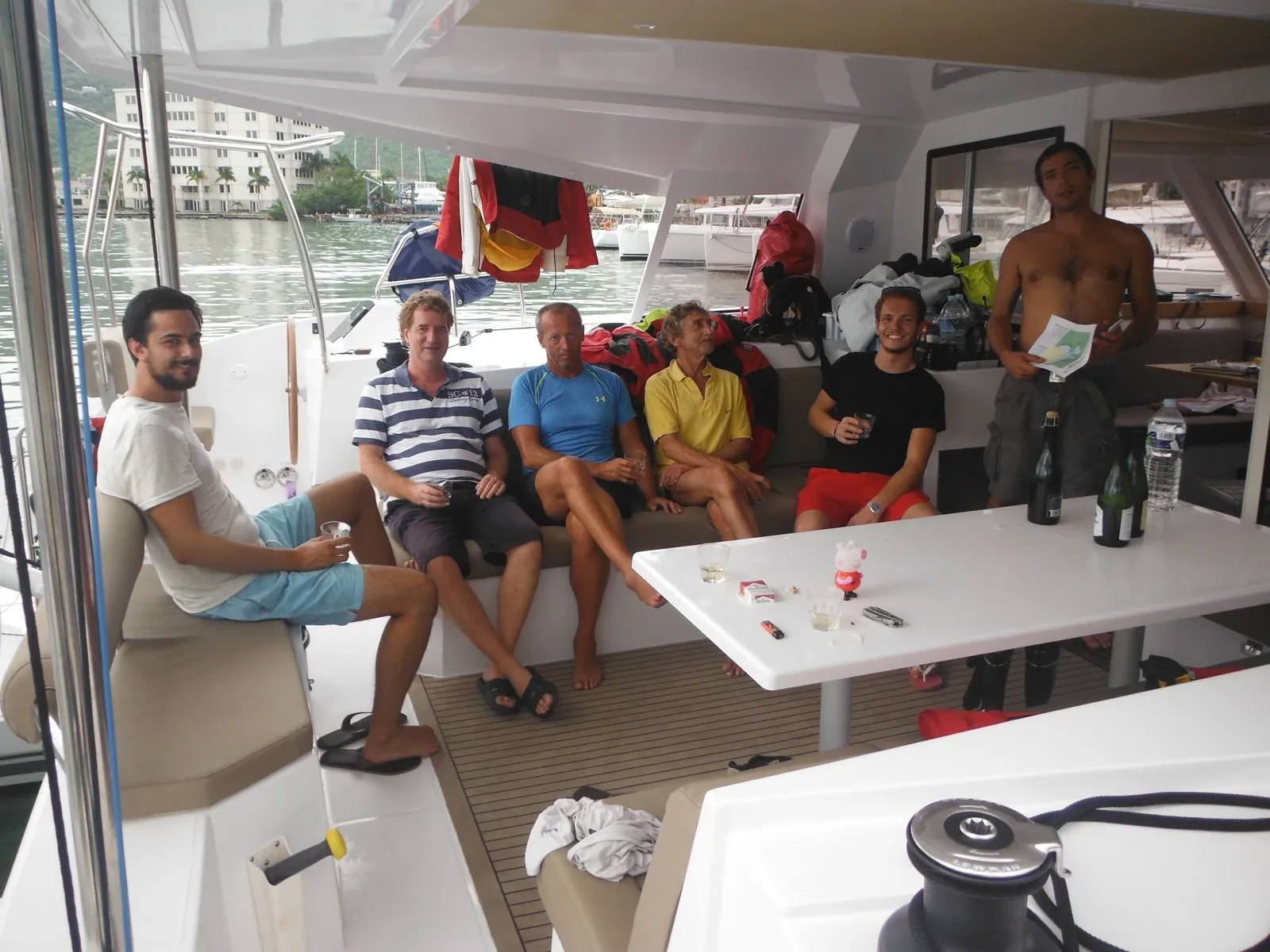
Things to bring next time:
Astronomy book – Sternzeichen App – Star App Night Sky
Cookbook – Seglerkochbuch für Windstärke – Willy’s bread recipe for boats
More reading – on a Kindle, so you can read in the evening too
Wristwatch – with alarm and barometer function (in case you lose your phone)
Diving knife, with sheath
More bait for fishing
Pirate bandana – so the wind doesn’t blow your head off on the night watch, and your head doesn’t stew in a ski hat
and custard powder….
and that’s the end
Machine translation (AI, Claude) of Balázs’s Hungarian original. Read the original →
Originally this was where my first blog sailing diary lived, the one I wrote as I went along during a sailing trip in 2017.
The Blog.hu editors are firmly convinced that the beginning of a real blog – the oldest post – can only start at the very bottom of the page, so that story also started at the bottom, and you could only read it through by jumping up and down. A disaster.
Later I figured out how to arrange the posts the traditional way, from top to bottom, in chronological order, so I moved the story of the 2017 round-Europe trip to https://balajaazoperencian1.blog.hu/, so I suggest you hop over there and read the story there, watch the little videos in nice order, just the way it all happened.
Since you can only write a maximum of 5 blogs under one name, and I wanted my trip to appear on a separate page, this Atlantic crossing only got a spot here. True, it’s also up on the Mérföld Yachting website https://merfoldyachting.hu/utleirasaink/atlanti-ocean-atkeles-hajonaplo/, but I wanted to immortalise it here as well, with the little videos and maps added.
Dear Reader!
One way or another, you’ve reached the end of this story. If you liked it, please click the blue like button at the top/beginning of the page (I switched it on on 7 January 2020), I’ll be very happy about every bit of feedback.
Balaja
Machine translation (AI, Claude) of Balázs’s Hungarian original. Read the original →
I can count on one foot how many interesting forewords I’ve read in my life so far. That’s why I didn’t write one. (at the beginning)
After a few lines the gentle reader usually flips past them, because at that point they’re not really curious about what came before and how many things had to be sorted out; they’d rather have the thrills straight away – how the boat didn’t sink in the storm, how they escaped from the robbers, and how seven people of different nationalities got on with each other – locked up together for weeks – on a small boat, when they’d never laid eyes on each other before in their lives. Well, you know all that already, but what you don’t know yet is how I ended up here.
When I asked the others why they’d come on this Atlantic crossing, basically everyone gave me the answer that it was the next step. A bit like the peaks of the Alps for mountaineers, after the High Tatras. Not much of a surprise in the end, since I walk in similar boots – you could say for me this is what comes before the Himalayas…
If you have a dream, a plan, of sailing round the world on your own boat, it’s good to know whether you’re up to it. I know that I love sailing, discovering foreign countries and islands from the sea, swimming and spending the night at anchor in bays, but crossing an ocean is a whole different kettle of fish. You’re cut off from the outside world for weeks, if you get into trouble you can mostly only count on yourselves, there’s no helicopter that could rescue you from the middle of the ocean, and an everyday appendicitis could mean the end of your life and your plans. You need to know how you react to confinement, to being cooped up together, whether fears arise during the voyage, and if so, whether you can handle them, whether you consider yourself capable of solving the tasks that come up.
In a word, whether this is for you or not. Whether you still want to sail round the world afterwards, or would rather stick to week-long boat charters, here one time, there the next.
Now I know the answer: this is for me. I liked this voyage, it was just what I’d expected. The tiredness, the wear and tear were worth those experiences, those moments you can only get out there. True, after one week we wouldn’t have minded arriving, but after two weeks we felt that at this rhythm we could sail on to the end of the world. Still, three or four days before arrival we were counting down the miles and the hours. The magic of the New World was waiting for us, the joy of arriving.
So I knew that after lots and lots of Adriatic charters and the week-long Mediterranean sailing trip, at some point I’d have to cross the big pond – the Atlantic Ocean – if I was still serious about my plans.
The problem lay “only” in the how, since so far I’d never come across an opportunity (with one exception) to take part in any longer sea voyage under sail in any shape or form. These opportunities simply gave me a wide berth, but it may also be that I was just hanging around in the wrong places, and I shouldn’t have been waiting at the Debrecen Flower Carnival for a roast turkey to fly into my mouth (in Hungarian, the lazy man waits for a roast pigeon).
In a situation like this you’ve got two options. The first is to fly blind to the Canary Islands in November and go round the marina in Las Palmas asking the yacht owners whether they need someone for the crossing. Funnily enough, pretty young girls have right of way here too – in the hunt for a boat – but the truth is it’s been quite a while since I was a pretty young girl. So, if you’re lucky, within one, two or maybe three weeks you’ll find a boat that can get you across the ocean in about 3 weeks. So you need a month and a half to two months in November and December to play the whole thing through. I didn’t have that much time.
The other option is to search the internet for Atlantic crossing opportunities.
I definitely wanted to do this voyage on a catamaran, because I was curious how they move on the waves, and how much more living space they offer than the monohulls I’d already sailed a lot on.
Catamaran berth fees ranged between €3000 and €4500, plus food, drink, fuel and the return air ticket – and that, well, was more than I’d set aside for the venture just yet.
So I carried on living the life of a landlubber, and only very, very occasionally managed to sneak aboard a sailing boat, until one day – in spring 2015 – an offer from Mérföld Yachting came my way, in the shape of a tempting e-mail.
https://merfoldyachting.hu/hirek/atkeles-vitorlassal-az-oceanon/
Atlantic crossing on a 40-foot Nautitech Open catamaran from Tennerife to the British Virgin Islands, for €1280.
– Well, if I don’t go now, I’ll be stuck here again. – I thought.
It turned out that Navigare Yachting, a Swedish charter company, was opening a new base on the Caribbean island, and wanted to take its new boats – 3–4 catamarans and about the same number of monohulls – across from Europe “on their own feet”. And that’s why the price could be lower than usual.
They provide 2 experienced skippers for each boat, whom they trust to get the boats across the ocean in one piece, us included.
As usual, the devil was in the details – luckily it stayed there too – because you had to sign a participation waiver that no sane person would sign.
The gist of it was that, on behalf of both myself and the family members I leave behind, I waive any claim for damages and any lawsuit against Navigare Yachting and the skippers it appoints, whatever material damage, personal injury or possibly death befalls me. I take full responsibility in the above cases, even if they were caused by the negligence of Navigare or its people, or by other circumstances. I take full responsibility for any permanent damage to the sailing yacht, Navigare is not responsible for anything, and by leaving port on the boat I acknowledge that it is seaworthy and complies with all regulations…
Etcetera, etcetera, for 6 pages. They won’t even refund my pre-bought plane ticket if they themselves cancel the trip. What can I say, I instantly and forever took Navigare to my heart, together with its lawyers, although I had to admit these guys know a thing or two… Which I didn’t yet.
I tried haggling to strike out this and that (at least a third of it), because it’s nonsense, but Navigare’s answer was short and to the point: either I sign it, or I can stay home on my arse. They didn’t put it quite like that – it was in English – but that was the gist.
I asked the Mérföld Yachting people what’s known about the Navigare Yachting company.
– They’re decent, fair. – came the answer (after all that, rather hard to imagine), so after a lot of hesitation I decided to take the risk and sign the waiver – maybe nothing will go wrong.
From then on everything ran like clockwork. I bought the plane ticket to Tenerife, and the return five weeks later, from Tortola to Budapest via Puerto Rico and Frankfurt. I found out what kind of gear is worth taking on the boat, and I also got hold of the phone number of one of my future German shipmates. His name was Bijan Hatam – I wonder what sort of roots that good man might have? – I couldn’t imagine, but he really was a decent guy, because he immediately offered to wait for me at the airport on Tenerife and drive me in their rental car to the marina at San Miguel, where our boat would be. They were flying out 2–3 days earlier to have a bit of a look around the island before departure.
In the end I didn’t take out insurance, because although helicopter rescue and whatnot sounded very nice, I had to realise that, with their maximum range of 2–300 kilometres, helicopters can only rescue you if our boat sinks within the first two or three days, or in the last two or three days before arrival. In between, for two weeks I’d be paying good money for nothing, and if needed I could pull myself out by my own hair, Baron Münchhausen style…
Of the many, many people who were interested, in the end I was the only one from Hungary who took part in this voyage, but Mérföld Yachting reassured me that they’d keep an eye on me, they wouldn’t want to lose a good old client. Neither this way nor that…
Very kind of them… Maybe I should have taken out insurance after all…
Machine translation (AI, Claude) of Balázs’s Hungarian original. Read the original →
Even in my early youth I longed for the sea. Like Robinson. I too was born in the last millennium, but I grew up on the edge of the Hortobágy – Hungary’s great puszta – and not in Hull, so I had next to no chance of sneaking aboard a ship when the occasion arose, driven by the thirst for adventure, and for a long time I could only prepare for the great voyages to come by reading books about ships.
I did manage to get on a sailing boat twice on Lake Balaton, first at about six at Szántód, on the Cadet dinghy of the caretaker of the Post Office holiday camp, then at 13 on some big sailing boat with a star’s name at the Zánka Pioneer camp. There was no wind, of course, but even so I coped very well without any seasickness, and it was clear already then that God had actually created me to be a sailor, he just mixed up west longitude with north latitude when he “launched” me…
To correct this, there was nothing left but to set out myself on the choppy road of acquiring sailing knowledge, so in 1985, after my school-leaving exams, Andi and I passed the category B inland small-craft sailing skipper’s exam at Balatonalmádi, then three years later category A. In the 15 m² touring dinghy rented from the Balatonboglár sailing hire, and later on the B-18 keelboats, we sailed a few times every year on Balaton.
Then in 2004, shifting in the direction of lesser resistance, I got the Croatian B sea licence too. Mind you, not one of those crash courses where they rattle off the questions and answers to you in the minibus on the drive down to Zadar – I chose a serious course where, alongside the theory classes in Budapest, we also took part in a one-week Adriatic training trip before the exam. After lots and lots of Adriatic charters and sailing regattas at sea, plus two rounds of Mallorca, I finally got the chance to try myself out on longer sea passages. In November (!) 2011 we took an Atlas 25 sailing boat across the Aegean from Lesbos to the island of Limnos, then in April 2012 I got to take part in delivering a new Lagoon 450 catamaran from Palermo in Sicily to Biograd on the Adriatic.
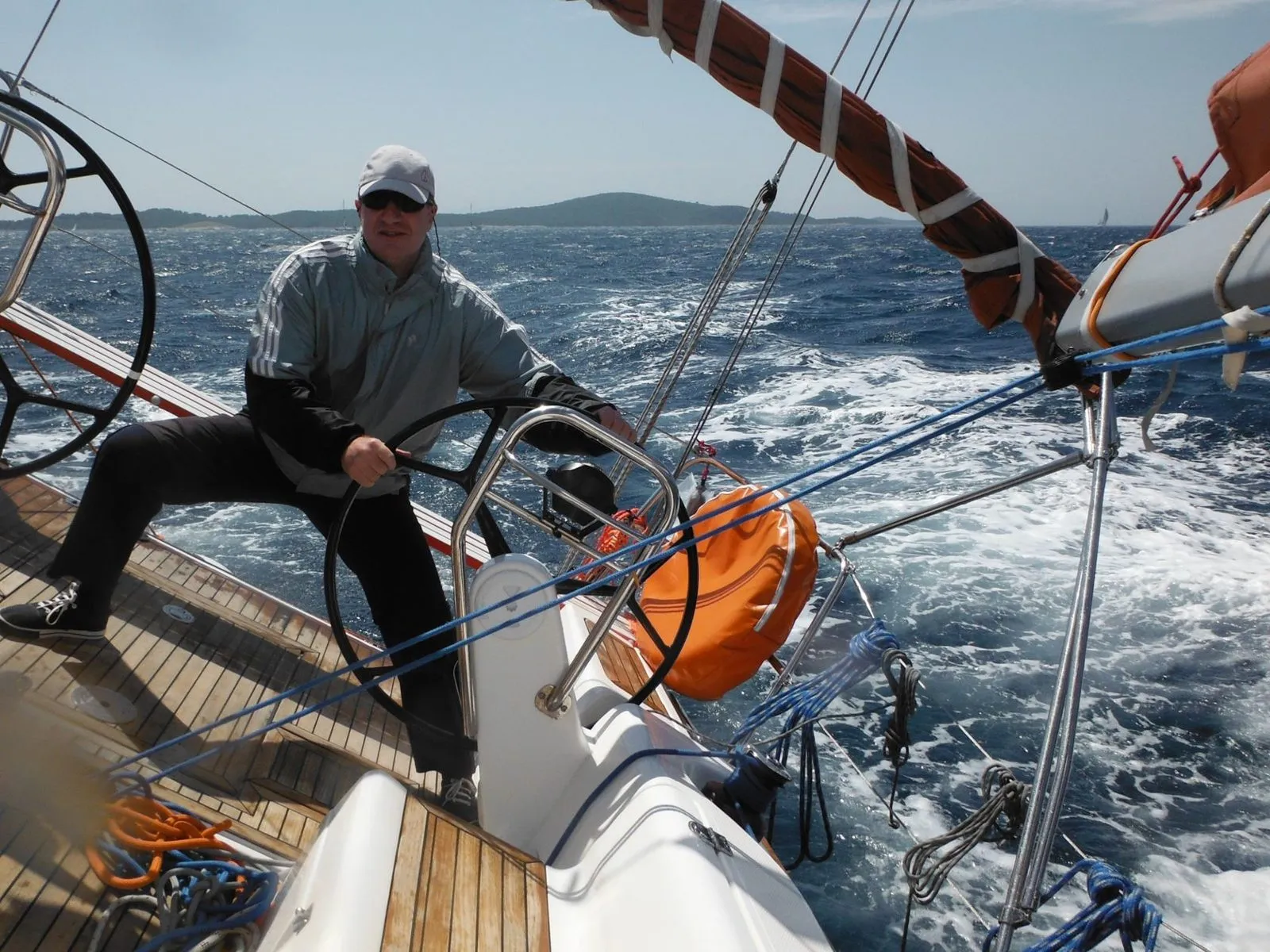
Fired up by my reading, ever since I was a child I’ve longed to sail round the Earth one day on my own boat, to reach lots of interesting places, the magical islands of the South Seas.
I already know that I love sailing, reaching islands by boat, getting to know the Croatian coast from the sea, and that life in a tight space on board – sleeping, washing, eating – is no problem for me. I’m a lucky type when it comes to seasickness too: so far I’ve got away with nothing more than a bit of stirring in the stomach region every time I’ve gone to sea.
What I didn’t know, though, was how a three-week ocean crossing would affect me – whether I could stand it, whether I’d like it, whether I’d get on with the others in such a tight space. Whether I’d get bored, or simply be scared. Scared of the forces of nature, of the distance from civilisation, or of the very limited access to medical care.
Because I’d already had the chance to meet fear once, when, with a licence only a few years old in my pocket, my friends and I sailed the length of Lake Balaton all night. The wind picked up properly, the boat heeled over and charged along on the roaring waves. It was frightening. Even though I knew – we knew – how to handle the situation, my head knew there was no trouble and we could sort everything out, fear still gripped me. And I didn’t know what of. Then before long I managed to convince myself that nothing justified the fear yet, this wasn’t that kind of situation. And luckily it has never gripped me again since, even though we’ve faced much harder tasks to solve.
So I knew that an ocean crossing is in a different category from anything I’d experienced so far. And there’s no point dreaming about circumnavigating the globe if it turns out I can’t stand an ocean crossing, don’t like it, or am afraid of it. There’s only one way to find out: to sail across the Atlantic Ocean once. I looked for opportunities, I definitely wanted to try a catamaran, because I think it provides more living space and better comfort by sailing more or less without heeling. Because it’s very exciting to keep a sailing boat of several tonnes in hand while it races over the waves heeled at 45° like a truck with no brakes, but to exist like that for days and weeks on end, constantly hanging on, planning every move in advance in a boat sailing at a slant – well, that’s pretty tiring, and on a long voyage it doesn’t really appeal to me.
So, in November 2015, the opportunity and I found each other, and as the only Hungarian member of an international crew I got to set off on the big adventure, crossing the Atlantic Ocean on a brand-new Nautitech Open 40 catamaran, about which I wrote my first sailing diary, which you can still read on the Mérföldyachting website.
http://merfoldyachting.hu/utleirasaink/atlanti-ocean-atkeles-hajonaplo/
I really liked the voyage, I enjoyed almost every moment of it, and it confirmed for me that this is what I need, this is what I like. From then on I wanted to gain further experience, and I had to start hoeing even harder so I could somehow scrape together a boat, plus some pocket money for the road.
In April 2017 Gyuri, the Hungarian owner of a new Hallberg-Rassy 48 yacht, was looking for sailing companions to bring the boat down from the yard in Sweden to the Adriatic. Luckily I got to be part of that voyage too, from Denmark through the Channel and the Bay of Biscay to Lisbon.
I wrote about this voyage in the first blog of my life http://balajaazoperencian1.blog.hu/, whose uploading was made possible by our stops in port every 2–3 days:
Half a year later Gyuri also set off on the great adventure of his life, a circumnavigation, and my wife – Andi – and I got to accompany him on its first, warm-up leg, from the Adriatic to the Canary Islands. That’s what the http://balajaazoperencian2.blog.hu/ blog was written about.
On 1 May 2018 I also got the Croatian category C sea licence, and in June fate threw me onto Dutch and Belgian rivers, then in December onto the Sió canal (with the active help of Balázs Kutasi and myself), where I managed to infect myself with the beauties of river cruising too. These experiences of ours are the subject of http://balajaazoperencian3.blog.hu/
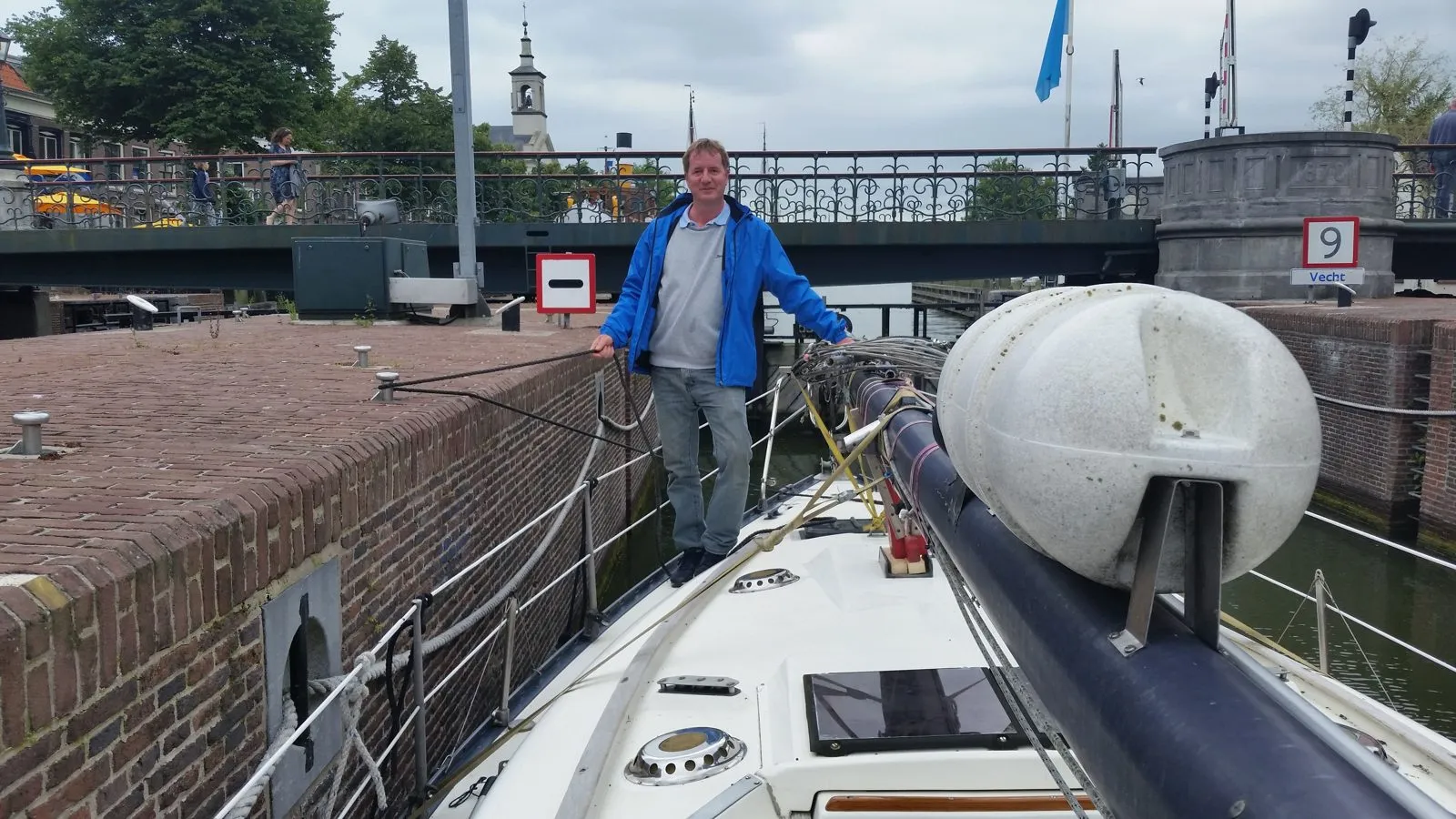
I was almost lured away from sea sailing, but in the end I gave myself a shake and said: I like this too, I need this too. Or rather, I would need it.
So slowly I’ve managed to put together plans for two lifetimes, and then we’ll see how much of it I manage to make happen…
At Christmas 2018 Gyuri called me to ask whether I’d fancy joining them again. They’re just in Cape Town – on their way home from the round-the-world voyage – and I could join in for the last leg from the Cape Verde Islands to the Adriatic. http://balajaazoperencian4.blog.hu/ I managed to say yes, so here I am, having to suffer again…:))
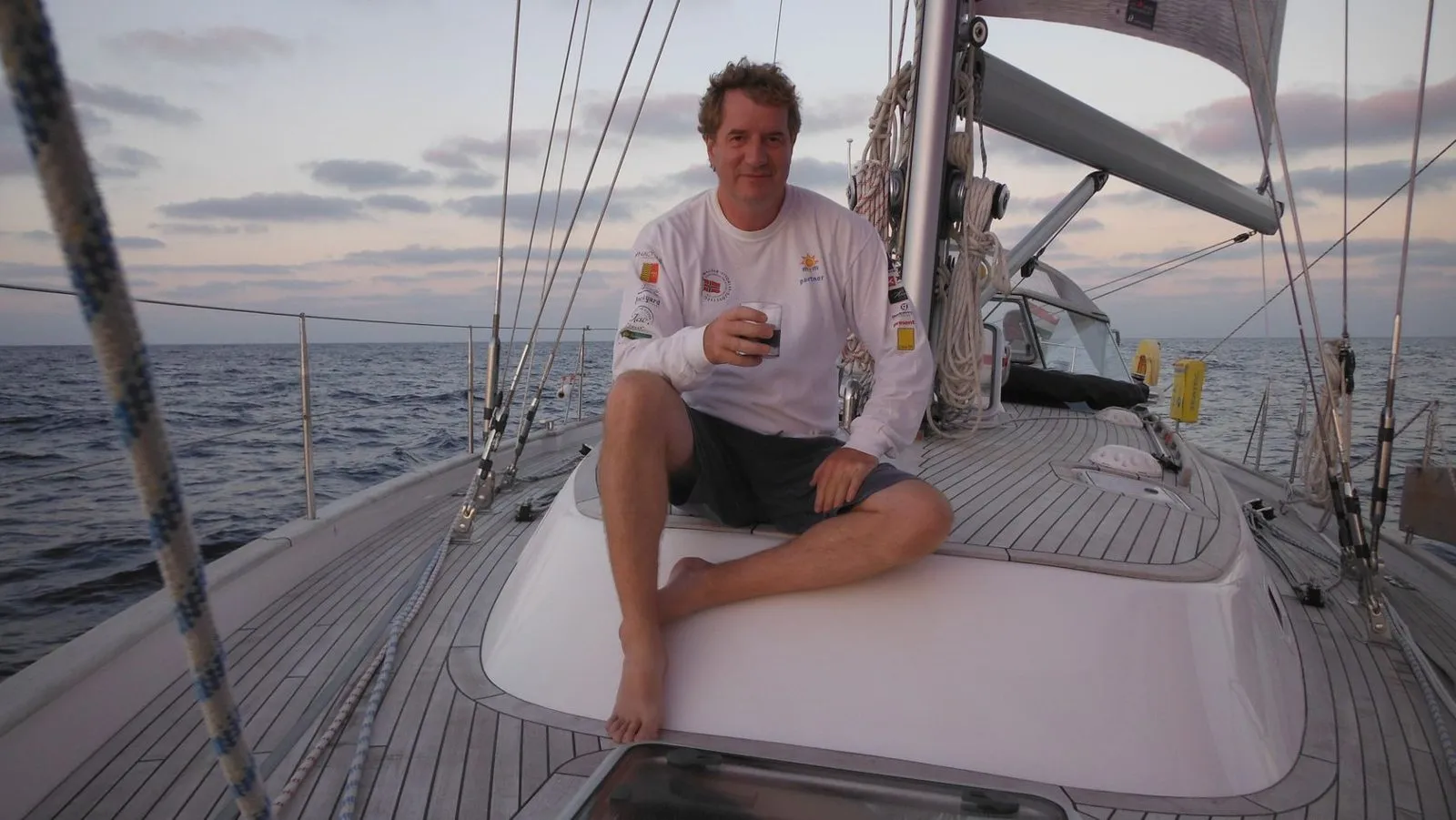
Machine translation (AI, Claude) of Balázs’s Hungarian original. Read the original →
Nautitech Open 40 catamaran
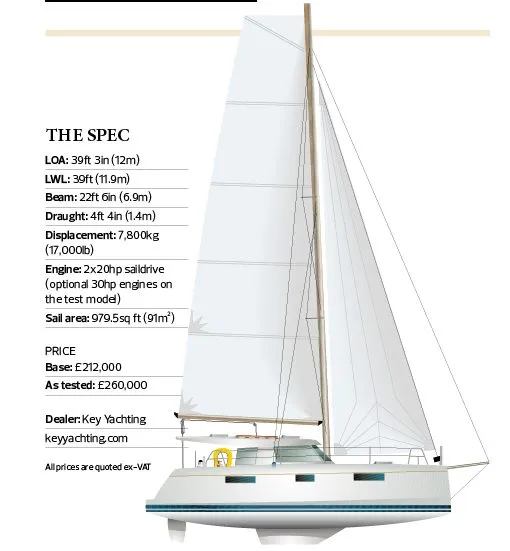
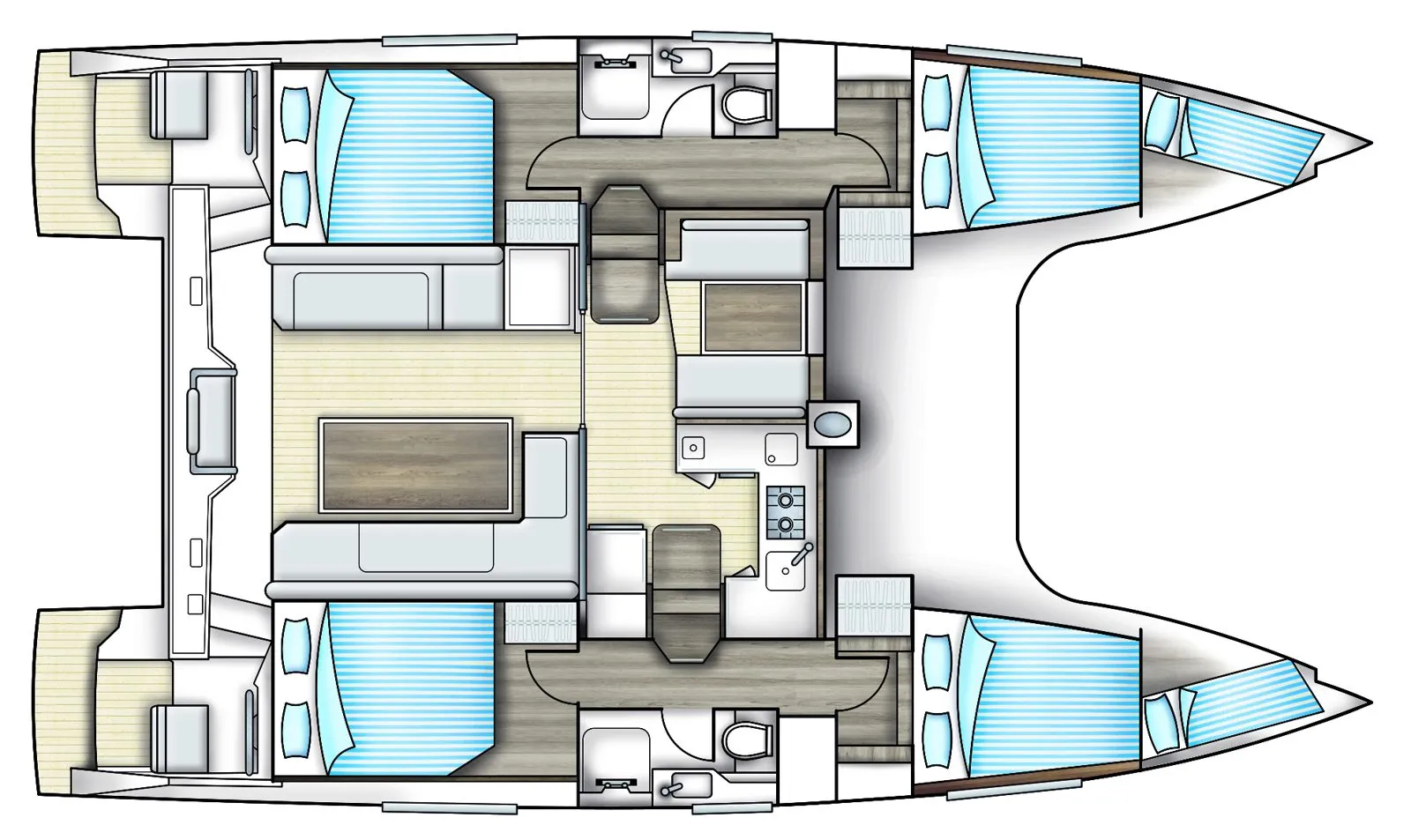
Finally, a few words about ALICE, our boat.
The boat had one enormous shortcoming.
Actually not one but two. Expert eyes will surely have spotted in the pictures already that there’s no fixed beer-can holder in front of the helmsman!!! On either side. Naturally we noticed this safety hazard straight away, and – if only temporarily – remedied the problem immediately and permanently.
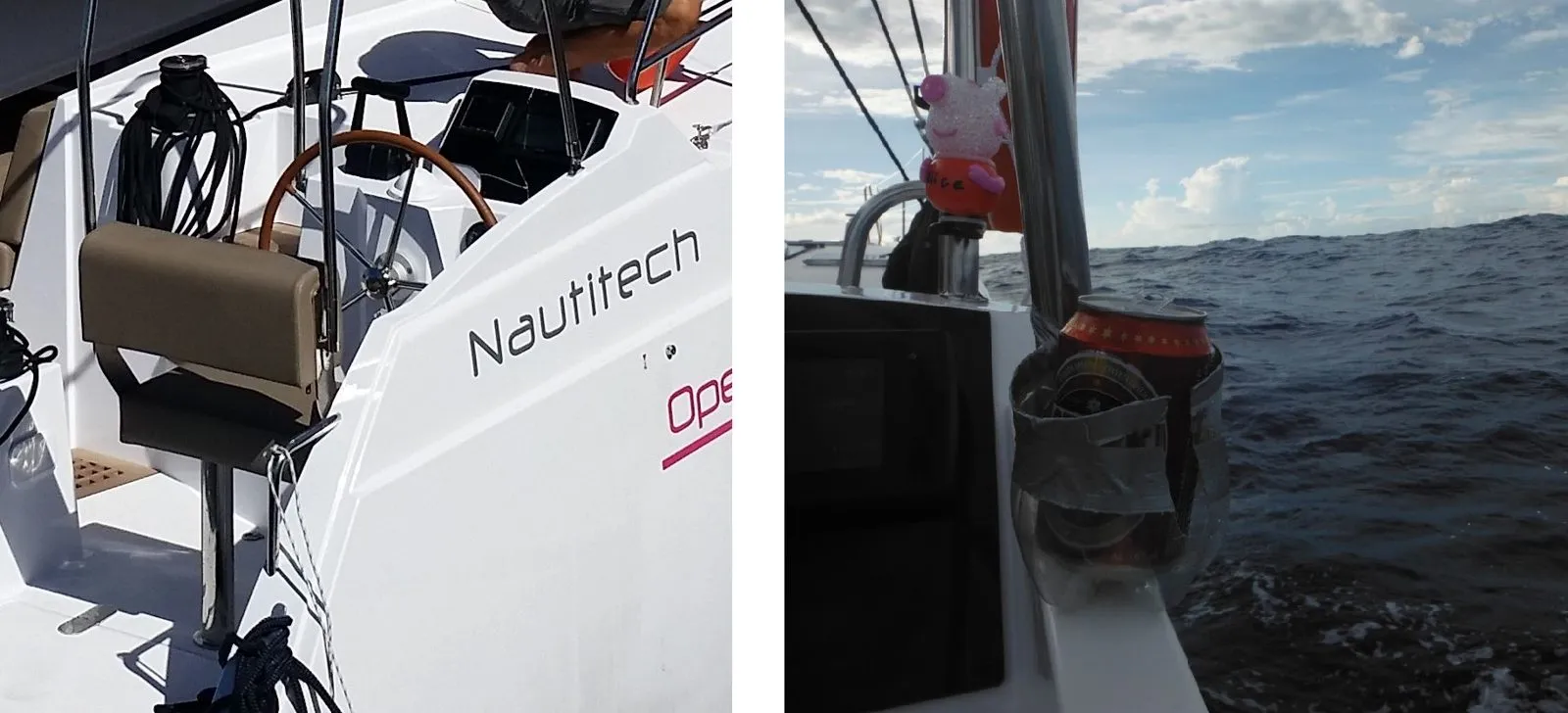
The German Bavaria – which builds monohulls – recently bought the French catamaran builder Nautitech. This is their first jointly developed boat, a new “Open” concept (ours is hull no. 44), meaning they made the saloon, which shares one space with the galley, smaller, and used the space gained to enlarge the covered aft deck. Not a stupid move, since life mostly happens outdoors anyway, but the interior is more cramped this way – with more people you already have to dodge round each other.

The other novelty – I’d only seen this before on the new Leopard catamarans – is that about 40 cm above the waterline both hulls flare out by 10 cm, on the right and on the left. This way the berths inside can be 20 cm wider, while the hull in the water became narrower, has less drag, the boat is faster, and it deflects the water splashing up onto the deck outwards. (maybe that’s also why the noise of slapping water is louder inside…)
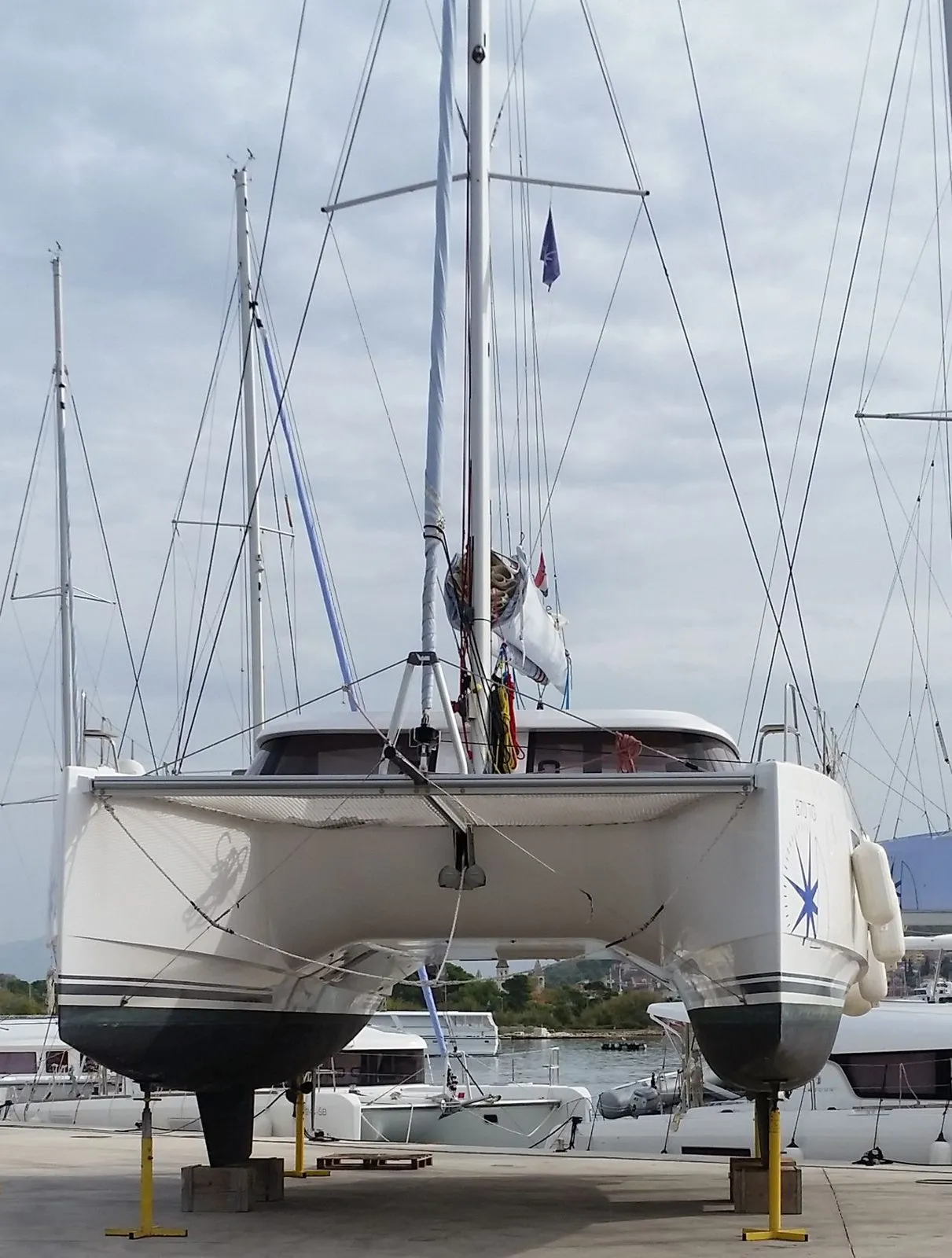
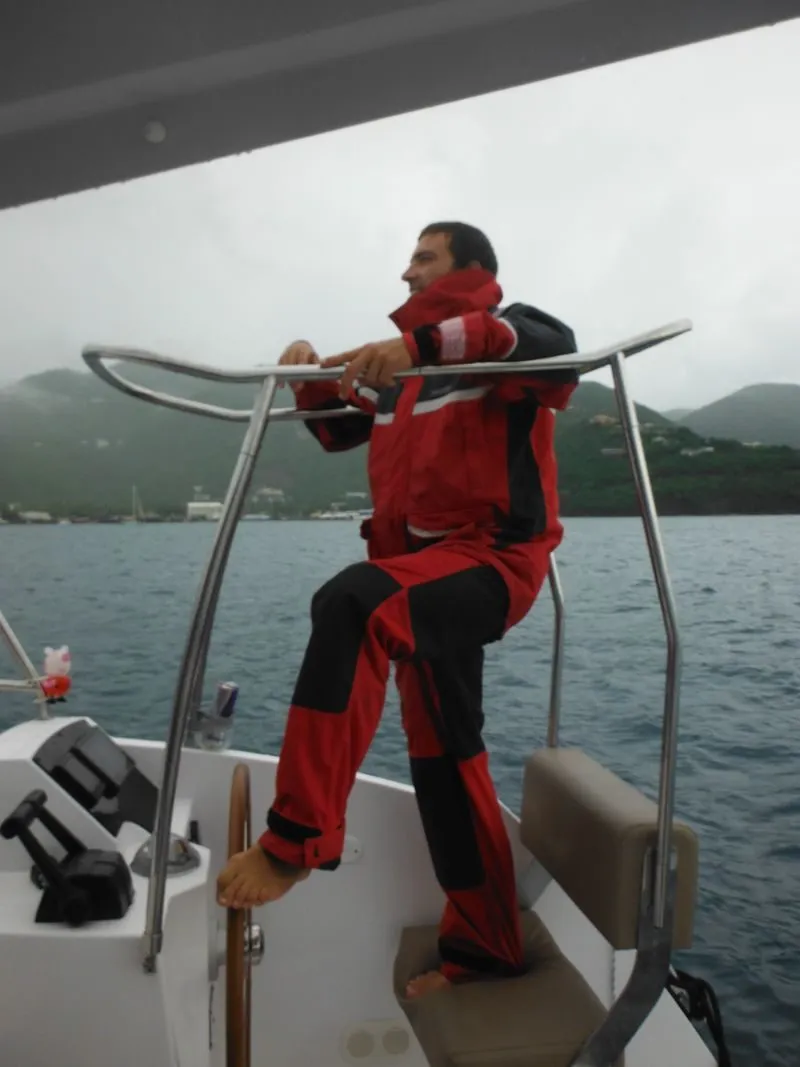
In keeping with the old Nautitech custom, the two helm stations are at the back ends of the two hulls. This has just one advantage, namely that the helmsman is on the same level as everyone else and can communicate better with the crew, nothing else.
The disadvantages, however, are plenty:
You have to stand up to see out to the left as well
Even so, the boat is stable and seems fast too. There’s enough storage space, outside and inside, we could easily stow everything. The cabins have a few more lockers than usual, too, but I miss a little bench to sit on while getting dressed. It’s not much fun hopping about on one leg down there in the swell, ricocheting off the walls like a billiard ball while you pull your trousers on.
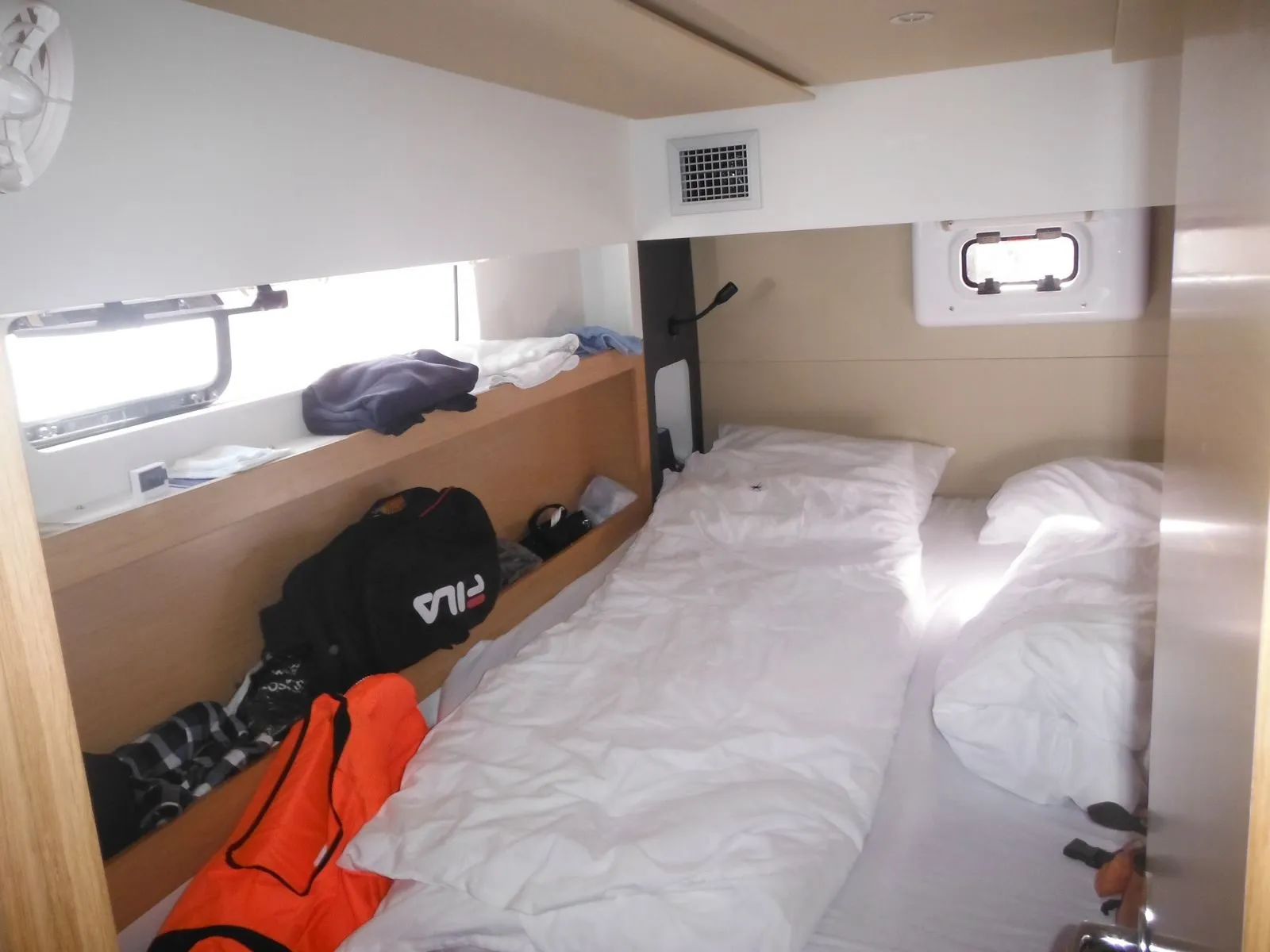
I’ve already mentioned the uselessness of the autopilot, but the way the engines are installed isn’t quite perfect either somehow. Volvo – the engine maker – prescribes that when sailing, the gear lever should be put in reverse, as is customary, so that the propeller shaft doesn’t spin (and whine).
Nautitech, on the other hand, prescribes leaving it in neutral, let it spin. That’s why it howled under our bed whenever we were going faster than 7–8 knots.
Navigare ordered 4 of these Open 40 catamarans from Nautitech. One wasn’t even finished by the time we left. On another, the skipper put the gear lever in reverse as usual after they set off from La Rochelle. They reached Porto after a week, and the engines wouldn’t even start. Somehow the exhaust system sits low (even though a catamaran doesn’t even heel), seawater got into the cylinders, and in a week it sorted them out so thoroughly that both engines were write-offs and need replacing. The boat is sitting in Porto, and Navigare, Nautitech and Volvo are squabbling over whose fault it was.
So only two boats arrived in Tenerife – luckily for us, ours, ALICE, and EBBA. Volvo’s technicians serviced the engines in Tenerife and found that the oil level in the gearboxes was low. It’s leaking somewhere. Presumably through the oil drain, which leads straight into the sea. Since checking this would mean hauling the boat out, which didn’t happen in Tenerife, they topped up the missing gearbox oil and advised us to be careful. Thanks. But how? Well, by not using them much.
Shall we row, then?
But OK, we took the advice and didn’t use the engines except when we had to.
And lucky that there was a generator on the boat, so we could charge the batteries with that too.
By the way, halfway across Gregor and co. checked the oil level in the gearbox, and it was still fine then.
Faults aside, ALICE was a decent sort after all, and carried us safely across the Óperencia – the sea beyond all seas of Hungarian fairy tales.
Thank You ALICE!
Machine translation (AI, Claude) of Balázs’s Hungarian original. Read the original →