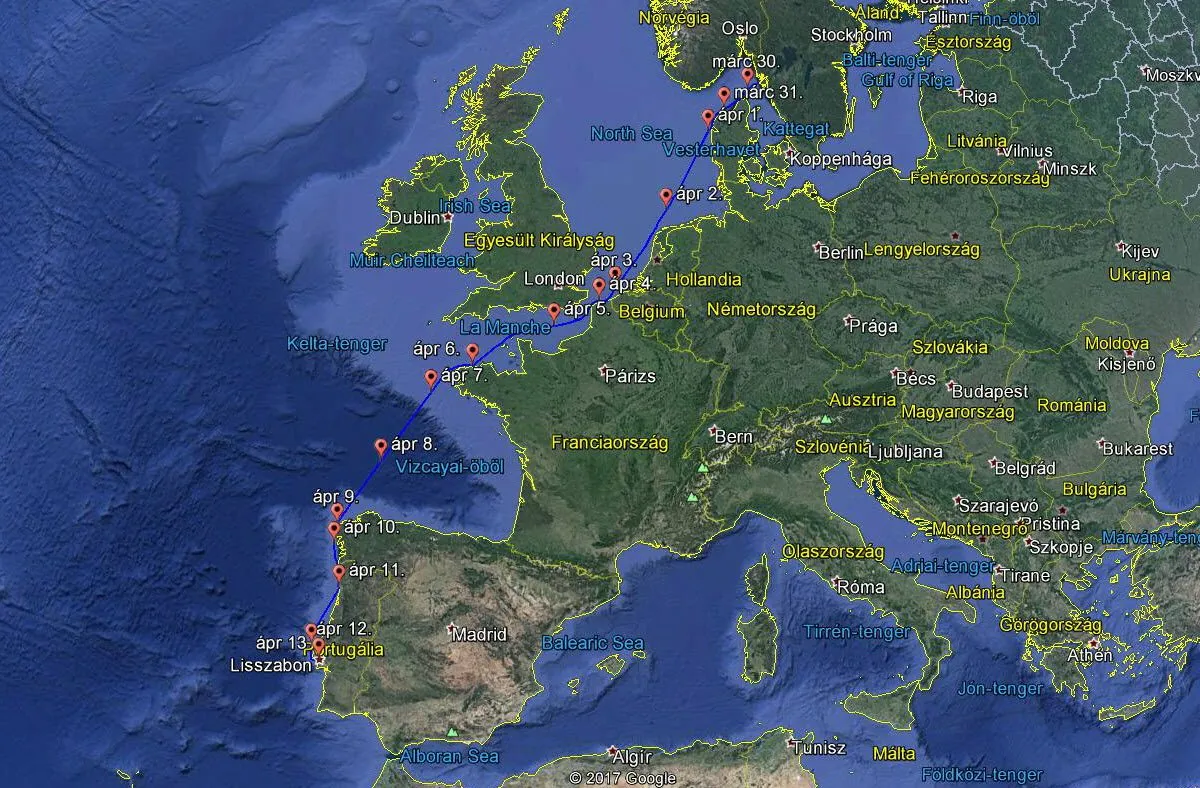
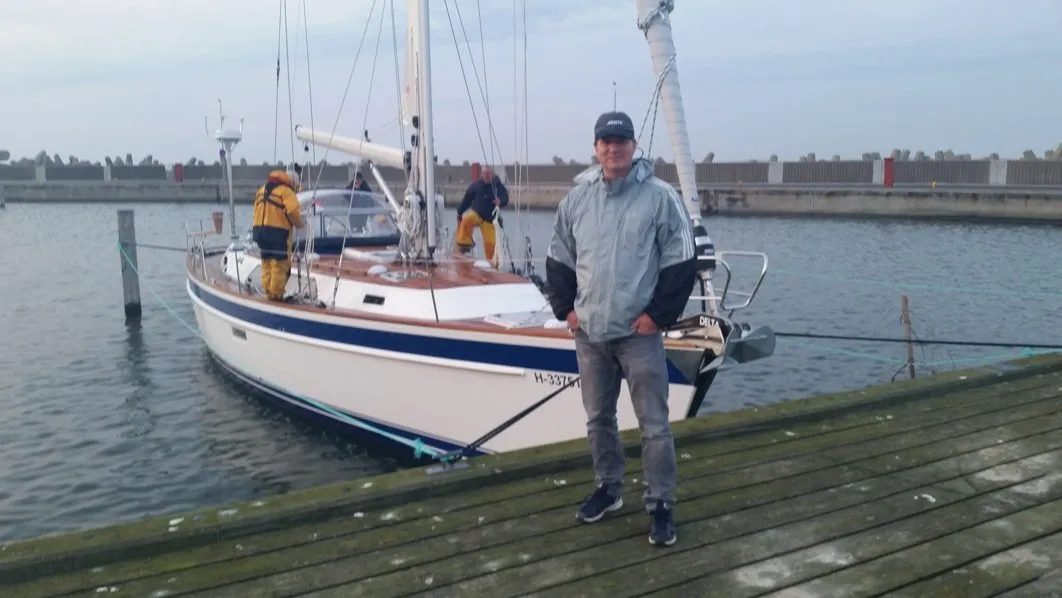
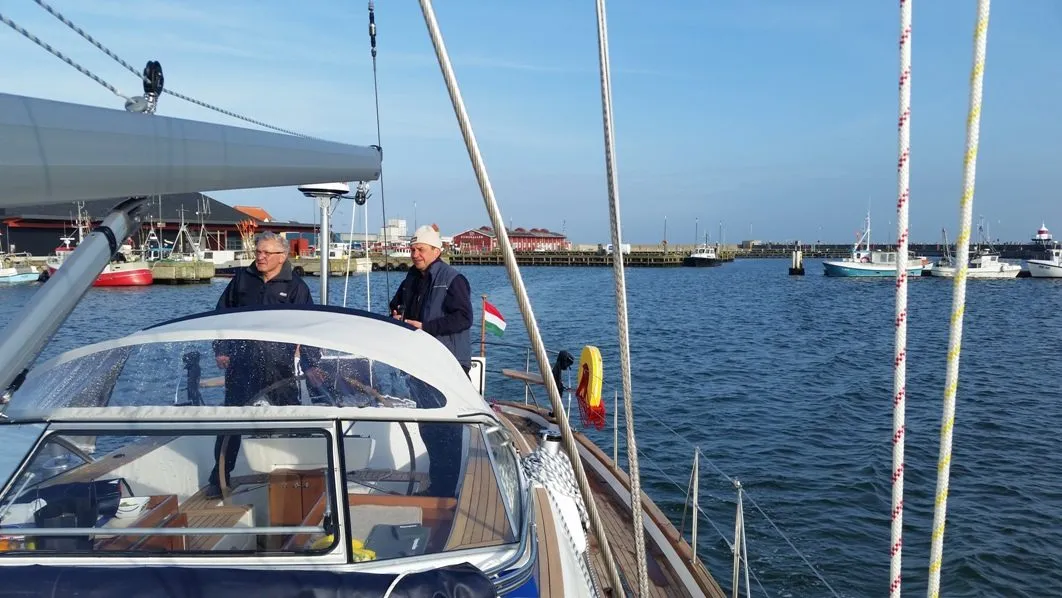
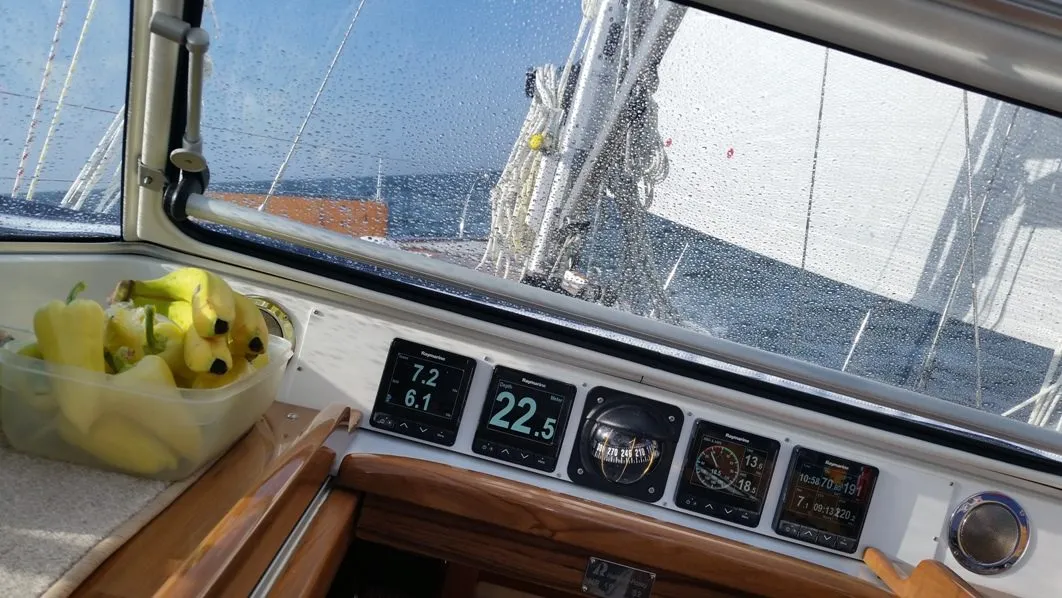
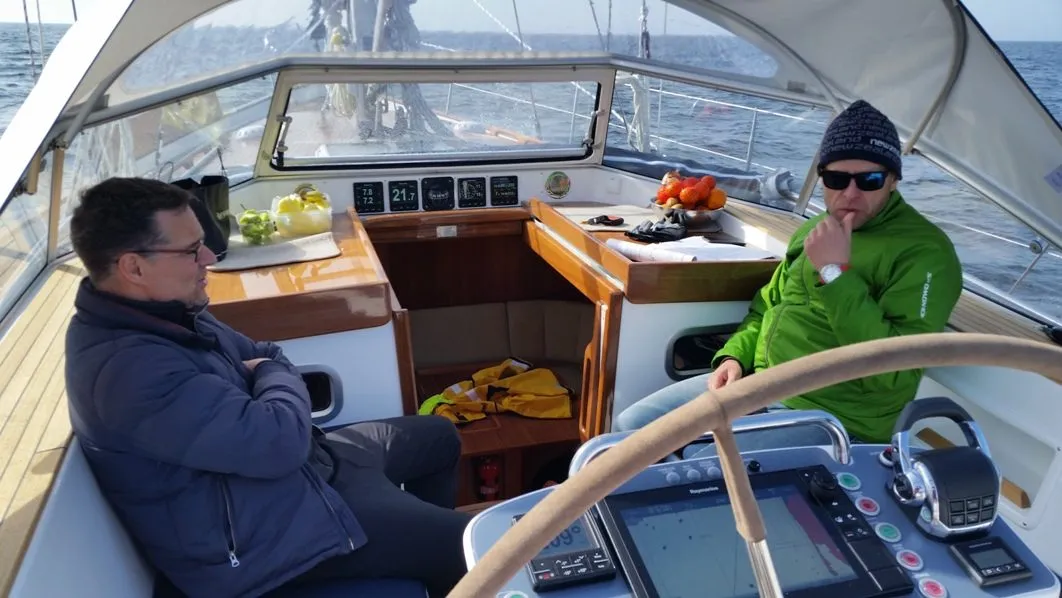
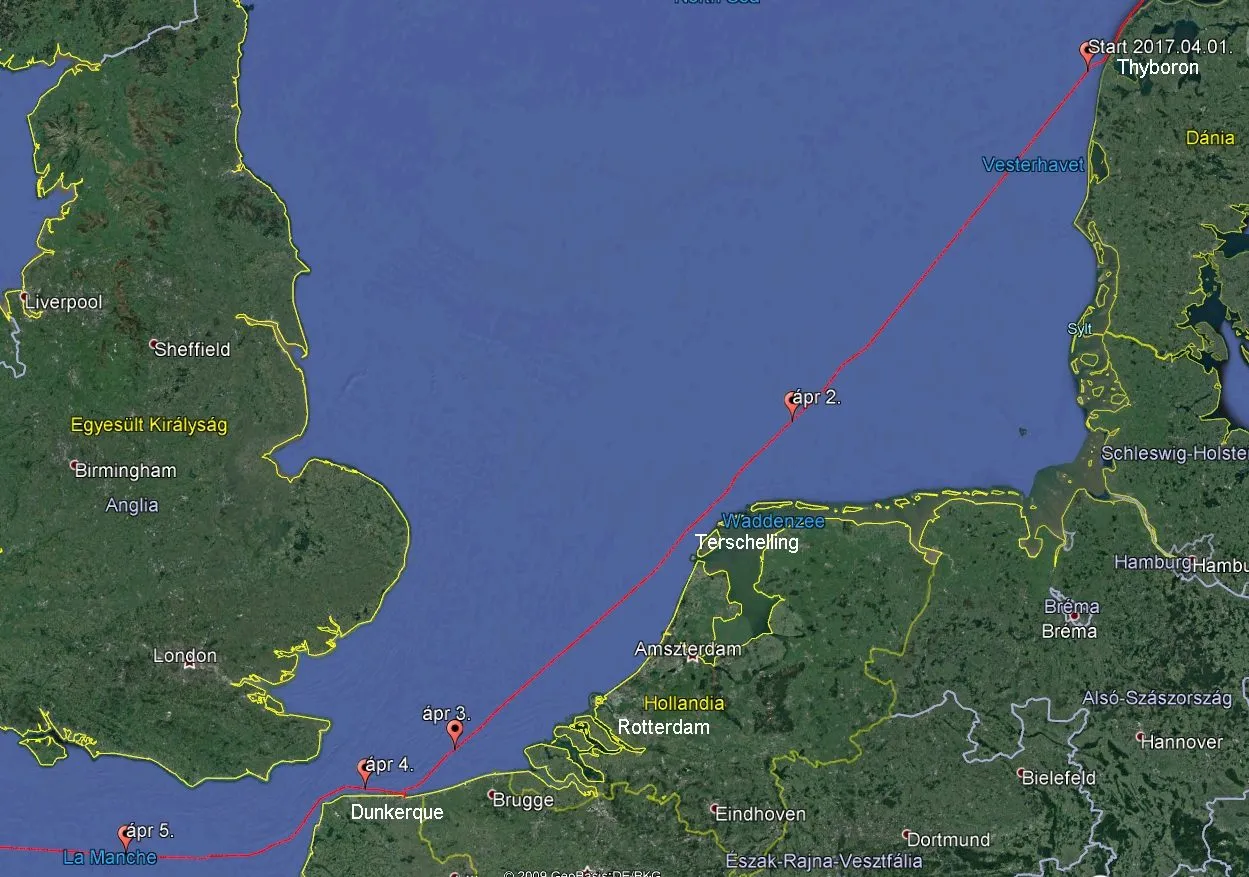
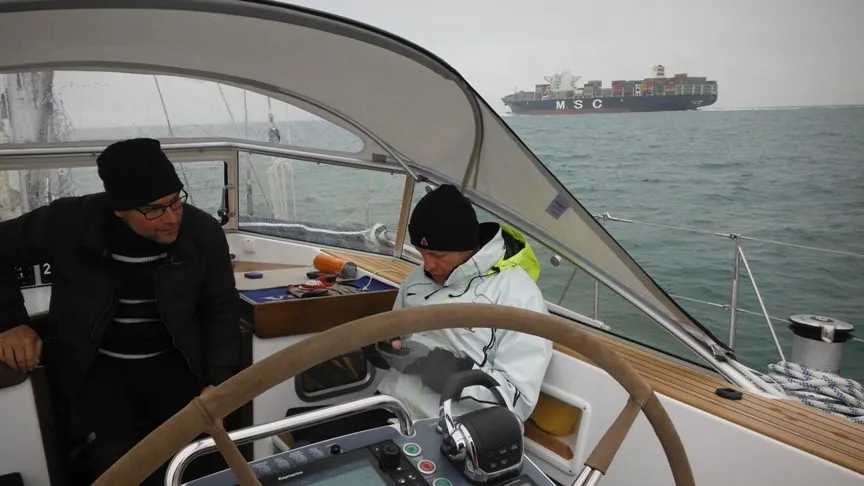
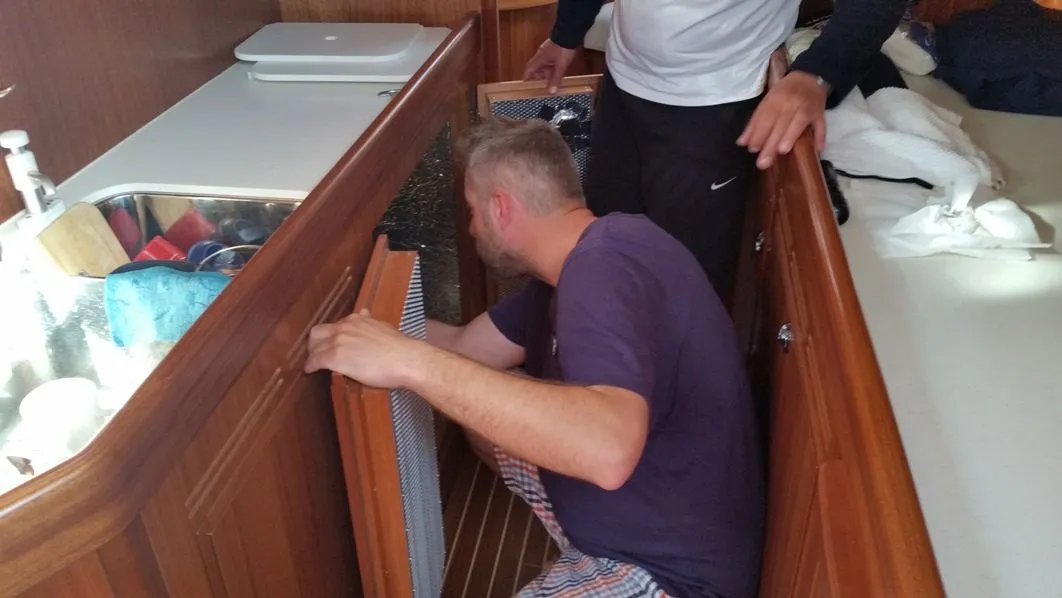
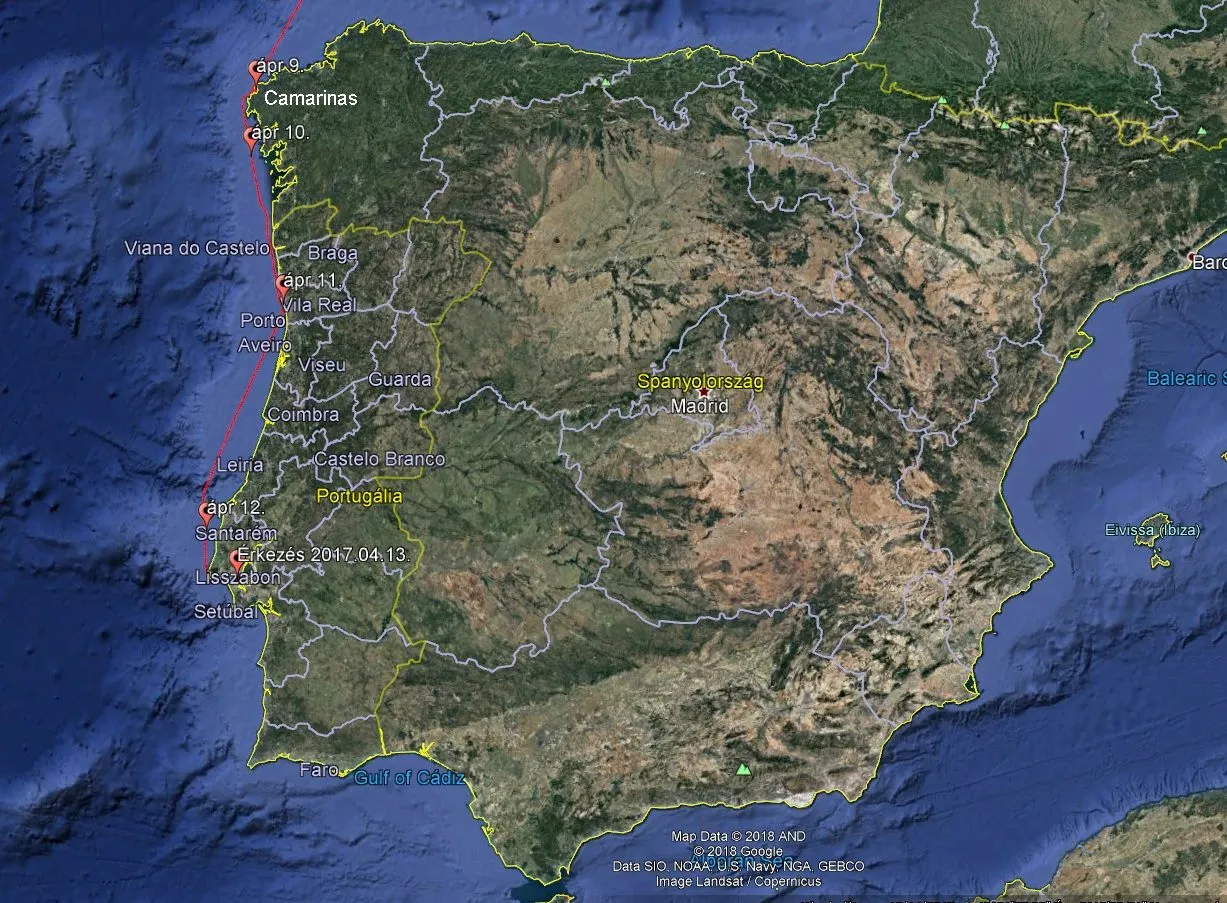
The Pinta's maiden voyage, from Thyborøn to Lisbon – source: balajaazoperencian1.blog.hu
· Berlin, Germany
The "Pinta"'s first voyage – destination Berlin.
From 30 March to 12 April 2017, from Ellös in Sweden to Lisbon
Background
About a month and a half ago I read about the opportunity: someone wanted to take a brand-new Hallberg-Rassy 48 sailing yacht down from the yard in Sweden to the Adriatic, in APRIL, and was looking for experienced sailing companions.
Why I wanted to go on this voyage:
another chance to gain experience,
getting to know new seas, countries, harbours and coasts – I’d never been this way – sailing the North Sea and the English Channel,
conquering the Bay of Biscay, notorious for its storms – of course all this would be much better in summer, but if the chance is here now, you’ve got to grab it.
Finally getting to Gibraltar. By boat. I’ve longed for this somehow ever since I was a child: in the books I read, the heroes of the Világjárók (“Globetrotters”) book series almost always set off from here in small sailing boats on their round-the-world voyages.
seeing Ibiza and Sardinia. I’ve already sailed from Sicily to the Adriatic, but the sea always has something new to show you,
and of course trying out a Hallberg-Rassy yacht, which the German Yacht magazine always raves about.
A chance like this comes once every fifty years – you’ve got to give it a go!
Thursday, 30 March 2017
Day -1, 1130 km by car
Where do I start. Maybe with the fact that at 7 p.m. I turned 50. All this somewhere halfway between Prague and Dresden. I do have feelings and thoughts about it – not about the place, but about the 50 – but maybe that’s not so interesting here and now.
The story starts when I spotted in the Mérföldyachting newsletter that you could take part in delivering a boat from Ellös in Sweden, from the yard to the Adriatic.
Quick consultation with the family – green light – and I’d already signed up.
I trusted that my sailing past – with the Atlantic crossing two years ago – would be a good letter of recommendation for my application, but when it turned out that 46 of us had applied for the 7 places, well, I got a bit less sure of myself. In the end they invited me for a chat, where it turned out they’d count on me, and for the first, supposedly harder half of the voyage at that, that is, from Denmark to Lisbon. (Well, I thought, I won’t see Gibraltar this time either, but I was still very happy to be part of the voyage)
In the end the plan was that Gyuri – the owner – would bring the boat as far as Denmark with the other crew, while the two of us, Zoli and I, would buy most of the provisions in Hungary – which is mainly to Zoli’s credit for his stamina – and drive them to Denmark in an estate car, where we’d swap with two ladies: they get off and drive home, and we go aboard.
That’s the plan. Which is working so far.
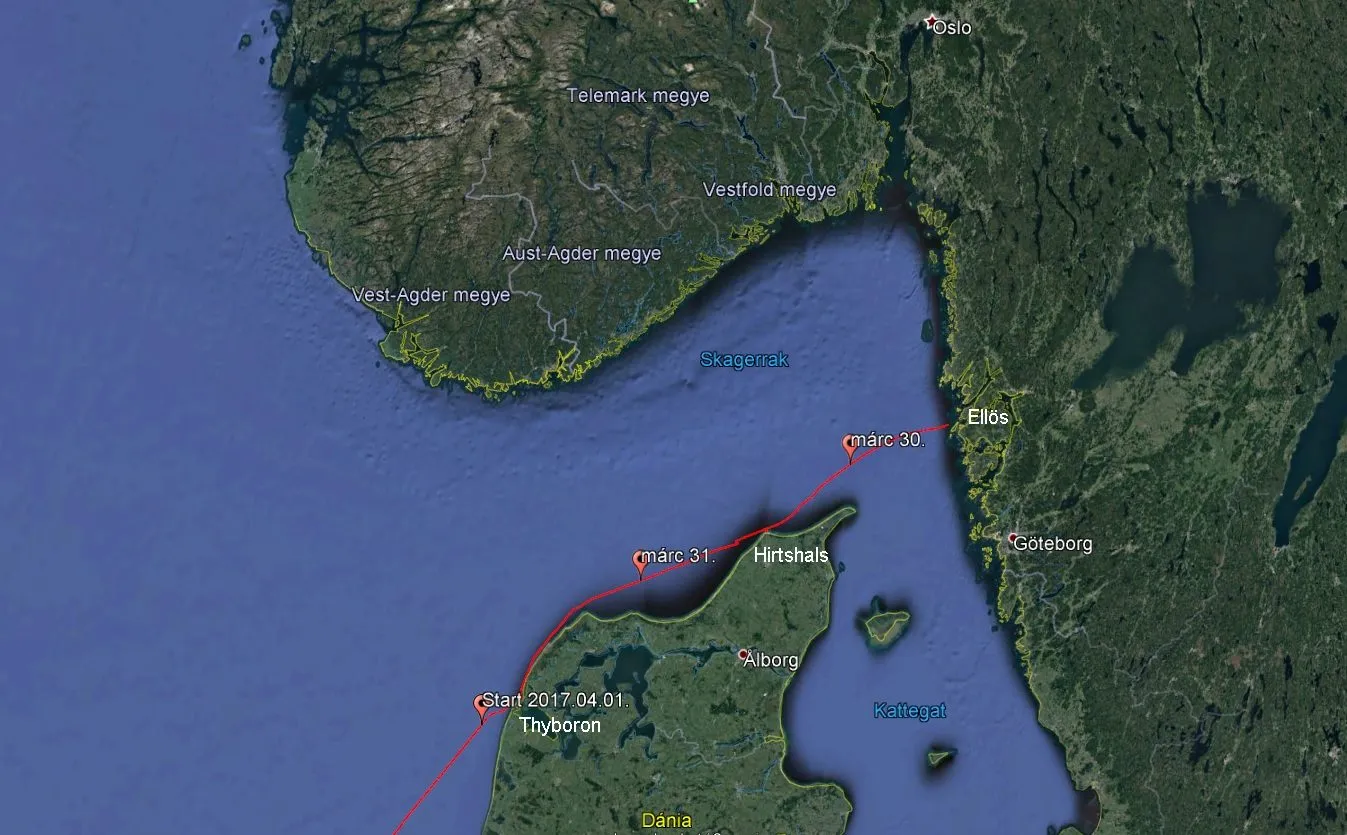
Before the trip I got hold of a satellite tracker, which is already on the boat, so since they set off this morning we’ve been able to see the boat’s position all the time. That’s how we noticed that, contrary to the original plan, at 7 p.m. they’d moored at the top tip of Denmark, in Hirtshals. I was here almost 30 years ago – this is where the ferries from Norway come in.
The Pinta’s route from the boatyard, from Ellös to Thyborøn
We phoned Gyuri to ask the reason for the change of programme. We learned that they’d been making good progress all day on a close reach in a strong wind, but in the cutting wind the 5 degrees of warmth felt like 5 degrees of frost, and it seemed wiser to pull in for the evening. It sounded a bit like what the little tomcat said to the big tomcat after hanging off the gutter for hours: “we’ve f…ed around enough, let’s just go home…” I can understand the decision very well…
Tonight we’re sleeping at a good friend’s place in Berlin, then tomorrow we push on.
Machine translation (AI, Claude) of Balázs’s Hungarian original. Read the original →
· Thyborøn, Denmark
It's not migrants we're smuggling
Friday, 31 March 2017
Day 0, 715 km
In the evening in Berlin there wasn’t a scrap of parking space anywhere in the area. It’s never happened before that I didn’t find the space waiting for me, but there, on my birthday, not one Berliner had thought of me. At least not in that respect. We did, however, find an almost empty multi-storey car park nearby, which we were glad of, because we wouldn’t have liked to leave the loaded car out on the street.
In the morning, right away, we had to pass a little intelligence test to get down to the basement, the parking level.
We got into the lift and couldn’t find a single suitable button going down. There was no P1, no -1, just 0 and from 1 upwards… I’d never seen anything like it. The 0 didn’t take us anywhere. Then we noticed there was also a button with a hyphen on it… Hmm… Surely you don’t have to key it in like on a calculator? Oh yes you do – we typed in “-1” with 2 button presses, and lo and behold, down we flew…
Then straight away came the next task: paying. The machine wouldn’t accept our paper money, and we didn’t have 9 euros in coins. Right, off to get change. I went first. Everything in the area was still closed (9.45). In the end I trudged to the Lidl, where the native cashier informed me that she’s not allowed to change money. I get that, but I’d have liked to see at least a bit of understanding in her blank stare…
I tried a bit more with the shoppers in the car park (no, I wasn’t begging for the 1-euro coins from the shopping trolleys, I wanted to break a 10-euro note), but with every refusal I felt more and more that I looked like an Eastern European trying to pass off his fake euro… A Turkish greengrocer took pity on me and changed a 5-euro note. That made 8. In the end I went back, and we decided to get the remaining shopping done at the Lidl.
We got going, and while I gathered the stuff, Zoli paid for a hot dog so he could get the car out. The hot dog somehow cost more, and our favourite cashier, naturally, wouldn’t give more than 2 euros in coins at the till, even when we asked, saying that would count as changing money…. God forbid, we shuddered at the very thought of changing money…. So we had the necessary 9 euros (because I had one stuck in the shopping trolley). Yes, but as time went by, the parking fee had meanwhile gone up to 10 euros….
This Berlin just won’t let us go…
Pretty soon we’ll qualify for German citizenship…
Zoli, in the bowling bar that had just opened at 10 in the meantime, knocked back a dark cola in a flash (like the local boozer does his morning shot of cherry brandy) and we were free…
We loaded up the car – the Superb couldn’t sag any lower – and goodbye Berlin!
Now only one question was on our minds: what would happen at the German-Danish border. Would they want to search our boot for migrants or not. Because in there they’d find 44 bottles of wine, 11 bottles of pálinka, gin and rum, plus 4 trays of beer, among raw meat, salamis, eggs and dairy products. All things that wouldn’t exactly give the Danish customs officers a fit of the giggles… Nor would we, afterwards…
But Neptune was with us, and the man waving cars through at the border, seeing our friendly Germanic smile, didn’t direct us towards the tent but shovelled the air with his hand – chop-chop, get a move on…
That’s exactly what we thought too.
Phone call with the boat: their wind has died, under engine it’s another 4 hours to Thyborøn, for us 200 km. We’ll be there first, if all goes well…
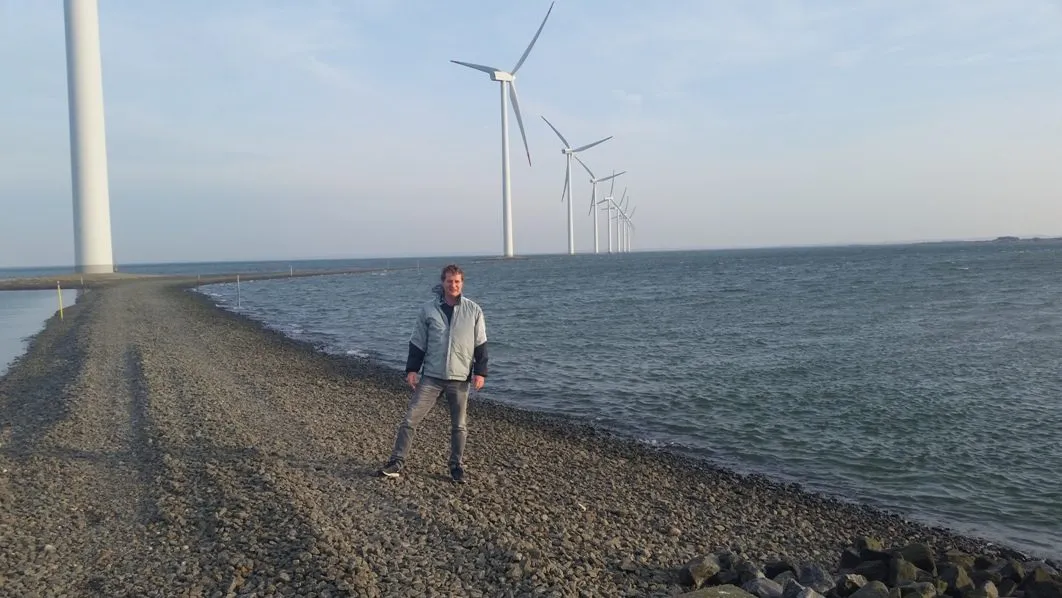
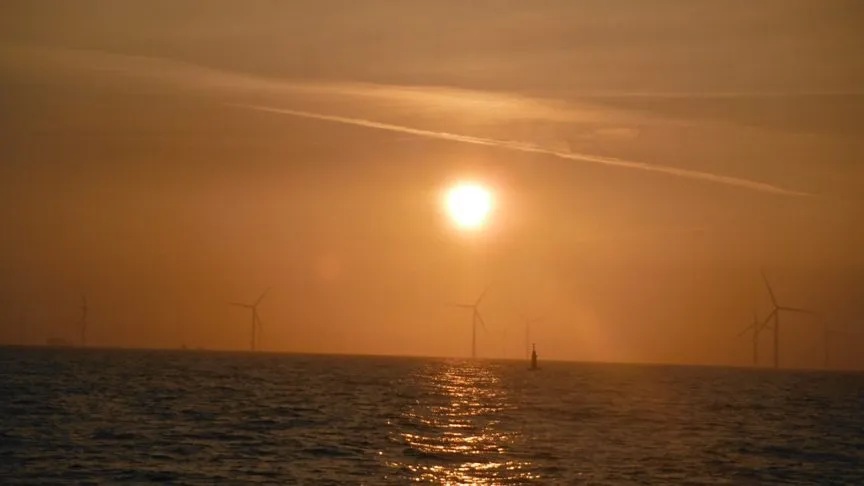
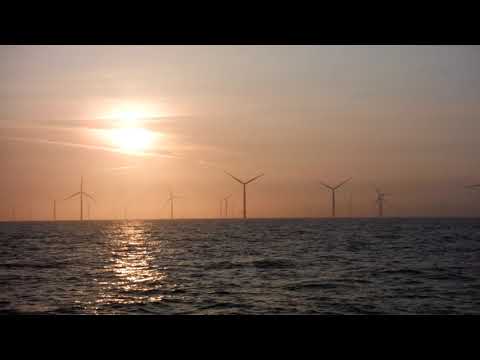
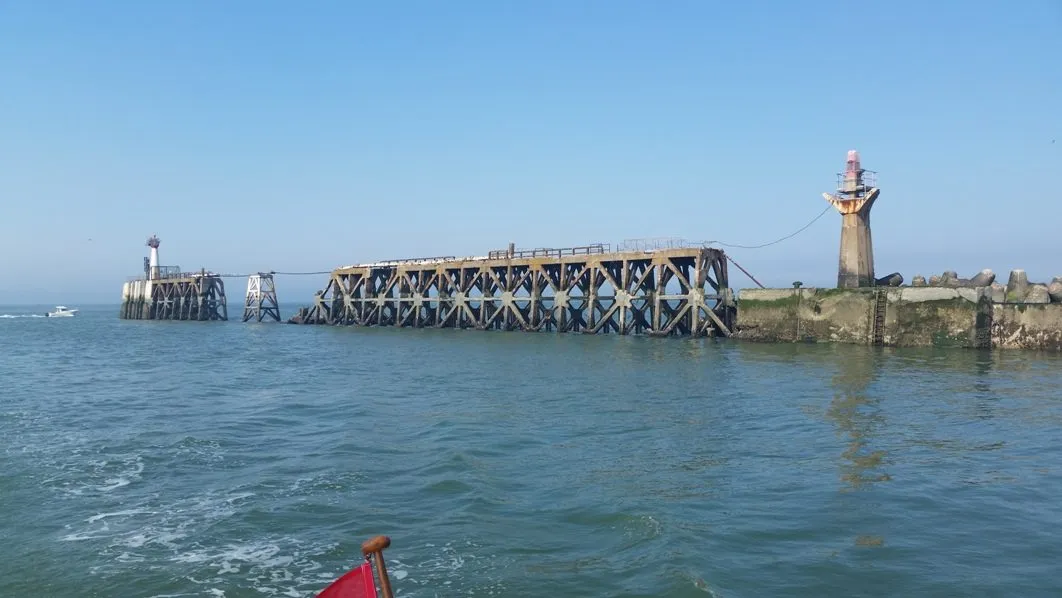
A few kilometres before the harbour we stopped for a bit and walked out to a wind farm of 8 turbines set out in a dead-straight row, built in the shallow inland sea.
Wind farm before Thyborøn, in the inland sea
Thyborøn, by the way, gave the impression of a quiet little suburban housing estate from the 70s. I didn’t see an older house, and thinking back, not a single tree either. Most of the harbour was taken up by fishing boats, with small fish-processing halls, and further along in the eastern basin a boat repair yard. The visitor yacht berths were in the seaward corner of the harbour, with card-operated water and power posts. We didn’t meet any marina staff either in the evening or in the morning.
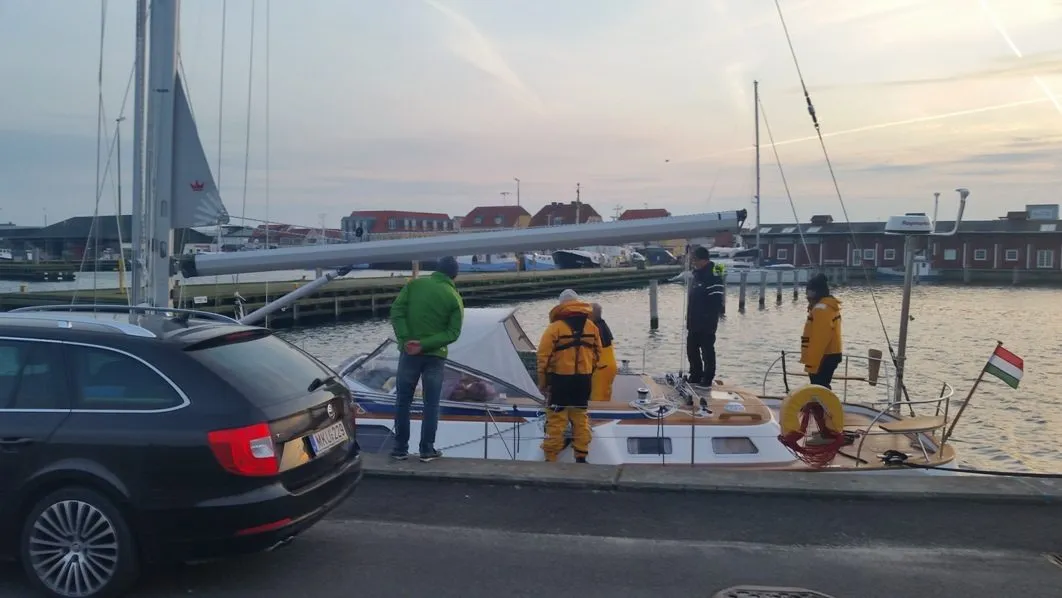
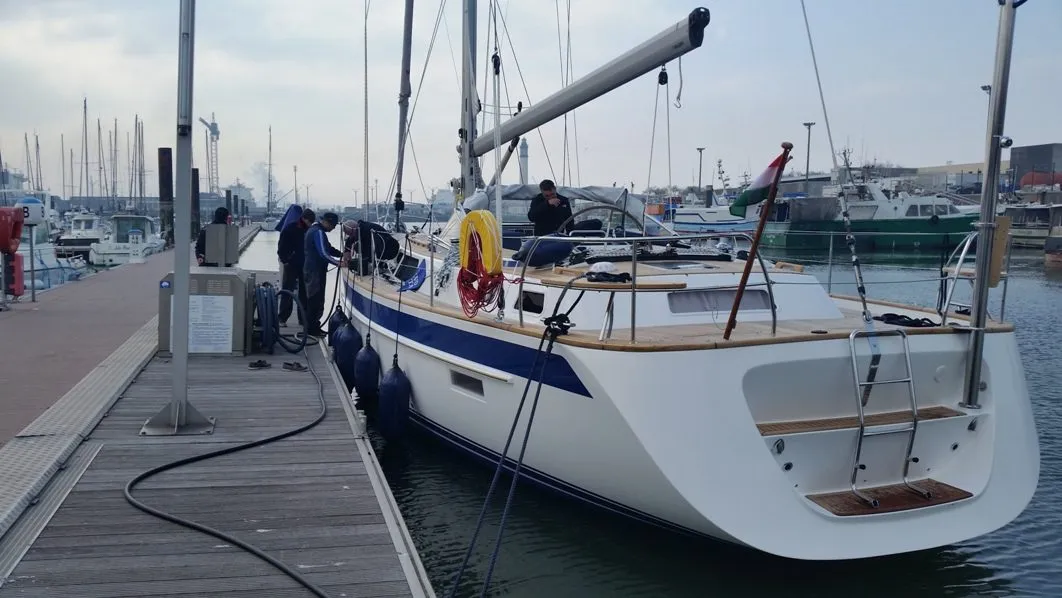
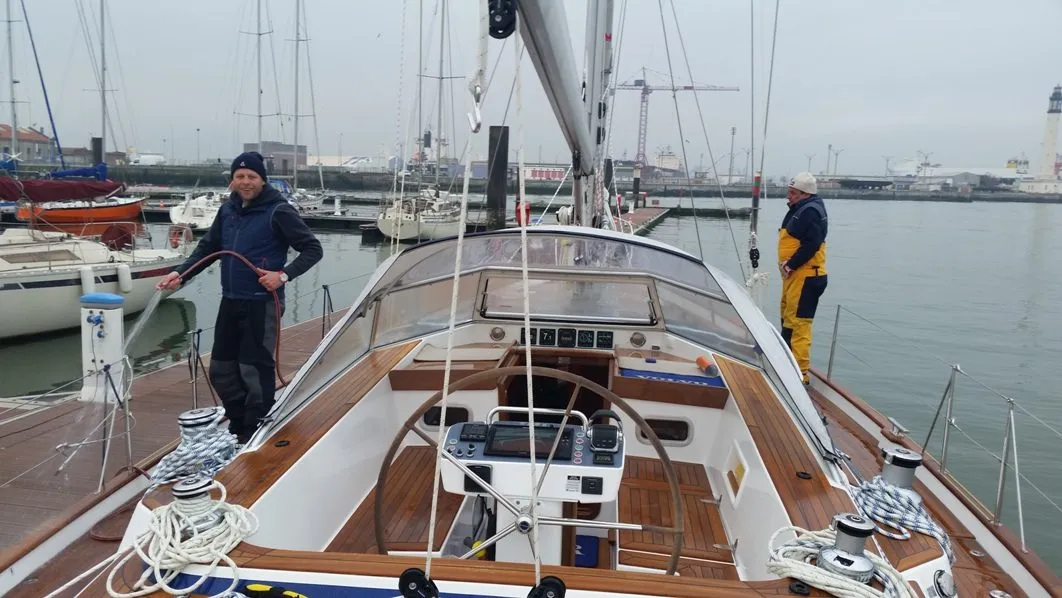
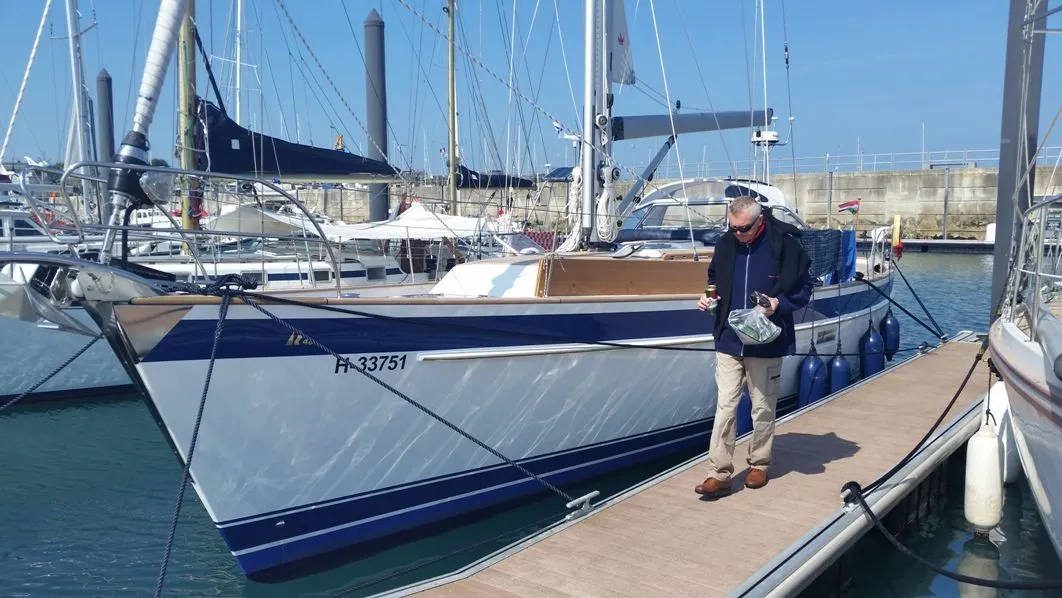
By half past seven in the evening our boat arrived too. At the quay wall we transferred the supplies from the car, then they moved over to the visitors’ pontoon. True, the boat didn’t fit in the first berth with its 4.4-metre beam, but it did in the second. After a warm welcome and dinner we turned in.
Loading up at the quay wallThis berth we did fit into – no two ways about it, tomorrow I set off on this boat!
Machine translation (AI, Claude) of Balázs’s Hungarian original. Read the original →
· North Sea, off the coast of Denmark
Setting off for the Netherlands, to West-Terschelling.
Saturday, 1 April 2017
Day 1, 18 nm to noon ( Log 198 nm)
In the morning, before setting off, we wanted to fill up our water tank, but the card terminal on the water and power post on the pontoon would only have accepted the Hungarian SZÉP card (a holiday voucher card Hungarian employers give their staff). And that, for once, we didn’t have on us. We tried every other kind of debit and credit card in vain – the tap just kept gurgling emptily, and our water tank stayed half-empty, which still meant 400 litres of fresh water.
Since the stupid machine is so far incapable of handling the mooring lines and holding us captive, unlike Berlin, we were free to leave for the Netherlands.
Sailing out of Thyborøn
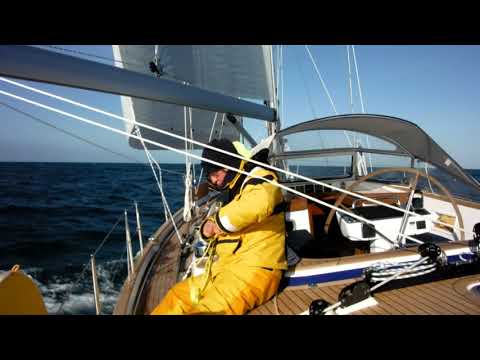
I brought the good weather here too (as I usually do): the sun shone all day and it was an acceptable 13 degrees, with minimal Balaton-sized waves. Unfortunately we’ve got 13–15 knots of wind dead on the nose, so apart from half an hour of sailing we motored all day.
Our boat, the Pinta, has a displacement of 23 tonnes.
The boat has pretty much everything.
It’s easier to list what it hasn’t got.
For instance, there’s no beer-can holder at the helm. Somehow I spotted that straight away.
And that’s almost the end of the “hasn’t got” list. I tried to be crafty:
And a hairdryer?
Yes.
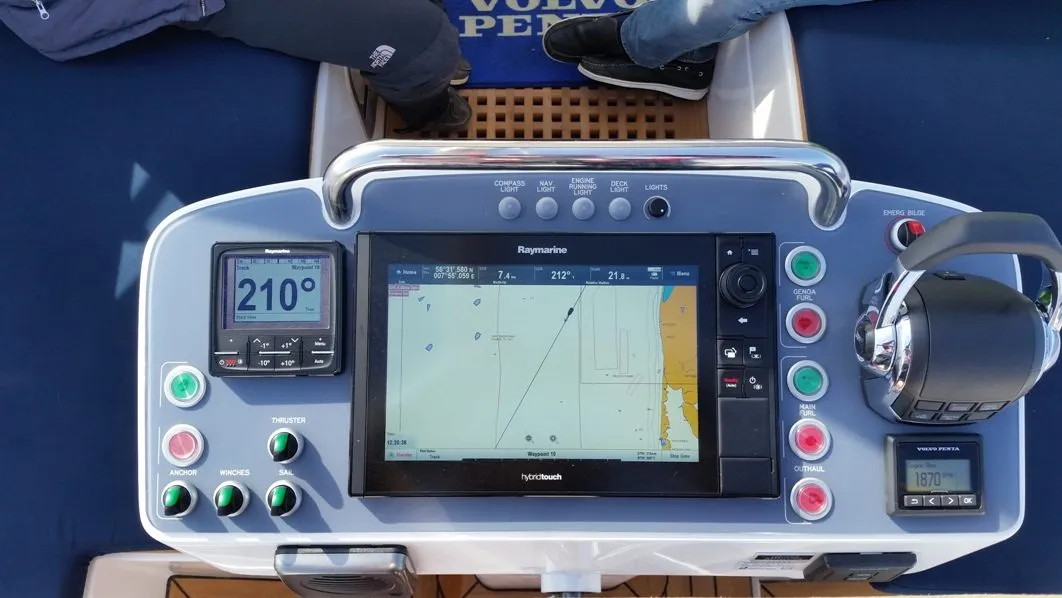
No further questions. Because among other things there’s heating, air-conditioning, a washing machine, a microwave, powered furling for the main and the headsail, electric winches, radar, AIS, Navtex, electric heads, etc.
There’s no satellite phone – but anyone who wants can bring one – and there’s no extractor hood or dishwasher in the galley either.
You’re forbidden to throw toilet paper into the traditional hand-pumped heads, because of the very real risk of blockage. Practically ever since I’ve been going to sea, almost every boat handover, every briefing of new crew, has started with this. It was one of the ABCs of sailing. Well, that’s history now too…
Here on board, you can happily throw used toilet paper into the electric heads (the cap’n expressly permitted it), only in reasonable quantities, of course…
He did add, with a wicked grin, that we should tear it into 1-centimetre strips first….
In the morning we held a national consultation (Hungarian-government style) on the Overdose function of our Gori propeller, and before it came to blows we agreed that as soon as the skipper is willing to let us experiment, we’d settle the question with an iPhone decibel-meter app.
Overdose or overdrive?
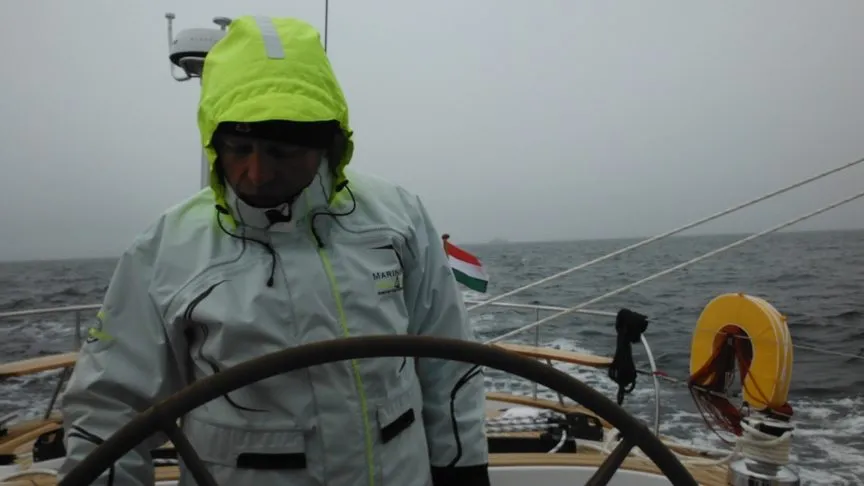
From 12 to 13 I was on duty at the helm, but I pretty much only had to keep an eye on the minimal shipping around us and on the debaters.
Under way on the North Sea
Lunch was instant onion and mushroom soup, followed by székelykáposzta (Székely goulash – pork stewed with sauerkraut).
In the afternoon, after a good sleep (in cowboy pyjamas, i.e. fully dressed), I had a shower. After the hot water I felt fresh, dewy and desirable again :)). And the hairdryer really does work, though admittedly I’m done drying my mane in 45 seconds.
No need to worry about dropping the soap, because the shower cubicle is such a snug fit that there’s no chance of bending down for anything in it… The joys of showering were somewhat reduced by the fact that every 2 seconds you staggered back-first into the cold wall of the cubicle, because that’s how often we nodded over the oncoming mini-waves (which is also why it feels a bit like Balaton).
In the afternoon I dipped into the e-mails from my old secondary-school classmates. I was 24 e-mails behind; music festivals and 50th-birthday greetings were the topics of the day.
In the evening, from 22:00 to midnight, I was on watch with Sanyi, my cabin mate. When I went aft to the stern, the cloudy dark night, the rain drizzling in the boat’s white stern light and the swishing foam involuntarily brought the Titanic’s last night to mind. Even the month and the cold matched. You couldn’t help imagining an iceberg looming out of the darkness…
Machine translation (AI, Claude) of Balázs’s Hungarian original. Read the original →
· North Sea, off the Netherlands
Under way on the North Sea
Sunday, 2 April 2017,
Day 2, 194 nm (Log 392 nm)
At dawn, between 4 and 6, Sanyi and I were out again. The temperature had improved to 10 degrees, but we still weren’t warm. When you think that 2–300 years ago merchant sailing ships and warships sailed the seas all year round, and the sailors didn’t have waterproof, warm clothing like this, no wonder their daily ration was half a litre of rum…
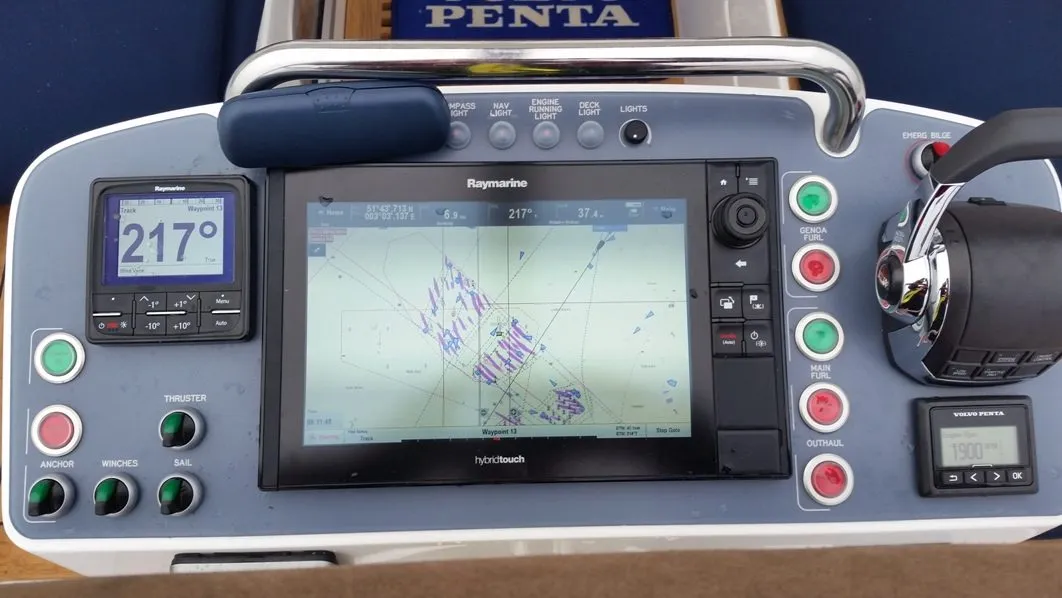
We passed an offshore wind farm where at least 200 turbines were turning in rows of four. That’s roughly equivalent to one unit of the Paks nuclear power plant (Hungary’s only one), and there are quite a few more like it nearby.
Wind farms on the radar at sunrise
In the morning, while I was asleep, a decision was made that since the weather is so friendly and the going is bearable, we’d rather carry on to Dunkirk and save the day gained this way for waiting out any worse weather in port.
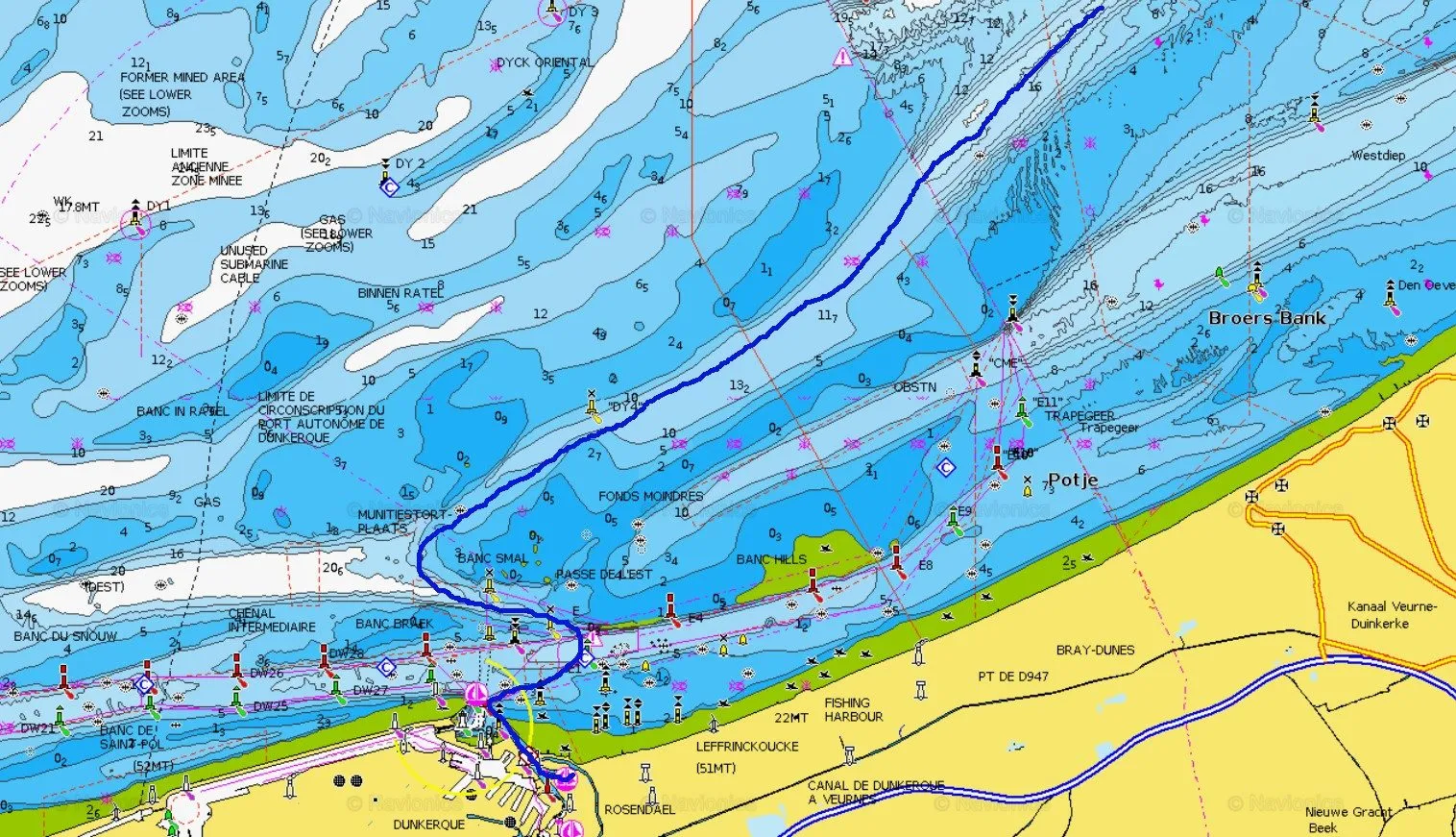
Our route from Thyborøn to Dunkirk
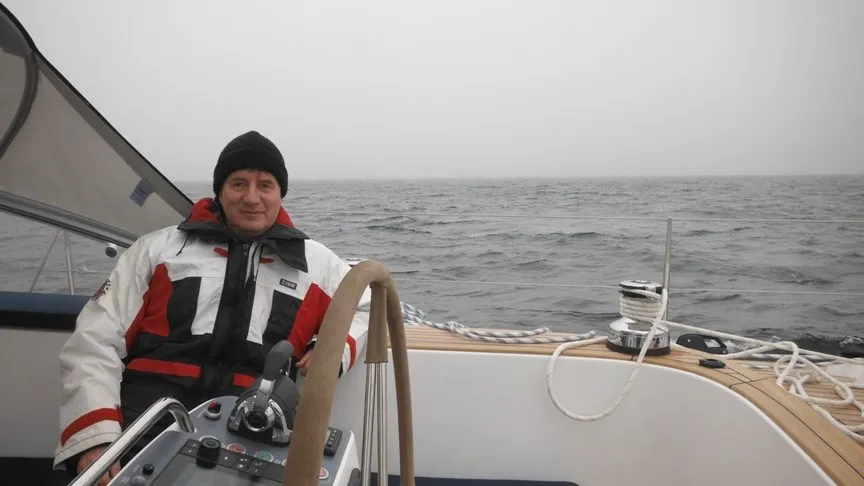
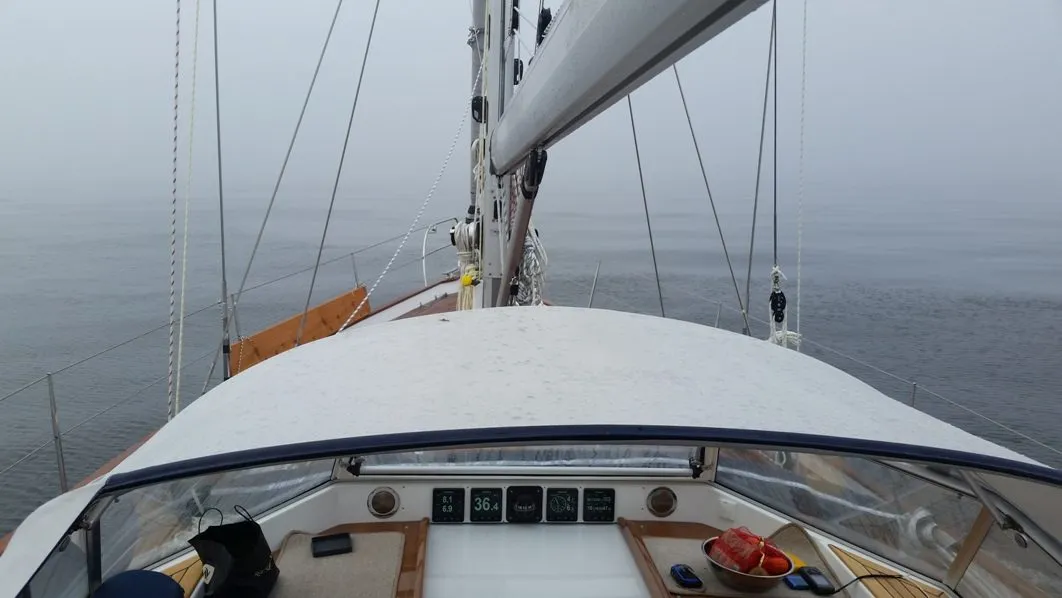
In the morning, in a brief 20 minutes, the fog came down. The wind stayed around 10 knots, so we can keep sailing. Somehow in my mind fog on the Great Hungarian Plain always went together with silence and no wind, but however flat this country may be, between the ground and our soles there are still 20–30 metres of seawater after all (plus a good boat).
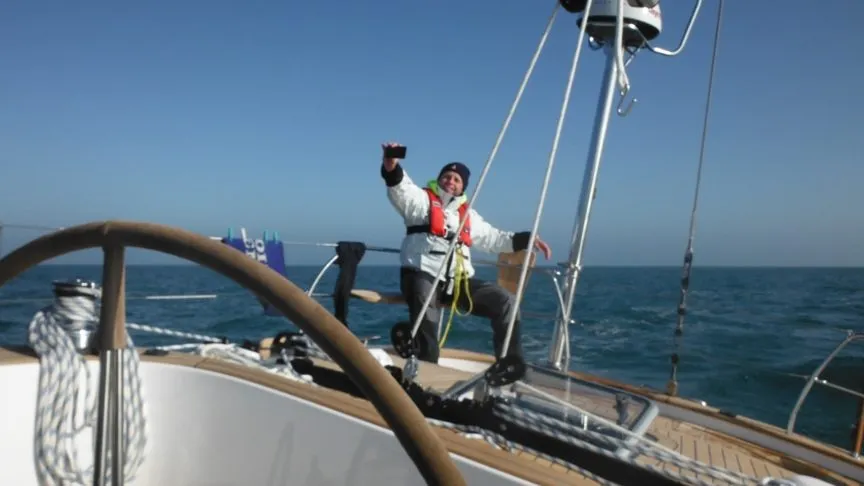
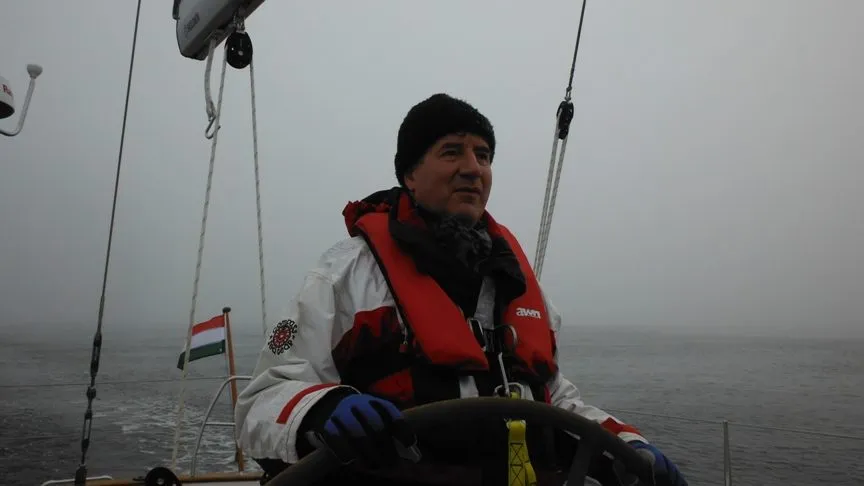
One more selfie before the fog
Zoli and I perpetrated today’s lunch together: we cooked chilli beans with rice. It can’t have turned out badly, because somebody asked whether we wouldn’t like to do all the cooking from now on…
During the after-lunch test (engine ahead-astern-ahead again, combined with noise-level measurement) the Gori propeller overdrive question was reassuringly settled, the loser sportingly congratulated the winner, and we all drank the peace pálinka.
A gas platform in the background. Can’t see it any more? Then the fog’s coming down again
In the afternoon we passed oil rigs and a gas platform, then crossed a two-lane shipping lane. The cargo traffic has 2 x 3-nautical-mile-wide lanes assigned, one for northbound and one for southbound, with a separation zone a mile and a half wide between them.
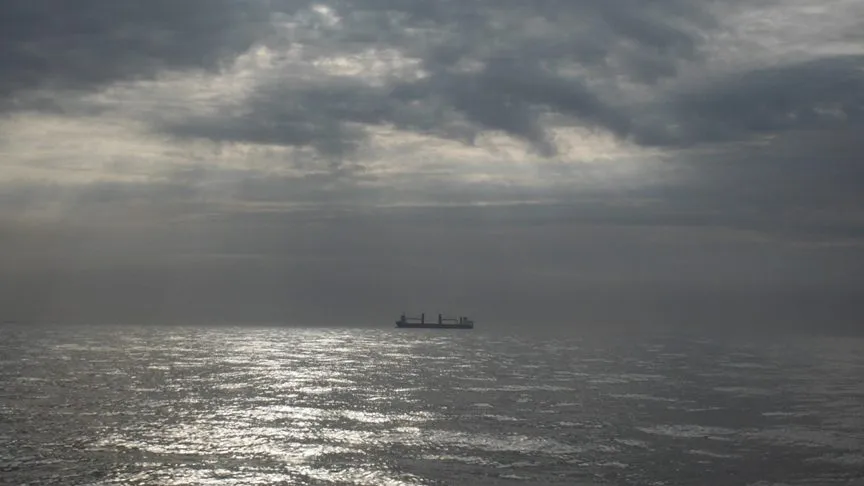
As we approached, however hard we strained our eyes, we couldn’t see a thing in the haze, but on the radar and the AIS signals we could see two freighters approaching from port somewhere in the fog, and if the wind eased and we didn’t do something, in half an hour we’d run them over. Watching the monitor, we felt exactly like a snail at the edge of a forest path, feverishly swivelling its head left and right, then taking off at a ground-squirrel gallop to get across before the tortoises come thundering down the trail…
We’d have to get across ahead of them
Speed up, start the engine? Bear away or head up? If we carry on like this we’ll collide with this one in 20 minutes, and if like that, the other one will run us down in half an hour. Slowing down or stopping was out of the question. In the end what we’d calculated worked out: we started the engine alongside the sails and sped up a bit, then bore away, finally headed up, and got across ahead of them safely, if a bit out of breath…
but we made it!
Yesterday, since I was asleep, the 17:00 Gin-Tonic-Time didn’t happen. Today I didn’t make this fatal mistake, and served everyone a glass. Nobody missed the ice cubes this time, but in the absence of enthusiastic pats on the back I had to admit to myself that a cocktail has quite a different effect at -30 degrees on the North Sea than at +30 degrees on the Adriatic… Well, we’ll get further south yet, I’m not giving up!
Machine translation (AI, Claude) of Balázs’s Hungarian original. Read the original →
· Dunkirk, France
Fog ahead of me, fog behind me, to the right and to the left as well…
Monday, 3 April 2017
Day 3, 184 nm (Log 576 nm)
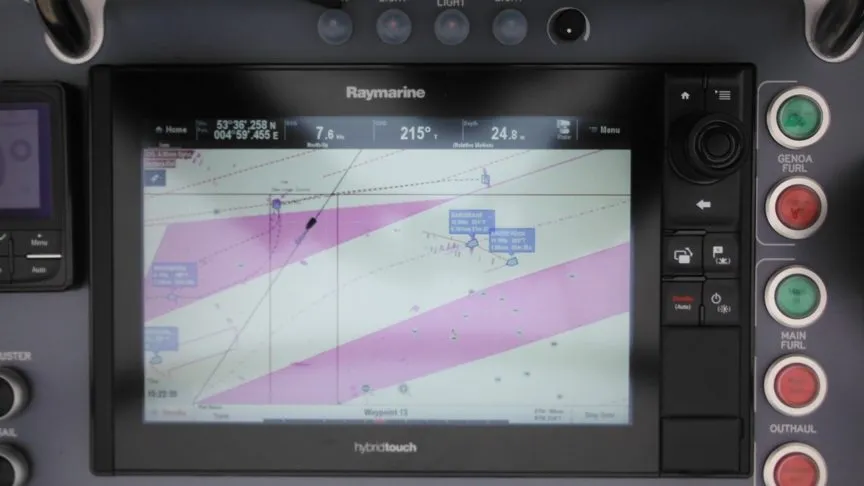
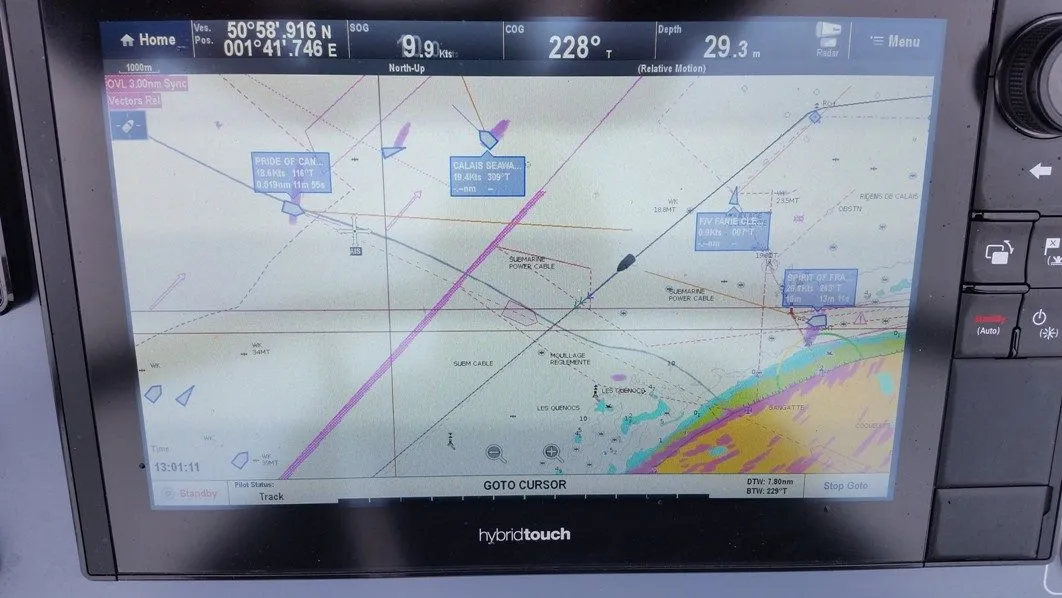
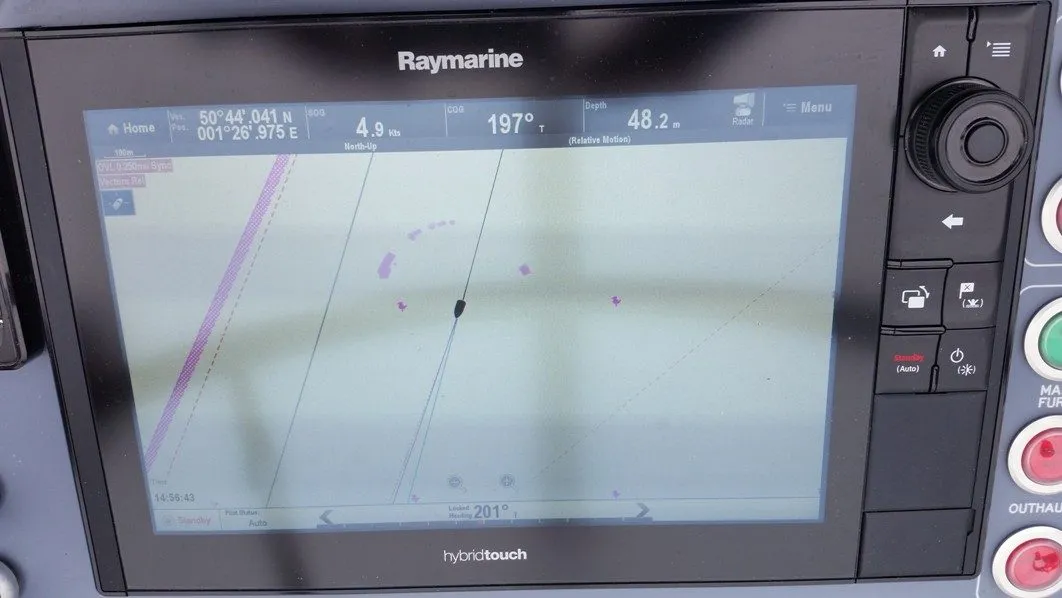
For the two of us, today starts with the dog watch at two in the morning. It wasn’t so damn cold, but that notorious, real Channel milk-black fog had blanketed everything. Visibility ahead was literally 0 metres, because the red and green navigation lights at the bow instantly, right there on the spot, project a greenish blackout curtain onto the fog in front of us. To the side and astern you can see about 10 metres of sea. That’s only good for seeing how fast we’d hit something if things went wrong. We’re motoring because there’s hardly any wind; our 8 knots are cut by a knot and a half of foul current, leaving us closing in on our destination at 6.5 miles an hour. We might as well be navigating in 3D glasses, because you can’t see a thing ahead. The only reason we dare to charge along “blindfolded” like this is that on the plotter we can see exactly the AIS and/or radar signals of the surrounding ships, objects, buoys and rigs, the depth beneath us, the navigational marks and our exact position on the chart.
I can’t really compare the feeling to anything, the way we navigate 99% by the monitor alone in the fog. Let’s say it might be something like sitting out after midnight, on a totally foggy autumn night, on a little stool with a laptop in the middle of one lane of secondary road 435. You could only follow the GPS signals of any approaching lorries on the monitor. If you’re sitting in the right lane, they rumble nicely past you; if you got it wrong, or misread something: Game over, there are no extra lives in this game.
Strange feeling aside, our progress didn’t seem like Russian roulette at all, although maybe we too trusted our instruments’ data a bit more than we should have, just like the other 8–10 faster cargo ships in our area.
Off Amsterdam we had to steer round 20 ships waiting at anchor, and later an oil rig hooting every 20 seconds. We passed 300 metres from it, but even so all you could see of it was a slightly brighter patch of light. We could still hear it 4 miles away – I wouldn’t have liked to sleep there.
In the end we handed over the watch at two in the morning in front of a wind farm; the next lot had the job of getting round it and manoeuvring between the ships anchored off Rotterdam and those hurrying in and out. They managed the task too.
After some sleep, from 10 in the morning I was at the helm on my own in the daytime fog. The only difference here was that you could already see 20–30 metres, and AHEAD too !!! Which is no disadvantage.
Fog ahead of meFog behind me
If the weather is like this at Dover tomorrow too, I’ll probably only be able to tell the grandkids about the choking fog, not about cliffs.
By the afternoon it had got up to 22 degrees, the fog had lifted almost completely, and in lovely sunshine we wove our way round the shoals and sandbanks off Dunkirk (which were only visible on the chart).
I drew our route in by hand – well, with a mouse – that’s why it’s so shaky…
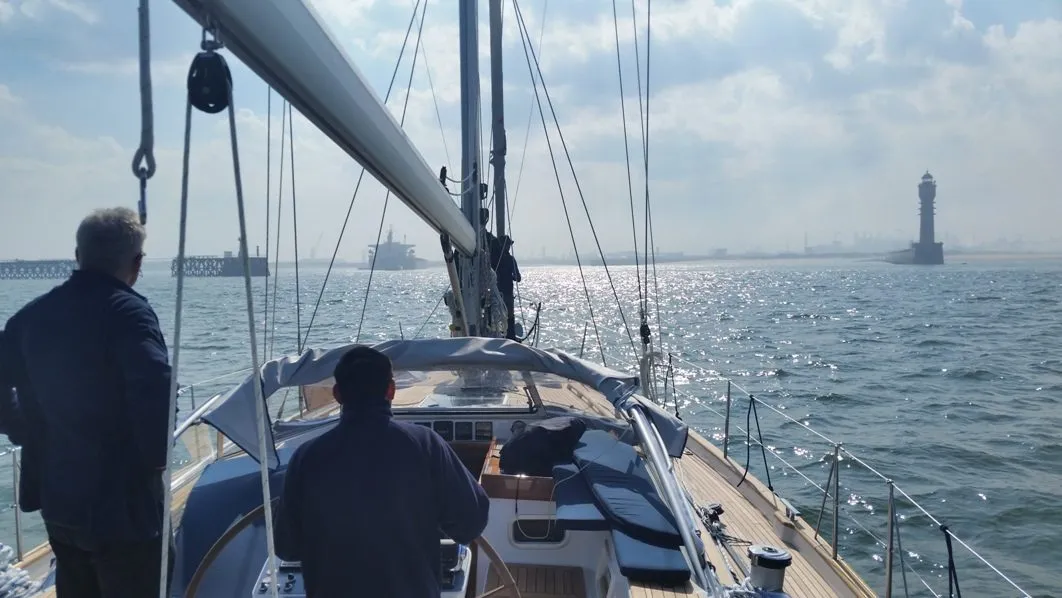
Around 16:00, following a giant being nudged along by two tugs, we sailed into the harbour. After a lap of honour we found the fuel dock and moored up. We’ve arrived in Dunkirk.
Sailing into Dunkirk harbourThis is the mole the British were rescued from. Either the Germans bombed it to bits, or the sea did…
We filled up, then checked in at the Grand Large Marina. It was €29 a night, the showers were perfectly civilised, but the surroundings are nothing like the atmosphere of a small Adriatic town.
Filling up the boatFoggy sunshine – they have that here too…
Oh yes, the showers.
In the men’s showers I went straight into the biggest one. I suppose subconsciously I didn’t want to lean against a cold partition wall again… To my surprise I noticed that the double-sized cubicle had two taps and two shower heads. How does this work with the French? Can a female partner come in here to the men’s showers too? Or have they thought of gay couples as well? I couldn’t decide, so I settled with myself that they’d thought of couples, full stop. Nothing to see here.
The unexpected solution came when I’d finished and opened the door. On the outside of the door there was a pictogram of a unisex mummy-daddy changing a nappy. Indeed, that table that was so handy for my wash bag was just about baby-changing height…
So what do you reckon: is anyone who thought of something else bad or good?
Looking for a restaurant on the Dunkirk plage – the fog has come down againI don’t think any of us would have been surprised to suddenly see British soldiers running towards the ships looming out of the fog…
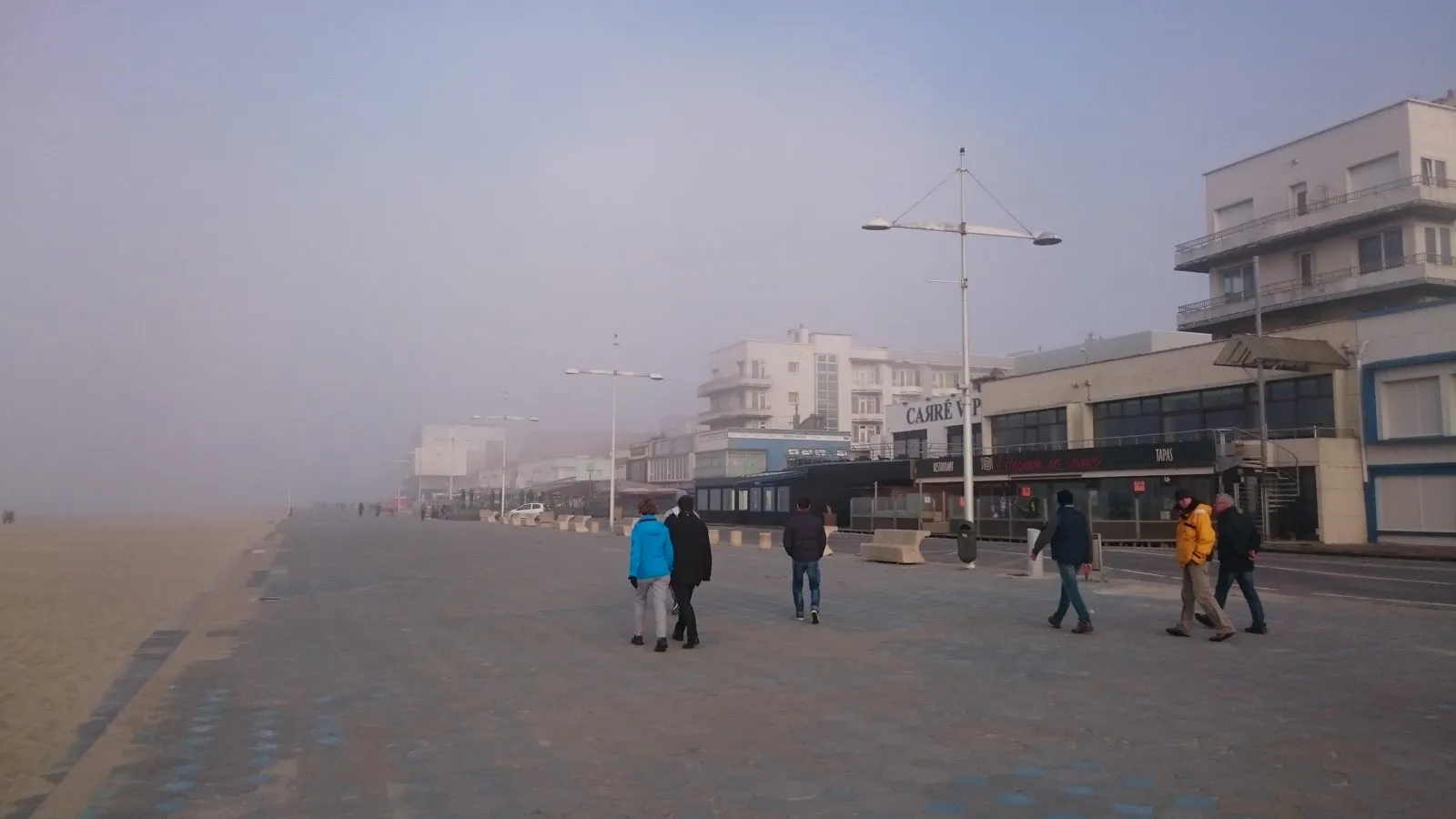
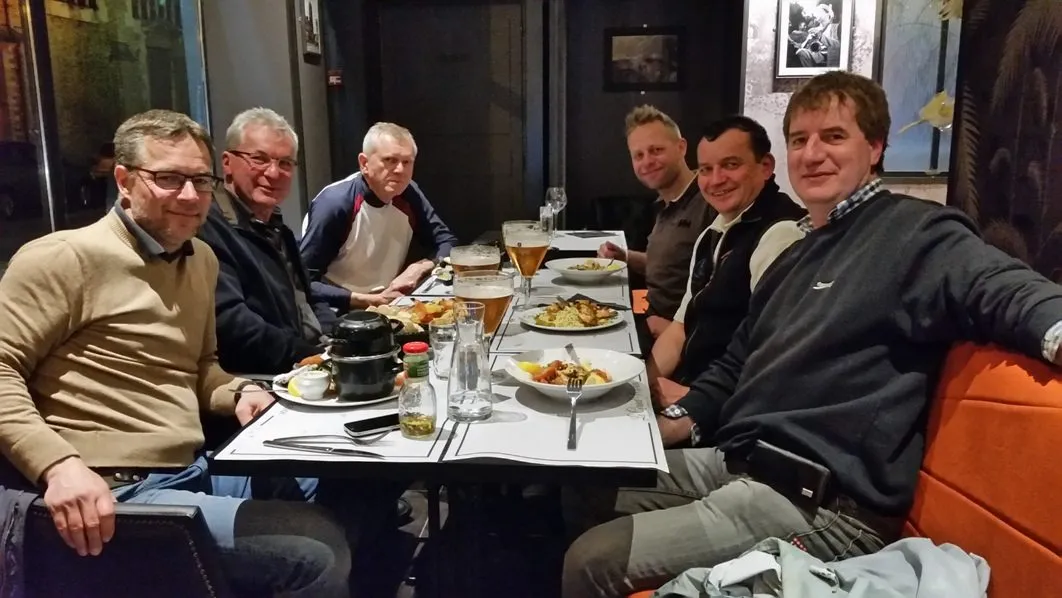
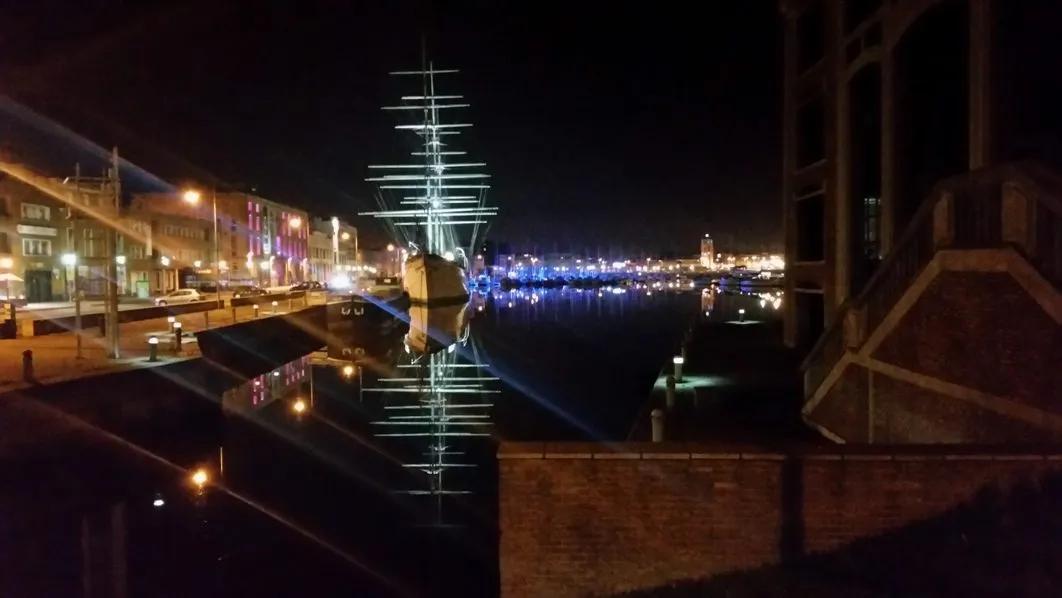
By evening we were really longing for a nice little dinner of assorted sea critters. The restaurant suggested by the marina receptionist – on the plage, wrapped in fog once again – was, naturally, still in its pre-season closure, and the internet favourite nearby that Google showed us wasn’t where it was supposed to be. So we headed for the town centre, and after a good hour and 9327 steps we found our spot. My companions didn’t come off badly with the mussel starter we ordered to share: I held back from my traditional pace. After the delicious fish dishes we headed home in the evening past the three-masted museum ship on the quay, and got back aboard our boat down a ramp sloping steeply at low tide. Nobody needed a sleeping pill.
And he got fed too, mind you…Dunkerque by NightA green buoy cast up high and dry
Machine translation (AI, Claude) of Balázs’s Hungarian original. Read the original →
We left Dunkirk just after 9 in the morning, in cloudy weather and drizzle.
Next came the narrowest stretch between Calais and Dover, with snow-white cliffs and heavy traffic. Or so we thought.
The reality: like Lake Balaton on a foggy autumn day – only the flat southern shore can be made out, because we’re closer to it.
True, the ferries are a little bit a lot bigger and two or three times as fast, but they steer round you. If you don’t get in their way. We didn’t.
The northern shore is wrapped in haze, the cliffs of Dover stay vanished, like a white donkey in the fog (Hungarians say things disappear “like a grey donkey in the fog”). I’d suspected as much yesterday – that I might well get to see them on the internet first…
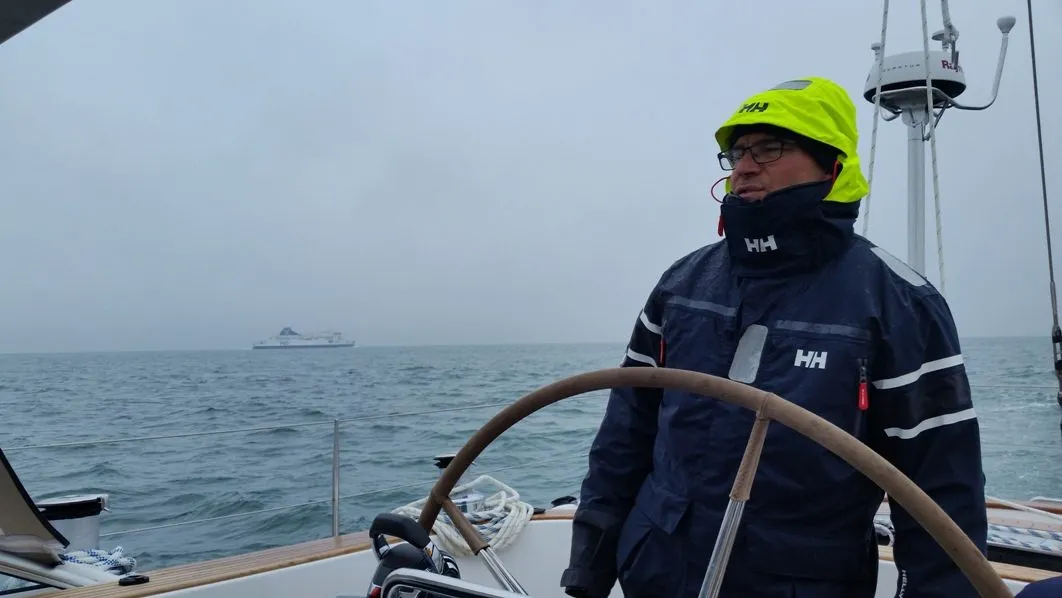
The ferry passing astern of usWe’re heading the same way down the Channel. It’s just that she’s 399 m long, 48 m wide, with a 10 m draught
The shipping traffic wasn’t too bad, although admittedly we were looking at the shipping lanes from a distance, which isn’t quite the same as crossing them…
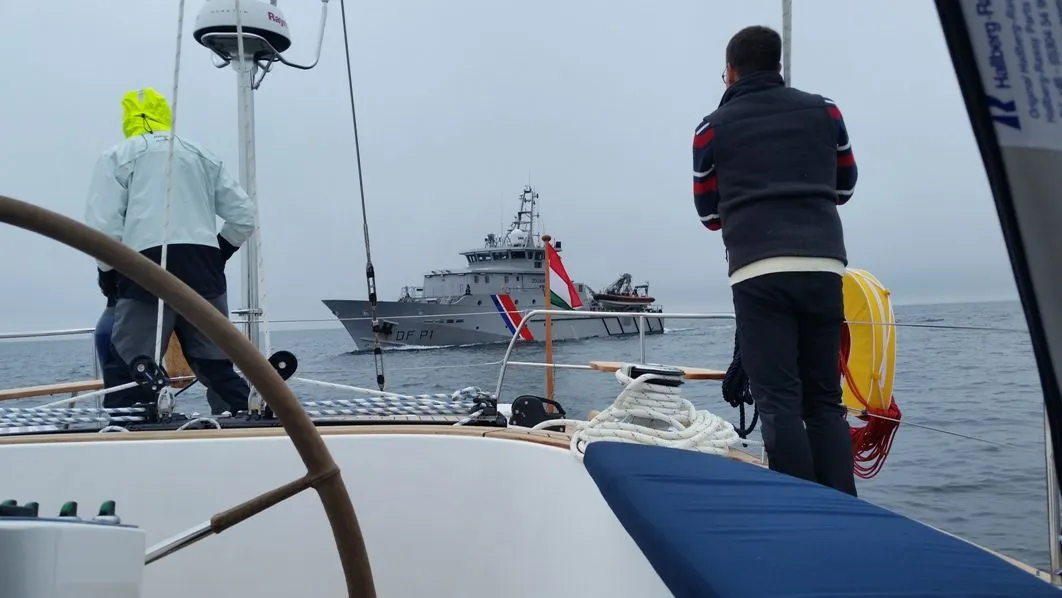
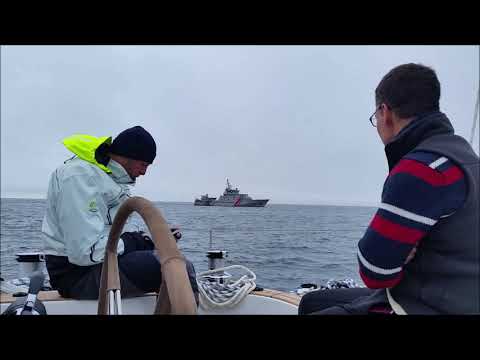
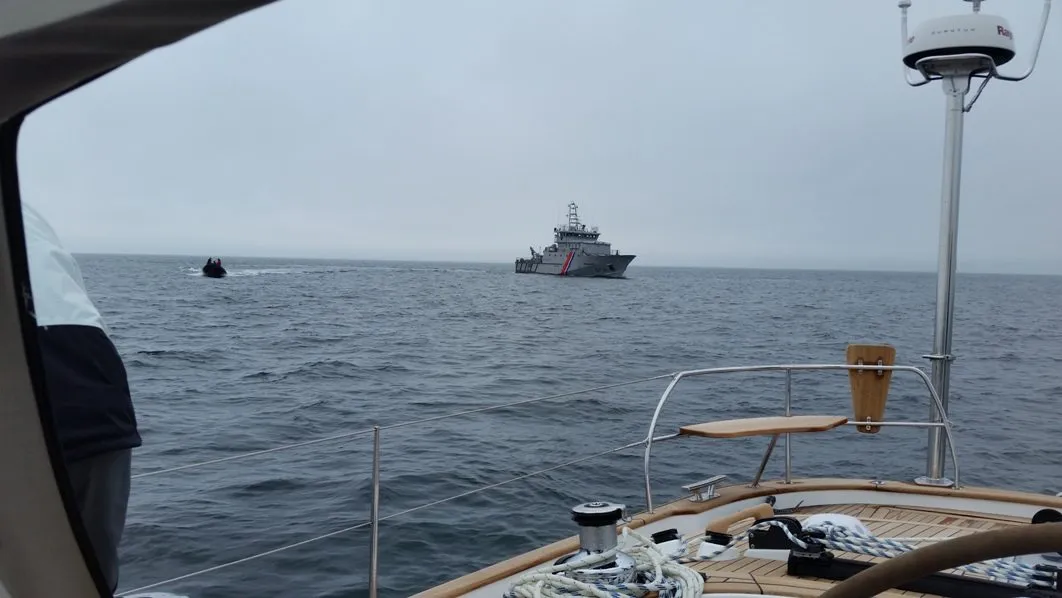
At 15:30 the French coast guard called us on the radio. They politely asked whether we’d allow them to carry out a little local inspection on board. The idea of saying “sorry, we’d rather keep going, we’ve got a long way to go” was tempting, but seeing that they kept on coming towards us persistently, in the end we didn’t have the heart to say no.
Here comes the French coast guardThey don’t have an AIS signal either – only the purple blob shows them on the radar
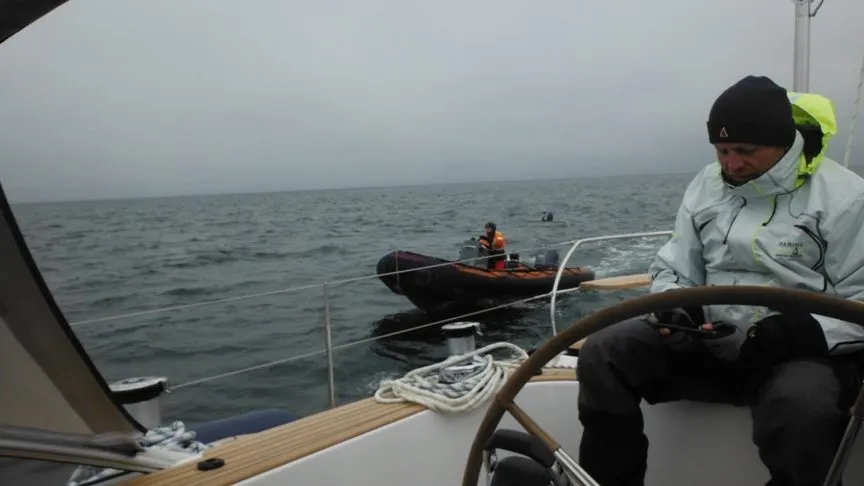
5 of them RIB-ed over to us from the warship, four came up on deck, and the helmsman stubbornly did rodeo laps around us.
Right at the start we cleared up the most important things: without them there are six of us on board, and none of us is in possession of drugs, weapons, any French, or more than 10,000 euros in cash.
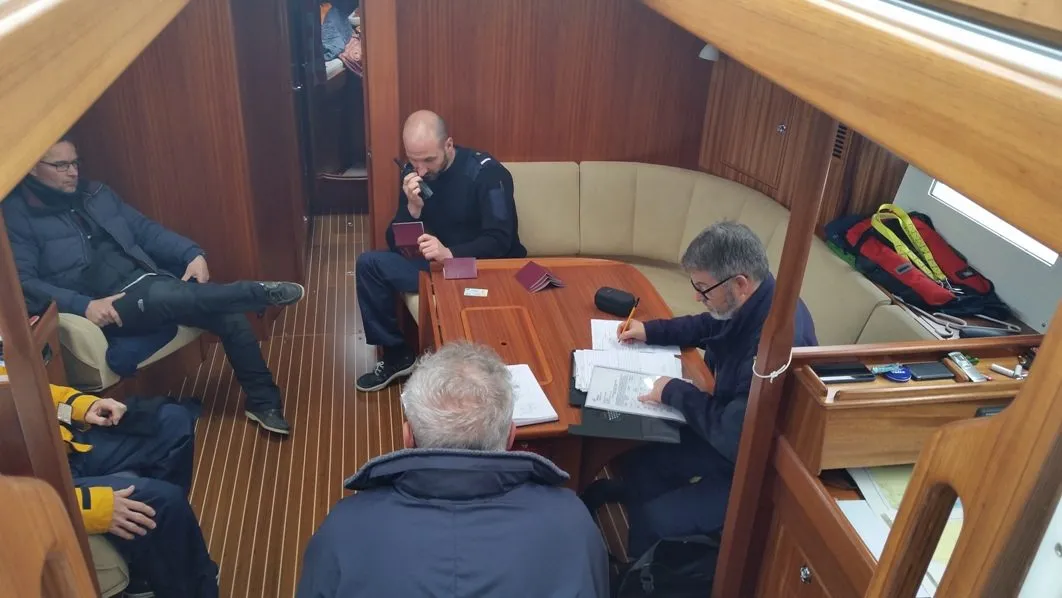
The leader of the detachment respectfully asked to come into the saloon with a colleague and checked our passports over the radio. Meanwhile the other two – at least one of them a lady – kept us in check on deck, as if they were watching whether we’d throw something into the water. They must have been environmentalists on the side.
Sierra, Zulu, Alfa, Bravo, Oscar – That’s me
Inside, they asked about our itinerary, where we’d been, where we were heading, then two of them pulled on rubber gloves. I thought I’d show them the heads and the toilet brush, but they preferred to check the tidiness of the galley cupboards, whether everything was in its place. They must have been satisfied, because they complimented us on how beautiful the boat is.
With gloved hands – hidden-camera footage
Meanwhile, outside, I asked the customs lady whether the cliffs of Dover can be seen from here in good weather, because they were our Rome – we’d so wanted to see them. She said of course they can, but there’s nothing special about them, they’re actually just the same as the French cliffs – if we’re curious, we should just look over there, she pointed, at least those are visible. I’m not joking, that’s really what she said.
When I asked, she told me that the migrants at Calais are no longer only trying their luck on lorries and trains, but by sea too. Last night they rescued three people from a sinking boat. What kind of boat was it? I asked. At which she contritely confessed that the dinghy had in fact been borrowed from the coast guard’s own rescue unit…
I saw straight away that they’re starting to test the Libyan trick here too:
Take a boat (preferably not from the French coast guard, of course)
Go out to sea
Sink within a set deadline
The British will rescue you and take you across
The pioneers made several serious mistakes: they didn’t notify the completely independent international rescue organisations in advance of where they were going to sink, and the boat they picked was an inventory item the French weren’t yet planning to scrap. And it nearly sank, too.
If I were the human-rights lawyers I’d sue the French coast guard for negligently endangering life. And the British too, for not getting there sooner, like their Italian colleagues….
Unfortunately solving the problem isn’t up to me, even though I’d have a few ideas…
Meanwhile, inside, the unit commander finally blurted out the real purpose of their visit: what do you have to do for a living to be able to buy a new boat like THIS? Gyuri revealed everything in detail. I tried to eavesdrop, but since I had to keep the customs lady’s attention diverted outside, I missed it all. Nothing has come out since, the others are all as silent as the grave.
Since we declared as one man that we hadn’t come from Venezuela, and the mobile stomach scan didn’t show anything either (we hadn’t had lunch yet), they started to fidget. In the end they couldn’t drag it out any longer – although I could see they were angling for my 17:00 gin and tonic – so they said goodbye. From the motorboat they waved back enthusiastically, but it may also be that they were just gesturing for me to stop filming and taking photos.
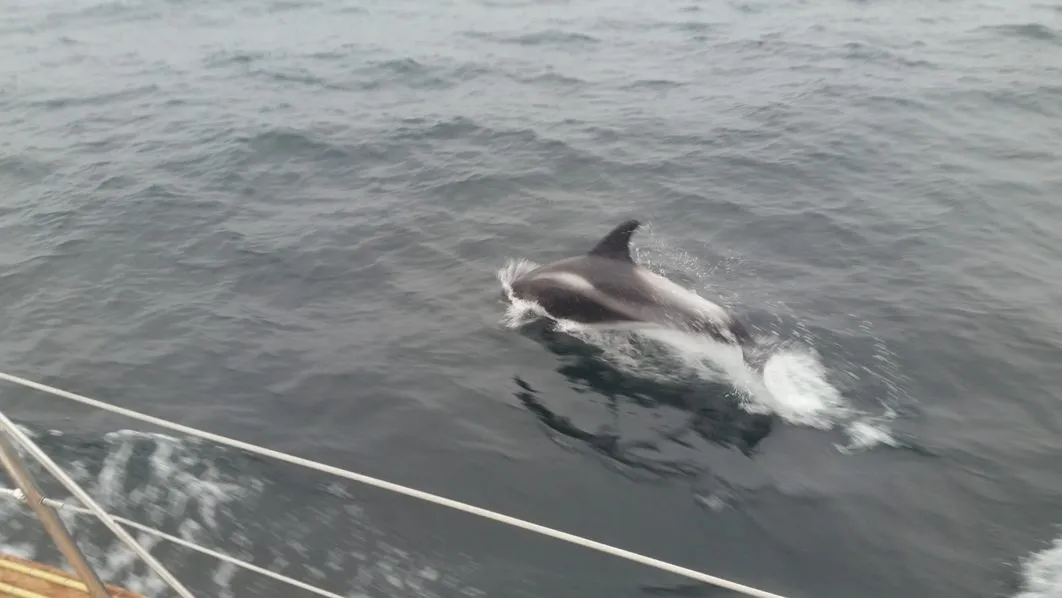
Between five and six I stood outside alone in the drizzling fog. The boat sailed itself, no need to change the sail trim. The long, flat Atlantic swells had arrived, my relief watch hadn’t yet. Dolphins did come, though, for the first time on this voyage. They escorted the boat for a good 10 minutes, checked it out from port, from starboard, from ahead and from below. I reckon they couldn’t decide either whether our propeller was in overdrive mode or not.
From this evening we’re increasing the watch from 2 hours to 3, so afterwards you can rest for 6 hours instead of 4 as before, and we’re also swapping round the pairs that have formed so far. In the watches, I mean. Variety is the spice of life, as they say.
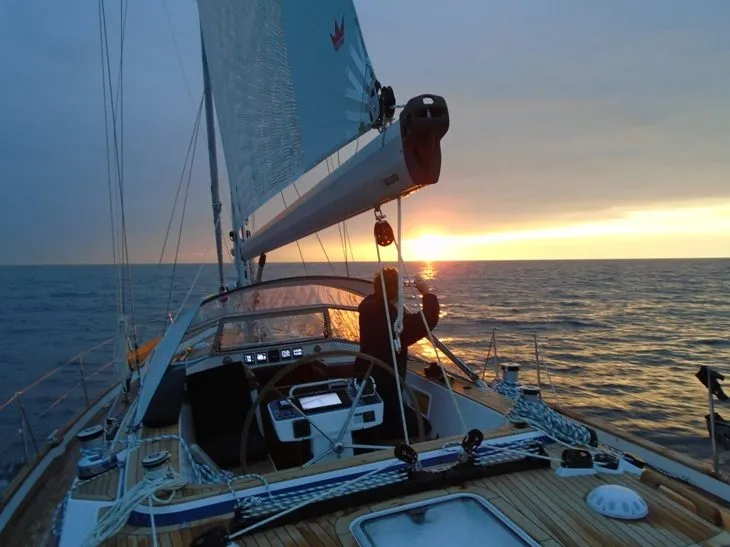
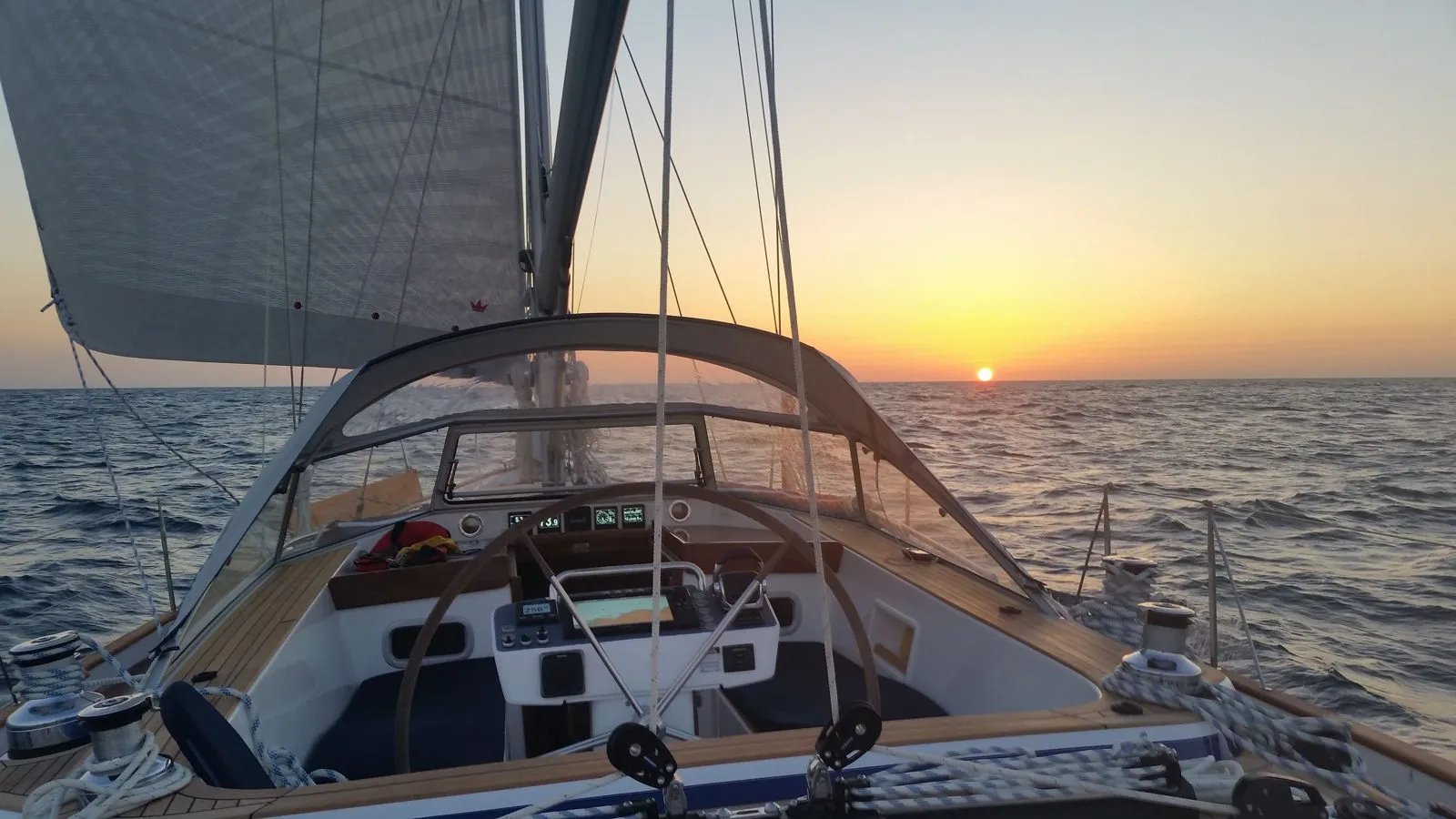
Me photographing the sunset
Machine translation (AI, Claude) of Balázs’s Hungarian original. Read the original →
· English Channel, by the Channel Islands
Past the Channel Islands in the sunshine
Wednesday, 5 April 2017
Day 5, 174 nm to noon (Log 793 nm)
Between midnight and 3 Gyuri and I were on watch. Since the sails were well trimmed, we only had to look around in the night now and then and check the instruments and the heading.
At 00:15 we crossed into the western hemisphere. This was the first time in the Pinta’s life, but certainly not the last. We acknowledged the event with a high five and carried on.
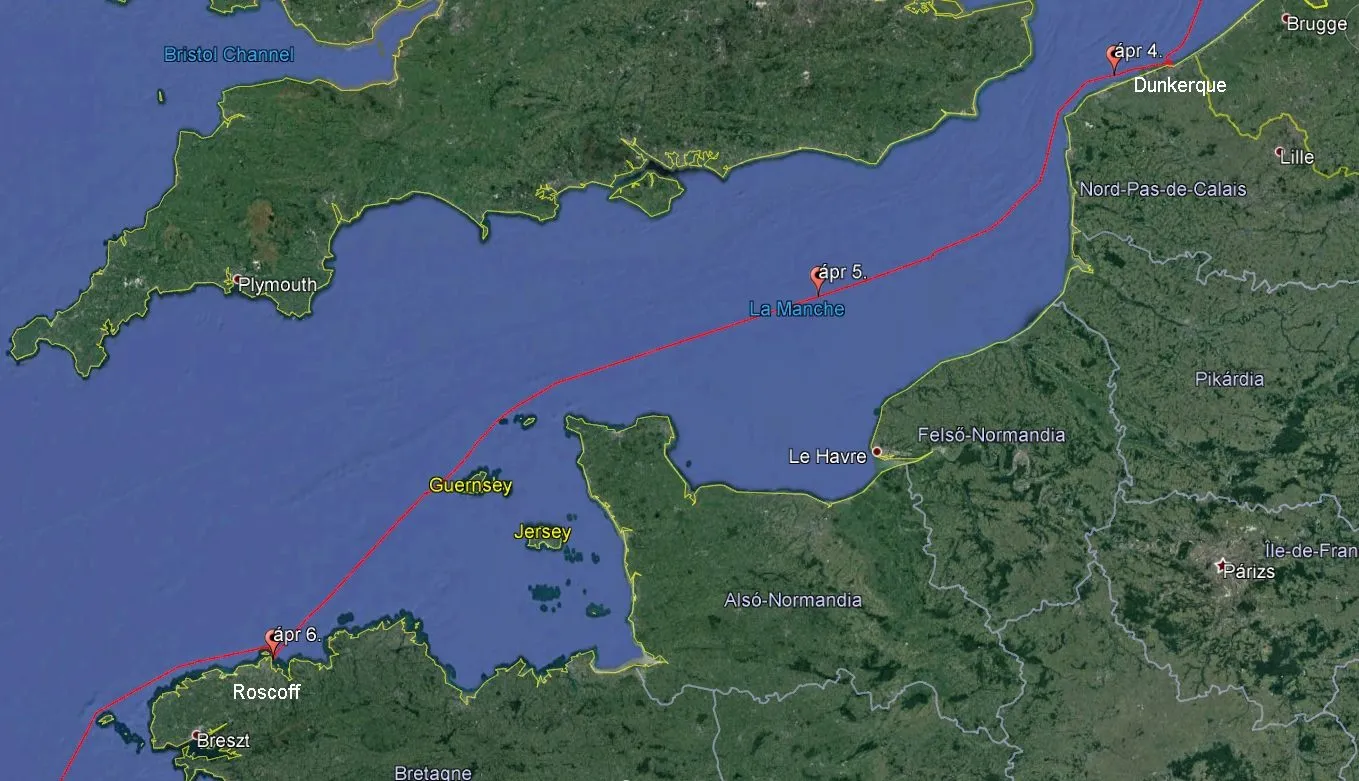
Our route through the English Channel, from Dunkirk to Roscoff on the Brittany peninsula
In the night – after I’d gone to bed – the wind picked up a bit and the boat heeled over. I dreamt there was an earthquake, we wanted to run out of the house, but I could barely stay on my feet, and everything around me just kept shaking and rumbling endlessly. In the end, with great difficulty, I realised it was only a dream, and that the bow of the boat, where we sleep, was shaking and slamming into the waves continuously…
The immediate mortal danger of an earthquake was over, the noise, shaking and rumbling remained, and now I had to hold on too, so as not to roll this way and that.
In the morning the sun rose, and the wind veered north, onto a broad reach.
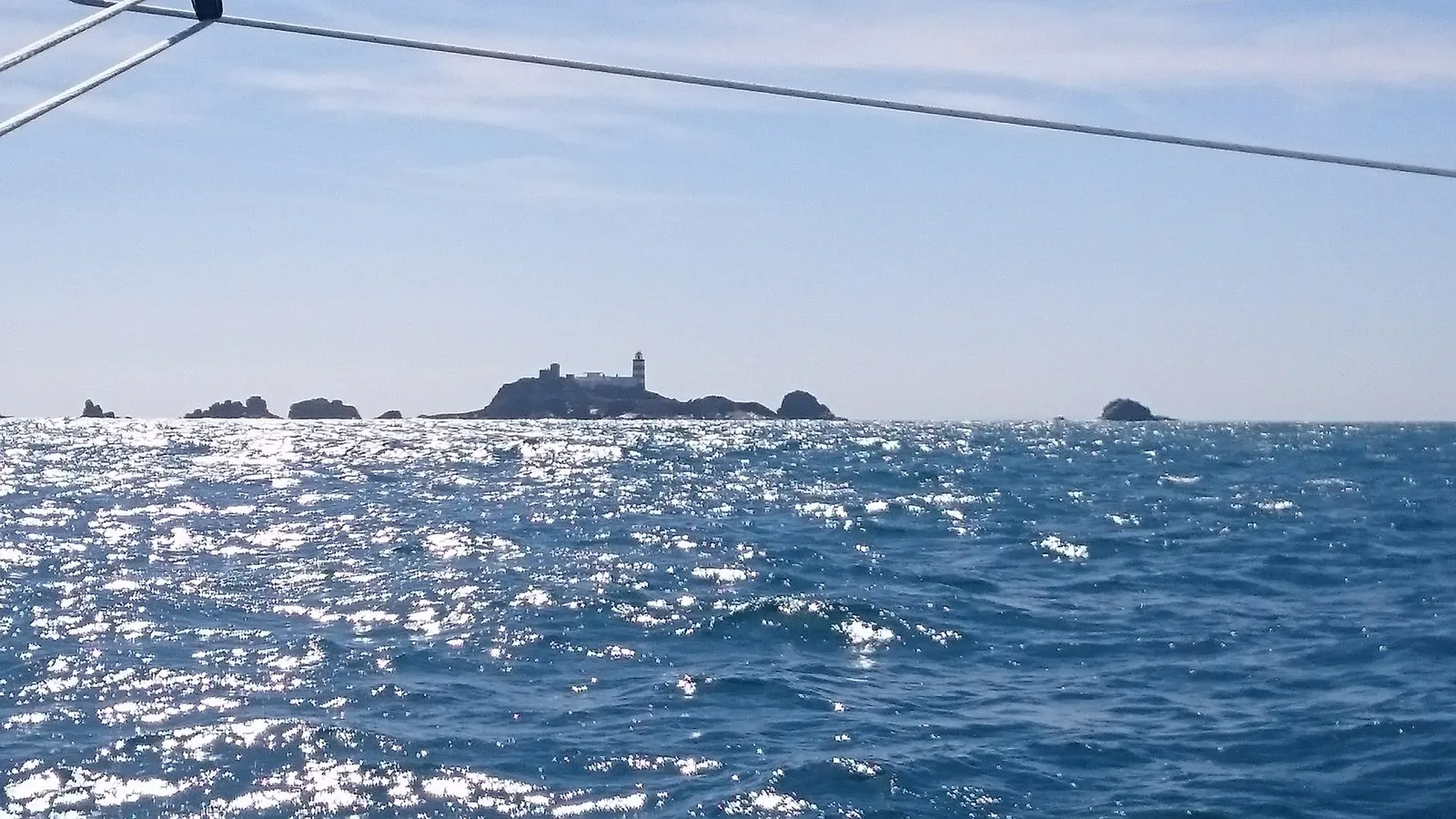
First we passed Jersey and then Guernsey, not too close. They didn’t even look that unfriendly in the sparkling sunshine. They’re under English-type rule, in the close embrace of the French coast. I wouldn’t be surprised if it turned out they’d changed hands quite a few times over the course of history. Look it up.
The Channel Islands
At some point the clock on my smartphone switched itself to London time. Either it sensed western-hemisphere GPS coordinates or a Channel Islands English mobile operator – the point is, it reset itself, and by the time I noticed, I was a good three-quarters of an hour late sending the midday “all OK” satellite message home.
Around half past one I set about cooking pörkölt (Hungarian stew) with the effective help of Tibi and Zoli.
Meanwhile Gyuri enquired whether there was any chance of bringing the 17:00 gin and tonic forward?
Whoa! See, it wasn’t so bad after all!
Of course there is. Setting ship’s time is the captain’s exclusive prerogative.
Gyuri exercised his power, and 10 minutes later we were all sipping together in the sunshine. The ice cubes still weren’t missed, though…
The pörkölt was ready – they said it turned out very good.
They asked what they’d be eating in the second half of the voyage?
If it’s up to me, nothing, because unfortunately I’ve only got a ticket as far as Lisbon…
All day we sailed in glorious sunshine on the long, leisurely Atlantic swells. The air is so clear you could perhaps see to the end of the world, if the Earth weren’t round.
Damn, if we’d stopped in the Netherlands we’d be reaching the Channel today and could see everything…
Although it may also be that the young French customs lady is right, and the other side is just like the French one, and that we’ve seen.
Somehow that argument isn’t all that comforting…
Then again, when I think about it, anyone can see the cliffs of Dover, but not many Hungarians can have sailed the Channel in FOG like that…
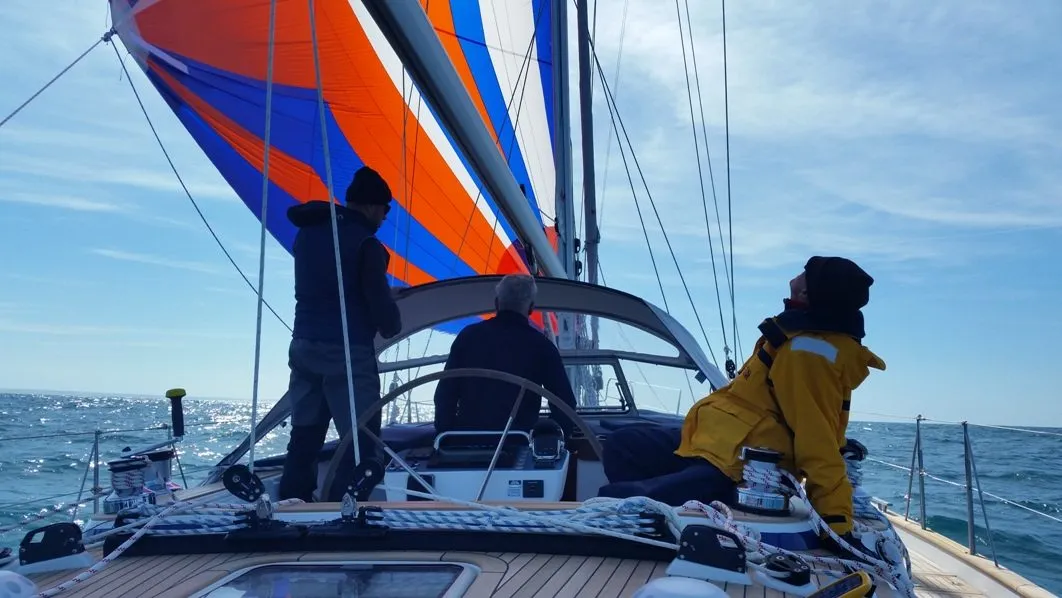
At 15:30 we hoisted the gennaker. Another first on the Pinta. The boat went nicely with it.
We expect to reach Roscoff in Brittany at two in the morning. Gyuri’s and my watch ends at midnight, but we’ll stay up for the pilotage in and the mooring in the marina, so we can help.
Machine translation (AI, Claude) of Balázs’s Hungarian original. Read the original →
· After Roscoff, off the coast of Brittany
Brittany, land of palm trees
Thursday, 6 April 2017
Day 6, 98 nm to Roscoff (Log 891 nm)
Gyuri skilfully brought the boat in through the dark, and at 2:20 a.m. we moored in Roscoff. We were just about to start spinning the spider’s web and securing the boat with more lines when one of us noticed that we’d managed to moor at the fuel dock. This won’t really do – we thought – so we moved across to a free berth on the opposite side.
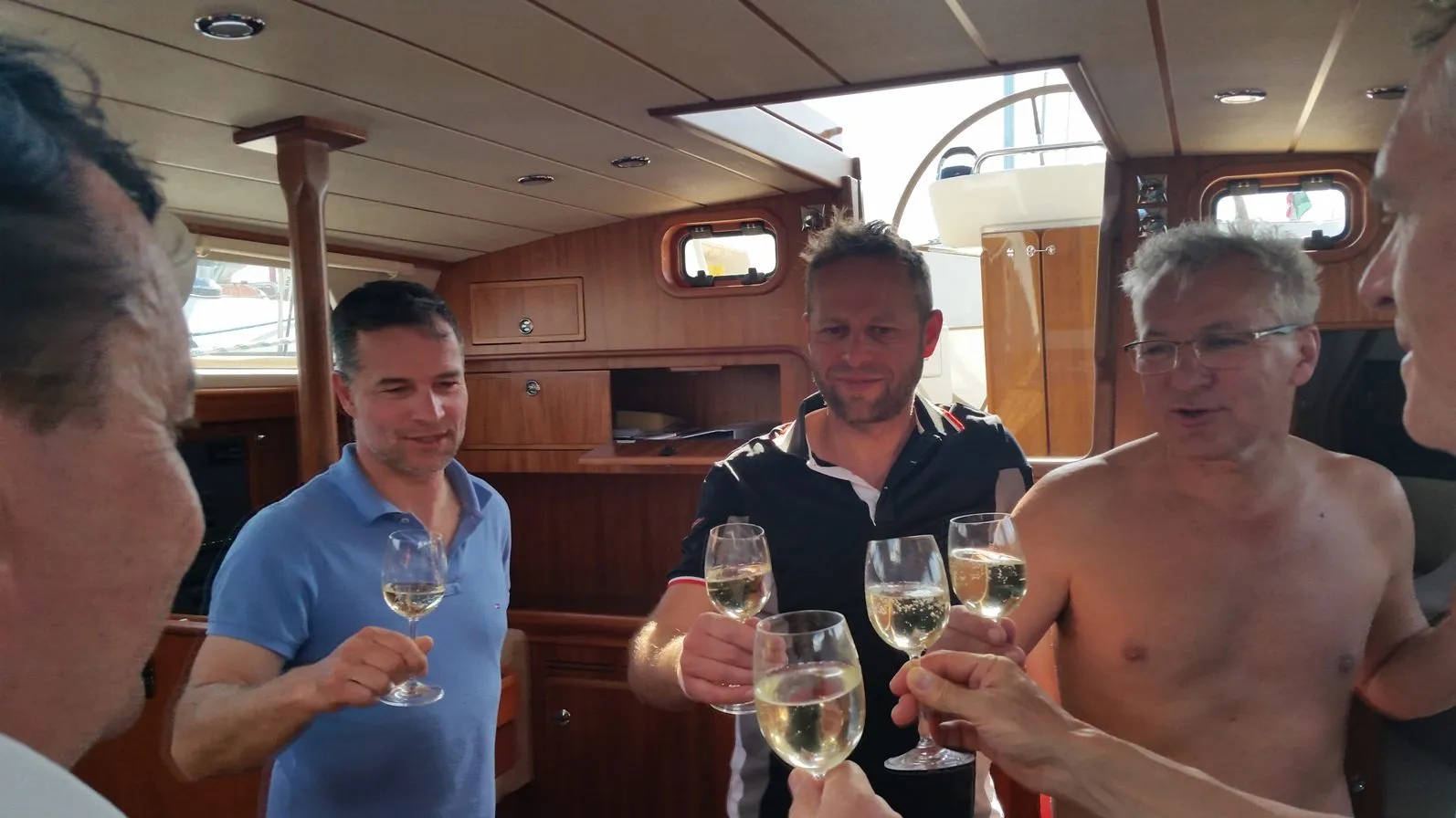
In honour of having completed the English Channel we opened a bottle of champagne, then another. And of course we drank them too. Then a bit of pálinka – you know how it is – when you’re chatting, time flies… At 4:15 the saloon finally went quiet and everyone turned in.
I slept till noon like a good sailor, then tested the local marina showers again. Here they hadn’t thought of nappy-changing dads, but there was a hairdryer, so you don’t have to kneel under the hand dryer – which, let’s face it, could give rise to misunderstandings.
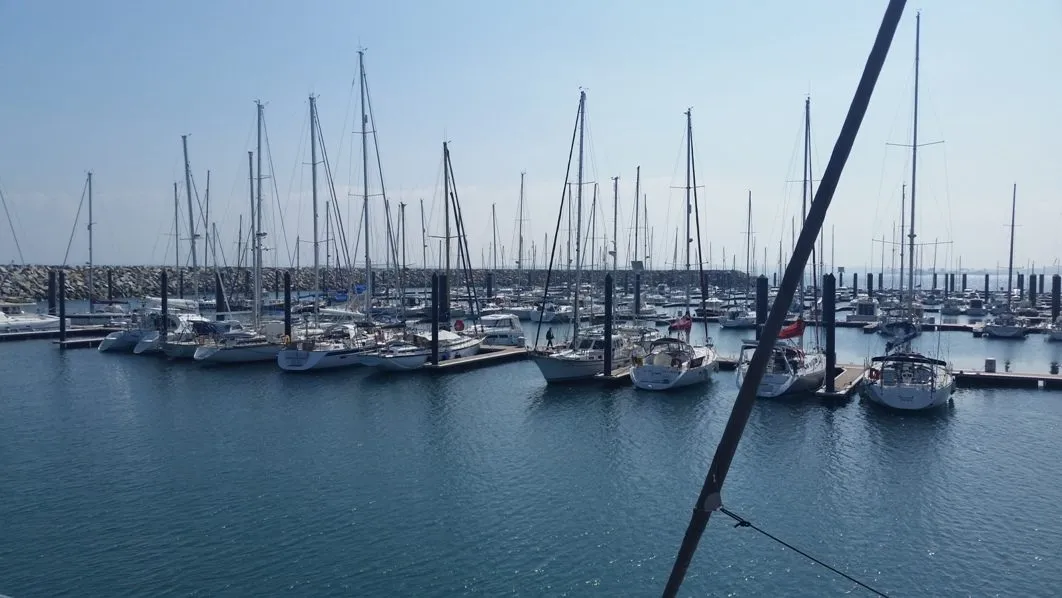
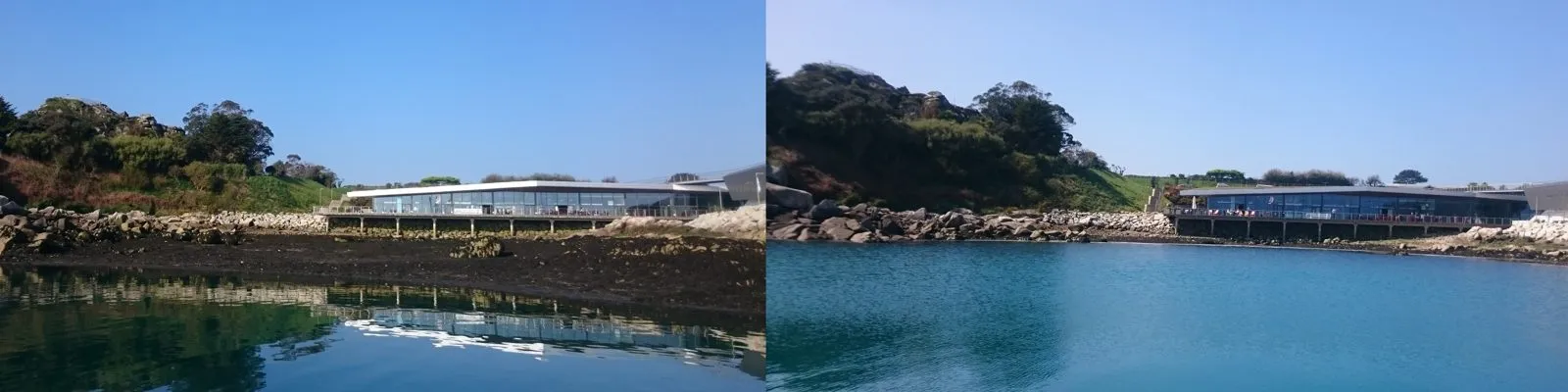
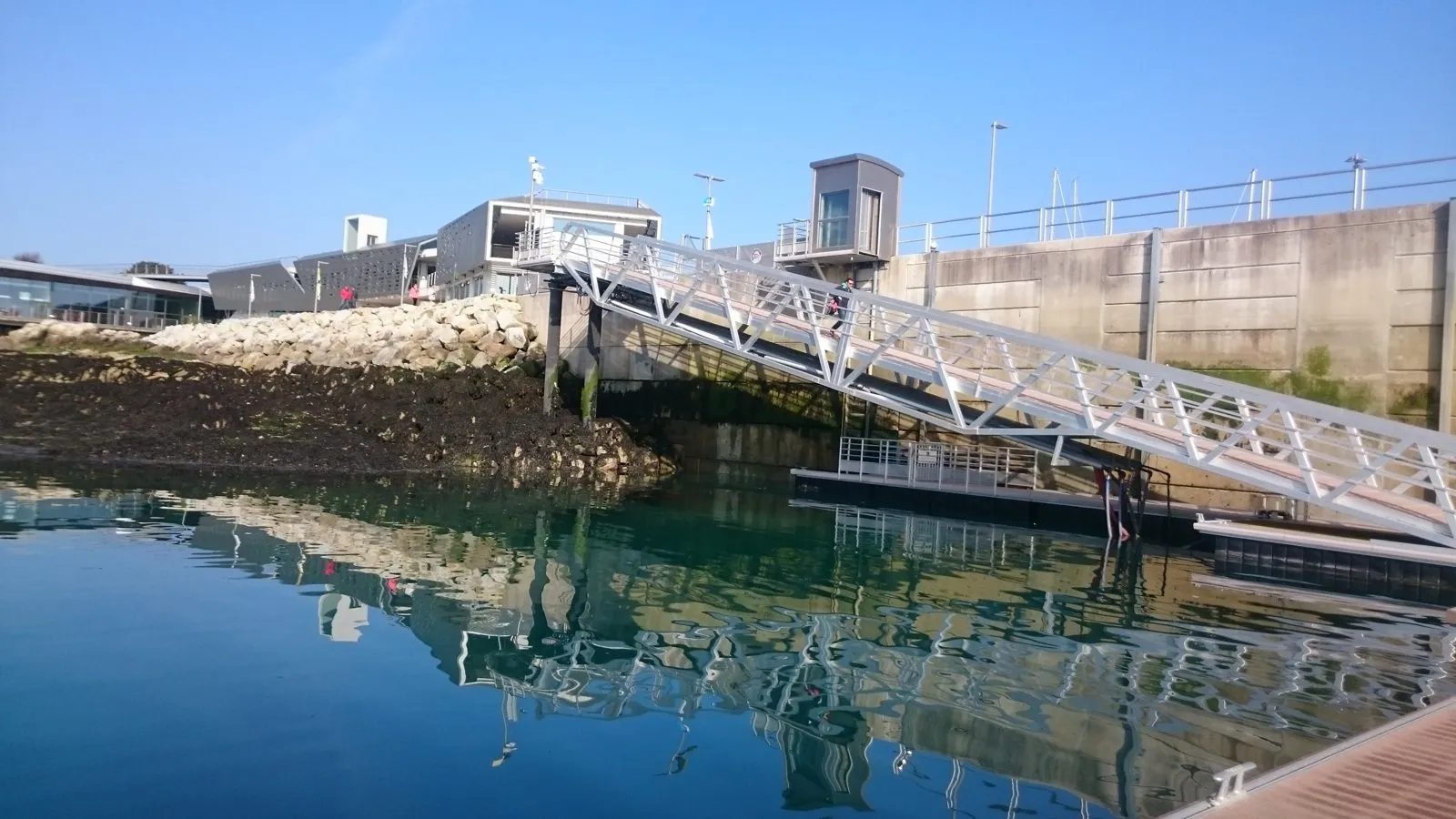
Our berth in RoscoffThe floating pontoon, fixed to hulking black steel piles, rises and sinks 6 metres every 6 hours, together with the sailing boats moored to itThe marina café at low tide and at high tide
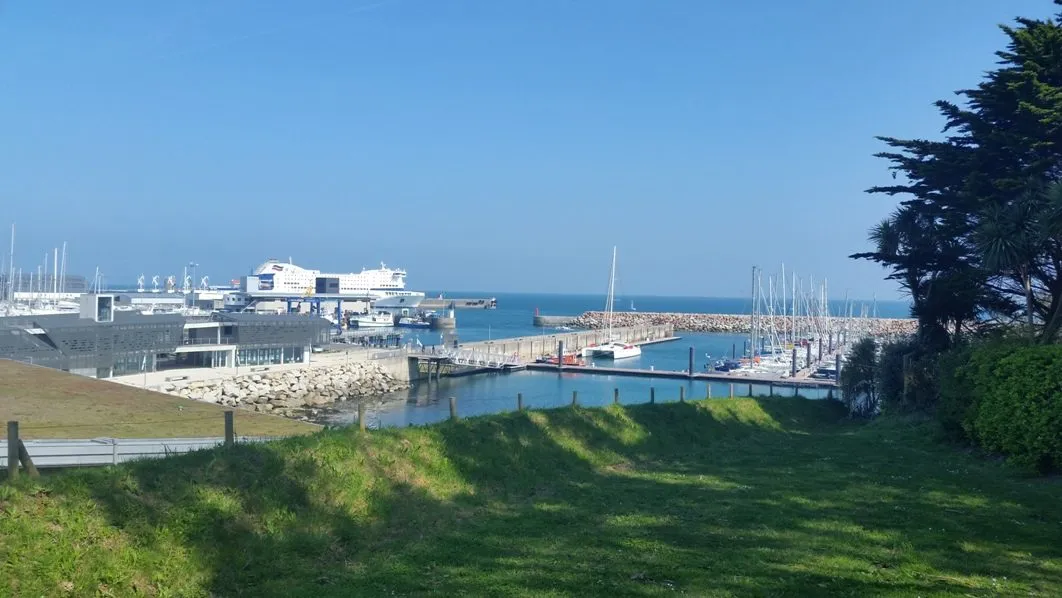
The other half of the harbour holds the modern terminal of the ferries to England. The yacht marina is very nice too, they can’t have built it long ago. Between low and high tide there can be as much as 6 metres’ difference in level, so for people with reduced mobility they built a panoramic lift that leads down to the pontoons lying 7–8 metres down at low tide. At high tide I reckon the lift goes down under water, from where you can admire the harbour’s underwater world through its glass walls. Don’t bet your life on it – if that’s not how it is, then I was wrong.
The Roscoff yacht and ferry harbourPanoramic lift
Taking all this into account, the €41 daily mooring fee seems perfectly fair.
At noon we kicked off the day with a fantastic sausage scramble – conjured up for us by Sanyi – after which the sun duly came out too, sunny side up.
Before setting off on a sightseeing stroll we ordered a coffee on the terrace of the café on the shore. The others were analysing the miniskirted waitress’s boots – and we’ve only been under way for a week – while I drank coffee.
We wanted to go up to the lookout on the neighbouring hilltop, but we didn’t get that far, because it rose in a botanical garden fenced off from the outside, whose entrance was on the other side of the hill. So we stayed at sea level and strolled into the centre of Roscoff.
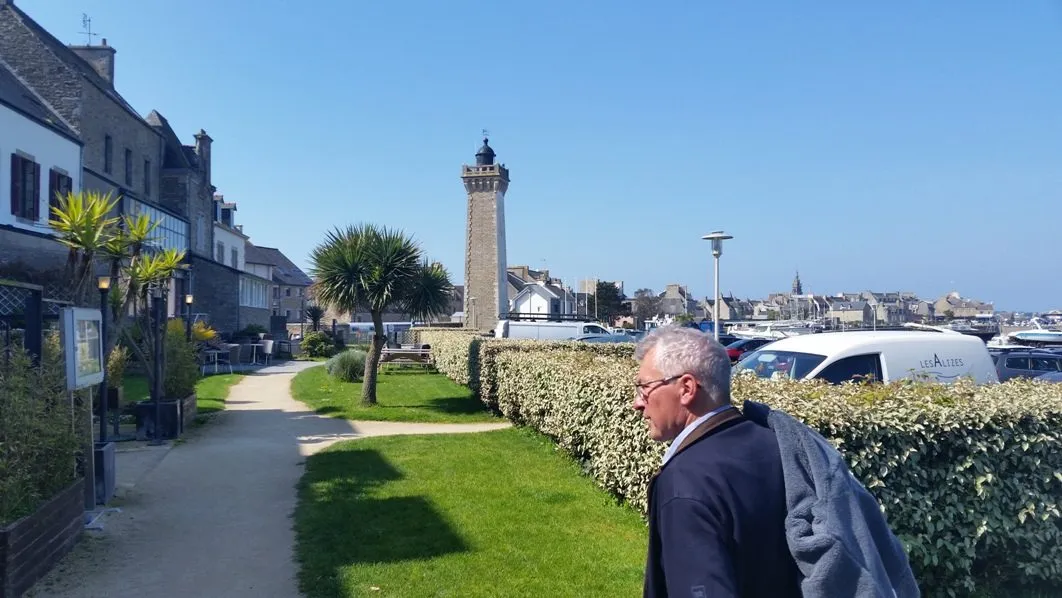
Our route led past very charming, little, old Breton cottages and along the old harbour.
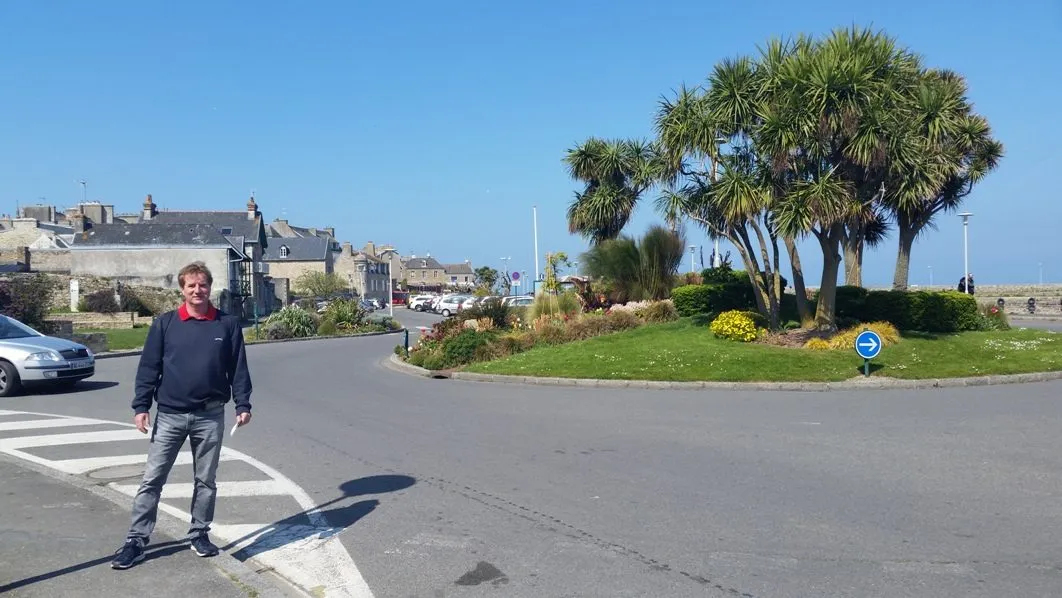
What did you learn in geography about the vegetation of the Brittany peninsula? All that stuck with me was some old baloney about greens, and in case you don’t know the right answer either, remember: this is where palm trees grow! Oh yes. I’ve got a photo to prove it – forget all the other nonsense!
Those Breton palm treesSightseeing stroll at the foot of the palm trees
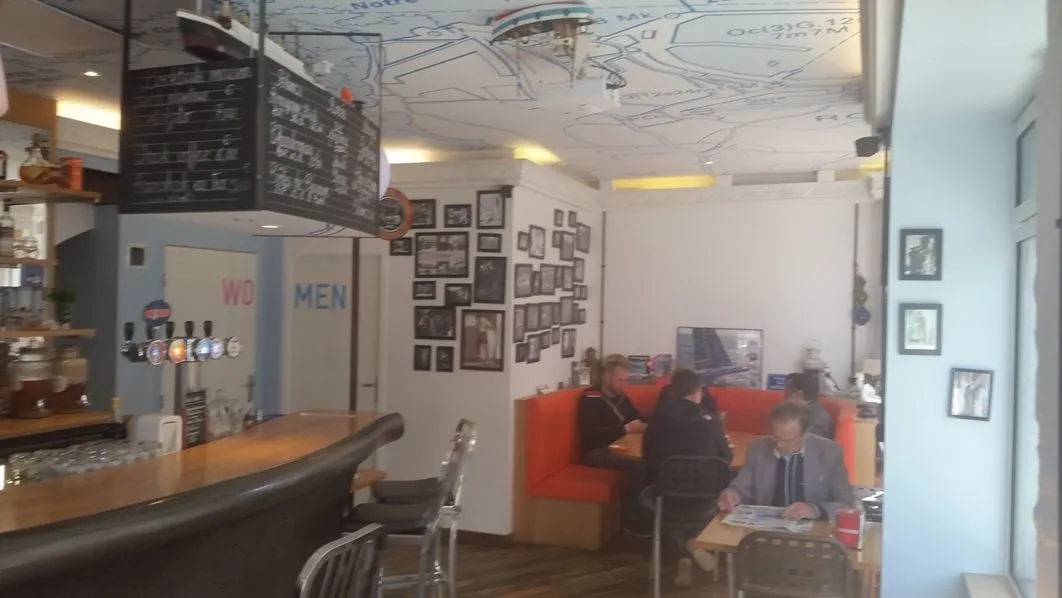
On the way back we dropped into a cosy little beer bar on the shore. We pushed the little tables together for the six of us, next to the oval regulars’ table with the leather sofa, because a young native was busy bewitching his laptop there next to a long-empty coffee cup. The kind young waitress got Jean up from there, saying “a little table is enough for you”, and sat us down in his place. The ceiling was painted with a chart of the surrounding coast, with models of little sailing boats glued to it upside down. The doors of the men’s and ladies’ toilets opened side by side,
one with the sign WO and the other MAN.
Once we’d finished, we went over to the crêperie on the other side of the little street, where we tasted this French speciality. It was delicious.
I went ahead to upload the photos and diary bits done so far in the marina café, but before long they were ringing me to hurry, because if I’m quick I can still hop onto our departing boat at the end of the pontoon.
Photo upload, paying, another photo, a merci, oh and the text of the last day, then off I dash, because these guys might really leave me here in the end….
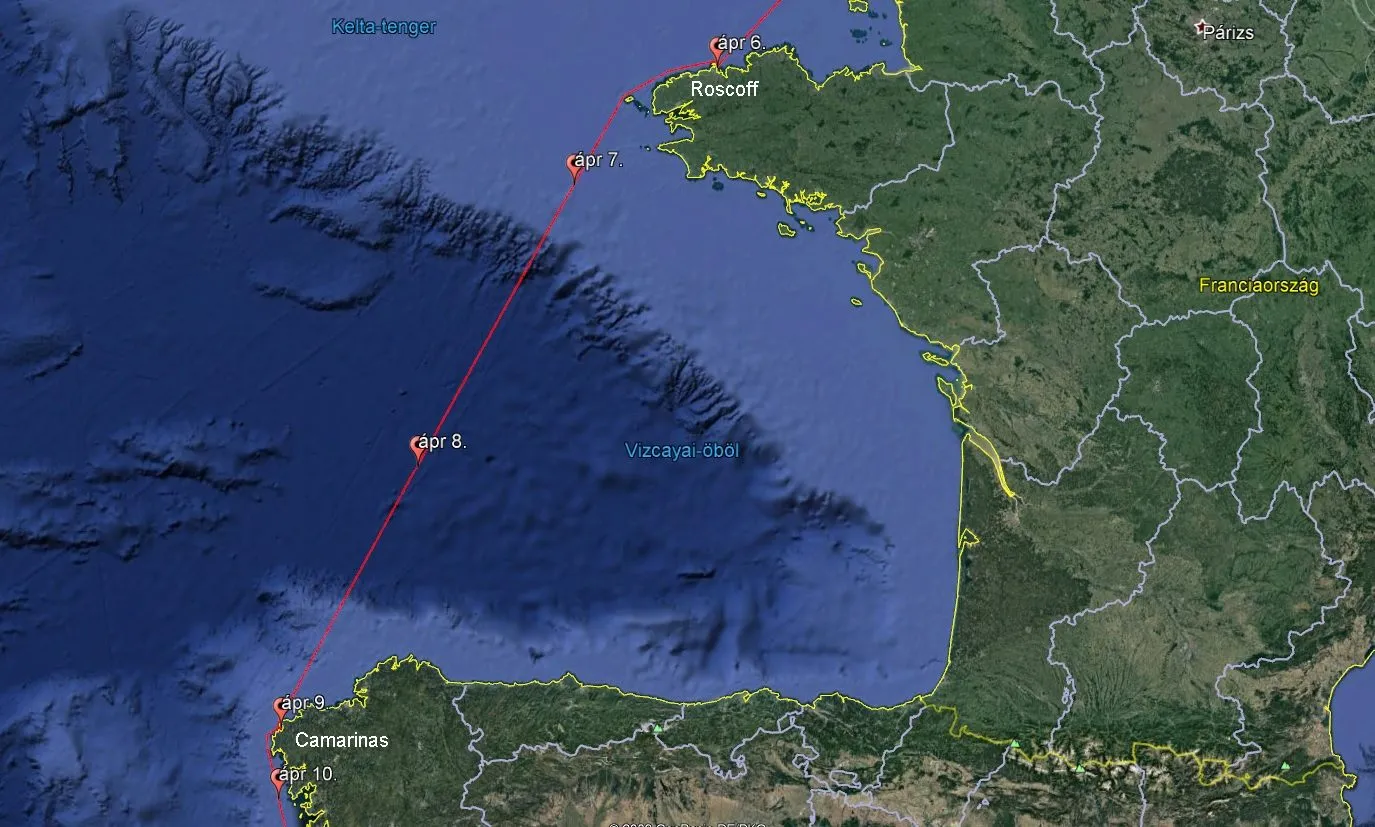
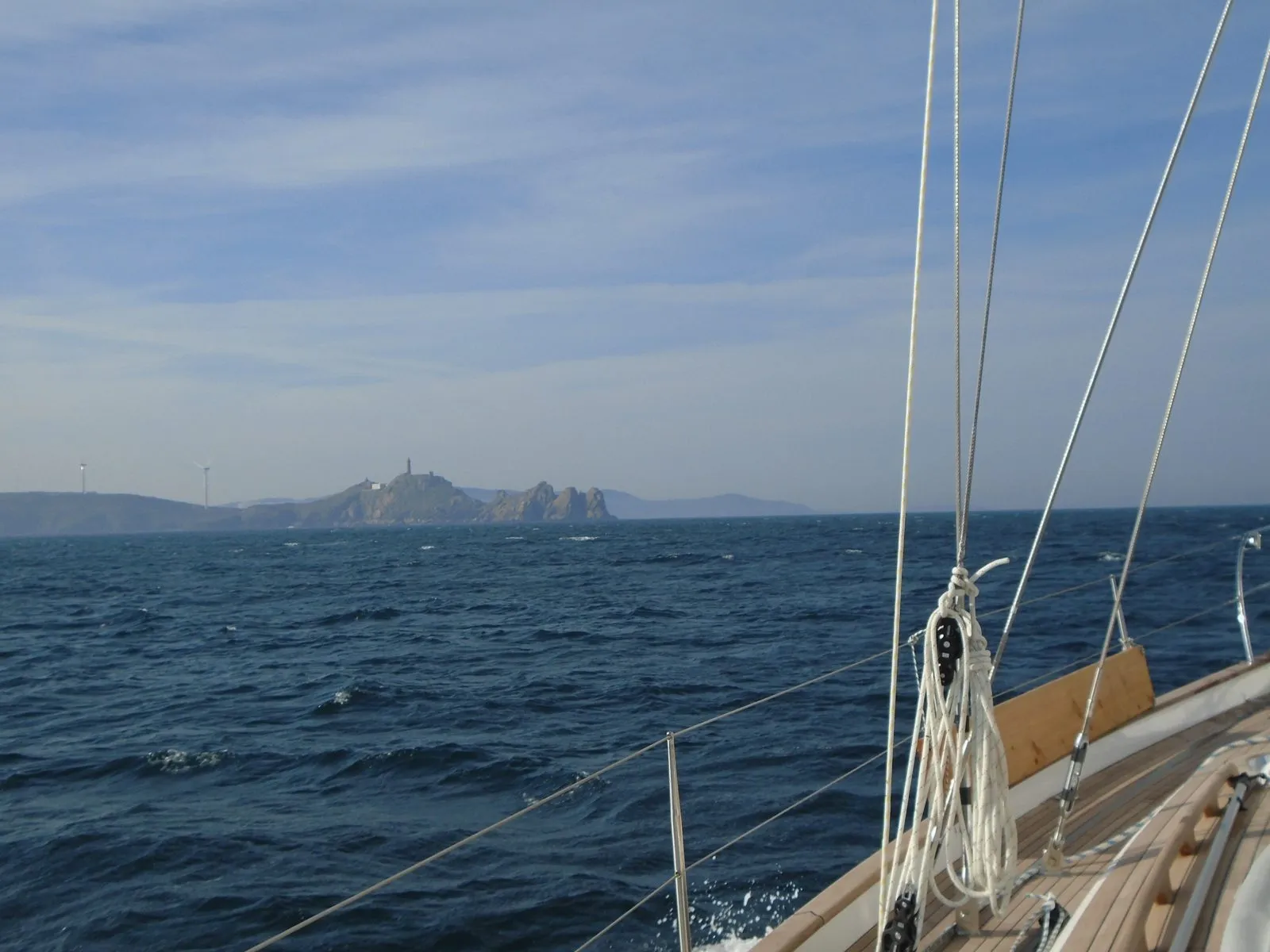
At 18:30 we cast off, heading for the far side of Biscay, Camariñas in Spain.
We left the lights of Roscoff behind, trusting that the forecast would be right and we could cross the Bay of Biscay, notorious for its storms, in favourable weather all the way.
Machine translation (AI, Claude) of Balázs’s Hungarian original. Read the original →
· Bay of Biscay
We took part in a firing exercise
Friday, 7 April 2017
Day 7, 108 nm to noon (Log 999 nm)
At 3 a.m. our captain shook me awake: “Wakey wakey, little brother, our watch is starting!” That’s not how he put it, but that’s how it felt to me, because I’d overslept yet again. In vain had I set the alarm on my phone in the evening – it quietly ran flat and didn’t make a peep. And I’ve even got a nice quartz watch that goes beep-beep when it wakes you, but it does it too quietly, and it wasn’t on my wrist anyway. Next time I’ll have to wrap an electric fence round my big toe…
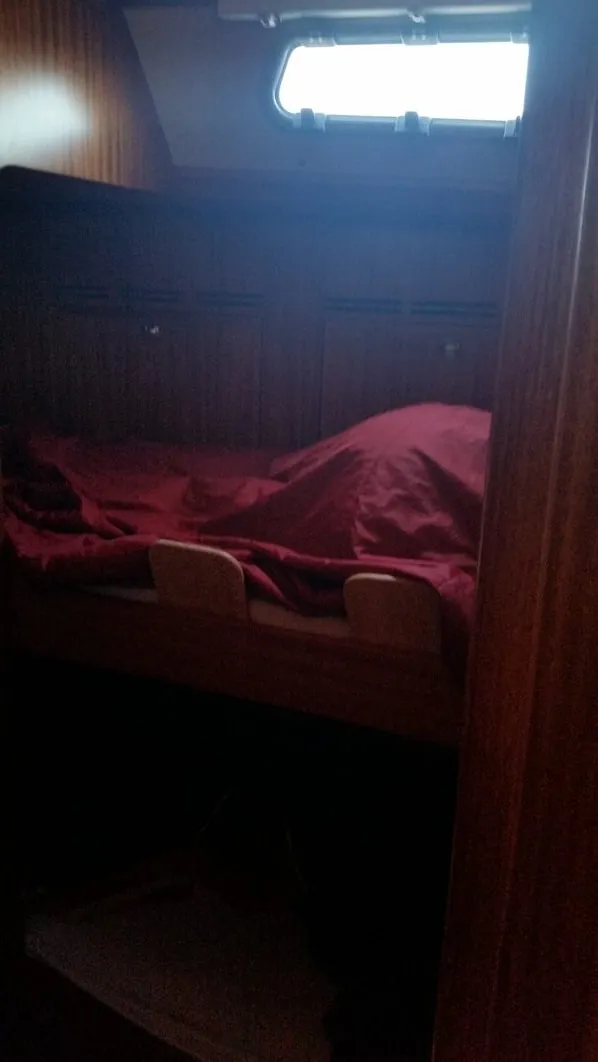
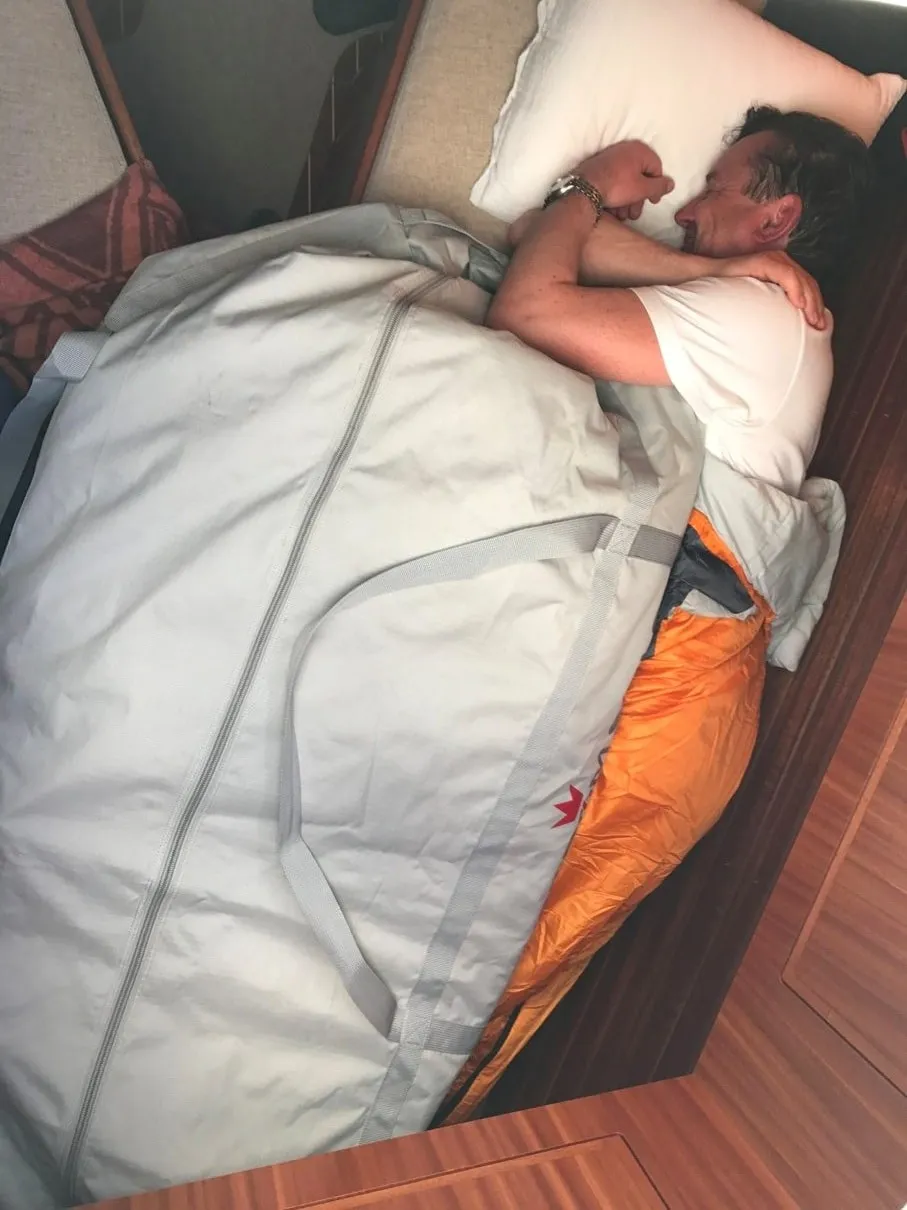
During the night the wind went round to the east-ish. So far on our voyage we’d always had the wind from starboard, which meant that whoever slept on the right side of the double bed – or tried to sleep – could have put a sword between themselves and their bedmate all they liked, they’d still inevitably have rolled on top of them, unless they hung on even in their sleep.
The occupants of the Trotsky cabin – that’s what Zoli calls their bunk-bed cubby on the right – hadn’t been threatened with the danger of cuddling up so far; they were simply fighting for their lives not to roll out of bed. You can try the situation at home: put 4 encyclopaedias under each of the wall-side legs of your bed, and enjoy a good rest for 4 hours. If you’d like to simulate the waves too, you have to drink half a litre of rum, and the bed will even spin…
Those famous chopping-lee-boards
Ordering the lee cloths that stop you falling out or rolling over got forgotten at the time, but Zoli found a self-taught way of securing himself, wedging three chopping boards between the mattress of his upper bunk and the wooden bed frame: one at his elbow, one at his knee and one behind his sitting bones. Everyone is now racking their brains over how, later on, when the chopping boards are used for their intended purpose, he’ll manage to avoid that last one.
So the wind turned and so did the tables: now the waves rock us to sleep, and the others are just starting to learn the hang-on-for-dear-life routine.
At half past 10 the captain is waking me up again: sorry, but the wind is dropping, we need to hoist the gennaker to go faster, and it’s under your bed… And besides, you’ve slept plenty already…
We set the blue-white-orange-striped light-wind sail, and straight away we were going a knot and a half faster.
At noon Sanyi and I made Hungarian-style chilli beans, to whittle down our ham and sausage stocks as well.
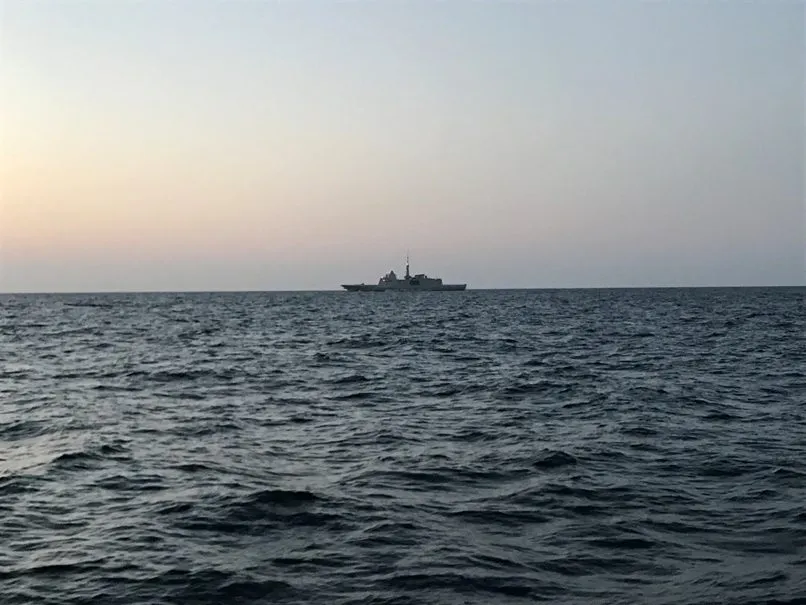
I only found out afterwards that in the morning, while I was asleep, NATO took advantage of my un-alertness and held a show of force near us. I only know from what our watchkeepers told me that before sunrise, in the dark, the lights of a ship were approaching fast, straight towards us. Neither an AIS nor a radar signal showed on the monitor, yet something just kept on coming at us. Finally, as it got light, a grey warship with no markings neatly blocked our path at about 800 metres. When it saw that we weren’t shitting ourselves at its shadow and were still determinedly holding course, our anchor like a battering ram, for the middle of their hull, first they came round to their senses, and then came round out of our way. For a few minutes they ran parallel with us – meanwhile you could hear the pings of their submarine-hunting sonar continuously inside the cabin – then they took French leave (in Hungarian you leave “the English way” – though these must have been French).
The silent cruiser
We’d already noticed in the Channel that warships don’t have an AIS signal. There’s some logic in not trumpeting their position and size to the world, or that their cargo is 14 ballistic missiles, 20 torpedoes and 4 anti-aircraft cannons.
It reminded me of my mother, who mistook a cute luggage tag she’d been given as a present for a keyring. She remarked how useful it was, because if we write our address on it and lose our house keys, they can bring them back… We must have looked at her pretty blankly, because she too realised the slip, laughing.
In the afternoon, when Gyuri was flicking through the Navtex, he noticed an earlier message. Guys, they’re holding an artillery firing exercise in our area, he cried. Checking the coordinates afterwards, it turned out that in the morning we might have strayed a bit into the edge of the closed area, and that’s what we owed the warship’s visit to. We can’t have been anywhere dangerous, because they didn’t so much as yap at us.
Or maybe their radio was just broken?
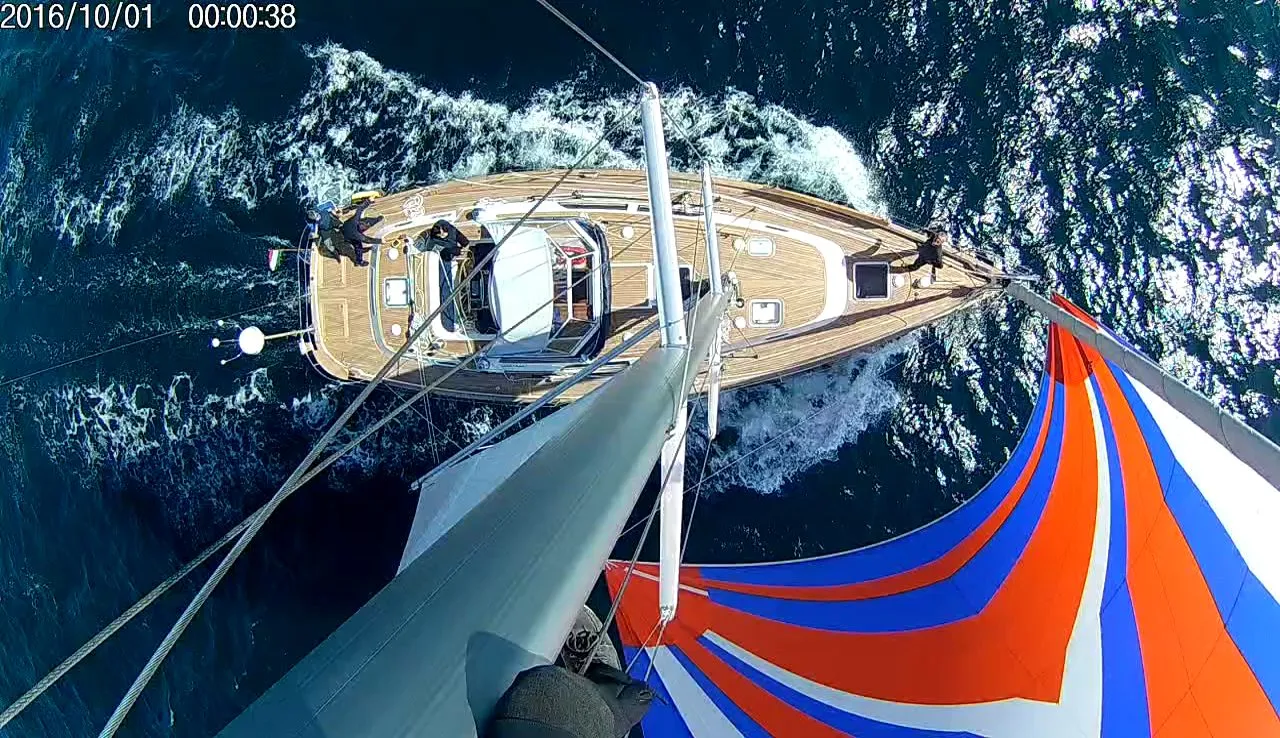
Then we hoisted Tibi up the mast. First he declared that he takes over all responsibility and longs for the high-altitude air of his own free will, and since he was up there anyway, he took some gorgeous shots of our boat with his GoPro.
The Pinta from the mast
At 17:00 on the dot, the same thing happened as on the previous days whenever we were at sea. Feel free to flip back if you don’t remember.
One evening we asked Gyuri whether the Hallberg-Rassy yard would have delivered the boat to the Adriatic. Sure, of course, they could have handed it over there too, for a decent surcharge. In our heads we all quickly divided the immodest sum mentioned by 6 (that’s how many of us there are on board), and I remarked off the cuff that actually we’d be very happy with half of it…. Gyuri’s answer was snappy too: Guys, other applicants would even have paid just to come on this voyage instead of you…
Before dark we swapped the gennaker back for the genoa, because the wind had also picked up a bit – to around 16 knots – and we didn’t particularly want to practise taking it down in the dark.
The others hadn’t yet heard my Berlin friend’s golden rule: “When should you reef the sail? The first time you think of it!”, but this time that’s almost how it went.
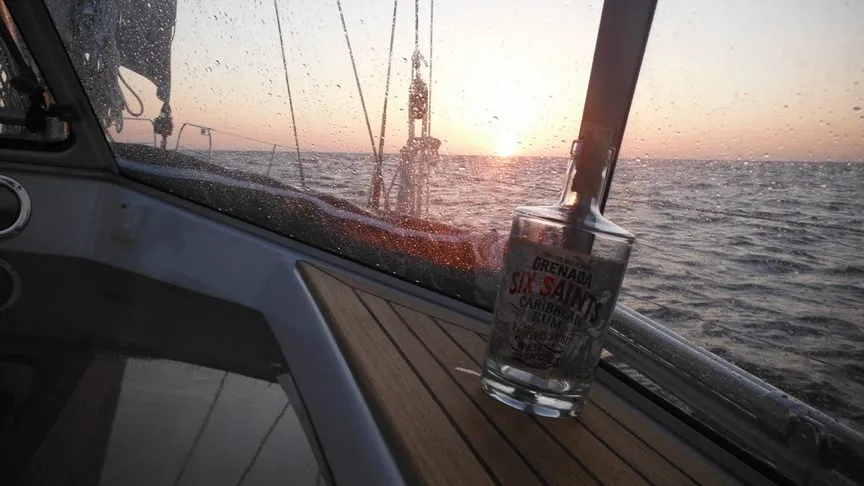
I haven’t told you yet that on our voyage – as soon as we left the iceberg zone behind – I introduced here too the very pleasant tradition of tropical waters of watching the sun go down all the way, sitting on deck chatting and sipping a so-called “sundowner”. In style, this is usually rum, or Campari, or any other heart-warming cold cocktail.
This time, shortly before sunset, I noticed that our rum supply had run out. “What about the sundowner – how’s the sun going to go down like this?” I fretted. “With pálinka, then”, someone quickly came up with the solution, and it really worked… Down it went.
Der Tag geht, Johnnie Walker kommt…
Machine translation (AI, Claude) of Balázs’s Hungarian original. Read the original →
· Bay of Biscay
Under way on the peaceful waters of Biscay
Saturday, 8 April 2017
Day 8, 172 nm to noon (Log 1171 nm)
On the dawn watch Gyuri and I swapped stories of our university days in Dresden, since we were both there on scholarships for 5 years and graduated there. Back then we missed each other, because he started eight years before me, but the halls of residence and the other Dresden sights were the same in those days. All night we sailed under full canvas.
Crossing the notorious Bay of Biscay to Camariñas in Spain
In the morning we listened with great attention to the French navy’s radio traffic. Well behind us they were calling on cargo ships, in English, to change course because of a naval convoy passing. In summary it went like this:
Channel 16:
FN: This is the Franch Navy, calling the (cargo) ship Emden.
EM: This is Emden.
FN: Switch to radio channel 10.
EM: Switching to channel 10.
We switch over too, and keep listening.
FN: This is the Franch Navy, due to a naval convoy passing, alter your course to 205 degrees and hold it for one hour (then you can return towards your original destination). Do you understand?
A longer silence – anyone could say they’re the Franch Navy…
EM: Please identify yourself, give your ship’s name and position.
Now the French officer goes quiet for a bit – I imagine he’s hiccupping hard; I reckon it’s been a long time since anyone asked the French navy to identify itself…
FN: For security reasons I cannot give it. The convoy is 15 miles from you to the north-west, making 18 knots.
Now it’s the Emden’s turn to go quiet – I imagine he’s checking on the radar and swearing to himself along the lines of: “Bloody hell, so that’s not a storm front there on the radar, that’s the French armada!” – then he replies:
EM: Altering course to 205 degrees and holding it for one hour.
FN: Thank you for your cooperation, and have a good onward voyage!
The French diverted another three ships or so, then went quiet for a while. It must have been yesterday’s firing-exercise crowd.
This is a conversation with another ship – this one wasn’t being awkward any more…:
By noon the wind had dropped, so instead of the genoa we tried the gennaker for a while, but since with it we couldn’t hold our planned course and had to deviate 15 degrees from it, and clouds were also arriving from the south – or we were just sailing into them – we took the gennaker down and carried on under engine. In these parts it’s better to be careful.
Sweet twosome with the gennaker – at least this way you don’t roll over to the other half of the bed…
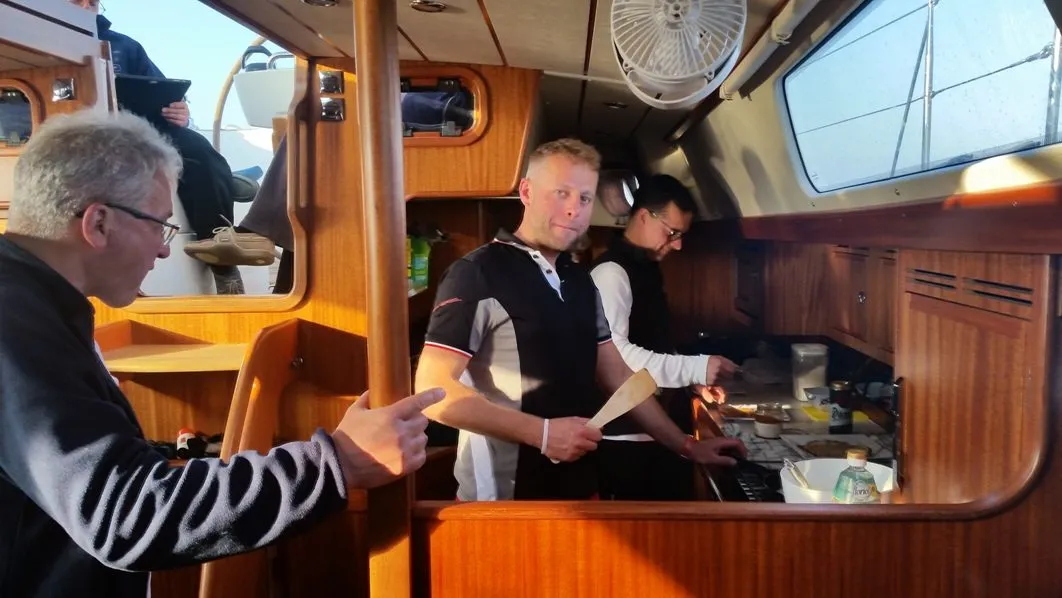
Today’s lunch was made by the two Zolis. On the menu: Biscay chicken soup and meatballs in tomato sauce with boiled potatoes. Gyuri and I only asked for a kid-size portion of boiled potatoes – we already ate enough for two lifetimes in the GDR.
Over the afternoon there’s more and more radio chatter in Spanish. The dispatcher lady at the Finisterre Traffic centre asks the sailing boat Sonja to take part in a helicopter rescue drill. What the routine would consist of we never found out, because the details were discussed in Spanish…
From 16:00 I’m alone on deck. Because of the light wind we’re motoring, but the sun has come out again and the waves are gently rocking, so it’s quite a different story… The others are making the most of the calm going and taking a nap, sleeping ahead for the bumpy tossing and turning tonight. Gyuri is reading below, and I’m outside catching up on my diary writing. Every 10 minutes I look around – not a ship on the horizon – I check the chartplotter: the nearest freighter is 15 miles away – heading for Antwerp – and will pass somewhere behind us.
I don’t think any of us is sorry about the light-wind weather – we had good sailing yesterday – let’s leave this region behind us in peace. We expect to arrive in Camariñas tomorrow morning.
17:00: Ticked off.
Zoli has promised pancakes for dinner. We’re waiting for them…
And he made them. We ate them with chilli beans and with jam too – very tasty.
Eating pancakes on Biscay… I’d never have believed it.
Recipe: Go to 44° North latitude and 008° West longitude, take out Ilona Horváth’s autobiography (the Hungarian kitchen bible, actually a cookbook), and fry them…
Machine translation (AI, Claude) of Balázs’s Hungarian original. Read the original →
· Camariñas, Spain
On the westernmost edge of the European continent: we've made it to Camariñas
Sunday, 9 April 2017
Day 9, 158 nm (Log 1329 nm)
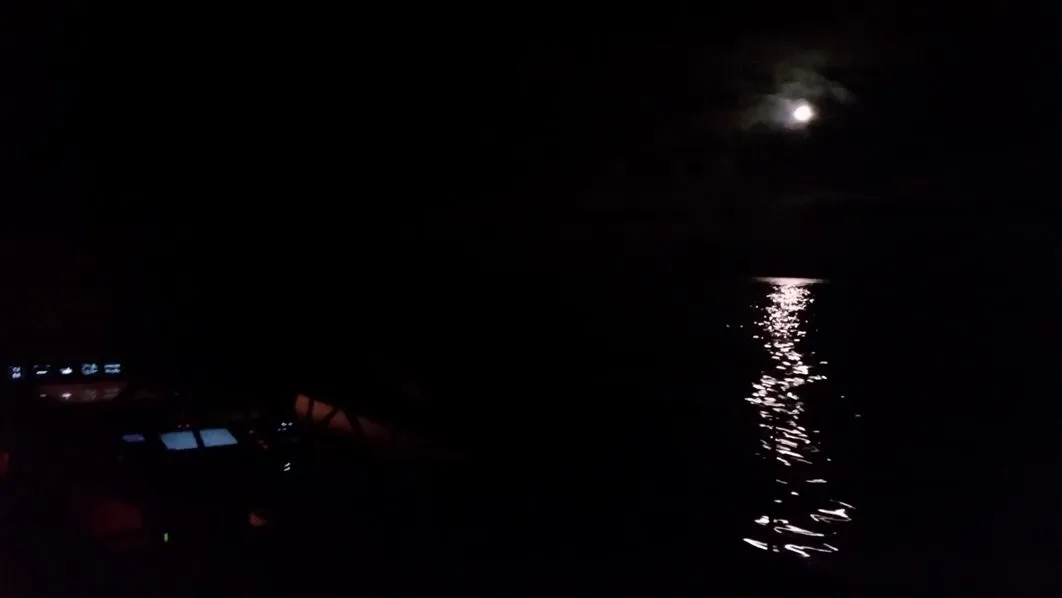
From 6.00 to 9.00 Gyuri and I are on watch. Under the cloudy sky it’s still pitch dark until half past seven – as far as I’m concerned that still belongs to yesterday – and not a trace of sunrise. We’re sailing by the light of the full moon – I even managed to get a good shot from the stern. After dark there are always two of us on deck at the same time, in life jackets. If for any reason we leave the cockpit, we clip on with the lifebelt too (a safety harness).
By 8 it started getting light, just as Gyuri fried up some cracking French toast. Lured by the smell, the sailors slowly started trickling out; I wolfed down about 4 slices before turning in and went to sleep, because my eyes were practically gluing themselves shut. Now the hardships of diary-keeping were catching up with me.
I set my phone for 10.45, because we were expected in Camariñas at 11.15 and I absolutely wanted to be there for the arrival and the mooring.
The phone would have woken me in time, but I snoozed it, and all I had the strength for was to pull back the blackout blind on the hatch above my bunk, in the hope that it would help me wake up. At least this much happened: through my eyelashes I somehow sensed that the sun was now shining from the opposite direction, i.e. we must have turned into the bay. I guessed right, and now I really had to crawl out.
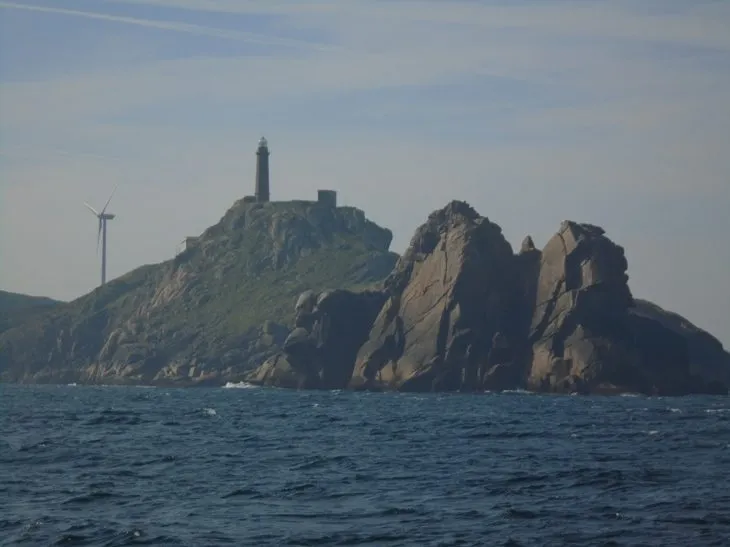
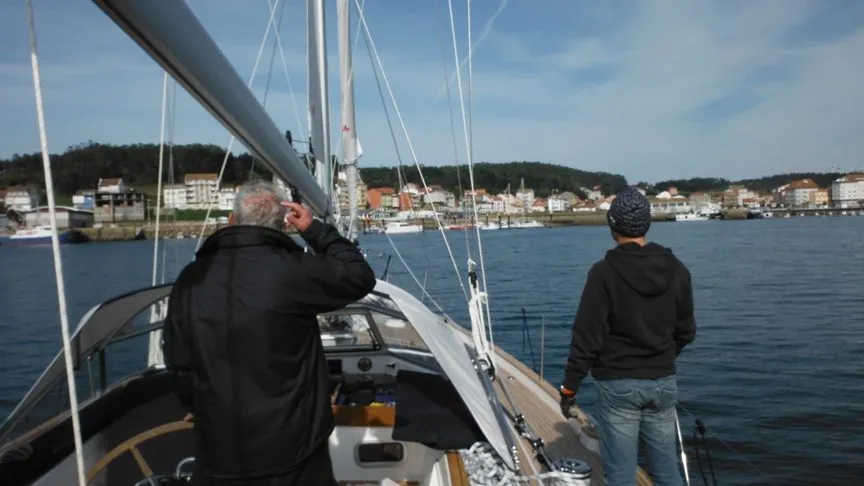
The guardian rocks of Camariñas – I didn’t see these either…Sailing into Camariñas
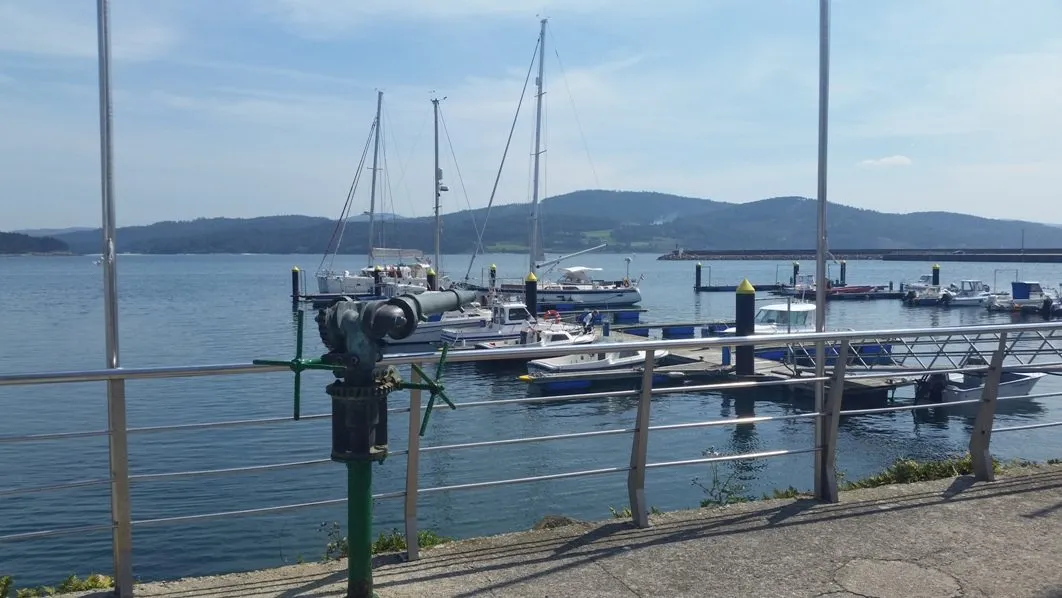
We moor on the pontoon of the Club Náutico Camariñas at 11.40, next to a Norwegian Lagoon 400 catamaran. They came from the Balearics and are heading for Scotland. They’d have dearly loved one of us to be a diver, because somewhere along the way their rudder had picked up a piece of rope.
For our one-day stay we had to pay 20 euros, which was entirely in proportion with the 1960s condition of the harbour facilities. EU funding has either not made it this far yet, or it got stolen here too. When we arrived, the old marinero quickly fitted the second shower head in the two-stall shower, which did nothing whatsoever for the brightness of the 10-watt bulb. That was a marginal improvement over shaving without a mirror, since peering into the fogged-up mirror, you could try to achieve usable results by scraping away in the direction of the white blobs.
On top of that, there must have been some problem with the foundations of the buildings too, because while the shower was only moving and swaying a little, I nearly fell off the toilet…
You shouldn’t drink so much, some would say, and they’re right, because I could barely get the last of my half-litre of tea down.
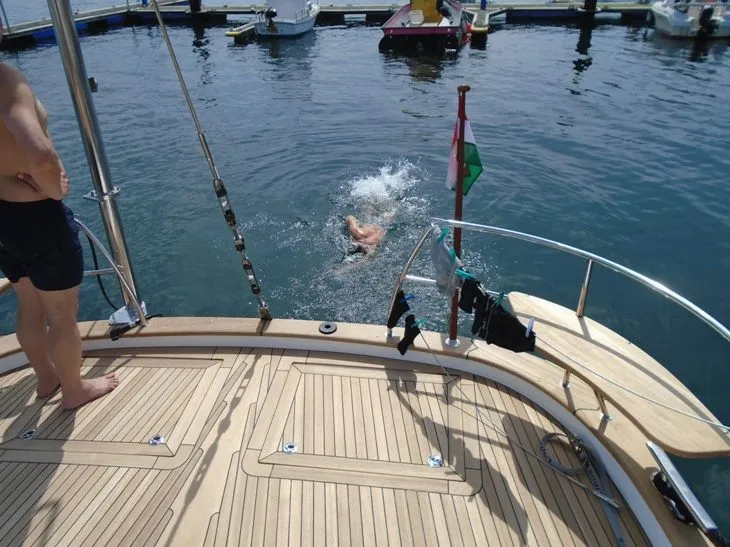
Thus cleansed, I sat out on the terrace of the Club Náutico to upload the material I’d finished so far. There was a lot going on in the garden, the locals were whiling away the time here with their families, and the kids were running down the slipway into the 16-degree water, frolicking happily. After two beers the wifi got up and left, even though I wasn’t even halfway through the upload. I moved over to the terrace of a café next door, where everything worked like clockwork. Meanwhile Zoli went for a little swim off our stern in the crystal-clear, oil-shimmering water of the harbour, though according to the logbook the sea there was only 15 degrees. Or 14.
Looking back at it now, this could even be me…
I was back on the boat at 17.00 on the dot, nobody had missed out on anything. However, that was the end of the tonic, and everything here is closed today. Tomorrow I’ll have to improvise.
The hungry crew all together – on the hunt for a restaurant
Around 18.00 we set off for dinner.
Two things slowly became clear: we’re here at the wrong time, in the wrong place.
The restaurants only open around 21.00, and as for the town, Camariñas, this is the best way I can describe it:
If one day you’d like to see a charming Spanish harbour town, with a historic old town, a beautiful main square, cosy little streets, tasteful houses that go well with each other, … then whatever you do, don’t come here.
We didn’t let it spoil our mood, and after the fourth restaurant-hunting lap we sat down on the terrace of a café overlooking the bay and switched to Spanish pace. We looked around, we chatted, we may even have drunk something, but I can’t remember exactly anymore.
See that cheeky little recycling station there in the background? – And we weren’t even being cheeky…
We waited for 21.00 for the cook to wake up, but in the end it was worth it, because we ate some really good fish – at least 4 kinds – and rounded off the feast with octopus and squid.
The real surprise came when we paid, because we only paid 10 euros a head for the food. The Croatians could learn a thing or two about guest-friendly pricing from these people….
Back on the boat, to wrap things up, another bottle of red wine got itself opened, and then we retired for the night.
Machine translation (AI, Claude) of Balázs’s Hungarian original. Read the original →
· Off Porto, Portugal
Along the Spanish and Portuguese coasts
Monday, 10 April 2017
Day 10, 45 nm by noon (Log 1374 nm)
Sanyi and Tibi volunteered to cast off at dawn and get us under way, so that we could reach Porto by evening.
Zoltán hit the big 6–0 at dawn today. Many happy returns!
At 5.05 I was jolted awake by an ungodly loud ship’s horn bellowing right underneath me. I stuck my fingers in my ears and slowly realised that they’d just switched on the bow thruster under my bunk a few times, to help swing the bow round as we left.
We’d already noticed that the powerful bow thruster howls pretty loudly when it kicks in, but it’s a whole different thing to notice it in daylight from 8 metres away than to be jolted awake 20 centimetres from it by something screaming your hair off.
I still managed to get back to sleep and only got up at 10. Until then we’d been motoring because the wind was light, but it had just picked up to around 10 knots, which is enough to try hoisting the big gennaker. Up it went, but almost immediately the wind dropped to half, so we got to take it down again while it was still warm. We’re motoring on again, because they’d like to get to Lisbon in time so that the crew change can happen without delay if possible. Four of us are going home – me too, sadly – we have to make room for the four lucky ones from among the many other fine applicants.
The blog in the making, this’ll be good…
Lunch was Portuguese shepherd’s tarhonya (a Hungarian egg-barley stew with potatoes and sausage). “What makes it Portugieser when we’re still off the Spanish coast?”, they asked.
“You can read about it in my blog, I’m not revealing all my secrets right away!”
Well, it’s Portuguese because I thought we were already off the Portuguese coast, plus I accidentally put the potatoes and the sausage in in the wrong order. The result turned out good regardless, the leftovers didn’t go over the side (and with Gyuri that’s saying something), but got put in the fridge for tomorrow evening.
In the afternoon the temperature climbed to shorts weather, 28 degrees, and the sea warmed up to 17, compared with the North Sea’s 8-degree water.
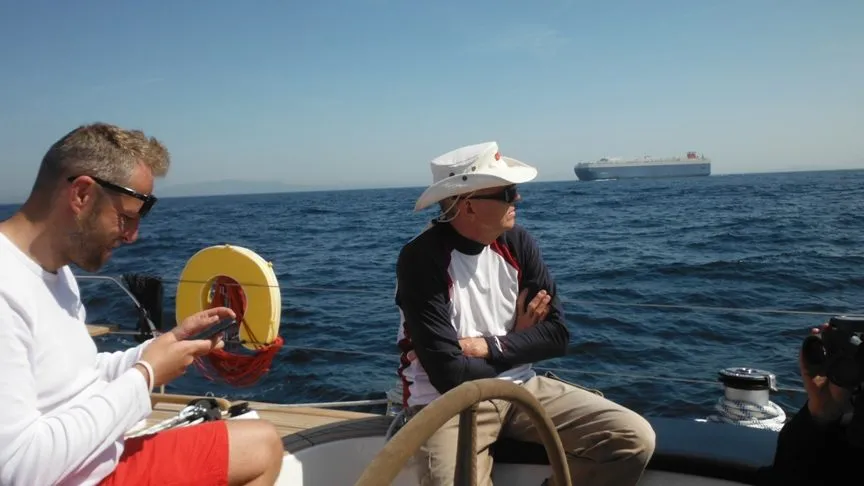
A staring contest with a car carrier
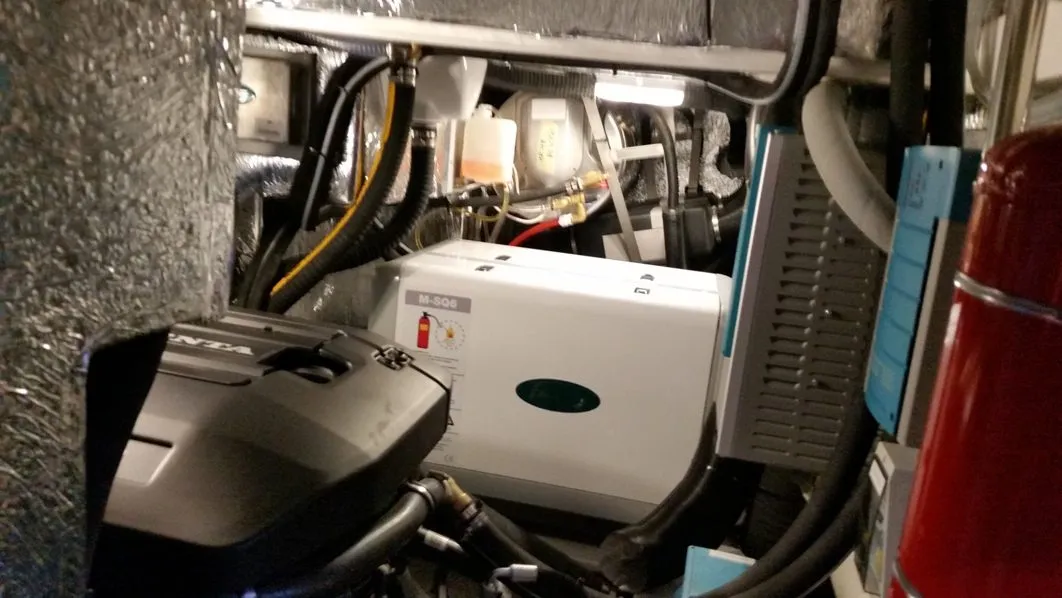
We checked the engine oil level again; there’s a proper little engine room under the cockpit. Some water has collected in the bilge again, we still haven’t figured out where it might be seeping in from.
The engine room
At 16.50 Zoltán asked point-blank what was going on with the gin and tonic. I have to do something, otherwise there’ll be a mutiny, so today’s G&T was made with Fanta and gin rationalised down to a third. They didn’t beat me up, they could see I was trying.
We’re sailing about 6 miles off the – now really – Portuguese coast, but from here all you can see of it is a silhouette half wrapped in haze.
“What would you say if we went closer – say 2 miles off – then we could actually see something of it, seeing as we’re passing by anyway?”, I asked.
The others agreed, the skipper approved, so we altered course towards the shore.
See we did, we saw more of the coast, but we also got to start dodging the fishermen’s buoys. The water here is only 30–40 metres deep, and one turns up near us practically every minute. Now that it’s got dark, things are starting to get interesting, but the full moon helps a bit.
Meanwhile I lost a bet: we had to guess how long it would take us to reach a tower block that had just popped up on the horizon. Zoli guessed one hour, I guessed two, and we passed it after an hour and 15 minutes, even though I fought to the last minute.
That hotel could have been a good 20 minutes further along…
We’ll reach Porto around midnight; we’re now sailing past its airport, which you can tell from the planes taking off and landing. (unless they’re landing in the cornfield)
This freighter is going to barge into Porto harbour ahead of us
Machine translation (AI, Claude) of Balázs’s Hungarian original. Read the original →
· Atlantic Ocean, off the Portuguese coast
O sole mio in Porto…
Tuesday, 11 April 2017
Day 11, 86 nm (Log 1460 nm)
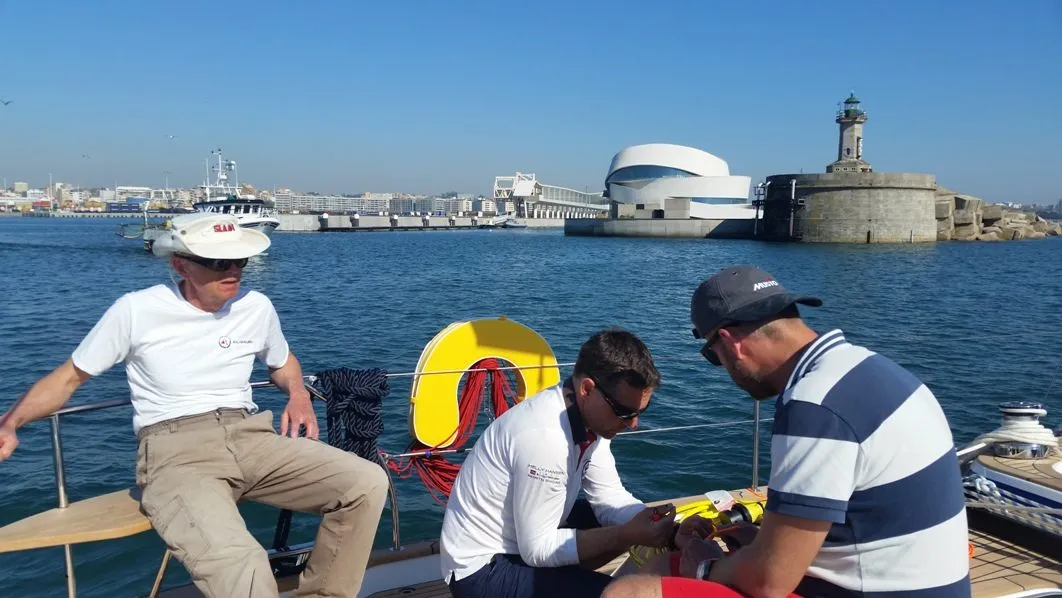
There’s an old piece of seamanship advice: arrive in a strange harbour by day if you can, while it’s still light. It’s still well worth heeding these days, but with good visibility, by the light of the full moon and with the help of the navigation instruments – just like the other time in Roscoff – we were able to moor safely on the visitors’ pontoon of Porto’s marina at midnight last night too.
So far there hasn’t been much feedback on my travel-blogging oeuvre, maybe I’ll only be remembered by posterity too, and I’m slowly starting to feel it wouldn’t make any difference if I put my daily letters in a bottle and tossed them into the sea, like Mikes did into the “Lake” of Rodosto back in the day (Kelemen Mikes, the exiled 18th-century Hungarian famous for his letters from Rodosto in Turkey)…
However, last night it turned out that a few people are reading my lines with interest after all, and the skipper, Gyuri, asked me whether, even though I’m getting off in Lisbon, I could keep writing the diary. Well, I said, I have to be there, I have to live it, I have to go around with my ears open, I can’t paint a landscape from a photo…
The plan for today was sightseeing in Porto combined with lunch, so that we could set off again for Lisbon in the afternoon.
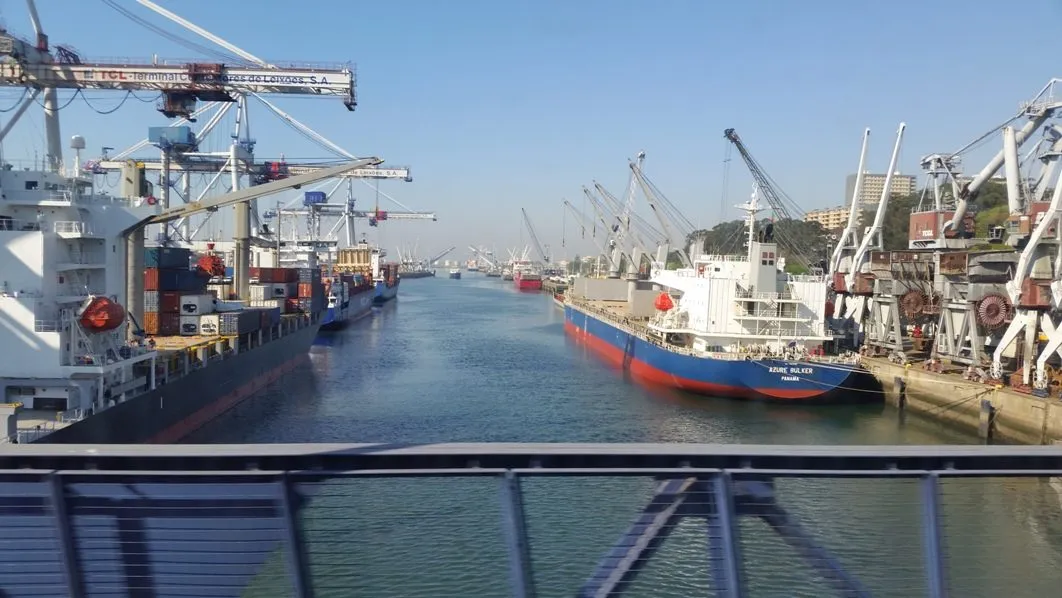
We took a local bus into the centre, which took at least an hour. On the way we went round Porto’s huge commercial port, where through the bus window we could peek in on the loading and unloading of bulk cargo, containers and the enormous blades of wind turbines.
(Do you know how many containers are lost overboard from ships every year? Have a guess. I’ll tell you at the end of the day)
All right, all right, you can say Hamburg and Rotterdam are the really big ports, but my yardstick is still the boating lake in Debrecen, which on top of that has since dried up…
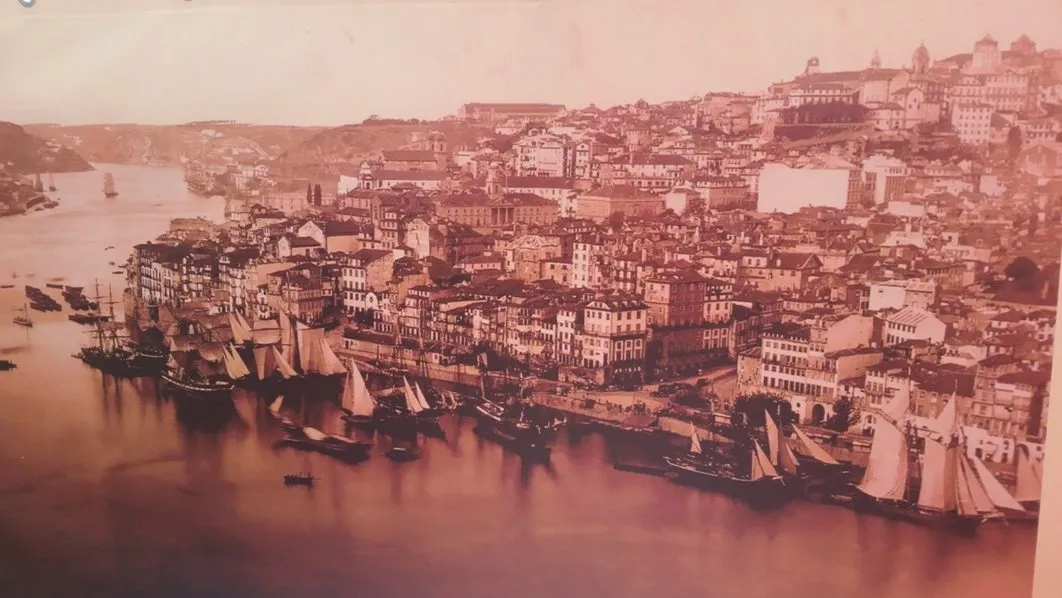
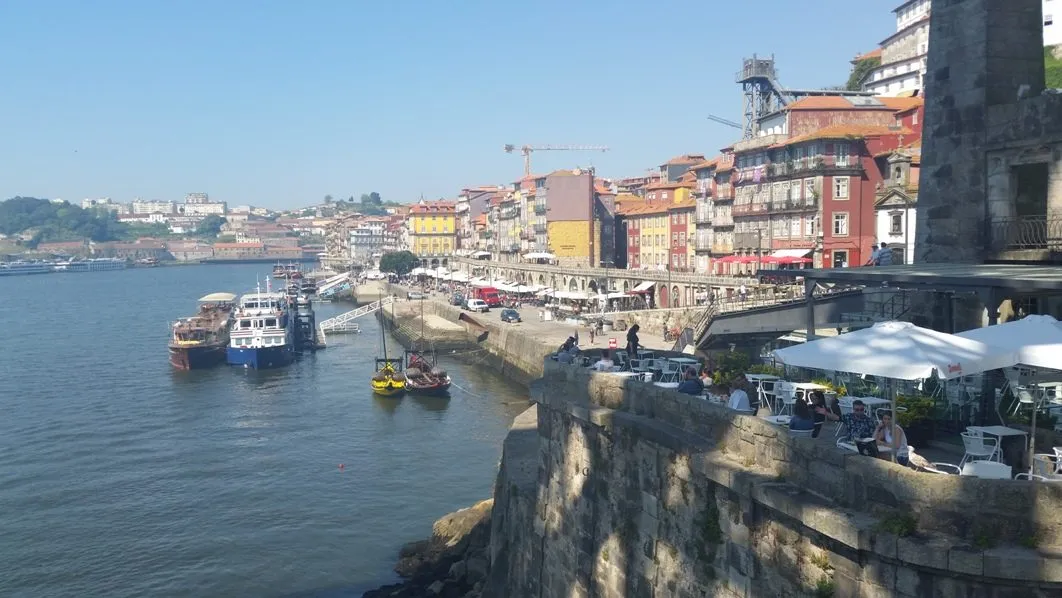
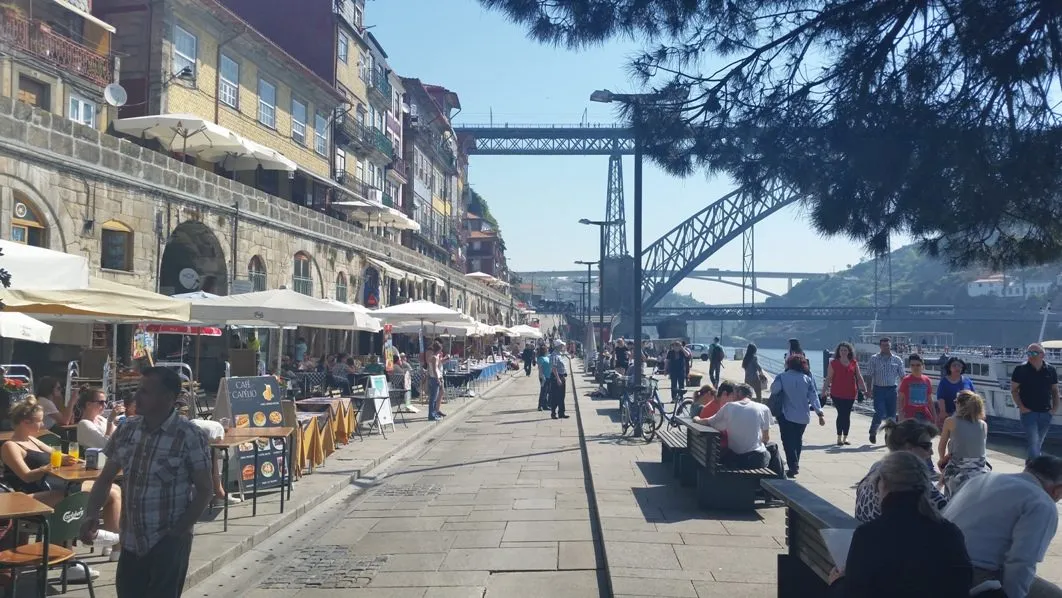
From the centre we walked down to the bank of the Douro, where in the old days the famous port wine was loaded onto sailing ships
Porto harbour back thenand now
I heard something along the lines of: during the long sea voyages a lot of the wine got smashed, so the people of Porto came up with the idea of boiling it down, shipping it like that, then watering it down or blending it, and in the end it’d be fine.
But if you’re more interested, better look it up yourselves, because my interest in wine got pretty badly mauled quite early on by an Adriatic sailing incident. The story goes back to the shopping list of a summer sailing charter, where everyone was told to bring, among other things, 2 bottles of wine. Admittedly, I didn’t pay overly much attention to choosing for quality, tossed two bottles of BB-brand wine (Hungary’s classic budget supermarket plonk) into the basket (semi-sweet, too, I reckon), and as far as I was concerned that was job done, ticked off.
We must have been about halfway through the trip, out at sea, when my first bottle came up, and whoever opened it roared:
WHO BROUGHT THIS CRAP???
I reckon I must have been rowing our galley with my back turned all afternoon, because that way I didn’t hear the question and had no chance to own up. However, by process of elimination its origin may have come to light, because wine has never been on my shopping list since, not even by accident.
Pálinka, on the other hand, I’m good at. And making gin and tonics. Soon I won’t even need gin for it, I’ll make it anyway.
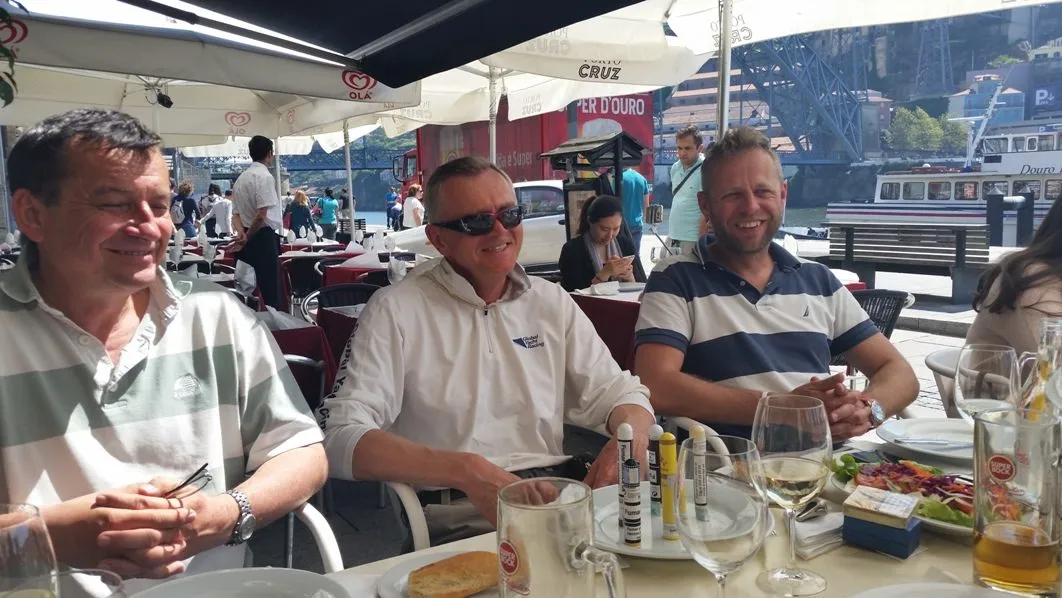
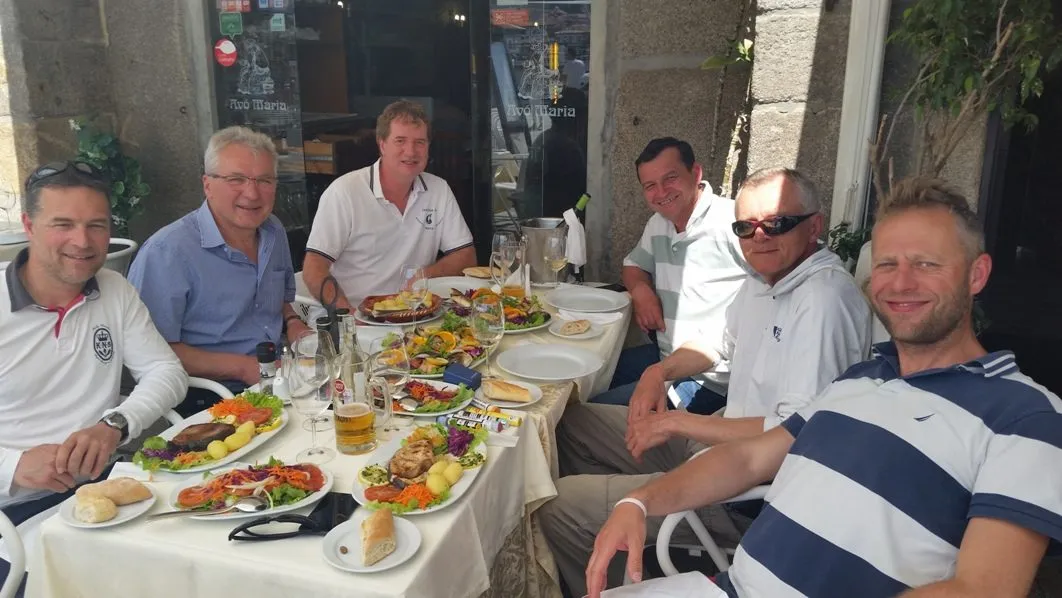
But, back to the banks of the Douro. We admired the Ponte Luís, the steel bridge built over the river at the end of the 1800s, then, with the utmost thoroughness, we picked a restaurant on the riverbank.
The Ponte Luís bridgeFive cigars and the big 6–0Landscape before battle
Zoltán treated us all on the occasion of his 60th birthday, and we surprised him with a cigar cutter and 5 different, high-quality cigars, which we pulled out of our pockets one by one. At the end we even had the local guitarist get his song plucked out for him (is that even grammatical?), O sole mio…
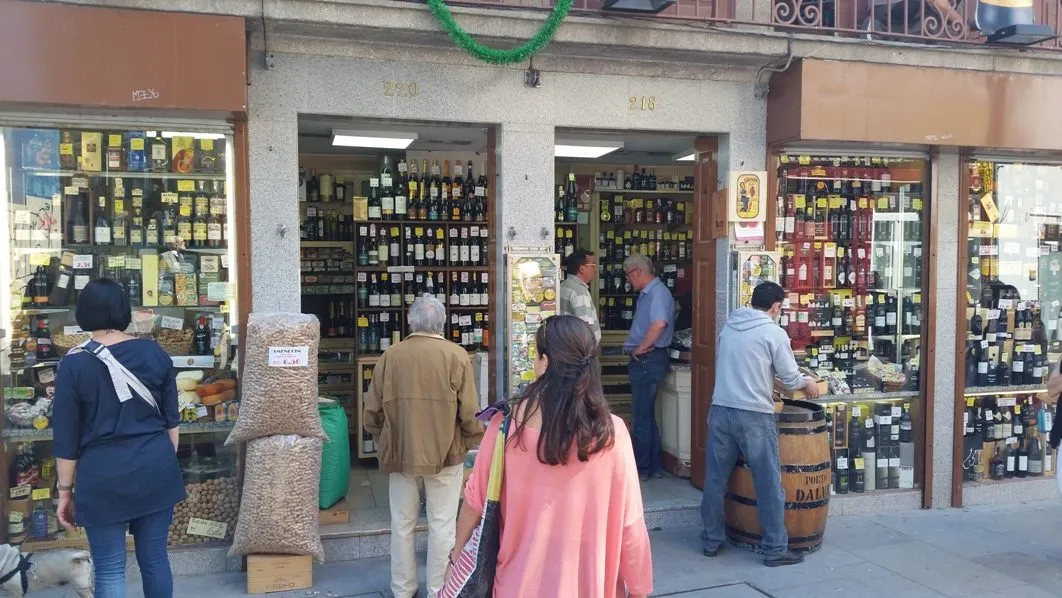
On the way back to the bus we bought a few bottles of port, Zozo bought some fishing gear for the next day’s lunch (no fish, sadly), at the marina we paid the 25-euro harbour fee, and we sailed off towards Lisbon.
At a port wine merchant’sSailing out of the harbour
I made an attempt to talk the skipper into motoring up the Douro a little – seeing as we’re here – and having a look at Porto from the river too, but, for lack of time and local knowledge, he didn’t back my idea this time.
Apparently ships lose 100,000 containers a year – I wouldn’t have believed it either – and a third of them stay afloat for a long time, posing a danger to other, smaller vessels.
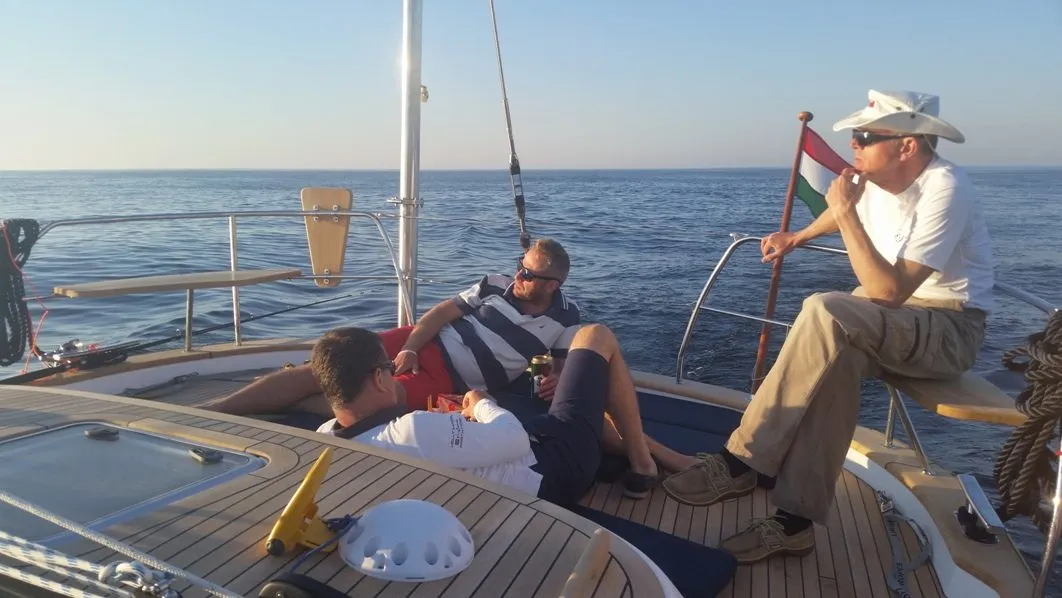
A peaceful cigar on the afterdeck
The wind was light, we had to motor, no fish took the hook, and the hazy, full-moon evening fading into fog had a bit of a Casablanca feel to it.
Machine translation (AI, Claude) of Balázs’s Hungarian original. Read the original →
· Lisbon, Portugal
We've arrived, this is where our voyage ends.
Wednesday, 12 April 2017
Day 12, 176 nm to Lisbon (Log 1636 nm)
We got our last night watch done; there was no longer any need to bundle up in our gymnastyorkas (the good old Soviet army tunic). The foggy haze condensed on the sprayhood and windscreen, so you couldn’t see anything ahead through them. We had to keep peeking out to the side to see anything ahead at all. Full moon again, but with the haze you could barely see the stars. In the moonlight I saw dolphins approaching – I’d never seen them in the evening before – and when they came alongside the port side, the red navigation light dyed the white foam red as they half surfaced from the sea to breathe. As if a shark had wounded them badly and they were trailing a wide streak of blood. It was a beautiful and slightly scary sight too. I called Gyuri twice, he came straight away, but by the time he looked out they must have swum under the boat, because they’d vanished into thin air.
At dawn Zozo and co. carried on fishing, but the fish still weren’t buying the bait. Maybe the engine noise played a part in that too.
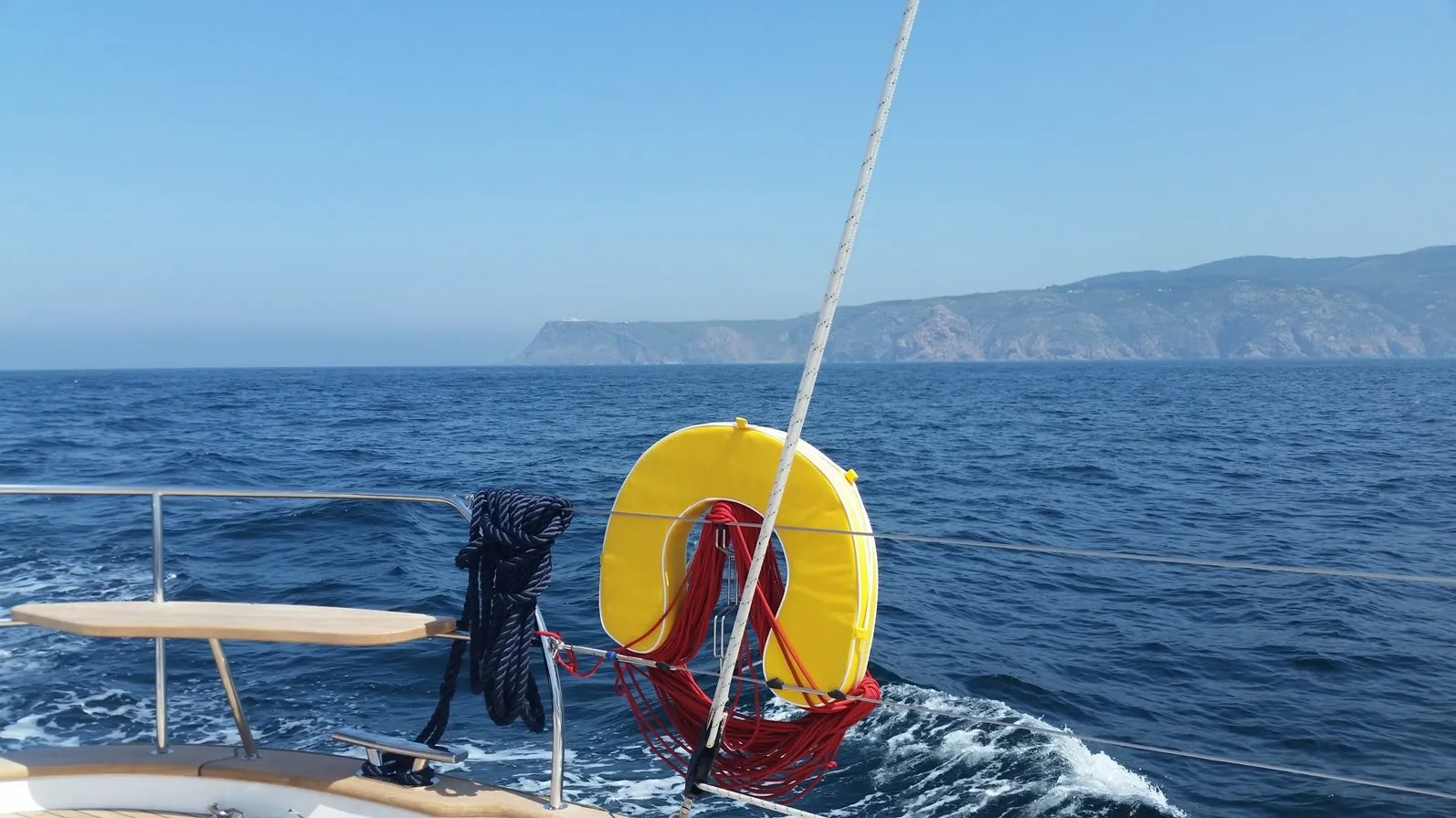
Contrary to the rota, the watches were handed over in a completely ad-hoc way, so it just happened to be me at the helm when, around 13.00, we passed the westernmost point of the European continent, Cabo da Roca.
Cabo da Roca
Since we were close to shore again here and the depth of the ocean had dropped to around 30 metres, the fishermen’s buoys appeared, so we decided to reel in the fishing line we’d let out. I didn’t take on this delicate task, and Zozo was asleep, so Tibi volunteered to wind in the string. I only found out afterwards that he really worked hard at it, he cranked the reel for a good quarter of an hour, it went terribly stiffly and just wouldn’t come to an end. The whole thing started to look suspicious to him – and/because he was well worn out too – and meanwhile Zozo woke up and finally took the rod off him. He quickly figured out that in that quarter of an hour Tibi hadn’t wound in a single metre of line, because it had got wrapped around the last guide ring at the tip of the rod and he’d only been flaying the line on the reel, that’s why it was so damn hard to wind. Zozo successfully cranked the line in, and lunch, instead of fish, became tinned stuffed cabbage with instant tarragon soup.
Our route off the Spanish and Portuguese coasts, to Lisbon
On the GPS plotter’s chart our course would have taken us through a narrow but long strip marked with a dashed green line, but we went round it with a minimal change of course and didn’t sail through it. We didn’t know what might have been marked there, but since there were lots of little submarine symbols on the chart in that area, my only guess was that that’s where submarines might surface, so better avoid it, like every place you’re not 100% sure you know what it is.
Browsing the charts, Gyuri established that at the marina he’d picked out, the one closest to downtown, you can’t take on fuel. So he decided we’d refuel in Cascais Marina, just below Estoril at the entrance to the estuary.
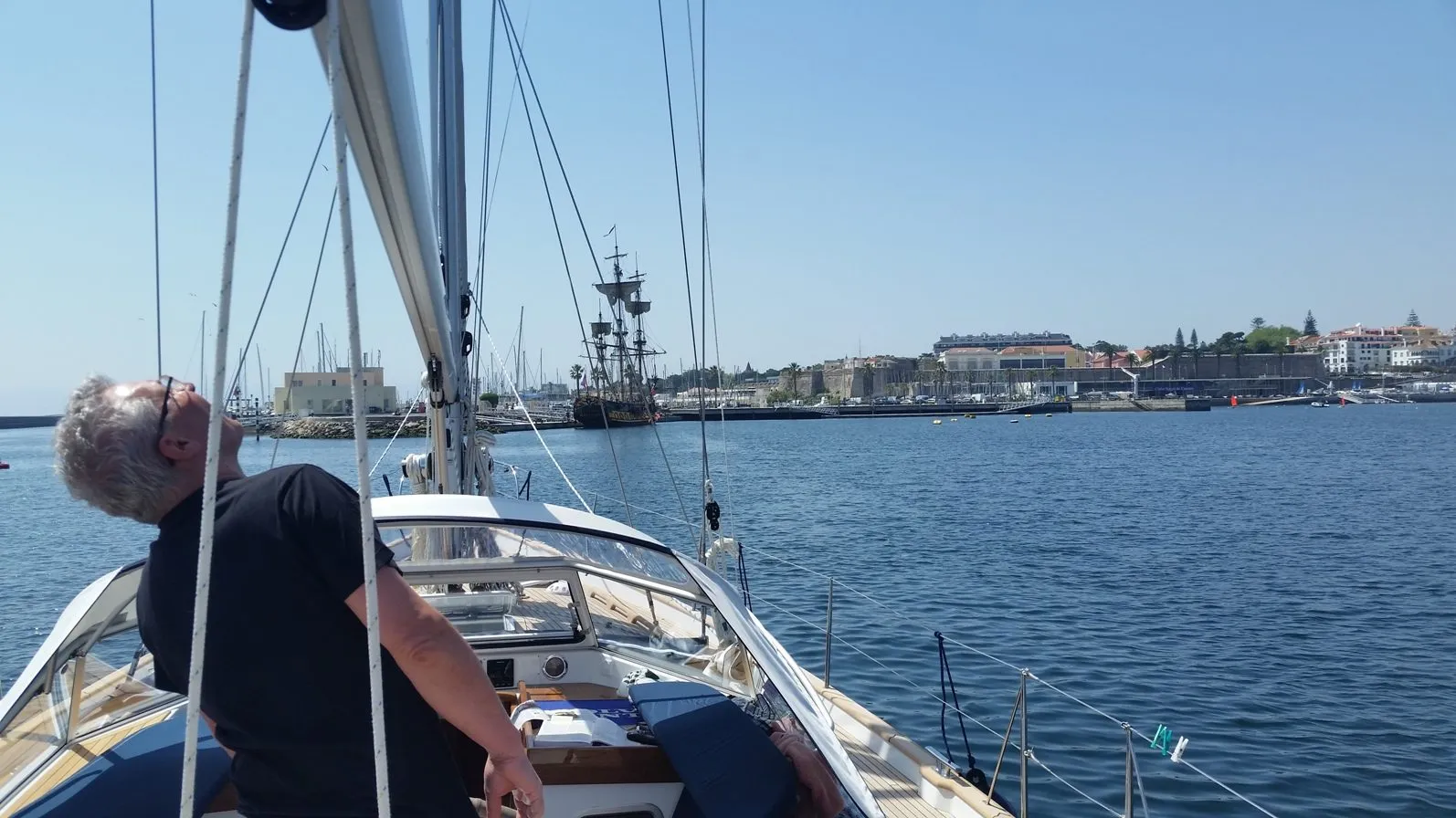
The pirates beat us to it
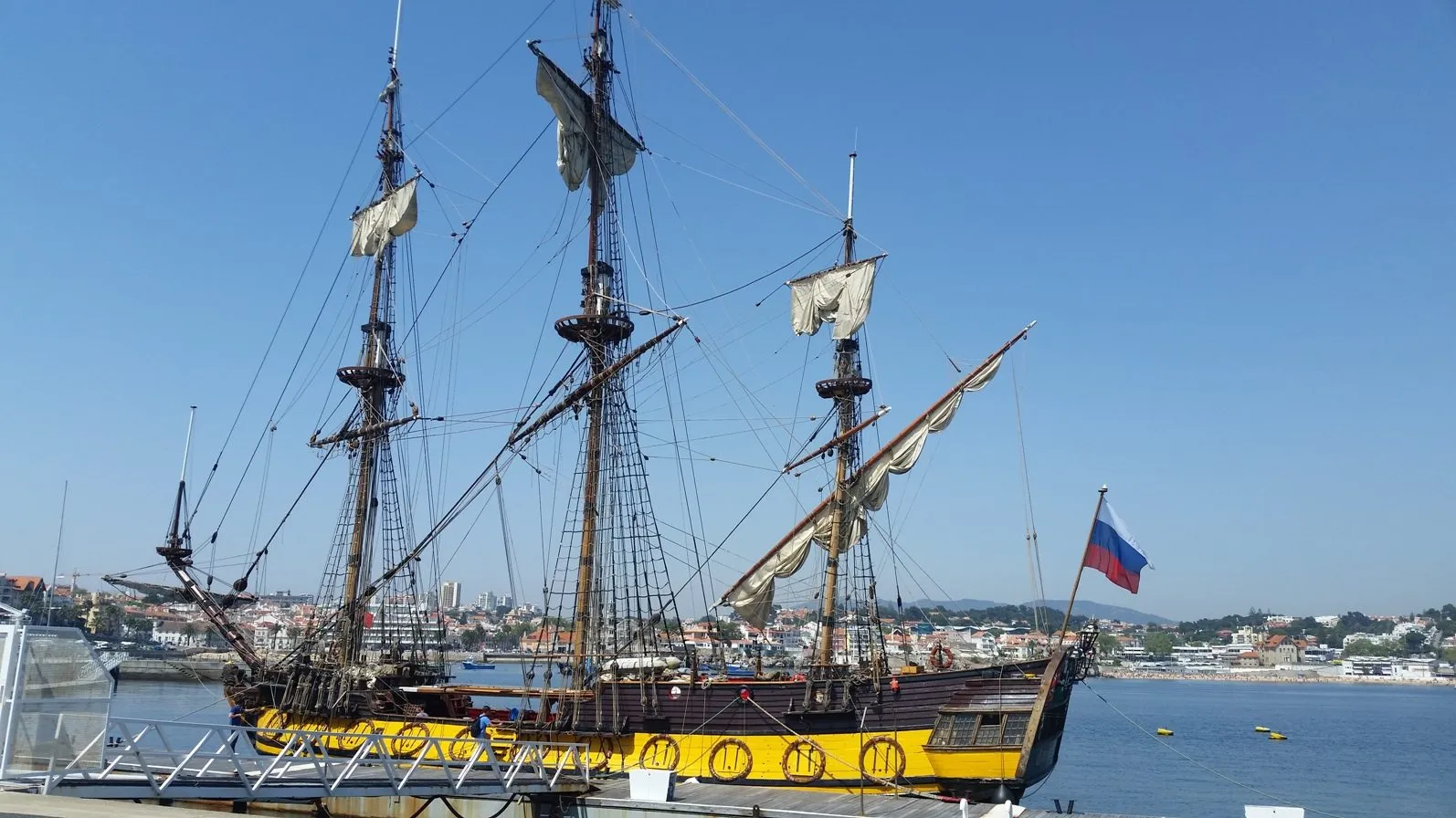
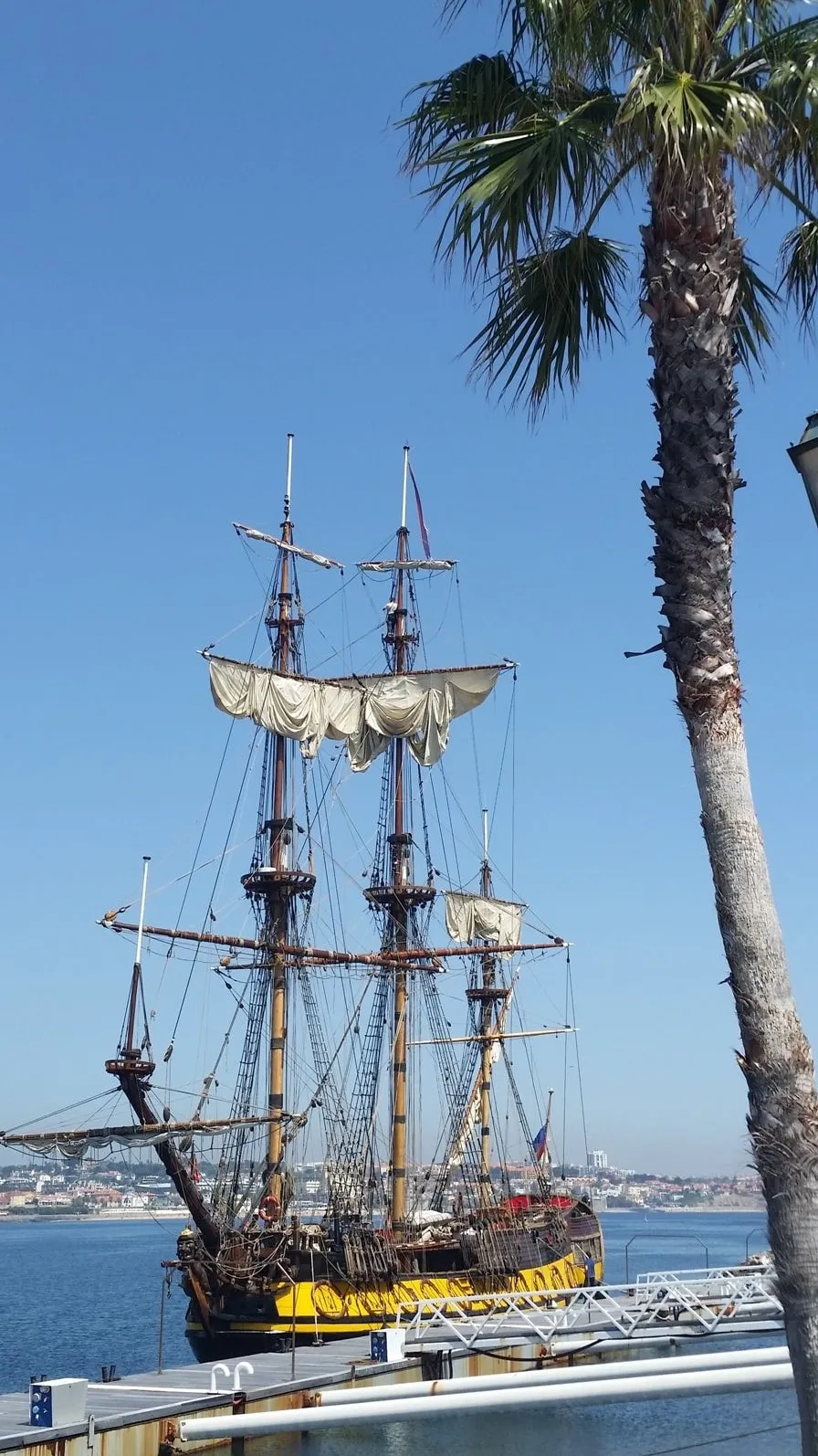
As we approached the harbour, it became more and more striking that a period three-masted wooden warship was moored at the quay. Getting closer, we could read the ship’s name: it was the 22-gun frigate Smandarmb, registered under the Russian flag, from St Petersburg. If we’d only looked at that ship and the bastions on the shore, we might even have believed time had flown us back 200 years…
This is the Russian frigate SmandarmbLike in Pirates of the Caribbean…
While refuelling it turned out that there could only have been 30 litres of diesel left in the tanks – which, given our boat’s consumption of 6 litres an hour – meant that “in case of a change of programme” we wouldn’t have had many options left, sooner or later the whole show would have stalled under us.
Here, off the harbour, the turquoise trimaran we’d already seen in the bay of Camariñas a few days ago was at anchor too.
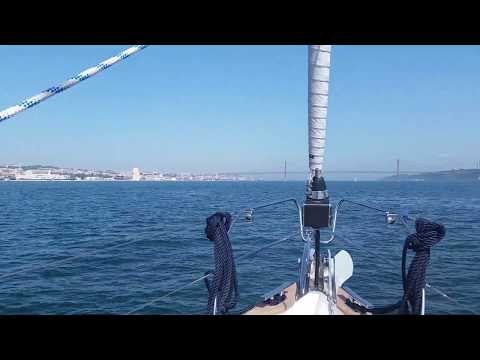
Once we’d filled our fuel tanks, we set off up the Tagus, towards the Vasco de Gama bridge. The beaches along the shore were full of bathers, after all the ocean here doesn’t get above 18 degrees even in summer, and our boat’s instruments were already showing 17.
First we passed the famous medieval Belém Tower, then the Monument to the Discoveries, shaped like a Portuguese caravel, which carries statues of the rulers, voyagers and cartographers of the Age of Discovery.
Every now and then little 10-centimetre peaked wavelets slapped up on the water, probably caused by the river water flowing down meeting the flood tide flowing up the funnel-shaped estuary.
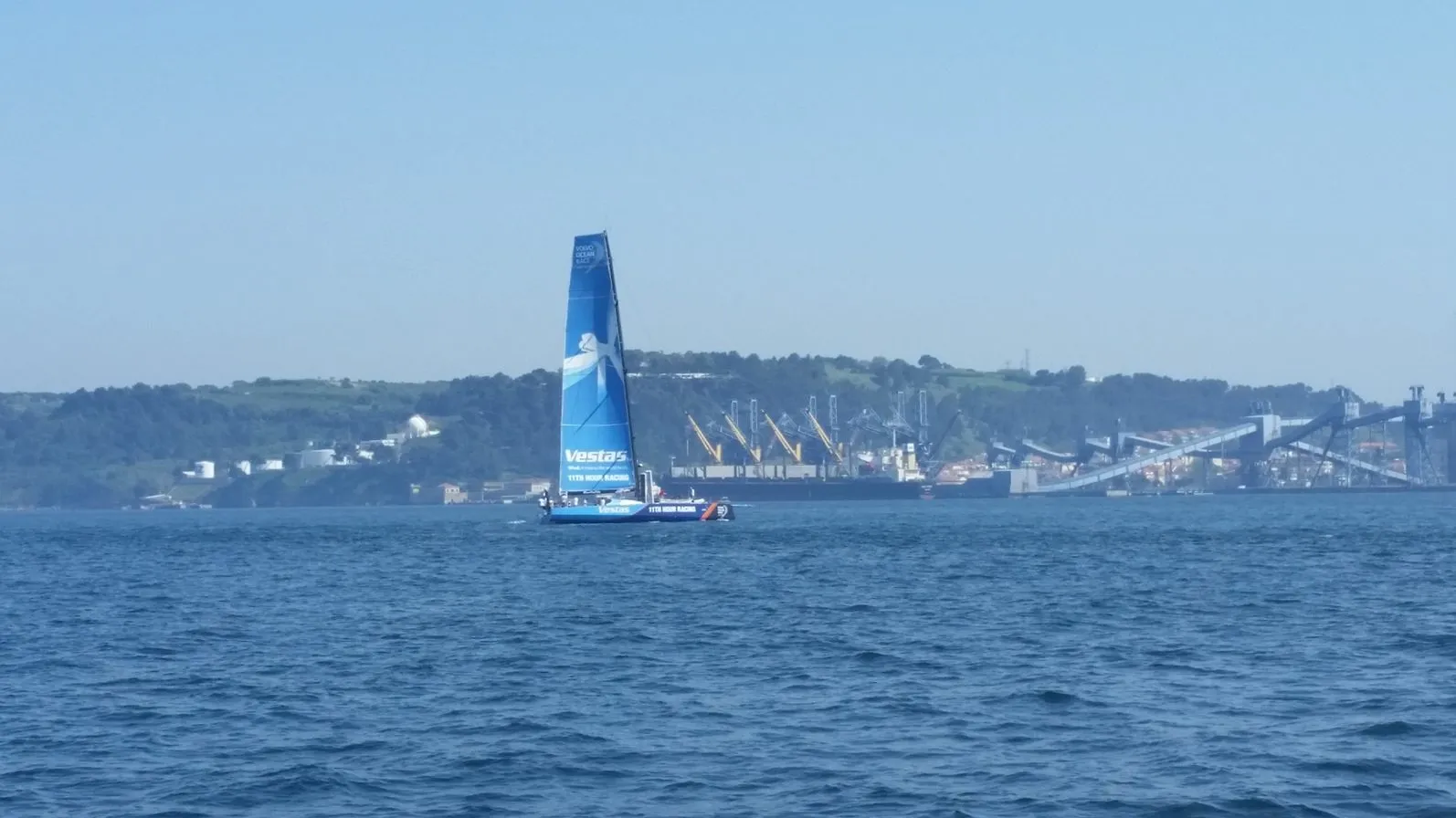
Ahead of us a racing yacht with blue sails was manoeuvring, which Zozo recognised as the Vestas that ran aground in the Indian Ocean during the last Volvo Ocean Race, so he called back to Gyuri at the helm: Careful, these guys may not know how to navigate…
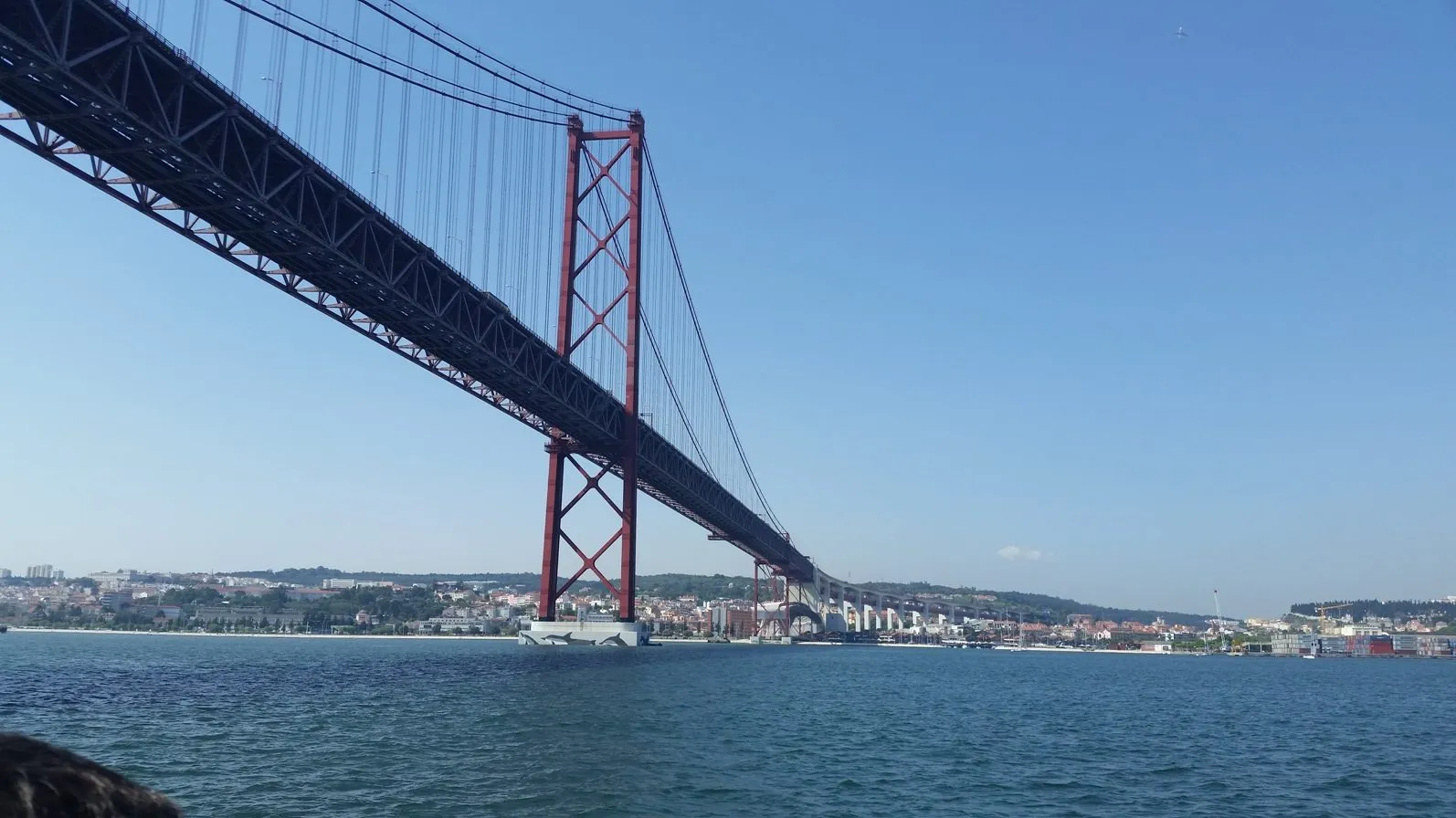
We successfully avoided them, and all that was left was to sail under the humming Vasco de Gama bridge.
As it turned out, the reason it was humming like a stirred-up beehive from far off was that on the bridge the cars, buses and lorries drive on steel grating instead of asphalt. Our Uber driver later guessed that it might be so that the wind can blow through it more easily and doesn’t twist the long suspension bridge.
This is the Vasco da Gama bridge, which isn’t
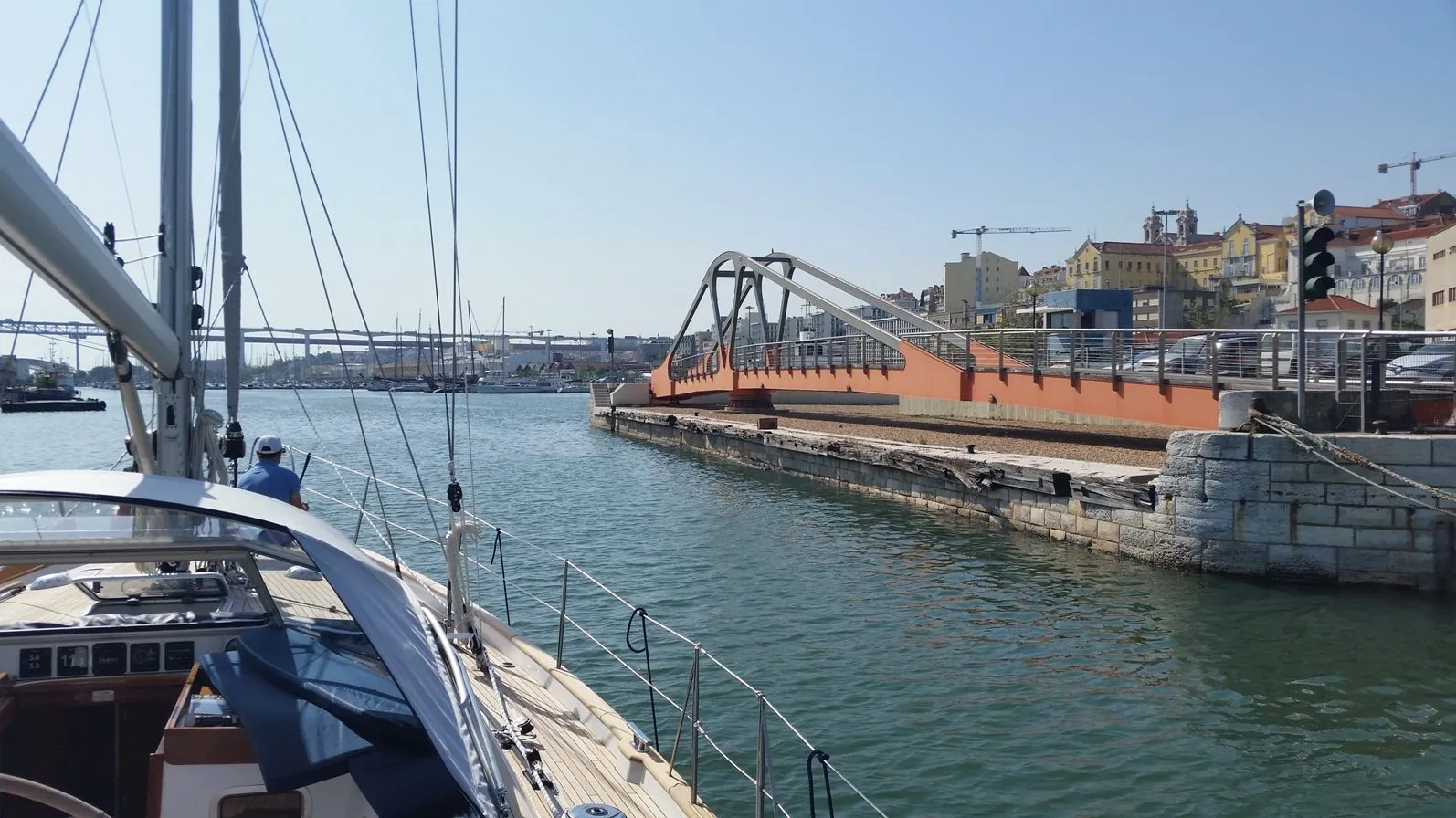
The channel leading to Porto Alcântara marina was, of course, closed off by the “usually open” footbridge, but when we called in on channel 68 they reassured us that it would open in 10 minutes.
The footbridge has been swung open, the way into the marina is clear
We couldn’t stay at the first free spot where we moored alongside, because its owner, who was out on a pleasure cruise, could come back any moment, so after much effort they directed us to berth 7/13, whose owner isn’t expected back until tomorrow.
According to Tibi, this must be the situation where if you ask by radio in advance whether there’s a free berth, they send you packing, but once you’ve got both hind legs in the door, they find some solution.
While manoeuvring into the new berth, I managed to limit the Pinta’s and the neighbouring moored yacht’s intentions of getting intimately acquainted to the thickness of one very, very flat and well-placed “laufende” (roving) fender, which in the end also marked the successful completion of the first leg of our voyage.
In the saloon we popped the champagne we’d chilled for the purpose and warmly congratulated each other on the successful voyage and our safe arrival.
We’ve arrived, now we can finally count our chickens…
Over the two weeks the little crew grew together, we teased each other no end, and I think all of us are sorry our ways are parting. We’re properly envious of the “rookies” arriving tomorrow to relieve us, because they’ll get to see Gibraltar, unless the fog gets in the way again…
But luckily for them, the chances of that are much smaller than in the Channel.
Just as a curiosity, I’ll mention that even at Lisbon’s most central marina they only asked 35 euros a day for our 15-metre boat. The Croatian price is exactly double that. Incredible. That it’s so expensive there.
We had sea bass for dinner in a little taberna near the shore, and its 7-euro price was likewise half or a third of what the Dalmatian robbers charge. That’s how it is. Such is the fleece market.
We wrapped up the evening with cigars and cocktails at a pleasant waterfront bar, and then, before bed, we rescued one more bottle of red wine from the decay awaiting it.
Machine translation (AI, Claude) of Balázs’s Hungarian original. Read the original →
· Lisbon, Portugal
Washed ashore in Lisbon
Thursday, 13 April 2017
Day 13, 14,524 steps
Our relief crew had already arrived in Lisbon last night. Gyuri had ordered them aboard for 9, and by then we had to pack up and clean the boat too. Gyuri took most of the cleaning upon himself, so first we got squeezed out of the inside of the boat onto the deck, then off the deck onto the pontoon. We were done, we could have left, but we wanted to meet our successors and pass on a few good tips. For example: “The skipper likes to plot our position on the chart himself, so feel free to wake him up every hour. He might look a bit grumpy, but don’t let appearances fool you, he’ll actually be very grateful to you, he’ll be glad from the bottom of his heart, though he’ll hide it well”. I won’t share the rest of the sparkling ideas with you now, because you might draw the wrong conclusions from them…
I was just heading for the marina’s keypad-locked entrance gate when I noticed three gentlemen with suitcases deliberating on the other side. I told them the code in Hungarian, their jaws dropped, they came in, we introduced ourselves and they asked: “So you’re Balaja, then?”
(Whoa! So somebody does read my blog after all…)
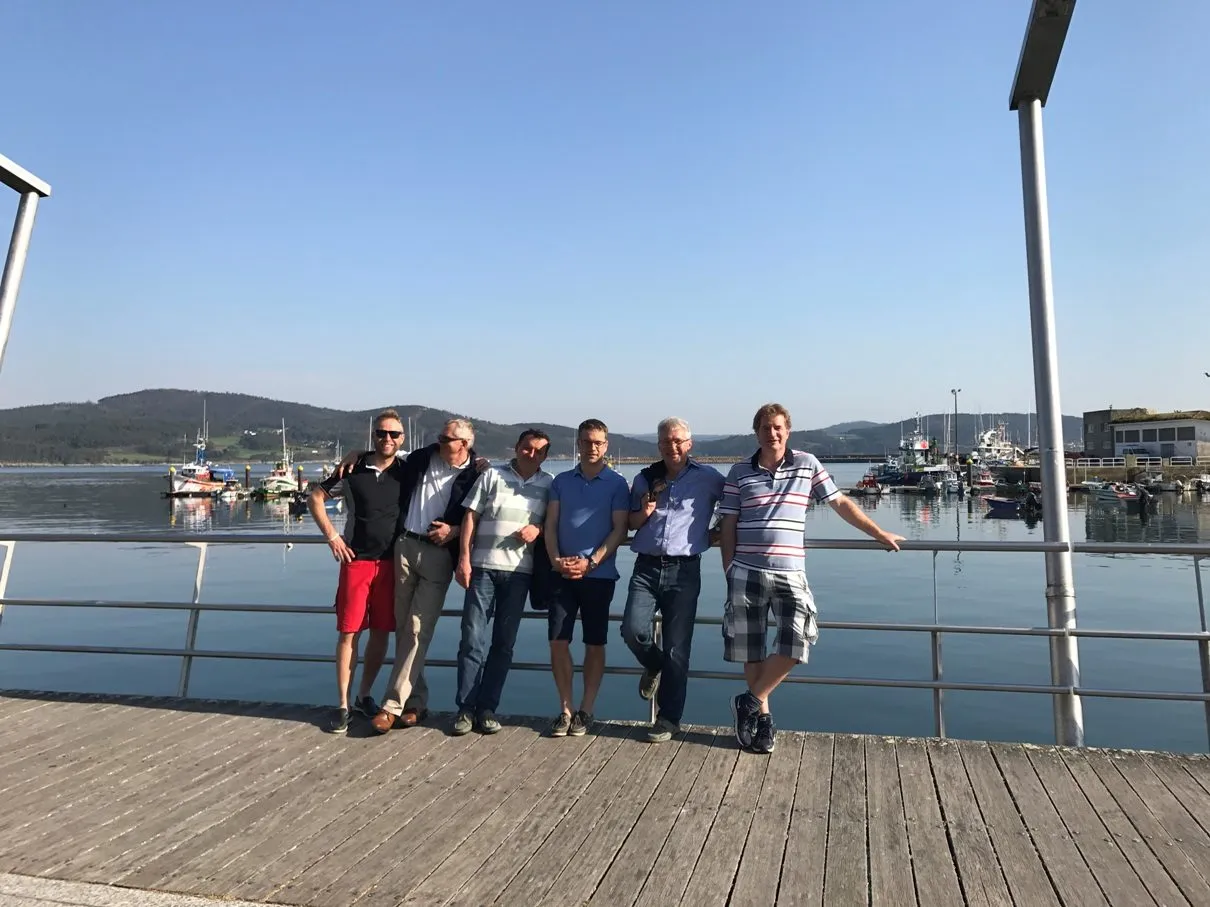
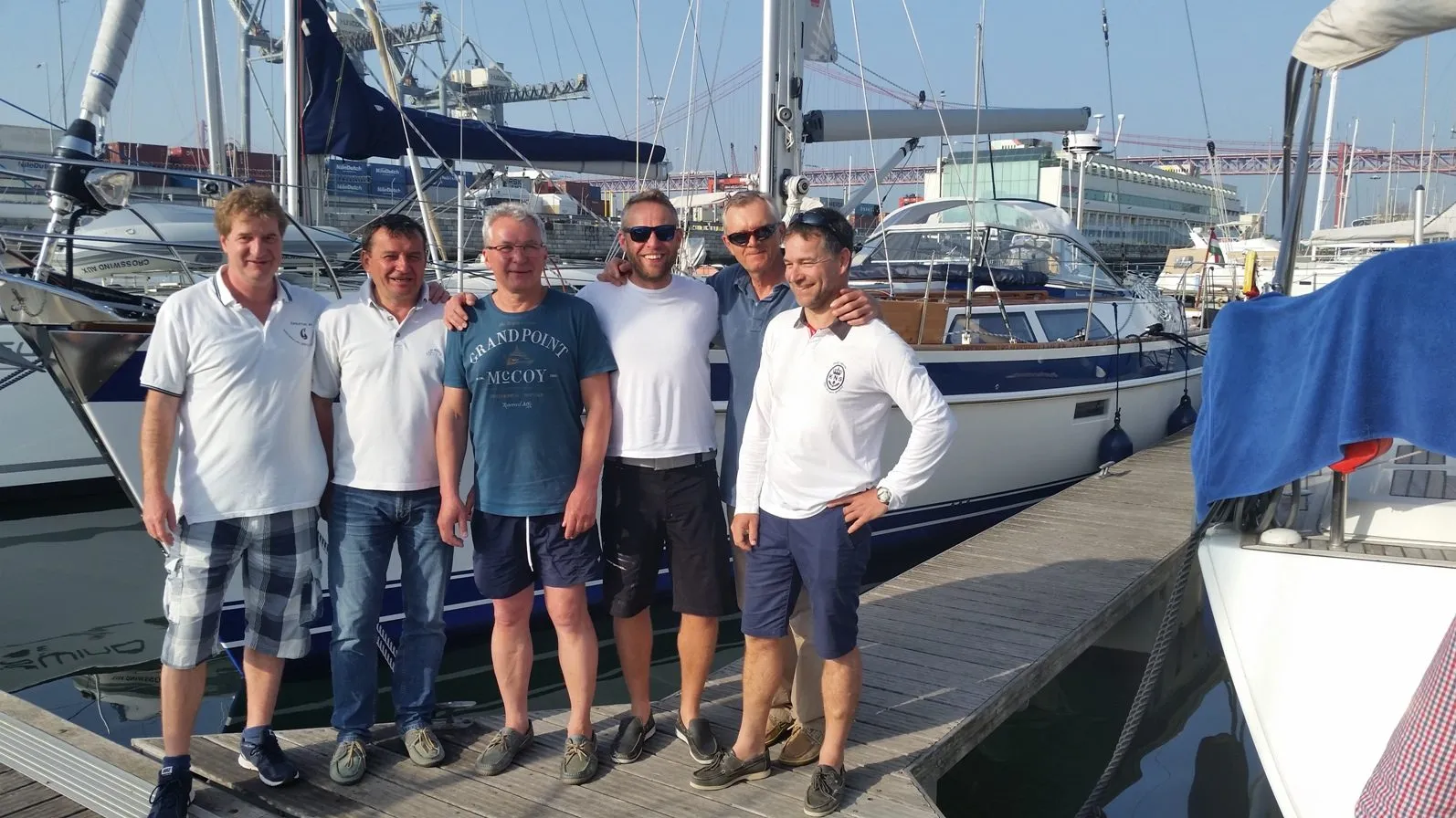
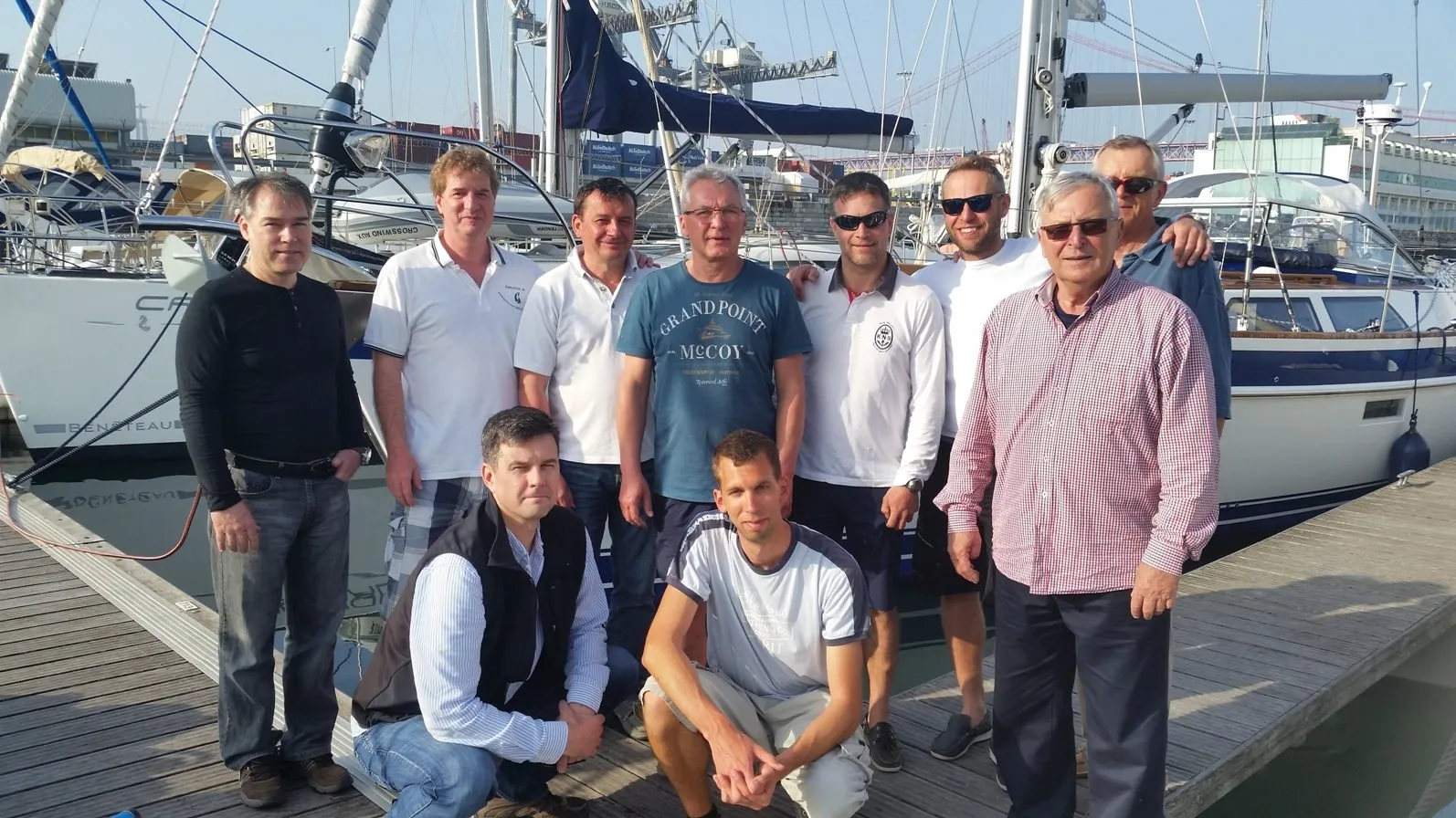
“In person.” I led them to the boat, where we took a few more group photos for the album, and then we rolled… our suitcases out of there.
One more group photo for the album. The blues sail on, the whites fly. Home, that is…The relief has arrived
Leaving last, I can still hear Gyuri’s first words of briefing to them: “Which of you snores?”
In the end we left without passing on the good tips, but they looked like capable lads. András let slip that he’s also planning to write a blog at www.lapinta.blog.hu. I hope he manages to sing the story of the Pinta’s further voyage, because I’m very curious about it myself.
They still had shopping to do (because the beer supply had somehow, mysteriously, run out completely), and then around noon they set off towards Gibraltar. I know this because I left the SPOT satellite tracker with them, so that we can follow their progress and route too.
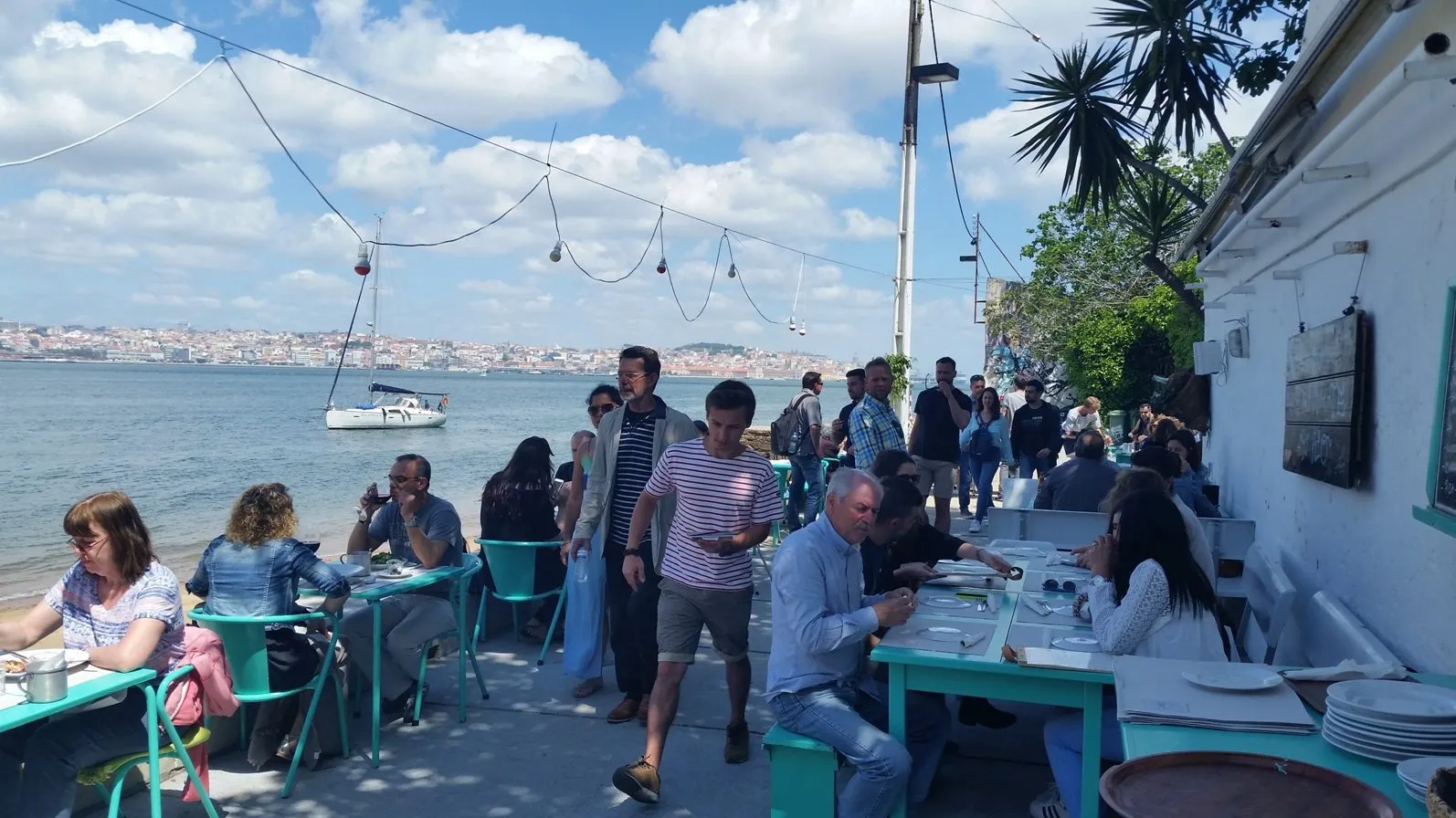
We Ubered over to our accommodation, dropped off our suitcases, and set off on foot to see the sights of Lisbon. In most places the beer was cold, but sometimes we only got a table with great difficulty.
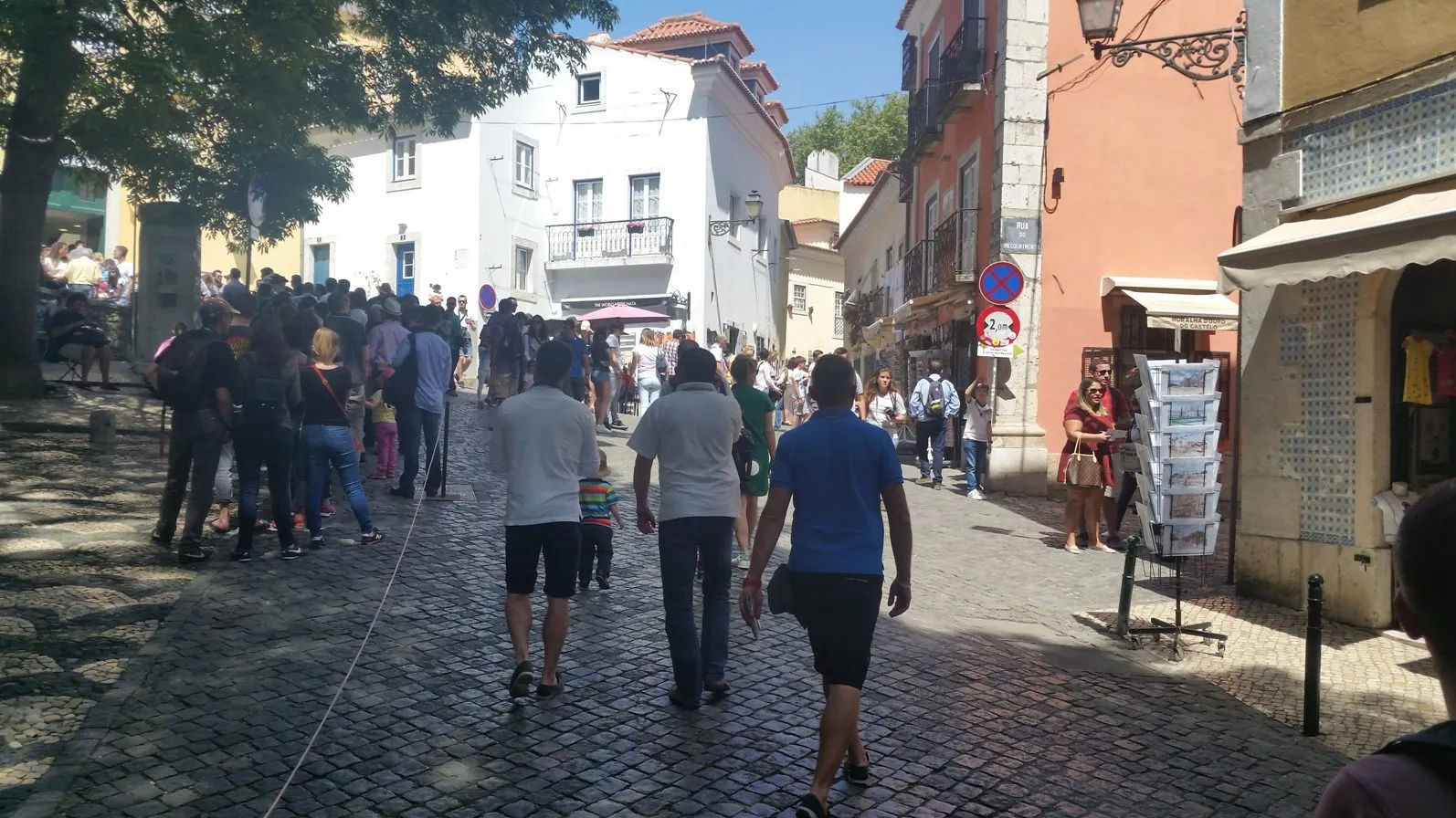
We climbed up to the castle too and very nearly went in, but a damn long queue snaked in front of the entrance, so we very quickly agreed that the time was long since ripe to find a homely little restaurant and have lunch. This time our choice fell on a little pizzeria. You can tell it really was well past noon from the fact that when we ordered, it turned out: they’d run out of pizza! Un-pizza-lievable. The waitress, however, warmly recommended some grilled bread, a sort of Portuguese speciality. We ate it, it wasn’t bad, but it’s not what we’ll be pining for Lisbon over.
Told you the queue was long,,,
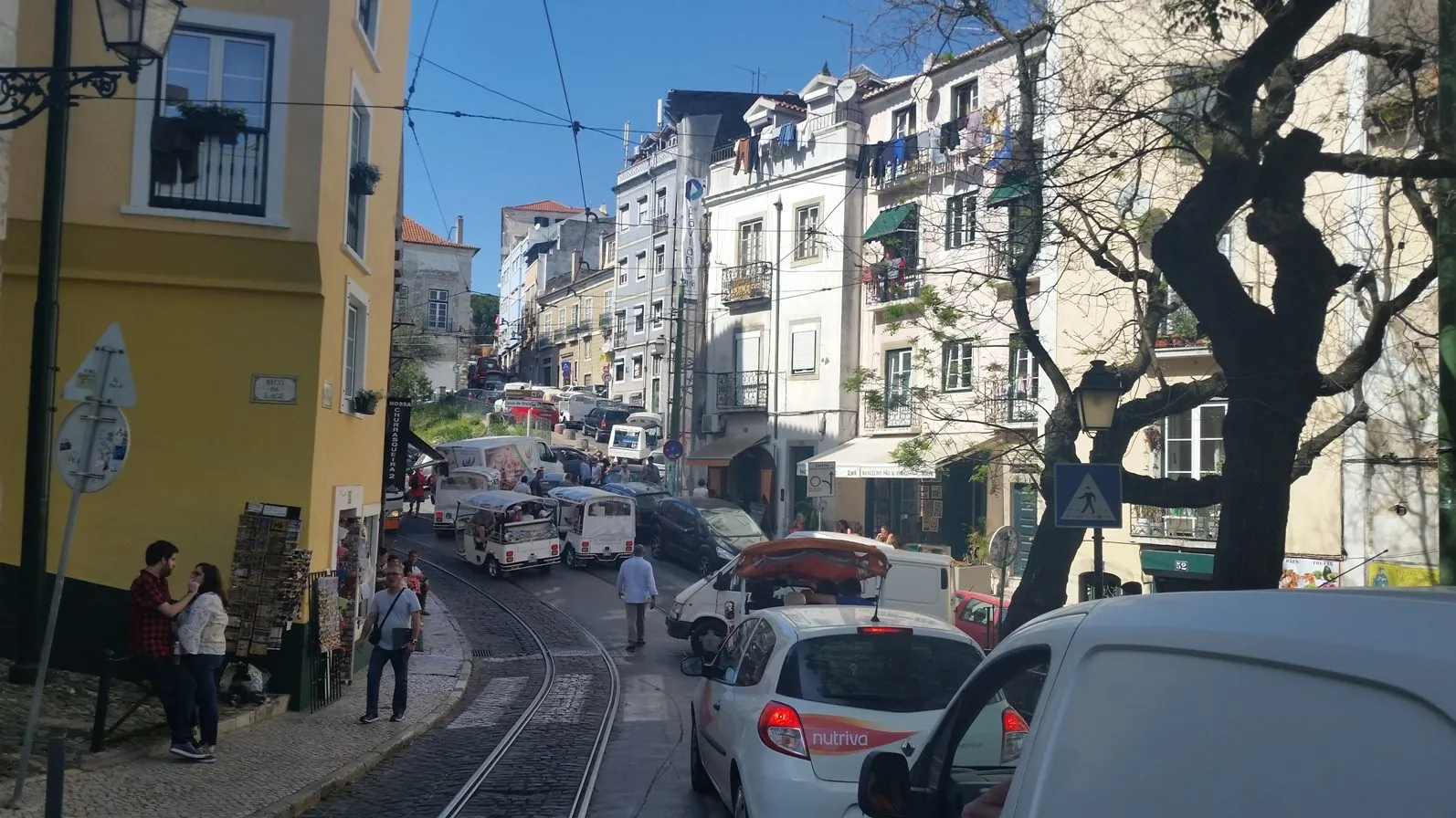
On the way home our route led through the Arab-Asian quarter of the old town (seasoned with a tuk-tuk traffic jam), and after we’d luckily found our way back to the hotel, we agreed that it wouldn’t be wise to stray that way again after dark.
Tuk-tuk traffic jam in Lisbon
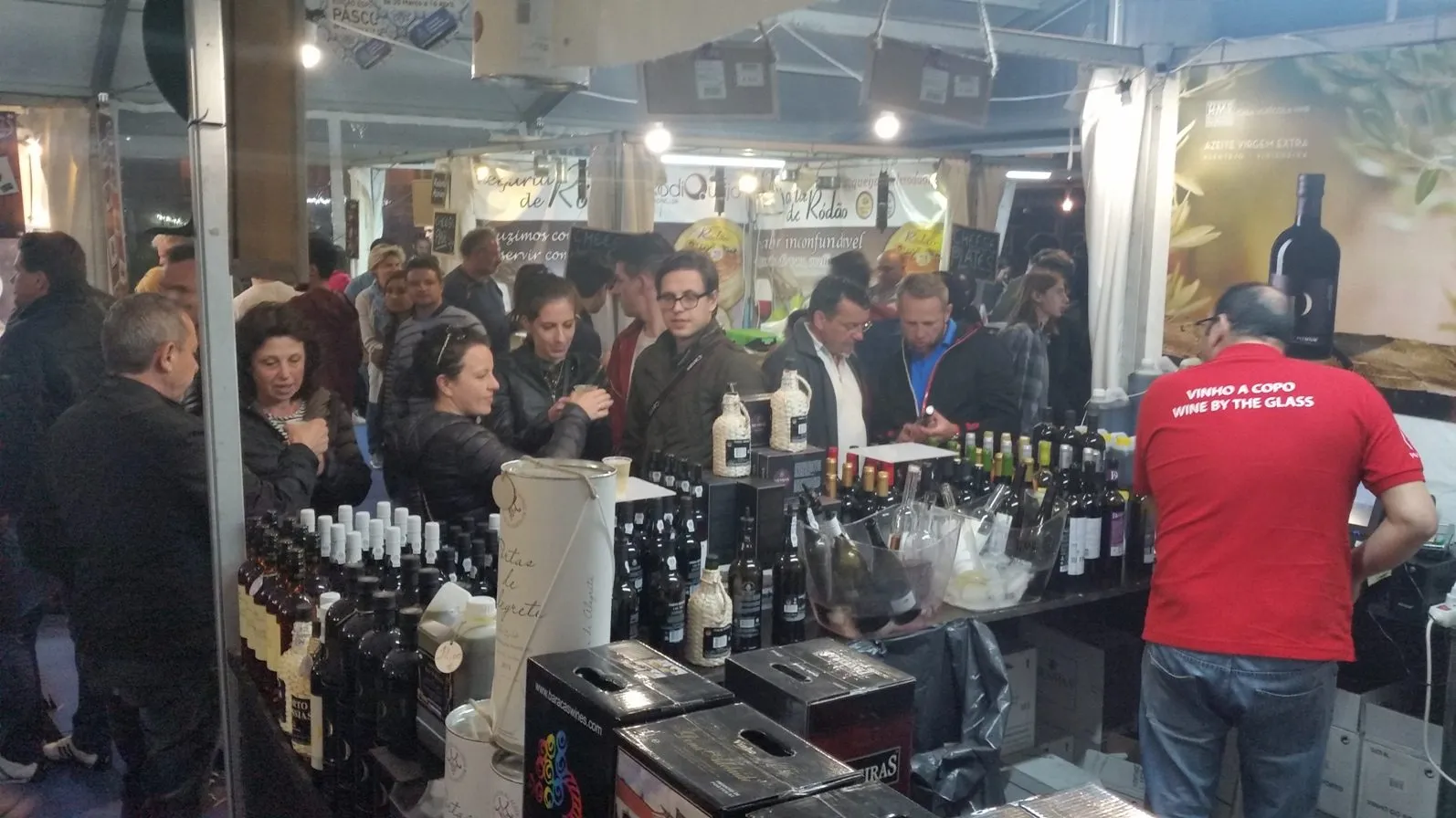
After a healthy afternoon snooze we strolled into the centre in the evening and grabbed a bite in the tent set up on the main square. There was a fairground grill stall, a wine seller, sangria, ham and cheese counters, and a small-scale tinned-fish producer too. He sold tins he’d filled himself, and recommended a nice little restaurant for the next day on the far side of the bay.
During our evening stroll through the city, coconut sellers kept offering us their wares all night, quietly stepping up to us: Coco???, but I never saw their stall anywhere…
We wandered down to the riverside too, where two musicians were conjuring a mysterious, oriental mood into the moonlit Lisbon night.
Machine translation (AI, Claude) of Balázs’s Hungarian original. Read the original →
· Lisbon, Portugal
Home again, with one more adventure in my kitbag
Friday, 14 April 2017
Day 13+1,
In the morning we packed and began preparing for the journey home on a café terrace. We planned our day precisely, so as to get out to the airport in good time in the afternoon before the flight. We got so carried away talking about sailing and circumnavigation that we were already running a bit late.
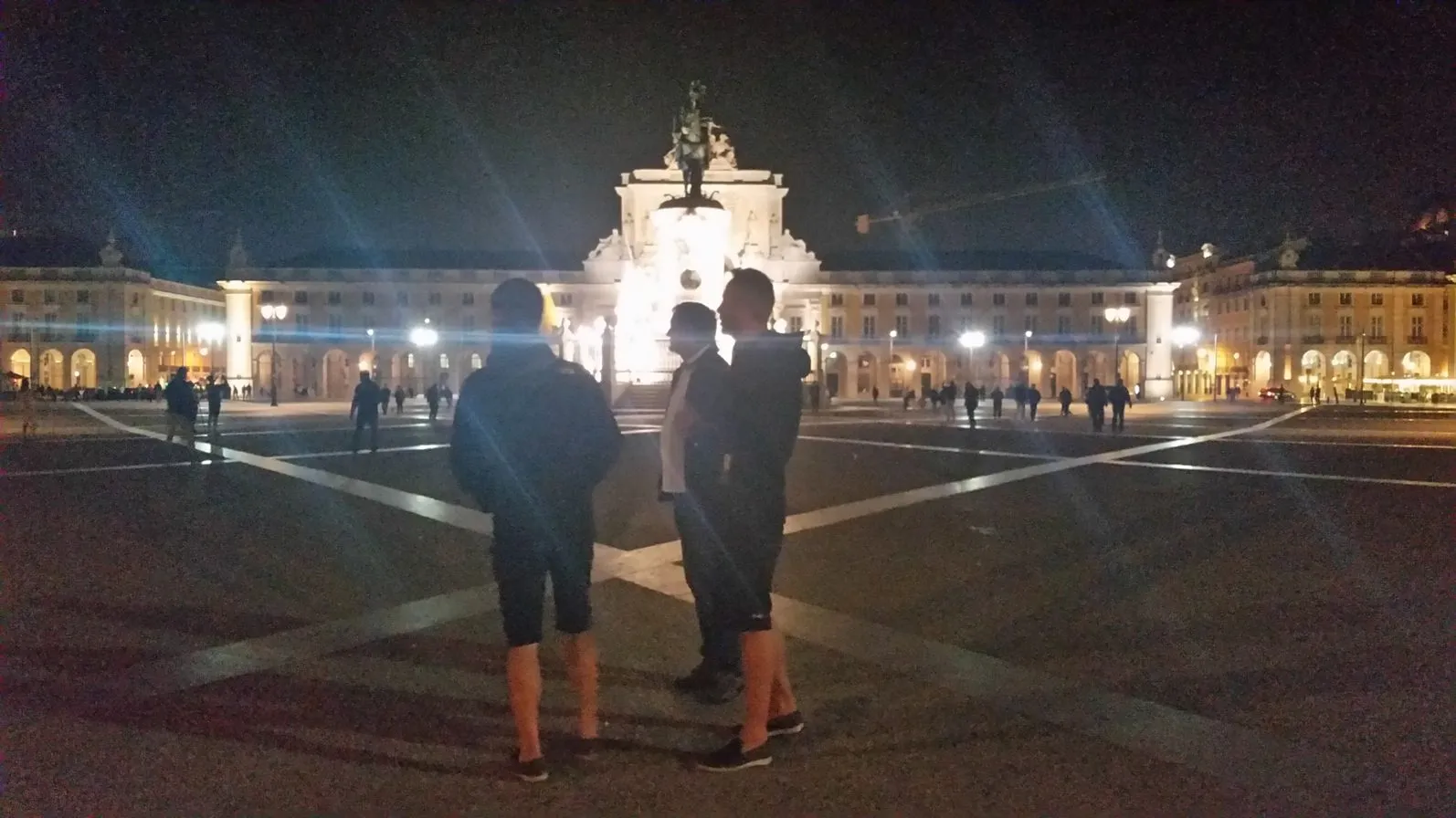
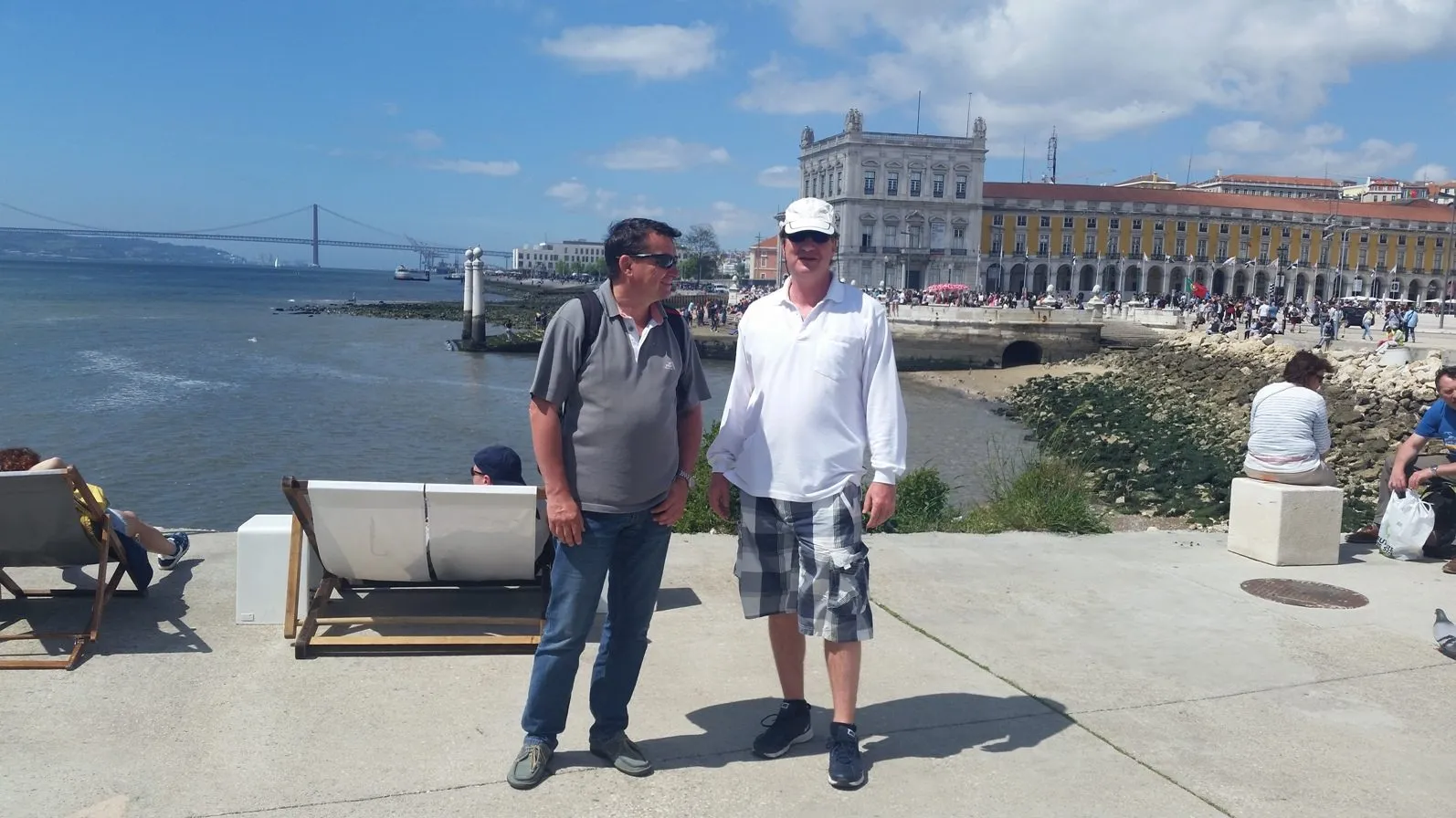
But where do the ferries leave from? – Last night’s square by day, at low tide.
We piled on some more at the ferry, because the machine’s 4-trip ticket was good for 4 trips, but only for one person, so at boarding three of us were left outside the barrier, got to buy 3 return tickets at the ticket office, and got to wait half an hour for the next ferry.
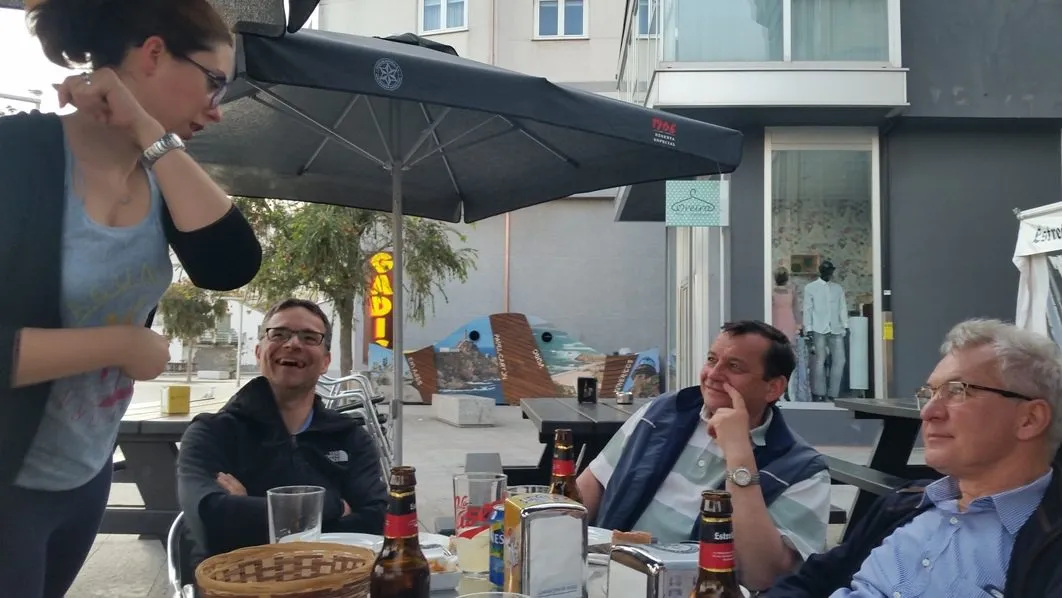
The restaurant on the far side really was very atmospheric. Just the kind Gyuri had been longing for in the previous harbours. I only hoped they weren’t serving the fish of last night’s tin-seller who had recommended this restaurant. We had no reservation, so we got to wait another half hour, until it turned out that the people a table had been waiting empty for the whole time weren’t coming.
Waiting for a table – Back there, the blond guy with the tray became our “friend”, but we had no idea yet.
I’ll tell you about the waiter in a moment.
I’d have taken him for a Russian sailor, but never mind – luckily we’re not all the same – we ordered a bottle of wine and four octopus starters. We got no further, because:
FOUR OCTOPUS? – he asked, in a “you lot are not normal” tone.
Four. – We answered, a bit unsure of ourselves now. (There are four of us, can’t you see?)
Why four? – he asks again.
Excuse me??? So he understood the four, but then what on earth is his problem?
What’s wrong with 4 octopus? – we wanted to know, because by now we really felt like idiots.
Well, you come all this way, here to Lisbon, and you order one thing, instead of tasting lots of different things….
Ohhhh! So what do you recommend?
In the end we ordered 4 kinds – the ones he recommended – 3 were a hit, and one was a little dish of fried sausage, which had already been coming out of our ears the evening before in the tent. Fine, there’s nothing wrong with a waiter recommending local specialities, just as long as the style isn’t so slappable…
Our all-knowing friend, of course, forgot to put our main courses through to the kitchen, and that only came out when, after half an hour, we started enquiring more and more impatiently. Time was tight – the plane doesn’t wait – and by then we’d started knocking together plan C, combined with hijacking a ferry.
Our Igor couldn’t have been in this situation for the first time, because a few minutes later he was bringing out our fish one after another, obviously diverting the neighbouring tables’ orders to us. :))
The delicacies got shovelled in, the tip got skipped, the bill nearly did too, the plan-Z ferry – which we absolutely had to take back to the airport side – was approaching the pier twice as fast as we were, so full bellies or not, siesta time or not, first at a race-walking pace, then at a marathon-runner’s gallop, we charged all the way to the ferry terminal building. We got there at the very last moment, only to …. wait exactly another quarter of an hour for the boat to head back…
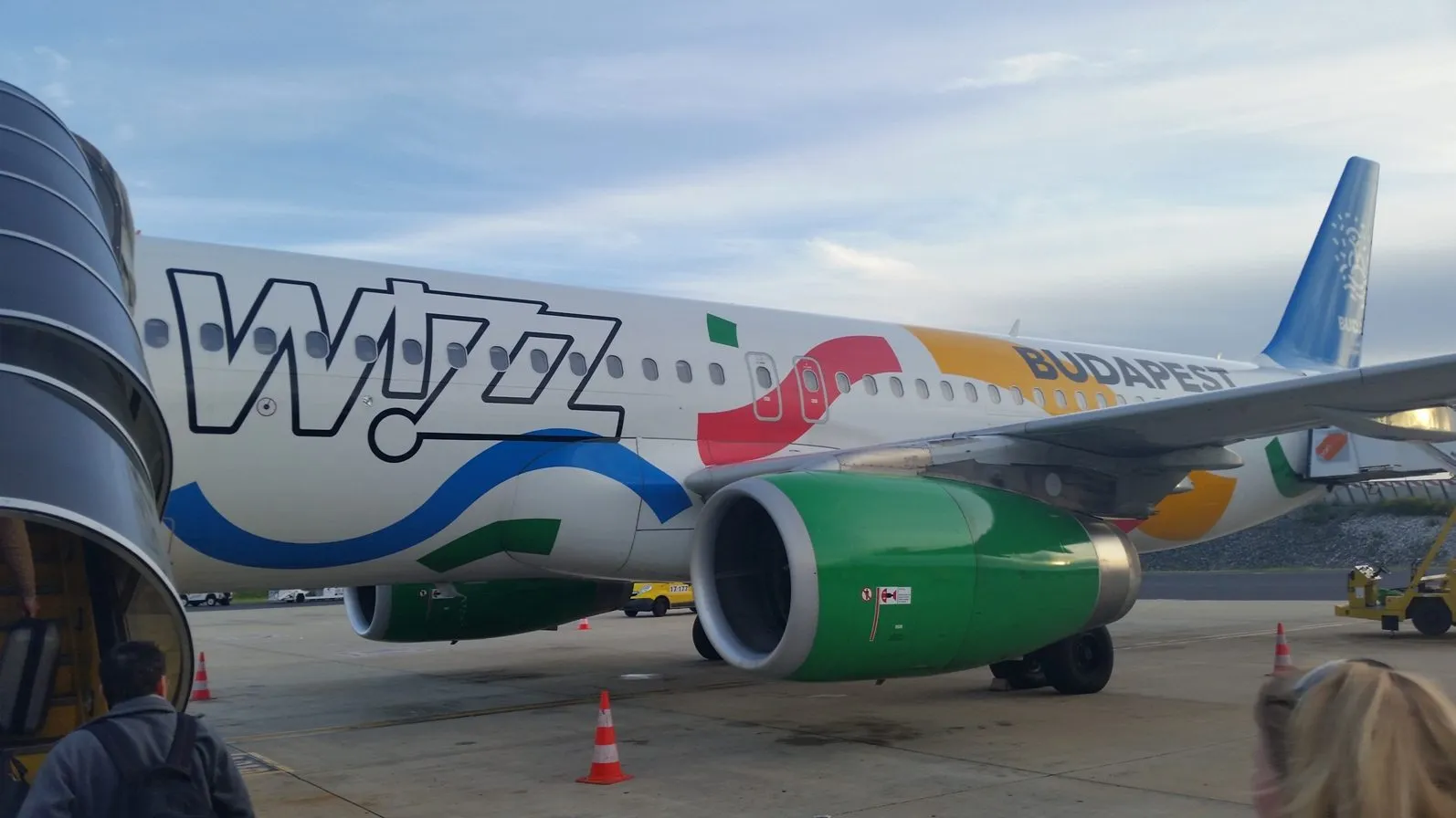
From there, however, everything turned out fine: Uber sent an estate car, which fitted all four of our sea bags at the hotel, we got to the airport in time, went through security and our flight was ready for departure, with a half-hour delay. Wizz Air’s plane, painted in the colours of the Budapest Olympics, brought us home to Ferihegy, and from there, after a two-hour drive, I finally got home safely. Because a voyage doesn’t end with mooring; it’s only successfully completed once everyone is home safe and sound.
A spectre is haunting Europe, the spectre of the Budapest Olympics
True, it was decided two months ago that, after the joint support ended, these Olympics won’t be held in our country, but we’re still going to be flown home by a Budapest Olym-pissed Wizz Air plane…
Thanks to Neptune for being gracious to us all the way, to Gyuri for the opportunity to get to these parts as a member of a great crew and to be the chronicler of the Pinta’s first voyage, in the month of April in the Year of Our Lord 2017.
Balaja
Correction
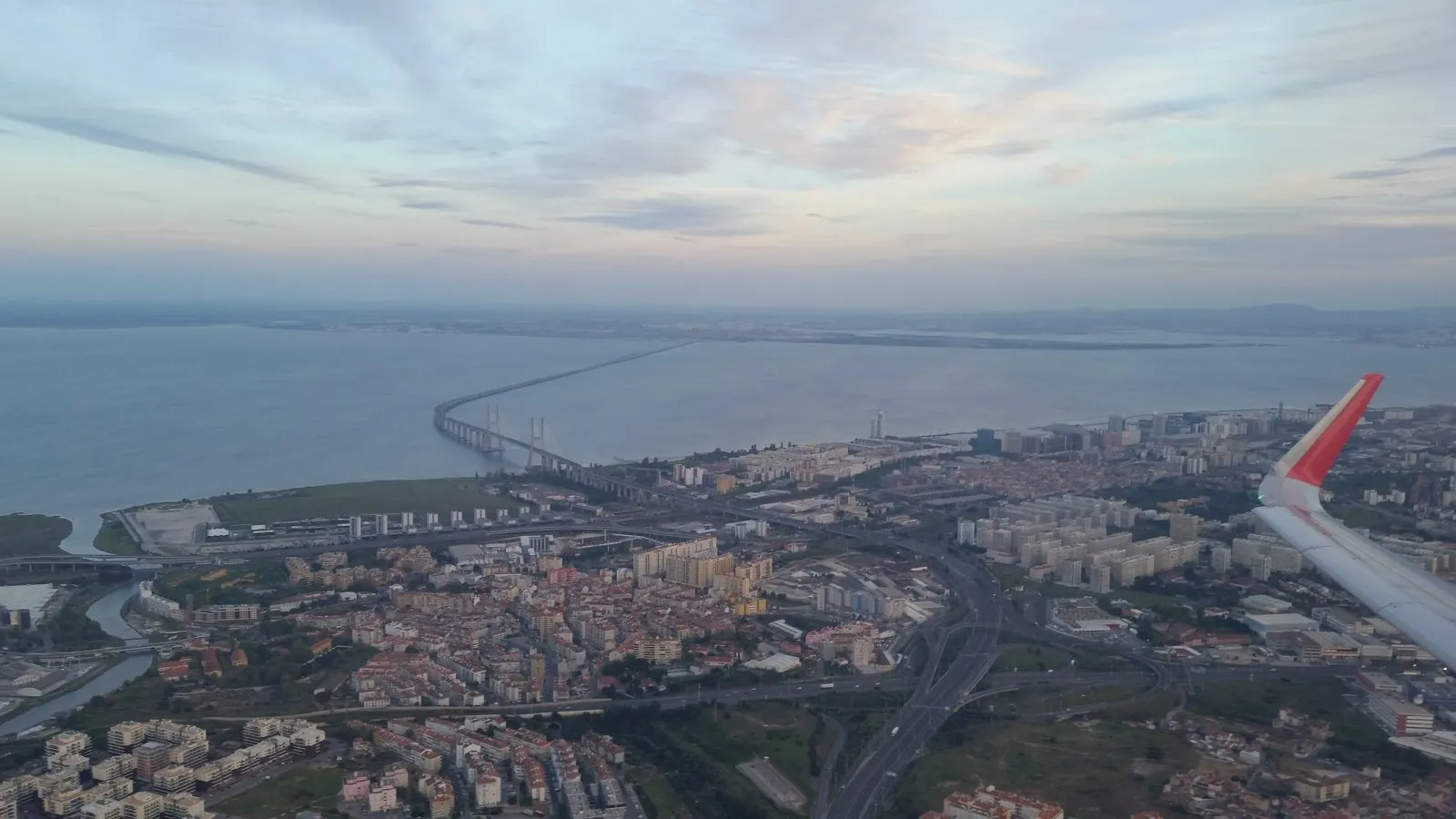
In my blog I falsely spread the word far and wide that the big red bridge in Lisbon – the one we sailed under too – is called the Vasco de Gama bridge.
The truth, by contrast, is that the bridge was named after my father’s birthday, that is, its name is**:**
25 de Abril Bridge (25 April Bridge).
A little further up the Tagus there’s a bridge which isn’t as spectacular, though admittedly it’s longer and newer and I’ve even crossed it, back in 2006 – well, that one is actually the Vasco de Gama bridge. We even flew past it on the way home.
The Vasco de Gama bridge. This one’s the real one…
I don’t know why I mixed the two up, maybe I felt a great explorer deserves a great bridge, but now that the truth has come out, I can see that my father’s birthday really does come first after all…
Even for the Portuguese…
Dear Reader!
One way or another, you’ve reached the end of this story. If you liked it, please click the blue like button at the top/beginning of the page (I switched it on on 7 January 2020), I’ll be very happy about every bit of feedback.
Balaja
Machine translation (AI, Claude) of Balázs’s Hungarian original. Read the original →