Carusoon World Tour

From Cape Verde to the Adriatic (2019)

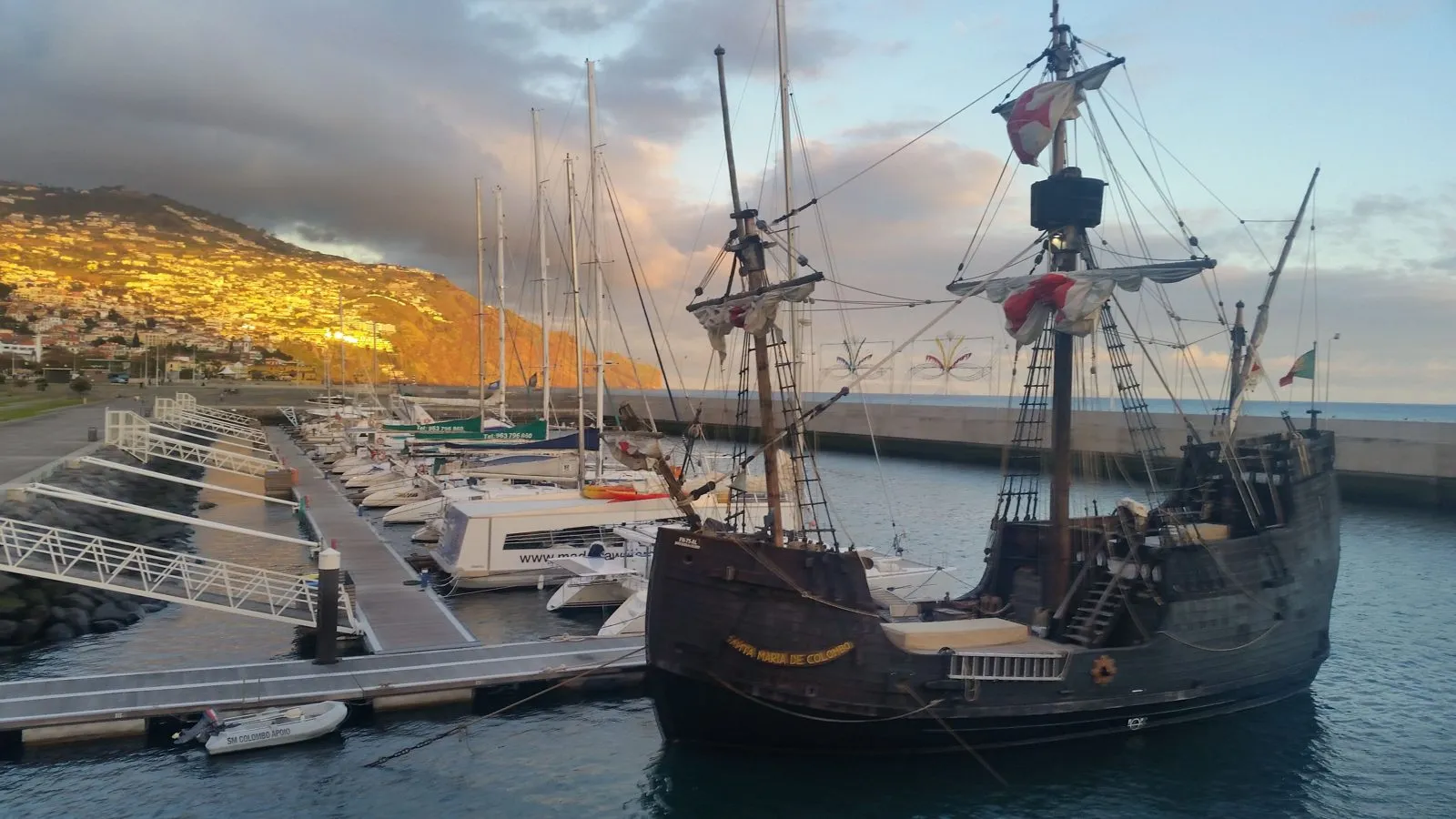
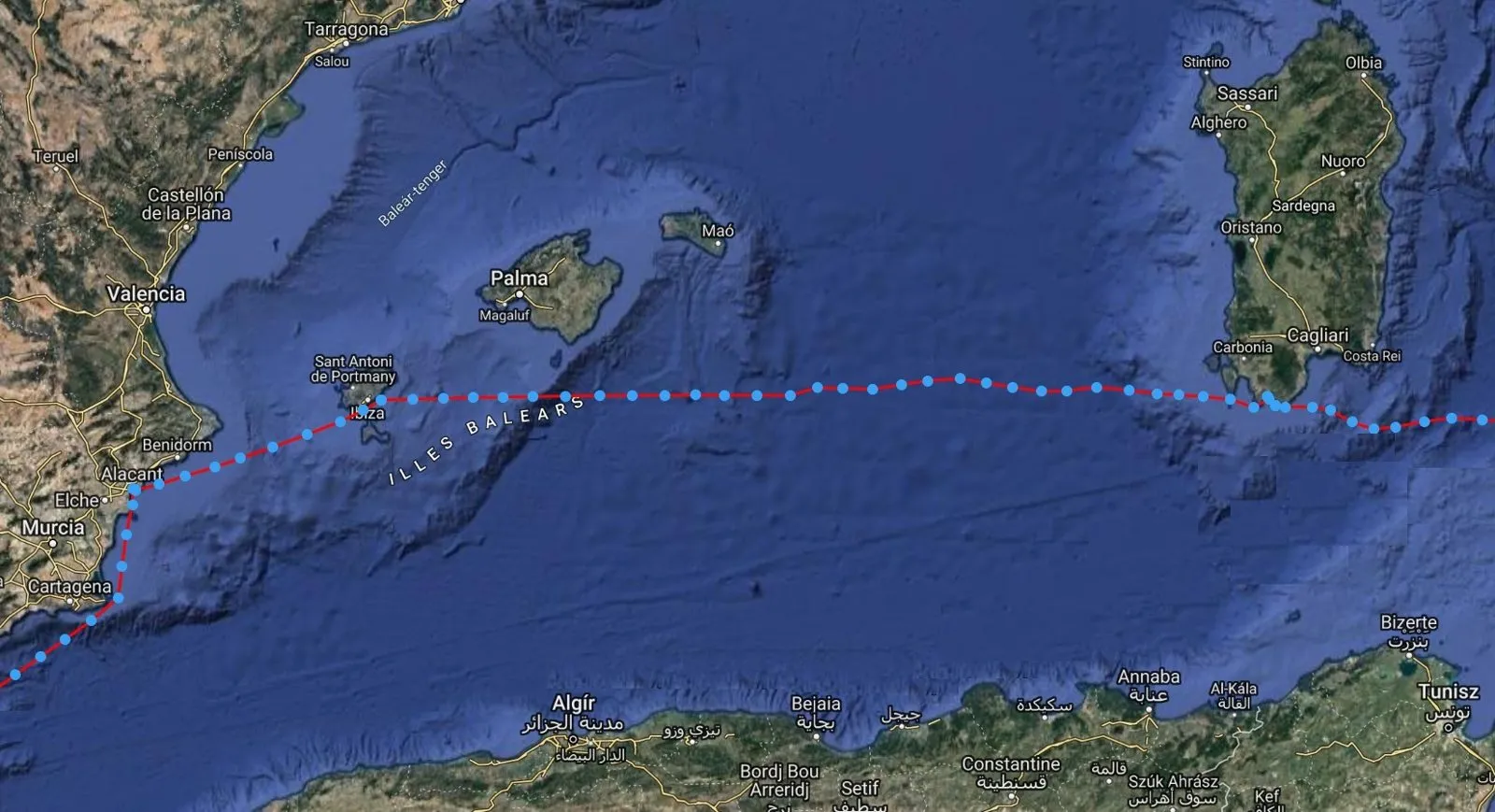
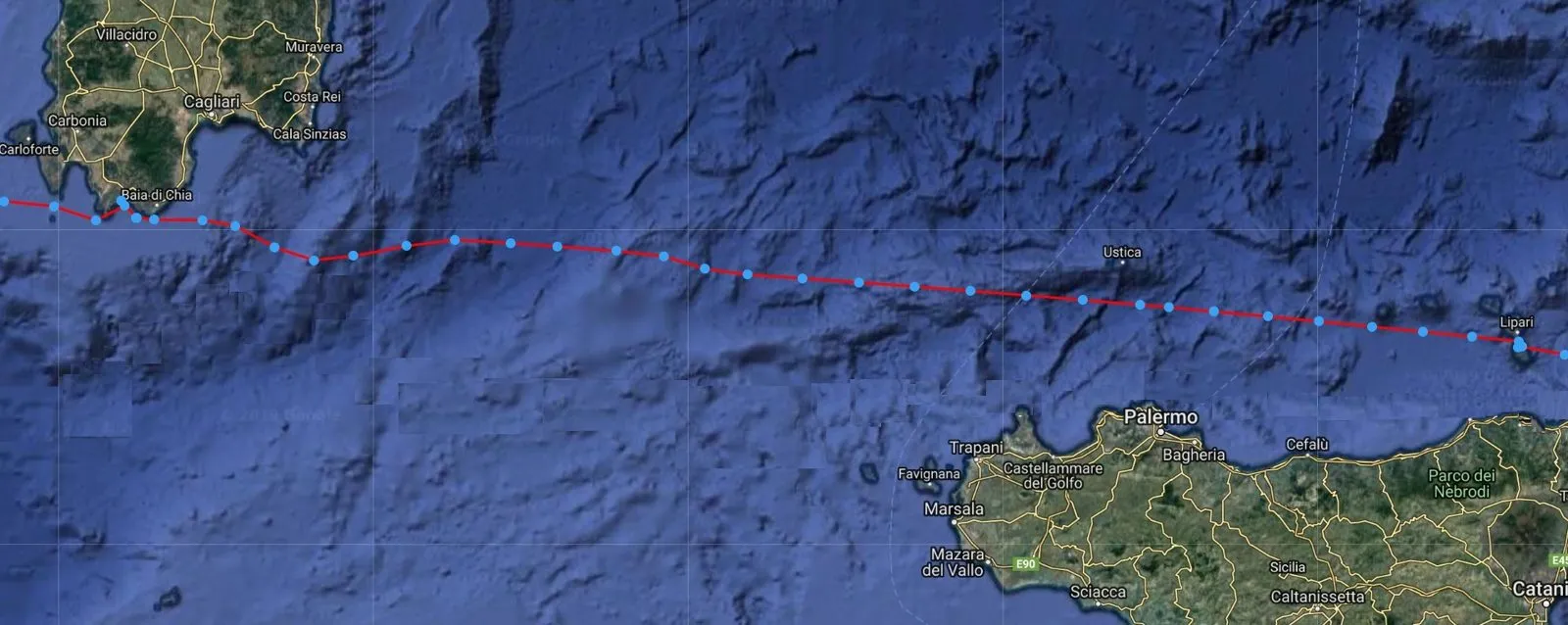
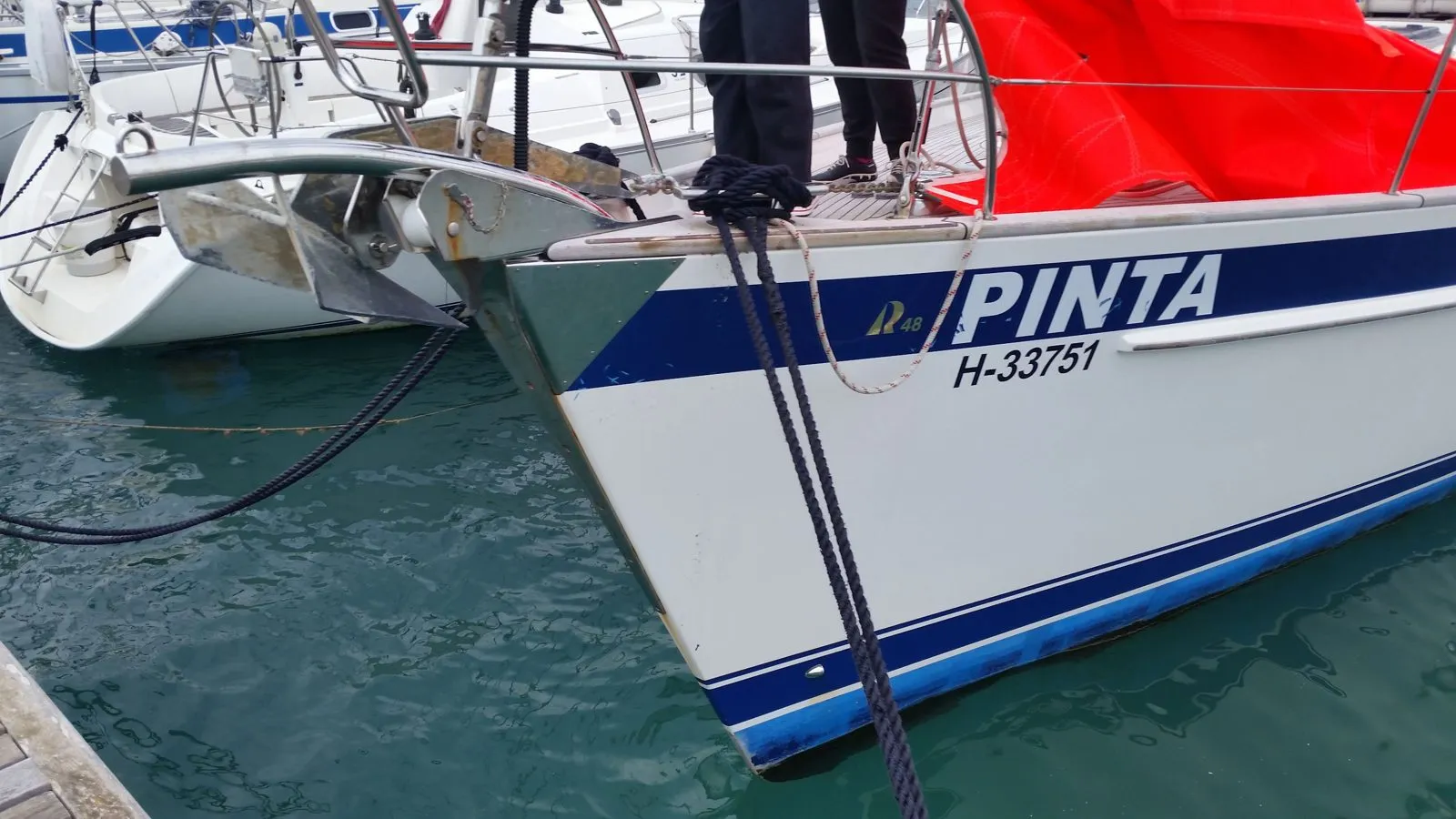
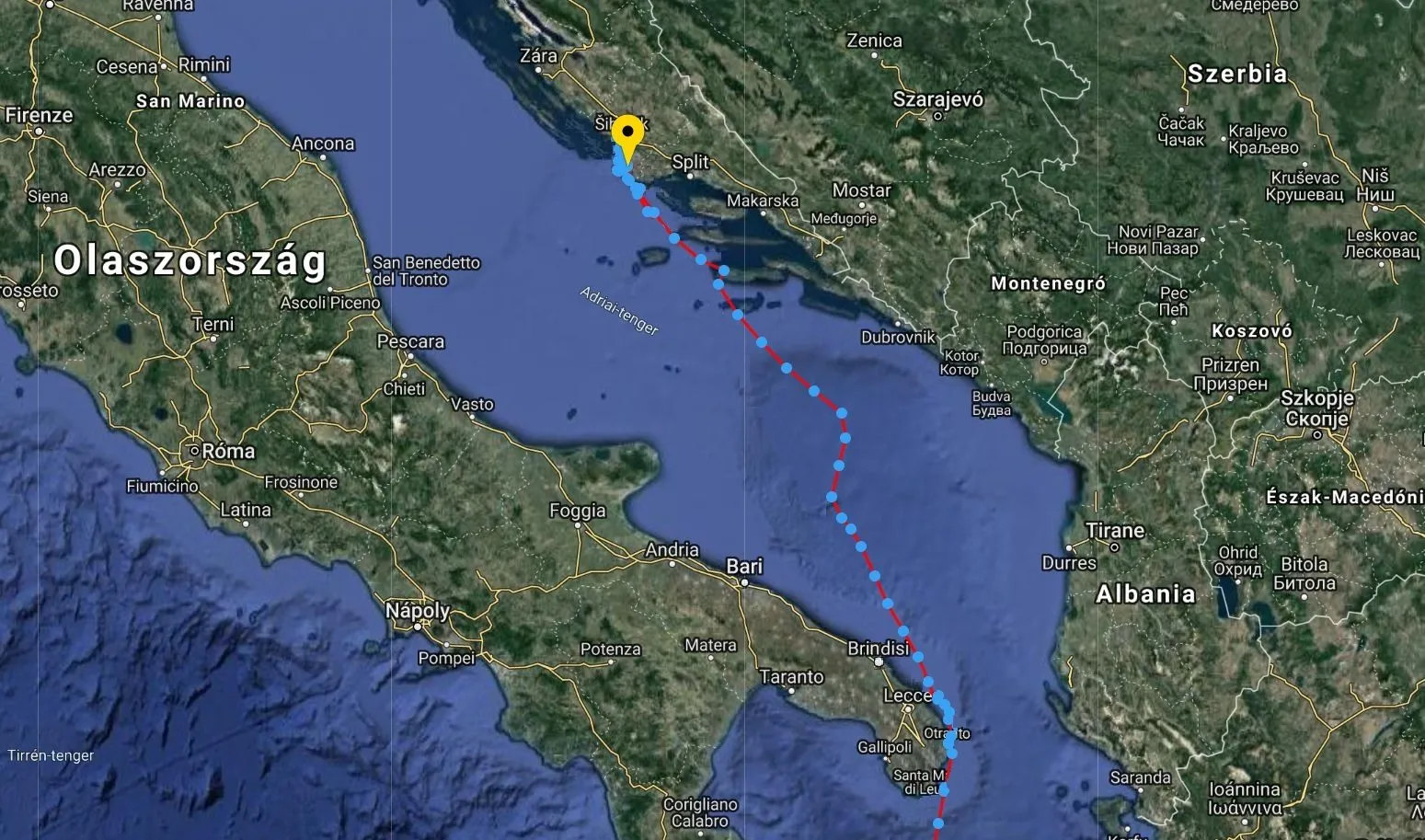
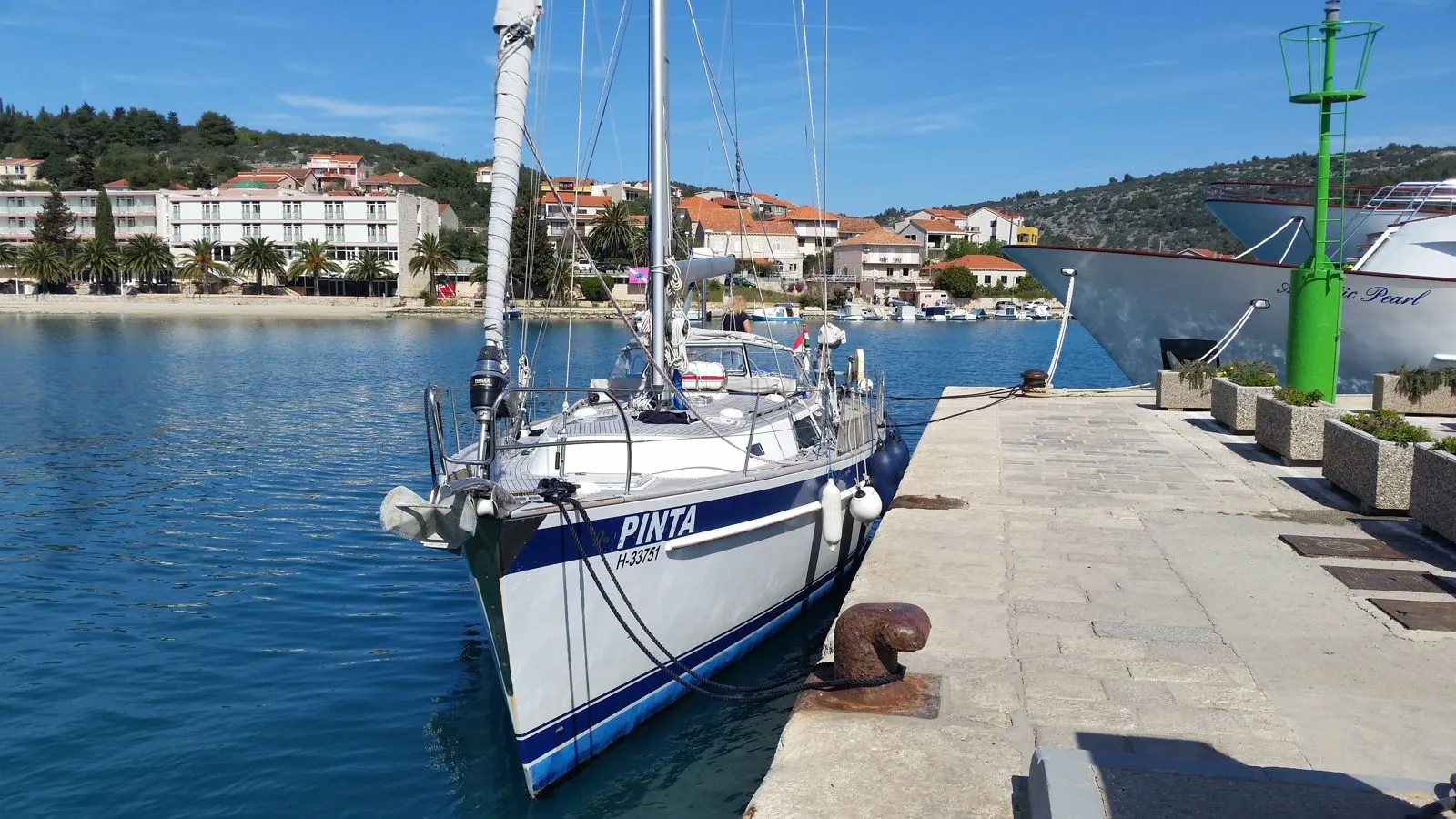
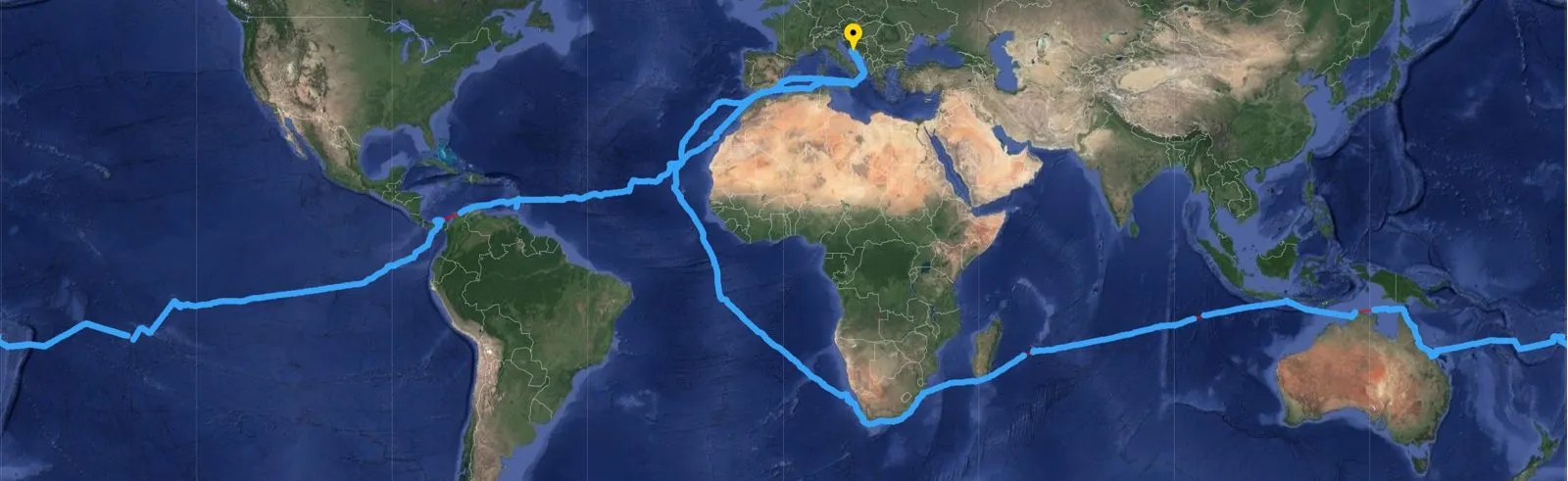
The voyage of the Pinta – source: balajaazoperencian4.blog.hu

· Praia, Cape Verde

Off to Cape Verde, and then onwards...

Debrecen Airport, passenger terminal

-Good morning, where do I check in for the Barcelona flight?

I could only ask the ladies at the information desk, because every single check-in counter stood there empty, yawning.

-Nowhere. Check-in has closed and everyone has gone.

-Fine, but then where can I drop off my bag? -I was starting to worry.

-You can’t, the desk closed an hour before departure, 5 minutes ago. Without luggage you might just about make the boarding.

-That’s impossible. – I couldn’t believe it. I have to get to the Cape Verde Islands, I can’t go without my bag – and I pointed at my enormous sailor’s kitbag.

-Well, there’s no one we can reach now – said the lady, proving barely more helpful – we don’t even have a phone number…

I couldn’t leave for a month and a half without luggage, and getting to Barcelona by four in the afternoon some other way, or to Lisbon by 8 in the evening to catch the flight to Praia, looked utterly out of the question…

I asked the ladies very, very nicely to help me somehow, because I simply couldn’t stay here, and they really did try the phone first: nothing. Then one of them ran off somewhere, and by the time she came back the baggage conveyor belt had started up. Phewww…

-Right, how many kilos is your bag? she asked.

-23 – I replied.

-Did you buy a ticket for a 32-kilo bag?

– No.

– Then you’ll have to take 3 kilos out. And where’s your ticket?

– You print it here, don’t you?

– Yes, but only if the passenger gets here on time and isn’t late…

I could see in the lady’s eyes that I’d given all the wrong answers – damn it –, not only was I late, I’d even mixed up the kilos: this flight was the 20-kilo bag plus two pieces of hand luggage, the other allowance was for the Lisbon flight…

-You’ve got half a minute to take out the excess weight! – she urged me on encouragingly.

With trembling hands I unlocked my kitbag, grabbed a yellow carrier bag that looked heavier than the rest, bag strapped up, onto the scales, successfully dropped off, and I was already sprinting to security. I showed my passport:

-Where’s your ticket? – they asked.

-I didn’t get one.

It didn’t occur to me that they meant that receipt-like thing I’d been given for my bag and stuffed in my pocket, but we quickly established that I must have a ticket after all – there it was, crumpled up in my back pocket…

I thanked the ladies very sincerely for helping me out, I could practically see the “You’re welcome” forming on their lips, but what came out instead was: “Next time, if you’re late once more, you’re not flying anywhere!!! You’ve got 3 minutes to get through security…”

They were right, they could just as well have leaned back and done nothing, they were truly very kind, I’m grateful to them!

I quickly piled everything onto the X-ray belt: phone, wallet, belt – I had de-metalled myself to perfection.

-Any liquids?

-Of course not. Oh, wait, yes, the tea I was going to sip while waiting.

I gulped it down fast, then walked through the metal detector gate, which instantly started flashing, wailing and buzzing…

I don’t believe this…

I made a vow: if I’m allowed to board this plane today, together with my luggage, then in Barcelona I’ll make a pilgrimage to the Sagrada Familia, buy an entry-ticket-cum-indulgence, and stammer out my gratitude.

OK, I know, people usually make that kind of vow on condition that they land safely, but this was an exceptional situation, I just had to commit…

Later I realised that I could only fulfil my vow if my plane didn’t stay up there anyway, so the usual expectation would be met too…

So, I was now a suspect. Rushes in at the very last minute, sounds metallic as well – this calls for a more thorough examination, if you please… So much for your 3 minutes!

They patted me down at a leisurely pace from my ankles to the tips of my ears: nothing. Right, once more then. Meanwhile the baggage X-ray colleague comes over, saying he’d like to take a little peek into that small yellow carrier bag (the one I’d just taken out of my kitbag to lose weight). Be my guest… And straight away he pulls out a sun cream, and a half-litre Coke bottle with a clear liquid inside… Jesus, the pálinka! Which I had originally so carefully packed in the checked bag so they wouldn’t confiscate it…

Shame or no shame, out slipped that two-word phrase beginning with “f” – and it wasn’t “fiddlesticks”. I knew instantly that I was seeing my firewater for the last time, and sadly, without it ever having made its way into my system.

-Only a maximum of 100 ml of liquid can be taken into the cabin – he began setting out the facts of the case, while his frisking colleague kept on massaging my calves. Sure, who’d be daft enough to take a measly decilitre of pálinka along for a month and a half, I thought.

Slowly it became clear that the metallic inner lining of the wet-wipe sachet in my back pocket had probably set off the alarm. I suggested I take it out and walk through the gate again – just to move things along – but the frisking colleague saw right through me (he finds the decoy wipe, and then I sneak the weapon on board) and wouldn’t let me go anywhere until he had personally and thoroughly satisfied himself that I wasn’t carrying any prohibited items.

In the departure lounge the snack bar had already closed, but half of the plane’s passengers were still waiting to board, so I could calmly join them. Wow, that came down to a hair’s breadth, and to the goodwill of those ladies. The best part of the whole thing was that I didn’t even know I was running late. I didn’t worry for a second, didn’t hurry, it was only in front of the empty counters that it dawned on me that something was badly wrong here…
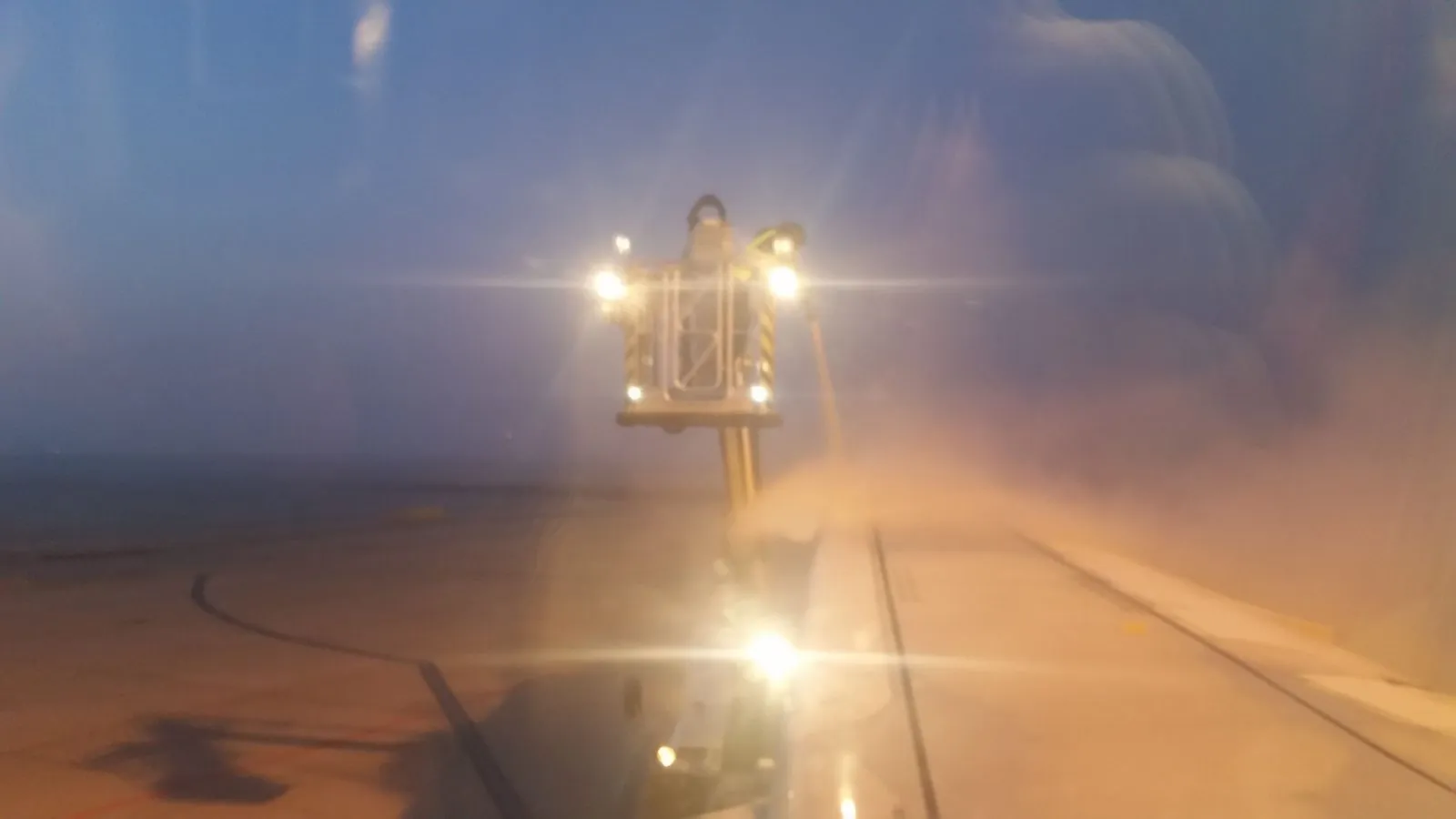
They de-iced the wings and off we went towards Barcelona

Gyuri – the captain of the Pinta – called me before New Year’s Eve to say I could join them from the Cape Verde Islands possibly all the way to the Adriatic, on the final leg of their round-the-world voyage. I’d already sailed with him twice on the Pinta, first from Denmark to Lisbon in April 2017 (https://balajaazoperencian1.blog.hu), then in October from the Adriatic to the Canary Islands (https://balajaazoperencian2.blog.hu), when they set off on the great adventure of their lives, sailing around the world. After a quick consultation at home I said yes, and now the moment had come for me to set off for the Cape Verde Islands. I’d been following their route continuously on a website (https://my.yb.tl/Pinta), and saw that last night they’d dropped anchor in Praia. On this day you could only get to the former Portuguese colony with 2 changes, so I looked for a solution that started directly from home, from Debrecen.

On the Wizzair flight we flew south of Lake Balaton towards Slovenia, so I could even see the Sió canal, which we had sailed all the way down this December. (https://balajaazoperencian3.blog.hu)
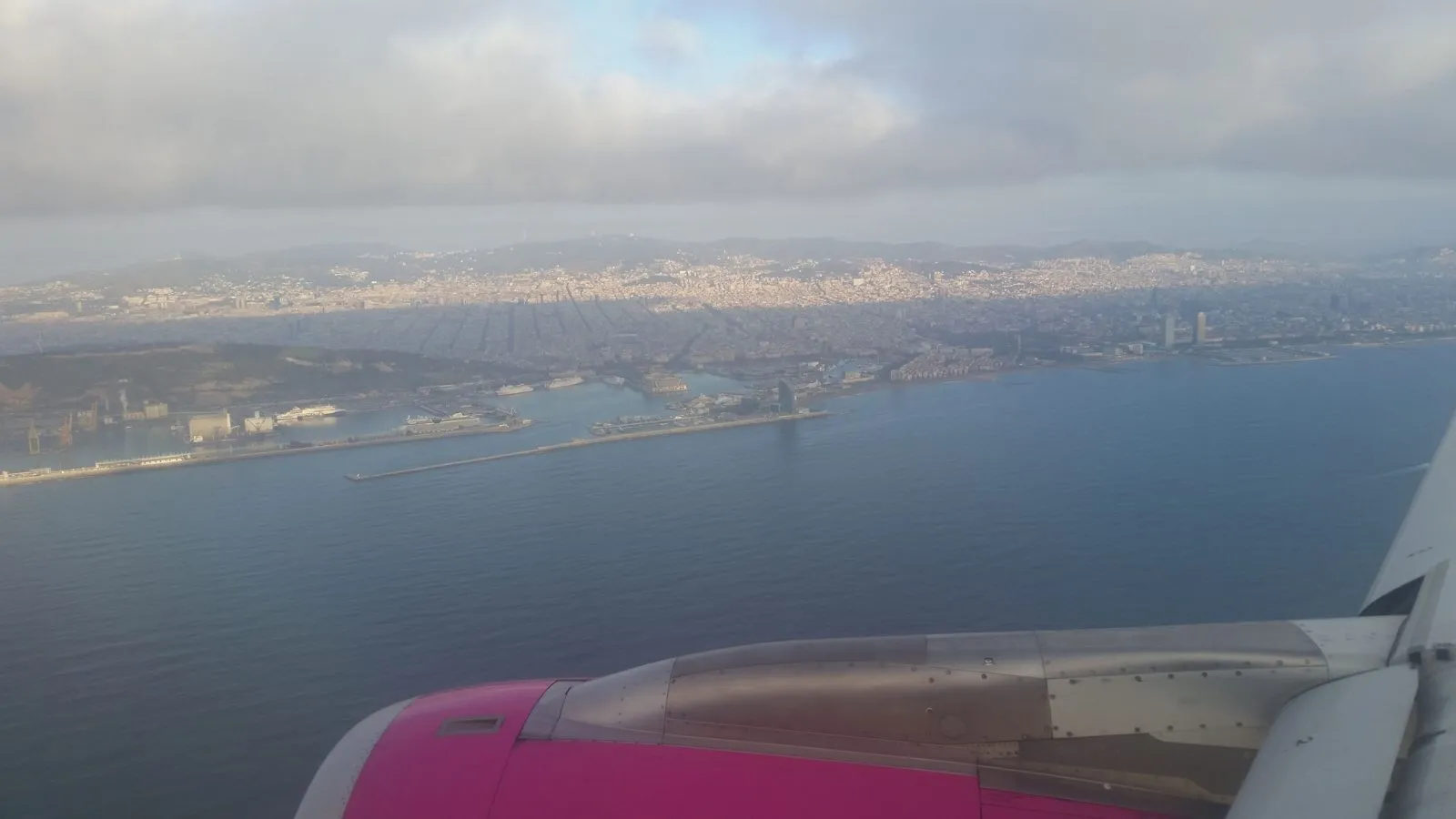
Barcelona

We landed in Barcelona at 8:55, and my last-minute-checked kitbag arrived too. Admittedly with broken straps, and without my originally so carefully packed pálinka, but at least it’s here with me.

My next plane leaves for Lisbon at 17:45 – I had no intention whatsoever of missing that one – and I was seriously calculating whether my pilgrimage to the Sagrada Familia would fit into the time until then. I’d been considering a visit anyway – thought I ought to see it before they finish building it in a jiffy – but now my morning vow had turned the free programme into a compulsory one, even if I wasn’t exactly craving any more excitement for the day.
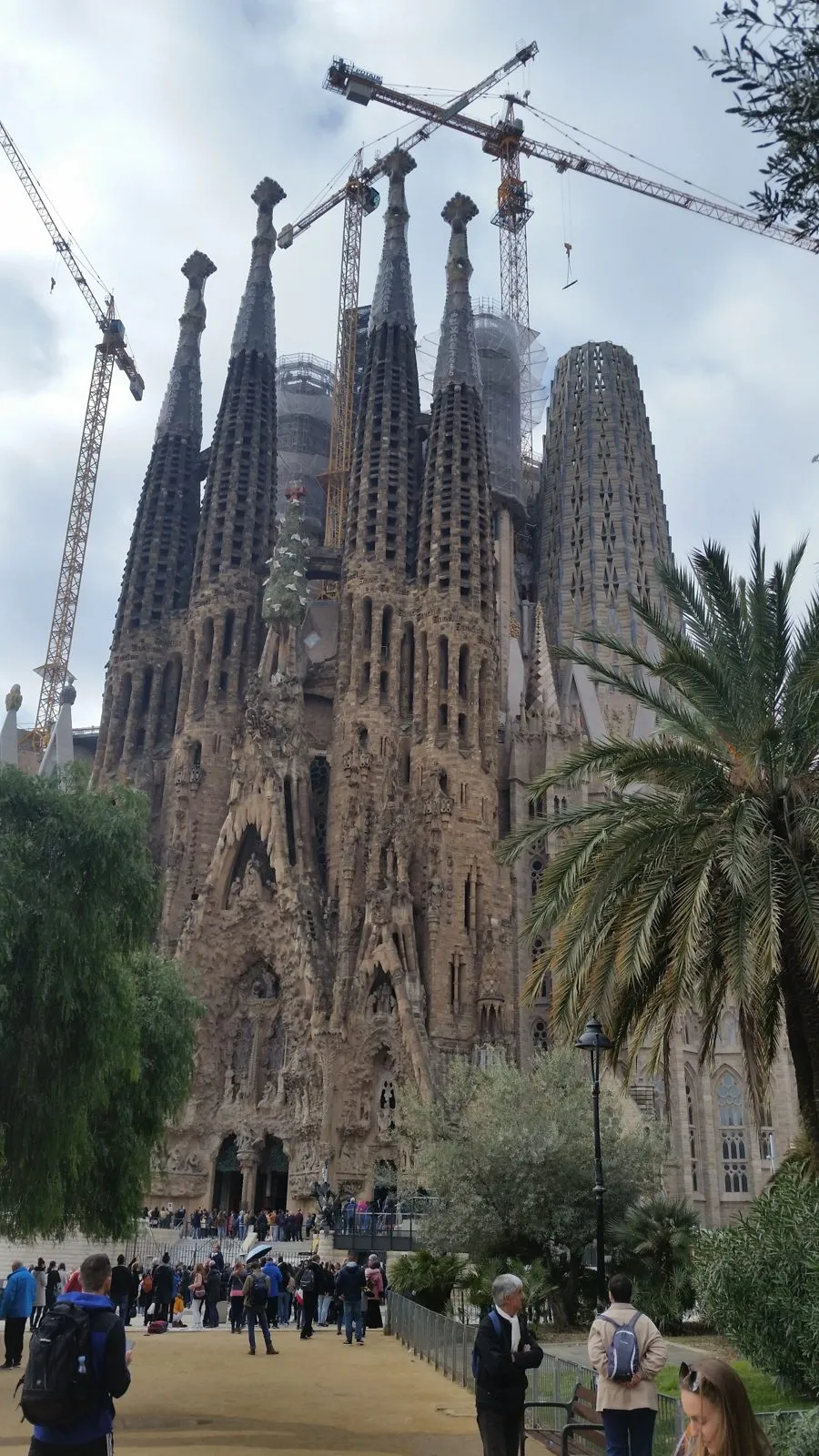
Still under construction, no panic…

I immediately started buying up indulgences, as I paid €20 for left-luggage for my two bags, then by airport bus and two metro lines I successfully made it to the cathedral that has been under construction for nearly 100 years. I could even buy the metro ticket from the machine, which – contrary to all the rumours – does not yet operate in Arabic… Meanwhile Gyuri called me from an unknown Cape Verdean number and asked where I was. He asked me that at one in the morning, when I arrive in Praia, I shouldn’t go to the accommodation I’d booked, but take a taxi straight to the harbour – they’d come ashore for me with the dinghy –, because he wanted to leave this place immediately, he didn’t want to stay a minute longer. He told me that last night they had been robbed on their boat at anchor, not too far from the maritime police building. Three shady-looking locals had swum out to them from the shore, climbed aboard unnoticed, then with a great war cry – brandishing knives – stormed them down below… They searched everything, took a few hundred euros in cash, a phone, a camera, but luckily didn’t hurt them (although they did want to tie them up). So I should hurry, a lot… And so I also cancelled my plan for a thanksgiving pilgrimage after arriving in Praia, along with the booked accommodation.

Well, this is carrying on nicely… I got so lost in thought that I nearly forgot to get off at the right metro station.

I queued all the way at the Sagrada Familia ticket office, coughed up €32 for my indulgence-entry-ticket, and got to marvel – along with a few hundred other tourists – at the forest of columns soaring up into the enormous heights.
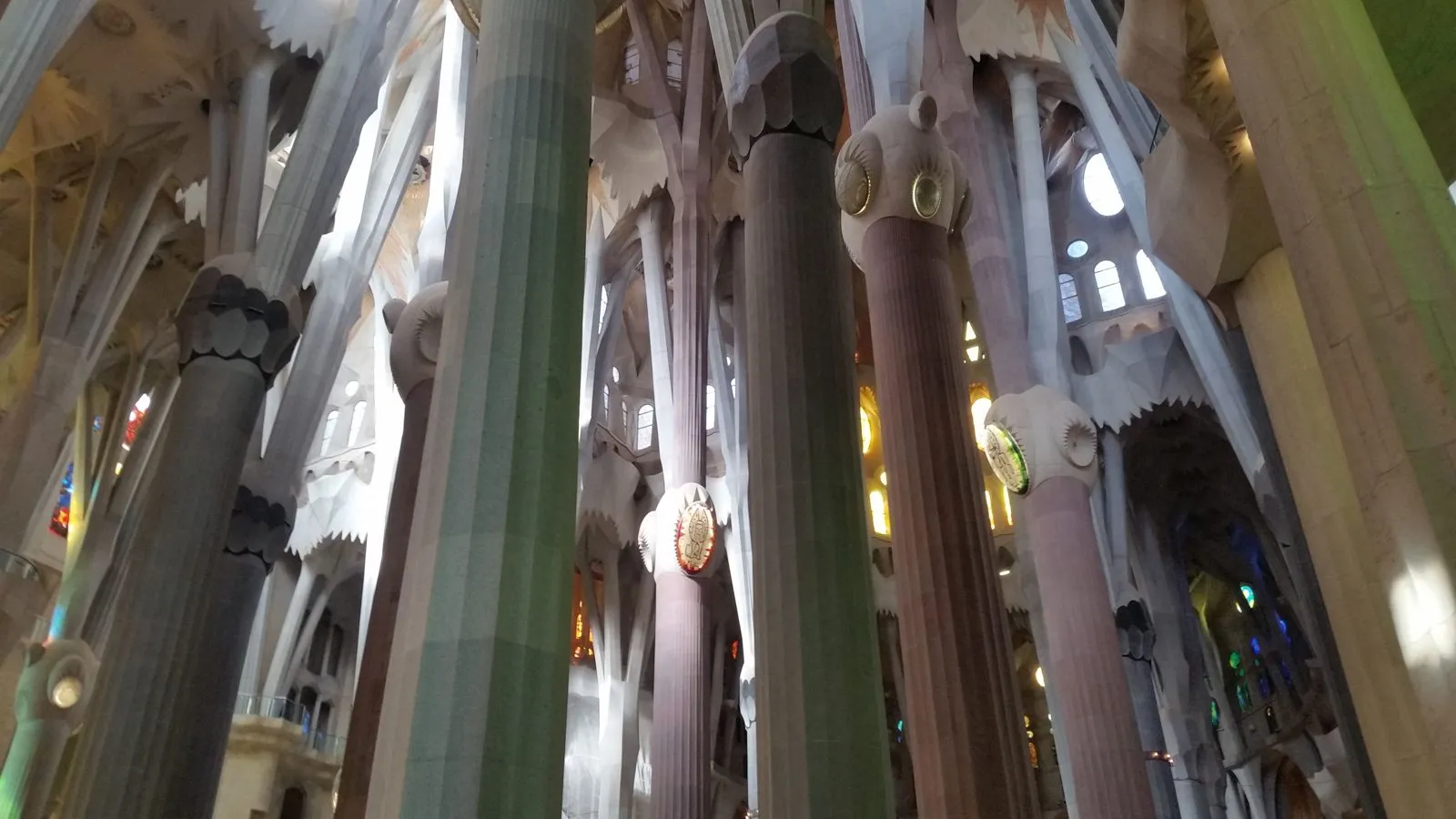
I arrived just in time, because they’re planning to consecrate the cathedral and finish construction only in 7 years – on the 100th anniversary of Gaudí’s death. The central tower to be completed by then will be 172.5 metres tall.

By 1 p.m. I was already back at the airport, collected my bags and took the bus to the other terminal. Had my back pocket X-rayed again: this time I was as clean as a newborn lamb, and I was granted admission.
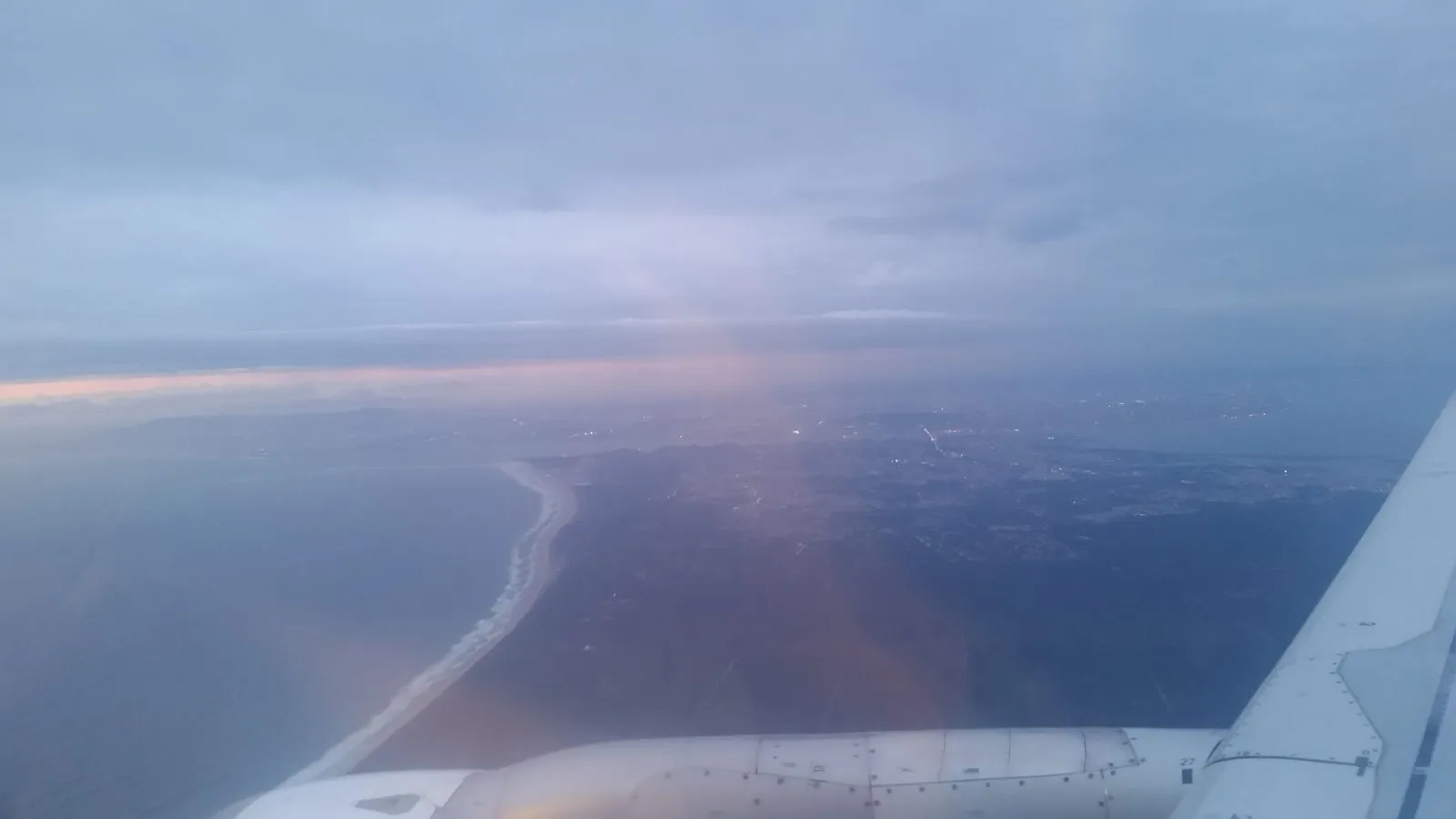
Before landing, above Lisbon

During the Lisbon change I managed to talk to Gyuri on the phone again, he said they had moved a bit further along, in front of the Maritime police, where a long wooden jetty runs out into the bay. They could come for me there with the dinghy, I should just phone, and hurry, a lot, because they didn’t feel safe.

I got onto the Portuguese airline’s flight to Praia with no trouble too, and on the plane I got a seat by the emergency exit, with enormous legroom. What a sleep I’m going to have, I thought, but then my brain kept churning over the robbery, and over the fact that at two in the morning a taxi would drop me off at a dark harbour where not only might robbers be about, but a few hours ago robbers had actually been about, and robbing – well, that thought was many things, but reassuring it was not. I decided I’d ask the taxi driver to wait there until they came for me from the boat – I wouldn’t pay him until then – I figured at worst it would be him beating me up in the end. I sorted my money into several different places (some of it went into my shoe), put my passport and ID card in separate places, tried to prepare for the worst. Go on then, have a nice sleep on a plane like that…

As we were landing I thought I recognised the bay – flitting past the window –, and I even saw the two sailing boats for a moment. So they’re where I thought they’d be, now I just have to get there somehow…

After landing I queued at passport control for about an hour, Gyuri called twice in the meantime asking where on earth I was. The other queue, where the local residents could enter, had run out in the meantime, an elderly European gentleman was the last one, so at an unguarded moment I sneaked over behind him. I asked him where he’d come from. He was French, which reassured me: if they let him in, maybe they won’t deport me either. To the other queue. He asked me where I was from too, and then his second question was straight away how we were getting on with Orbán… I answered honestly, but there was no time left to ask back how things were with Macron, because it was his turn. And then it was me, having saved a good 20 more minutes of waiting.

Here they slapped me with an indulgence-visa for €32, even though since 1 January we could enter visa-free. I didn’t complain, I was in a hurry, I’d rather go on doing penance for my sins of the early morning.

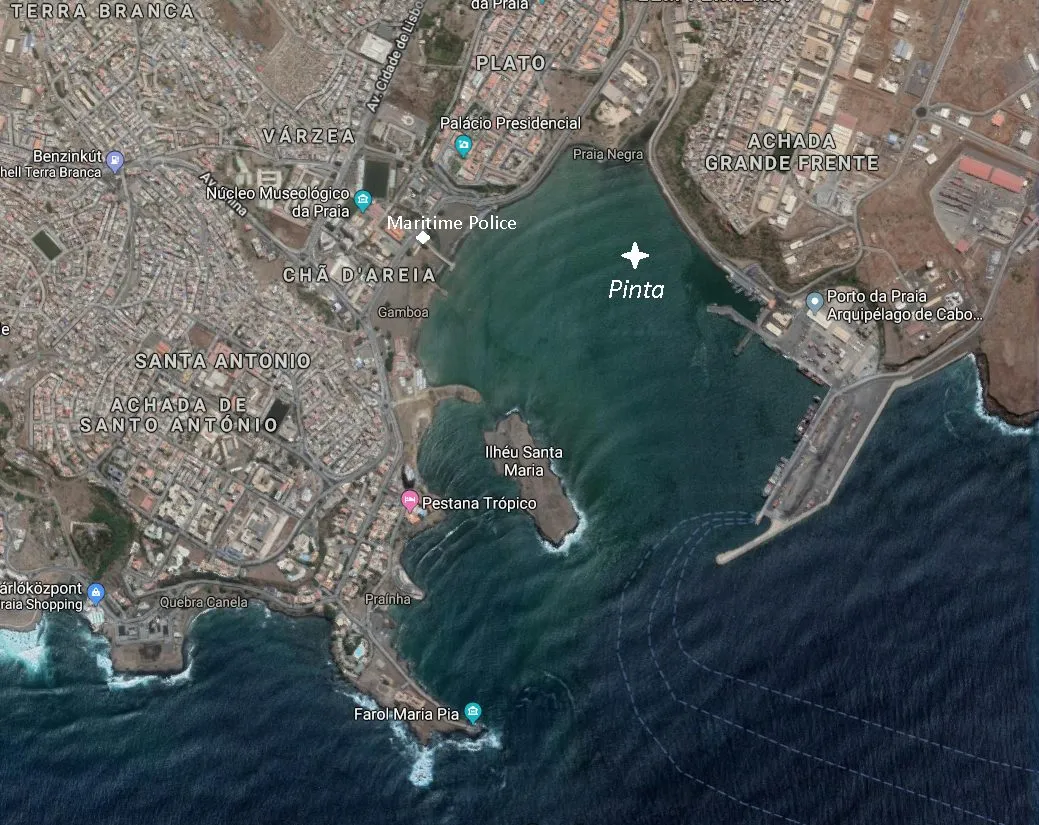
Stepping out of the airport I flung myself into the first taxi, and agreed with the driver that he doesn’t speak English and I don’t speak Portuguese. I showed him the screenshot saved on my phone, the satellite image of the bay where the Pinta should be, but you could see he couldn’t do much with the map. He kept trying to poke the touchscreen of my phone in the hope that the navigation might start, but we clarified that it’s “No internet” on my phone, and let’s go, destination “Porto, a Maritime Police”. That much at least he understood, and I knew it was on the edge of the bay where the Pinta should be anchored.

I had him stop on the seafront after the commercial port, and got out into the darkness, but no matter how hard I strained my eyes, I couldn’t see a single sailing boat, let alone two. Damn, had I got the wrong bay? But I’d seen them from up there… And where’s the “Maritime Police” then? On the other side of the bay, he gestured over there. Right, let’s go there then, although I didn’t really believe we’d see any more from there.

We turned into the yard of a ramshackle little house, I got out, trudged out onto the crumbling CONCRETE jetty, and at last I caught sight of the Pinta. It had been a long time since I’d been this happy to see a boat… Meanwhile the policemen emerged too, we sorted out who I’d come to see, one of them was a decent sort and even came out with me to the end of the jetty, though I suspect mostly so I wouldn’t fall in the dark into the huge holes at the end of the crumbling jetty. From there we hollered to the Pinta – I could see Gyuri and Zsófi on deck – they heard us and were already motoring out for me.

I lugged my stuff down in the dark to the sandy beach beside the jetty, and with trousers rolled up, shoes and socks off, I hauled myself and everything into the dinghy that had reached the shore. Shooing away a dark figure loitering on the beach who wanted to help, we pushed the boat into the water, climbed in and motored out to the boat at anchor.

I’ve arrived, no two ways about it, I’m here safe and sound. I sent a text home so they wouldn’t worry.

Climbing aboard the Pinta I felt as if I’d arrived in the tower of Eger castle during a lull in the Turkish siege (Hungary’s most famous heroic siege). Everywhere, striking and cutting tools lay scattered about, a hammer, and heavy winch handles, plus a kitchen knife taped onto the end of a boathook – only the pools of blood were missing, or rather, no, they weren’t missed at all! We quickly hauled the dinghy up onto the deck (like a siege ladder), and only here did we dare greet each other. On the shore we’d just been busy loading and pushing off, like Captain Cook surrounded by natives. We quickly knocked back a welcome drink – Gyuri told me later he’d been surprised I didn’t pull out my pálinka – and we were already hauling up the anchor so we could leave at once.

He radioed the Maritime police that we were leaving for Mindelo, and they wished us a good trip. We motored out of the bay, then turned west to round Santiago island on that side.

Meanwhile Gyuri and Zsófi told me the story of the attack; we agreed that in the end they’d been lucky to get away without injury, and the damage could have been much worse if professionals had paid them a visit. Finally we decided the order in which we’d helm the boat for the rest of the night, and since I’d have liked to get a good sleep in one go if possible, and they were tired too, I took it on myself to be on watch until 6 in the morning. Gyuri offered to sleep up in the cockpit next to me, to be on hand if some help was needed. Then, tired or not – I guess all the excitement had wound him up – he couldn’t fall asleep, so we talked for a good while longer into the night.

By around 6 in the morning I was starting to flag properly, I’d been on my feet for more than twenty-four hours…

They say the day has 24 hours, and then there’s the night as well – well, that wasn’t borne out this time…

Machine translation (AI, Claude) of Balázs’s Hungarian original. Read the original →
· Atlantic Ocean, among the Cape Verde Islands

Under way between two Cape Verde islands

I slept it off quite tolerably, although as soon as we came out of the lee of Santiago island, the waves arrived along with the north-easterly trade wind, and my dreams became very rocky, rollercoaster-like. I tucked myself in on the lee side, where my bunk sloped, put my back against the wall and slept like a sharkskin. (It’s like sleeping like a log – or “like a fur coat”, as Hungarians say – only at sea that’s what they call it…)

This first day at sea started for me around 11 o’clock, when I got up.

All day I could feel that I still had a stomach, sometimes a bit lower, sometimes a bit higher, but in the end everything stayed in its place, even the green bean stew Zsófi made for lunch, which I wolfed down, together with the fried eggs. Still, I didn’t spend much time down below – better safe than sorry – best to let sleeping dogs, and sleeping lunches, lie…

After lunch we had a good chat and together we looked for a solution to a leaking-building problem, seeing as all three of us are in the trade. Then in the late afternoon – taking turns – we each got another bit of rest in ahead of the night.

From 8 in the evening until midnight I was on watch. There was a gorgeous full moon, the stars could hardly be seen

I tried to get yesterday’s events down on the laptop, but the wind kept interfering, keeping me busy. One moment it died down and flapped the sails, the next it picked up and I had to reef again.

We wanted to reach Mindelo on São Vicente island around 8–⁠9 the next morning, where the archipelago’s only marina operates. At half past midnight I went to sleep, and half asleep I registered once again when we came into the shelter of São Vicente island, our boat straightened up and the waves quietened down.

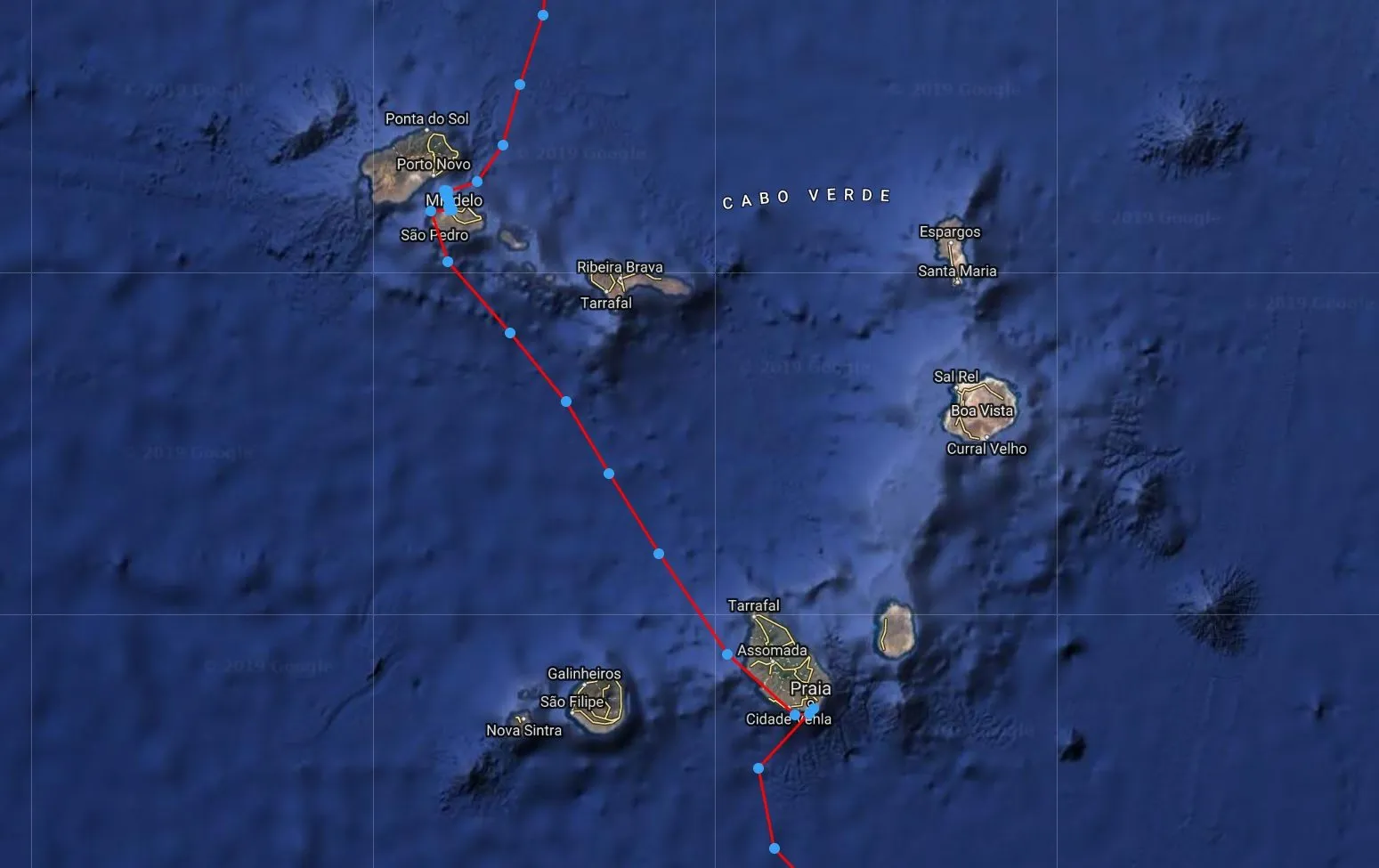
Our route between the Cape Verde Islands

Machine translation (AI, Claude) of Balázs’s Hungarian original. Read the original →
· Mindelo, São Vicente

In Mindelo

In the morning Gyuri woke me as agreed, because we were already approaching the harbour.

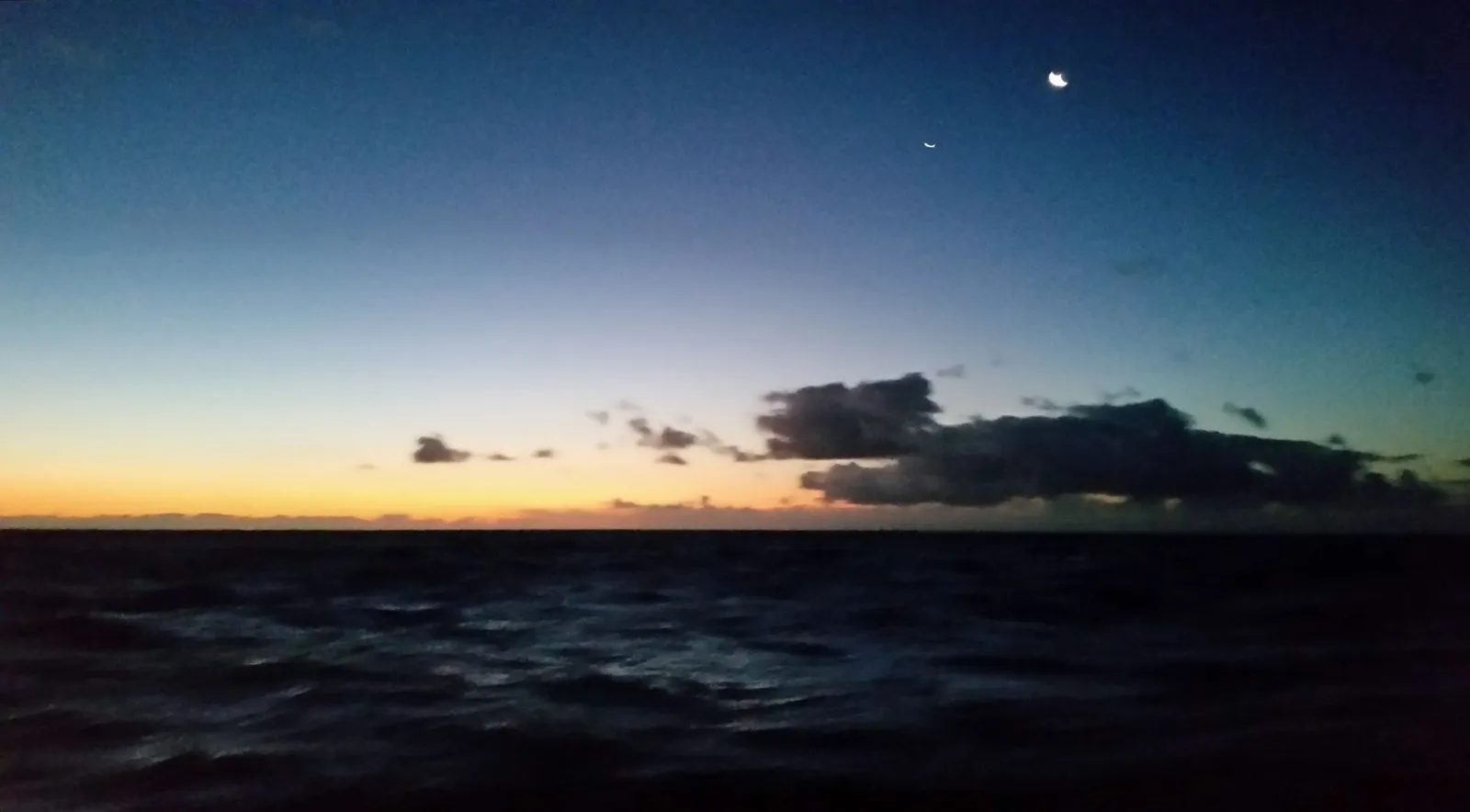
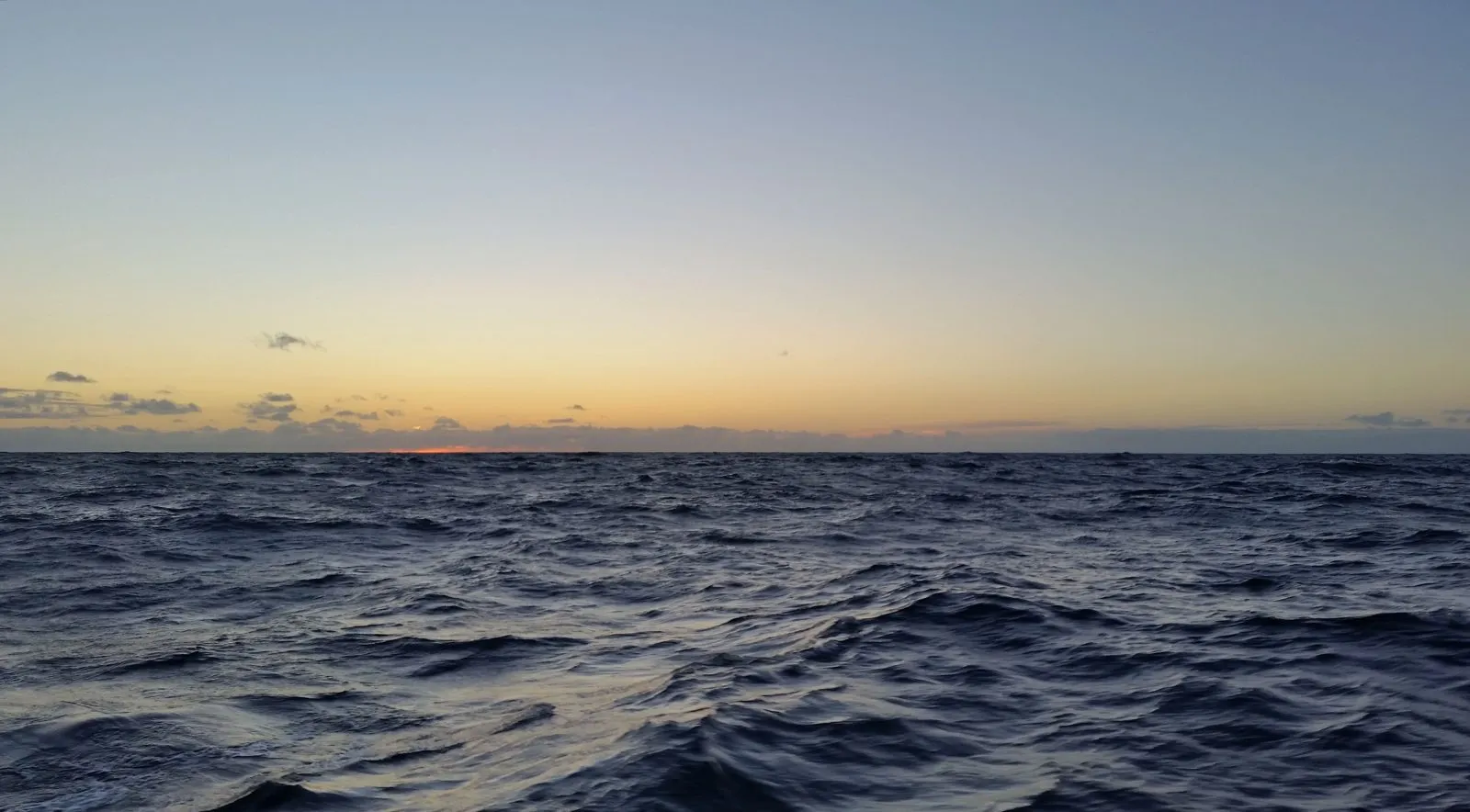
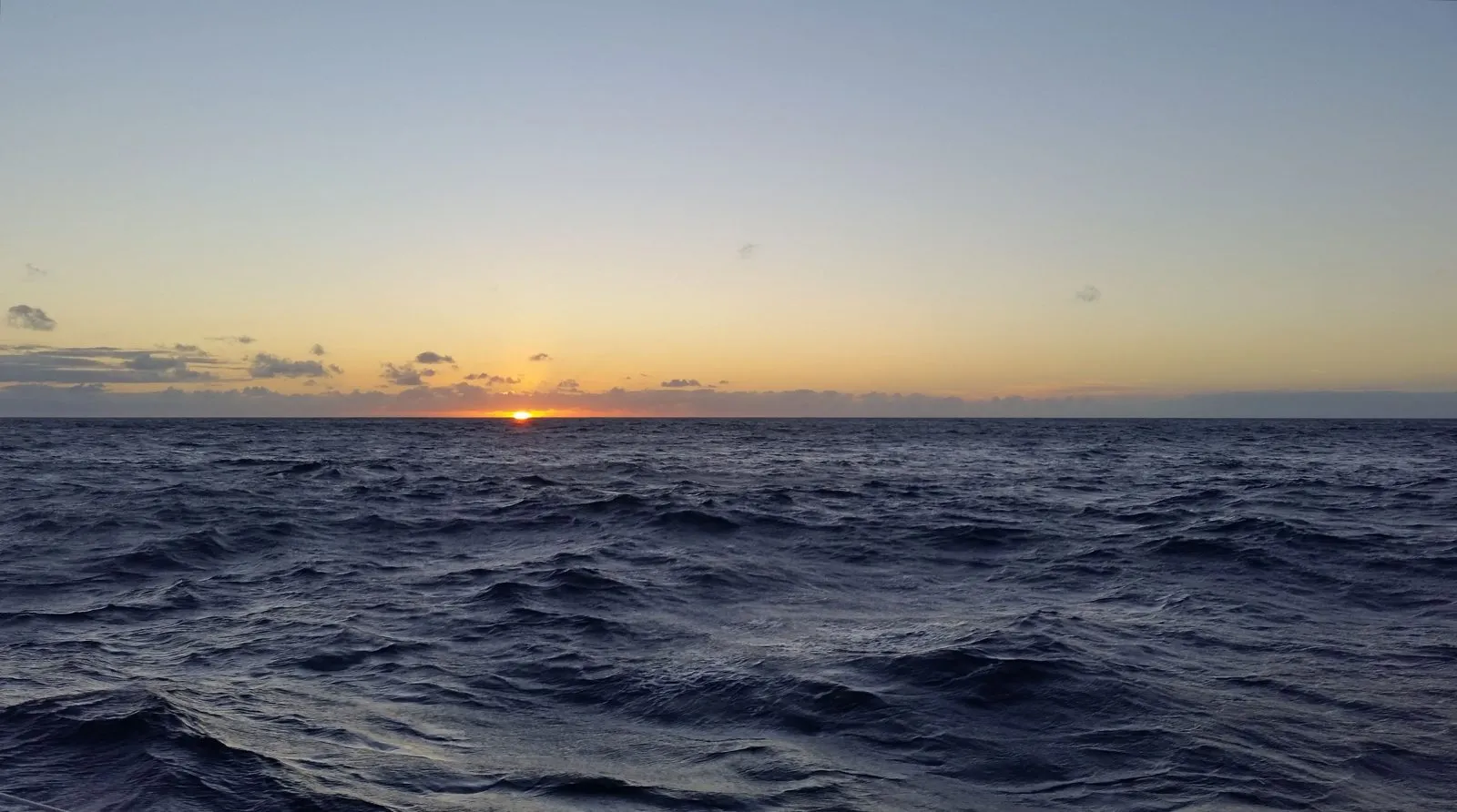
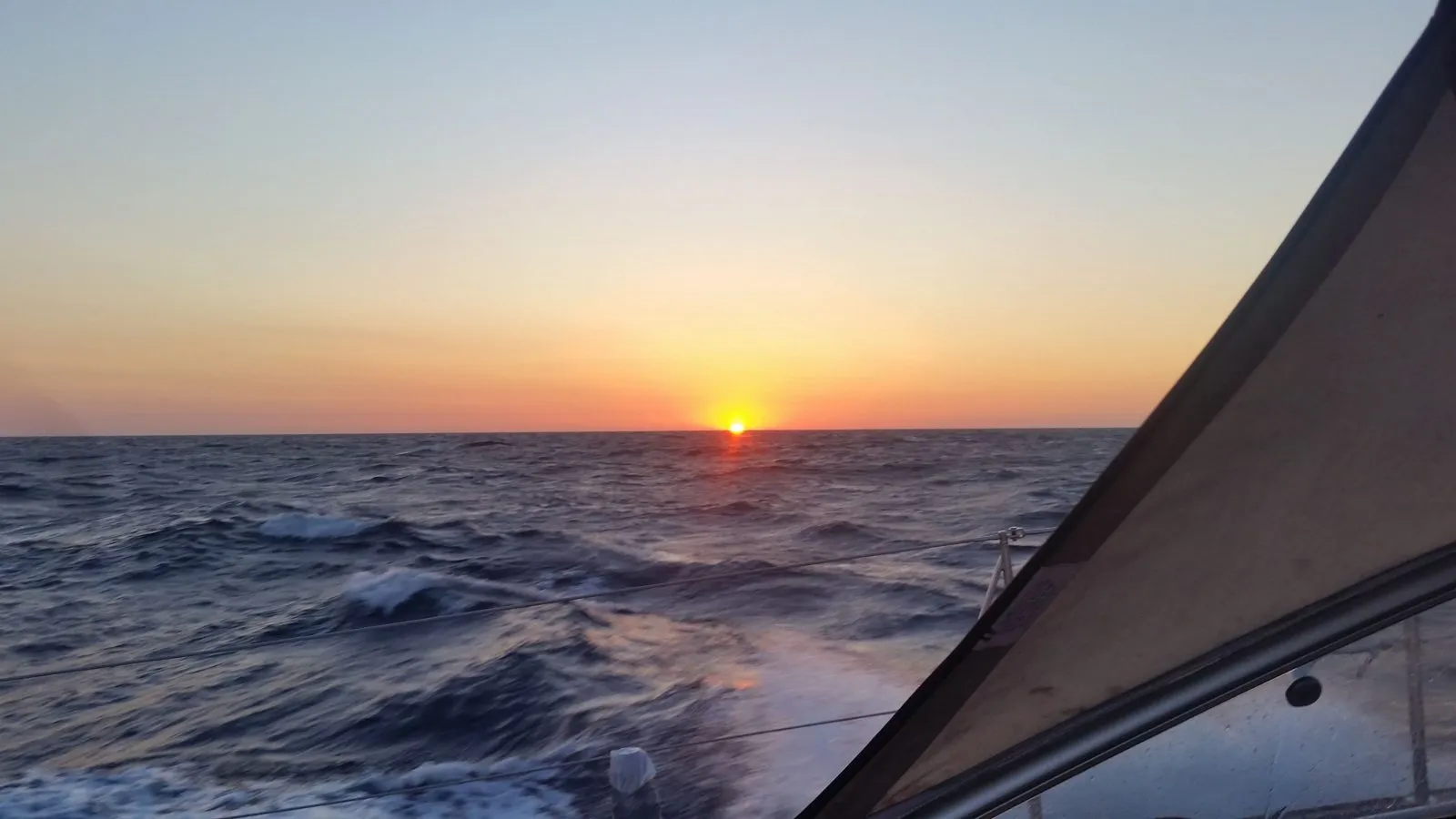
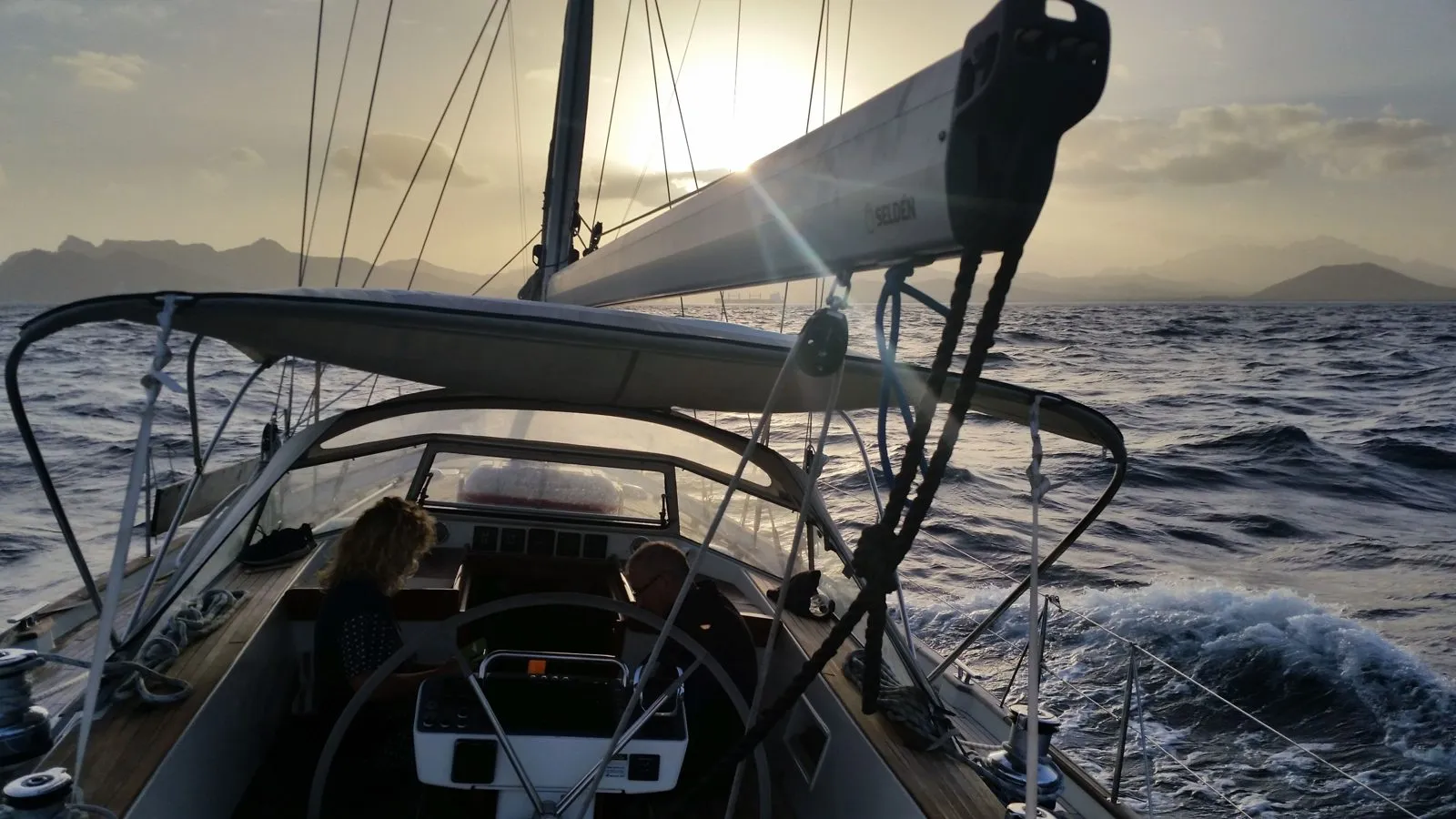
Sunrise off São Vicente

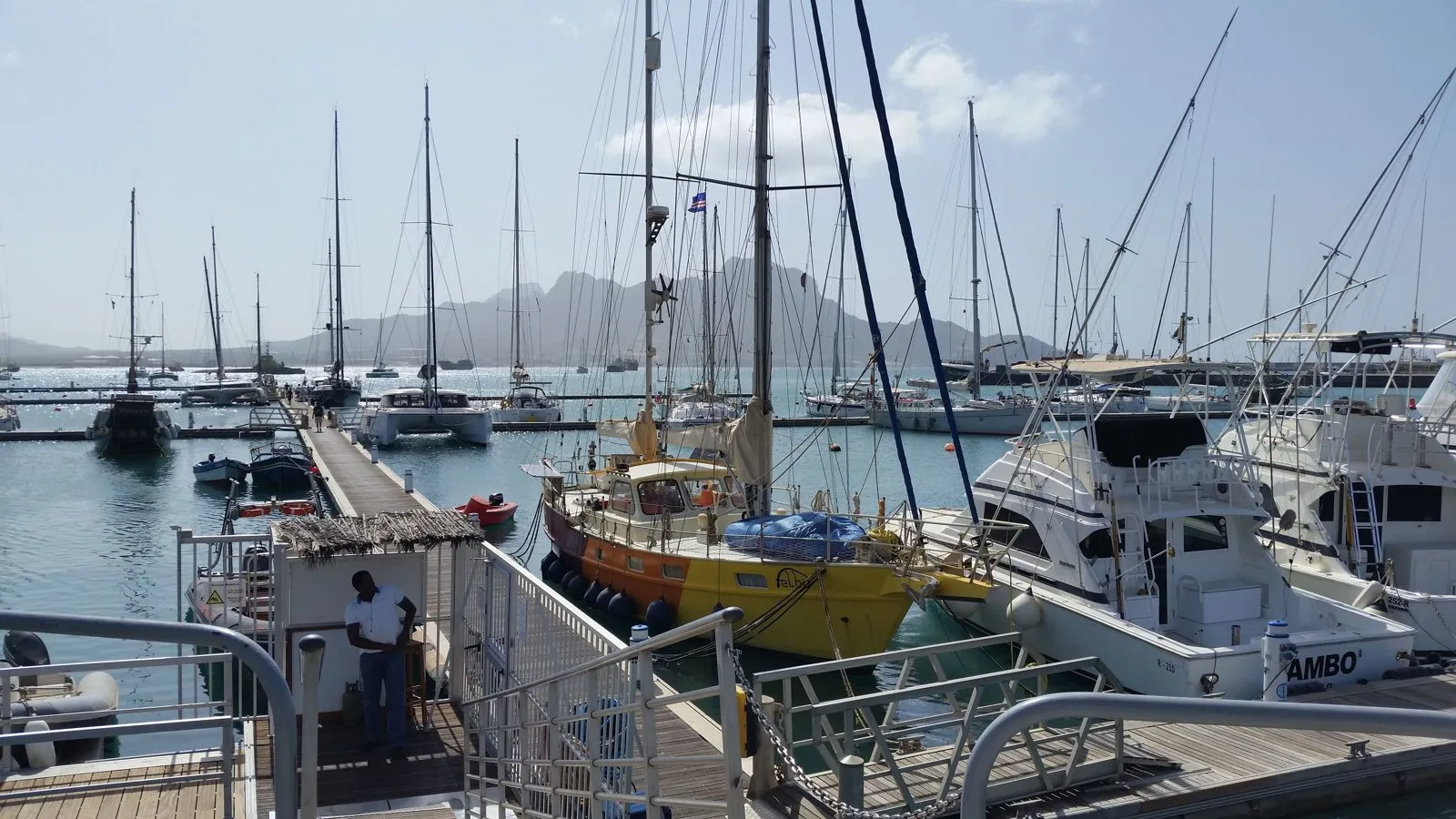
We navigated into the marina between anchored cargo ships, sailing boats and wrecks run aground. We went straight to the fuel dock at the end of the pontoon and filled up the Pinta’s tanks. Gyuri and Zsófi talked to the owner of a Portuguese yacht called Le Aum, who had arrived here a few days earlier and were already leaving today for the Canary Islands and Portugal, to catch the weather window that promised more favourable winds.

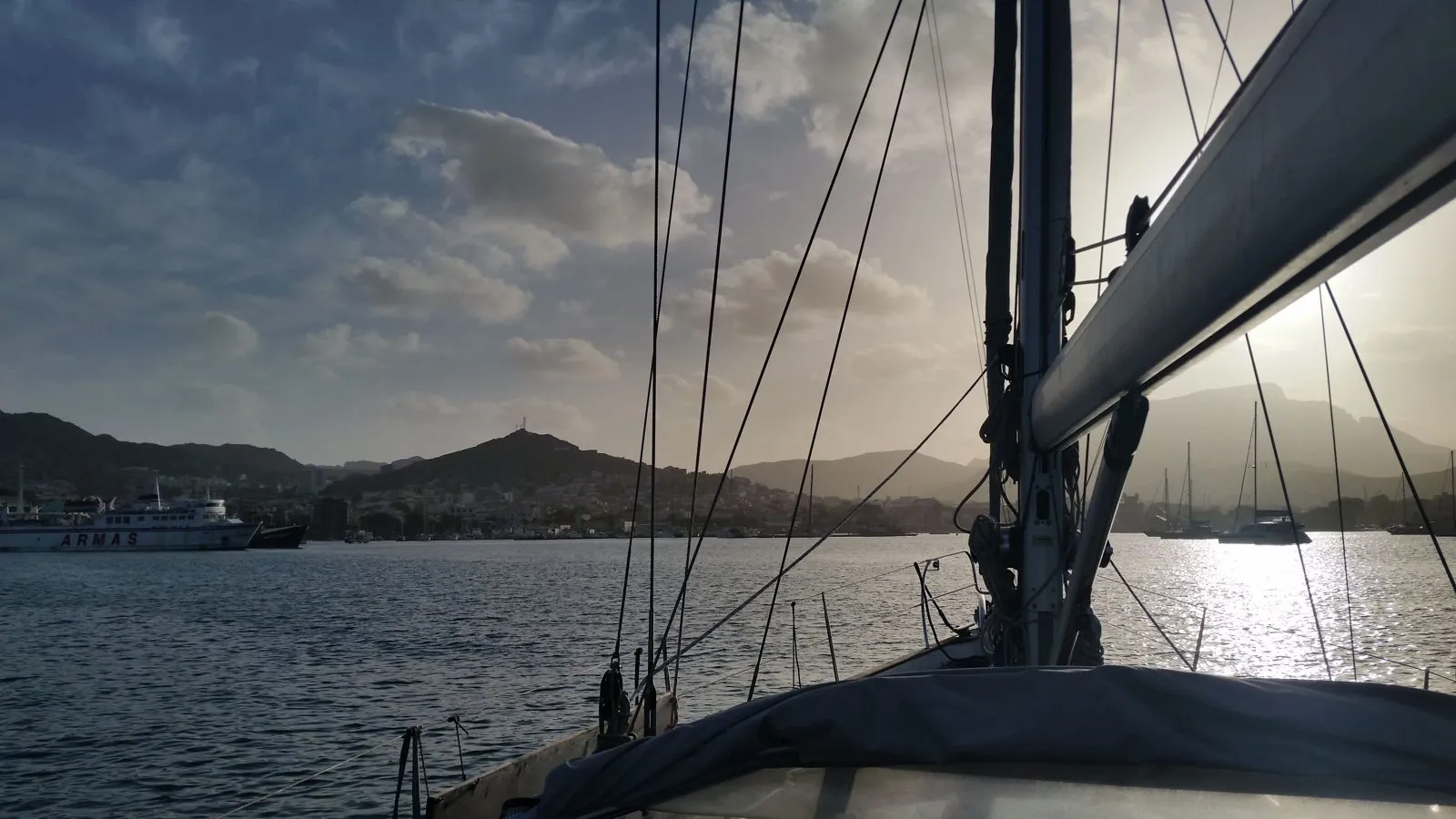
Sailing into Mindelo harbour

We walked over to check in at the Maritime police office, had one of our empty gas bottles refilled, then rented a little car, a KIA Picanto, for tomorrow’s island exploration tour.

Marina Mindelo
Off to check in with the Maritime Police

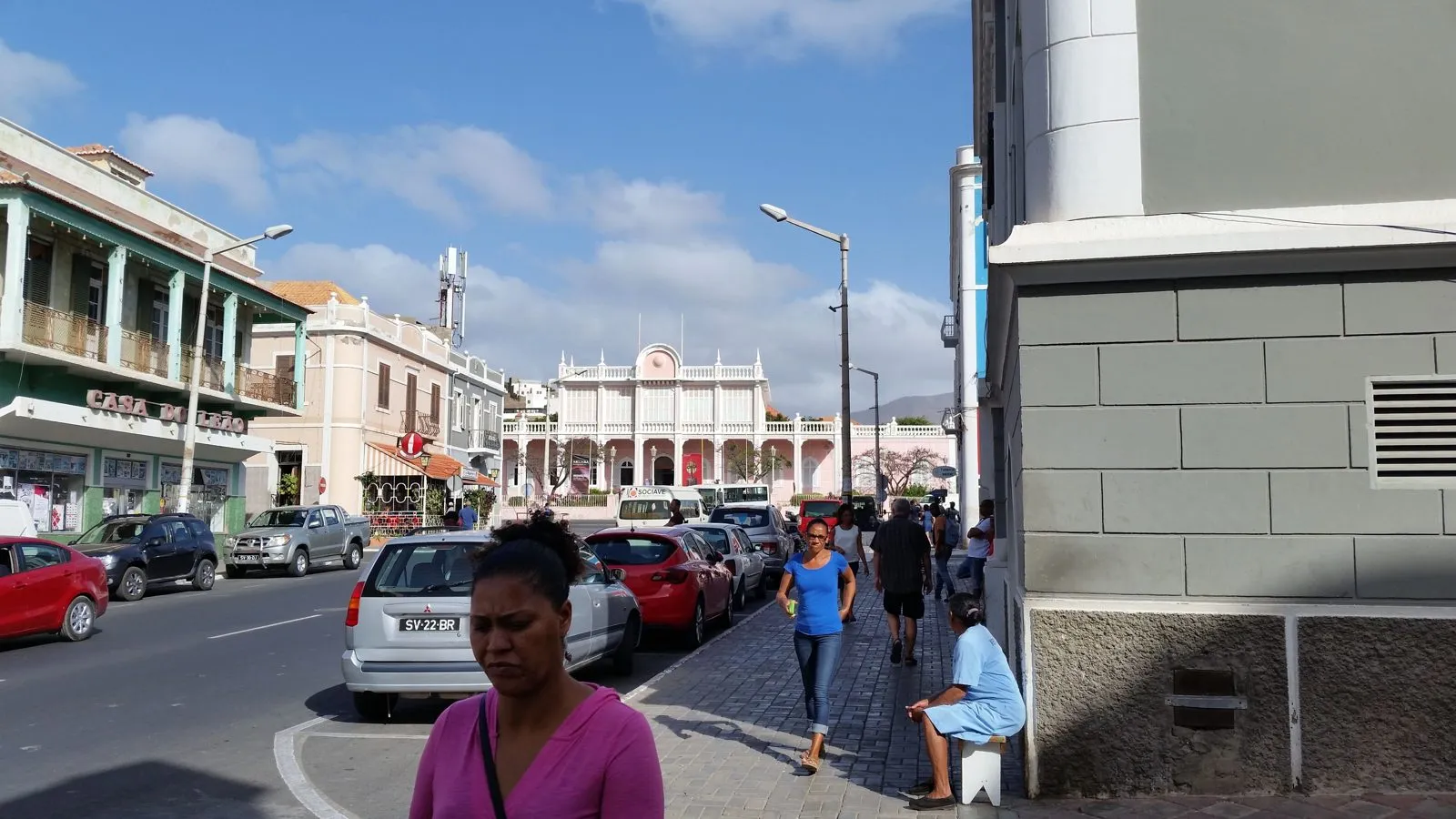
Finally we set off for a little sightseeing stroll around town, went round the market, the centre, bought postcards and stamps, and in the corner of a restaurant we found a little Tourist-Info corner, where we quizzed the lady about the island’s sights.

Mostly she recommended nice beaches and volcanic mountains – which is what the average tourist is after – and she also drew our attention to the highest peak, which you can even drive up to.

The palace
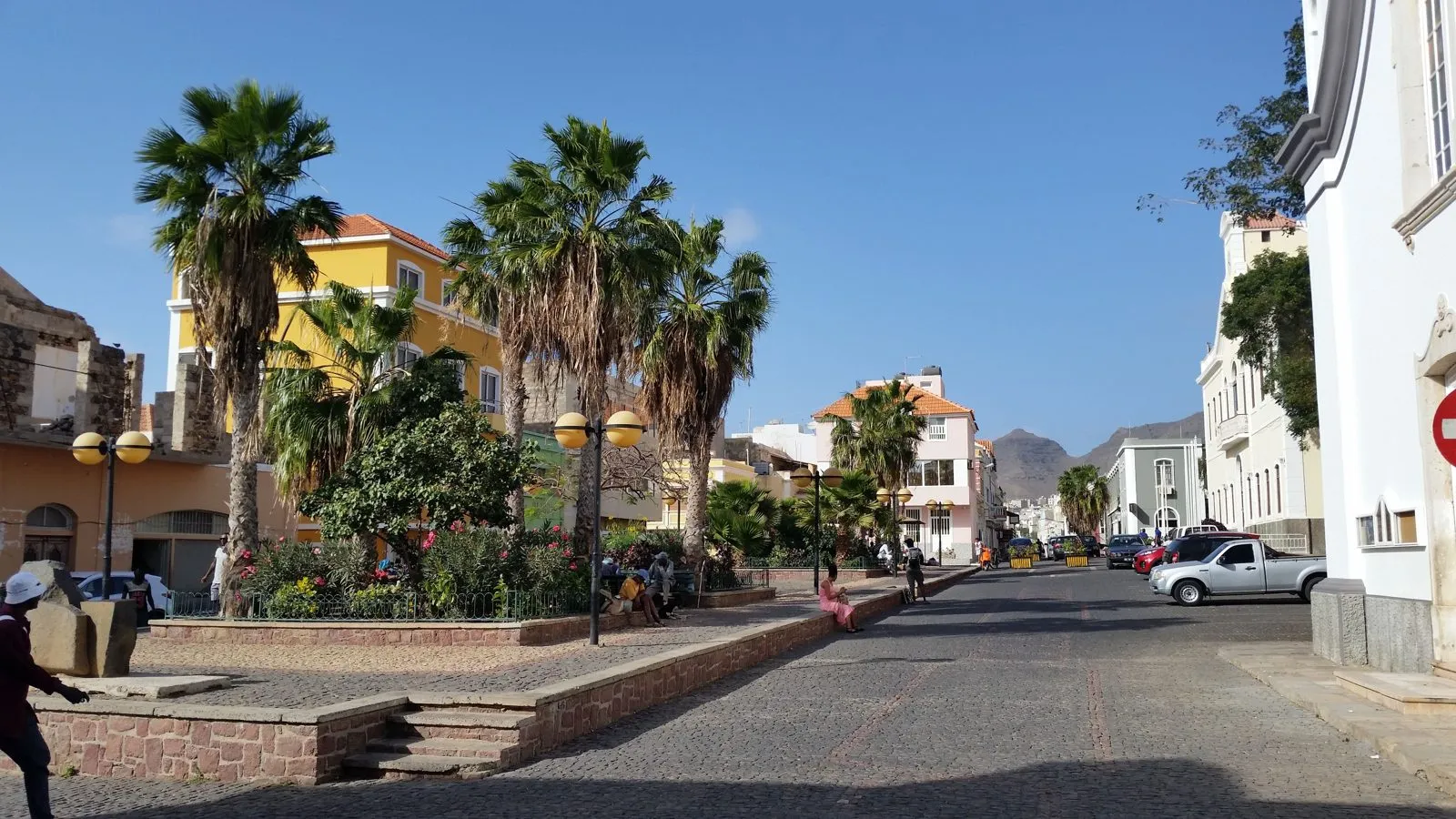
Mindelo street scene

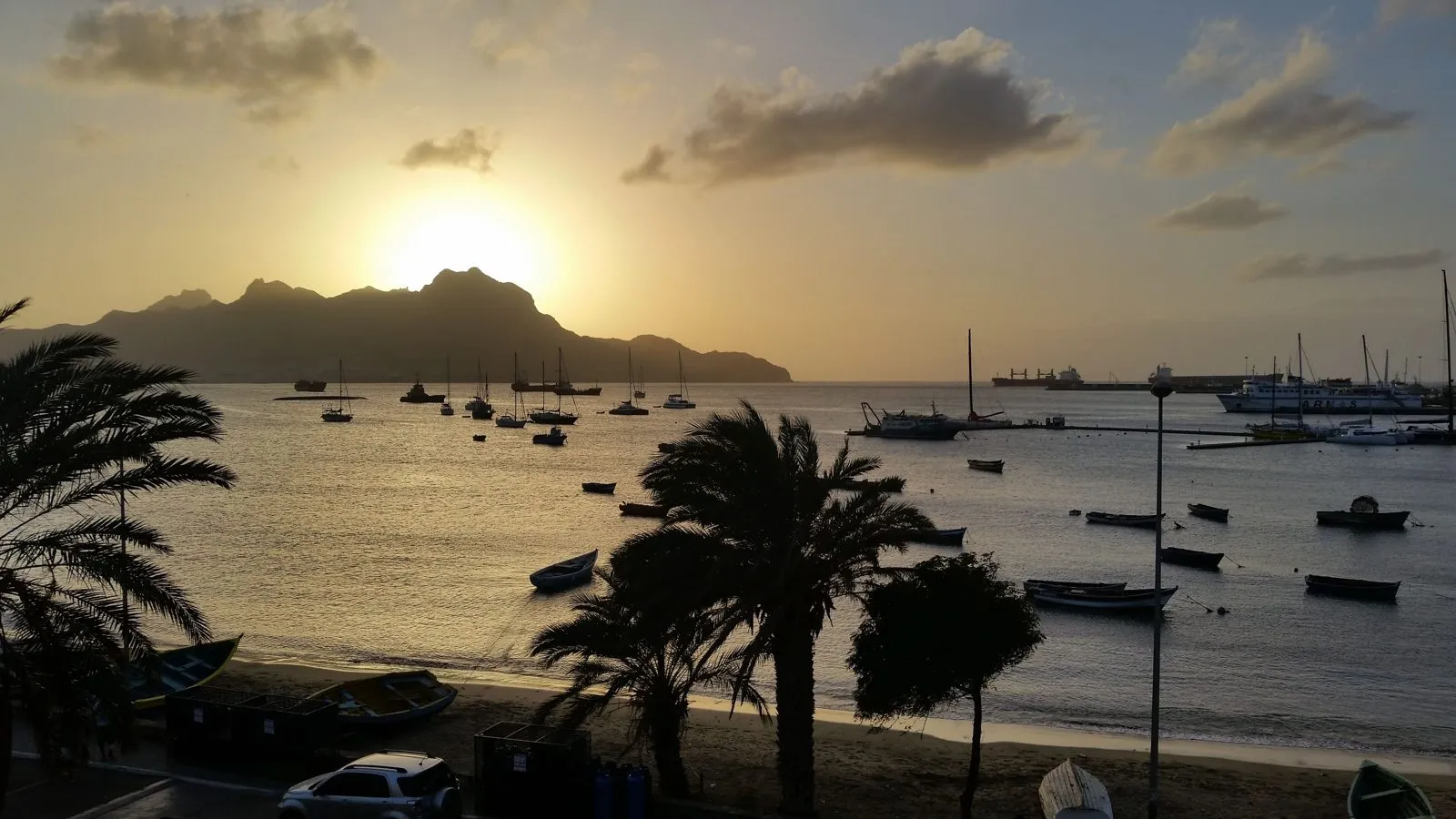
As the venue for a cosy wifi-lit dinner (instead of a candlelit one), we picked an upstairs restaurant on the seafront, with a gorgeous view over Mindelo bay and the crags of the ridge opposite that form a human face – looking up at the sky.

Sunset in Mindelo

Can you see the face looking up at the sky, formed by the mountain top?

Over the World Wide Wifi we could talk to our loved ones and friends, then, well fed, we returned to the boat and turned in.

Machine translation (AI, Claude) of Balázs’s Hungarian original. Read the original →
· Mindelo, São Vicente

In search of the Green Cape

In the morning we picked up our rented red car and immediately filled it up, because there was only an eighth of a tank of petrol in it. First we dropped the clothes off at the laundry, then set off towards the highest mountain.

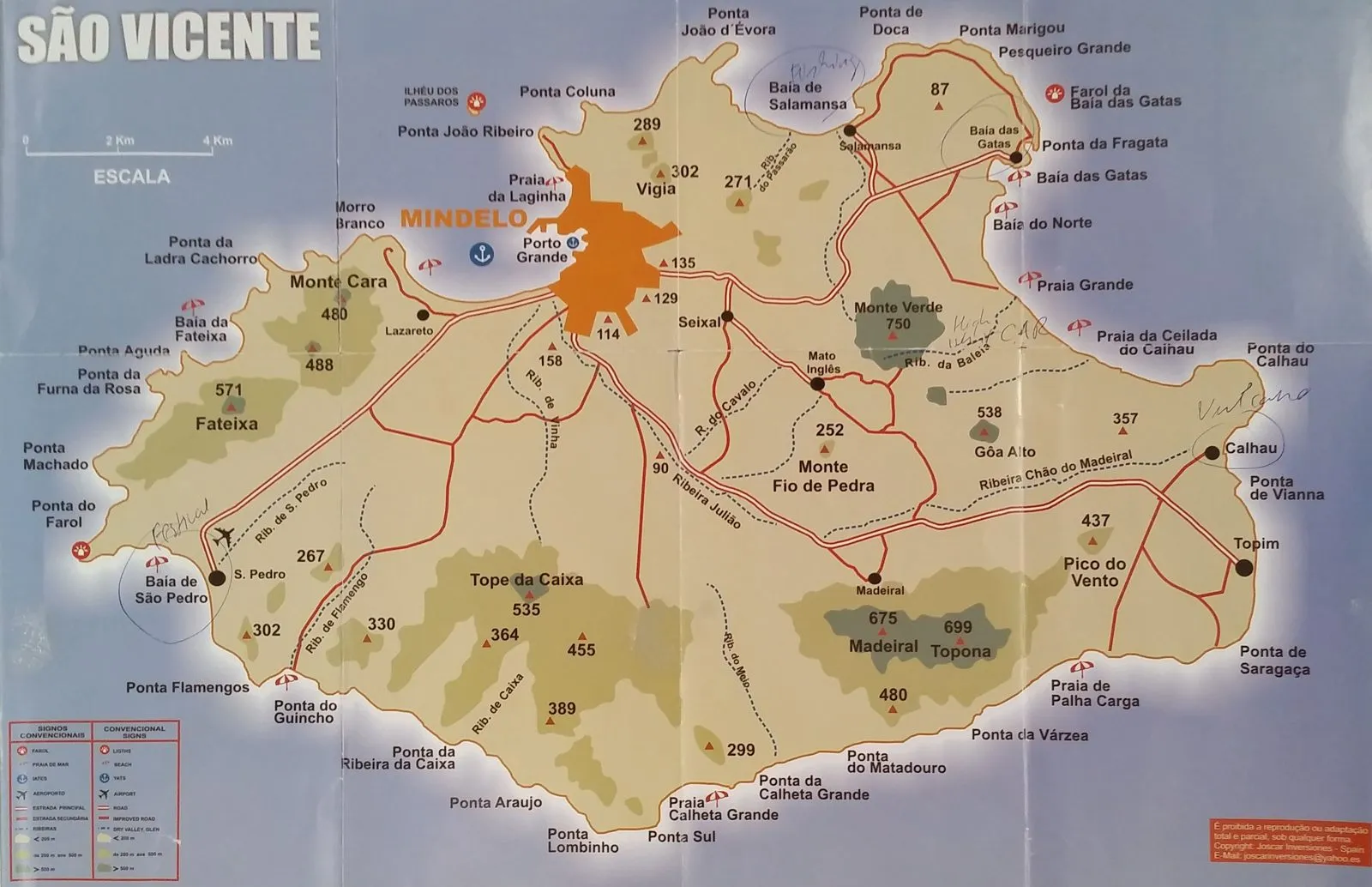
We had to conclude that it’s no wonder they can’t find their way around on the map, because the copy we bought at the information office was so rough and sketchy, it marked roads where there were none, and where there were roads, it showed desert. I swear, if they marked the pirates’ buried treasure on it, nobody would ever find it in a month of Sundays, except by accident at most.

Map of São Vicente island

We wound our way higher and higher on a cobbled hairpin road – which I reckon the Portuguese colonists must have had built – shooing aside a few goat-highwaymen.

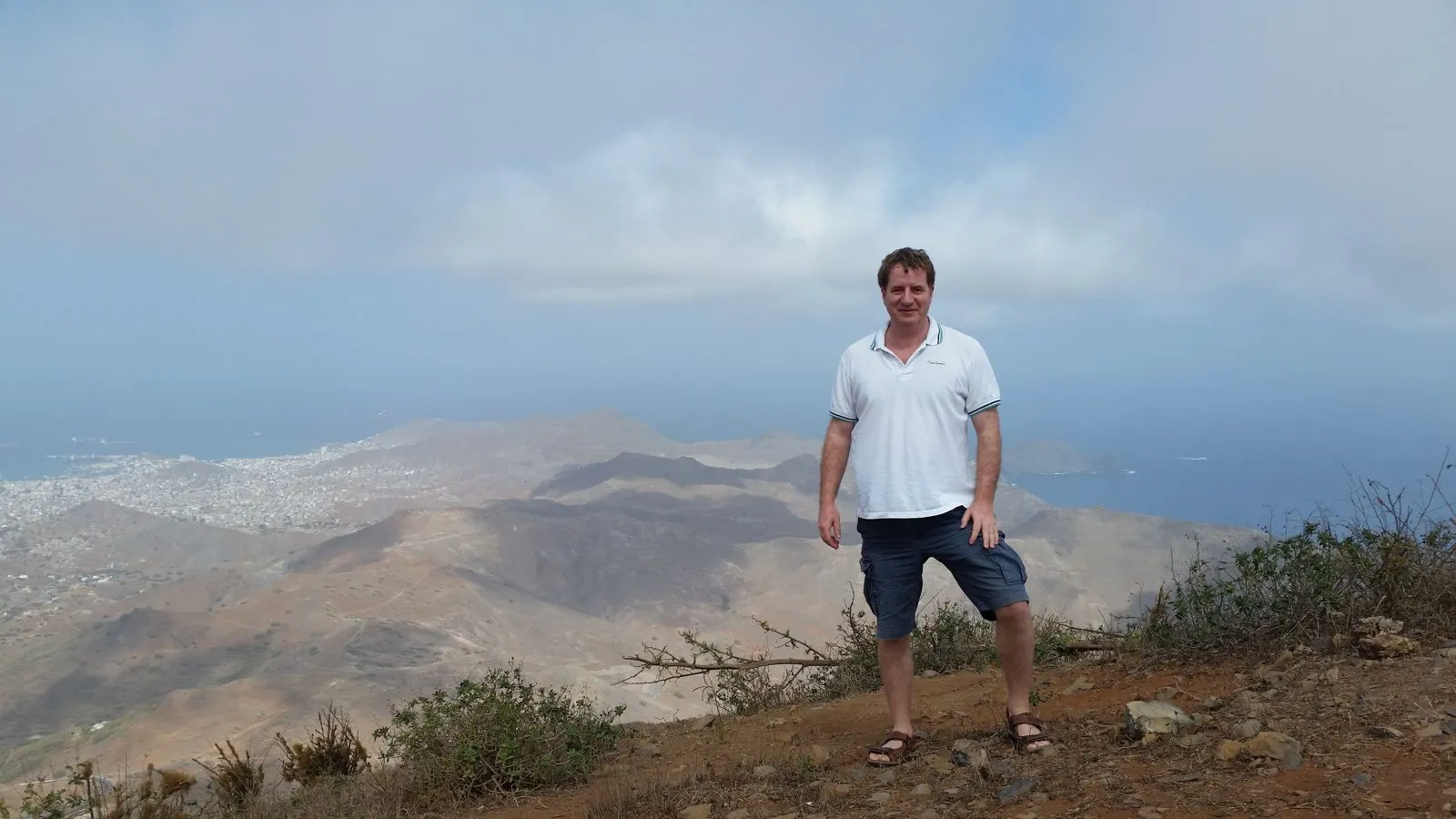
From the summit – I almost wrote that – a really great view opened up before us; in reality all we could see in every direction, right down to the ocean shore, was a bare, rocky, desert-like landscape. Wherever we looked, we couldn’t see a single green cape here. I bet the people who named the islands either didn’t land here first, or were in a very jokey mood, and with a good marketing trick came up with an attractive name for the Crown.

So where’s this Green Cape, then?

The top of the mountain was occupied by a military-guarded telecommunications installation with lots of big antennas, but one of the guards walked us round the outside and obligingly pointed out what was where on the island. He let us in on the secret that you just always have to turn right – like in certain labyrinths –, and then we’d go round the whole island and at the end easily find our way back to Mindelo.

Mindelo in the background

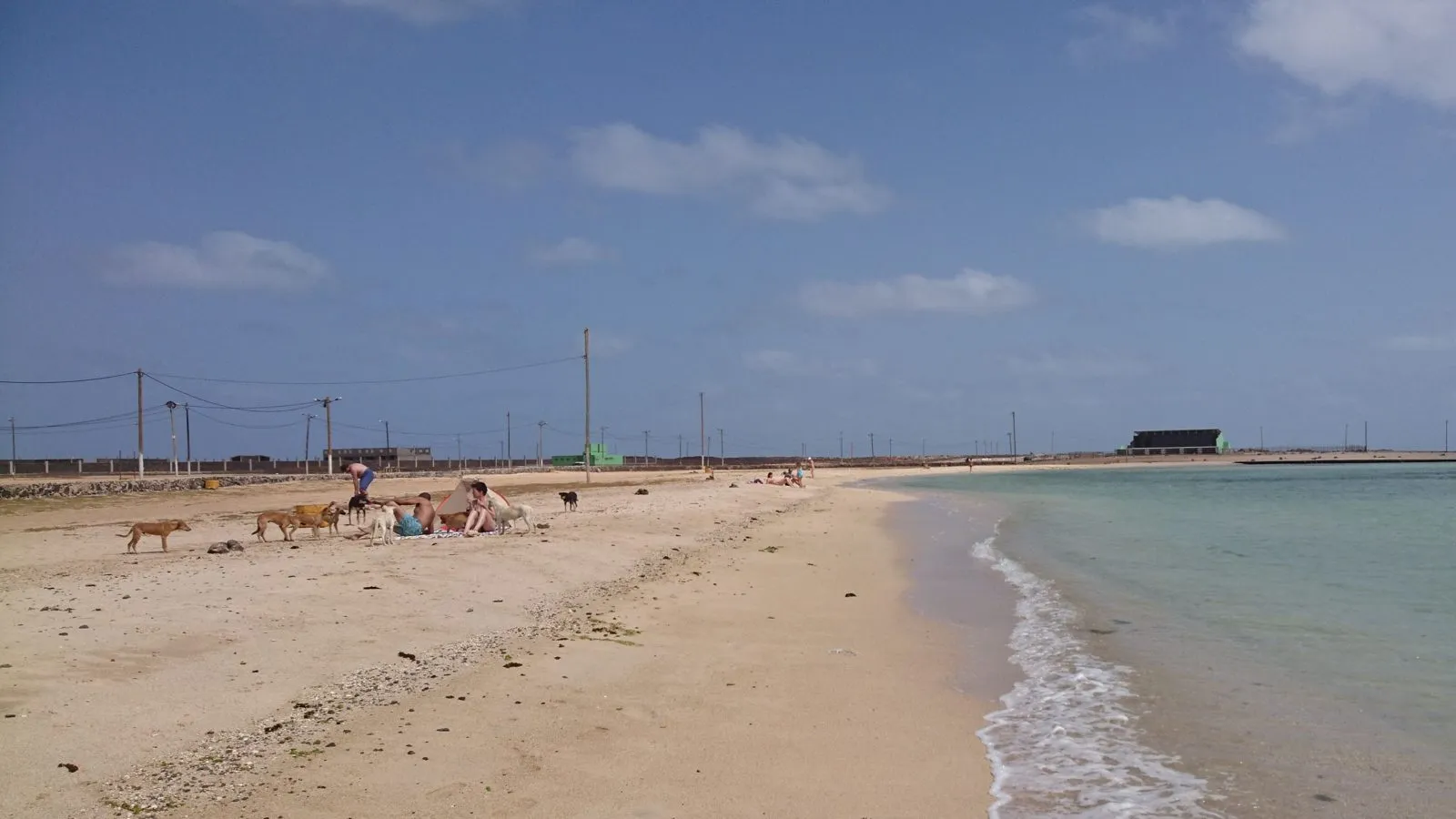
We carefully descended the mountain roads to the ocean shore, to one of the warmly recommended beaches, Baía das Gatas. We had brought our swimming things, but since there were more stray dogs on the beach than bathers, we agreed unanimously to postpone the immersion procedure.

Doggy Beach (Photo: Zsófia Rédly)

Then we headed for the eastern tip of the island. We passed a shanty-like fishing settlement – one that had seen better days – and crossed several bare valleys sloping down to the sea, their sides full of black lava boulders.

Several times we stopped on the ocean shore to admire its blueness, and the snow-white sand dunes heaped up by sea and wind at the foot of the black lava mountains. We saw a green navigation buoy washed up here from somewhere far away, and little fishing sailboats out on the ocean.

Eventually the main road turned away from the coast and led through a smallish desert area, between two volcanic cones, towards Calhau. Beside the road a larger area was fenced off, which looked like some kind of salt works. I’d imagined Calhau to be a small town, but in the end it consisted of just 20–⁠30 houses on the ocean shore, some of them newer. We walked to the edge of the settlement, where at some point a good 5–⁠6 metre thick layer of the volcanic mountain had slid into the ocean.

On the way back we watched the fishermen who had landed with their colourful boats sorting the catch, and some of them had already started cleaning the fish.

For lunch we went to the only restaurant, on the edge of the little settlement, the “Hamburg”, which looked as if we were in El Paso in the Wild West. When we arrived there wasn’t a single guest in the place, we would have sat down at the only laid table, but they politely pointed out that it was already reserved. Then guests started trickling in from somewhere, and by the time we’d finished our hearty lunch almost every table was full, and our little red car was no longer the only one parked in front of the porch.

The Hamburg restaurant

As our next destination we picked out a volcanic cone, but the rocky dirt track we’d chosen got steeper and stonier, and when the underside of our car had banged loudly several times, we stopped, reversed back to a spot where we could turn round, and keeping right set off towards Mindelo.

From then on our road led along a dried-up river valley, where in small oases they were doing irrigated farming, growing vegetables. Next to big water-storage cisterns, wind-driven water pumps were working, which made the irrigation possible.

Leaving the oases behind, another desert stretch followed, in the middle of which stood a long, drawn-out white building with a car park in front. As we got closer, something like blue slides seemed to rise out of it. What’s this, a Fata Morgana, or is a Cape Verdean mirage pulling our leg? In the end, beyond any doubt, we could read the sign: Aquapark.

In the desert.

This, I assure you, is no joke but a dry fact. It stood there empty and yawning, like the guesthouses and manor hotels built in Hungary from development grants – which have never seen a guest. If I saw it at home, I’d be sure they’d tapped EU funds to develop this nonsense, but HERE?

An aquapark in the desert. And it’s even on a slope…

We wanted to cut across – on a shortcut that exists on the map – to the main road to the airport, but slowly even the dirt track ran out under our wheels, and we ended up in the kind of scrubland where I wouldn’t advise you lot to go wandering after dark either. Several times we reversed, chose another direction – like in the Paris-Dakar rally – and in the end we wound up in Mindelo, we must have always turned right.

Industrial park (Photo: Zsófia Rédly)

Since it was still early afternoon, we drove out towards the airport – on a first-class tarmac road – but apart from a dusty little village we found nothing else of interest nearby, on the coast. Local men were hanging around in the streets and on the ocean shore – well, we certainly won’t be going jogging here, that’s for sure… The airport building, on the other hand, was new and modern – nicer than the one in Debrecen – I had to admit. Though it’s far from certain that latecomers get let in here either…

Airport São Vicente (Photo: Zsófia Rédly)

On the way home, before Mindelo, we passed a good number of ships run aground near the shore, collected the – by now – clean clothes and bedding from the laundry, did a big shop for the next two-week leg, and finally settled into a beach bar where we sipped a few Caipirinha cocktails, seeing as they were pouring them so cheaply, 600 forints (under €2) apiece.

Greek ship washed ashore in Mindelo bay

We drove about 70 km in total, covered the island’s more notable spots, and I didn’t see anything that makes it an absolute must to come here, even though they write that Mindelo is the most colourful, liveliest little town of the archipelago. I don’t know what you could do here for a week, unless it’s sunbathing by the pools at the Aquapark. Only if it’s open, of course…

Back home on the boat we lugged in the things we’d bought, then I jogged back with my laptop to the marina’s beach bar where there was good wi-fi. I Skyped with the folks at home, uploaded the first days’ happenings and pictures to my blog, and meanwhile – strictly as camouflage – ordered a few Caipirinha cocktails.

Because, you see, it’s not only the old folks of the future who keep saying it these days, but ocean sailors too:

“There’s only one important thing in life: as long as you’ve got wi-fi, and your health…”

Machine translation (AI, Claude) of Balázs’s Hungarian original. Read the original →
· Mindelo, São Vicente

Off towards the Canary Islands

In the morning we drove to the harbour authority to check out. We got our exit stamp – we have to leave the country within 24 hours – then returned our rental car, the little red KIA Picanto.

Then we headed for the market, where we bought fruit, vegetables and eggs. It was interesting to see that some wrote the price on their palm with a pen, and others pulled a tablet out of their skirt pocket and tapped the amount due into its calculator…

In the street, on the pavement too, they were selling vegetables and fish out of baskets and wheelbarrows, and then all of a sudden they’d snatch up their wares and move a few blocks along, because a police patrol pair was coming in the distance – who clearly weren’t bothered, they’d long got used to this nationwide parlour game.

Back on the boat – before leaving – Gyuri still wanted to wash down the deck and change the engine oil.

From the tap on our pontoon – for the credit loaded on the magnetic card we’d been given at check-in – we could draw 100 litres of water, and with that we could only rinse the salt off half our boat. At the office I bought another 400 litres of water for 8 euros, with which we finished washing the deck, and the rest I filled into the Pinta’s water tank.

The oil change took much longer than we’d have liked, because the oil from the funnel didn’t only flow into the opening, but generously beside it too, under the cover panels, which we only noticed after starting the engine. Oil was running down the side of the engine block, and it took us quite a while to figure out where it could have come from. And then of course it all had to be cleaned up…

Meanwhile Zsófi stowed away all the shopping and cleaned up nicely down below, like Snow White.

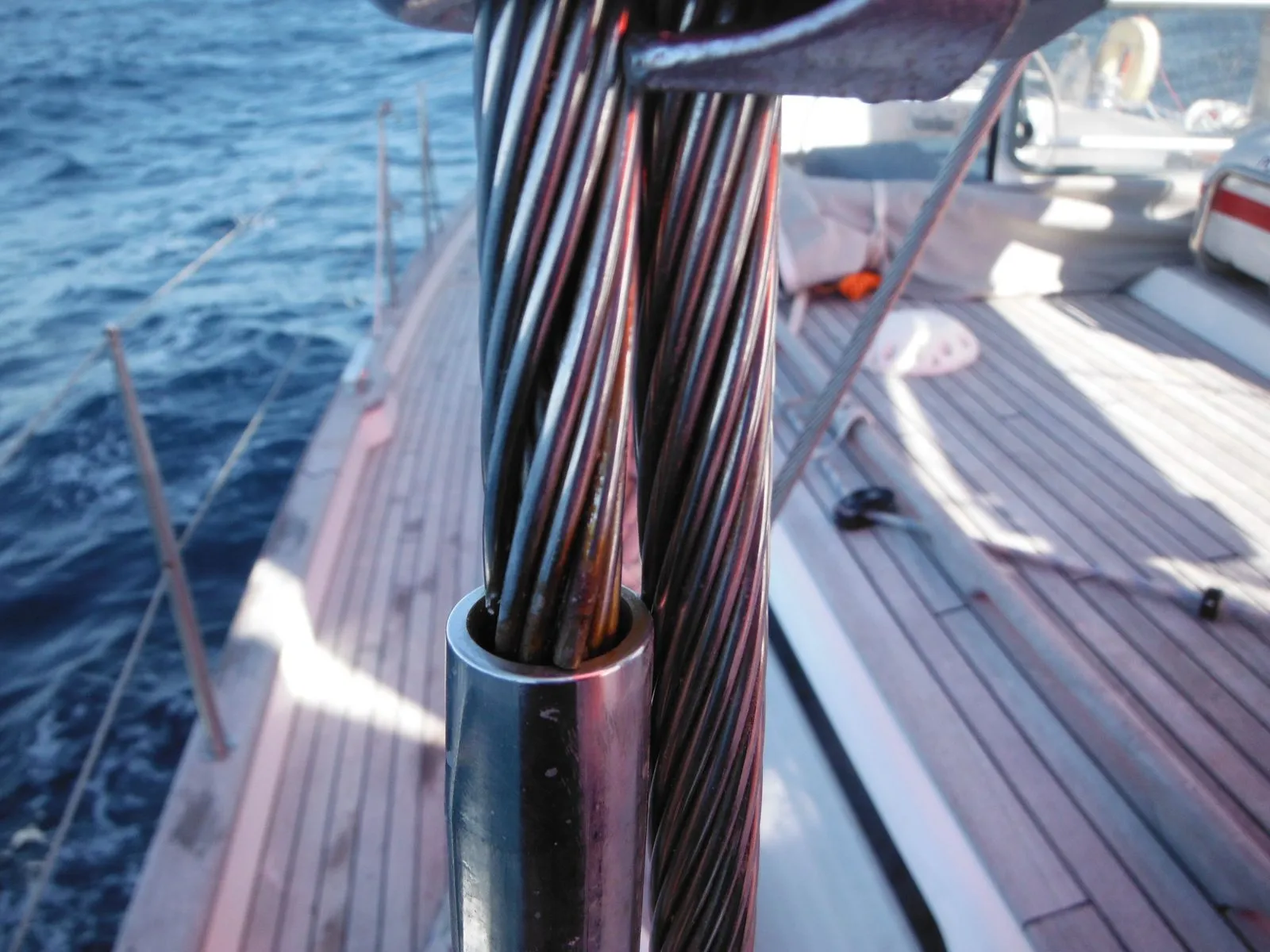
After that we also rigged the forestay wire that holds the little storm jib, so we wouldn’t have to struggle with it on a heaving sea. We tightened the bolts well, so they couldn’t possibly work loose. Our idea was that with this smaller orange storm jib we might be able to beat into a stronger headwind better than with the heavily furled genoa.

By the time we’d finished everything it was afternoon. Originally we’d wanted to buy a few more things, but none of us really felt like it any more, and we’d worked up a proper appetite too. We settled into the marina’s seafront Floating Bar, pooled and counted our remaining money, and calculated that there was enough left for one meal and one drink each.

Once we’d polished everything off and paid the bill, we scraped together all the small change too, and there was still enough left for 3 cocktails. Bring them on!

Meanwhile we were on the internet, checked the wind forecast, and talked online with the folks at home once more before leaving. We sent Zsófi off – no we didn’t, we just floated the idea – since she’d surely be better at getting back our €20 deposit for the access cards from the big black receptionist, without them making us pay for an extra day – as they’d earlier hinted – because we’d stayed until the afternoon instead of leaving in the morning.

Somehow or other, there was still enough money left for one more drink, so we ordered that and drank it too.

It sounds odd – since we’re talking about ourselves, respectable people – but like proper sailors we sat in the waterfront pub until we’d drunk all our local money. Meanwhile back home they couldn’t understand what was going on with us, why our tracker dot wasn’t moving, when we’d meant to leave today. Before anyone starts rocking the boat with accusations – let me point out – we were guided purely by practicality, in the spirit of thrift, so that our leftover Cape Verdean escudos wouldn’t go to waste. The cynics might say we could have bought postcards or milk, but that’s not how it works. The pub sells neither, and our boat might leave at any moment, and we certainly didn’t want to miss it…

So we could put ourselves exactly in the shoes of the sailors of old, who likewise drank their last local coins so they wouldn’t go to waste… What could they have done with them in another country, anyway…

In the end our money ran out down to the last escudo, and then the captain suddenly gave the order to depart.

See, I told you… we might leave at any moment…

Before leaving I asked Zsófi to take a few star photos of me for the Hajú-Bihari Napló (our county paper back home). It wasn’t easy for her, as she had to work with the material provided, but we did manage to pick one good picture out of a few thousand. I had the photo taken at my father’s request, who has been a subscriber to the Napló for a good few decades, and that way I hear second-hand about the more interesting local goings-on too, even if a few days late.

In the sunset we sailed out of Mindelo harbour, said goodbye to the giant stone face, who didn’t even look at us, just kept silently staring at the sky. Only now did it dawn on me that we’d been in Lilliput, and it was Gulliver who turned to stone here, who perished miserably here when they tied him down. Swift exaggerated everything, and besides, Gulliver was the giant, and the normal Mindelo folk were the little Lilliputians. There was no happy ending at all, the whole thing is a Swiftian, Hollywood hogwash, and I’m the only one who has figured it out so far… But now you know the cruel truth too!

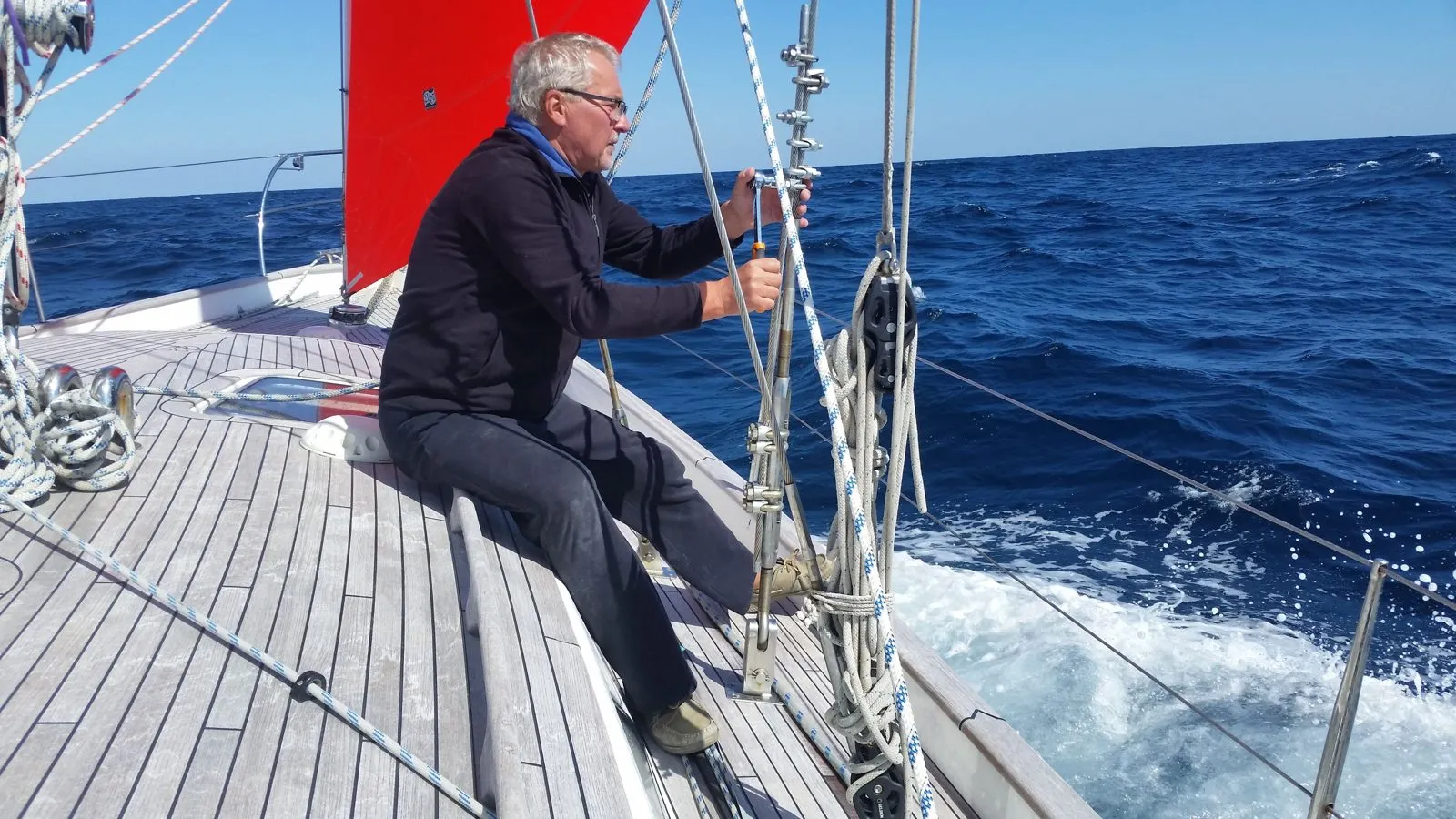
Out on open water, when rigging the storm jib, it turned out that we hadn’t attached its forestay wire to the right point, so we got to start with exactly what we’d wanted to avoid: unrigging the whole thing in the bow dancing up and down on the heaving sea, in the flying spray, then rigging it back correctly. Meanwhile we thought gratefully of our far-sighted selves, and how very well we’d tightened those blasted bolts…

Rigging the storm jib (Photo: Zsófia Rédly)

After that – already half soaked to the skin – we rigged and hoisted the little storm jib, and at last we could lean back and look at the result.

Which was pathetic.

Two hours later we were still beating back and forth in the dark between the two islands.

Like this it isn’t worth a hatful of, ahem, good wishes – let’s take it down! In life jackets, clipped on, armed with headlamps, Gyuri and I crawled forward in the dark, took down the storm jib and dropped it into the cabin. There, with a great deal of effort, we folded it up, and I put it back under my bunk in the forepeak cabin. And then we could catch our breath. Until midnight I was still on watch, the boat went nicely by herself, then I woke Zsófi to take over.

Machine translation (AI, Claude) of Balázs’s Hungarian original. Read the original →
· Atlantic Ocean, between Cape Verde and Madeira

Product launch on the ocean

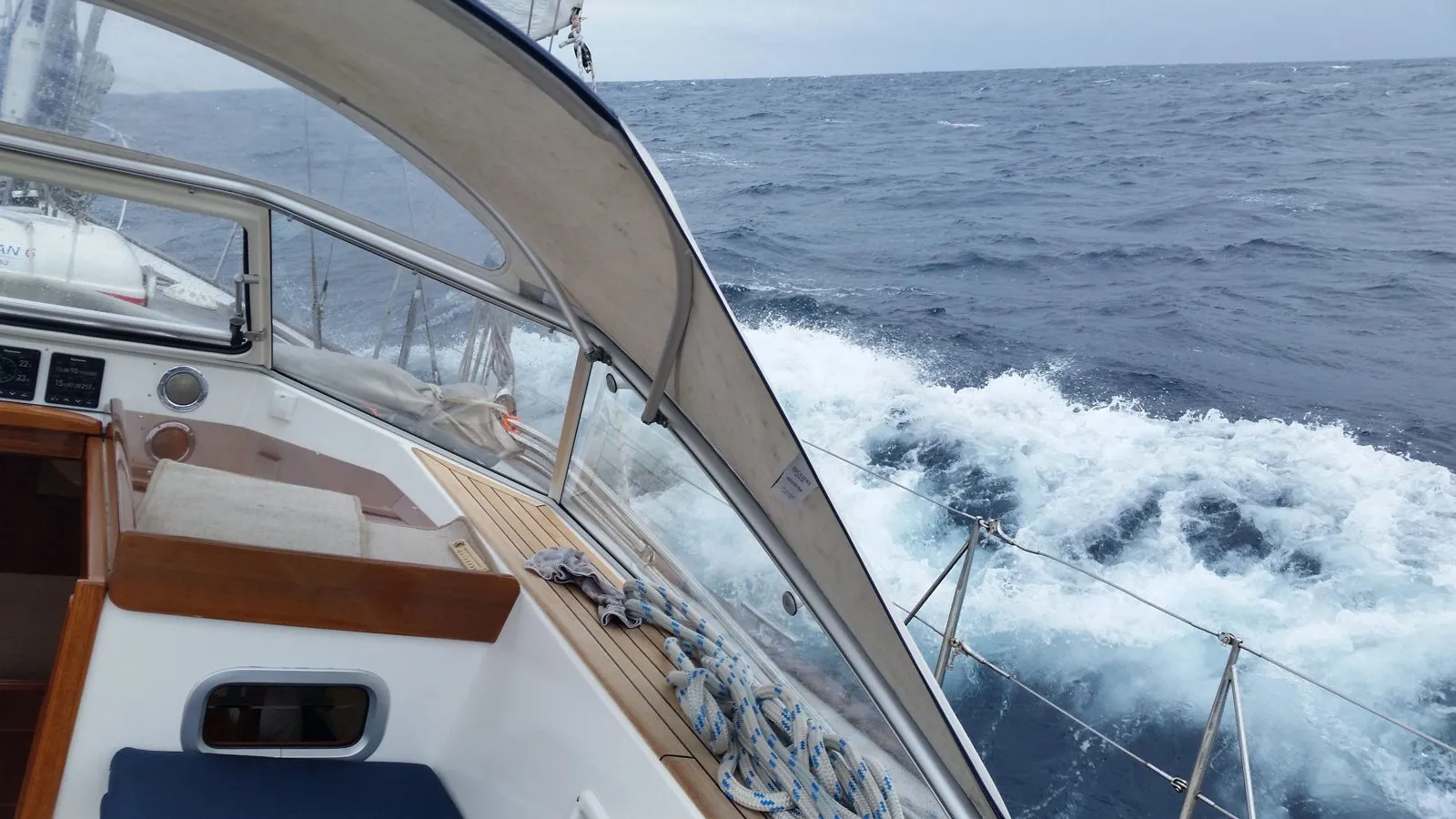
In the morning I felt like the clothes in a washing machine mounted on a rollercoaster. I have the forepeak cabin all to myself, so I can always roll to whichever side the boat heels. The 4D effect is perfect, the waves were slapping and sloshing around me in quadro against the sides and bottom of our sailing boat, twisting the boat now right, now left, just like a washing machine drum does. Since we’re going into the wind, the waves come at us faster from the front too, which means that every 2 seconds the bow rears up onto a wave crest, then plunges down 1–⁠2 metres and slams into the foam. Meanwhile fresh sea breeze blows in your face from the vent in the cabin roof, and the sight of the jackets swinging right and left guarantees the flawless 4D experience.

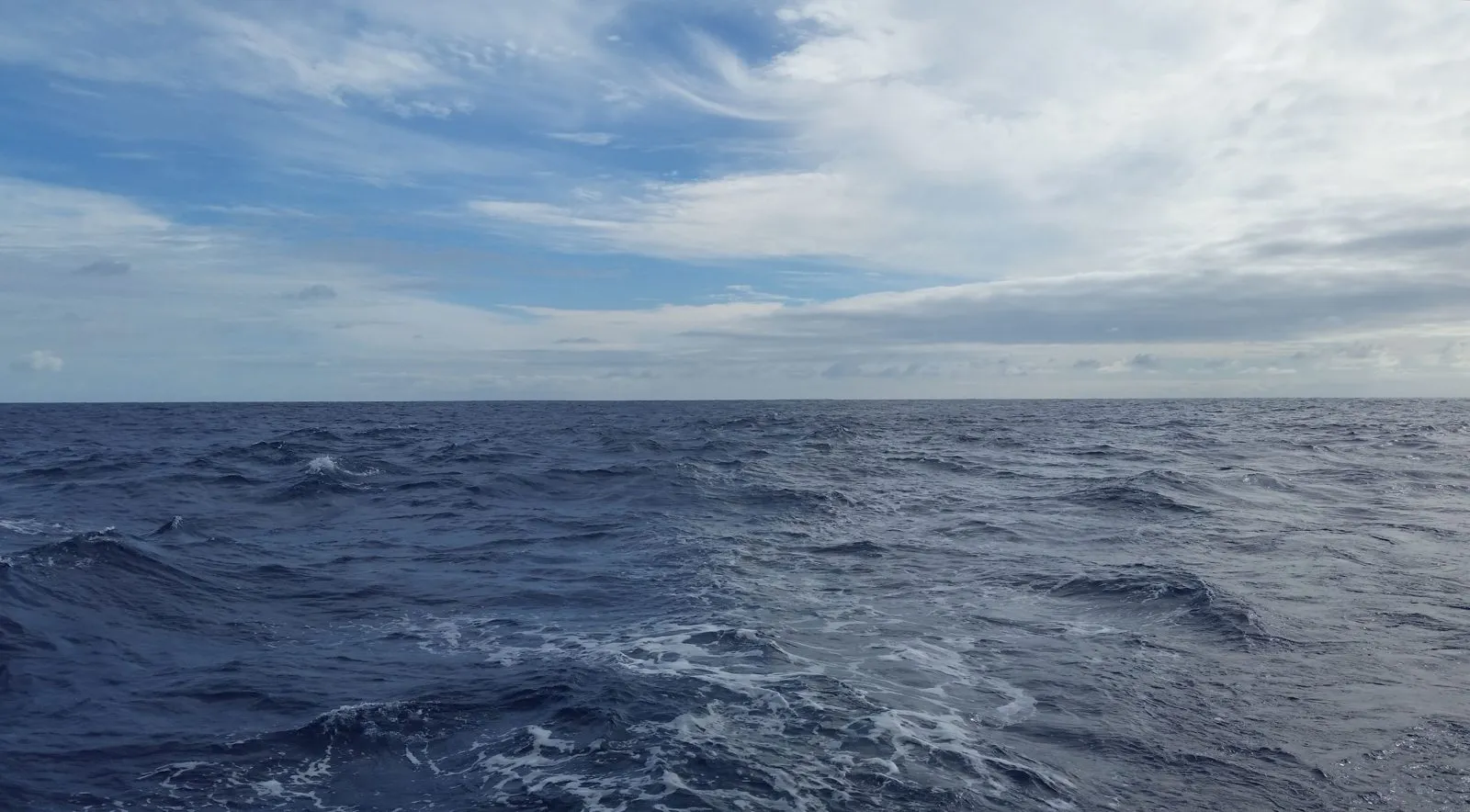
Before 8 o’clock I climbed out of my washing machine drum, and for a few moments I still had to acclimatise to the sight of the endless ocean. Behind us, very faintly, the outline of the high mountains of Santo Antão was still just about visible in the morning haze, but otherwise just water and water. Sorry, sea as far as the eye can see. This was one of the main tenets on the sailing course. Water comes out of the tap, and you find it in rivers, but we sail on the SEA – at most on the ocean – and the sea is what you fall into if you’re not careful enough.

We’ve been motoring since 4 in the morning, because the wind had weakened so much that the sails kept collapsing.

Around 8 o’clock, together with me, the trade wind woke up too, so we could set sail again, and close-hauled on the 15-knot north-easterly, with full sail up, we raced on northwards.

For lunch Gyuri and Zsófi fried the barracuda steaks that Szabi had caught earlier, served with rice and steamed carrots. Much tastier fish than what we’d eaten in the waterfront restaurants.

In the afternoon I held an impromptu product launch and showed them my patent-pending pallet-guard invention. I was very glad that they too could see potential in it, and we talked a lot about how feasible it would be in Hungary.

https://raklapor.hu/

Instead of the 17:00 gin and tonic Zsófi made each of us an iced Piña Colada cocktail, before we drank all the white rum neat.

Machine translation (AI, Claude) of Balázs’s Hungarian original. Read the original →
· Atlantic Ocean, between Cape Verde and Madeira

Déjà vu

Since midnight the big-boat “washing machine” had been running, shaking, spinning, gurgling – well, this is when you ask yourself what the hell am I doing here – and on top of that, around four in the morning, you could feel even in the cabin how the wind was changing, strengthening, the boat heeled more and sped up. The amplitude of the rollercoaster ride grew, and at the tops of the crests it was supplemented by “pancake tossing”, where this time I was the pancake. Every now and then I literally lifted off the bunk, and if the blanket hadn’t stopped me, I could even have flipped over in mid-air… Now this is further from restful sleep than Makó is from the Cape Verde Islands (Hungarians measure hopeless distances as “from Makó to Jerusalem”), so I climbed out of my spinning drum, hand over hand made my way aft to the galley and drank some water. The wind had picked up from 15 to 20 knots, and our boat speed had risen to 8–⁠10, which was the reason for the rougher motion. By the time I got aft, I heard Gyuri and Zsófi reefing the headsail, world peace was immediately restored, our boat slowed down to her usual 6 knots or so, almost straightened up, and was no longer galloping so wildly over the backs of the waves.

Since my rest period lasts until 4 in the morning – I could even get some sleep, if only I could – I lay back down for a gentle cycle…

Even in the morning the bow is riding the elevator with gusto, slamming into the waves…

After waking up, all morning I had a déjà vu feeling, as if I’d seen these wave crests, troughs and clouds before…

And then it hit me – of course, a good three years ago I’d been exactly here, when we crossed the Atlantic towards the Caribbean on a Nautitech Open 40 sailing catamaran. Right at this spot. Back then I was very sad that I wouldn’t get to see the Cape Verde Islands – not even from a distance – but our skipper was unbending, and 70–⁠80 miles before the Cape Verde Islands he turned west towards the Indies…

And now here I am again, I’ve seen a Cape Verde island – which is by no means green – and I get to sip the soft drinks bought there. Perhaps you’ve noticed too that Fanta isn’t equally sweet in every country. Sometimes it’s more sour, sometimes a bit sweeter. Well, it seems the Cape Verdeans like their life and their Fanta very sweet, because even I had to dilute this one, and I take three sugars in my coffee…

Machine translation (AI, Claude) of Balázs’s Hungarian original. Read the original →
· Atlantic Ocean, between Cape Verde and Madeira

Looking for the optimal route to the Canary Islands

As this day started at 00:00, so did my watch. The north-easterly wind had dropped to 8–⁠9 knots, and with it our speed fell to 3–⁠4 knots, and the moment came to furl the only headsail we had up and start the engine.

Normally, if the wind blows from behind or from the side – which is how it was for practically the whole of Gyuri and Zsófi’s circumnavigation – there’s no complication at all, you can head dead straight for the next destination. This leg, from the Cape Verde Islands to the Canary Islands, and then probably on to Gibraltar as well, is an area where the prevailing wind blows right against us. Which means that before leaving we had to study the wind forecast thoroughly, so as to forge the best plan, the one that takes the least time.

Just for comparison, I’ll tell you that in November 2015 – when I was on the Atlantic crossing – we covered this 860 nm stretch in about 7 days from the opposite direction, which worked out at approx. 120 nm a day. That was with a favourable following wind or broad reach.

In Mindelo we asked the owner of the Belgian boat moored opposite us on the pontoon what route he’d suggest to the Canary Islands. He thought about it: “Well, he’d go to the Azores (on a close and beam reach), then sail from there to Gibraltar or the Canary Islands…” That would be some 1200+900 nm, and would take at least 18–⁠20 days. Plus however long we spent in the Azores. Well, we wouldn’t devote that much time to it, but he wasn’t talking nonsense, because for anyone who doesn’t want to box against the wind and has the time, this is the logical route, just as Columbus too always returned from the Indies by way of the Azores.

So our options:

  1. If we beat to windward under sail all the way, into the wind and waves, we’d have to sail at least 1900 nm – more than two weeks, 16–⁠18 days – given that we can only point to a maximum of 55 degrees off the oncoming wind.
  2. If we wanted to motor all the way – against the 15-knot wind –, that would mean we could only make 3–⁠4 knots, because the headwind and the waves would slow us down from 6 knots to that, while burning more fuel to boot. That would take 10–⁠12 days, but we don’t even have that much fuel, “only” 800 litres (which is still not nothing).
  3. A mix of the previous two.

What we noticed in the wind forecasts was that around day 3–⁠4 the wind would probably drop to 6–⁠9 knots, and after that, for a few days, the otherwise prevailing north-easterly might even veer to the east. That would be suitable for motoring in the right direction against the weaker wind, and then, once it turns east, sailing directly towards Tenerife. We chose this 3rd option, and hopefully we’ll cover the passage to the Canary Islands in 8–⁠9 days.

As a result, so far we’ve been sailing close-hauled on the 14-17-knot northerly wind, and even so we could only make way northwards, at 120 – 130 miles a day.

Since midnight we’ve been motoring against a 9-10-knot wind, the boat isn’t heeling, the waves are low, the going is quite bearable, we’re closing in on Tenerife at about 5.5 knots. Right now we reckon we’ll get there around Sunday, 3 March, but Neptune may still have a few choice words to say about that…

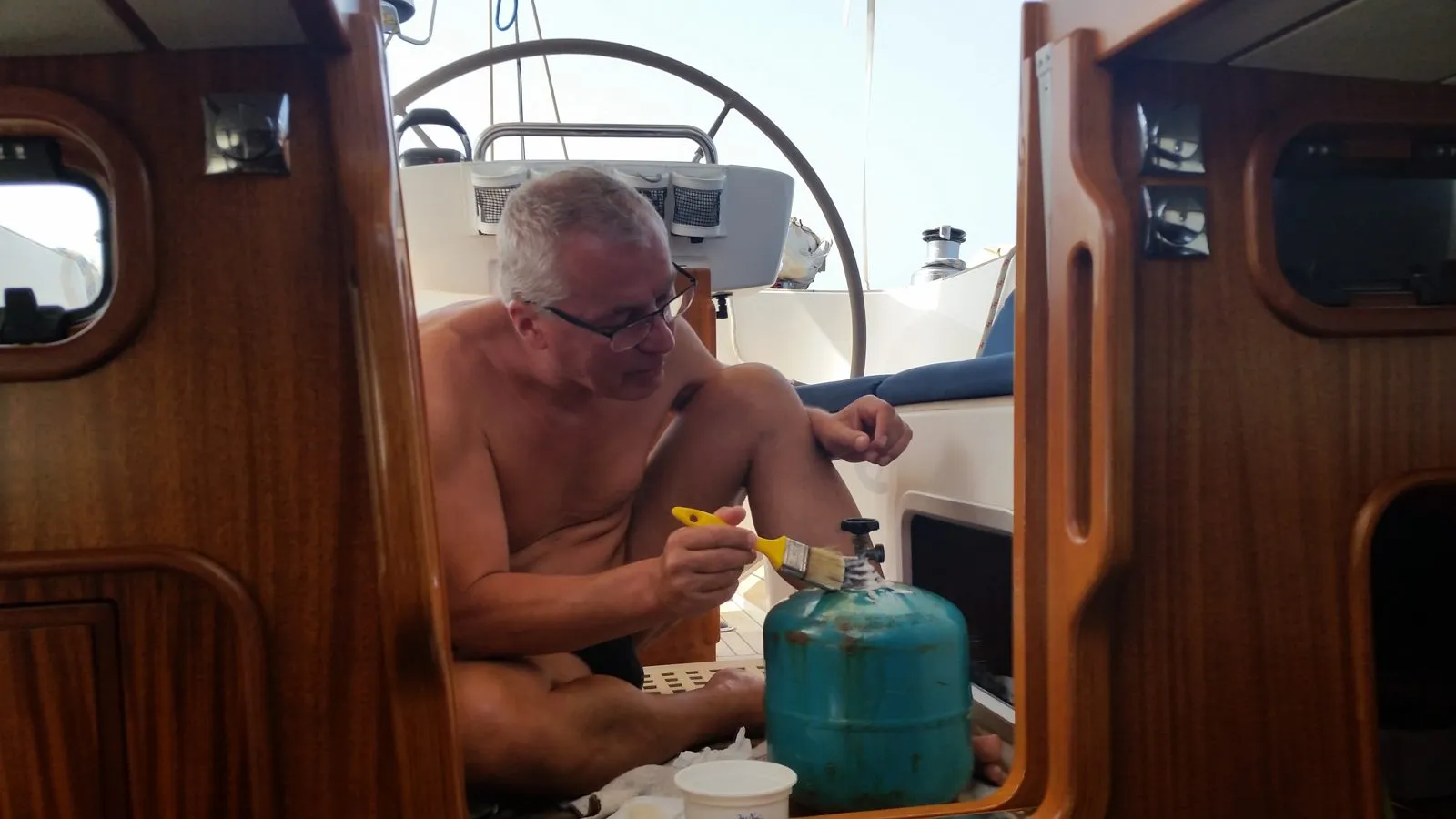
Ever since the gas bottles were filled in Mindelo, Zsófi has been noticing a faint smell of gas in her locker. This is no laughing matter at all, plenty of yachts have burnt down in moments when the gas exploded. On top of that, gas collects unnoticed in the bilge. So this morning Gyuri soaped up the suspect bottle, but even though you could smell a faint whiff of gas leaning in close, no soap bubbles formed anywhere, which would have indicated a gas leak. In the end we banished the bottle to the stern, tied to the rail.

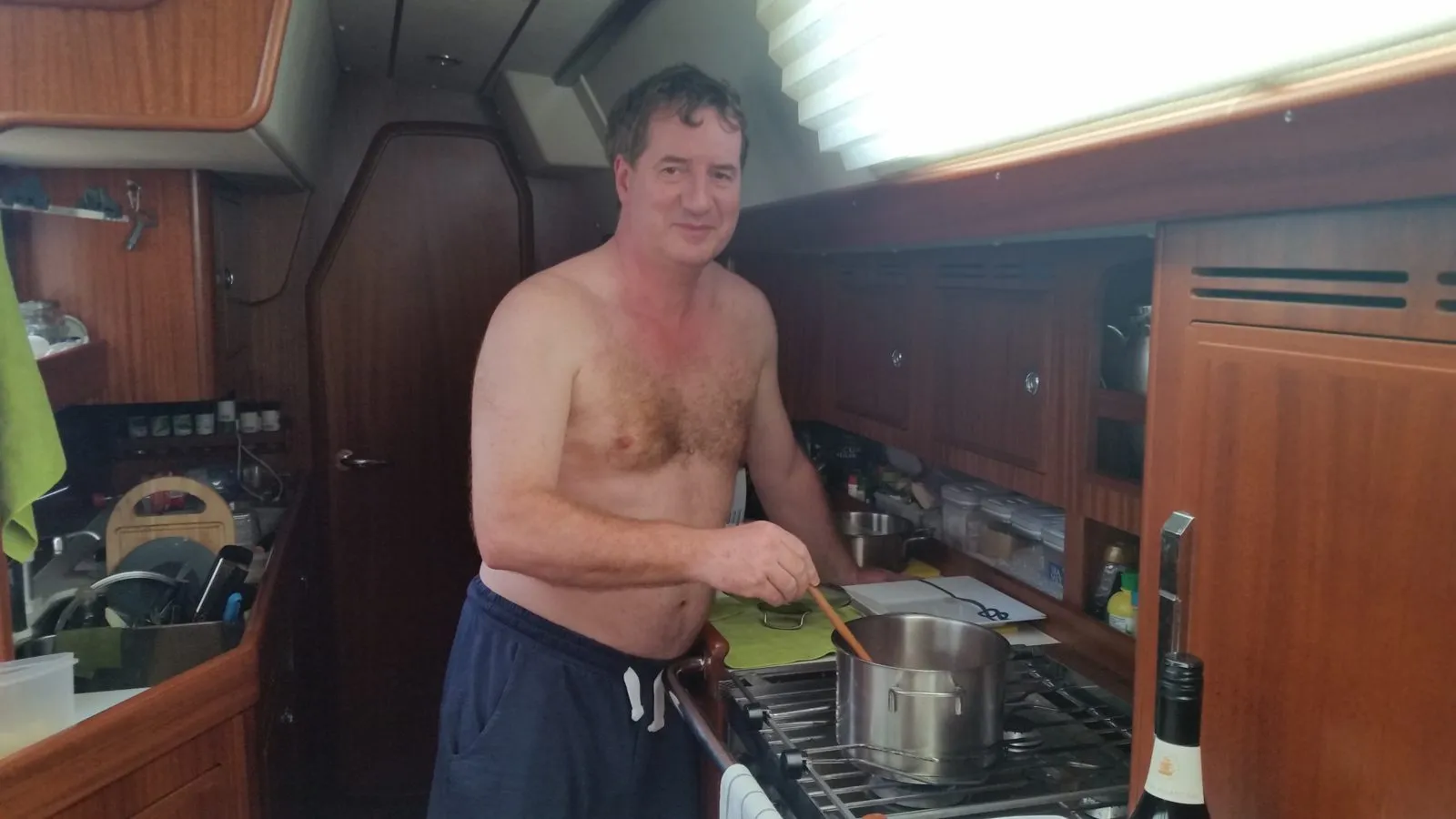
Up to now Zsófi had been cooking all sorts of delicious things with Gyuri’s help, today I took on making the beef pörkölt (Hungarian beef stew), I’d better get started slowly…

It turned out pretty well, as proved by the fact that it was eaten down to the last bite – may no one ever eat a worse beef pörkölt on the Atlantic Ocean!

At half past 5 in the evening the wind shifted again, this time blowing from north-north-west, which meant we could unfurl the big headsail again – whose honest name is the genoa – and this time, close-hauled on the wind coming from the left, we sailed towards Mauritania. A quarter of an hour later it turned out the whole thing had just been a joke: the wind died down and swung back to its original north-easterly direction, sail down, engine on, and once again we chugged towards Tenerife. In the evening I managed to talk briefly with the folks at home on the Iridium satellite phone, this technology is mind-blowing. As the little master tailor said on seeing the Eiffel Tower: Incredible what we craftsmen are capable of…

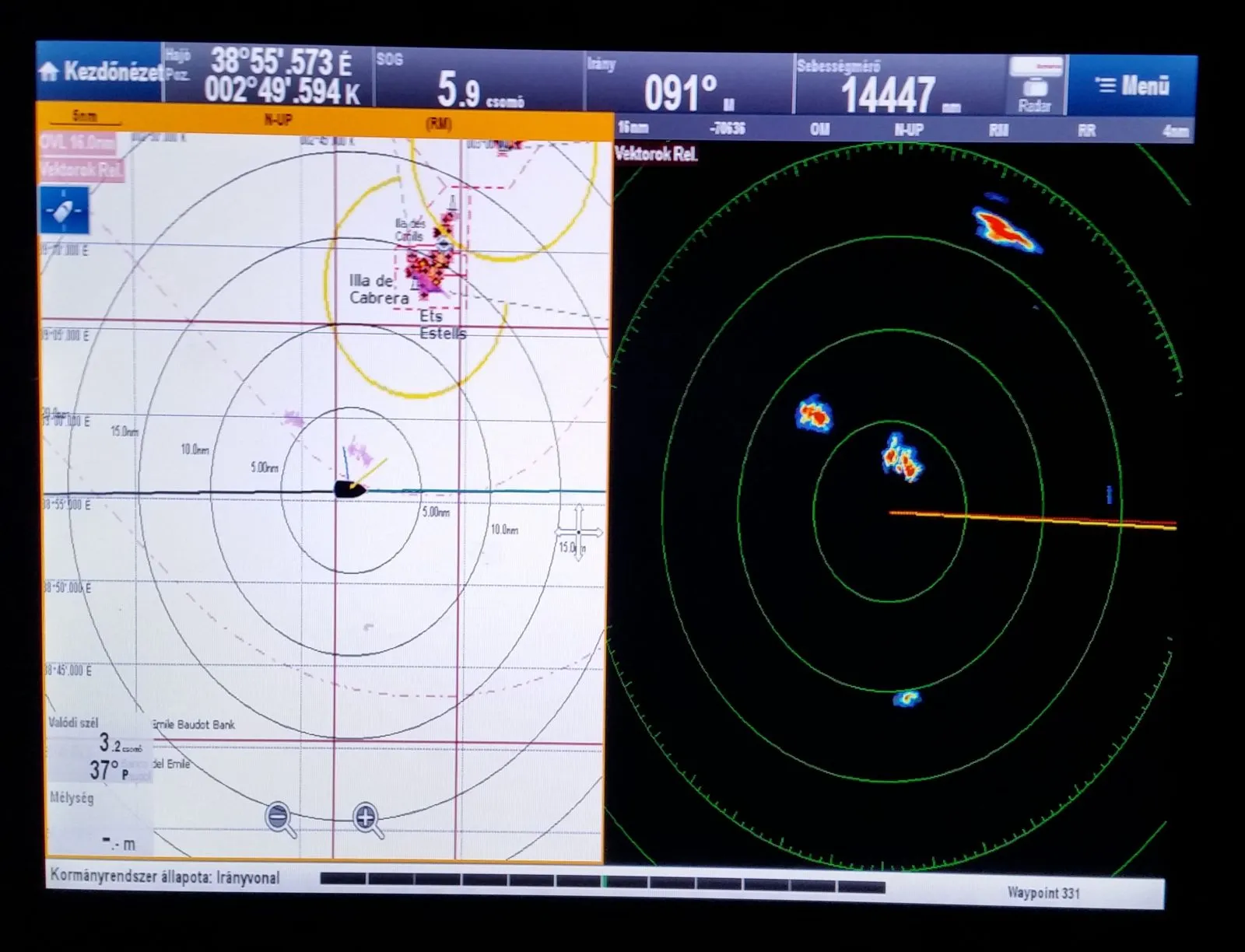
Now, at 21:00, we saw the first ship of our voyage, or rather only its lights. An hour earlier its signal had appeared on the monitor – heading straight towards us – and sure enough, just as the AIS had shown, the 300-metre cargo ship Zheng Kai passed us 1.25 miles away.

Machine translation (AI, Claude) of Balázs’s Hungarian original. Read the original →
· Atlantic Ocean, between Cape Verde and Madeira

The Pinta has sailed around the world!

Sadly, there’s nothing new under the sun – or rather under the moon – as far as the nightly non-rest goes. And yet there was every opportunity for it: from 11 p.m. to 7 in the morning I could have slept in one go. Could have.

No use counting the 678 corners of the forepeak cabin, it didn’t help, the boat literally shook the sleep out of my eyes, so I can give you an authentic report on the proceedings. In the first half of the night it was “pancake tossing” (the oncoming waves had grown), then a long RINSE cycle (the waves breaking over us ran in through the cabin hatch and soaked my bunk a bit), and finally a persistent, dream-rocking spin cycle at 0.5 rpm. I registered every single wave, and then around 7 in the morning I must have dozed off after all, because I woke to Gyuri shaking me: “You’re up, Balázs!” Ohhhh…

I’m not writing this to complain, just for the sake of the facts: it’s not enough that you’re not seasick, it’s not enough that you can lie down for 8 hours in one go, you also have to be tired enough to fall asleep. And so as not to put anyone off sailing round the world: you mostly get to enjoy such “shaky” experiences in the forepeak cabin, with head winds and head seas, whereas for 95% of the voyage – in the trade wind belt – the going is much more pleasant, downwind or on a broad reach.

And one more thing: what I’m whingeing about here would have counted as a restful, dream-rocking toddlers’ party for Nándor Fa and István Kopár (Hungary’s solo round-the-world sailors) in the Roaring Forties around Cape Horn…

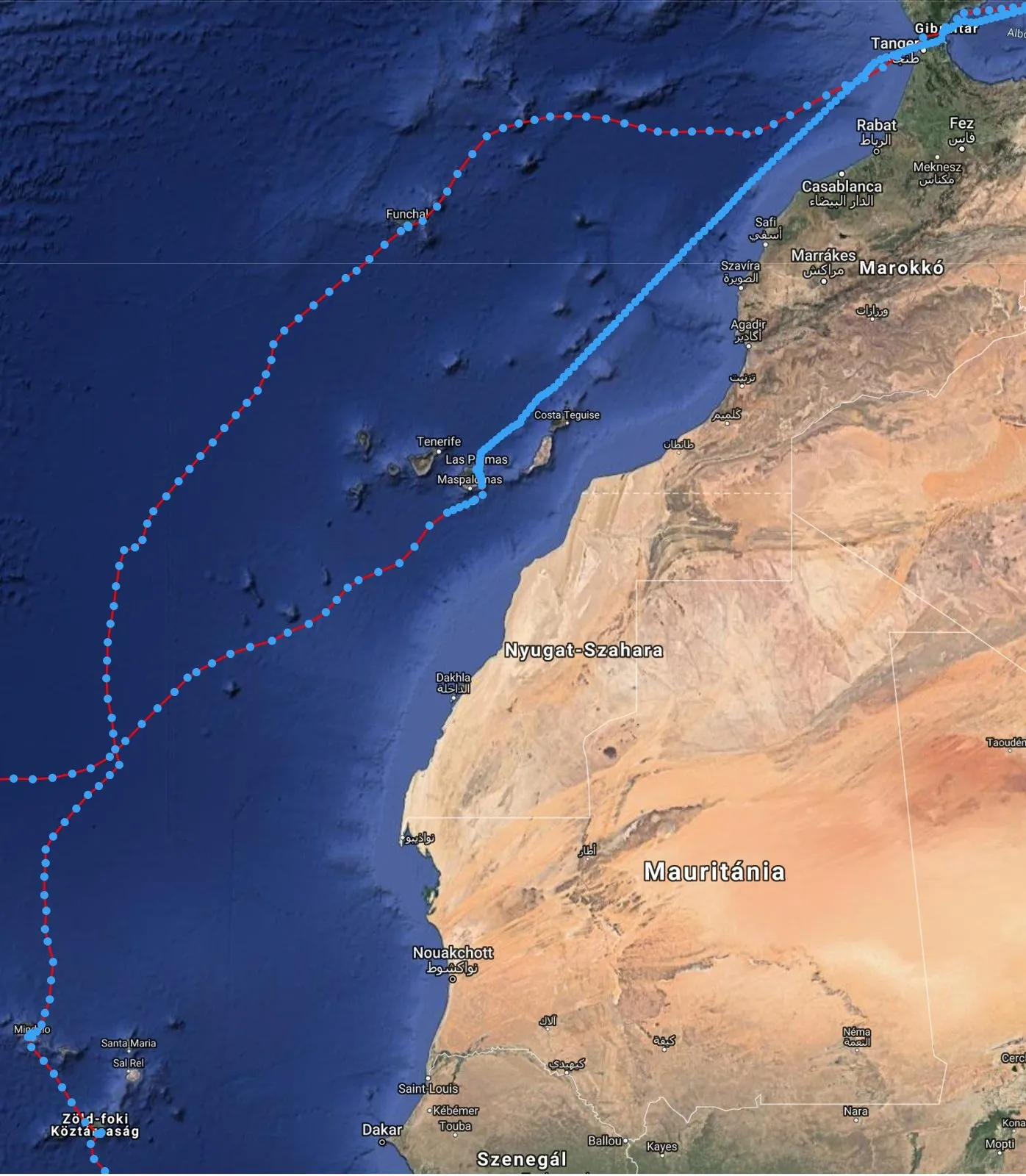
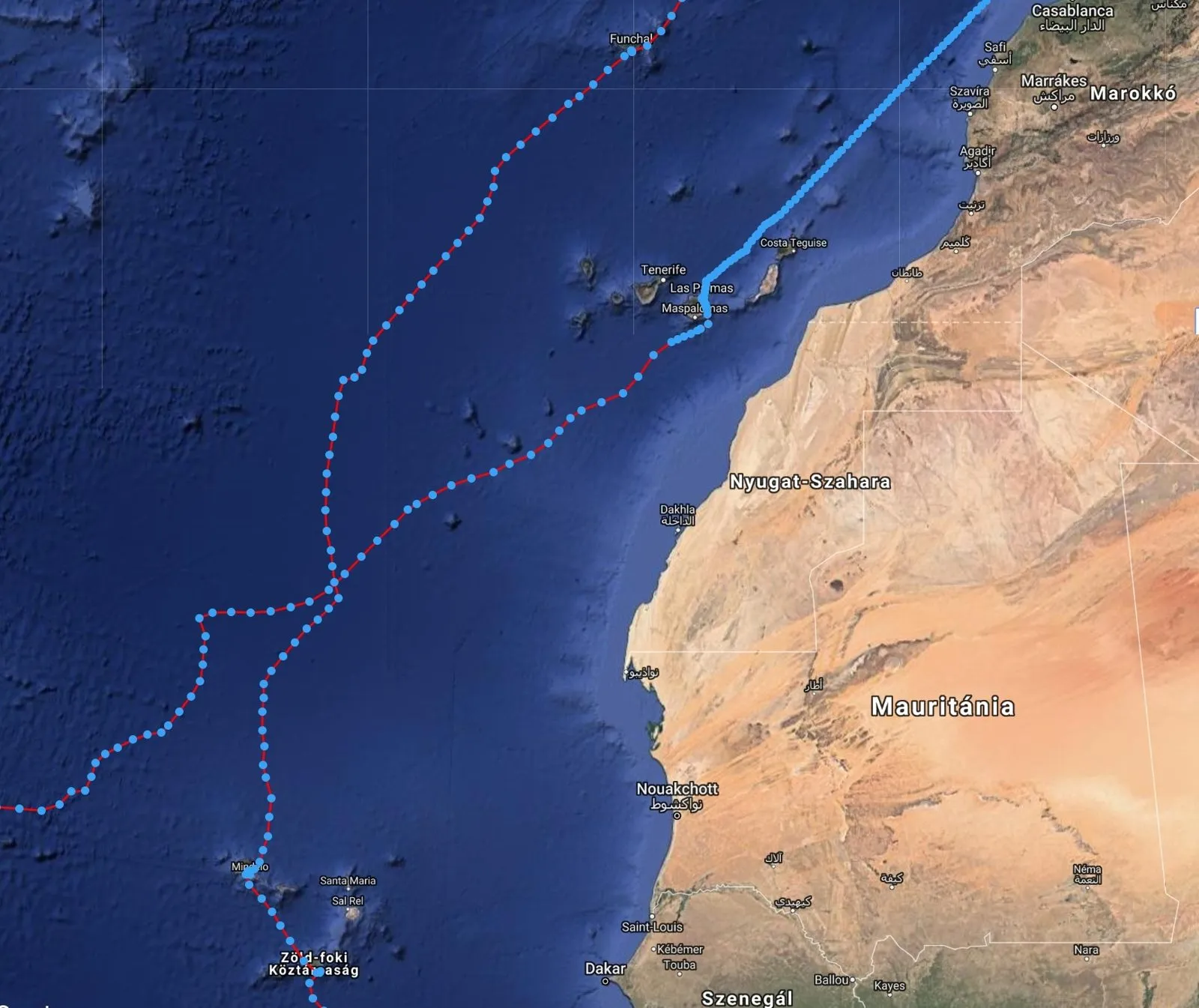
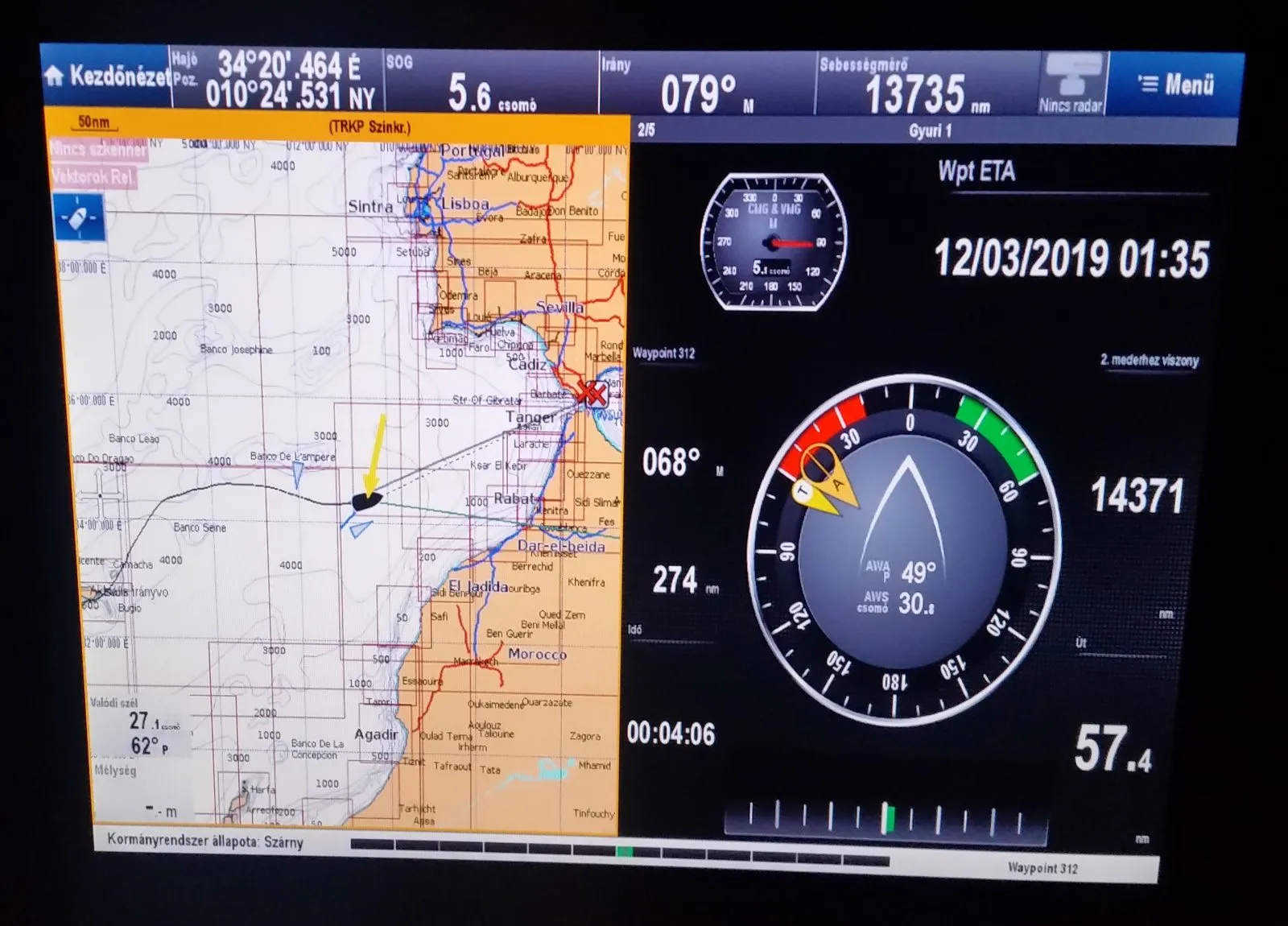
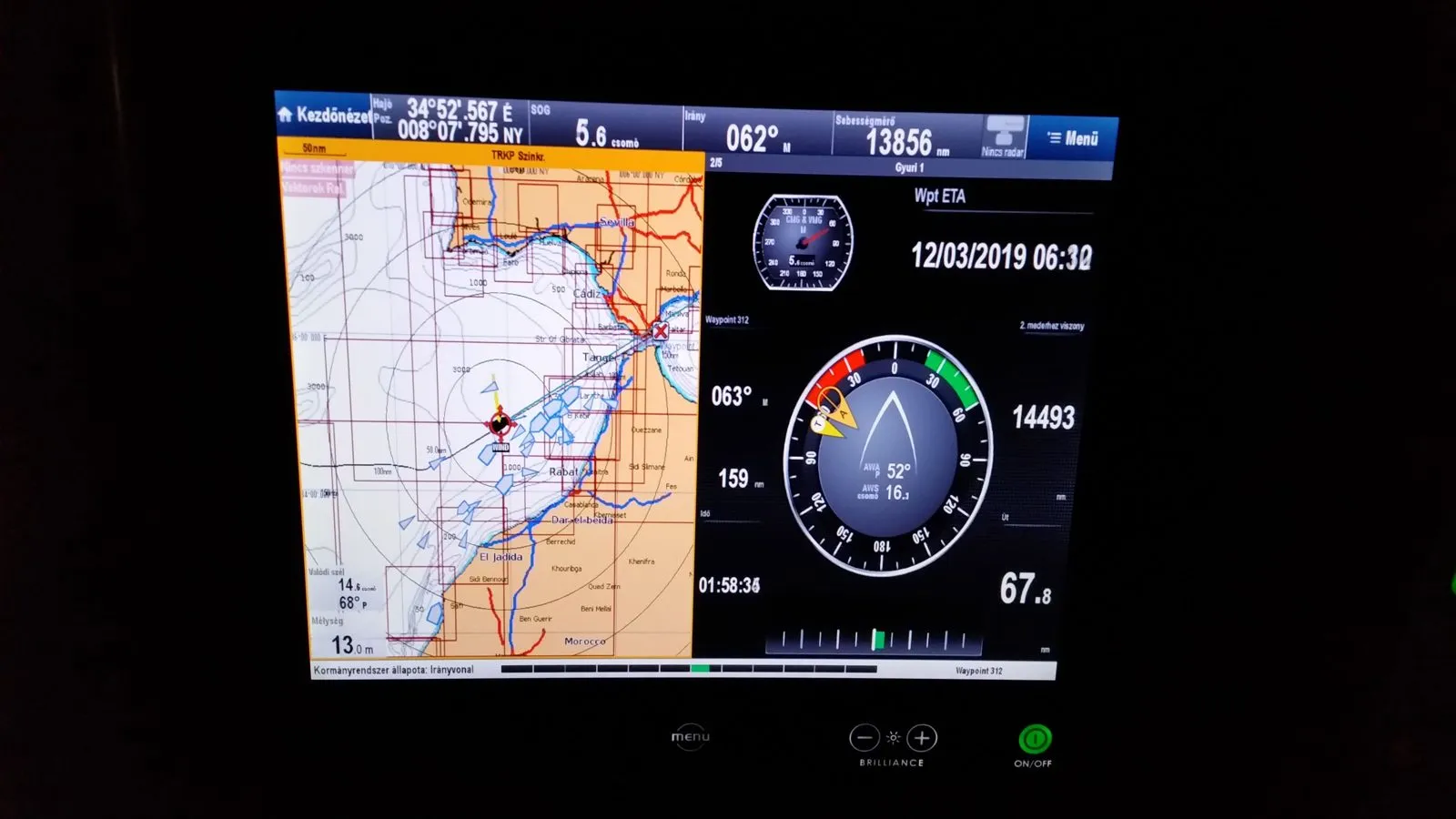
Today at 9:52 the great Moment arrived: we crossed the Pinta’s westbound track from a year and a half ago, which means this Pinta has sailed around the World! We felt a teeny-tiny bump as we crossed the earlier track, but full certainty was provided only by the intersection of the routes plotted on the chart. We postponed the official ceremony to the afternoon, so that everyone could get properly dressed up.

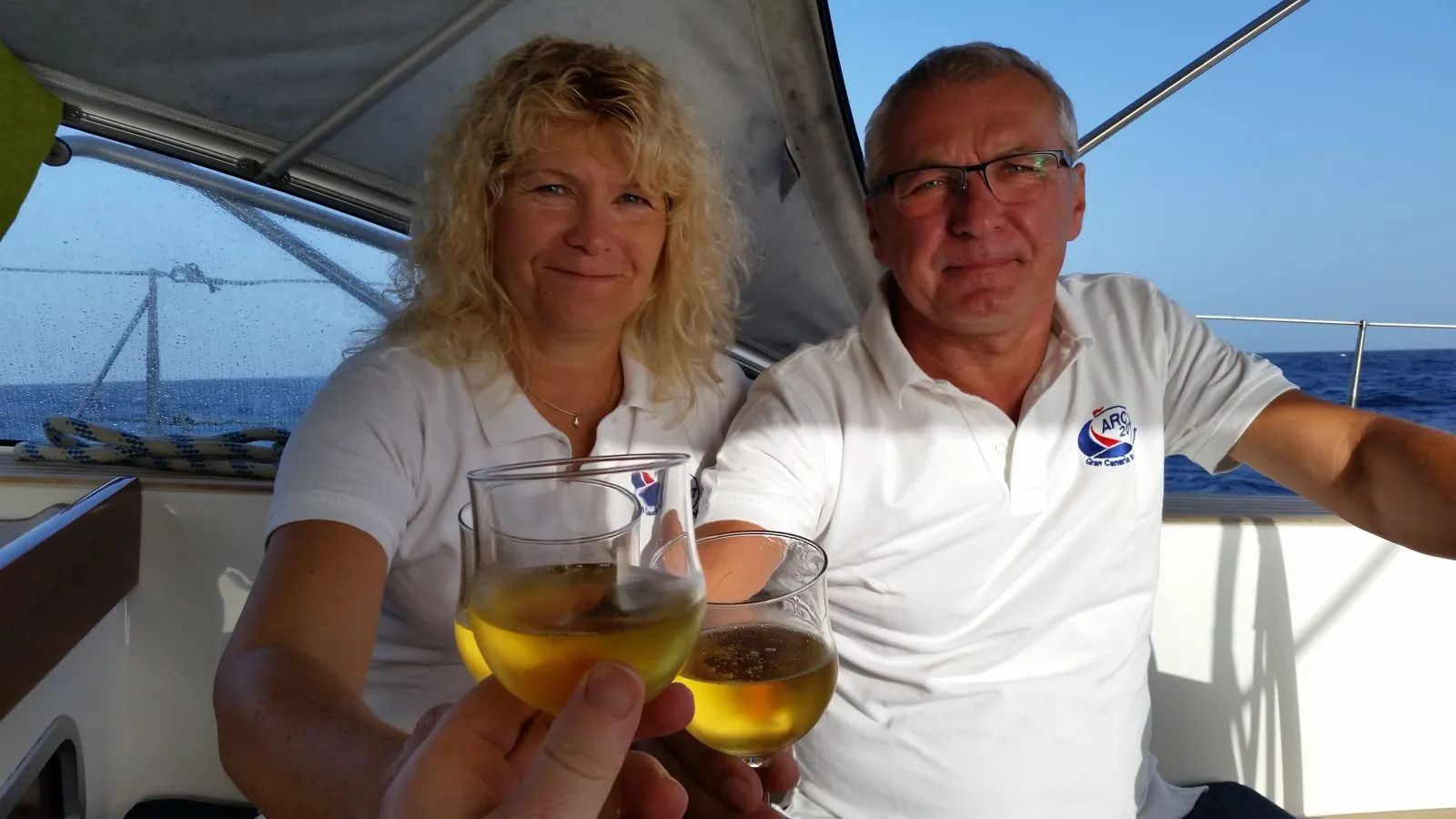
I had the honour of being the first to congratulate them on this magnificent achievement of 26,159 miles (48,446 km). Including stopovers it took 453 days, and besides Gyuri and Zsófi, another 24 people took part in it, leg by leg, just like me now. We popped the champagne, celebrated – this is an experience nobody can ever take away from them! Hats off to their perseverance and determination!

The festive lunch was made by Zsófi: a delicious Cape Verdean pumpkin cream soup, and cabbage-and-bacon rolls made Atlantic-style. (If you’d like to bake the latter at home too, I can let you in on the secret of “Atlantic-style”: for the whole baking time you have to keep shaking the oven left and right, and occasionally lengthwise too, with feeling…:)

Oh, and one more trade secret. Since Zsófi is also writing a diary – which may even become a book one day – we have to keep comparing notes now and then on what we write, so we don’t get caught out in the end…

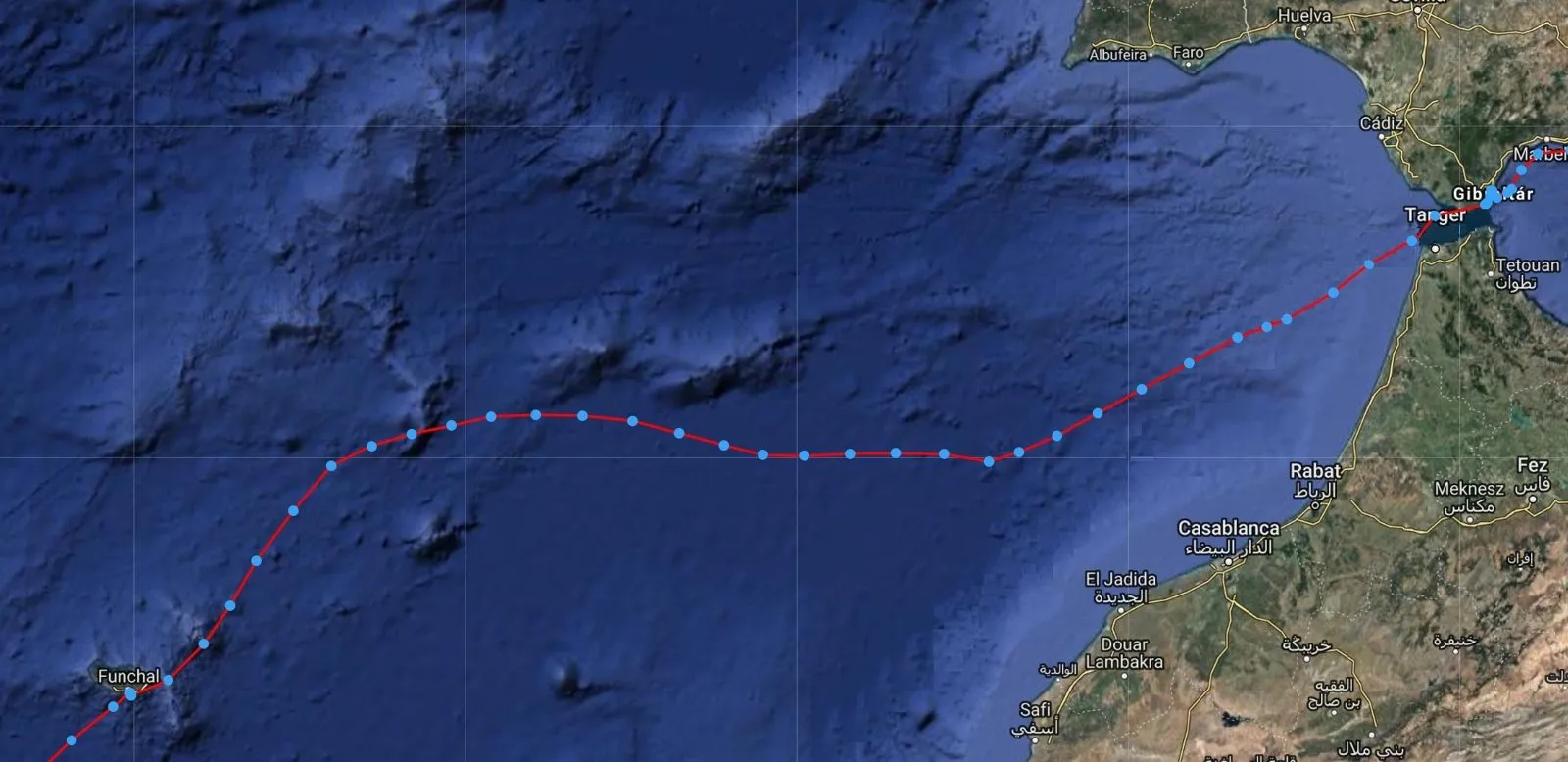
Our route between the Cape Verde Islands and Gibraltar. You can clearly see where we crossed the Pinta*‘s earlier track, where the circle closed.*

Machine translation (AI, Claude) of Balázs’s Hungarian original. Read the original →
· Atlantic Ocean, between Cape Verde and Madeira

The rubbish…

In the morning I was sitting at the stern, with my back to the direction of travel, when a big black cylindrical tank, a good 2 metres long, sneakily floated past me (and our boat), about a metre and a half away… “Whoa, that was close!” – I exclaimed. For all I’d have noticed, a giant octopus could have reached out and given me a clip round the ear… Good thing it wasn’t an abandoned big floating container, because that encounter could have turned out a real knockout. A few months ago – in the North Sea – a storm swept some 40 containers off the deck of an ocean-going ship.

By the time the camera came out, you could hardly see it…

One thing’s for sure: many dangers threatened Columbus’s ship, the Pinta, but not that of hitting a lost floating container and sinking like that…

During the day, by the way, it’s a pleasant 25–⁠27 degrees, which only drops to 22 at night.

The waves are 2–⁠3 metres at most, but they follow each other at such a distance – 100–⁠200 metres apart – that you can hardly feel them. Picture standing in the goal of a football pitch, and first the far goal slowly rises two metres, then ours, while the footballers just watch the ball roll back and forth between them, just like in the Hungarian first division.

In between there are smaller and bigger dips, into which the boat nods a little now and then, but only just enough that you always have to hang on to one of the goalposts, so as not to get tangled in the net.

There are no more flying fish around here, I didn’t see a single one during the day, only after the first night did we find a “Pechvogel” (a German “unlucky bird” – in this case an unlucky fish) on deck.

This afternoon I made the first gin and tonic of our voyage together. For this ceremony we set the ship’s clock back an hour, so I served it on deck at 17:00 sharp, in the shade of the sunshades.

Oh, and the thick plastic bags we got when shopping on the Cape Verde Islands are still holding out. It was interesting to observe that commerce in the Republic of Cabo Verde is still at that stage of evolution where shops hand out free – nice thick – plastic bags to customers. Although we already know there’s no such thing as a free lunch, even when there is, and these bags weren’t financed by Uncle Scrooge either, but by us, the customers, whether we put anything in them – and take any of them – or not. Besides our own bags, we had to pack some of our shopping into these too, so now we’re using them as bin bags, and bringing them back to the Portuguese, the former colonial masters.

Which reminds me. At the secondary school in Debrecen where my wife, Andi, teaches – which we both attended – there’s another building, a, to put it mildly, not-yet-renovated building, where teaching also goes on, and the teachers have to go over there when they have lessons there. Everyone just calls it the “other” building. Andi told me – as an illustration of how differently history can make people see things – that the teachers and language assistants who came from Spain just refer to the “other” building as “I’m off to the colonies!”…

On Monday I’d arranged with Andi that I’d call her on Wednesday evening at 22:00 Hungarian time. There was signal, but for some reason the connection just wouldn’t go through. After a quarter of an hour of continuous trying – some 15 attempts – I was starting to give up on talking today, when the call finally connected. It turned out she’d been on the phone with someone else, and the line was busy, that’s why I couldn’t reach her. Well, so that’s how eagerly they were waiting for my call, apparently – and I didn’t even praise her for it.

Before my 23:00 watch I’ll test the corridor, to see whether sleeping there on the floor is better than in the elevator-riding forepeak cabin.

Machine translation (AI, Claude) of Balázs’s Hungarian original. Read the original →
· Atlantic Ocean, between Cape Verde and Madeira

One of our biggest winches gets torn off

I was slowly starting to worry that I’d run out of things to write about in this diary…

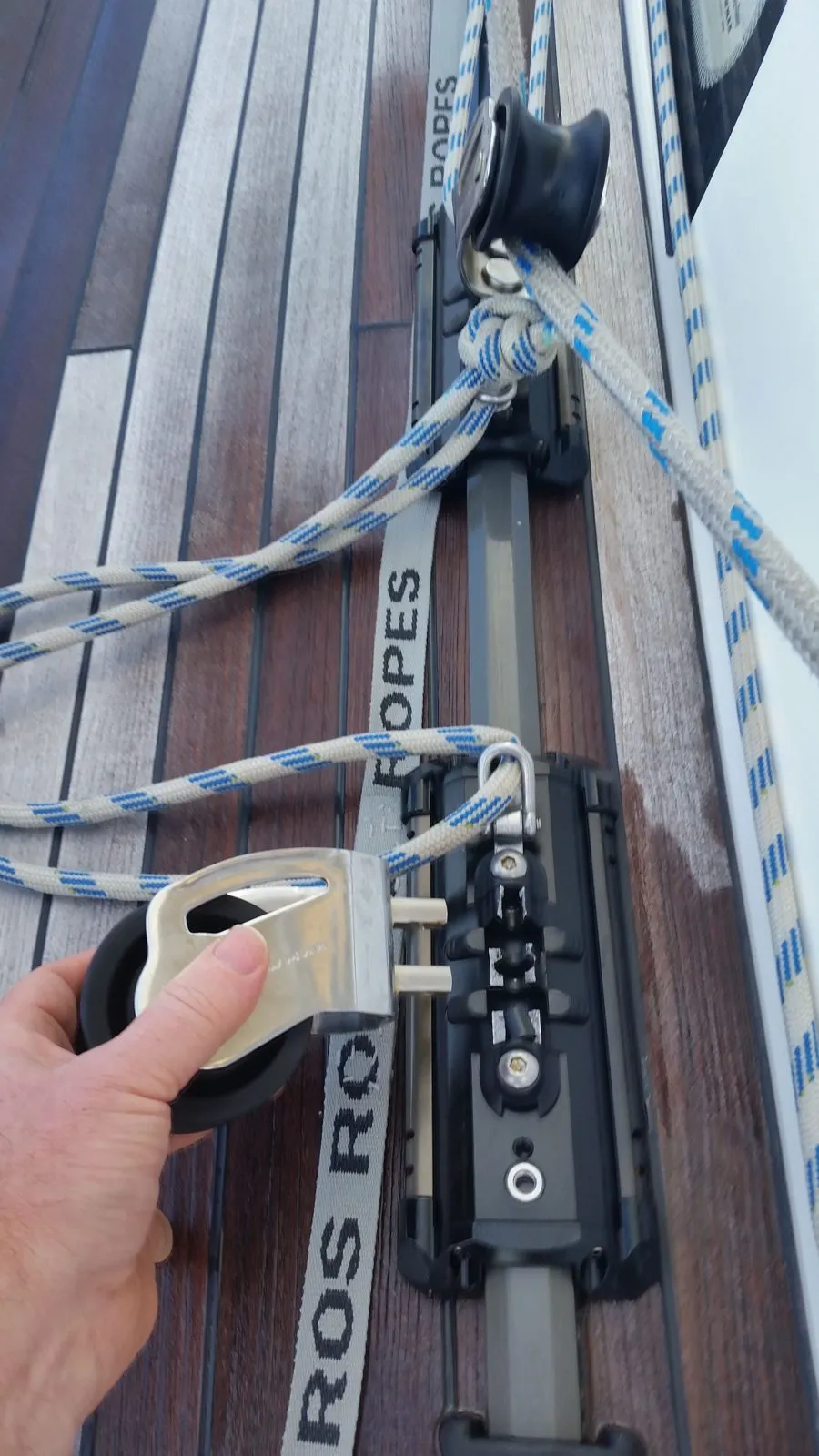
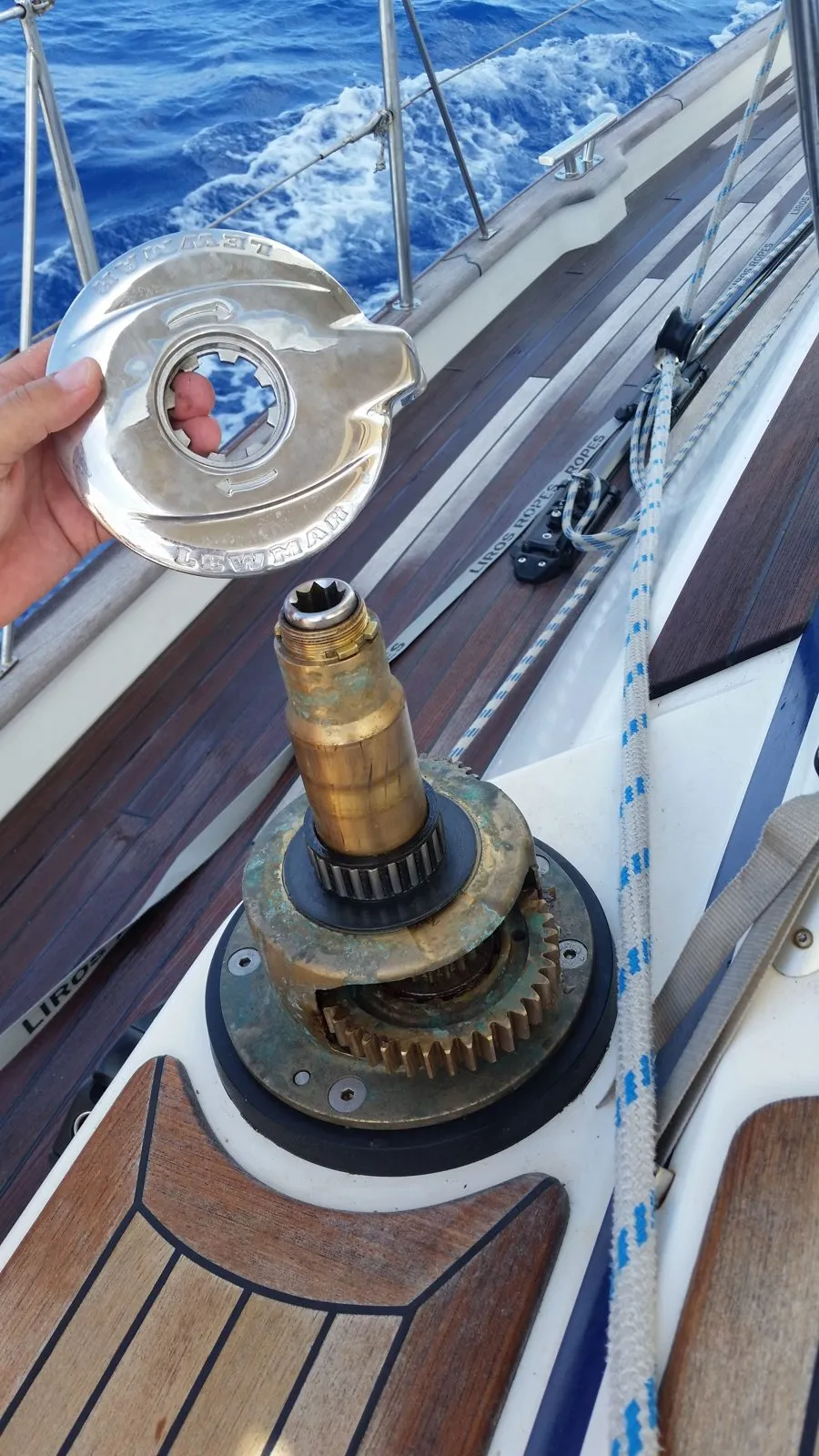
From 11 on Wednesday night until 3 on Thursday morning I was on watch. For two days we’d been close-hauled, pinching up into the steady north-easterly with nothing but the fully unrolled genoa, making our way north. Gyuri and I had agreed beforehand that we’d only reef, i.e. shorten sail, if the wind picked up above 20 knots. It kept moving between 15 and 18, we were steadily making 5–⁠6 knots, and apart from keeping a lookout I had nothing else to do. At 2.00 sharp, just as I came down to the chart table to fill in the logbook, there was a huge bang from outside, from the deck, a metallic tearing sound, followed by the wild flogging of the headsail. Gyuri shot straight up from the galley gangway (he was sleeping there on a mattress again tonight because of the heel), Zsófi came out of the aft cabin too, and I, since the mast had noticeably not come down yet, leapt out into the cockpit to see what on earth had happened. The mast was standing where it should, so maybe it wasn’t the rigging that had parted. The genoa kept flogging wildly, so the sheet, the line that hauls in the headsail, must have snapped or jumped off the winch. A glance at the winch: all I see is the empty spot where it used to be, well, just a stump, the whole thing had flown off, the wind pulling on the genoa had simply ripped it away…

The boat slowed down in the dark, we switched on the deck light (the patio lighting, as it were) and first of all carefully furled in the headsail. I started hauling the torn sheet out of the sea – I could feel there was something on it, a bite, it came in hard – maybe the top of the broken winch was still hanging on it, though I’d have been very surprised if it had been. In the end, at the end of the line I found a block – which had originally been part of the car fixed to the deck track; that’s where the headsail sheet had ripped it out from. In the dark we couldn’t tell whether it had come out because of a lost retaining ring or for some other reason – one thing was certain – we couldn’t sail in this direction, towards Madeira, until we came up with something.

We decided that until sunrise – until it got light – we’d motor straight towards Tenerife, into the waves, and then we’d decide how and where to go on from there.

Since the boat was no longer heeling, I lay down to sleep in the forward cabin – which turned out to be a pretty bad decision – because the boat, heading into the waves, rolled, lurched and tumbled more and more in every direction.

I’ve practically run out of washing-machine similes by now – I was simply longing for the gangway floor – but I was too tired to drag myself over there through the enchanted water castle.

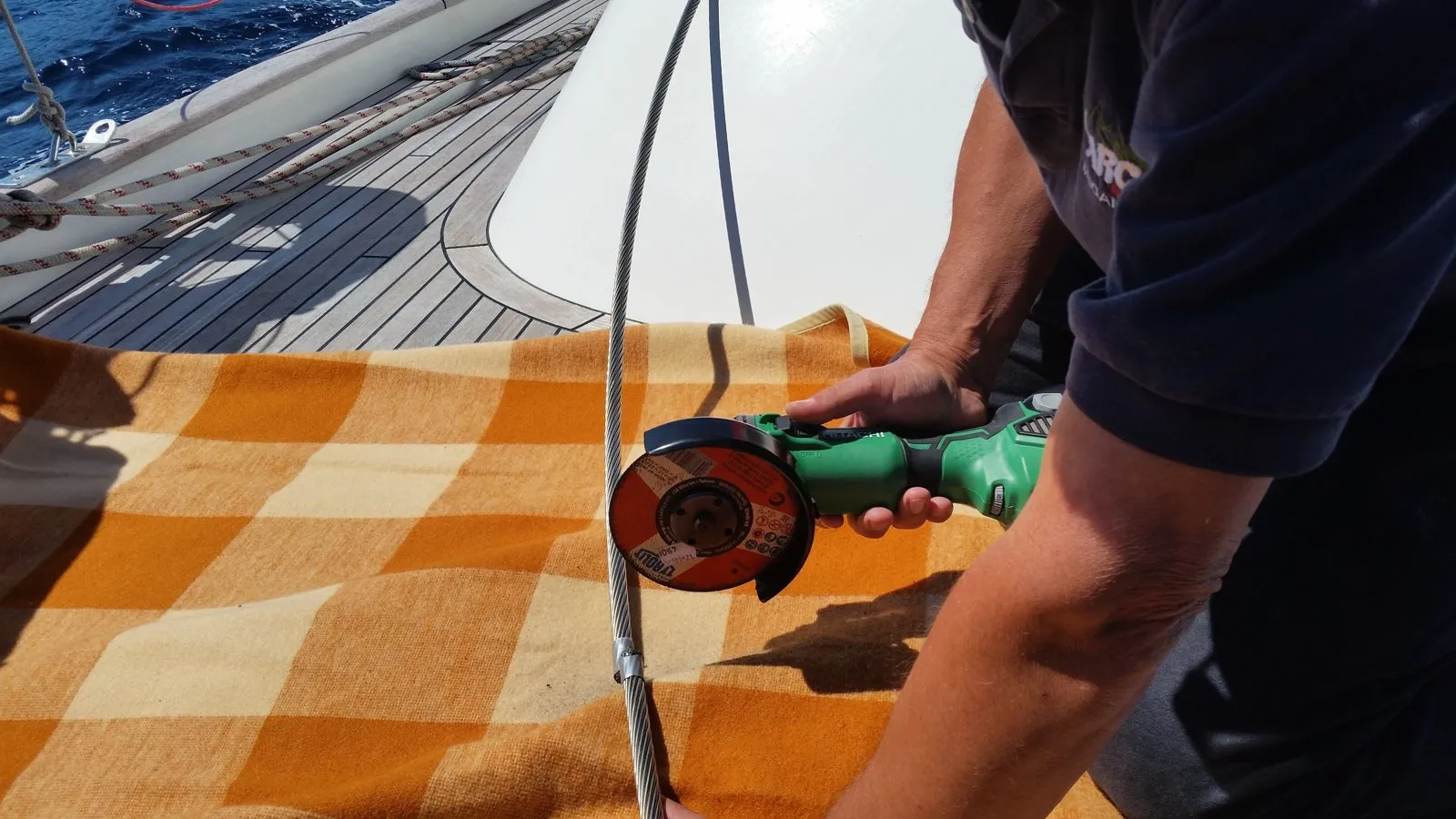
In the morning, in daylight, we worked out what must have happened. The fitting of the block leading the headsail sheet had shattered – probably metal fatigue – and torn out of the car fixed to the deck. The sheet, stretched to breaking point, shot upwards – like a bowstring – together with the ripped-out block, and simply tore off the top of the winch and its cylindrical drum.

We did find the top of the winch on deck in the end, but Neptune must have had his eye on our winch’s shiny drum, because he simply nicked it, finders keepers. Good thing none of us got hit by the flying piece, it could have caused a serious injury if someone had happened to be leaning out over it to have a look around.

First we tried to sail on the other tack – with the genoa pulled out to the other side – but that way we could only go backwards. Then we tried to see how far we’d get with just the mainsail, well, it was pitiful, we practically stopped. In the end we led the port jib sheet across via two smaller winches to the starboard – still intact – big winch, and so, with full main plus a half-unrolled headsail, we’re again making about 5 knots towards Madeira. Luckily there are two cars on the deck track, so we could pull the still-intact one aft, and that’s the one we’re using now.

We took photos of the damaged parts and sent them by radio e-mail to one of Gyuri’s friends, asking him to try and get hold of them and have them sent to the marina in Funchal, on Madeira.

Before that, though, we had decided once and for all to skip the Canary Islands this time. Over the past week the prevailing north-easterly had only allowed us to sail more or less due north, and right now we’re about 300 miles south-west of Tenerife, and 400 from Madeira.

We led the port genoa sheet across to the starboard side

Today Zsófi made meat soup and máglyarakás (a Hungarian bread-and-apple bake with meringue on top) for lunch. It’s amazing how skilfully, how varied, how fast and how deliciously she cooks in the heeling, lurching boat, as if she’d been doing nothing else all her life. All right, she had time to practise during the circumnavigation, but still…

At noon today, though, what the wind forecasts had predicted really did come true, namely that on Thursday the wind would veer to the east. It held all afternoon, and meanwhile we could sail straight for Madeira. By evening the wind had died down; before sunset I handed out everyone’s regulation gin and tonic ration, told the story of my rather short film career, then we took in the sail and motored through the night, straight for Madeira.

Gyuri and I wrote a short e-mail to Ricsi saying that instead of the Canaries he’d be able to join us on Madeira, he should come there, probably on Monday, 4 March. We’ve sailed with Ricsi before, he came with us in October 2017 too, on the opening leg of the round-the-world voyage, from the Adriatic to the Canary Islands.

I don’t know yet,

where I’ll sleep tonight-hight,

in the ever-wavier forward cabi-hin,

or on the gangway floo-hoor, maybe…

Machine translation (AI, Claude) of Balázs’s Hungarian original. Read the original →

· Atlantic Ocean, between Cape Verde and Madeira

One week under way, Madeira is the new destination

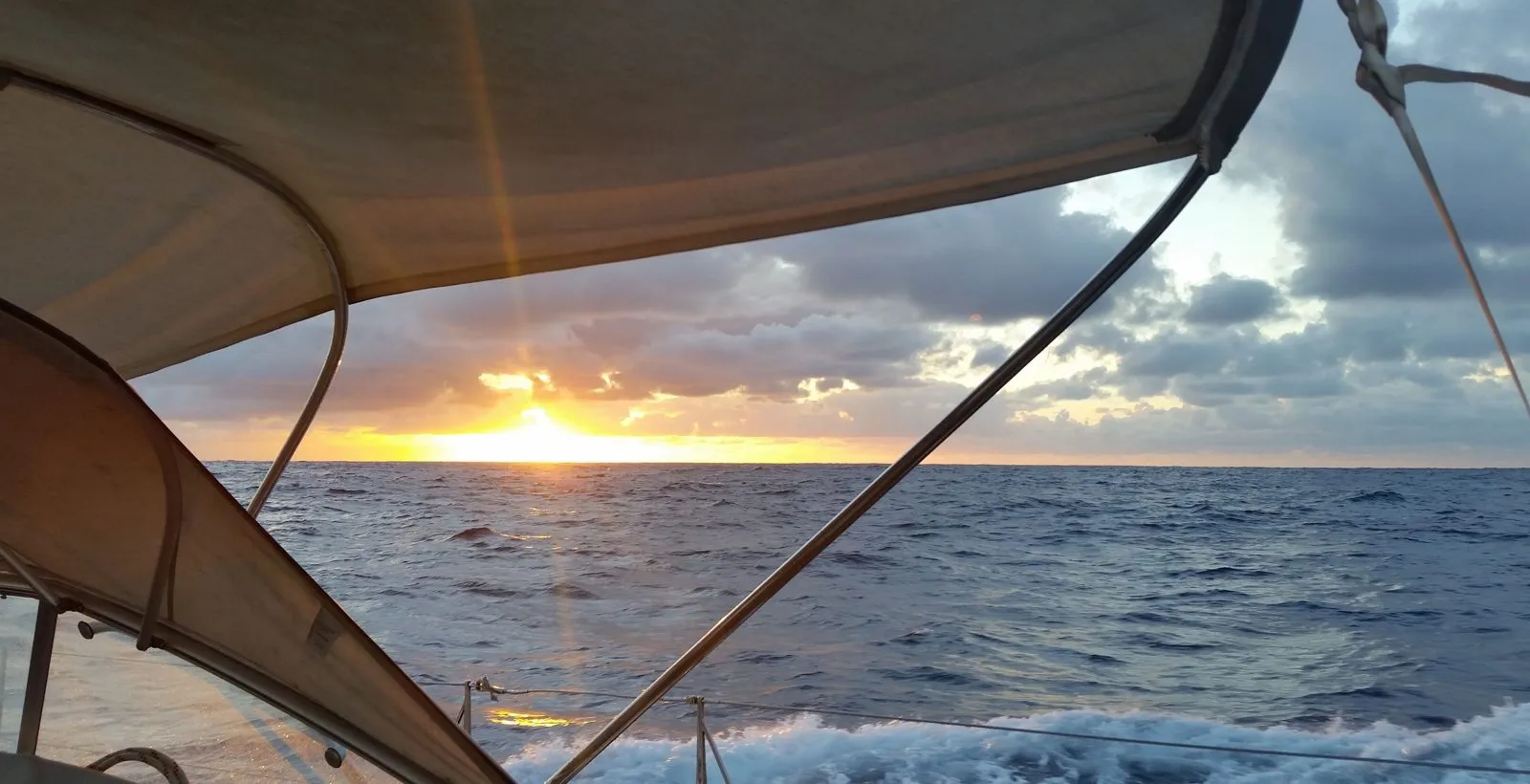
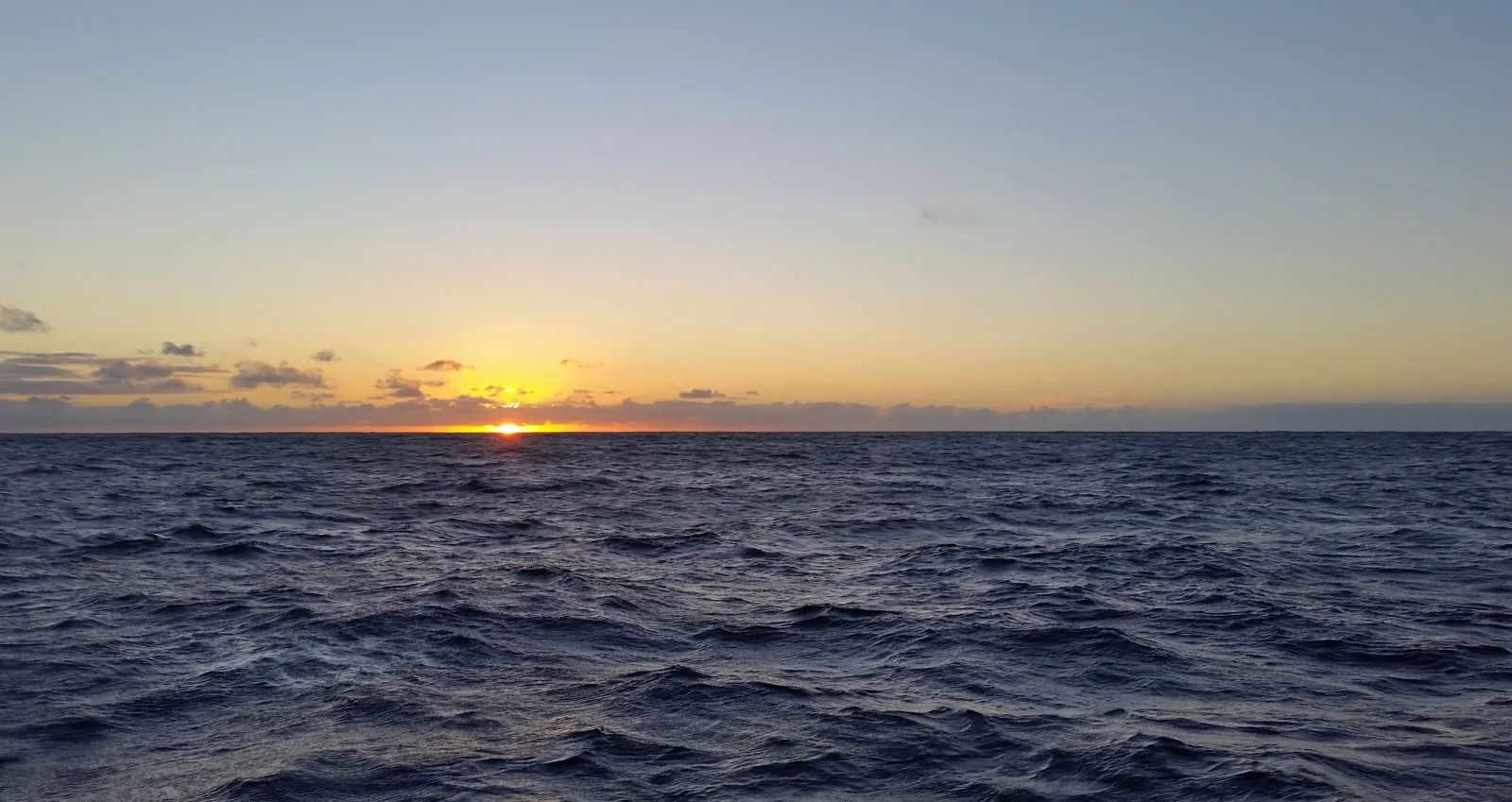
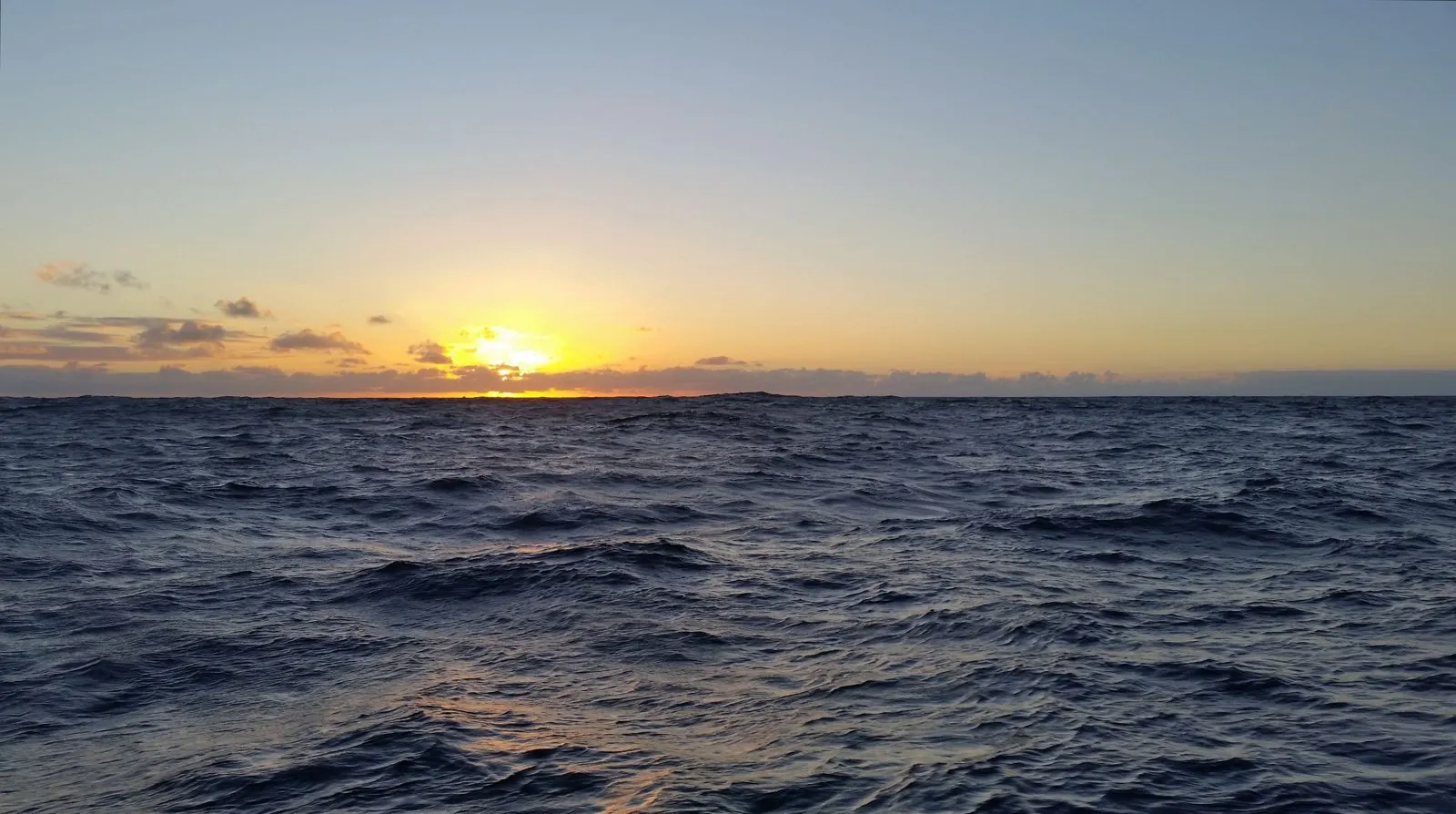
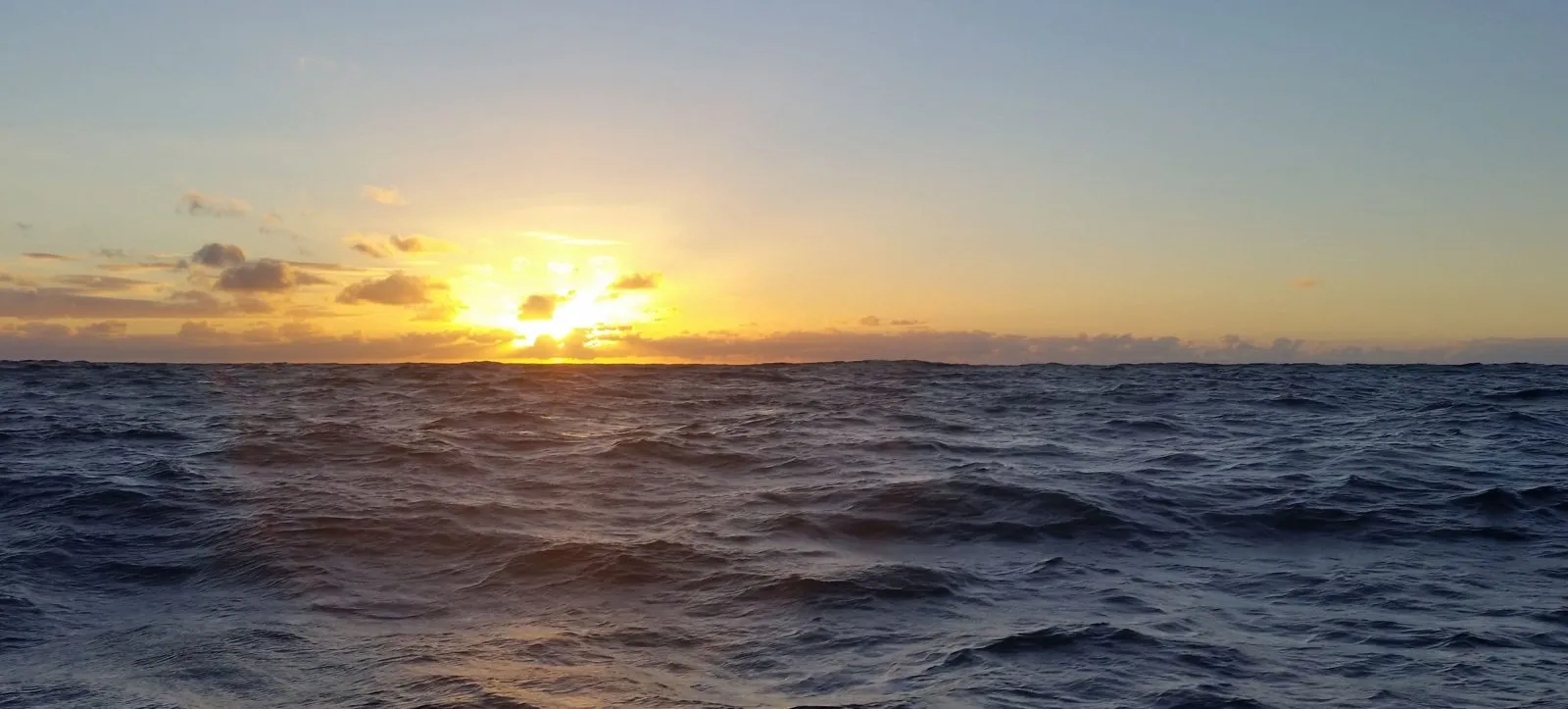
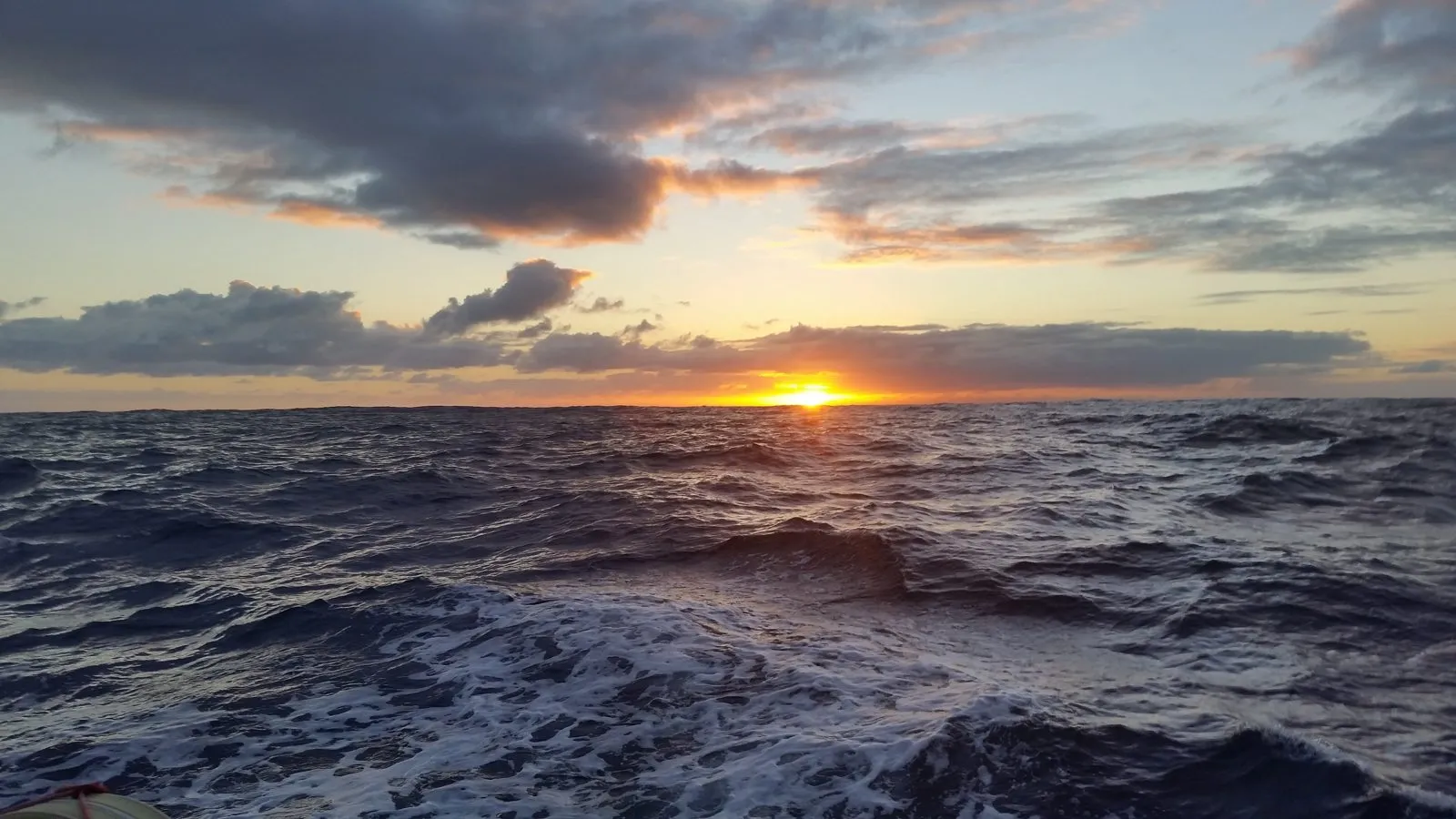
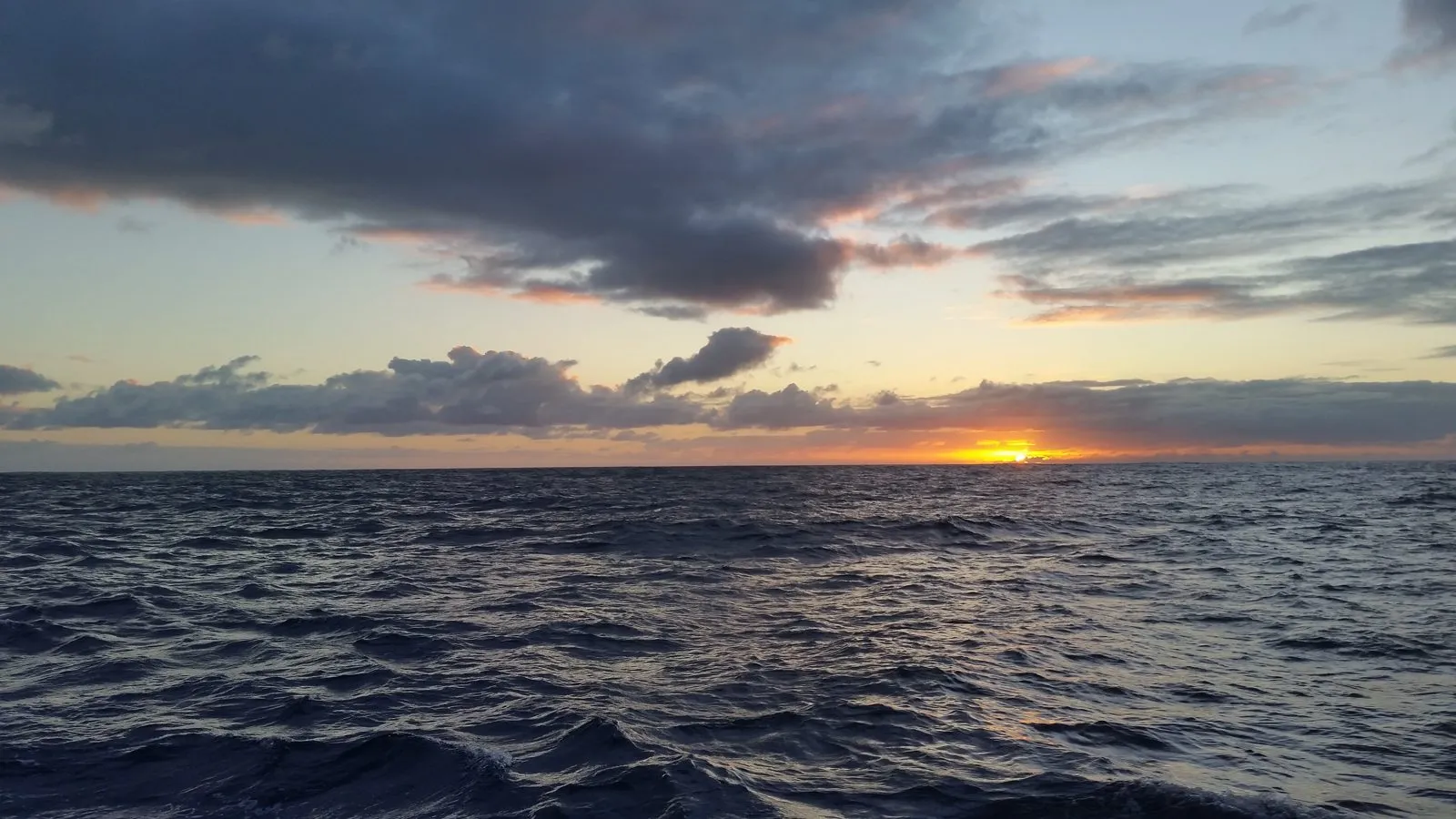
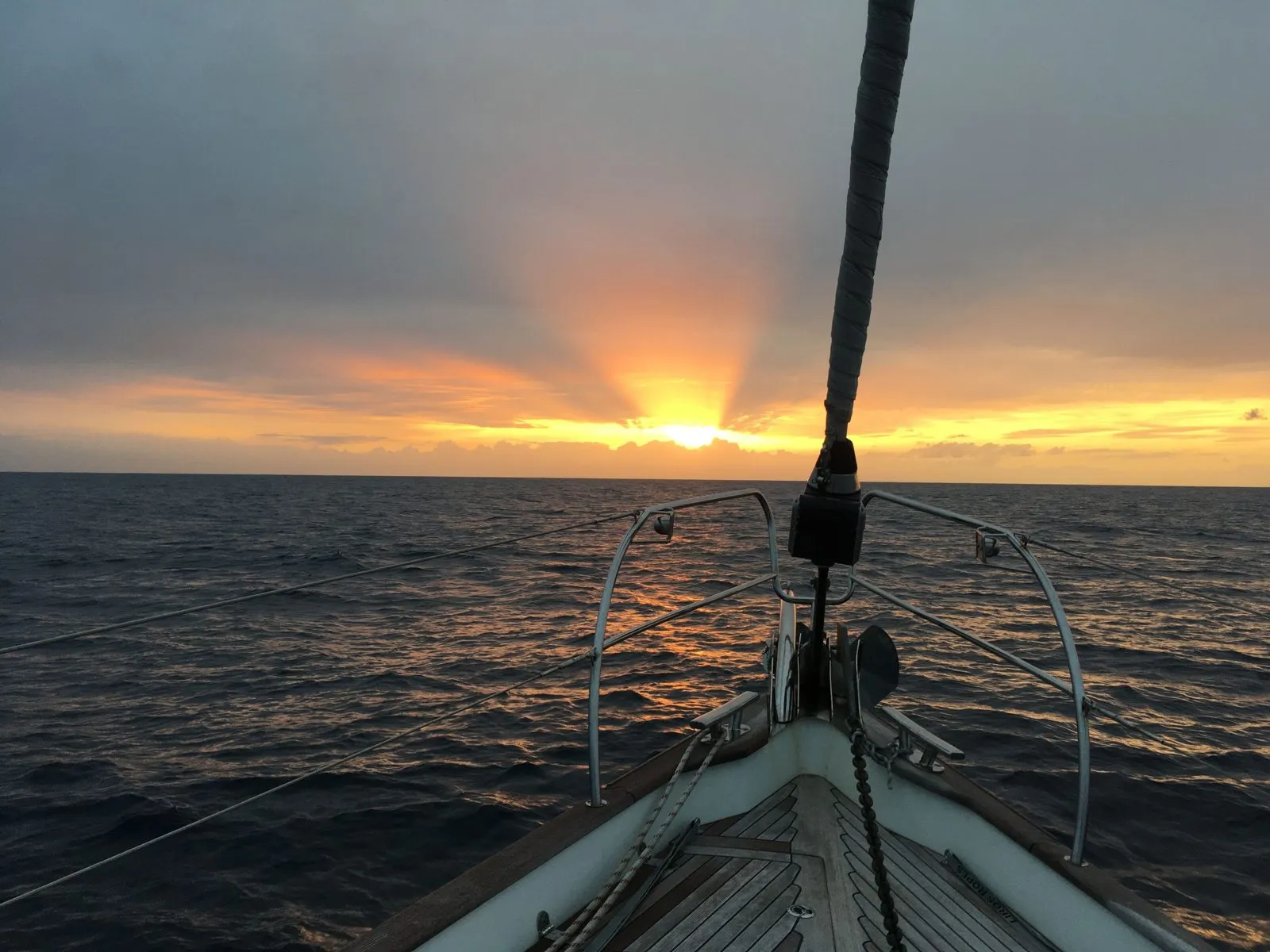
This morning, for once, we could see the sunrise really well. Just above the horizon there was a narrow clear, cloudless strip of sky, which I very rarely get to see.

The sun rises, and I set…

Last night I had a good look at the stars. The Little and the Big Dipper with the Pole Star, Cassiopeia, Orion and Taurus the Bull were all there, only Leo the Lion was roaming free somewhere, I haven’t found him yet, though I know he’s there, he’s just hiding somewhere.

Zsófi told us that seen from the southern hemisphere the moon waxes and wanes the other way round. It’s “C”-shaped when waxing and “D”-shaped when waning. Perfectly logical if you think about it, it’s just that we don’t usually think about things like that. Maybe only Copernicus did, when he realised that the heavenly bodies might move across the sky like this because the earth goes round the sun, and not the other way round.

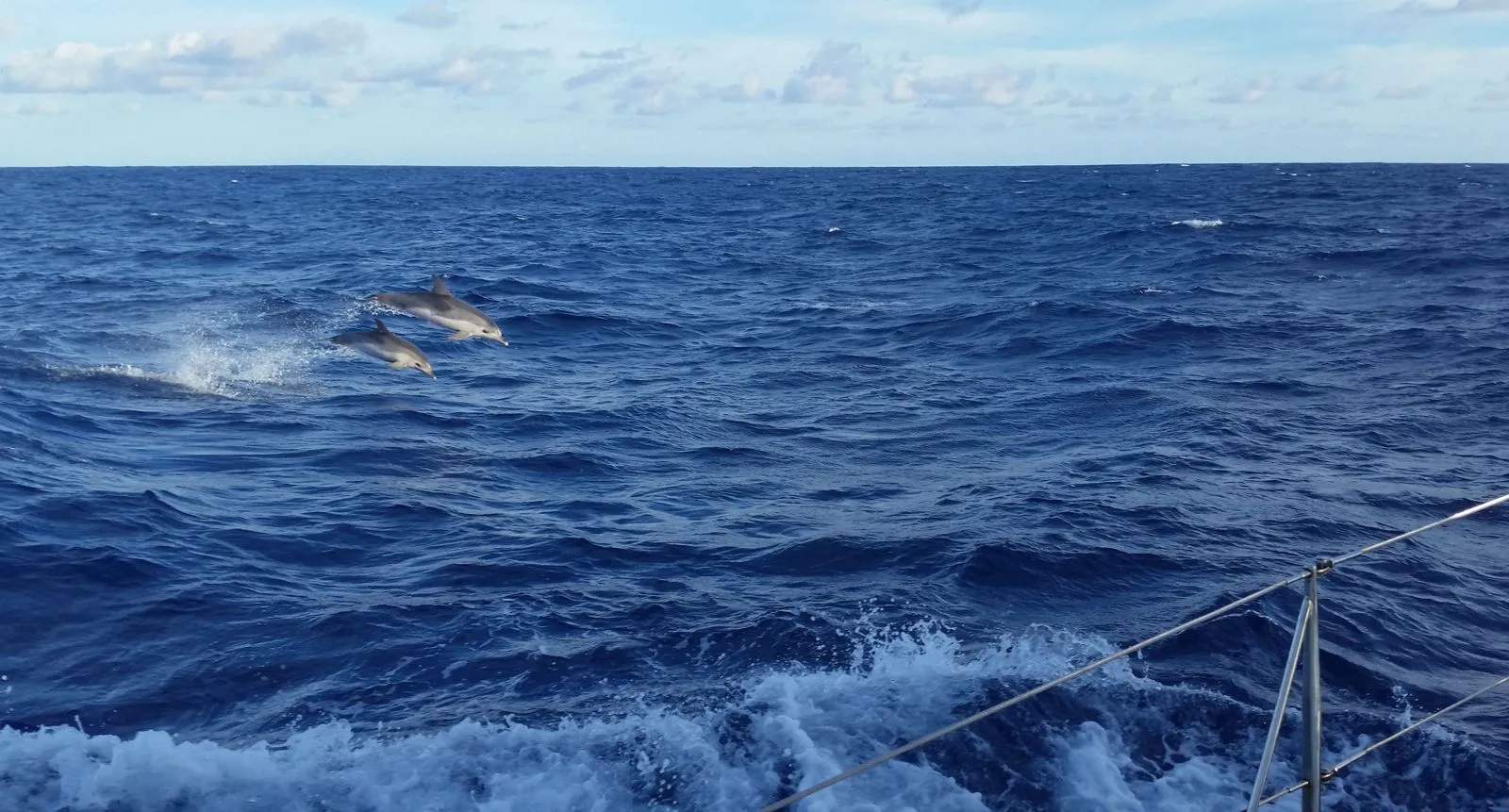
In the morning dolphins joined our boat. Zsófi and I eagerly set about taking pictures, but they just would not get it into their heads that they shouldn’t jump out when they happen to run out of air, but when I happen to be pressing the shutter. So 99% of the photos show only the splash, or the tip of a tail.

Well, at least I have one photo to prove they were here

Dolphins always swim to the bow of the boat, that’s where they usually zigzag and leap about. We got to wondering why that might be. Maybe they see the submerged hull as a swimming creature, and head for the “head” end in the direction of travel to communicate, to look for eye contact. When we approach a friendly animal, we too go for its head, the “front” end, first, and for some reason don’t make friends with its backside.

This time we didn’t feel like going out onto the foredeck, because the waves kept slapping up over it, and we didn’t fancy a shower in this early, fresh weather.

We’ve been under way for a week since the Cape Verde Islands, the mood on board is good. On the heeling deck we haven’t yet brought ourselves to do any fishing, and anyway there are still a few fish steaks in the freezer.

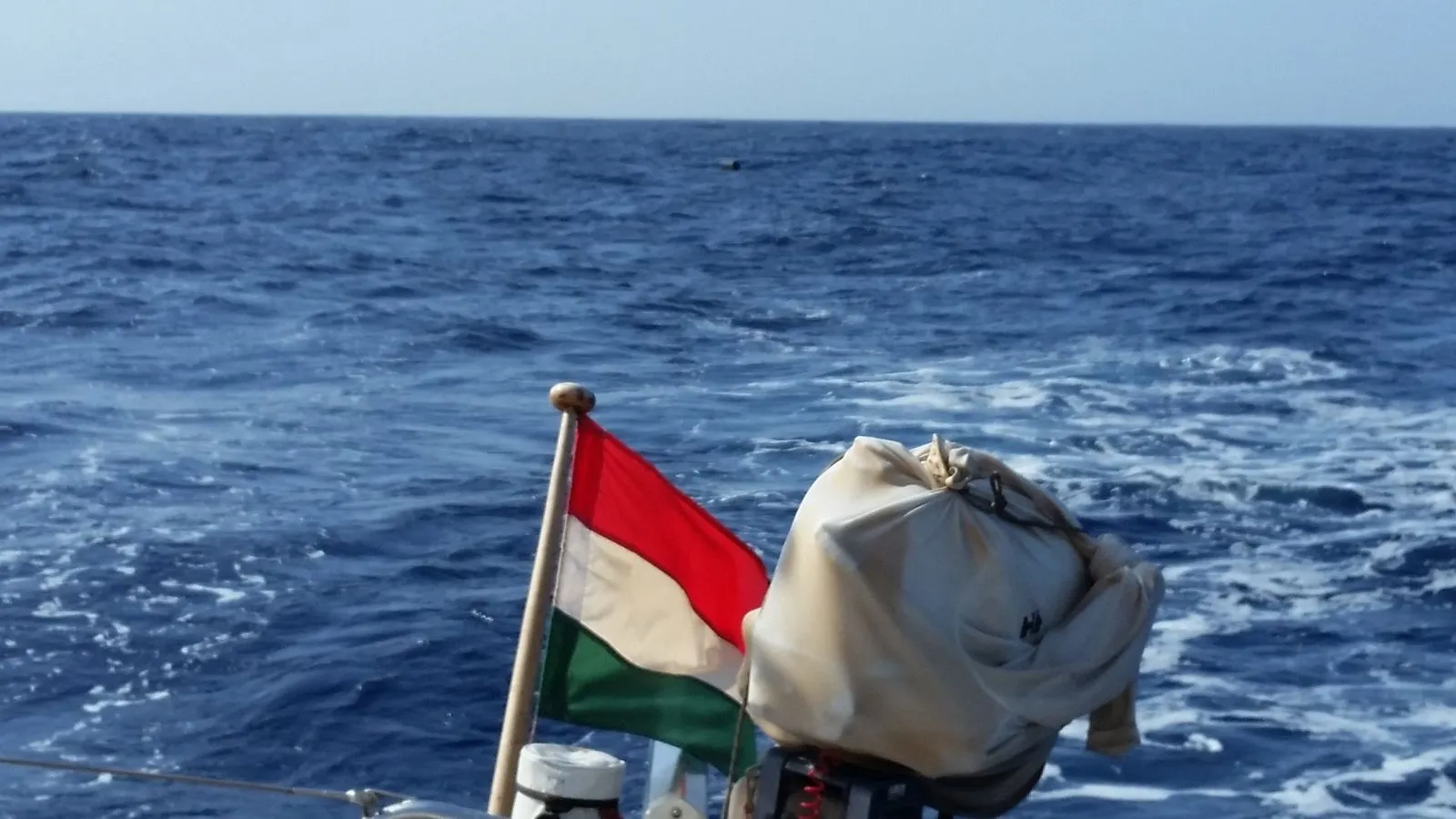
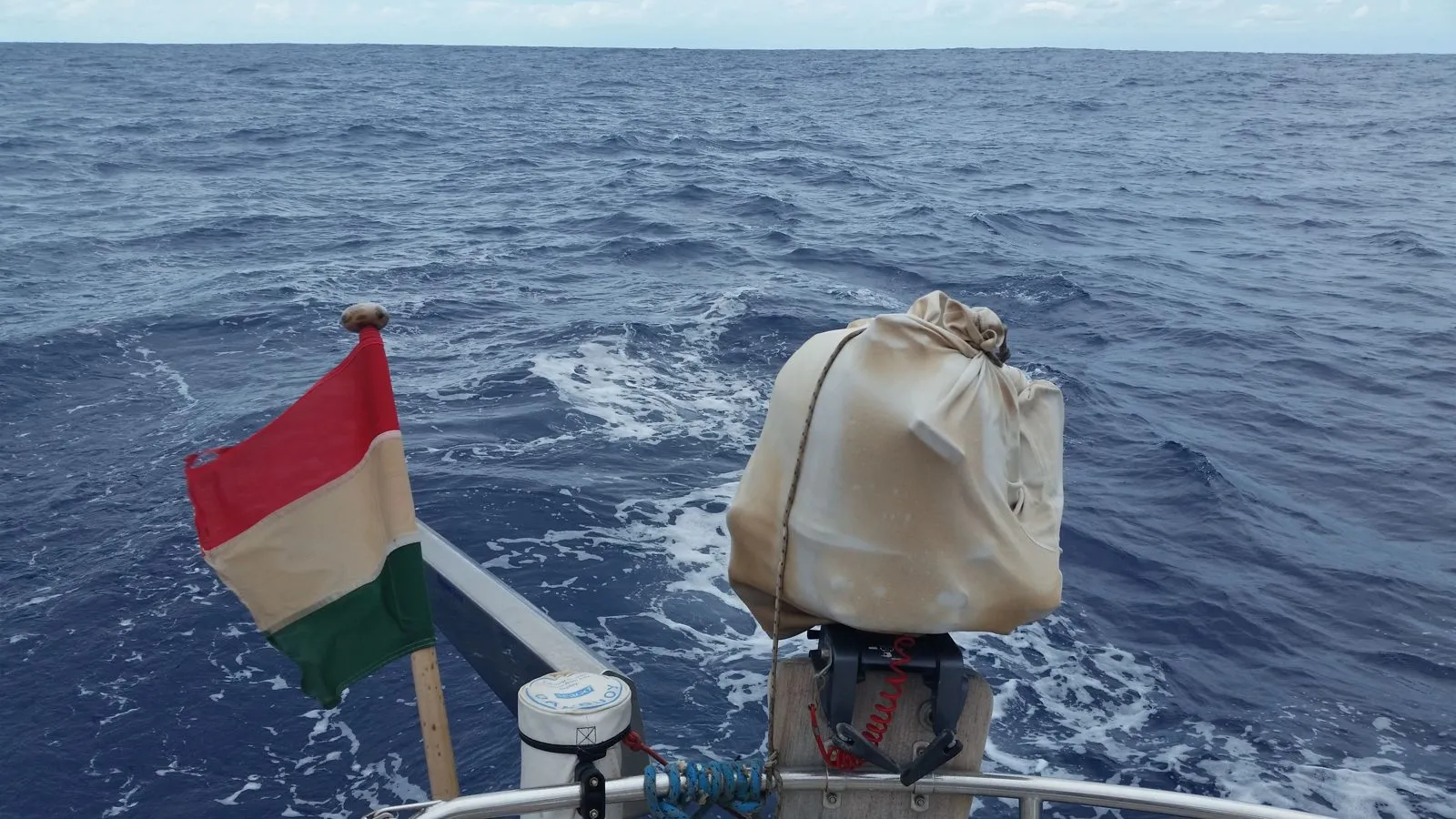
We’re sailing the Atlantic Ocean 500 miles, about 1000 km, from the African coast – from the Sahara – and yet the Saharan sand gets all the way out here, the trade wind blows it here. It has turned brown the UV cover of the outboard – originally a white HH sweater – and the white stripe of our Hungarian flag too. It almost looks red-gold-green, I don’t even know whether there’s a country with a flag like that.

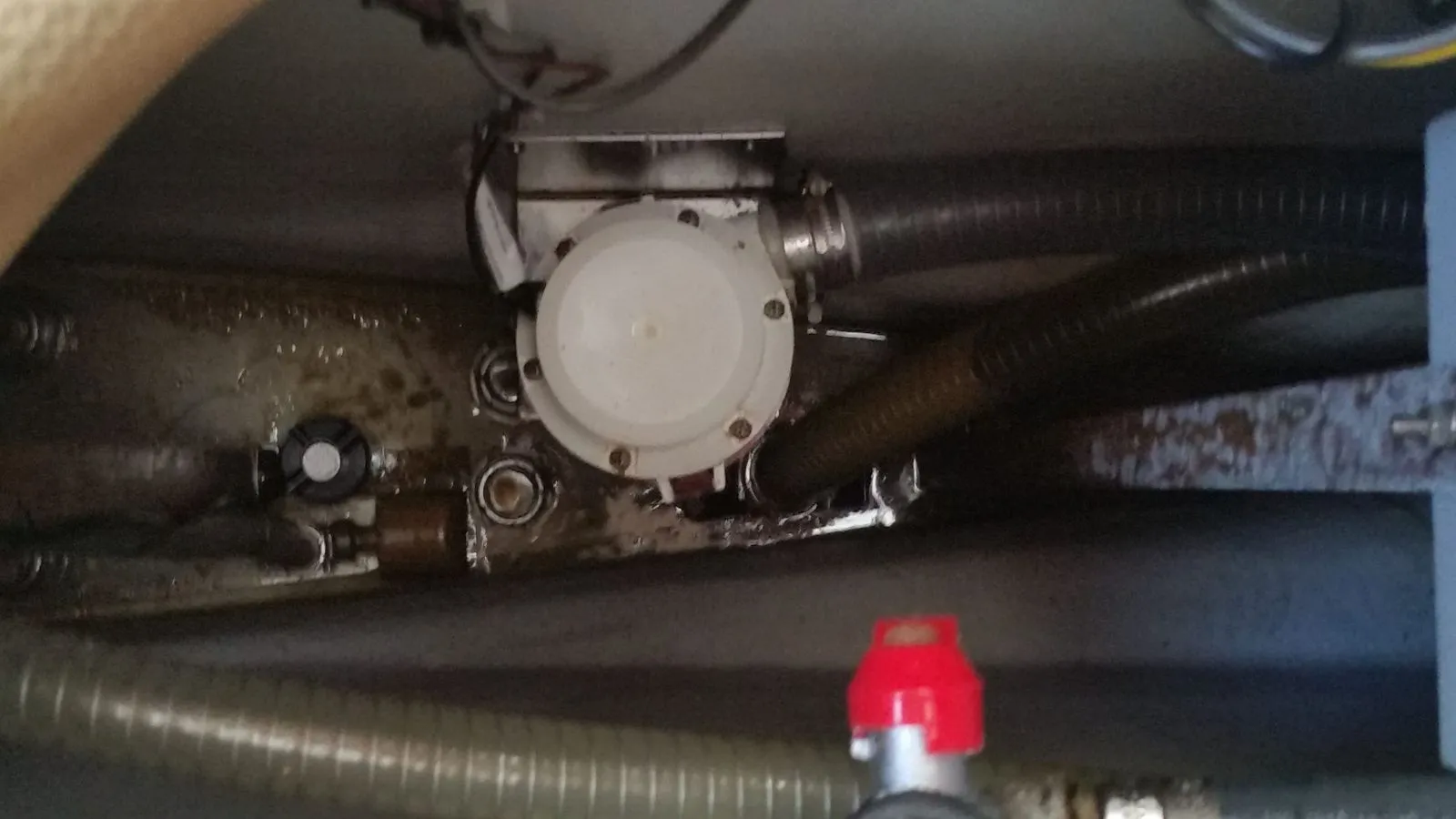
During the day we pumped about 320 litres from the 400-litre reserve fuel tank into the main tank, which filled it up. That way we could even reach Madeira on the engine alone, and there would still be 80 litres in reserve. The picture shows the bilge – the deepest space inside the boat, under the floor. This is where any water that has somehow got into the boat collects, along with spilt oil and knocked-over detergent. There are three ways to pump it out from here: with an automatic bilge pump, with a high-capacity pump, or with a manual bilge pump.

The bilge, with the pumps in it

During the night I moved out onto the gangway floor, because sleep was impossible in the forward cabin, which was riding a roller coaster in the strengthening wind. The closer you get to the middle of the boat, its centre of gravity, the less of a lift ride it is and the quieter the noises, because you’re at least 3 metres instead of 0 from the bow slamming into the waves, and there’s a cabin door in between too.

Machine translation (AI, Claude) of Balázs’s Hungarian original. Read the original →
· Atlantic Ocean, between Cape Verde and Madeira

The true story of the Praia robbery

It didn’t happen today, but I haven’t yet written about the robbery on the Pinta.

The Cape Verde Islands used not to have a good reputation in this respect, but nowadays they’re recommended to tourists as a safe country. The office responsible for developing local tourism obviously has a stake in that, too. In that light, an attack like this was not to be expected, least of all in the bay of the capital of the Republic of Cabo Verde – at a designated anchorage – right next to the commercial and ferry port. The Pinta arrived in Praia on Sunday evening before dark, after a tiring two-week passage from tiny Ascension Island. They tried to reach the local authorities on the official radio channels, but nobody answered, so – there being no marina – they had to anchor in the bay so they could check in with the local offices the next day. The chart didn’t show where the Maritime Police were, so of the two designated anchorages Gyuri dropped anchor at the one near the commercial port, 5–⁠600 metres from the shore. Right below the local slum on top of the cliff along the shore. After dinner the skipper turned in to rest in the aft cabin, and the others – Zsófi, Anikó and Szabi – still wanted to watch a film. I was expected on Tuesday morning.

They must have been about halfway through the film when three dripping-wet young black men in their underpants burst in from the deck, shouting and waving knives.

They must have watched the Pinta anchoring from up there in the shantytown, waited for dark, swum out, quietly climbed onto the deck and burst into the saloon from there.

Satellite image of the bay of Praia

They interrupted the screening rather rudely – one of them stopped the playback on the laptop with the press of a single button because the sound bothered him – aggressively demanded money, and the dinghy – the inflatable rubber boat – so they could get back to shore in it. At the shouting, and at Zsófi’s call, Gyuri woke up too and came out of his cabin, which got him invited to the party as well, on the hostage list. Two of them searched everything, started gathering up the valuables, camera, mobile phones, wristwatch, and luckily they settled for the 400 euros that had been put out separately on the chart table for the next day’s paperwork and shopping.

They kept going on about the dinghy, looking for it, which was easy to deny, because it was deflated, rolled up and stowed under the bunk in the forward cabin. With that – to put it in Cape Verdean – a bit of shit hit the fan, because they had to swim back with the loot too, so they couldn’t take anywhere near as much as they might have liked. They’d brought along some Comecon-grade sticky tape (the kind we used to get behind the Iron Curtain) to tie people up or to strap down the loot, but its quality was so poor – especially soaking wet – that it kept tearing and was useless for what they wanted to use it for. On top of that, the laptop expert even meticulously cut off a piece, slicing through about 10 layers at once.

Despite the seriousness of the situation, the hostages very nearly burst out laughing, it was so comical watching the robbers struggling in vain with the tape they’d brought along, swimming, always tearing off just a 10-centimetre bit that was good for nothing. In the end Gyuri – so that the intruders would leave as soon as possible – offered them the boat’s strong duct tape so they could tape the money onto one of their wet bodies, even though there was a risk that in the end they’d tie up the crew with it too, like in the films.

They made the victims promise several times that they wouldn’t call the police, which wasn’t hard, because nobody had answered their calls on emergency channel 16 in the afternoon either. The robbers backed out of the cabin – meanwhile the PC guru politely restarted the film with another press of a key, as if wishing everyone a pleasant evening – three splashes could be heard, and off they went. Or rather, off they swam.

The idea came up of leaving at once for Mindelo, 160 miles away, because nobody liked the thought of spending the night here. In that case I would have had to follow them by ferry or plane somehow, which would certainly have taken a few days. In the end the skipper decided to stay, so for the rest of the evening they kept watch on the boat, Szabi and Anikó took on the lookout.

At dawn they thought they saw 4 swimmers in the water, and a small boat set off from the shore too, so they urgently alerted the skipper, weighed anchor, circled for a while – the small boat turned out to be a fishing boat – then anchored again, this time at the bay’s other anchorage, in front of the Maritime Police building, which Zsófi had found in the meantime, during the dawn circling, by browsing an offline map.

The next day they inflated the dinghy and all went ashore to check in, then said goodbye to Szabi and Anikó, who found a hotel until they could buy their plane tickets home.

Gyuri and Zsófi filed a report with the police, which turned into a pretty lengthy procedure and dragged on into the late afternoon. Meanwhile they called me – right in the middle of my Barcelona pilgrimage – and told me what had happened, and I concluded that my missing the plane at the airport that morning was small beer next to their ordeal.

During the police proceedings it suddenly became clear that they were trying to take the matter more seriously; after all, the good or bad name of the Republic of Cabo Verde’s security was at stake. They were even taken to the Ministry of Justice, which sent a forensics expert to the boat, and they were shown photos of the more notorious robbers, in case they could recognise the swimming champions among all those shady characters.

Hearing all this, it was understandable why they were waiting for me until two in the morning, keeping watch on deck, on tenterhooks, so that we could leave this ill-remembered, troublesome place at once.

I think Gyuri and co. behaved in the smartest way possible in that situation, trying not to provoke, being – as far as they had to – cooperative. The most dangerous thing in these situations is that if for some reason things escalate, then unfortunately anything can happen – even murder – even if that wasn’t the plan beforehand. It doesn’t take anything away from how dangerous it all was that, looking back, their behaviour seemed pretty amateurish; it’s exactly people like that who can make fatal decisions in a critical moment.

Could these events have been avoided? You’re always wiser after the event: they could have locked the companionway door at nightfall, they could have anchored a bit further from the shore, but you don’t necessarily expect something like this when you’ve sailed round the world without any trouble and you’re on your way home, almost in Europe already.

I think the most important thing is that everyone got away without injury, and at most the whole thing will come back to them now and then as a bad dream…

And it’s also true that if we always dreaded the worst, we’d never set foot outside the panic room, because anything can happen…

Still, I think it would be important for sailors travelling the world to know what happened, so they can take precautions. Say, scattering drawing pins across the deck at nightfall, like Joshua Slocum did in the Strait of Magellan…

Machine translation (AI, Claude) of Balázs’s Hungarian original. Read the original →
· Atlantic Ocean, between Cape Verde and Madeira

Variations?

Found the Lion! This evening we folded down the bimini over the cockpit, so that if the wind picked up at night it wouldn’t flap and tear it. That gave me the chance to observe a wider stretch of sky as I lay on my back in the cockpit. I started from home base, from Orion, above the south-western horizon. To its right I found the – already familiar – Bull, then above it the knock-kneed, left-footed Twins, which I hadn’t identified until now. The bright star to the left of Orion’s belt – five waist-widths away – is Sirius. Above the head of the left-hand Twin there should be the Crab, but it seems he’s on holiday today, because I couldn’t make him out among the faint stars. Further up to the left, though, there lay the Lion on his belly, no doubt about it. I told you he was hiding, I just didn’t realise yesterday that he was behind the bimini, right above my head. Under the Lion’s backside is Virgo the Maiden, but the boom kept poking into the picture and kept dashing my hopes of recognising her graceful lines as shown in the app on my phone. This sky, free of all light pollution and cloudless, is fantastic!

The second ship we’ve seen, or again only its lights, is a 300-metre tanker called Freud, passing us on our port side – in the opposite direction – about 6 miles off. A thumb’s width between the light on its foremast and the one at the stern.

Otherwise there’s no traffic; whoever is on night watch sticks their head out every quarter of an hour or twenty minutes, looks around, then glances at the monitor to see whether a ship’s AIS signal has appeared.

Sunrise:

It was interesting to notice that when we were sailing due north (at 000°) – which could be clearly seen on the electronic chart monitor – our compass showed 020°. There are two reasons for that. One deviation – the variation – comes from the fact that the earth’s magnetic pole isn’t exactly under the North Pole but off to one side, and on top of that it keeps wandering a bit all the time. Every nautical chart shows how big this difference, the variation, is in the given area, and gives the annual correction to be taken into account since the chart was published. Around the Cape Verde Islands it’s about 10° at the moment, in the Adriatic an almost negligible 1°, while in the Caribbean the variation can be as much as 17°.

The other difference is caused by the magnetism of the metal objects in the boat – this is the deviation – which is different on every boat and on top of that changes with the heading. Here on the Pinta, when we’re heading this way, north, it’s about 10°, and since in our case these two values – the variation and the deviation – add up, our compass shows 020° instead of the correct 000°.

As long as we set the destination on the electronic chart, the technology steers the boat precisely there via the autopilot, but if we have to enter the course manually and don’t take these two differences into account – well, we might just end up in the Azores instead of Madeira…

The third option is when, because of an unfavourable wind direction, we can’t head straight for our destination, so we set the autopilot to keep the boat’s heading at a constant angle that we choose to the wind that happens to be blowing. In that case it’s wise to check every so often that we’re going where we want to, because if the wind shifts, we shift with it and go in a different direction, possibly one we don’t want.

Our route between the Cape Verde Islands and Madeira. The route via the Canary Islands is the first leg of the Pinta*‘s round-the-world voyage in 2017*

In the afternoon the wind turned favourable – north-westerly – so we could hoist sail again, and it’s true we were going slowly, at 2–⁠3 knots, but at least in the right direction, towards Madeira. It was no bad thing that our boat wasn’t galloping along, for several reasons: for one, we didn’t want to arrive in Funchal at dawn while it was still dark, and for another, at this speed the boat hardly heels, so the ride is much more comfortable. If everything else is pleasant, we might as well play cards again – yesterday we played “Sevens”, which Zsófi and co. have just taught me – today we chose Rikiki (a.k.a. Oh Hell), which you can just about play with three. In Sevens we didn’t keep score, it was so even, slightly to my disadvantage. I managed to win the Rikiki, so I had to promise a rematch so that they wouldn’t kick me off the boat – before my time…:)

Sunset:

During the big card game darkness fell on us, and it was only an hour later that Gyuri noticed someone hadn’t switched on our navigation lights, ergo we were roaming the seas unlit, like a stealthy pirate ship, while we sat inside slapping down the cards, not to mention the flask of red wine…

Our AIS transponder is always on, so the merchant ships can see us on their monitors from 20–⁠30 miles away, but fishermen are capable of anything…

True, we looked around and kept watch at the usual intervals, but it was still gross negligence; luckily nobody was passing where we happened to be sailing. The identity of the culprit was never established, but I was on the list too, as a possible offender…

In a car it’s completely self-evident that if we can’t see – because it’s getting dark – we switch on the lights. Here on the boat, if we switch on the navigation lights – to simplify, red and green at the front, white at the back – we still can’t see anything in the dark, and we only see another boat if it’s properly lit…

You have to pay more attention to this; luckily nothing bad happened this time.

When my watch ends at 23.00, Madeira’s lights are already very faintly visible ahead of us. They can be seen from 50 miles away, the air is very clear.

Machine translation (AI, Claude) of Balázs’s Hungarian original. Read the original →

· Funchal, Madeira

We make landfall on Madeira

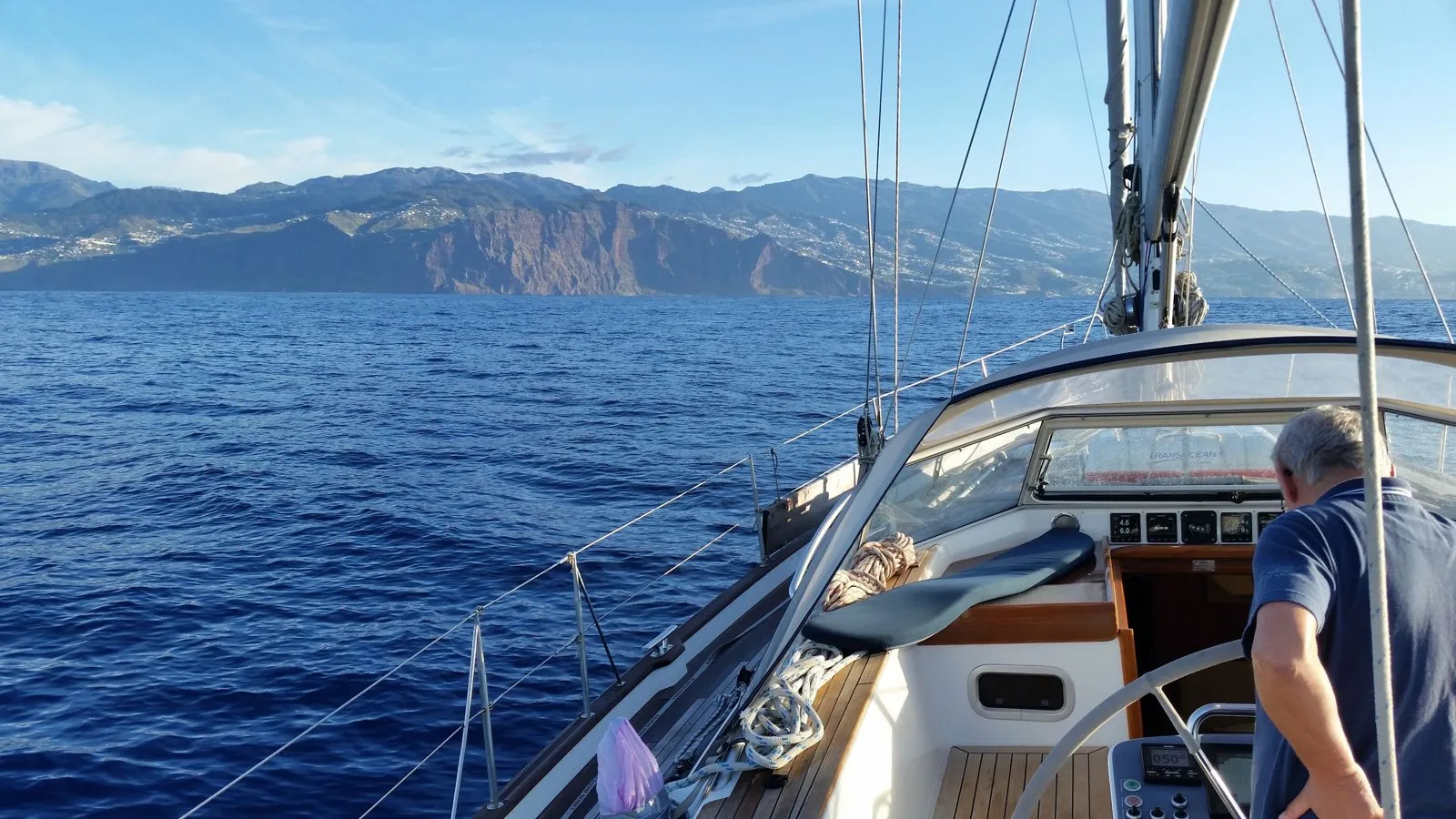
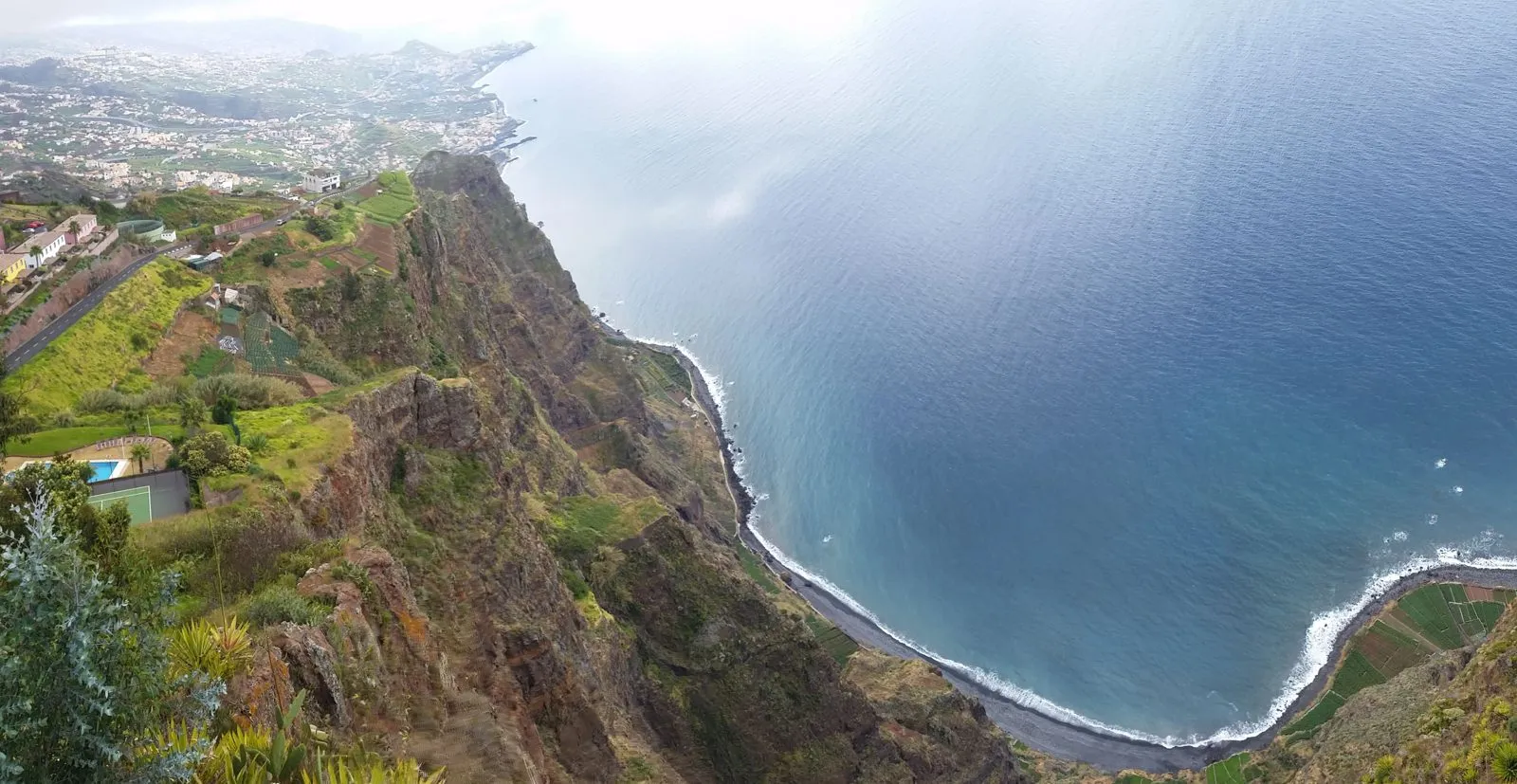
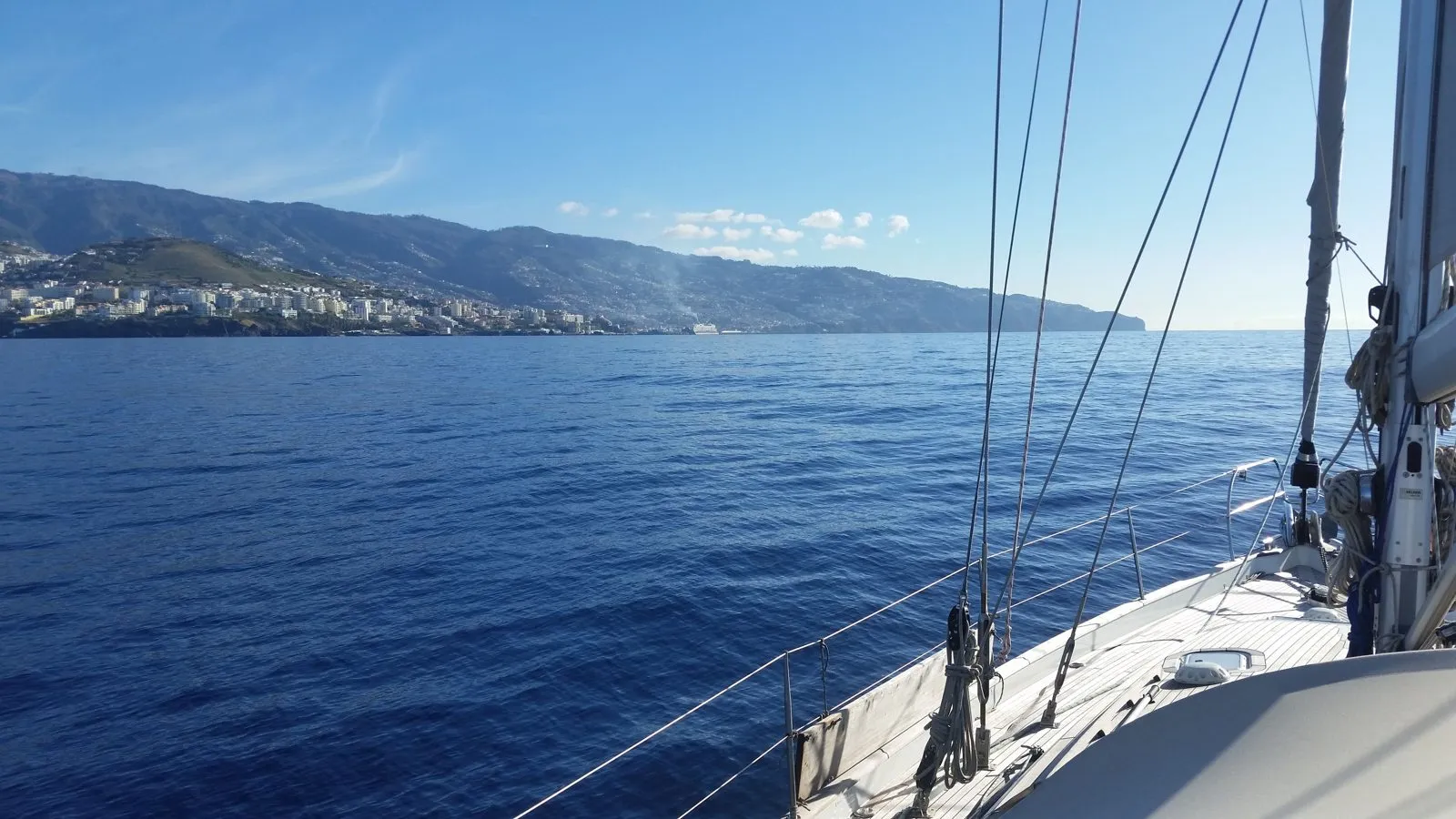
At 7 in the morning, when my turn came round again, it was already light and there, 10 miles ahead of us, rose the wild cliffs of Madeira. We sailed past Cabo Girão, the world’s second-highest sea cliff, rising almost 600 metres above sea level.

Cabo Girão

Marina Funchal answered our radio call and told us there was no room, we should wait outside at anchor. Gyuri deployed his tried-and-tested method – and I have to admit, this is the second time I’ve seen it work.

The gist of it is that if you check in nicely – the way you’re supposed to – and politely ask whether there’s a berth, the answer is very often no, because the staff are too lazy to look into it a bit and shuffle things around. If, on the other hand, you sail in, neatly tie up in the spot of a boat that happens to be away, and stroll into the office to say you’d only be staying a few days, have you parked in the right place, then they’ll generally always find some solution…

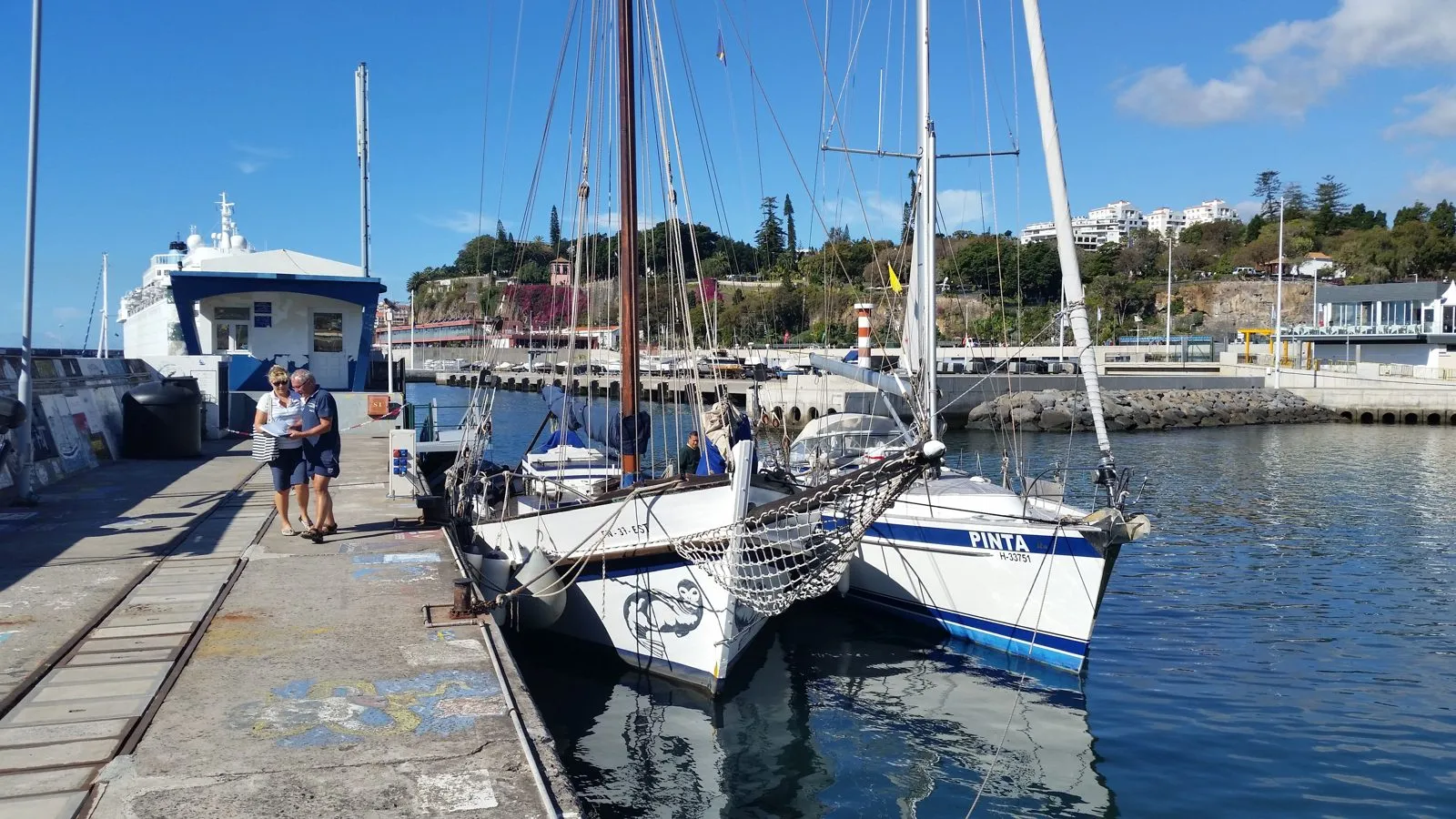
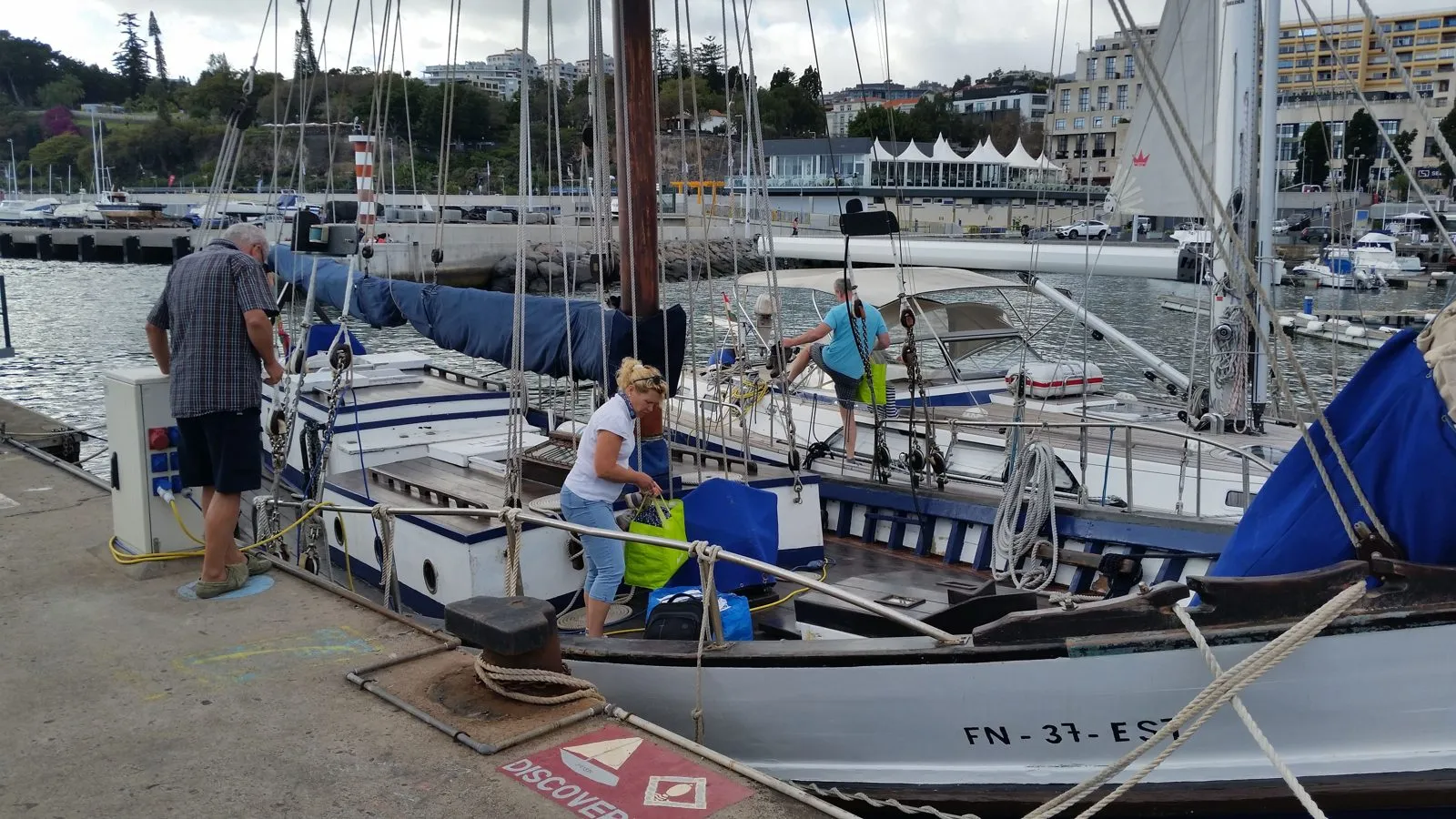
This time too, instead of the distant anchorage they suggested, we sailed over, and already at the entrance the marinero told us to wait a bit and we could come in. At the marina entrance a tourist catamaran soon set off, and we could tie up in its place. Not to the quay, but to an already moored – at least hundred-year-old – sailing fishing boat. We spiderwebbed the Pinta on good and proper, we’d arrived. After 9 and a half days of sailing into the wind and 1135 nautical miles covered. In the Middle Ages, square-rigged ships – like the Santa Maria – waited long weeks for a fair wind before they could set off, because they couldn’t sail against the wind.

After tying up, we all trudged over to the harbour master’s mini office, and with the ship’s papers and passports we checked in in no time; this is Europe already – Schengen, what a blessing – we’re practically home. The office floor and the concrete jetty comically swayed under us every now and then; that’s what dry land does to a seafarer if he isn’t careful…

First of all I wanted to pop in on Señor Braganza – the wine merchant – in case I could snatch a wine cargo for Gibraltar from under old James Onedin’s nose. The way I reckon it, if he was about 40 at the end of the 70s, the old wheeler-dealer must be past eighty by now. And still putting one past everybody…

Looks as if they’re about to collide… Doesn’t it?

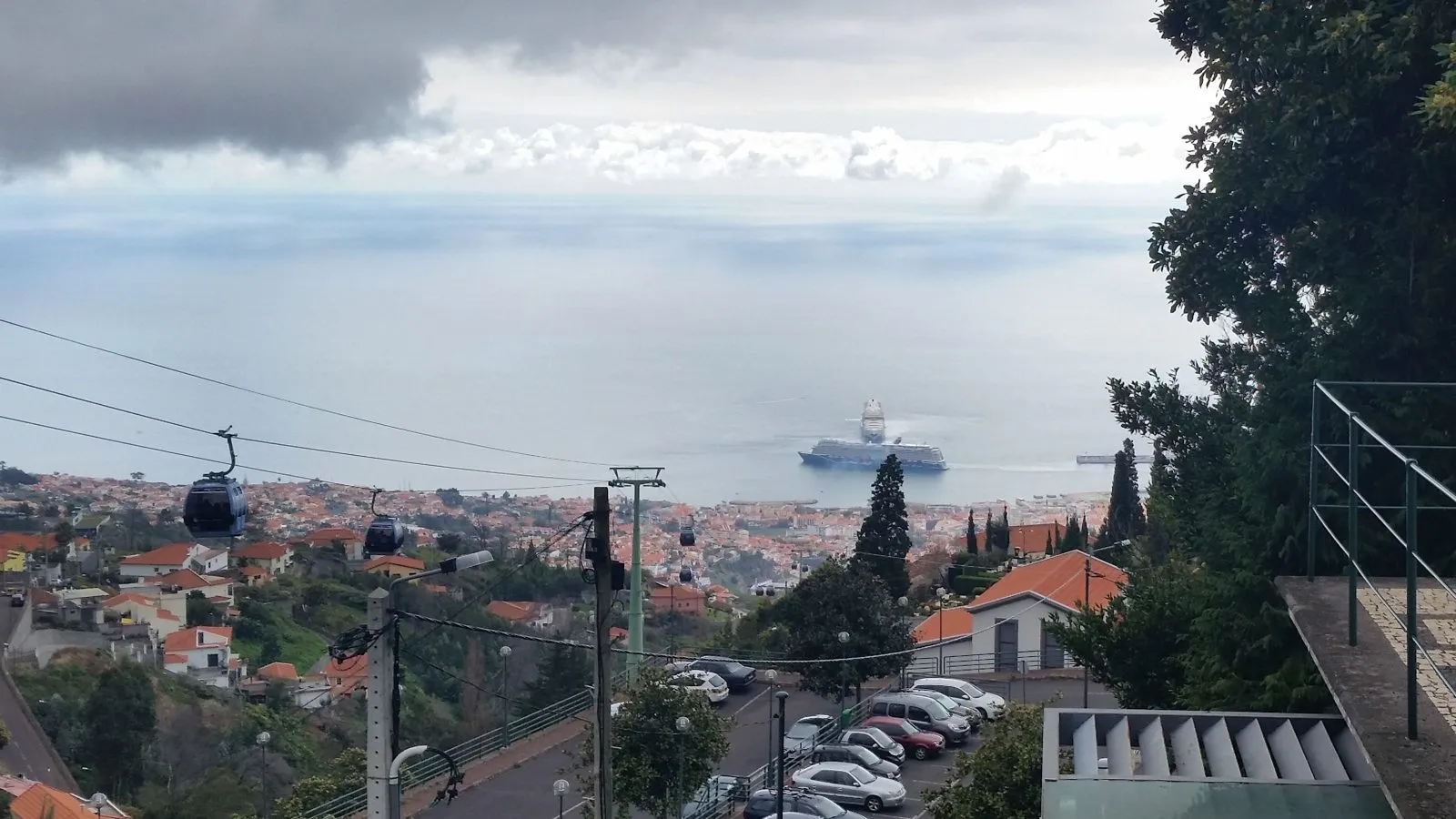
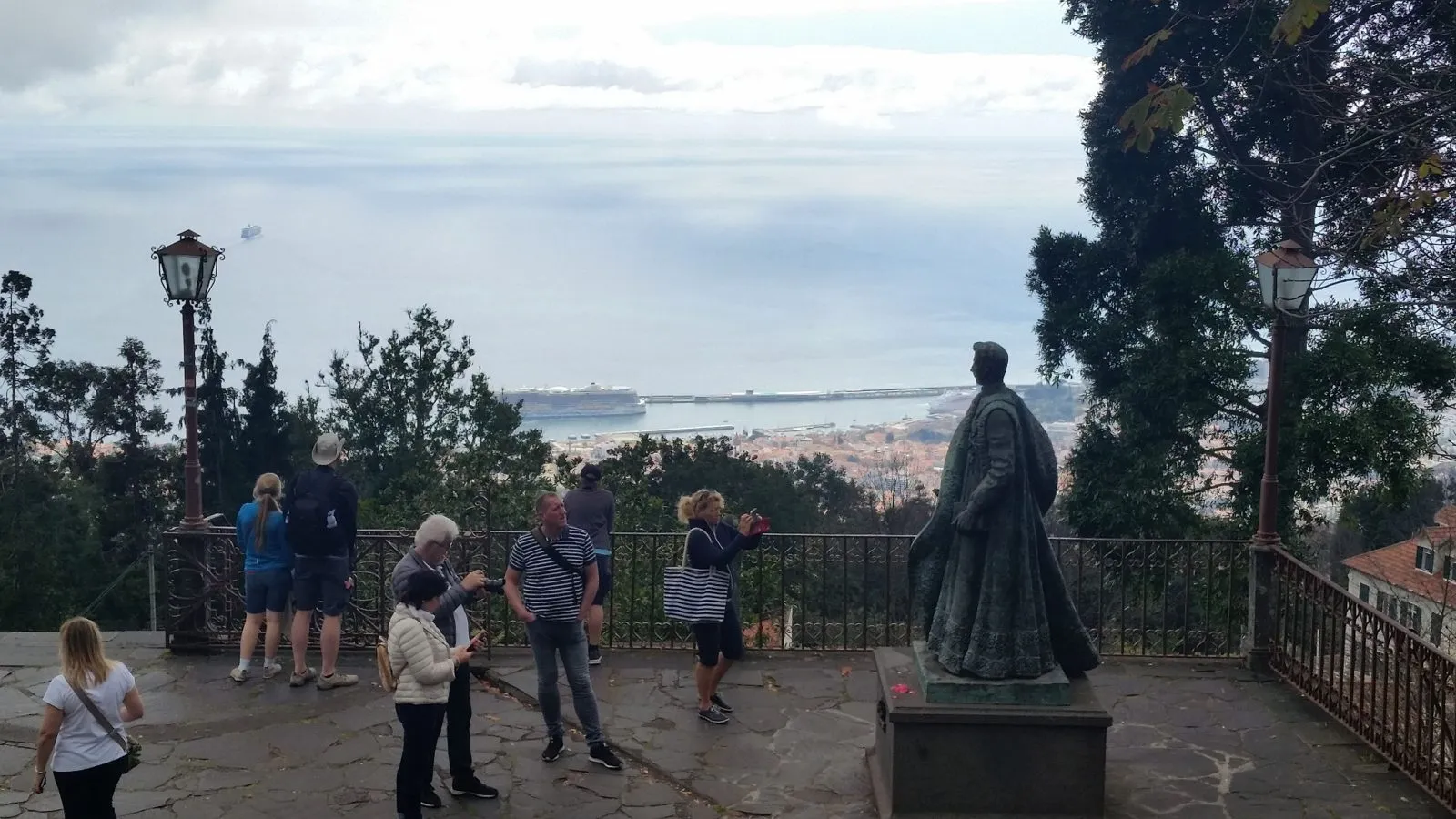
But then we quickly had to book a car for the next day, and it went clean out of my head. We strolled along the seafront promenade to the cable car’s bottom station and rode up to the church of Our Lady, where the last Habsburg emperor – and Hungarian king as well – Franz Joseph’s son, Charles I, is buried. He came to the throne in 1916, and by ‘18 they’d already throne him out. (Why don’t we ever say it like that?) After Switzerland he came to Madeira with his family in 1921, where in 1922 he died of complications from a bout of pneumo-whatsit. His and Empress Zita’s son must have been Otto von Habsburg.

The statue of Charles I in Funchal

In the end we didn’t slide down on the toboggan, we left something for the next visit to Madeira. In the cable car cabin on the way down a short, black-haired couple got in with us – Gyuri very nearly remarked how typical they were, sweet little Portuguese – whereupon they greeted us in Hungarian. They were Hungarians from London on their honeymoon, small world. Further along our walk we bumped into another Hungarian family, this time from Mosbach in Germany – the small world got even smaller – and Gyuri and co. instantly worked out that they even had a friend in common…

Toboggan starting point

Over dinner we established that all three of us must have slept very well the night before, because each of us had dreamt some kind of nonsense.

That’s the Pinta over there

And this is a life-size replica of the Santa Maria

Back on the boat I tucked all my electronic gear under my arm and set up shop on the terrace of one of the modest harbour bars. The only power was behind the bar, so the young waiter obligingly pulled my table over next to the ice-cream freezer, and off went the surfing.

Now I was loading up the blog, now they were loading up my glass, so the time flew by until closing.

My press box in the harbour

Back on the boat we then held an impromptu press conference. By e-mail we informed the German Yacht magazine and the www.noonsite.com website – the information site for round-the-world sailors – about the robbery in Cape Verde, so that they could warn other seafarers. And I also sent my star photo and the blog address to the Hajdú-Bihari Napló (our county paper back home), I’m curious whether they’ll do anything with it.

Machine translation (AI, Claude) of Balázs’s Hungarian original. Read the original →

· Funchal, Madeira

Discovering Madeira

In the night land sickness caught up with me. Its typical symptom is a headache. Many others know it as the wife’s ailment (“not tonight, darling, I’ve got a headache”); luckily I’ve never come across that one.

I’ve never been a wife…

Maybe this headache was why I had such a wild chase dream, one that knocked even the most bloodcurdling zombie films into a cocked hat. And I don’t even watch those.

In my dream the pursuers weren’t zombies but construction workers. Occupational hazard, surely… One horrible situation followed another, all in an apparently logical order.

The brain is one of the best directors, I had to conclude after waking up. Orson Welles was a mere tea boy compared to what I have to dream through, and how. How the heck do dreams like that sometimes get generated, how does this stuff even come into my head???

Then I realised that in my dream it’s always my fear of that particular moment that comes true. And the in-house dream-editing software adjusted the set to it, unnoticed, after the fact…

If I was afraid that the workers at the building site would spot the wanted person next to me, then they recognised him and started chasing us. “Just don’t let me get a red light!” – I prayed – and right away there came a junction, and the traffic light, which – wouldn’t you know it – turned red, we had to cut across through the cross traffic, – I don’t even understand – how we slipped through between two cars without a problem. “If we turned into a dead end” – we’d be done for, I thought – and immediately there came a complete road resurfacing job, we had to flee on foot… Quick, into a house under construction, up to the first floor, maybe the pursuers will run past. As I peek out of the window to see whether the coast is clear, wouldn’t you know it, some meathead happens to look up and notices the movement. I step back, but through an opening – which wasn’t there a moment ago – a mug looks in and bellows: “They’re in here!” What can I do, I kick his noggin – but it’s too late – they swarm up the stairs, climb up a ladder – which is now there too – and pin me down. I can’t move anymore – in final desperation – I try to bite one guy’s finger off, but it’s pure bone – like the Pirates of the Caribbean – and it grins… If he yanks his hand out now, my teeth will come out with it, so I let go. He raises his skeletal arm to strike, and with his finger bone – the one I couldn’t bite off – to punch a hole in my skull…

And that’s where I woke up. Phew!

As a child I’d at most dream now and then that a bear or a wolf was chasing me and caught up with me… Little naive me.

The point is, I survived, and I just lay there flabbergasted at the nonsense my – supposedly resting – brain had produced for me here. It very rarely happens, but when it does, my noggin really runs amok. I don’t even understand why I don’t dream about things like dribbling on my shirt during a meal, right where my non-existent tummy would be. Or a real horror scenario: accidentally knocking over my freshly poured glass of pálinka… But no, I never dream of things like that, even though those are what I’m really afraid of…

Or, say, about the cute Easter bunny wandering off and not finding his way home…

Uh-oh! Careful with that one too – speak of the bunny and he shall appear – I’ve seen what they’re capable of in that nature documentary, Monty Python and the Holy Grail…

My head ached and buzzed, I took an Algopyrin (this space reserved for advertising), which slowly helped, and I just about managed to fall asleep before the alarm went off.

A new day began, and my head no longer hurt, it just buzzed a bit from tiredness…

At the crack of dawn, 10 a.m., we picked up the hire car, a little Nissan Micra. The poor thing was really feeble; if we accidentally switched on the air conditioning it was like getting punched on the nose, its performance dropped to micro levels. That must be where it got its name…

First, from the glass-floored viewing platform at Cabo Girão, we looked at the famous sheer cliff – this time from above – and the panorama. We were lucky, because the clouds coming down from the mountains stopped – right above us – and didn’t block the view.

Then, through the local version of the Békás Gorge (the famous ravine in Transylvania), we cut across to the other, northern side of the island and drove along a new road with tunnels and gorgeous views to Porto Moniz, where we just stood and marvelled, but once again didn’t bathe, the pools were closed. The pictures speak for themselves…

On the way back we drove all along the island’s north side, where after São Vicente we were still winding and twisting along the old serpentine road at an average 20–⁠30 km/h as far as Santana. Here in the town centre they’ve built 5–⁠6 old-style cottages, open-air-museum style, whose common feature is a gabled roof reaching almost to the ground, with thick thatch. They were selling local crafts and wines in them, and in one of them a junior granny – slightly mixed metaphor – was spinning her yarn on an electrically humming spinning wheel. Instead of “God give you good day, old mother!” like the lads in our folk tales, I only greeted her with a short “Hello”, and maybe that’s why, by the time we reached the eastern tip of the island, it started drizzling heavily – and only there – so, much to Zsófi’s sorrow, we couldn’t hike out to the Ponta do Furado headland.

We did still jump out quickly at two viewpoints and shot a few pictures of the breathtakingly beautiful cliffs besieged by the sea, then scurried back to the car out of the rain – apparently – junior granny never forgets…

Back in Funchal, Gyuri and I topped up the Pinta’s 14 service batteries, 1000 Ah in total, with Aqua desmineralizada, i.e. distilled water. They’d drunk a good 5 litres since the last top-up back in December. I don’t know why our boat doesn’t have maintenance-free gel batteries, but there must be a reason.

Then – armed with my laptop – I trudged out to the harbour bar again, yesterday’s waiter was already obligingly dragging the table over to the ice-cream counter and – on the life-giving wi-fi – I set about uploading the rest of the material and phoning home.

Machine translation (AI, Claude) of Balázs’s Hungarian original. Read the original →

· Funchal, Madeira

This evening we leave for Gibraltar

The car had to be returned by 11, so before that we used it to go shopping for the next week. We also bought a bicycle pump so we could raise the air pressure in the expansion tank of the boat’s water system, because the water pump has been buzzing more and more often, and we suspected low pressure.

Then I wanted to buy another 5 litres of distilled water as a reserve. What was it called again? Now I’m testing you. I wrote the Portuguese name down under yesterday, so, how would you ask for it?

I knew there was something like demineral in the word – meaning there are no minerals in it – and I hemmed and hawed, got tangled up in it about three times – like a tongue twister – until every time they sent me packing, saying they didn’t have any.

But it must be somewhere! In the end, at the third petrol station, I spotted the jerrycan, and what did it say on it? Agua destilada. In other words, if I’d simply asked for distilled water, they’d have understood me first time for sure…

By the time we got back to the marina, Ricsi had just arrived from the airport too, and helped us lug everything aboard.

While they stowed the provisions, I took the Micra back.

As I’m walking back to the boat, guess who I bump into? No, not more Hungarians, but Cristiano Ronaldo in person! Admittedly he must have been standing there in the square with his legs apart for a long time, because his trousers had got as shiny as the pecs of Romeo’s Juliet in Verona…

In the morning Gyuri refuelled the boat, and Ricsi and I quickly washed the salt off the deck.

We put the dirty laundry into the machines of the marina laundrette, which in a good hour nicely washed and dried it all.

After that we took another walk round Funchal, bought some more bread and tomatoes, then sat down in a small homely restaurant for the last supper. They brought everything at a very leisurely pace, and it was already quarter to 8 when it suddenly dawned on us that we hadn’t checked out yet, and we wanted to sail out this very evening. Yesterday evening, from the bar terrace, I’d seen the policeman of the little border office go home at 8, that’s when he shut up shop.

Gyuri and Ricsi ran ahead to catch him so we could check out, while Zsófi and I stayed behind to pay. On the way home to the boat our route led past a carnival band and pretty dancing girls samba-ing to the drums and whistles. Well, if those two got there before 8, then either they’re blind, or they found a shortcut through the woods…

According to them, they were there at 7.55, but the office was already closed and they couldn’t check out. Take a good look at the picture and the video! What do you reckon???

So we found ourselves in a real dilemma: we’re all set to go, should we stay until morning after all? Let that nice wind go to waste? What could happen if we were to leave Madeira without checking out?

We fiddled with untying the mooring lines and taking in the fenders for so long that we completely forgot about the exit procedure, and the next thing we noticed was that we were gliding out of Funchal harbour, into the night…

Machine translation (AI, Claude) of Balázs’s Hungarian original. Read the original →
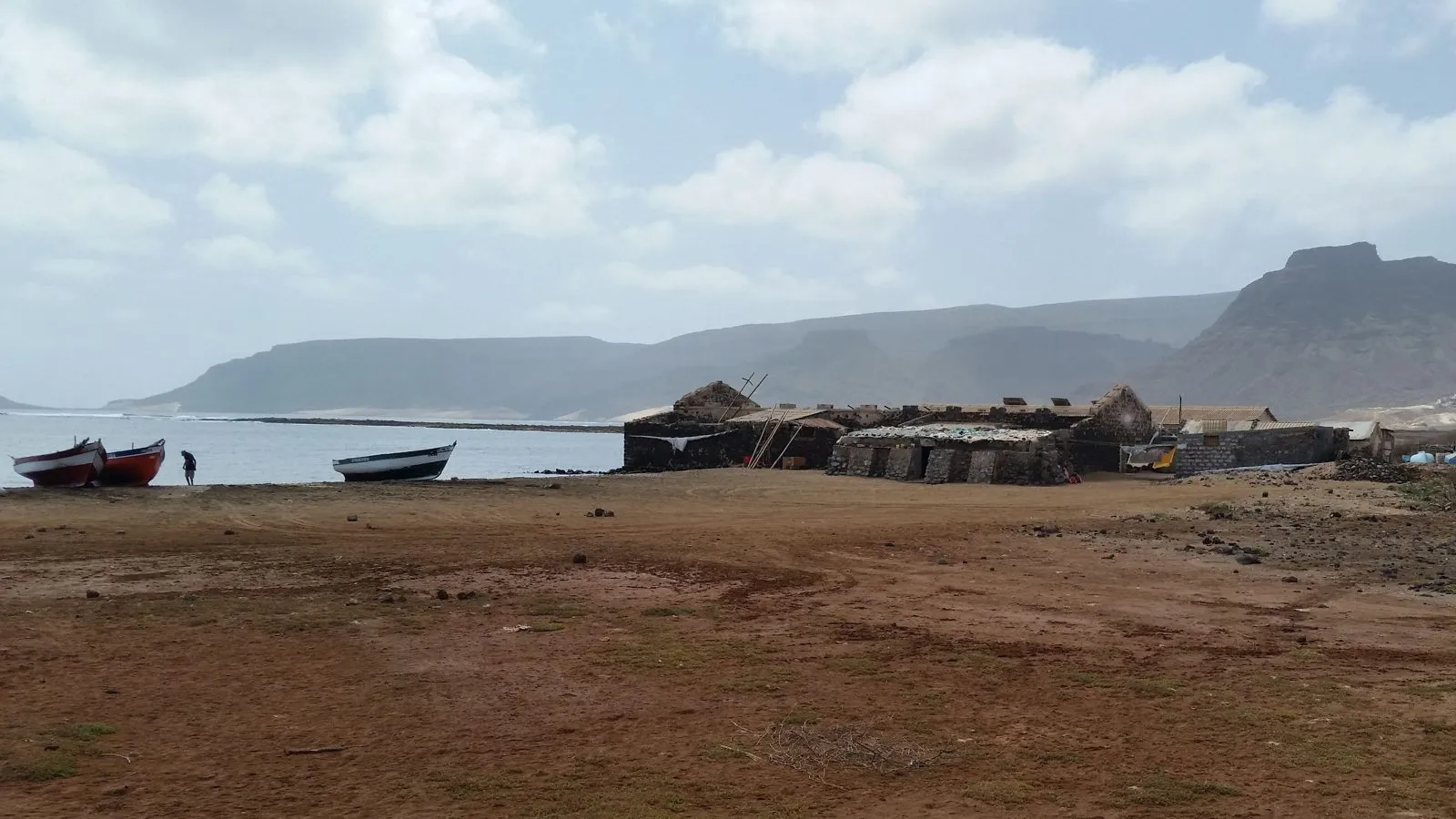
· Atlantic Ocean, between Madeira and Gibraltar

Sailing a croissant, billing by the engineer-day

Gyuri is still preoccupied with the best possible way to replace our winch that flew off. The way we led the line across to the other side was fine as a temporary fix, but it chafes in a few places, so he’s racking his brains over a block-and-tackle solution that could even halve the pull of the sail.

He did come up with a solution, the only problem with it being that, as Ricsi pointed out, it didn’t halve the pull, it actually doubled it. Luckily we’re getting the wind from port now, maybe all the way to Gibraltar – so the other side, the starboard one, is in action, and here on the damaged side we’re free to brainstorm.

Gyuri came up with the idea of building a model tackle out of the spare smaller blocks on board, and we’d try out how to arrange them so that they halve the force, sit in the right place and don’t chafe.

We measured forces, weighed things up, deliberated; if we were paid by the engineer-day, we’d be earning quite nicely…

In the end Gyuri fitted the right solution to our boat, and meanwhile I solved the maths problem I’d set myself last night. You can have a go too; correct entries may photoshop themselves next to me into a picture of my choosing.

So, the Problem:

A sailing boat passes an island in the dark of night. There’s a lighthouse on the island’s highest point. The wind is strong, the waves are big. The person on watch (that was me) notices that the biggest waves momentarily hide the whole island, even the top of the lighthouse, when the boat is at the bottom of the trough. How high must the biggest waves be at the very least, if according to the chart the lighthouse is 5 nautical miles from the boat (1 nm = 1852 m), its light is 282 metres above sea level, the eye height of the observer on watch is 2 metres above the sea, and he estimates the horizontal distance between the highest point of the wave crest and the lowest point of the trough at 50 metres.

We were sailing past the island of Porto Santo, next to Madeira, and the flashing light must have been on the peak called Pico Ana Ferreira, which has basalt columns like the “organ pipes” at Badacsony on Lake Balaton.

Ricsi has been tormented by seasickness since the morning – he’s already shed his excess weight – and the bug is circling Zsófi too. I can also feel that my stomach is somewhere around my belly and not in my head, though my wife sometimes questions that…

Around 11 the lunch question is becoming more and more pressing. Zsófi took on making a good chicken soup, but she’s not up for the main course today. Neither cooking-wise nor eating-wise. I suggested making a chili con carne, but since Ricsi had also cancelled his attendance at the main meal, I proposed making it another time, when everyone can praise it. Today Gyuri and I will each have a tin of ready-made “Farmhouse” székelykáposzta (Szekler pork-and-sauerkraut stew).

We ate lunch in the cockpit, so as not to spill anything inside in the saloon, and anyway Ricsi didn’t fancy spending long minutes inside the boat just yet. After the soup Gyuri heated up and served the tins, so I was predestined for the acrobatic operation of washing up.

In a skier’s stance you brace your knees and backside between the two sides of the galley gangway, then lean forwards and backwards in time with the boat’s motion, tensing now your right, now your left leg muscles, all the while thinking tenderly of the inventor of the dishwasher. On the other hand, I don’t need to go to the gym today either…

Today is our first overcast day at sea since the Cape Verde Islands. The wind is still favourable, so we’d rather sail a croissant towards Gibraltar. That means we don’t point the boat exactly at Gibraltar, but – now at the start of the passage – about 30° off it, to the north, and then keep turning gradually towards our destination, so our track won’t be a straight line but sort of croissant-shaped. The route is a bit longer this way, but if the wind shifts unfavourably later, maybe we won’t have to beat back and forth at the end, thanks to the height we’re gaining now. Got it?

Today rum suited the chilly sunset better than gin and tonic. Without Ricsi we played three games of Sevens, which, thanks to favourable cards and winds, I managed to win.

Around 9 in the evening the wind started to swing round to the north; it could have waited a bit.

Well, either this croissant is going to end up very flat, or it’ll have turned into a pretzel by the time we get to Gibraltar…

Our croissant between Madeira and Gibraltar

The solution to the Problem, tablet users at an advantage:

The highest waves were at least 3.52 m high

But – reportedly – there’s a simpler solution too… Now that I’ve drawn it, it’s easy to figure out…

Machine translation (AI, Claude) of Balázs’s Hungarian original. Read the original →
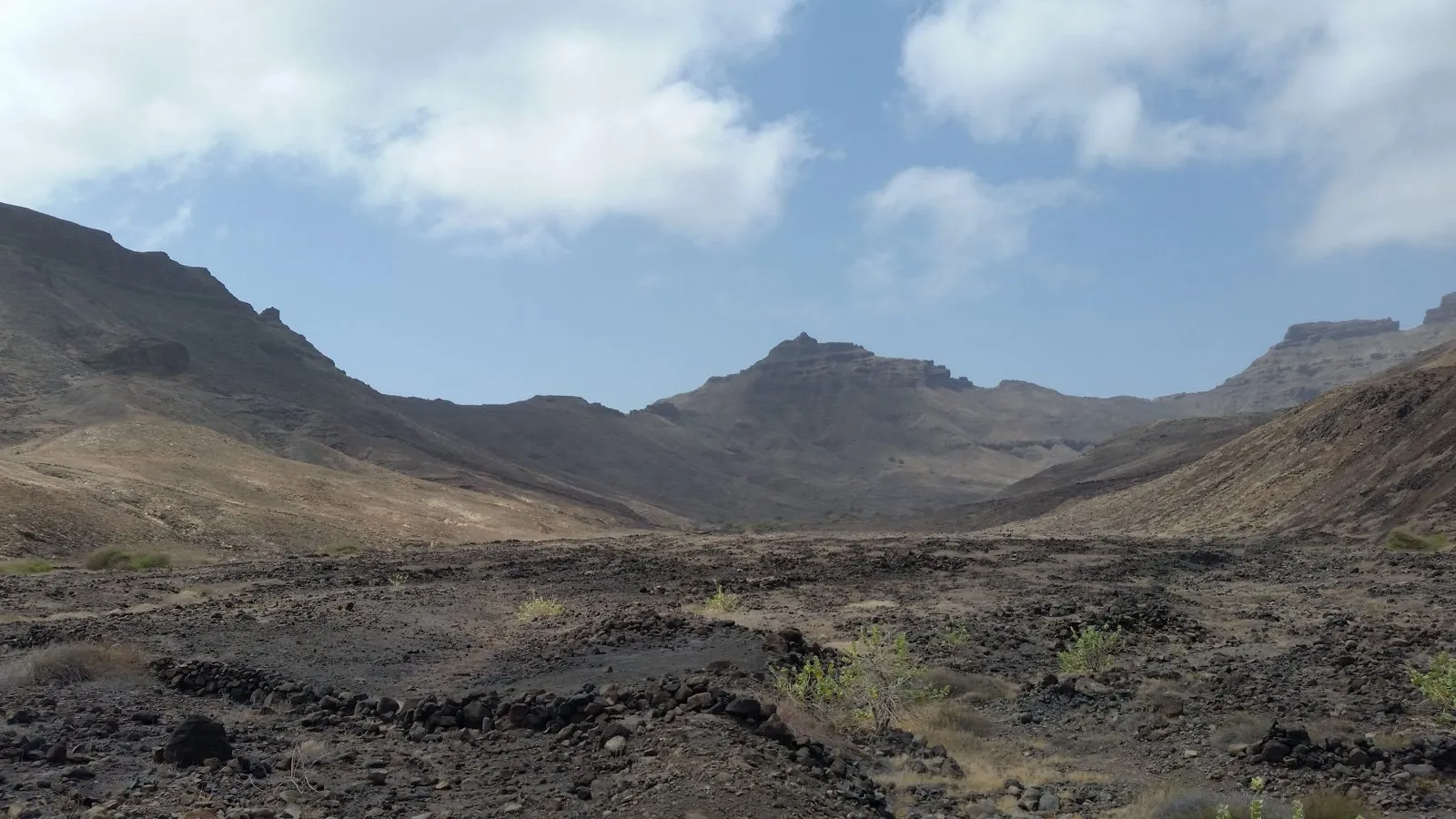
· Atlantic Ocean, between Madeira and Gibraltar

I caught a swordfish with my bare hands

For my 4–⁠7 a.m. watch the wind picked up to 24–⁠25 knots, with gusts of 28 (52 km/h). It’s foul, unfriendly weather out there. Moving about hand over hand in the heeling, bucking boat takes care of my daily uneven-bars routine.

In the night Ricsi saw a fishing boat without AIS close to us, which again confirms that you still mustn’t sail a boat relying only on the instruments, you have to keep watch all the time…

The morning was free time; somebody was always having a snooze, catching up on the sleep lost on night watch.

After lunch a tanker crossed our path, the British Seafarer. We were watching to see whether she’d pass ahead of us or behind us when the officer of the watch called us on VHF, on channel 16. At his suggestion we switched to 11 so as not to tie up channel 16, which everybody monitors. I think he was bored and called us more out of curiosity. He asked where we were coming from and going to, what kind of passage we’d had, then, without being asked, told us they were coming from Amsterdam, heading for Lagos in Nigeria, and had had absolutely dog-awful weather in the English Channel. Finally he confirmed he’d pass ahead of us and – wishing us a good voyage – signed off. Not long after, we see her change course and head towards us, but then she turned further and passed a good half a mile behind us. Vessels under sail theoretically have right of way on the open sea, even over big tankers, but out here it’s especially true that right of way belongs to whoever is given it, so it pays to keep an eye on every critter moving about nearby.

The British Seafarer passes behind us in the end

Not long after, I caught the first fish of my life on the ocean. A swordfish, right off the bat, and with my bare hands to boot.

I admit, it somewhat reduces the sporting value of the catch that it was 17.5 cm long at most and the breaking waves probably washed it onto our deck, but still… To quote Comrade Pelikán (from the Hungarian cult film The Witness and its famous “Hungarian orange”): “Small it may be, dead it may be, but it’s mine!” I was the one who spotted it, I was the one who – risking my life – climbed out on deck for it and grabbed it with my bare hands.

After documenting it – being a sportsman – I threw it back into the sea, even though it didn’t grant me a single wish, let alone three… I believe folk tales call this a classic case of lapsed self-interest.

We gave our International Women’s Day greetings extra weight with an extra round of gin and tonic. (We only toasted Zsófi. That’s slowly ceasing to be self-evident…) As I’d seen done elsewhere, I sugared the rim of the cocktail glass and hung a slice of lemon on it. Unfortunately we only have brown sugar, so the optical miracle wasn’t perfect, the rim of the glass looked more dirty than frosted. But – with your eyes closed – at least it was sweet…

Machine translation (AI, Claude) of Balázs’s Hungarian original. Read the original →
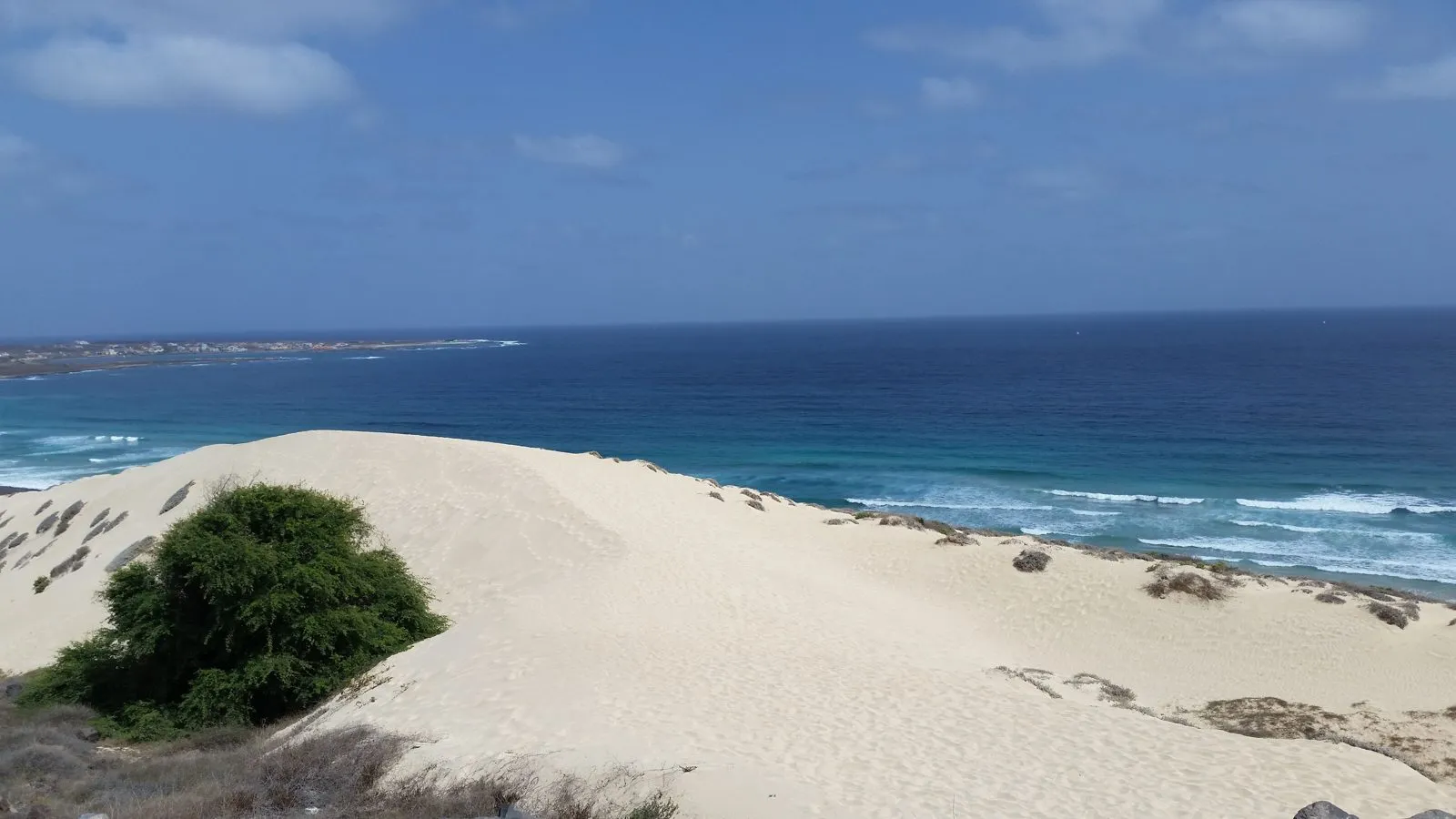
· Atlantic Ocean, between Madeira and Gibraltar

Neptune gives me a good clout round the head

Saying I slept well would be an exaggeration. I lay there for about 8 hours in one go, and still woke up like someone who’d been beaten up. My muscles are tired; you have to brace now this way, now the other – all of it happens automatically while you sleep – and only in the morning do you notice that instead of resting, you’ve been boxing all night. Then I observed another interesting phenomenon: the blanket bellows. It goes like this. It’s chilly in the cabin by evening, after all, so you tuck yourself in well, but you’re too lazy to wedge the blanket under your feet too, so a little gap remains. What happens? The bow of the boat, together with your bunk and you, keeps riding the lift up and down; fine, you’re used to that by now. But at the highest point you lift off a little – like in a car going over a hump – the blanket rises an extra 3 centimetres, and sucks the cold air in between your legs. When you get down into the trough, it blows the warm air out from under your blanket. If you’re not on your guard, you’re half frozen by the time you figure out the dirty trick.

As I crawled out of the bow in the morning – shivering, stiff – our skipper’s sigh came straight from my heart:

“If only we’d get a nice big calm!” Because then the waves would be much smaller (we hope), we could motor, and move around standing upright.

Today, though, the sky is cloudless all day, the sun is sparkling. The wind is blowing just as hard as last night and yesterday, 20–⁠25 knots, the waves are just as big – but blue – the boat is riding the lift just the same, and yet it feels completely different. It’s cheerier, the mood is better; the wind is whistling just the same, but somehow it doesn’t seem threatening. All of this was much less friendly yesterday, on a grey, cloudy, overcast day, with grey waves and a howling wind. And at night not a single star could be seen, just the big stinking darkness, the same wind howling, you being shaken about inside the boat – like a cockchafer in a jam jar – you don’t even feel like looking out…

This wind is expected to stay with us tomorrow too; still, we’re getting closer to Gibraltar, even if we can’t head straight for it.

In the afternoon the MSC Symphonia passed us, about a mile and a half off. This is one of the newest and biggest cruise ships of the MSC line, with about 2500 passengers. Judging by her course, she may be coming from Madeira like us – though not by croissant – and heading for Tangier.

The MSC Symphonia passes 1.5 miles from us

These ships are largely responsible for air pollution, especially in ports. They sail under flags of convenience – like Panama – where the rules are much looser, whether on safety, labour or pollution.

They burn the same lowest-quality, dirtiest fuel oil as the cargo ships, with the difference that they keep their engines running in port as well, to generate the small town’s worth of energy – day in, day out – that they need. As far as I know, no port can supply that much electricity, so they have to run the engines day and night, blowing out the exhaust of tens of thousands of cars. Cities – like Hamburg – are torn between the interests: they ought to ban these polluting monsters – as they do with cars – but on the other hand they provide jobs and attract tourists, who spend their oceans of money there.

A cruise ship belching smoke in Funchal

So the smoking goes on; the whole thing is left solely to the conscience of the shipping companies, which – as has been common knowledge since the Titanic – is more non-existent than not. Something has started to move, though, because – I think – Mein Schiff has ordered a greener ship as its next one, to keep the German port cities happy.

One more thing. I think this wandering-hotel-style, all-inclusive kind of holiday is worth trying too, but you should know that towards the stern of the ship, near the funnels, the level of pollutants in the air is very high, many times the recommended limit.

For the umpteenth time I note that even this boat is optimised more for life in port and day sailing than for long, uninterrupted passages. For example, there isn’t a single handhold in the forward cabin! As long as you’re standing, you can brace your back against a wall or a locker, but as soon as you have to sit down – or rather climb up onto the bunk, which is 80 cm high – you’re at the mercy of the elements. Your feet don’t reach the floor, they dangle in the air, you try waving your arms about like a rodeo rider on a bull, and you’ve basically got seconds before you take off. Today Neptune got bored of my attempts very quickly, and with an unexpected wave knocked me out of the saddle so hard that I went over on my back like a stink bug – I mean, like a firefly – and only the shelf stopped my noggin, with an honest-to-goodness crack. I counted myself out on the spot – 1:0 to him – felt the new bump on my head, and, scratching it, concluded that I’d actually got off lightly by not landing on the edge of the shelf…. They say everything has a bright side; apparently even a shelf…

In the evening we held the Rikiki rematch – I’m not telling you who won – because you’d surely just think I’d only been lucky…

Our croissant is finished, but it came out only half as big as we’d have liked; the wind swung back to the prevailing direction much earlier. Now we’re heading due east, towards Rabat. Maybe as early as tomorrow, Monday at the latest, we’ll be able to head for Gibraltar.

Here’s our croissant. Sadly it doesn’t reach all the way to Gibraltar. But at midnight there’s 30 knots of apparent wind howling

Around midnight the wind sometimes picks up to 28–⁠29 knots, and then the whole boat shakes, rattles and judders like an aeroplane in very heavy turbulence, as if the whole thing wanted to fall apart… A fan comes loose from the ceiling and flaps back and forth, dangling from its cable. The two of us subdue it.

Machine translation (AI, Claude) of Balázs’s Hungarian original. Read the original →
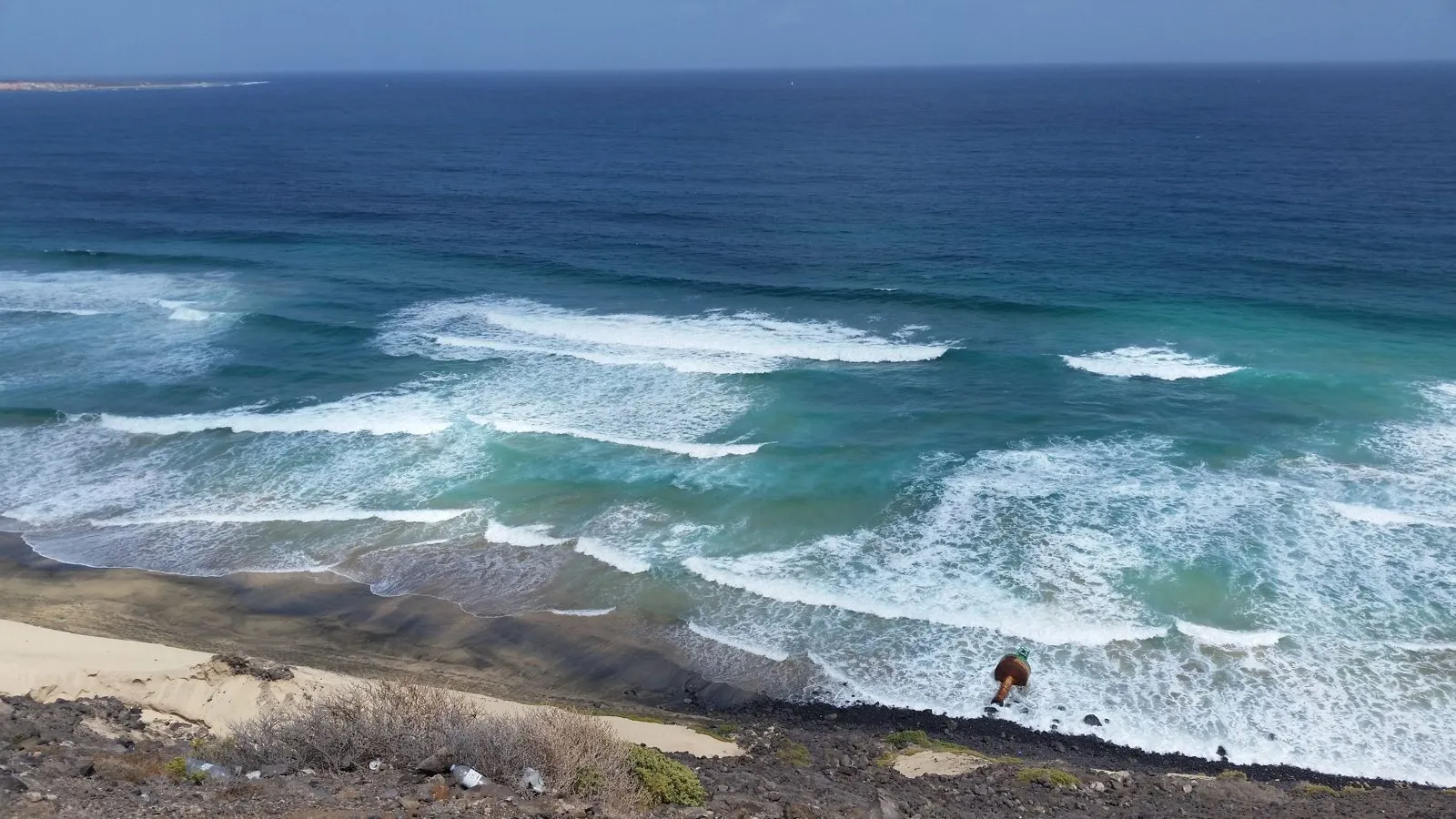
· Atlantic Ocean, between Madeira and Gibraltar

The headsail tears

By morning a hefty – 80-centimetre – tear had appeared in our headsail.

It had been under heavy strain for days; that’s also why the block tore off the lead car.

We had to furl it away completely – to stop it tearing further – so we started the engine, even though we’d planned to do that later. The wind is still stronger – 20–⁠22 knots – and slows us down a lot; even at full throttle we’re only stumbling forward at 3–⁠4 knots instead of the normal 6–⁠7 miles an hour.

On Madeira I’d arranged with Andi that she’d come to Gibraltar and join us for a shorter leg. The most sensible solution seemed to be that a plane comes from Budapest on Tuesday the 12th – Gibraltar is 500 miles from Madeira, we’ll be there by Sunday evening, Monday at the latest – and then I’d go and pick her up in Málaga with a hire car. We even bought her plane ticket – everything’s on track – which was one of the reasons we pushed for the Wednesday evening departure from Funchal. Then we realised that somebody had measured the distance wrong, and Gibraltar is actually 100 miles further, about 600, not to mention the extra detour of our croissant. In other words, our passage will take at least a day longer – than originally thought – and if we only reach Gibraltar on Tuesday evening, it becomes highly questionable whether after six in the evening I’d still find an office open where I could hire a car, while Andi’s plane only lands in Málaga at 19.15.

So for days now I’ve been constantly, anxiously calculating our possible arrival – it’s not impossible – but this persistent headwind makes the time of our Gibraltar landing highly uncertain.

Before sunset, at Ricsi’s suggestion, they pulled up the sunblinds in front of the saloon windows, so now you can actually see something out of the inside of the boat. The Pinta went round half the globe blacked out like this, obviously as protection against the tropical sun, and since there isn’t much room in the cockpit, half the company travelled down below in the saloon when there were six of them on board at once.

I’m not telling you who won tonight’s Rikiki game either, maybe just this much: I wasn’t lucky…

After that, from 9 until 1 in the morning, I could have had a decent sleep, but sleep – in the shape of a butterfly – just wouldn’t come and land on my eyes. Simply none came by… Butterflies, I mean. Or am I having withdrawal symptoms? Because Neptune isn’t constantly banging next to my head, and my cabin isn’t going like a badly loaded washing machine on the spin cycle? What will become of me at home like this?

Machine translation (AI, Claude) of Balázs’s Hungarian original. Read the original →
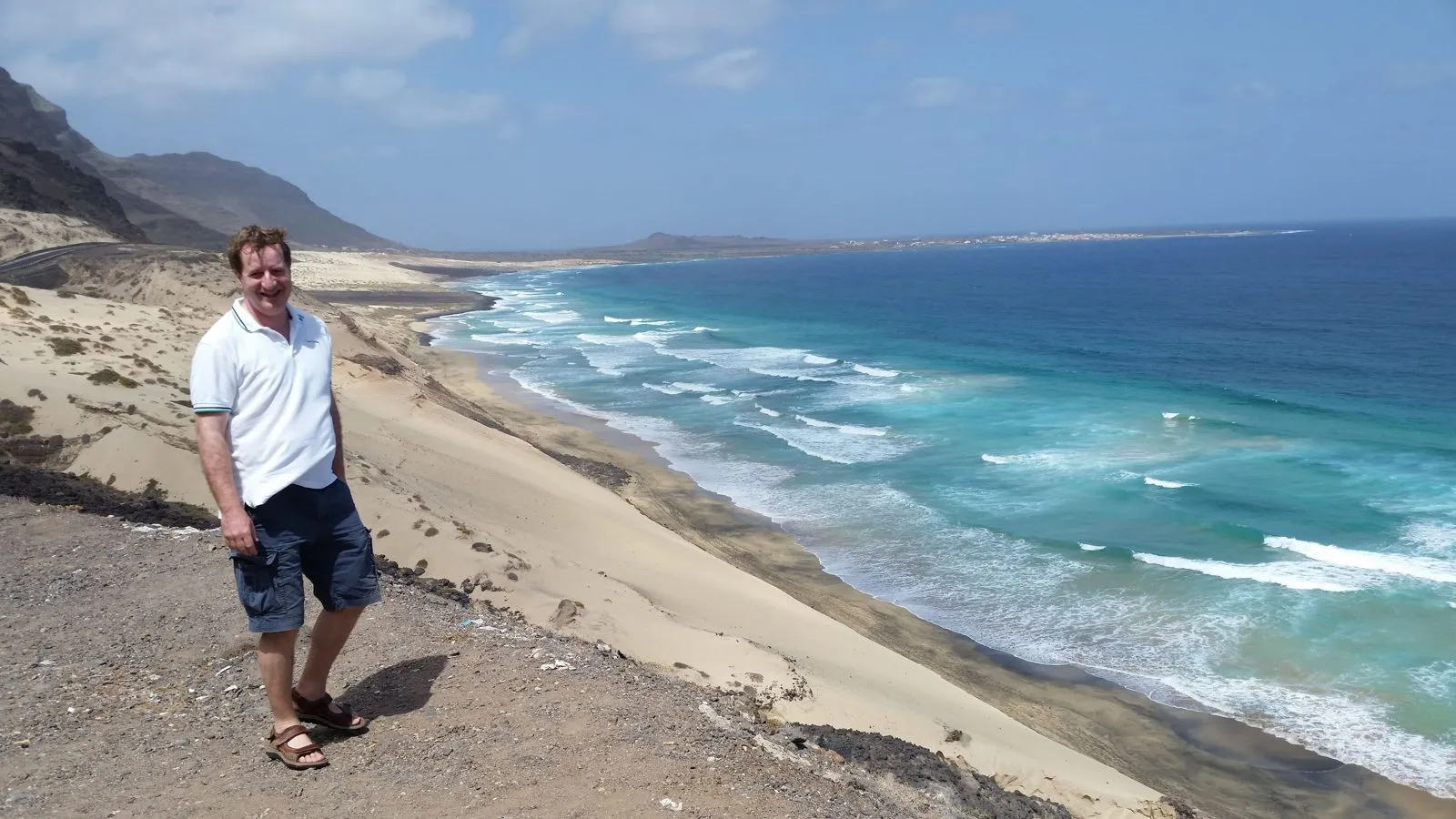
· Atlantic Ocean, between Madeira and Gibraltar

Ghost Ship on the Ocean

At one in the morning I relieved our captain, who retreated to his cabin and is sleeping there again, for the first time since Madeira (5 nights). Now that we’re motoring and the waves have calmed down, the boat isn’t heeling so much either.

It’s not that he has a beef with Zsófi – speaking of beef, the two of them made some really tasty meatballs yesterday! – it’s that lovely double bed: on a heeling boat it’s impossible to sleep in it, you simply roll off. (A boat optimised for marinas and day sailing.) It’s like trying to sleep in a tent pitched on a 40° mountainside… The other reason – why Gyuri slept out in the saloon – was surely to be at hand if there was any trouble steering the boat in the strong wind.

As we approach Gibraltar, the shipping is getting denser. This is where all the big ships pass after turning out of the Strait of Gibraltar, heading for South America or the Cape of Good Hope.

Ship traffic near us at two in the morning

Bioluminescent plankton have been twinkling in the churned-up sea beside our boat ever since the Cape Verde Islands, but not on a single night in the sparkler quantities that amazed me in 2015, at the start of the Atlantic crossing… To our south-east the bottom of the sky is a little lighter – obviously the light pollution of Rabat in Morocco, 80 miles away. Still, I can’t for the life of me see the constellation of Cancer between Leo and Gemini – it’s made of such faint stars – that I think they simply appointed something there – an animal in hiding – so as to have the full 12 constellations, or to fill up that spot in the sky…

Partly this is when – during the night watch – I write the diary; this is when my freshest, corniest ideas sprout.

At half past two in the morning Gyuri moved back to the saloon; he can’t even sleep on a hillside in his own bed…

As we get closer to Gibraltar, the matter of our forgotten check-out in Madeira comes up more and more often. What are we going to say? We have clearance papers from Mindelo, in the Cape Verde Islands, but then how did Ricsi get on board? The only half-decent answer we could come up with was that we rescued him from the stormy sea off Madeira. Like a migrant who is dead set on getting to Europe. As long as he doesn’t forget to apply for refugee status with the Spanish authorities… Maybe he’ll even get a bit of money…

Speaking of Madeira. In Funchal we didn’t manage to replace the parts of our winch that flew apart. Lewmar is to winch makers what Mercedes is to cars. Expensive, with fat profit margins. It took ages to get an answer: at first they could only deliver a complete “car”, in 4 weeks – for the price of a few-year-old little Suzuki – then a London dealer agreed to send the missing drum and rings in 5 weeks, for a third of that. It’s as if a Mercedes dealer could deliver a whole new car in a month instead of a broken windscreen…

So we’re sailing to the Adriatic with this block-and-tackle – it seems to work well – even if we have to haul in twice as much rope on every tack, but hey, we’ve got time, we’re not racing…

In the afternoon – during one of my look-arounds – I spotted the stern of a white ship far ahead of us. Oh, did we miss it when it passed us??? Not nice. Then half an hour later – at the next look-out – it’s still there, but maybe a little closer… I must be wrong, the monitor clearly shows it’s ahead of us, going the same way, and the big ships are all faster than us.

Another half hour later it seems even closer… How the heck is that possible? I checked its data on the AIS, and the mystery was partly cleared up. The ship – a 200 m long, 32 m wide car carrier, the Glovis Condor – was drifting ahead of us at the same speed as the current, 0.9 knots, in the same direction as us, and where it usually says “Under way using engine”, it said “Not under command”. So we really are closing in on it, because we’re motoring and it’s just drifting.

If we didn’t change course, we’d have passed it at about 2 miles, so I asked Gyuri if we could turn towards it and see what’s going on. Maybe they need help, a tow to the nearest port, or they’ve run out of fuel and could use 20 litres of diesel or so. “All right, but you’re the one in a hurry to get to Gibraltar by Tuesday noon…” This much still fits in – I thought – and set course for it.

When we came alongside, I called them, the Glovis Condor, several times, but no answer came.

We didn’t see a living soul on deck or on the bridge. As if a secret plague had finished everyone off, or pirates were on board, or as if everyone, captain included, was down in the engine room fixing the engine.

The only thing that saved them from us seizing the abandoned ship was that we couldn’t climb its seven-storey-high side…

Oh well. If you won’t let us help, that’s your lookout, you’ve only yourselves to blame…

We’ve been motoring in near calm since the morning, there are hardly any waves, today we got a good rest. The sundowner was made by Zsófi, in the form of a delicious Piña Colada.

The forecast promises a pleasant night, with 15 knots of wind at most; I’m on watch from 4 a.m., until then I’ll get a good sleep, and by then we’ll be in the Strait of Gibraltar.

Finally I’ll get to see it in daylight too.

Machine translation (AI, Claude) of Balázs’s Hungarian original. Read the original →
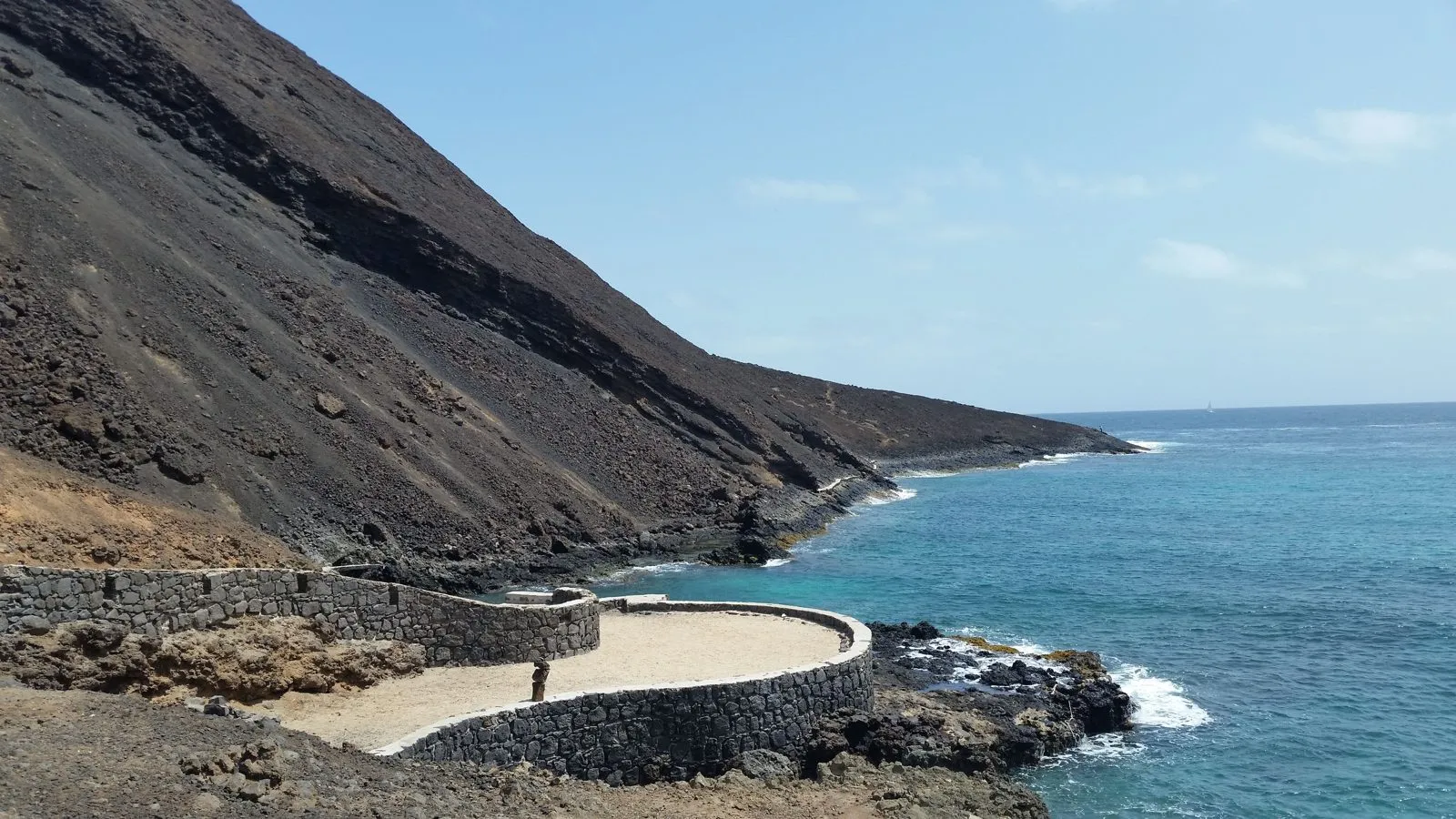
· Gibraltar

Night storm in the Strait of Gibraltar

Then everything turned out completely differently. In my sleep – around midnight – I registered that the wind was picking up, whistling louder and louder, and the roller coaster started, with ever bigger amplitude.

For a while you try to ignore the noises in your sleep – the ever bigger lift rides, the waves pounding the wall next to your head – but then, when for the third time you rise into the air off your bed at the top of a wave, and this time land 30 cm away from where you were lying, you check the time: half past one in the morning. This is not the pleasant night they forecast; you could sleep another two and a half hours, but no chance, let’s just look out and see if Gyuri needs help.

I got dressed, climbed out into the saloon: nobody anywhere. I look out into the cockpit: nobody. Well, that’s nice. The wind howls, the waves slap in the dark, the engine is straining to push us forward, faltering in every bigger oncoming wave. Then I see Ricsi in his foul-weather jacket, clipped on with his safety line, climbing back into the cockpit from one side, and a little later Gyuri from the other side. They had to fold down the bimini and lash it, because the wind was starting to shred it, tear it apart. I put on my Ölzeug too: foul-weather jacket, trousers, lifejacket, harness, but for the time being no help was needed. From below I watched the shipping on the monitor; we were already off the entrance to the Strait of Gibraltar, in the Atlantic Ocean. Meanwhile the easterly had built up to a gale, a steady 30–35 knots, which on the Beaufort scale counts as force 7–8, and considering that we were taking it on the nose, it was a solid force 8 “fresh gale”.

Every wave crashed over the boat – drenching the whole deck – and ran aft along both sides; only under the sprayhood could you find shelter. Down below, Ricsi noticed water running out of the kitchen cupboard, from under the microwave. We’d never had a leak here before, we couldn’t understand where it could be coming from. It was like in submarines when – during a dive, in battle – the water starts breaking in, first just dripping, then…

There was proper battle noise coming from outside here too, and then Gyuri realised that back in the afternoon – in the lovely sunny weather – he had removed the lee car outside and hadn’t screwed the end stop of the track back on; the water could be coming in through those two holes. He was absolutely thrilled to climb out onto the deck again with a head torch and screw the part back on, on a boat being tossed about in the dark. Luckily the operation succeeded: neither the screwdriver, nor the end stop, nor the screws fell out of his hands.

Originally we had planned to go through the strait close to the African coast and only then cut across towards Gibraltar – through the heavy shipping – but Gyuri decided that we should cross over to the Spanish side while still out here in the Atlantic, hoping the wind would ease and the waves would be smaller there.

We had to watch very carefully as we crossed the path of the big ships in the dark – who would let us through, whom we had to avoid; the AIS was a great help in this too.

The bright lights of a ship kept coming steadily from the left straight at us – we should have given way to it, got out of its way – and in the end at the last moment it changed course and galloped past about 50 metres behind us in the dark, on the stormy sea: a two-masted sailing ship, like the Flying Dutchman, without sails, of course. Not a soul to be seen on deck; now I understand how legends are born. Only from the AIS data did we learn that it was the 56-metre sailing yacht Piropo that had cut it so fine with us.

https://www.yachtcharterfleet.com/luxury-charter-yacht-22908/piropo.htm

The little arrow below us is the two-master Piropo, galloping past behind us

In the bottom left corner you can read the wind speed: 33.9 knots

When we got near the Spanish coast, it turned out it was no better here at all; in fact, here we already had mobile coverage, we could download the wind map from Windy, and from that it looked as if things were milder near the African coast. This time the forecast didn’t work: instead of the predicted 15–17 knots, a 30–35-knot gale was howling, and Windy got the current conditions wrong too – according to it a 25-knot wind was blowing from the east, with – occasional – gusts of 30, whereas we measured a continuous 30–35 knots for 3–4 hours.

Here we’re already on the Spanish side, heading for Tarifa

It was already getting light when we reached the Tarifa lighthouse at six o’clock, since against the wind – even at full engine power – we could only make 2.5–3 knots, crawling and pitching along.

Gyuri then lay down for a bit of sleep, and I stayed at the helm alone, but the long-awaited drop in the wind – the one Windy was showing – only came true hours later, very slowly.

Whoops! That’s not the kind of spritzer I ordered!!!

Around eight o’clock Gibraltar emerged from the haze. The fishermen were heading off to work, and the wind really was slowly starting to die down. Among the anchored ships – in the lee of the Rock – there was no trace left of the night’s hullabaloo; the sun came out innocently too, as if nothing had happened a few hours earlier.

Before we came in, Zsófi made a delicious scrambled egg, which together with hot tea worked wonders on us, even if we had to shovel it down in a hurry, because the harbour was getting close.

On the British side we filled up the Pinta with cheap diesel, then sailed across to the new Alcaidesa Marina on the Spanish side. We hid Ricsi for nothing, because nobody gave a hoot how many of us there were or where we’d come from. Maybe that’s how migrants should come too: in a storm, four at a time, and on a Hallberg-Rassy. Once every year and a half… Nobody would even notice if they got off in the evening.

Gyuri confessed that this had been the most uncomfortable leg of their round-the-world voyage. Since the Cape Verde Islands we’d been bashing into the prevailing wind and waves for three weeks. Of course, this refers to circumnavigating in the trade-wind belt; it can’t be compared with the route of round-the-world races, which runs through the permanently stormy Southern Ocean. The usual route of sailing wanderers from St Helena to Europe goes via South America and/or the Caribbean, through the Azores – the way Columbus got home too – helped by favourable winds. That route is a good few weeks longer, but probably far less unpleasant.

A few years ago I read about a retired German couple who sailed round the world in a catamaran on the trade-wind route, only in the opposite direction, beating against the wind all the way, tacking, struggling. They admitted they’d never do it again, and what they regretted most was that they never again met the nice sailors they’d got to know along the way… But they saw their crazy idea through: they were the first to circumnavigate the globe by catamaran “the wrong way round”. So what? Serves them right; I can only take my hat off to them for their perseverance.

There is at least one positive outcome of our trip so far, namely that I’ll certainly have no trouble sleeping on a roller coaster or in a haunted house from now on…

Reading this back – well, maybe – I haven’t exactly made many people keen on sailing, though that might be one of the aims of my writing. Anyone who wants to get the urge should read the accounts of the earlier voyages too. It’s a fact that there are stretches, days, hours that test you and your stamina – when you ask yourself what the heck am I doing here… – but then at other times you get sights and experiences that easily make you forget the earlier hardships, and the sailor says to himself: “See, it was worth it!…”

We rewarded ourselves with a hot shower, Gyuri and Zsófi went to see the monkeys – Zsófi had never been to Gibraltar –, I rented a car, then together with the sailmaker we took down our torn headsail, and he took it with him to Tarifa to repair. In the afternoon we managed to grab an hour’s snooze before Ricsi and I set off in the little Toyota Aygo – to fetch Andi – to Málaga airport. Lunch got skipped; we could only gulp down the leftover broccoli soup before leaving. On the way – at a viewpoint – we took a photo of the Rock, then thanks to Ricsi’s brilliant navigation – avoiding accident jams and toll sections – we arrived just in time at the airport 120 km away.

On the way back we stopped in Marbella – we weren’t exactly enchanted by it – and at last we could eat a good Italian pizza before we starved to death in the front seats…

Machine translation (AI, Claude) of Balázs’s Hungarian original. Read the original →
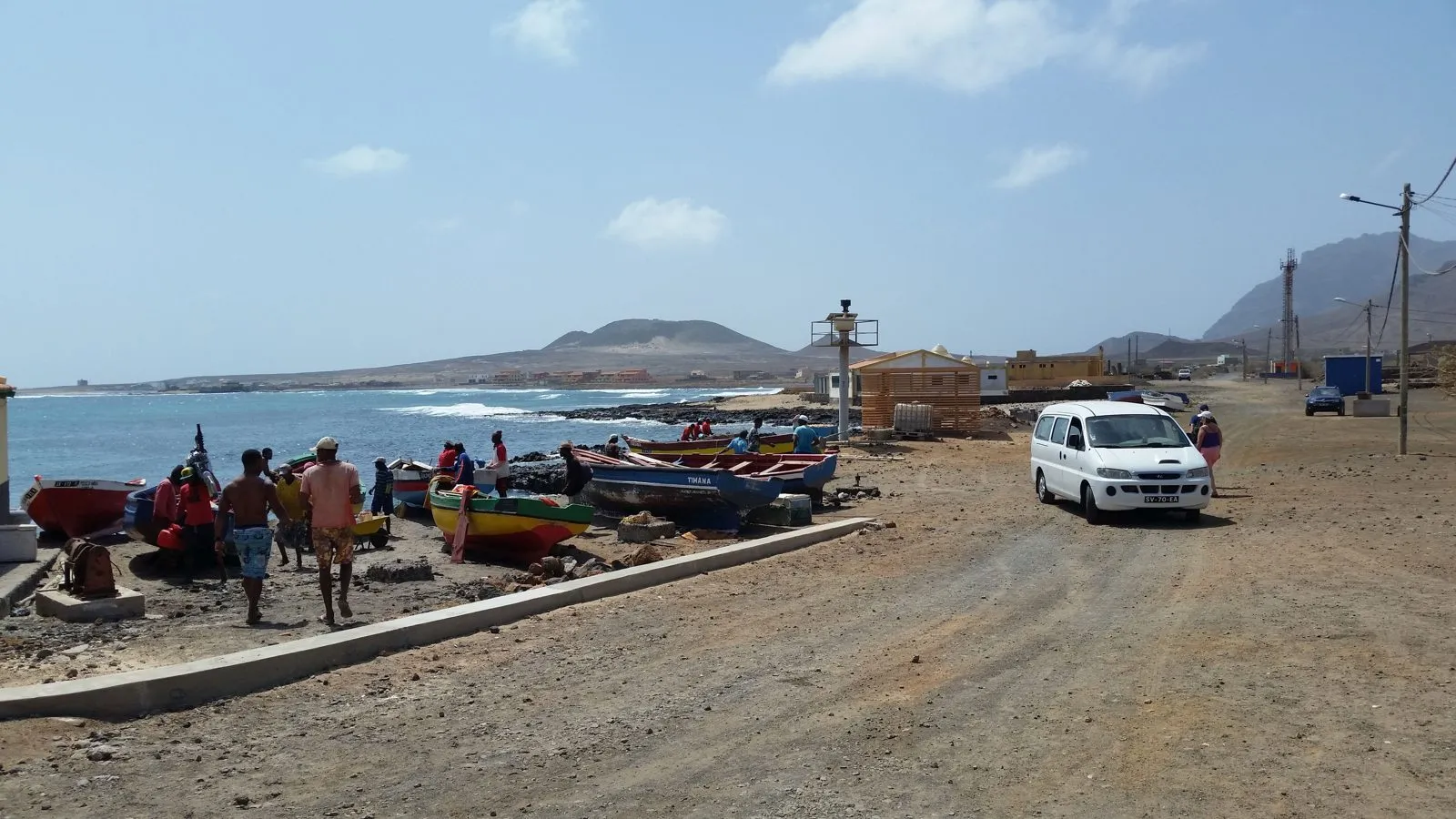
· Gibraltar

Another day with the monkeys

In the morning we went shopping in the little Toyota; the three of us barely fit in next to all the drink and food – without a car we’d have had a lot of lugging to do.

Little Spanish church in La Línea

We had no time left for a longer excursion, even though the beautiful little Spanish town of Ronda isn’t all that far from here. So Andi, Ricsi and I headed for Gibraltar, this time by car. Interestingly, in Gibraltar, unlike in England, they drive the same way as on the whole continent. Supposedly there were too many crashes between tourists driving in and the locals, so around the 1970s they switched here too – to the right-hand traffic we’re used to. First we ate a very good tuna steak at the foot of the cable car, then had it take us up to the top. A return ticket costs €16, but we wanted to walk down, so we bought the cheaper €13.50 one-way ticket.

In that case you also had to buy a nature reserve ticket for 2.50 – heaven forbid we should enjoy ourselves – as a contribution to maintaining the monkey population (and here I don’t mean the English, but I won’t go into that now, because a year and a half ago I got thoroughly tangled up trying to clear it up). https://balajaazoperencian2.blog.hu/

They only asked for this nature reserve ticket at the new glass-floored viewing platform, part of which was taped off because of cracked glass panels.

The mountains of Africa in the distance

We were healthily tired by the time we’d walked down – but it was worth it – because the weather was beautifully clear and we could even see the African mountains.

Before dark we drove out to Europa Point too; from the mosque the loudspeaker was just carrying the drawn-out chant of the local imam calling to evening prayer. Two cube-shaped new buildings – next to the mosque – got me thinking, with small windows and no balconies. Here, in front of one of the most interesting panoramas in the world, why would anyone build such a plain, closed-in, almost puritan building? The only thing I could come up with was that it must be some kind of Islamic boarding College, for the students who will one day spread the true faith… A year and a half ago there was no sign of them.

Photo: Richárd Müller

Going round the Rock on the eastern side we wound our way back into town, to post Zsófi’s postcard at the post office on the main/pedestrian street – she sends one home from every port.

Photo: Richárd Müller

At the evening game of rikiki (a Hungarian trick-taking card game) Ricsi racked up the most points; I can’t think why I’m even writing about it…

Machine translation (AI, Claude) of Balázs’s Hungarian original. Read the original →
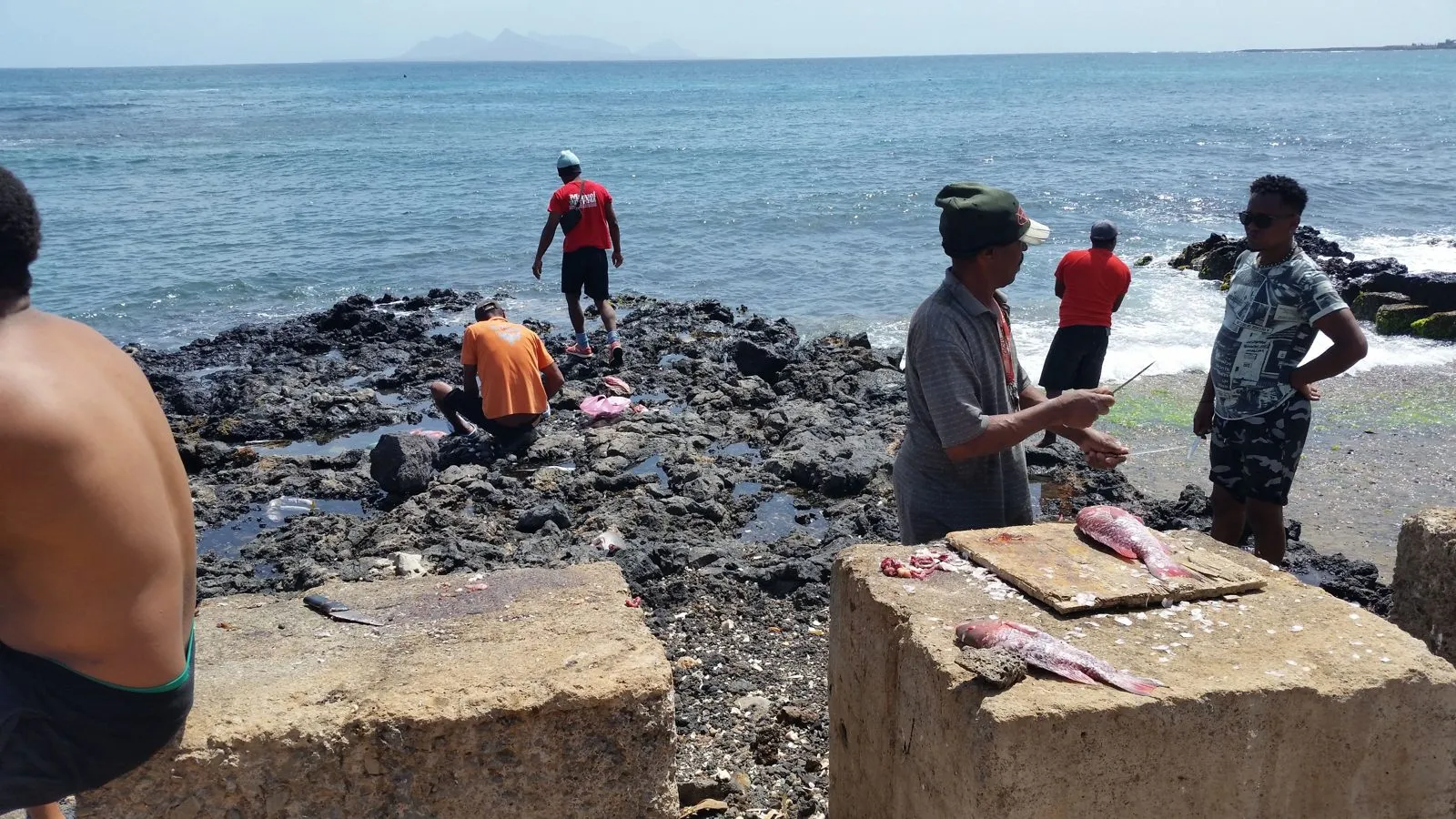
· Alboran Sea, off Andalusia

PAN-PAN, PAN-PAN

Morning planning: how far is Alicante?

In the morning Andi and I drove to Tarifa to collect the repaired headsail. After a bit of friendly haggling we agreed on €300, and we squeezed the folded genoa onto the back seat. We also made a detour to the lighthouse on the southernmost point of mainland Spain – which we had sailed past in the storm early on Tuesday morning –, then, inching through the small, Moorish old town, I filled up and we drove back to Gibraltar.

I returned the car in a simplified procedure, then we motored over to the marina office to check out, where Gyuri paid 46 euros for the two days, electricity and water included. With the Croatians this costs nearly 200 euros in summer…

Clever fender step from Australia

We quickly bent on the headsail and set off round the Gibraltar peninsula towards Alicante.

Bending on the headsail
The crew at departure. So as not to start with myself: if you stand with your back to the picture, then starting from the right:

Ricsi, Zsófi, Gyuri, Andi and Balaja

It was dead interesting to watch the process of cloud formation, as the Rock forces the easterly wind to rise, just enough for the cooling, condensing water vapour to turn into cloud, and in that state the wind blows it on westwards. This cloud formed continuously only above the mountain; we could watch the process from behind, from the side and from the front.

The Gibraltar cloud factory working at full steam:

We had agreed that Andi and I would cook today, but she had barely started the preparations in the galley when the boat’s motion let her know she’d be better off outside, and she weathered the afternoon sitting in the cockpit, sometimes with her eyes closed. So I cooked the pörkölt (Hungarian stew) on my own, while the green pea soup I made in continuous consultation, with Andi’s advice.

Near the Strait of Gibraltar the radio traffic on channel 16 is enormous. Repeated PAN-PAN calls from the Tarifa rescue centre warned all ships in the area that a migrant boat with 58 people on board was being tossed about somewhere, everyone keep watch. It remained a mystery to me how on earth they knew there were 58 of them in the boat. I think the warning was only meant to make the big ships take great care not to run over the inflatable, which might not be able to get out of the way. What happened to them after that, we never found out.

From Gibraltar to Alicante we sailed along the coast of Andalusia

We could sail until 7 p.m., then the wind died, the sea went flat, and we started the engine so as to reach Alicante by Saturday evening, because on Sunday morning at 9:50 Andi and Ricsi’s flight leaves from there for Budapest. By early evening Andi was feeling better too, her on-and-off nau-sea had completely gone, and she was moving around the boat like someone who’d also been here for a few weeks.

Sunset off the coast of Andalusia. I reckon this is the most photographed radar set in the world

Let’s agree that from now on I’ll only write about card games when I win. That’s good for everyone’s self-confidence, the reader’s and mine too…

So here I won’t even mention it.

Machine translation (AI, Claude) of Balázs’s Hungarian original. Read the original →
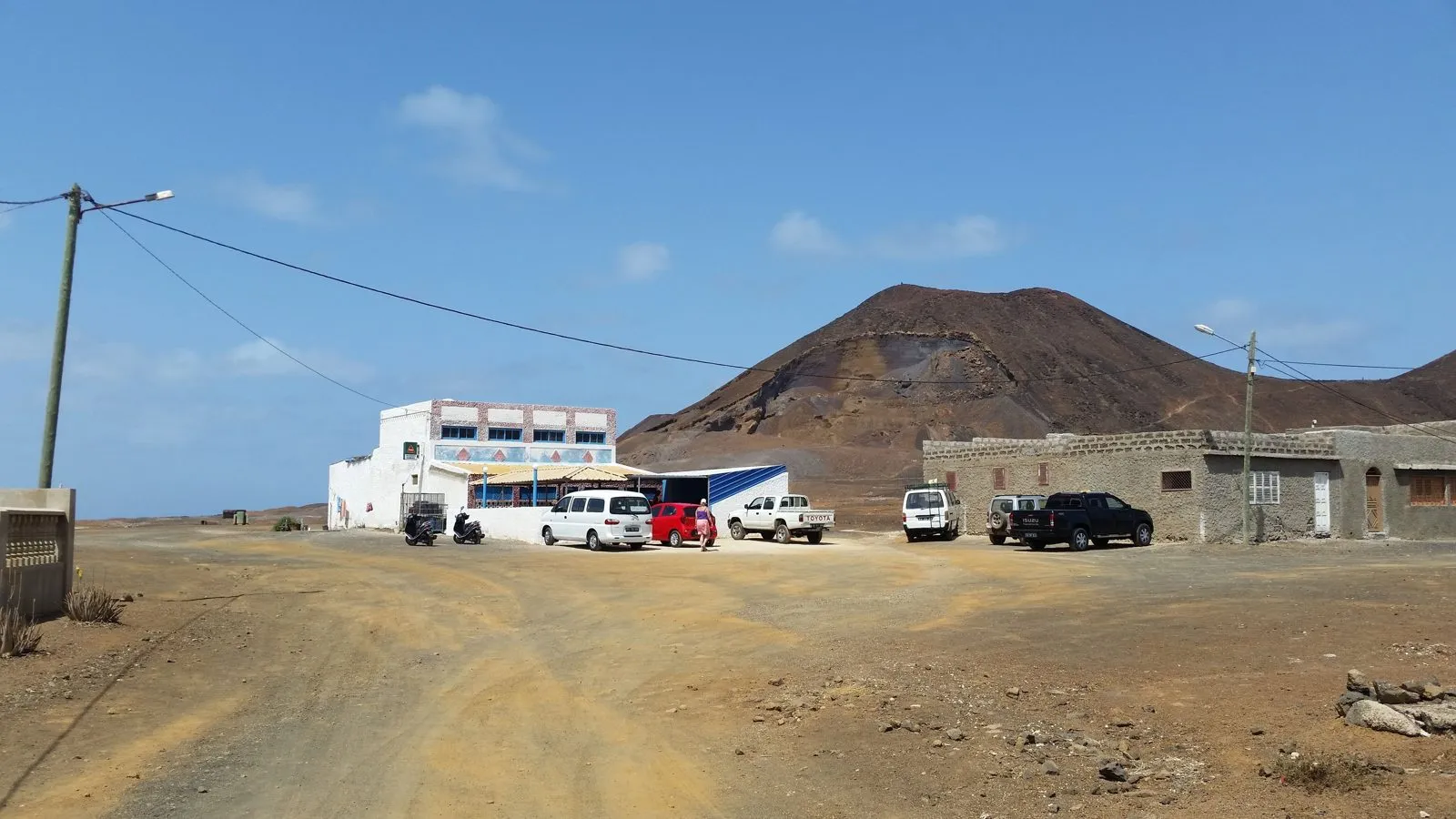
· Alboran Sea, off Andalusia

Past old watchtowers on the Alboran Sea

Rocked to sleep, with teeny-weeny pleasant little wavelets – we haven’t had such a pleasant night since we left the Cape Verde Islands. Around half past seven the sun rose, popped out of the sea in a moment and shone dazzlingly at us from the clear sky.

The sun rises ahead of us

We’re sailing 5–10 miles off the Costa del Sol, the Spanish “Sunny Coast”; in the evening we passed the lights of Marbella and Málaga, today we’re approaching Almería, past the snowy 3000-metre peaks of the Sierra Nevada. At the foot of the mountains regular grey patches can be seen. Lots of them, really lots. First I thought of dirty snow, then of solar farms, but those are more bluish, darker; finally I guessed greenhouses, but this many??? “Polytunnels!” said Ricsi – of course, I don’t know why it didn’t click for me. This is where 1000% of Spain’s vegetables are grown, and from here they’re shipped across the continent to the multinationals’ shelves.

Those grey bands are the polytunnels

Modern-day slavery goes on here: masses of migrants work for starvation wages, they get just enough to have a roof over their heads and something to eat. The Spanish government looks the other way a bit, because whoever works here at least isn’t a burden on the welfare budget. It’s a vicious circle for the farmers. Someone started using migrant labour and sold tomatoes cheaper than everyone else, at dumping prices. The multinationals only care about the price, so they can offer the vegetables cheaper than the rest, and as long as there’s a piece of paper for it, they don’t care how the goods are produced. Strictly speaking, checking that isn’t even their job, and the shopper can’t be blamed either for the majority, being price-sensitive, buying the cheaper goods, even though everyone suspects that for this money it’s impossible to grow, pick, pack, transport and sell produce from polytunnels by the rules. So one grower started black slave-keeping, swept the market, and the others were forced to use the same method if they didn’t want to go bust in short order – with their heads held high. Their plot, their tunnels would have been taken over by the competition at once, and we wouldn’t even notice that somebody had wanted to play by the rules…

And we’re happy about the cheap tomatoes and keep the whole thing going without knowing it.

The sea doesn’t care about any of this. Once again it’s flat calm; the freighters pass 15 miles further out, we don’t have to dodge each other.

In the afternoon another PAN-PAN call informs us, with exact coordinates, that somewhere ahead of us – already near the Spanish coast – there’s another migrant boat with 35 people (exactly 35!). We only see a grey warship far ahead of us, and that too soon disappears.

At last the wind turned favourable, we could hoist the gennaker too

In the afternoon we commemorated the 15th of March (Hungary’s national day for the 1848 revolution); it was short and snappy: Zsófi pinned on a cockade, and we chatted about our experiences of 15 March from before the change of regime.

All day we sailed along the Andalusian coast, and we could see that watchtowers left over from bygone ages stand within sight of one another on the tops of the coastal cliffs. With flags and light signals they could send urgent messages from Gibraltar to Valencia about the enemy’s approach, or the return of their own fleet or merchant ships. Us they just watched in silence; we were judged neutral…

Watchtower along the coast

We moor in Alicante

All through the early hours we made comfortable, good progress 10–15 miles off the coast; we saw no fishing boats, only the merchant ships kept running parallel to us, sometimes coming towards us, sometimes going our way.

I haven’t slept this well at sea for a long time as in the last two nights. In a smooth, rocking bed, to a soft, gentle lapping – we may well pay for this yet…

The port of Alicante

At 3 in the afternoon we moored in Alicante, filled up, showered and got ready to go ashore.

First we visited – for free – the Volvo Ocean Race museum, where the friendly man at the door, as soon as he learned we’d come from Hungary, lit up at once: “Ahhh, Orrrbaaan, I am a big fan of him!” – he said with a broad smile, quite convincingly, and only a small spark of doubt arose in me when he went on to say that at home he has a huge, full-size Orbán poster up on the wall… Where on earth could he have got one of those – I thought –, but knowing the inexhaustible state funds devoted to popularising the government’s activities, even that didn’t seem impossible.

We didn’t push the matter any further, but went into the exhibition hall instead, where you could learn interesting things about the round-the-world sailing races held every four years since 1975 and starting from here, and then outside – kitted out with a hard hat – you could even climb into the Spartan interior of the 2005 race boat Brasil 1.

The whole thing is one space; only the single loo could be separated off with a curtain. This is not the place where you can sit musing for ages over the news and e-mails on your phone while you strain.

Now that’s what I call a privy…

There’s no shower cubicle, no dining corner, and of the nets stretched on frames that serve as bunks there are only as many as the off-watch half of the crew needs. At first try the bunks didn’t seem uncomfortable; what’s more, with a little block-and-tackle you could adjust their height while lying in them, so that under way they could be set close to horizontal relative to the boat’s heel.

We could do with a bunk like this on the Pinta too sometimes…

The stove and the sink were in the middle of the boat, opposite the companionway, fixed on a gimbal-like mounting so that the whole thing stayed level despite the boat’s heel. The crew took in their daily 6–10,000 calories from powdered “food”, like astronauts.

The stove and the sink

The navigator had a little table with the instruments and a laptop, aft below deck, in front of the wheel – like in a tank turret –, and from there gave his instructions to the helmsman through a tiny window opening aft. They kept in touch with the race organisers via satellite, and received the latest weather forecasts that way.

The navigators’ “firing position”

The inside of the hull – obviously not by accident – was painted completely black, but I can’t for the life of me imagine why. Every member of the crew can take only a toothbrush with them; personal belongings, a change of clothes, luggage, a wardrobe are unknown concepts on the 10–20-day legs.

Winch test

From here our way led past the packed beach to the entrance of a tunnel at the foot of the castle hill, which led to a lift in the belly of the mountain.

Only a few people were swimming in the 17-degree sea; the rest were burning with Saturday-afternoon fever on the sandy beach. Some strolled about in swimsuits or in T-shirts and shorts (northern peoples), others shivered in long trousers and winter coats (native Spaniards and other southern peoples).

Then we took the lift up to the castle standing guard on top of the hill, which in some of its elements reminded me of a medieval Spanish fortress, but I wouldn’t rule out that the Moors extended it at some point too. I’ll have to look that up.

View from the castle over the port. Really!

Coming down into town, we looked at the cathedral of San Nicolás, which with its high windowless walls looked more like a castle wall from the outside than a church.

We had a good dinner in a Spanish restaurant, and bought all kinds of firewater, because our reserves were badly depleted – and our captain knew too that you can survive weeks without food and water, but a shortage of spirits can lead to mutiny on board within days –, and we roamed evening Alicante until we managed to replenish our stocks in this department.

There was tremendous life in the city, as if the whole place were one big party district. We passed an ingenious middle-aged beggar who left it to the donors to decide what purpose they wanted their donations to go to. He had four cups in front of him, in this order: Beer, Food, Ferrari, Disneyland…

I missed one more sign stating which audit office checks that the earmarked funds end up in the right place…

At 10 in the evening Ricsi’s replacement arrived on board: Ferenc, the son of one of my good friends – Májsztró – from Berlin. He couldn’t get a seat on the direct flight to Alicante, so he flew to Madrid and came from there by train, on the Spanish super-express.

Machine translation (AI, Claude) of Balázs’s Hungarian original. Read the original →

· Costa Blanca, Spain

Crew change

Ricsi and Andi disembarked from the Pinta at 7 in the morning; they flew home on Wizz Air’s 9:50 direct flight to Budapest. I was very glad that Andi could come with us for 4 days and switch off from the school hamster wheel for a few days, and with her help I could make up a bit of my cooking deficit on board. We wanted to leave early so that we might perhaps reach Ibiza while it was still light this evening.

Ricsi and Andi set off for the airport
We sail out of Alicante past a long guard of honour of anglers

We briefed the newest member of our crew, Feri, on the most important things, for example on how to use the WC – and other vital matters –, such as that we don’t step on deck in street shoes. One also has to pay attention, for instance, when instead of the quay we can only tie up to someone else’s boat – as in Madeira –: then it’s good manners to climb across it without shoes, so as not to scratch it or get it dirty. The English are particularly touchy about this, and it’s understandable after all; it’s as if we marched across someone else’s terrace several times a day. It goes without saying that we have to pass in front of the mast, so as to disturb our neighbour’s privacy as little as possible.

By the way, on British warships – in Nelson’s day – at this time, on a Sunday morning, they either held divine service, or instead read out to the entire crew mustered on deck the laws and rules in force on warships, and above all the punishments for breaking them.

It was quite simple: for most things the punishment was death. So for mutiny, desertion, treason, insubordination towards officers, as well as for gross negligence – which could endanger the ship –, for indecency, for sodomy, and for a whole lot of other things that don’t come to mind right now. Liberalism and trade unions were still in their infancy back then.

We warned Feri never to get himself into such a situation…

From Alicante we sailed to Sardinia via Ibiza

At 11:29 we crossed into the Eastern Hemisphere, which we celebrated with a shot of something strong. (Aren’t you glad we did our shopping yesterday…)

In the top left corner you can see that we’re at 000°00’,004 east

Around five in the afternoon the mountains 25 miles behind us disappeared in the haze; Ibiza is still 35 nm away, we won’t get there in daylight. At 7 in the evening we caught sight once more of the mountains left behind on the Iberian peninsula, because the sun set behind them and their outlines stood out clearly, even though they were already 35 miles away.

Having covered 90 nm from Alicante – after fifteen and a half hours of sailing – we arrived at the island of Ibiza and at 10 p.m. dropped anchor in the dark, off the Beach of the Hanged. Well, what a lovely spot Gyuri picked out for us… The wind howled as if the executed pirates wanted to blow our souls out too; only an 8 m high sand dune protected us from the waves, which still curled round into our bay and rocked our boat all night – sometimes more, sometimes less. During the night the anchor chain often banged against the bow, as if skeletons were climbing on deck… Maybe I’ve watched Pirates of the Caribbean once too often?

Machine translation (AI, Claude) of Balázs’s Hungarian original. Read the original →
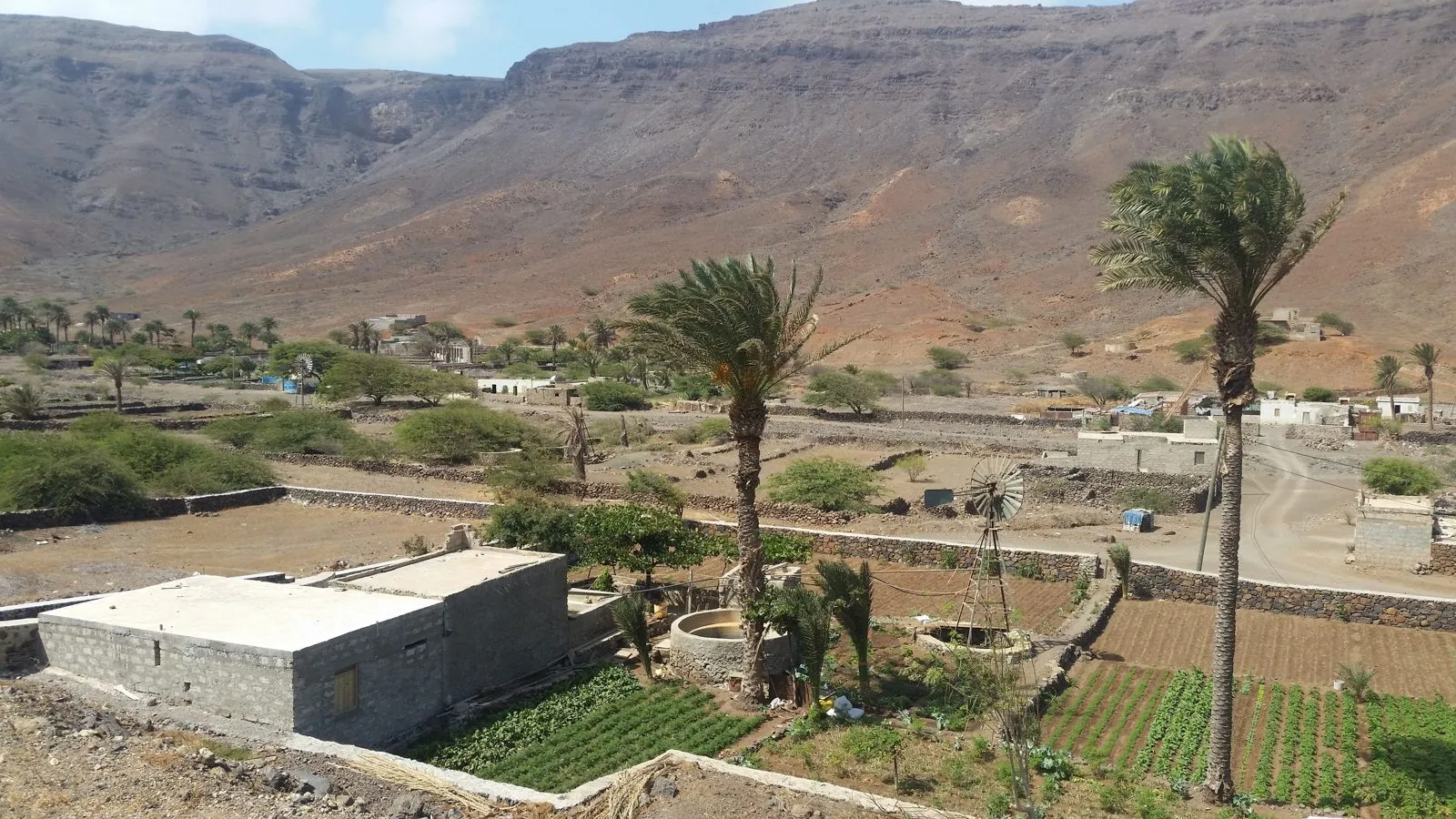
· Ibiza, Balearic Islands

On Ibiza

Around half past nine we motored over to Ibiza town, and meanwhile breakfast was once again a standing buffet reception, as it was quite a few times on the Atlantic, when the boat’s heel makes it impossible to lay things out on the dining table. Then we approach the galley counter one or two at a time, brace ourselves with legs apart between the two counters – and, catching the things that occasionally break loose – methodically eat our breakfast.

Standing buffet reception on the Pinta

At the marina where we filled up, they didn’t want our money, not even for half a day: four bored clerks sat behind the counter and informed us regretfully that rebuilding was under way, so it was impossible for us to moor with them even for a minute. We should move to one of the two marinas opposite, near the town.

So we did; we moored on the town quay next to the luxury yacht Princess Too, nobody came anywhere near us, and we stayed there half a day for free.

Gyuri and Zsófi went off to find the Raymarine agent, while Feri and I climbed up to the castle and explored the old town within the walls. The weather was overcast, now and then it even drizzled, but you could sense what a charming little place this must be in sunshine.

A good hour later we met up at the agreed spot; Gyuri and Zsófi had walked all that way for nothing, because the shop had moved and the owner was off the island today anyway. We had lunch together in a charming little restaurant, enjoying Feri’s Spanish: he volunteered for half a year in Peru as an assistant at the Goethe-Institut, and then studied in Valencia for a year.

Gyuri and Zsófi got the urge to see the castle too, so I climbed up there again with them, while Feri took a walk around town, but he didn’t find any more nice places. We had a coffee on the main square, did some shopping at the local Spar, then cast off straight away and set off towards Cagliari, on the southern tip of Sardinia. We studied the weather forecasts; they promise usable winds, but by now we only believe Windy with certain reservations.

As soon as we got out from behind the breakwaters protecting the harbour, we found ourselves facing a nasty, rotten leftover swell. Last night’s north-easterly had built it up; the wind has died by now – so we have to motor – but the waves coming from far away keep annoying you through sheer inertia for a good while yet – up to a day even. The weakened wind has already backed to the south-east; it’s too little for sailing, but it does whip up smaller cross-seas, which are just the thing for shaking the soul out of you from left and right, and churning up the stomachs of those prone to seasickness. Feri struggles with the elements for a long time too, but then he surrenders to a bucket, which will remain his faithful companion through the following day too.

Machine translation (AI, Claude) of Balázs’s Hungarian original. Read the original →
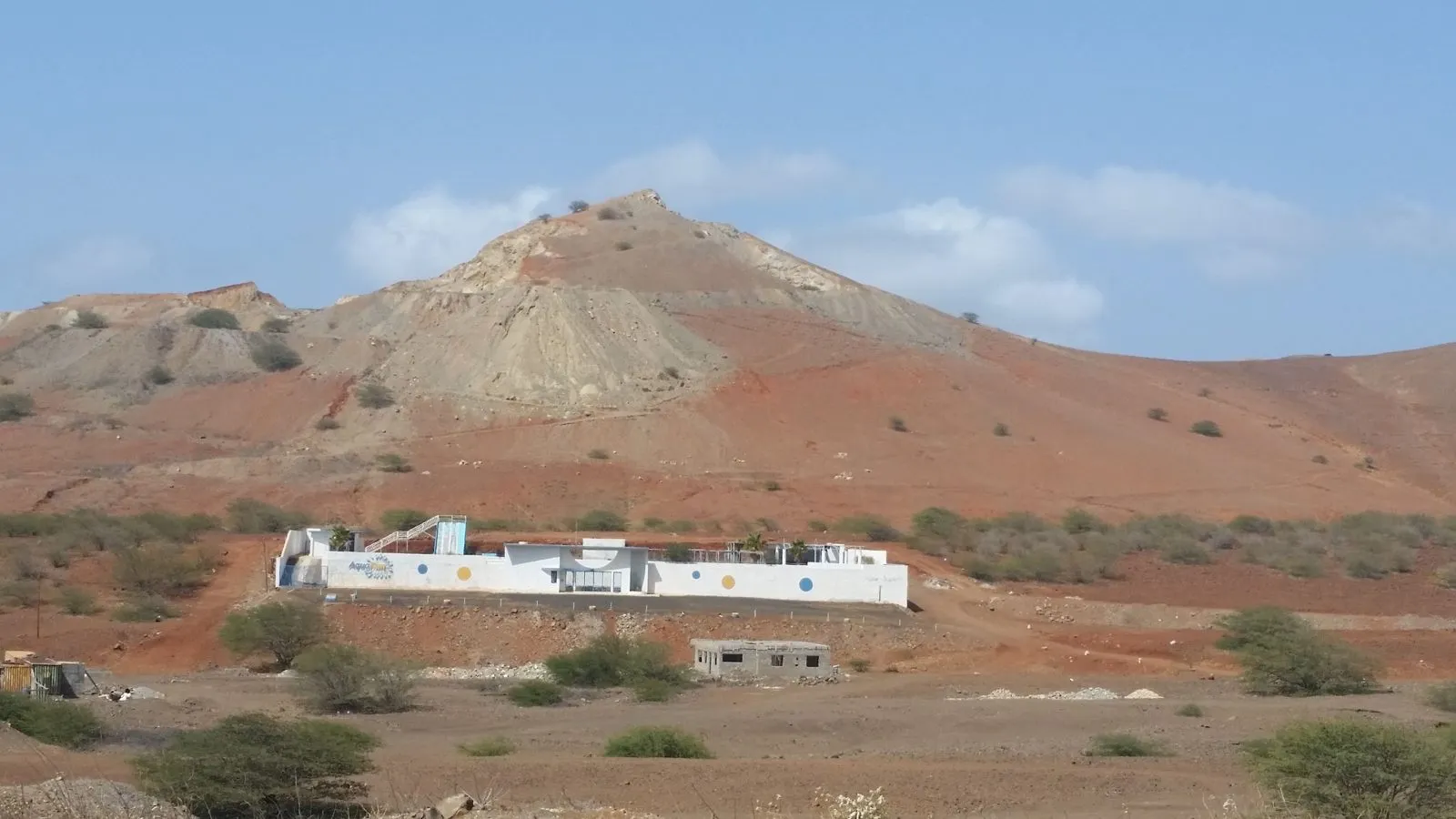
· Mediterranean Sea, between Ibiza and Sardinia

When the shortest way between two points is not a straight line

Luckily last night’s nasty leftover swell has gone.

Around 3 in the morning the lighthouses of the Cabrera islands can already be seen from here in the clear, moonlit night.

The little archipelago is a nature reserve; yachts too may only sail in with a special permit, which has to be applied for in advance – by e-mail. When we came this way a few years ago, we had to sail up and down in front of the zone for a few hours until the approval arrived.

In the evening we usually switch on the radar too, on which you can see not only the coastline and ships as blobs, but also low-flying thunderclouds.

Two thunderclouds on the radar picture, the Cabrera islands at the top
Then the sun rises. And how!

Right, and now about when the straight line is not the shortest way between two points.

If we sailed from Ibiza to our current destination, the southernmost tip of Sardinia, dead straight according to the chart, we would have to steer exactly east, 090°. This is called sailing on a loxodrome (rhumb line). In that case we’re not actually covering the shortest distance between the two points, but we can go all the way without changing course, and on the most common Mercator nautical charts we can draw our route as a straight line.

There is, however, an even shorter way – one being the shortcut through the woods – and the other if we sail on an orthodrome, which runs along the great circle passing through the starting point and the destination.

Odd, isn’t it?

I’ll try to explain the whole thing with an example. There’s an apple. 1 cm south of the core (the North Pole) a worm is drooping. He hears that almost exactly opposite, on the other side of the core – also a centimetre away – a lady worm is wiggling and wobbling herself… Just imagine. That centimetre. For some reason he wants to get there as fast as possible. According to the (Mercator) map he’d always have to crawl east – the way we start peeling an apple – and then he’d hit the spot exactly. He’d have to crawl roughly 4 centimetres along the loxodrome, if he were a fool.

Whereas if he heads there across the core, he gets there after two centimetres – assuming – he goes round the core and doesn’t climb over it. But not even a randy worm is that stupid…

Of course this doesn’t mean that every route via the North Pole is the shortest; I just put my starting point at the core for the sake of better illustration.

I tried to explain the question so that even the more visual type of gardener and housewife could understand it, because I’d like to cater for every class of reader.

I know, the example is a bit lame (but examples are like that), because any sensible worm would bore through the apple, but you can’t do that with a boat. And I could have used caterpillars for the example – but the truth is – I’ve never heard of a lady caterpillar.

But, getting back to the Pinta, this means that if our destination is due east, at 090° from us, then along a very flat croissant (this pastry is very important in sailing) we first have to steer the Pinta a little to the north, at 089°, then at 090°, and at the end a little to the south, towards 091°. Luckily the Raymarine navigation software does this for us, because we have it steer the boat to a point – the southern tip of Sardinia – and we just watch the croissant take shape.

How much can you save? You could work it out; on such a short route probably not much, by my guesstimate 3–6 nm at most. Not much, but if it means you get into the sheltered harbour half an hour or an hour before the storm, then it makes a huge difference. This really plays a big role for the merchant ships crossing the oceans, because there time and fuel are money, and a lot can be saved. For yachts it’s not entirely irrelevant either, but here the wind direction often has a say in the navigation, and we can’t always sail the shortest route.

Around noon I put Feri in charge of watching out for icebergs, because the temperature outside had dropped sharply, which can allegedly point to icebergs nearby…

With this I was trying to entrust him with a very important task – hoping to take his mind off the wretched feeling of seasickness – but he didn’t really feel the weight of the matter, because he took half a glance around, then hugged his faithful companion – the black plastic bucket – even more tightly, bowed his head, and fell into deep thought… He didn’t reveal what about, but I had a hunch…

It’s 13 degrees outside, the sky is cloudy and overcast, and the waves are an accordingly unfriendly grey. In the afternoon the rain starts too, then an hour later the rain cloud moves on, or we sail out from under it.

Feri isn’t feeling well today either – last night he had already brought up everything he possibly could – he went to bed and skipped lunch too; I’m really hoping his body is getting used to the constant motion in his sleep, and that tomorrow he’ll be feeling better.

In the evening I looked in on him in the cabin – he was awake – and took him some biscuits, bread and cold cuts; he munched the whole lot down nicely, so we provisionally put him back on the next day’s meal list.

Machine translation (AI, Claude) of Balázs’s Hungarian original. Read the original →
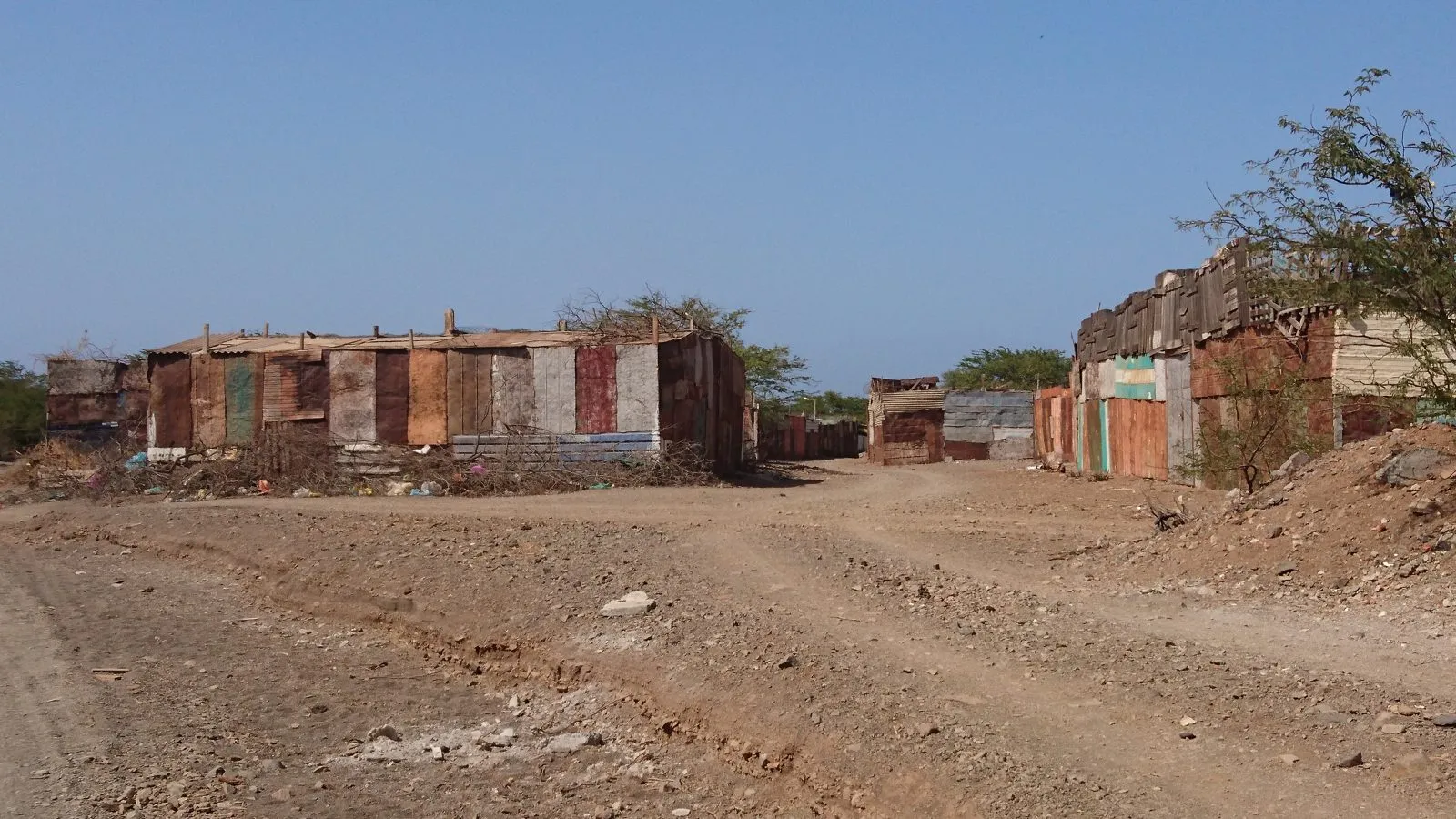
· Mediterranean Sea, between Ibiza and Sardinia

That steak

The sun rose, and Feri with it. As if it were the most natural thing in the world. He came and went about the boat, had breakfast, chatted away nicely with everyone, like someone with nothing wrong with him at all. I couldn’t believe my eyes.

But I was very glad. I’d started to worry that we’d lose him… His appetite for seafaring, I mean. Because sadly there are cases when all the enthusiasm, interest and will for sailing is not enough, and seasickness floors you so thoroughly and keeps you there that, well, you know. In the worst case the poor soul is choked by nausea almost all the time, but it’s not very comforting either if it takes 5–6 days for someone to get used to the boat’s motion. The day before I’d tried to encourage Feri by telling him that Admiral Nelson was cut from the latter cloth too, and threw up for a week after every departure. Fortunately, by the naval battle of Trafalgar there was nothing wrong with him at all, as the defeated Franco-Spanish fleet found out.

For lunch Zsófi topped up yesterday’s green bean soup, and Gyuri made steak. Half of it medium, the other half done a bit more. He served it with rice and iceberg lettuce (one shouldn’t tempt fate, I know), and we ate everything down to the last crumb. I even praised him that the colour was spot on, he’d done it just right, I really loved this beef steak. “Beef? That was the ostrich that’s been lurking in the freezer since South Africa.” Eeek…

Now then, either ostrich meat resembles beefsteak to begin with – which I’d never heard of –, or Gyuri worked some moo-rvellous magic on it, or – and I’m slowly starting to fear this – it means they can put anything in front of me as beefsteak and I’ll eat it (and swear that’s what it was). But it really was delicious.

Sadly I can’t prove the – to me deceptive – resemblance with a photo, because by the time the trick came to light everything had long since been eaten, and anyway flavours don’t really come across in my pictures.

Feri remarked how interesting it is that food from so many corners of the world lands in front of us day after day: South African ostrich, fish from St Helena, beer from the Cape Verde Islands, wine from Madeira, gin from Gibraltar, sangria from Spain, oranges from Ibiza, and so on…

I didn’t get over the mishap until evening, and swore that next time I’ll just say it was very tasty – that can’t get you into trouble…

At midnight the red lights of a ship approach almost head-on. It has no AIS signal and can’t be picked up on the radar either. It passes 100 metres from us: a sailing boat about the size of ours. It’s not a very reassuring thought that the instruments detect plastic boats so poorly, and in poor visibility they are practically invisible, or if someone is only watching the monitors. That’s why it’s good for a yacht to have an AIS transponder and receiver, or at least a cheap radar reflector, which reflects the radar waves emitted by other ships much better and makes plastic-hulled sailing boats visible on the radar screen.

Machine translation (AI, Claude) of Balázs’s Hungarian original. Read the original →
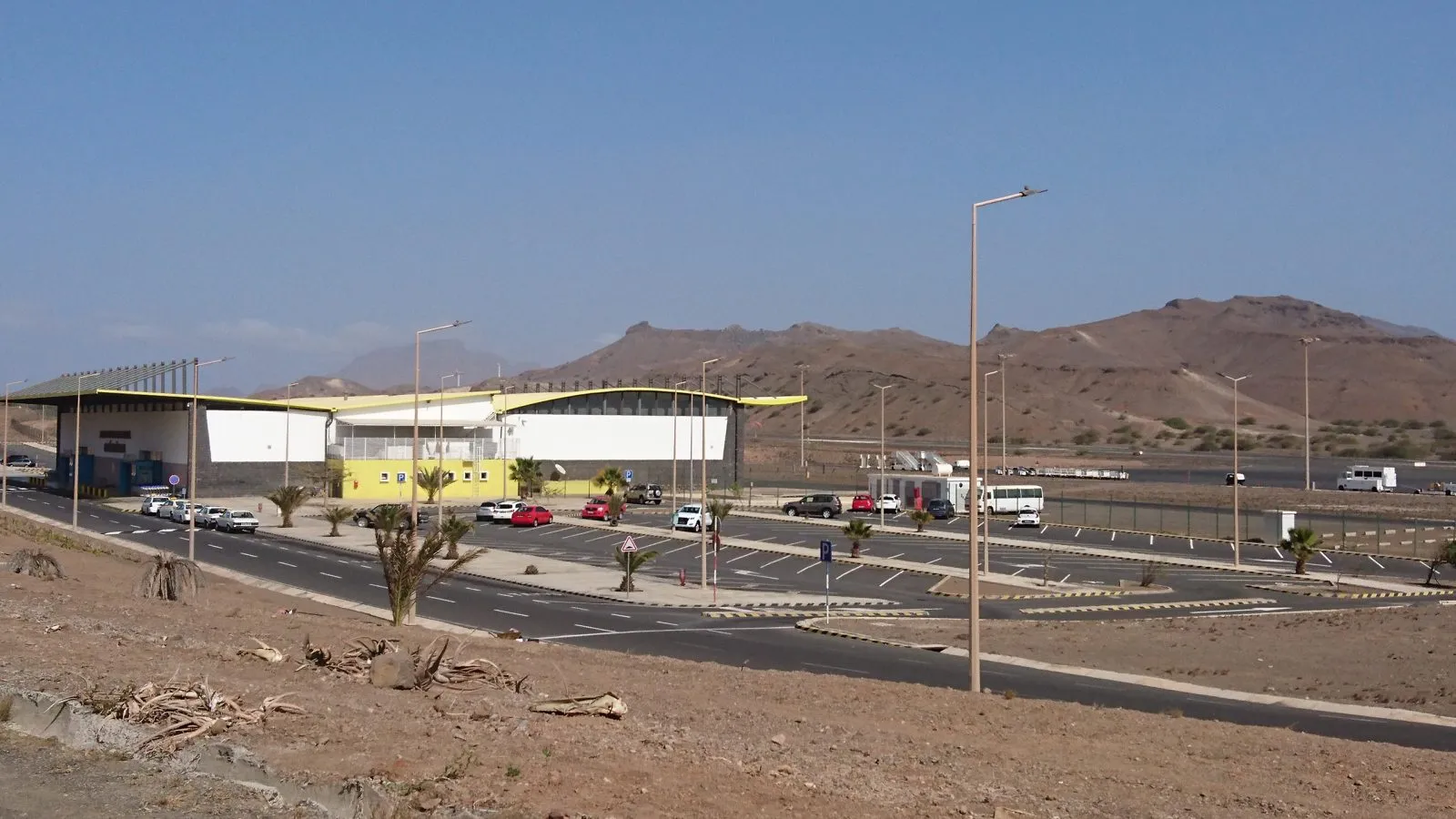
· Teulada, Sardinia

We've moored in Sardinia

Last night Gyuri and I deliberated over where it would be best to moor in Sardinia. Neither of us had been to Cagliari yet, so we wanted to head there. The city of Cagliari lies at the end of a bay 35 miles deep. The other option was the Marina di Teulada on the southern tip of Sardinia – Gyuri had been here two years ago –, but from there you can only get into Cagliari by car. Going to Cagliari would be a detour of 50 miles in total, but we wouldn’t need to rent a car. In the end the wind decided: as we approached Sardinia we had a strong – 20–22-knot – headwind, in which we had to motor, and towards the end, even at full throttle, we could only make about 3 miles an hour. If we chose Teulada, we’d get there around 8 in the morning and have two full days for the area, given that we planned to set off again on Friday evening. If we wanted to go to Cagliari, we’d only get there by evening, and we’d have to bash into the wind and the waves almost the whole of Thursday – and we’d be no further on – so we decided on Teulada.

We reached the marina on channel 9; they said just come in, they’d be waiting. The wind didn’t drop, because although the bay was sheltered by mountains to the north, it was open through a little river valley, and from there the blessing kept howling in. Still, we managed to moor without trouble in the fierce crosswind, but it was good that two people came out to catch the lines. As I was hauling in the mooring line at the bow, I felt a stab in my lower back. Not the kind that brings you to your knees, but I knew I’d have to leave any further heaving to others if I didn’t want to be flat on my back for a good week…

Approaching the harbour of Teulada
Moored

Feri arranged with a taxi driver for 2 p.m. to come and take us to the little town of Teulada, 10 km away. At the only possible place – a FIAT garage – it turned out there wasn’t a single free rental car, only two covered tuk-tuks, but those weren’t for hire.

This Feri speaks great Italian. Too. I can only nod intelligently (but that in every language), whereas he can clearly ask questions too, and give long answers. So they phoned around and found that in the neighbouring little town, Sant’Anna Arresi, there’s a rental place, and there we’d have a good chance of success. Our taxi driver took us over there too and dropped us off on the deserted main street of the little town.

The travel agency – where you can rent a car – only opened at half past 4, so we thought we’d have lunch somewhere until then. Every restaurant was closed; they were supposed to open at 3 or half past 3, so meanwhile we set off for a little walk. I spotted something like a lookout tower – let’s have a look, maybe the view is interesting – but it turned out to be the free-standing bell tower of a 1960s church, best admired from the outside. The bell tolled once every 15 seconds; elderly locals were slowly trickling in to a funeral service.

We went back to the restaurants, but none of them opened; obviously the posted opening hours applied to the summer season. Luckily the door of a pastry shop wasn’t locked, so we went in and from the sweetly smiling Indian saleswoman bought 4 pizza-flavoured pogácsa-type things (pogácsa: a Hungarian savoury scone), which later proved to be a life-saving decision. Then we sat down in the only open café to while away the little hour left until half past 4 over a beer.

In vain did the lady at the bar give us both wi-fi codes; neither worked. The four of us tried to crack them – lower case, upper case, other numbers – but to no avail. To our shame we almost had to talk to each other, if we hadn’t had a few MB of data crumbs left over from our monthly subscriptions.

István Kopár has just moored in France, after his 263-day non-stop circumnavigation – accomplished with the techniques in use 40 years ago. This trophy was still missing from his career. By way of comparison, Gyuri told us that more than 3000 people have climbed Mount Everest, but the number of non-stop solo circumnavigators is still under 100. Among them two Hungarians, Nándor Fa and István Kopár, though Kopár did it under the American flag, because after the change of regime he felt he’d been frozen out at home.

How true is the saying “As long as you’ve got wi-fi and your health” – I experienced it first-hand: my back hurt too, and the wi-fi was only up in the attic, so I wasn’t too happy. But somehow we survived the tribulations – like ship-wrecked castaways on a wi-fi-less desert island – and in the end we got a car too, or rather a four-wheeled Panda, and with Feri driving we set off to see Sardinia. They recommended the nearby little island, with the little towns of Sant’Antioco and Calasetta on it.

Maybe it was the overcast weather too, but I didn’t like them. As if time had 80% stood still: the houses were mostly unrenovated or run-down, but the renovated ones weren’t much better either; they didn’t fit in with the old buildings.

One street façade, for example, was clad in grey frost-proof stoneware tiles meant for terrace floors. A few metres from the little church on the main square… Grandioso…!

You could see there was no wealth here; the fences aren’t made of sausage here either (as Hungarians say of a land of plenty) – maybe that’s exactly why in quite a few places they grew them out of cactus.

Shortly before seven in the evening we found the recommended restaurant – in a single-storey, grey, modern building in an office/industrial park – lit up, fence and gate locked, not a soul stirred when we rang. We’d already got into the car and turned back when a waiter came out, opened the gate and looked around. We quickly went back, with great difficulty chose from the 96 kinds of pizza and 6 kinds of craft beer, and only just escaped starving to death. Well, this day – with its Sardinian sights – turned out rather forgettable.

Machine translation (AI, Claude) of Balázs’s Hungarian original. Read the original →
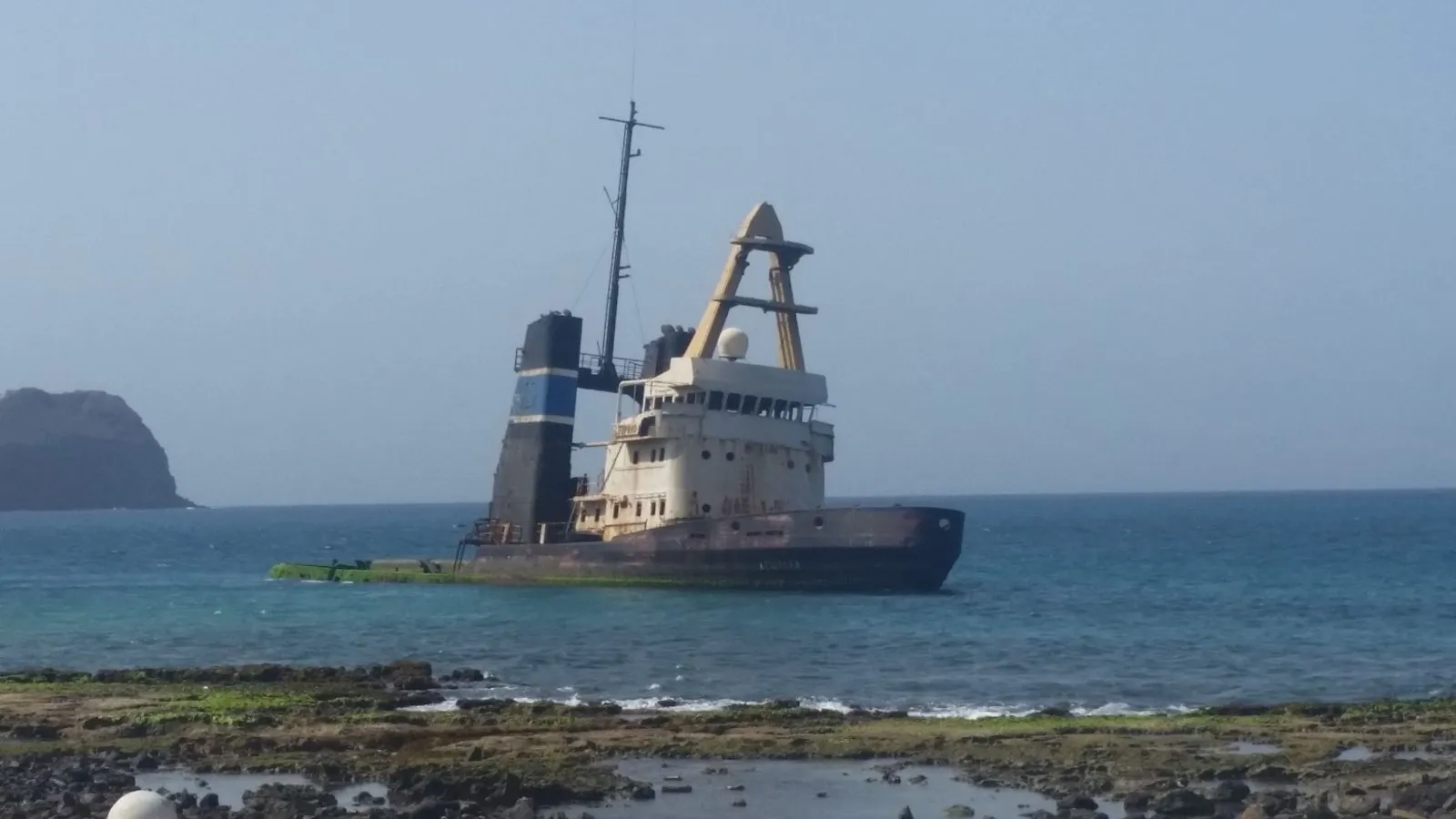
· Teulada, Sardinia

Cagliari

After breakfast, around 9 o’clock, we set off for Cagliari. The sun came out, and we wound along the wild, romantic, rocky coast road – now, these are the pictures that come to mind when you think of Sardinia.

Approaching Cagliari – from far away already – Feri spotted giant Imperial walkers getting ready to march on the city. Zigzagging practically between their legs we managed to overtake them, and didn’t stop until we reached the old town on top of the castle hill.

We parked in a spot not necessarily designated for us, but in the end we found our little Panda in the same place later. We visited the cathedral, from whose crypt below there was a unique view over the city, given that the whole building stands on the edge of the cliff.

We had a cappuccino on a panoramic terrace and picked out the next targets – in the city spread out below us – that we still wanted to see.

We didn’t quite manage to find our way – instead of the domed church we ended up at a convent – in the end we parked near the harbour and looked for a little restaurant where we could finally eat real Italian pasta, which Gyuri had been longing for for so long. At the table behind me a pair of lovebirds kept bringing smiles to Zsófi’s and Feri’s faces, so I asked Franci to take a few pictures of me as they were kissing my ears, but either he couldn’t catch the right moment, or my head proved too wide; the great l’amour doesn’t fully come across in the picture…

Although Cagliari won’t become the city of my dreams either, it seemed a notch tidier to me than Palermo, the rough diamond, as a guidebook called it.

On a postcard we noticed that there’s an ancient Roman amphitheatre somewhere here too; we found it and looked down into it – this one must have been really big too, but not semicircular, rather oval, as the hollow in the hillside allowed. Sadly this one looked neglected too, rusty scaffolding and bits of stage abandoned here and there, as if the Italians didn’t care about their own past.

From this point of view, though, credit goes to the Croatians, who have made the amphitheatre in Pula – also in the town centre – nicely visitable, and in summer they hold open-air concerts and theatre performances there in the evenings. People flock there, almost like in ancient times…

On the way back we first did our shopping, then drove back through the interior of the island to Sant’Anna Arresi to return the car. The landscape isn’t bad, not bad at all, but I think our own Zemplén Hills (in north-eastern Hungary) are like this too, though without the cacti…

The clerk at the travel agency was very kind: he took the Panda back from us, then got in with us and drove us back to the marina about 20 km away – to our boat – so we didn’t have to take a taxi with our big shopping bags.

My back is slowly getting better – apparently Voltaren isn’t only good for toothache –, but it’ll surely take another 3–4 days before I’m my old self again… Or better…

At nightfall we sailed out of the Teulada marina and set off for the little island of Vulcano, one of the Aeolian (Lipari) Islands north of Sicily.

Machine translation (AI, Claude) of Balázs’s Hungarian original. Read the original →
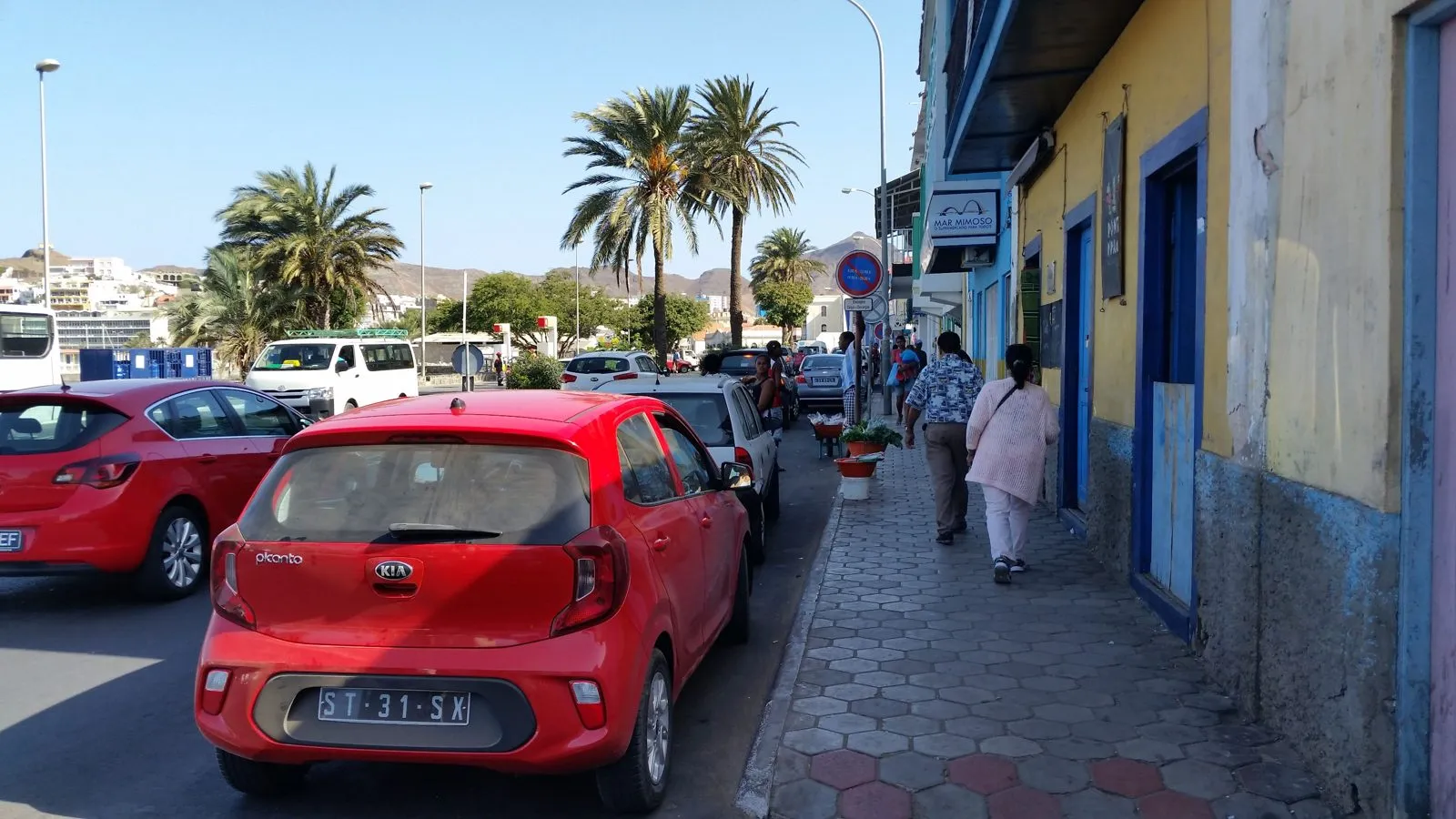
· Tyrrhenian Sea

Birthday on the Tyrrhenian Sea

This voyage is good for getting a feel for distances within the Mediterranean.

Gibraltar – Alicante: 3 days. From there Ibiza 1 day, then Sardinia another 3. From here Sicily 2 days, plus another 2 until you reach the heel of the boot. Crossing the Adriatic takes a good 1 day. The ancient Greek and Roman sailors could sail at about half this speed on average, if the wind was good. So they too could cover these distances in twice the time. But as long as there was no compass, they could make big detours too, often made landfall somewhere else, and reached their destination by sailing along the coast. For that, though, the navigator had to know the shapes of the coastal mountains well, to recognise where they were.

Oh, and the wind being good means that it’s neither too weak nor too stormy, and blows from the right direction. In every other case everything goes pear-shaped. That’s why oared galleys stayed popular for so long – of course only among shipowners, not among the galley slaves – they gave a certain predictability, of course only until the human resources ran out. Our best friend is that 110-horsepower turbodiesel Volvo engine, which helps us faithfully and reliably when the wind happens not to be on our side.

The Pinta’s route from Sardinia to the Aeolian Islands north of Sicily

We document our voyage in several ways. The most important is this diary you’re reading now. Besides this, two more diaries are being kept in parallel: one that Zsófi writes, and the other the ship’s log. When we’re under way, the person on watch records in it every full hour the log reading (the “odometer”), the boat’s position, course, speed, and the direction and speed of the wind currently blowing. We note the charge level of the batteries, what sail plan we’re under, what we changed in it, when we started the engine, when we refuelled, who came on board as a new crew member or left, any injury that occurred and what we did to treat it, and everything important that happened on board or could affect the voyage. This way the logbook also works as a kind of black box: with it the captain and crew prove that they did everything in their power for safe sailing, free of accidents and damage. If the sinking ship has to be abandoned, then after the life-saving equipment this document is one of the most important things they must take with them.

Keeping the logbook has several other important aspects too. For instance, it makes the person on watch aware that at every moment of the watch they are responsible for the boat; at night they may not fall asleep, because the rest of the crew has entrusted them with their lives and the boat’s safety. And in the daytime, when everyone’s awake, without a designated watchkeeper you can easily believe that someone else, or the captain, is keeping an eye out and will act if necessary, while meanwhile everyone is busy with something else. Of course the person on watch may also have urgent business – for instance, in the place where even the king goes on foot, as Hungarians say of the loo –; then they hand over the watch for that time to someone, who must acknowledge the handover out loud, otherwise it can happen that they didn’t hear it or weren’t paying attention, and won’t do anything.

The person on watch can of course ask the captain or another crew member for advice or help at any time, if unsure about something, or if they need reinforcements for a sail-handling manoeuvre.

Keeping the log continuously draws attention to changes in the weather, the wind picking up, the barometer falling, a possible low charge in the batteries, and then countermeasures can be taken in time.

On the Pinta we recently started the third logbook; two have already been filled during the round-the-world voyage.

What makes this day at sea different is that today is Gyuri’s 61st birthday. His biggest present – his dream come true – is the successful circumnavigation, but he still had one more surprise in store for himself, and announced that he’d fire up the heating on board tonight, because as we head towards Siberia the nights are getting chillier and chillier…

Machine translation (AI, Claude) of Balázs’s Hungarian original. Read the original →
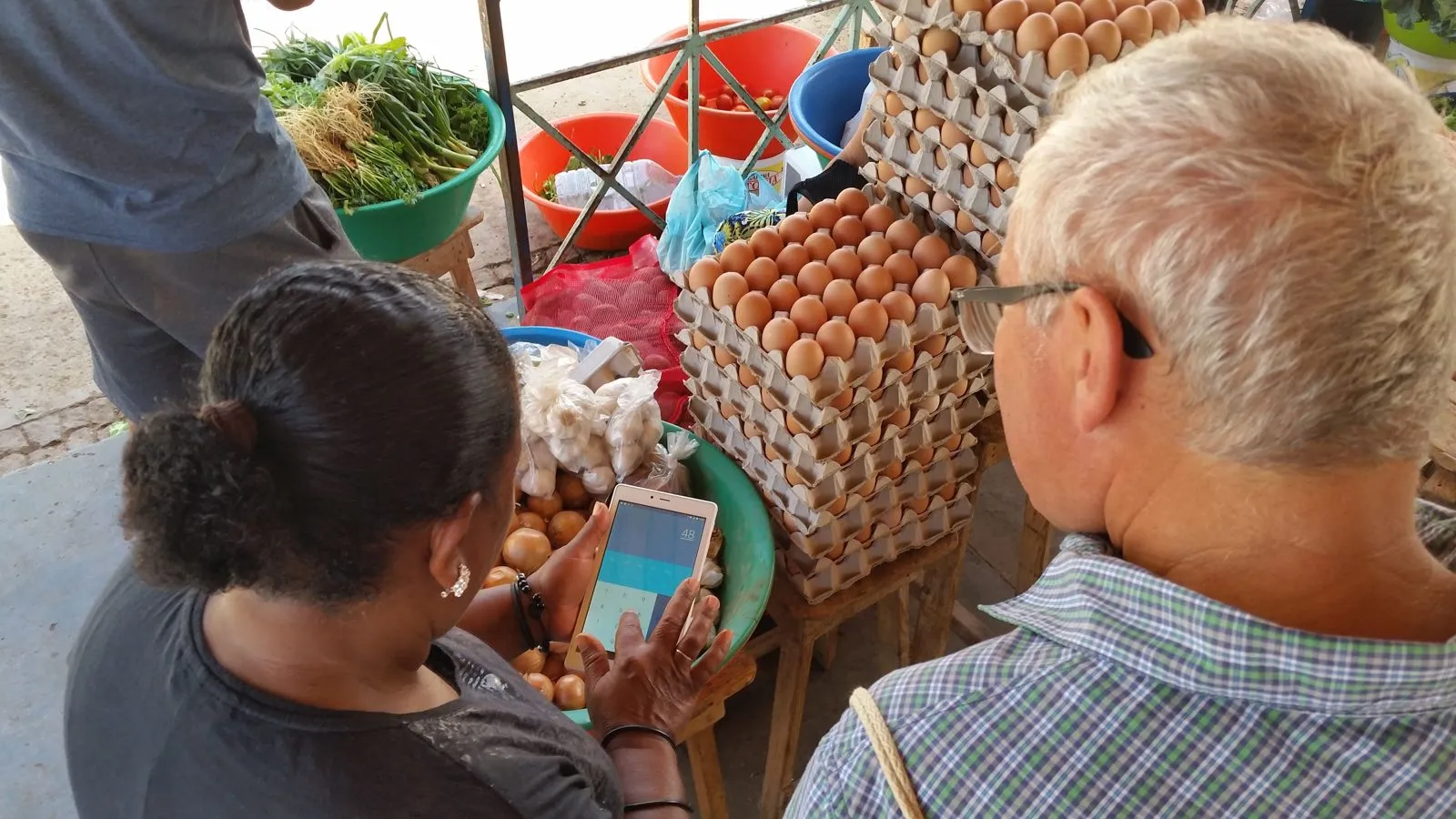
· Tyrrhenian Sea

Spring sunshine at sea

Today is Sunday, here at sea too. Since the morning the sun has been shining nicely, so spring-like. I can’t say what makes it spring-like, maybe that the sky is so clear and the sunlight so sparkling. The sea is smooth, the current helps us along by one knot, and even if the wind isn’t blowing from a favourable direction any more, at least it’s not on the nose either. The deck-swabbing was skipped, but the rag-shaking wasn’t.

Gyuri asks me to shake out the blue covers protecting the cushions – since I’m outside anyway –, and as he hands them over he adds emphatically: four of them. I get the hint. It happened on the very first day that Zsófi asked me to shake out the tea towels, rolled up in one ball, separately. Naturally, I thought, grabbed firmly the only corner sticking out, and gave it a good shake to get the breadcrumbs out, and whoops, what’s that flying over there, another tea towel… As we drew away from the little brown patch floating on the water, it began to dawn on me that the word “separately” may well have referred to at least two tea towels, and this one, however I fold it, is just one here in my hand…

I had to confess to Zsófi that one of them had outwitted my vigilance and – whoosh – thrown itself into the sea. For a while they shook out their rags themselves, but then through hard work I won back their trust; still, before they hand over the task – even now – they look me deep in the eyes and say only: “TWO of them!”…

Today, as you see, they’ve already entrusted me with four – the trust keeps growing. “Four of them,” I acknowledged, but I did try to leave myself a little loophole, just in case of the case, and asked back: “Does size matter?”

Well, I managed to accomplish even this complicated task too – even though I don’t have four hands –; my self-confidence is back to its old self, now I’m capable of almost anything…

Around noon we passed within sight of the island called Ustica. We switched our phones back from boat mode to phone mode and waited for reception to come.

I’ve already managed to make a call,
Feri is still searching for the Force

When we set off, as soon as we leave the coastal signal behind – after about 10 miles – we immediately switch our mobiles to boat mode (rather wrongly labelled as flight mode), because otherwise the poor little things would keep searching the ether for signals and can drain completely in a few hours. So we switched them back on; they picked up the scent quickly, but a good while passed before they started beeping and catching mails, texts, likes and other vitally important messages. From then on we could even make short calls to the folks at home, and then, as the little signal bars got smaller, we switched the devices back to boat mode.

Instead of a birthday cake Zsófi made a csúsztatott palacsinta (a Hungarian stacked-pancake cake), with a big 61 on it.

Ferenc had a swim in the 16-degree Tyrrhenian Sea, then we could even hoist the gennaker for three hours, so at least for that long we glided along quietly, burbling.

Machine translation (AI, Claude) of Balázs’s Hungarian original. Read the original →
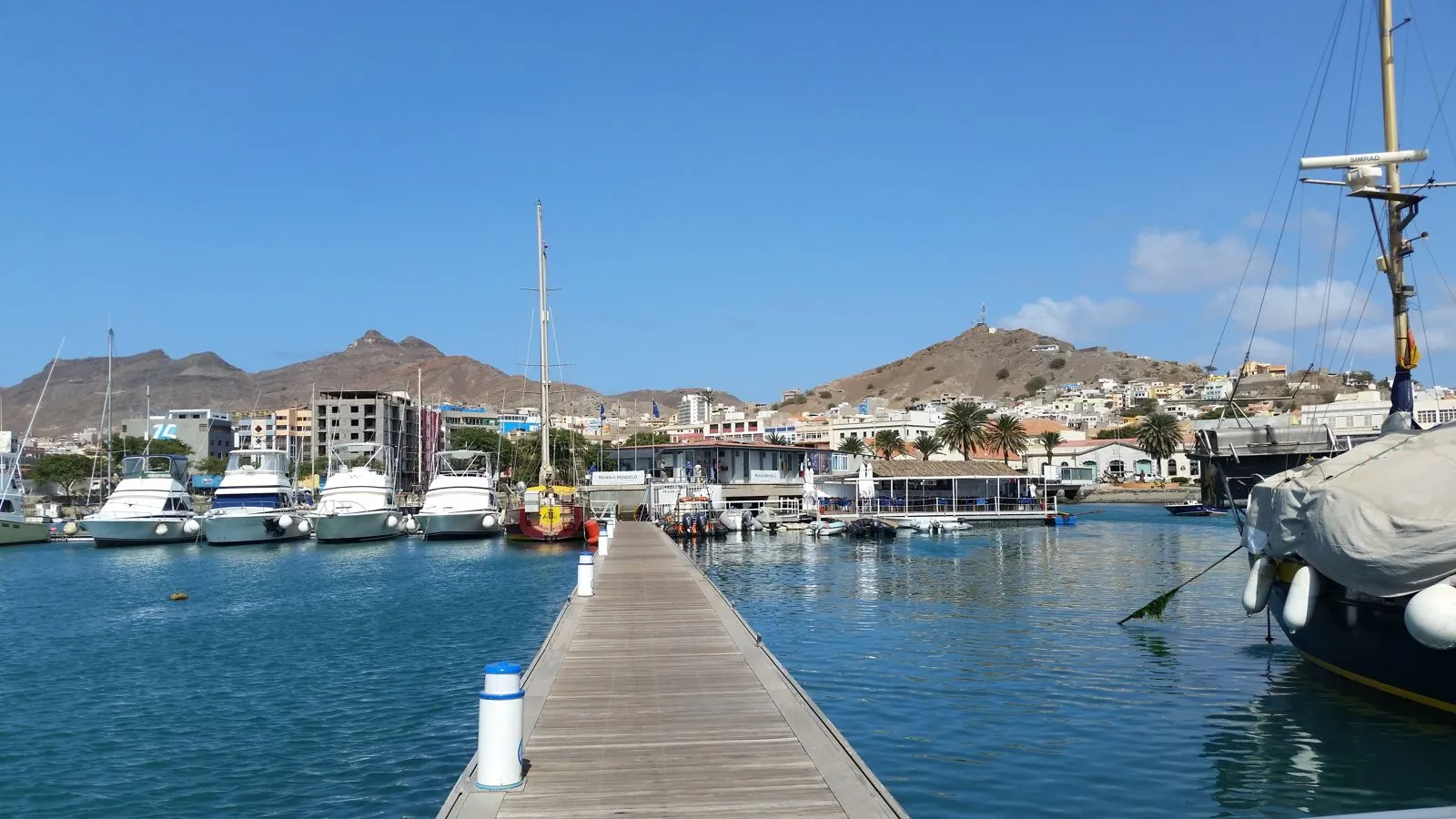
· Vulcano, Aeolian Islands

Moored on Vulcano, at the brimstone gates of hell

I got up at 4:00; my job was to navigate the boat through the strait between Lipari and Vulcano until we were off the little harbour on the far side of Vulcano. In the moonlight the grim outlines of the islands and the high cliffs off the coast were already taking shape, the lights of the villages, and as we got closer I also noticed an orange lava flow at the foot of the mountainside. Bhaaa! An active volcano! And indeed, as we got closer, the patches became more and more distinct, and I almost woke the others – they have to see this too – when I got suspicious: maybe it’s something else after all? Lights of buildings right next to it and at its foot – how can that be? As I kept scrutinising it through the binoculars, I realised that it was just a high cliff face lit by yellow floodlights, like the castle hill in Alicante or the Rock in Gibraltar. Well, I’d have looked a right fool if I’d roused everyone because of a plain, floodlit lump of mountain… We passed an old fisherman coming the other way in the dark, then after I’d turned into the bay I woke Gyuri, as agreed.

A sulphurous volcanic smell hit our noses – well, well, well – so there’s some volcanic activity here after all? It was already getting light, so we could clearly see the top of the mountainside steaming and smoking.

At the top of the mountainside the sulphurous gas we could smell is smoking

In the harbour we had to drop the anchor from the bow and reverse onto the quay. Then a worker came and warned us that one or two ferries would be coming here, so Feri and I stayed on the quay while the Pinta weighed anchor, dropped it again a bit further along, and backed in to us.

Meanwhile the sun rose, people trickled into the harbour, then a ferry really did arrive, and then the other one after it. Looks like we’re in the right spot; we’ll see…

Workers waiting for the morning ferry cheer on a grey-bearded little old fellow fishing with a single line

We breakfasted on slightly harder soft-boiled eggs and planned what we ought to see on the island.

First we thought of renting electric bikes, but then Paolo only had two of them, so we stuck with a car; this time a yellow Panda became ours. We had to fill it up straight away, because the rental places hand them out the way they came back in. So the cars have turned into real petrol-laying hens: you start the rental by filling up, but since you don’t know how far you’ll go, you put in a bit extra. I reckon everywhere we returned the car with more petrol than we got it with (Cape Verde, Gibraltar, Sardinia, Vulcano), not to mention that this island is only 6 km long…

First we climbed up to the rim of the volcanic crater. The signposts said the top was 800 metres away, and according to Paolo too it’s only half an hour’s walk, depending on the person. We’d been puffing uphill for a good 40 minutes – the top still nowhere in sight –, and Gyuri and I remarked that the 30 minutes probably applied to the local Sherpas, going down… I was very glad we hadn’t gone to the Stromboli volcano after all, because that one was clearly at least twice as high.

Down there is the Pinta, moored to the harbour quay

But then we did make it to the top, and the gorgeous panorama that opened up before us – the view of the surrounding islands, into the volcano’s crater and over the neighbouring green hillsides – made up for everything.

To the left the peak of the crater would have been closer, but the wind was blowing the rising sulphurous smoke that way – not advisable to cut through it – so we went round the crater on the right and walked up to the summit.

Once we were down, we drove to the island’s most distant, southern tip – we thought – we’d have lunch there, but practically the whole thing was almost as if we’d reached the end of the world. (Flat-earthers, take note!) The road led into the sea; apart from two old houses and five cats there’s nothing here. All right, we did pass two closed restaurants on the hairpin road down, but then that really is the end of the list of sights. You can make out the coast of Sicily well enough, but in the haze it’s impossible to see any details. Oh well, never mind. Feri liked it, and we were there and back fairly quickly. We headed back towards our harbour, where Paolo had recommended a restaurant, Maurizio’s. First we looked through the menu of the restaurant opposite it, then that of grey-bearded Maurizio, and finally we went back to the other side, where we had lunch with almost family-style service from a lady of grandmotherly age. A suspicion arose in me that granny and Maurizio might be a married couple, because Maurizio gave us up so easily, as if he were saying: “Go on then, the money all goes into the same till anyway, let the missus do some work!”

Lunch was delicious, and meanwhile we decided to bathe in the volcanic mud pool near the harbour, because warm water bubbles up in it. Gyuri decided to stay on the boat instead; he fancied a little afternoon nap. We changed into beach gear, walked over to the brimstone pool, coughed up the 3-euro entrance fee plus another 1 euro for a shower token, which I carefully put away in a good place, so that at the end I wouldn’t have to rummage through my stuff with muddy, wet hands. Feri only came in as a spectator, because he had absolutely no desire to immerse himself in the milky, murky water.

Zsófi and I waded into the small, round, knee-deep pool, and at a bubbling spot we sat down in the nice warm mud. I can’t compare it to anything else, sorry – and now stop eating –, it was like nestling in warm poo. (I’m relying on my memories from infancy.) The faint sulphurous smell and the fart-like bubbles coming up only reinforced the effect. Luckily the almost milk-white water can also give you the feeling of bathing in milk and honey, if only it weren’t for that faintly sulphur-scented bubbling…

Zsófi smeared her face with the warm mud, and I my lower back; she became more beautiful and younger, while for me only my back is starting to be reborn…

Right next to it, on the seashore, hot springs like these were bubbling up too; Feri dared to go in there without a shudder, later we followed him too, but the bottom was very pebbly and the seawater much cooler, so we soon returned to the volcanic pond’s 35-degree, murky, milky water to warm up. At half past 4 they whistled us out of the mud; we went to shower, but the devil had swallowed my shower token. With wet hands I searched all my pockets; in the end Zsófi let me under the cold, slightly salty shower for a bit of de-mudding. We still had a little hour with the Panda until returning it, so we drove round the three spots that Paolo’s map recommended as sights.

They’re real rascals, these island car rental people, because they list the most distant point of the island – the end of the world – as a sight; that really can only be reached by car or scooter for non-racing cyclists, but otherwise everything else is within walking distance; in my opinion there’s no point renting anything at all.

We drove through the harbour to return the Panda, but at Gyuri’s frantic waving we stopped to ask what was wrong. It turned out that a departing ferry had kicked up such big waves that the Pinta’s rudder blade had hit the underwater concrete slabs hard several times; luckily Gyuri was there and, letting go of one of the stern lines, managed to pull our boat further out with the anchor chain, but to tie her back further off he needed our help. Feri returned our car, and we secured the Pinta at a safer distance. Our captain pulled on a wetsuit and dived down with a mask to examine our rudder blade, to see whether there was any visible damage giving cause for concern. Luckily he found none, so as soon as he’d towelled off, we set off in a hurry.

On the boat I found my shower token; I put it in the towel bag so that I wouldn’t have to rummage through my clothes with wet hands… Good thing I was so far-sighted; it’s just a pity that an hour later my token had already sunk into the mud of oblivion.

This Vulcano was a very charming little island. I think it’s worth coming here and seeing the other members of the Aeolian archipelago too. There are no marinas as yet; you can either moor to the quay with your anchor, or anchor in the bays.

At 10 in the evening there were fireworks on the island of Lipari, which was already 15 miles away, but in miniature it was interesting. For a few minutes a dolphin joined us too, and our navigation lights lit up his lordship now in red, now in green. I’ll get up at one – though it won’t be my turn – so that I can keep watch too in the Strait of Messina; the shipping there is always heavy.

Machine translation (AI, Claude) of Balázs’s Hungarian original. Read the original →
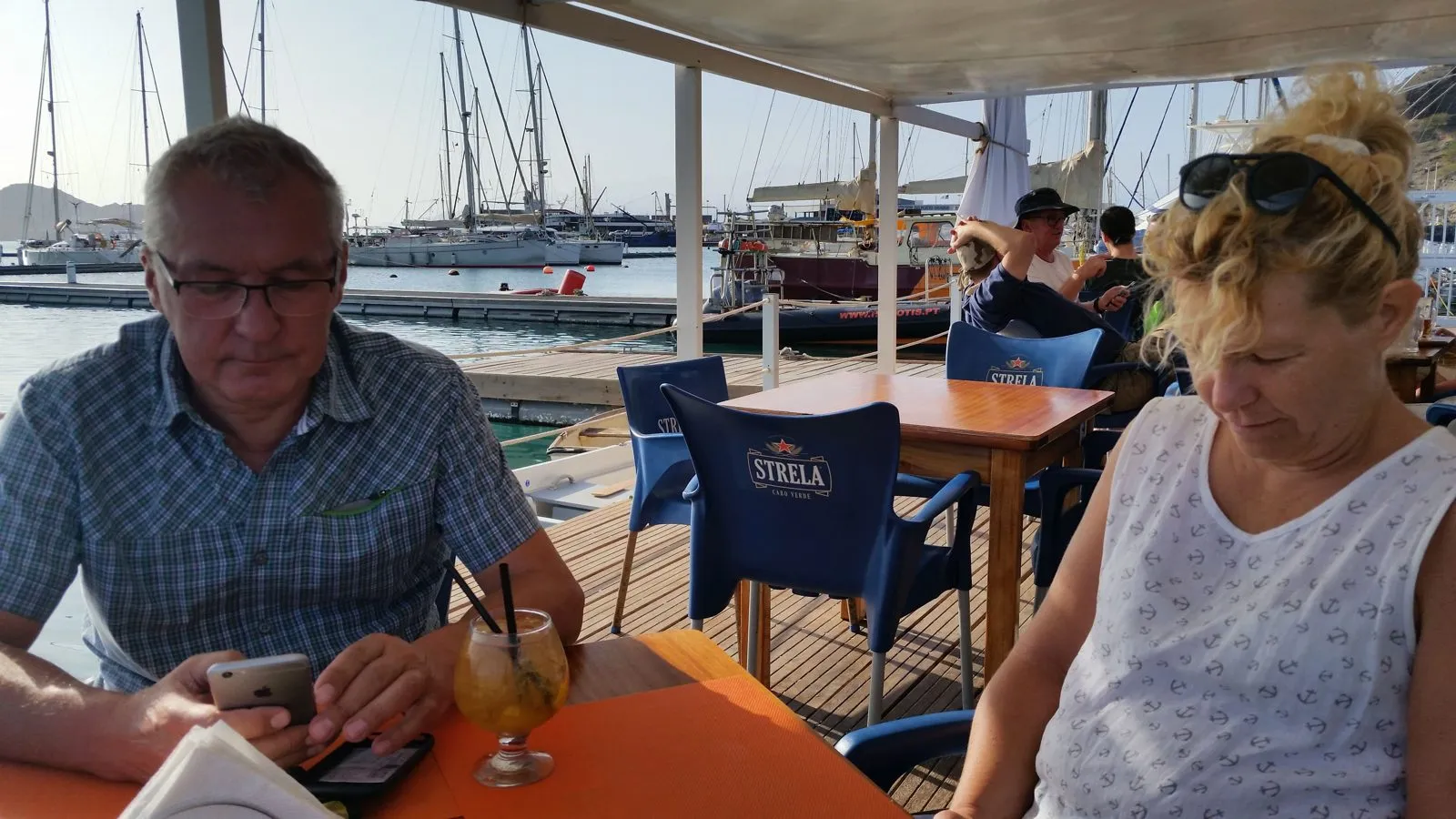
· Ionian Sea, off Calabria

Under the sole of the boot

At 1 in the morning Gyuri woke me: we were already in the Strait of Messina. Visibility was good, the ferries were criss-crossing as they usually do, only a great hulking freighter popped up behind us out of nowhere, with no AIS signal, but since we were going along the edge of the designated shipping channel, it overtook us, passing 100 metres away. The current sped us up this time too – we’d reached the strait at the right time –, adding 4 knots to our 5 to make 9; it makes a huge difference whether you get through at 9 knots or crawl along agonisingly at one. Even in the dark we could see those whirlpools, plates 30–40 metres across, which not only spun Odysseus’s ship round but can still play tricks on smaller boats today.

Our route from the island of Vulcano – through the Strait of Messina – to Otranto on the heel of the boot

At 7 in the morning I got to get up again, and steered the Pinta alone under the boot’s big toe, parallel to the coast. Etna stayed beautifully, clearly visible for a long time; here we were already sailing on the Ionian Sea in lovely sunshine.

Etna still visible behind us
Fishermen passing us

Today I was in charge of lunch, and I made the chilli con carne that had long been queuing up on our menu. Feri offered to help, so the two of us made the chilli beans together, and in the end it turned into such a huge portion that we were all scratching our heads over how many days we’d be eating it. But then it was such a hit – everyone kept going back for seconds and thirds – that it was gone to the last bite. I stuffed myself so full that call me a catshark if tonight I don’t dream of a giant whale farting trade winds that bites off the bow cabin of the boat with me in it…

In the end there was no need to dream about anything: the Gulf of Taranto introduced itself to us nicely, showing what it’s capable of.

By evening the wind had picked up enough that instead of the engine we could unfurl the headsail, and it carried us along properly too, although not exactly in the planned direction.

Then at 22:00, when my turn came, the wind had already risen to 20–22 knots, instead of the forecast 12–15. When we were scraping 25 knots more and more often, and our boat was heeling at 45 degrees all the time – and we were clinging to everything like kittens –, Gyuri and I simultaneously suggested to each other that we reduce our lone headsail too. We rolled it in to the 3rd reef, to about a third. (Golden rule: When should you reef? The first time you think of it!) That way the boat didn’t heel so much any more, yet our speed barely dropped; we were galloping into the waves at 6 knots. We did very well to reef, because before long the wind rose to 28–29 knots, and not infrequently hit 30. The steep waves thrown up by the bow broke over us more and more often; out there the howling wind was already tearing the white crests off the waves, and under the overcast sky the whole thing looked very unfriendly. This Neptune just won’t let us finish the circumnavigation with a pleasure cruise, and the notorious gulf bared its teeth… And the wind forecast failed again, right where we were.

The towels hanging on the hook are the ones that are vertical!

The nasty waves shook Feri out of his bunk too – he grabbed the black bucket to be on the safe side – and he really did get hit hard by seasickness again; you could hear him shaking out everything that was in him. I took water and paper towels to his cabin so he wouldn’t have to climb out for them.

Machine translation (AI, Claude) of Balázs’s Hungarian original. Read the original →
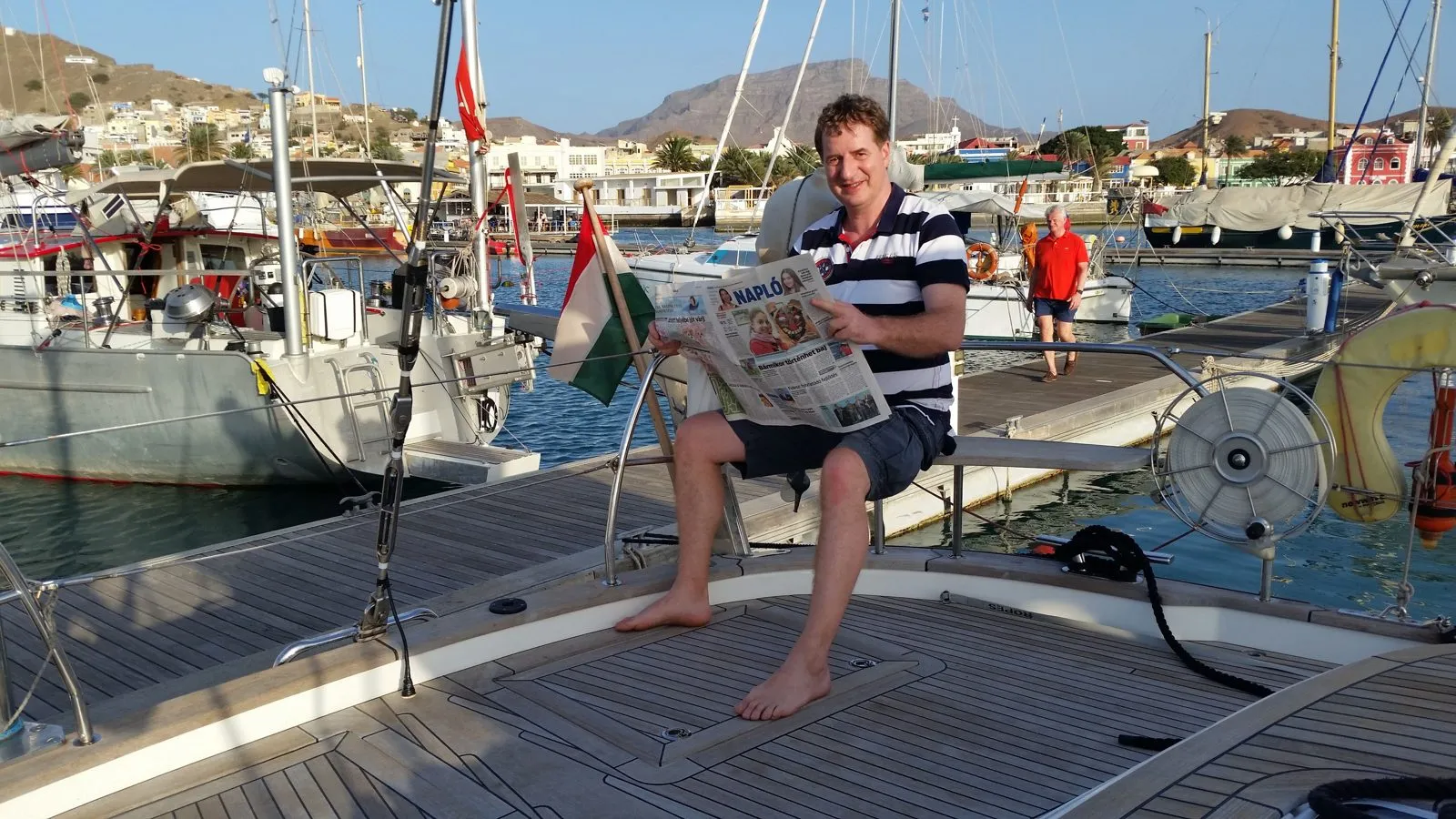
· Otranto, Italy

We arrive in Otranto

At one in the morning I woke Zsófi – she always comes after me. By then the wind had dropped to a more bearable 22 knots; I slipped into my pyjamas and fell asleep relatively quickly.

I’ve read that even in the stormiest weather – if you can – you should take off your cowboy pyjamas, your daytime clothes, slip into a nightshirt, and if possible go to sleep in a bed made up in the usual way. Then your body knows that now is the time for rest and sleep, and you have a much better chance of falling asleep – or even resting – on the lurching boat if you can pull the duvet over your head. I think it helps too, but of course you have to be sure that whoever is outside supervising the boat’s progress does their job reliably and is able to carry out any manoeuvres that may be needed, alone or with someone else’s help.

At 7:00 I took over the watch from Gyuri; we left Feri out of the rota so he could rest. The wind is the forecast 14–15 knots, the lone genoa had been shaken out of its reefs earlier, and with minimal heel we’re making 5.5–6 knots, though not exactly in the set direction – towards the heel of the boot – but about 20 degrees off. If Windy is right, the wind will die around noon, and then we’ll correct our course. True, our route will be a few miles longer this way, but we’ll probably get there sooner, because last night under engine we couldn’t even make half this speed.

At 11 in the morning tiredness knocked me out; I thought I’d have a sleep until lunch. I managed it too, waking up just before it was served, at half past 4 in the afternoon. I slept right through this day. Feri was better by now, but he skipped lunch, and was seriously considering getting off in Otranto and flying back to Berlin from Bari on Friday. We couldn’t really encourage him by saying it’d be better on the Adriatic, because according to every forecast we’ll have a strong headwind almost all the way, with all the roller coaster, shaking and lurching that comes with it. We arrived in Otranto before sunset and moored on the mole where the fishing boats lie, next to the coast guard launches. Gyuri and Zsófi had spent a night here too, two years ago; however, whoever we asked, everyone said that 2–3 more fishing boats would be coming in tonight. We asked Feri to call the phone number we’d been given over the radio while coming in, and ask whether there was a place for us somewhere. The little fellow said he’d be here in 20 minutes and would surely find something for us. Half an hour later he did arrive, and directed us between two sailing boats at the edge of the marina, where we reversed in nicely, and I secured the bow with a mooring line to a big concrete block on the bottom of the harbour. As I made it fast on the cleat, I saw fishing line tangled round the rope, so I didn’t fiddle with it much, so as not to get hooked in the dark. What did surprise us, though, was that our depth sounder showed 2.2 metres, while the Pinta’s draught is 2.4 metres, yet we clearly hadn’t run aground on anything. We showered on the boat, put on our going-out clothes, and strolled into the charming old town behind the walls. We found a little restaurant with a locked door, which we could only get into after ringing. Simple, tasteful interior design, courteous service, delicious food, and once again a pair of lovebirds behind me. I didn’t ask for a photo of them, because you’d end up thinking I really do have a big head.

Instead, a picture of the goodies

When we got back to the Pinta we saw that five fishing boats had moored rafted up on each other in the spot where we’d first stopped. I don’t even know what would have happened if we’d left our boat there and gone off to see the old town…

That’s where we first stood, behind the grey launches, where the five fishing boats are now rafted up on each other…

Even though I’d slept almost all day, I had no trouble falling asleep; apparently I had a good backlog to catch up on in that department.

Machine translation (AI, Claude) of Balázs’s Hungarian original. Read the original →
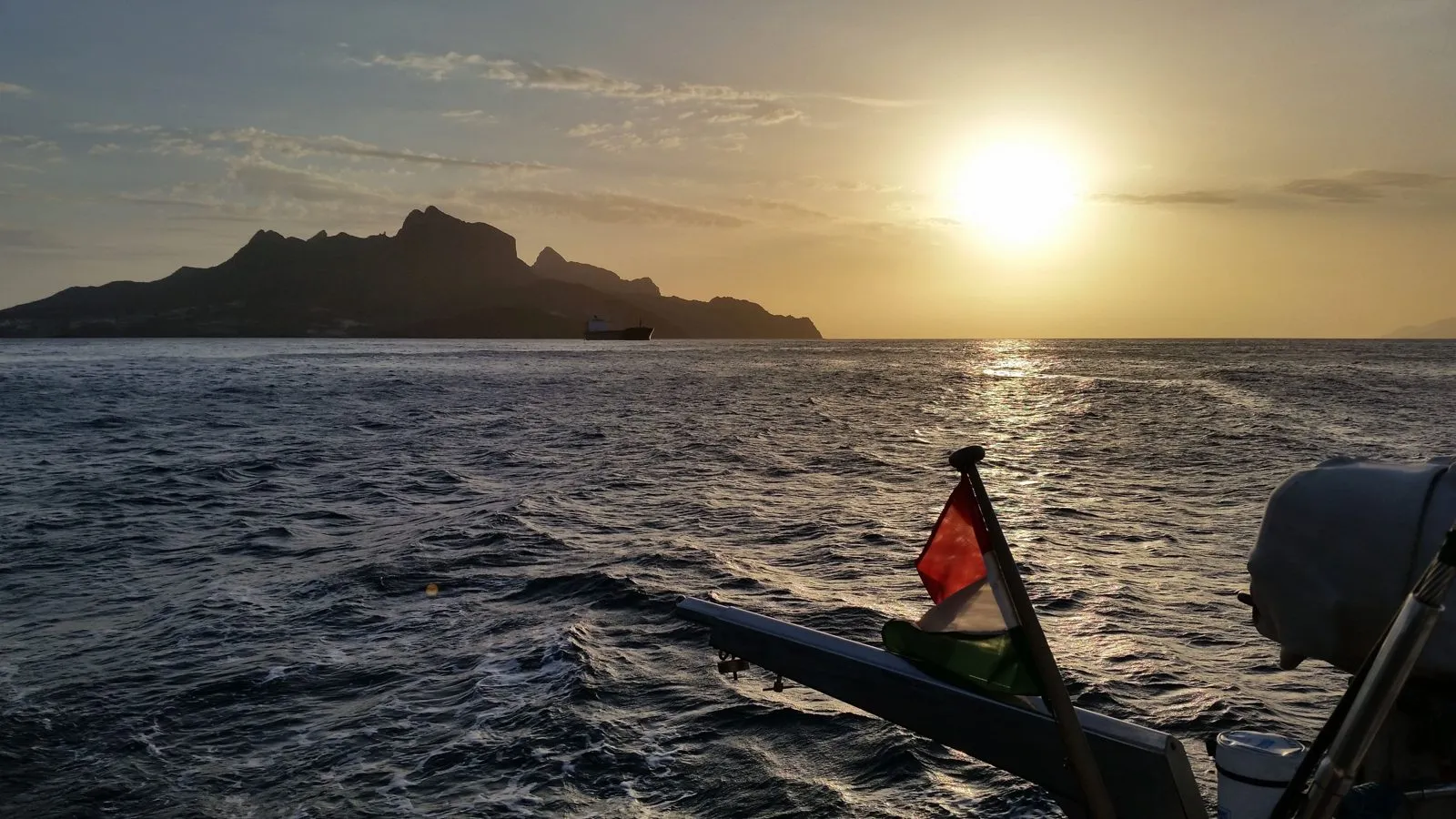
· Otranto, Italy

We drift onto the moored boats

In the morning Feri packed his things, and we took one more sightseeing-and-shopping stroll; all we really needed for these two or three days was bread and butter. We looked for a pizzeria where you could get everything except pizza, but at least the everything was tasty.

Otranto – the seafront promenade in front of the town wall

At half past one we went back to the boat and said goodbye to Feri, who was in a hurry so as not to miss his bus.

Ferenc has disembarked, rushing to his bus to Bari

Gyuri and I rigged and prepared the storm jib, because they’re still forecasting pretty nasty weather, with stormy headwinds. By a quarter past two we were ready to leave, but a rather unpleasant crosswind was blowing, so we had to decide what tactics to use to get out of our berth without the wind immediately pushing us onto the neighbouring boat. Gyuri’s idea was to run a guide line over to the neighbouring boat on the windward side, which would stop us drifting off while we pulled out, and at the end – letting go of one end – we could pull our line back aboard the Pinta. But that boat was moored too far from the quay, so it looked impossible to get aboard it to pass our line round and lead it back to our boat. So we went with my suggestion. The wind was coming from starboard, so we left the starboard stern line till last. Zsófi dropped the mooring line holding the bow into the water, I quickly cast off and pulled in the port – leeward – stern line, Gyuri gave it just enough throttle, and as soon as I cast off the starboard stern line last of all, the Pinta pulled out from between the two boats dead straight, without any drifting at all, and it looked like the hard part was over, when the engine started to labour and then stalled. What the heck could be wrong with it? We still had a bit of momentum, Gyuri managed to restart it, but it wouldn’t respond to the throttle at all; pretty obviously, every sailor’s nightmare had caught up with us: the engine dies in a crowded harbour and the wind pushes you onto the other boats, and you smash up theirs as well as your own.

Sinking in a harbour isn’t really the done thing, but you can cause considerable damage; if, however, it happens out at sea off a rocky shore, and for some reason you can’t hoist a sail and sail (e.g. because the wind has already torn it to shreds), then the boat may even go down. With a car, if pulling out of a parking space – blonde-style – doesn’t quite work out, you can stop, pull the handbrake, get out and ask for advice or help. A boat isn’t like that. Once you’ve set off, there’s no handbrake to pull: the boat either goes, or drifts helplessly, until someone comes to help and tow it, or it hits the shore or other boats.

What the heck do we do now? We slowly start drifting towards the yachts moored 10 metres away, the engine is out, our propeller has obviously wrapped up a mooring line in the water and that’s why it stalled –, dropping the anchor in this little time is impossible, and it wouldn’t even hold our boat anyway, nobody is around who could take us in tow, the big furling genoa can only be pulled out slowly too, but the storm jib, the one we’d prepared! Gyuri shouts at me to hoist it, and I manage to yank it up taut in 20 seconds without a winch, and on top of that I had to untie the lashing from the cleat. The wind fills our little orange storm jib, and we wait tensely for the Pinta to start moving forward. Unfortunately it quickly becomes obvious that today isn’t our lucky day: the wind from starboard is too far ahead. To get the boat moving we’d have to bear away, head further to port, but that’s exactly where four yachts are moored on a pier, – we can’t do that – so the hoisted jib actually does more harm than good, it just makes the wind push us even harder onto the parked boats. We let the sail flog, running our bow thruster furiously slows our drift for a few minutes, but then we have to brace for impact. I wait at the bow – a fender in my hand – for the approaching battering ram, the forward-jutting anchor of a motor yacht, while Zsófi at the stern receives a sailing boat’s anchor, and the wrestling match begins. Trying to hold a fender between the foreign anchor and our bow, not dropping it, making sure neither my hand nor my foot gets caught between the two boats, and preferably that the pulpits and guardrails don’t break each other, or my hand. It’s pretty hopeless, because the round fender keeps slipping out of place, and it’s almost impossible to pray it back in. I shout back to Gyuri to try calling the coast guard on channel 16 – they’re right across from us – maybe a motorboat could come and tow us off. They answer and tell us to wait a bit, they’ll send people over to help in 10 minutes. They really ought to send a motorboat instead, but sadly that’s not on the cards. Gyuri tries to help Zsófi at the back one moment and me at the front the next, and meanwhile his hand gets trapped for a moment between the two guardrails going up and down like a lift, but he manages to yank it out. Slowly two harbour men arrive and try to hold the boats apart from the other yachts, then a sailor from the Coast Guard turns up too, and with great difficulty we start dragging the Pinta along in front of the four yachts. Luckily our deep keel doesn’t snag their mooring lines, but we’d need to pass our stern line to our helpers so they can swing our boat’s stern in next to the last sailing boat.

These are the four yachts we drifted onto

We set off from between the white and the blue sailing boats on the left. The protruding anchor kept jabbing the Pinta*‘s side.*

The stern line isn’t long enough, Zsófi has to grab another one, make it fast amidships and throw it. Unfortunately the line flies off in a clump, so the throw falls short, and twice it lands in the water. Meanwhile the Pinta keeps drifting backwards; even if the third throw went well, it wouldn’t reach the people waiting for the line any more. I quickly fetch another line, ask Zsófi to make its end fast to the cleat on our bow, while I gather the line into my hands for the throw. I’d love to throw it straight away too, but I know this throw has to work, otherwise the Pinta drifts into the shallow water and runs aground there. I know I have to spend those 4–⁠5 seconds properly coiling the line into my right and left hands, rather than have it tangle mid-throw and land in the water. It takes much, much longer to haul it out of there and coil it up again than to spend those few seconds straight away and get it ready properly. Easier said than done when you’re in a real hurry. Luckily the throw works first time, they caught the line, now we can’t drift away any more, but the Pinta’s stern needs swinging in too. Another line is needed, we quickly make it fast amidships, one more throw, and olé! That worked too. The line was only just long enough. Now they can pull our boat in, and what’s more a motorboat finally turned up too, and it also helped swing the Pinta in. We tied her bow to the pier, made the stern fast with a mooring line, and We Did It!

Phew… That…, that was rough. We all worked up a good sweat.

We set off from behind the blue sailing boat on the right, and drifted onto the yachts behind the Pinta*. This is where we finally managed to drag our boat in. The orange storm sail is down; it didn’t get us out of the soup.*

Mille gracie! We thanked everyone for their help, and our harbour man was already on the phone to a diver to free our propeller from the lines wrapped round it. We didn’t have to wait long: he came, dived, and surfaced holding a small piece of rope and an apple-sized tangle of fishing line. The diving cost 70 euros, we left 30 euros with the harbour master for one boat’s broken navigation light at the bow, plus Gyuri’s business card in case anything else needed sorting out. Luckily we couldn’t see any damage on the other boats, and it looks like the Pinta got away with scratches from the mishap too, although Gyuri reckons repairing the gelcoat and getting rid of the scratches won’t be a cheap bit of fun.

Scratches from the enemy boat’s anchor on the blue stripe and the Pinta lettering

There was no reason to stay any longer, the engine and the propeller worked, so with the help of our diver’s motorboat we reversed out of our spot and at 15:50 set off once more for Croatia.

The sailing boat impounded by Italian customs, its jib torn to shreds by the wind…

We’d already left the harbour and gathered up the lines and fenders to stow them, when luckily Zsófi noticed that one of our dark blue fenders had somehow made a run for it and was floating in the sea behind us.

We carried out a – boneless – man overboard rescue, although our fender flatly refused to grab hold of the hook of our boat hook, so Zsófi crocheted a few patterns with the handle of the boat hook and managed to lift the fender’s line just far enough for me to nab the runaway; it was already starting to slip away, but in the last few centimetres I caught it by the scruff of the neck and locked it up with the others in the bilge…

Right, that’s enough now! We knocked back a shot of rum for the excitement, and Gyuri thanked us for our help, which is only natural in a situation like this. I mean, a Pioneer helps wherever he can (as the old Hungarian Young Pioneers’ motto had it).

Before the rum…
After the rum…
it worked on the other side too…

We hoisted the storm jib again, plus the mainsail well reefed, because we’re expecting strong wind for the night. Expecting, my foot – but that’s what they keep promising. We divided up the night watches; my turn would only come at 3 in the morning, so I had a good 7 hours for a nice sleep until then. Of course the wind picked up nicely, the waves arrived too, the boat started heeling and the bow going up and down like a lift – with me in it – so I didn’t sleep a wink, just tossed and turned and flew about above my mattress right up until three o’clock. Meanwhile my brain kept churning over what we might have done differently so this wouldn’t have happened to us.

Machine translation (AI, Claude) of Balázs’s Hungarian original. Read the original →
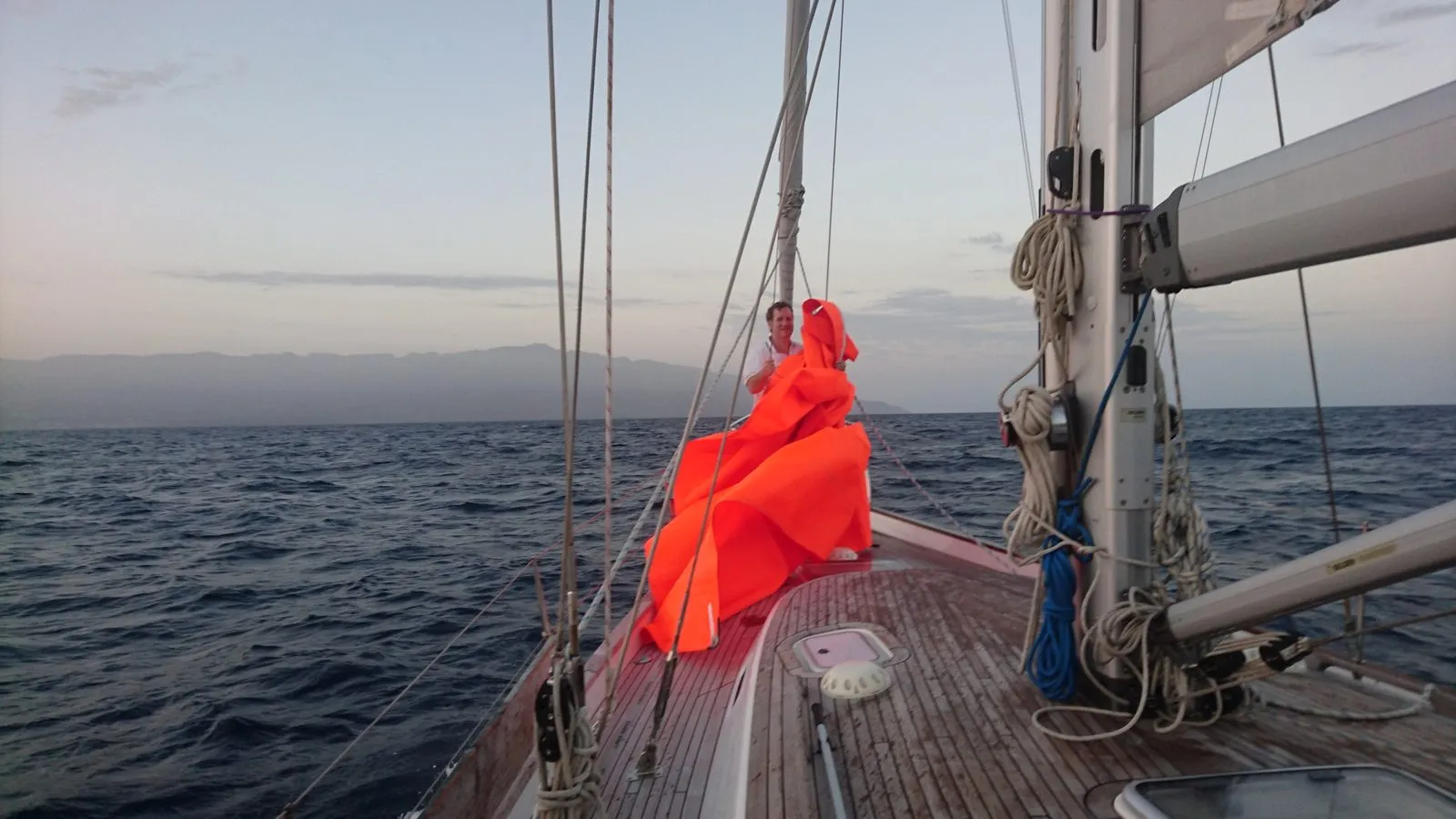
· Adriatic Sea

The shroud starts to snap

During my early-morning watch the moderate gale reached its peak, but with our storm jib and a bit of main we made steady progress – at about 5 knots – until morning.

30 knots of wind at half past four in the morning
The Adriatic gives us an unfriendly welcome
But the sun rises again

Thinking over yesterday’s events, I couldn’t really work out what we should have done differently, how we could have avoided the harbour mishap.

The facts surrounding the engine failure:

  • We didn’t wrap up the thick mooring line, and we didn’t cut it, so the mooring line that was dropped sank to the bottom.
  • The thin mooring pick-up line only reached to the middle of the boat, so it was on the bottom the whole time, alongside the boat.
  • In the evening there was fishing line on the thick mooring line; it’s not out of the question that it was wound round the thin one too, floating invisibly just below the surface.
  • Besides the small piece of mooring pick-up line, the diver also cut a fistful of tangled fishing line off our propeller.
  • The Pinta’s depth sounder showed 2.2 metres, even though her draught is 2.4 m, and we didn’t run aground on anything. (Can seaweed also reflect the waves sent out by the depth sounder, I wonder?)

To me the only sensible explanation is that a load of fishing line was floating invisibly just below the surface, wound round both the thick and the thin mooring lines, and maybe even the seaweed held the lines up, at roughly the height of our propeller. As we set off, our propeller first wound up the fishing lines, pulled the thin mooring line in with them, cut it, and then as soon as we got out of our spot – from between the two boats –, everything was wrapped so tight round the shaft that it choked the engine, and it couldn’t turn the jammed propeller any more. I don’t know how this could have been avoided; my feeling is – to put it in Formula 1 terms –, it was a racing incident, not really foreseeable or avoidable. That’s how it goes… In my opinion, even if we’d tried to tug the fishing line off the thick mooring line before leaving – having seen the big tangle in the diver’s hand – I think it’s pretty much out of the question that we could have pulled it all off.

And once the engine had died, there was neither the room nor the time to drop the anchor, pulling out the furling genoa would also have taken far too long, and anyway, since there wasn’t enough space to bear away, chances are the Pinta wouldn’t have got going with that either; in other words, avoiding drifting onto the other yachts – in that tight space – was impossible without outside help. But if anyone has any useful idea how the wrapping-up and the drifting could have been avoided, please write it in a comment, you can always learn something new…

The last leg of the round-the-world voyage, from Otranto to Kremik in Croatia

But let’s move on, because the boat – without mooring – doesn’t stop, and we immediately found ourselves facing a new task, when Gyuri, on his daily inspection round, discovered that 3 strands of the starboard shroud, the steel wire rope bracing the mast, had given in to corrosion and constant load and had snapped. Here’s a hump to go with your limp, as we say in Hungarian… If 3 of the 18 strands are gone, the cross-section of the wire is reduced by almost 20 percent, and obviously its load-bearing capacity along with it. During their round-the-world voyage this shroud had already been replaced twice on the other side, but this one had been done once too. It’s annoying that this happens right at the end of the trip, but it’s good that he spotted it, because this way we can reinforce it right now. They’re forecasting stormy wind again for the evening.

We got out the parts, used an angle grinder to cut a metre-long piece of similar-strength wire from the spares, and fixed it with 10 strong clamps, bridging and reinforcing the weakened section.

Cutting a metre-long piece off the spare with the angle grinder
Fixing it alongside the damaged shroud with 10 clamps

We had a lumpy day, one of our full days at sea.

Here you can see the 3 snapped strands

In the afternoon we start the engine too, so we can head in the right direction. In the evening between 7 and 11 I get the best of the storm blowing head-on again, 25–⁠32 knots of wind. There isn’t really anything to do, the sails are well reefed, at most every half hour you have to look out for any ships, check how the sail is setting, and the shroud repair. When the Pinta’s bow slams into the waves with a big thud, she shudders in every fibre; Gyuri and I look at each other, listen out for any change in the noises, and then we keep bumping along on the shaker table. Gyuri remarked: “Well, now you know what the most unpleasant leg of a round-the-world voyage is like on this trade-wind route, and you can decide whether you need something like this… If I’d known before we set off, well, I’m not sure I’d have taken it on.” Not a chance; tomorrow the sun will shine, and it’s a thousand percent certain he wouldn’t swap these experiences for anything! This jolting isn’t pleasant, but it’s bearable, especially if it really is only 5 percent of the circumnavigation, and the other 95% is much nicer, broad reaching, downwind, practically pleasure sailing.

Sitting in the armchair in the saloon you can see the sea when the Pinta rears up on a wave. Even I’m surprised by this, since I’m sitting a metre and a half lower than the helm station, which in turn is 2 metres above sea level.

In this position you could see the sea while sitting in the cabin…

For the rest of the night the wind died down almost completely, and a few hours later the waves calmed down too. I no longer took off regularly from my mattress, and in the end I even managed to sleep – I know, because I dreamt some proper rubbish.

Machine translation (AI, Claude) of Balázs’s Hungarian original. Read the original →
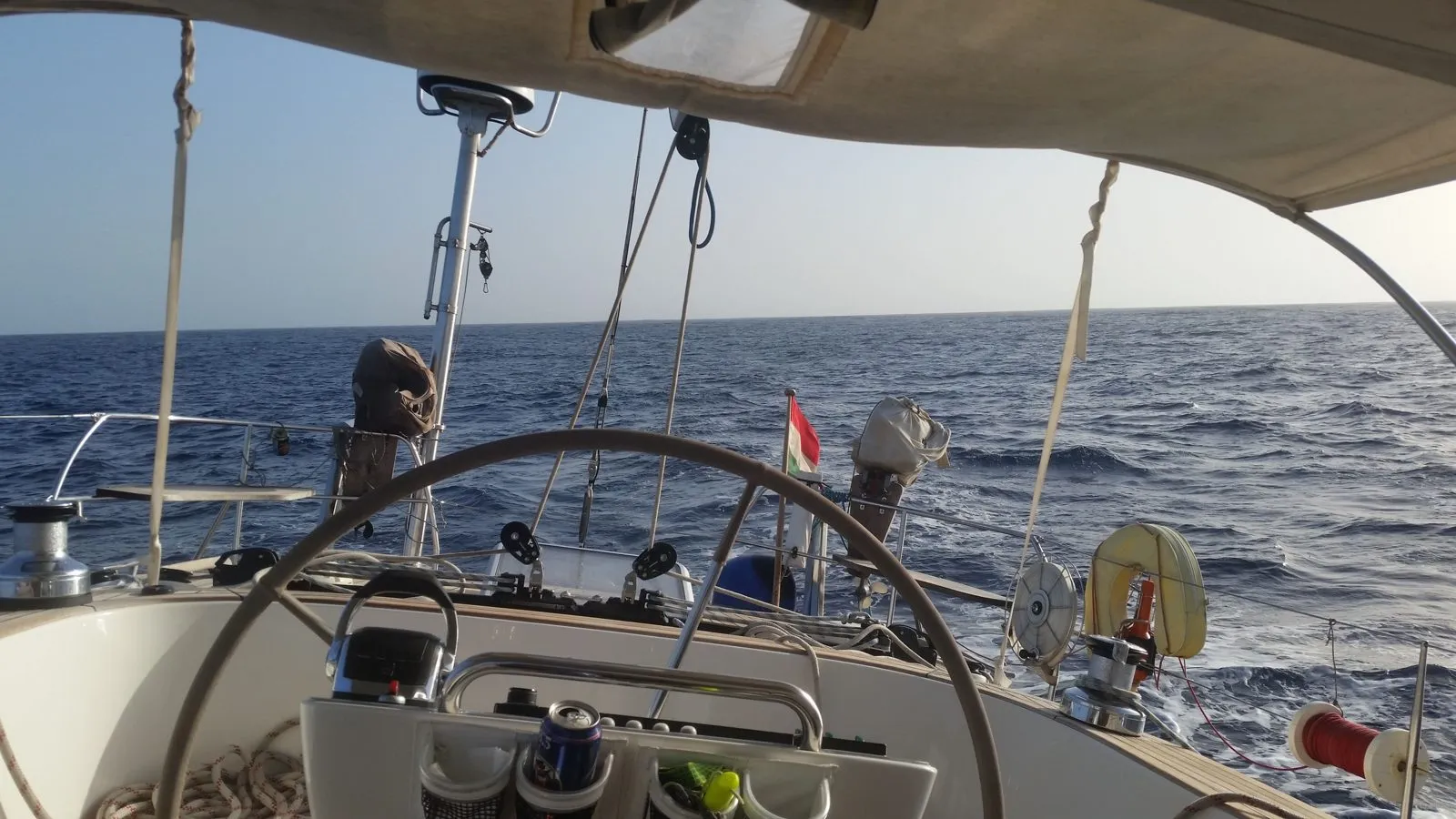
· Šibenik, Croatia

We think we've arrived, but Big Brother was watching us…

When I got up in the morning, wonderful sunshine and a cloudless blue sky greeted me. The wind was still blowing gently from ahead, but the waves had died down, and the blue water of the Adriatic was almost mirror-smooth.

Passing Lastovo already

Gyuri told us that on the island of Korčula, in Vela Luka – right on our way – he’d found an office open all year round where we could officially check in to Croatia, so we wouldn’t have to make a 4-hour detour to Split. We were really pleased about this, because that way we could get to Kremik before dark. Ferenc’s father had agreed to come and pick me and my luggage up and take me home to Hungary. He’s already on his way too, though right now he’s actually heading back, because he left his ID card in Balatonfüred. I’d been sad for two reasons when Ferenc announced he was getting off – early – in Otranto: one, he hadn’t managed to beat his seasickness for good and couldn’t sail the whole way as we’d planned; two, this probably meant goodbye to my hope that his father would come to pick him up, and of course take me home too. To my great joy, Péter agreed to come and get me in Croatia, though obviously he too was sorry he couldn’t see Ferenc this time. I’m very grateful to him for taking on this long trip just for me.

In the harbour of Vela Luka we kept peering around so long, trying to work out where to moor for check-in, that we nearly wrapped up a line again. The sun was shining right in our faces and we only spotted it a few metres away: a thick rope stretched between two – widely spaced – little yellow buoys, floating just below the surface. Half the bay had been closed off because a new marina was being built. There was no time left to turn away, Gyuri put the engine in neutral so the propeller wouldn’t spin, and we watched with bated breath to see whether we’d get caught or the rope would slide under the keel. The boat glided on quietly and slowly, soon the rope surfaced behind us, and luckily it didn’t catch on our rudder either. Well, we got away with that one…

Sailing into the bay of Vela Luka on the island of Korčula

Once we’d moored next to the fuel station, Gyuri went off with the papers to get the check-in done. He soon came back, because everything was closed, even the police building. He took a photo to prove he’d been there, in case it were ever needed anywhere. Gyuri and Zsófi bought a few things, we quickly refuelled, and off we went again.

The rule is that if you enter the territorial waters of a foreign country (which extend 12 nautical miles from its coasts and islands), you have to sail to the nearest designated Port of Entry, and go through passport, customs and other checks there. This is taken seriously all over the world – in Croatia especially – it’s only between the Schengen countries that they seem to be really laid-back about it.

In the morning Gyuri had tried to find an answer on the internet to the question of which ports you can check in at out of season, and when the season starts. The Croatian government portal pointed to a page that didn’t work, and we didn’t find any other official source either – though admittedly we didn’t search in Croatian –, which didn’t surprise me one bit, because in August I couldn’t find this information either when I sailed over to Venice. In the end we relied on a 2017/18 German publication dedicated specifically to sailing in Croatia. According to it, the entry point in Vela Luka should have been operating all year round, and in Kremik – our final destination, where the Pinta will be berthed – the office should open the day after tomorrow, i.e. on 1 April. Since according to the publication there was no other open port of entry on the way, Gyuri decided we wouldn’t detour via Split, but head straight for Kremik, and they’d check in on Monday morning. If we’d checked in at Split, Péter could even have come with us to Kremik and seen what a boat where almost everything works is like, but in the end I didn’t mind the shorter route either, because the sooner we could head home.

In that case I’d have been a proper border violator, because I wouldn’t have waited for Monday’s check-in, and I’d have entered Croatian territory without permission, but I’d have taken that on myself. Mind you, I don’t even know what I’d have said if they’d asked me how I got here to the Croatian-Hungarian border from Madeira. I’d probably have blamed the NGOs, saying they rescued me off Madeira and dropped me off a few kilometres from here, but I don’t think I could have said it with a straight face…

So we chugged dead straight towards Kremik, and meanwhile the birthday lunch was being made, which I got to choose, seeing as today I turned twice twenty-six. In the morning Zsófi said I could wish for anything – for lunch, that is – , but she could only cook what there were still ingredients for on the boat anyway. My choice fell on Esterházy steak (a Hungarian classic: braised beef in a creamy root-vegetable sauce), because I’d never eaten it before, neither from beef nor from ostrich. This one was most likely made from beef, because there was a little calf on the packaging, I checked. They won’t fool me a second time…

In the end it turned out udderly delicious, and later we even got dessert, French cream slice!

After the celebratory lunch I started packing and cleaning the shower cubicle, so we could set off home soon after mooring. Before sunset the cry “All hands on deck!!!” rang out one last time, as I handed everyone their daily gin-and-tonic ration. I could see from the sad faces that they couldn’t even imagine what life would be like without it….

Another Santa Maria, this time coming towards us on the Adriatic…

Once I’d finished packing came a bit of diary-writing, and soon Gyuri told us to get ready because we were approaching the marina. Zsófi and I put out the fenders and the mooring lines, we radioed the marina that we were arriving and asked for someone to come out and show us our spot. The Pinta got a good place on pier C, because there’s a bit more room in front of her berth than usual. Gyuri parked her skilfully, and the marinero quickly and expertly made our mooring lines fast.

We’ve arrived. With Gyuri and Zsófi at the helm, the Pinta has successfully sailed around the Earth – I don’t know how many Hungarian boats have done it before her – and returned to the marina she left a year and a half ago, on 15 October 2017. Back then too I was lucky enough to sail with them, together with Andi, from Kremik on the Adriatic all the way to the Canary Islands. They sailed more than 29,000 nautical miles, collecting countless unforgettable experiences.

The Pinta*‘s voyage around the world 2017 – 2019*

26 fellow travellers accompanied them on shorter or longer legs – like me – and I was both the first and the last of them. On the Pinta – including this trip – I’ve now sailed more than 7,000 nautical miles, out of the 15,600 I’ve got behind me. We congratulated each other and opened the chilled champagne. We hadn’t even finished it when Péter and his companion rolled up, and they’d almost climbed aboard when two Croatian police officers appeared behind them in the dark, looking for the Pinta and her crew.

Uh-oh… Somehow we sensed they probably hadn’t come to congratulate us on our successful circumnavigation…

So instead of Péter and co., it was they who came aboard, and after checking our IDs they explained that they’d been sent with a task, namely to impose a fine because we hadn’t checked in at the nearest port after entering Croatian territorial waters. We should have done it on the island of Hvar, or in Split, or in Dubrovnik. They understood our defence that we’d tried to check in at Vela Luka, but that didn’t change the fact that if it didn’t work there, we should have gone into Split. They’d gladly have let us off the fine after hearing we were just back from a round-the-world voyage, but they couldn’t, because at headquarters Big Brother had seen us arrive, and that’s why they’d been sent out to fine us, which is why they’d come racing in at full throttle, as Péter and co. told us later. They imposed a fine of 670 kuna – on the skipper only – to be paid by bank transfer, and informed us that we had to go and check in at Šibenik immediately, and BY BOAT, no less. No ifs and buts. Péter’s travelling companion, András, could come with us that far, on the grounds that we were tired and some help would come in handy; so with the justification “Safety first!” they left us to it, and we cast off with great enthusiasm and at 23:00 sharp set off for Šibenik, 14 miles away. By car it would have been 20 minutes; by boat the trip took a good two hours. We needed that like a hump on our back, but that’s how it was, we had to comply with the regulations, even here at the end of our voyage. András admired the boat, then lay down for a nap in the bunk-bed Trotsky cabin, while Gyuri and I navigated the Pinta between the fishing boats and the islands, into the Šibenik channel. On the closed-off entry pier a police car was already waiting for us – they flashed their lights for us to come over –, well, these ones hadn’t come to greet Zsófi for Women’s Day either… They took our skipper away with the boat papers and passports; this welcome, all this attention, wasn’t very encouraging, but in the end, when Gyuri came back a good hour later, it turned out that it had all been in our interest, so that we could check in as fast as possible. They drove Gyuri in the police car to all three places, the harbour master’s office, the police and the customs office, although they couldn’t bring him back, but it was still a great help that he didn’t have to wander around the town alone at night looking for the offices. I put this help and consideration down to the fact that we’d come home from a round-the-world voyage, and the Croatians really appreciate that too, but it could also be that they simply wanted to make sure we didn’t miss anything else in the check-in procedure, given that we’d moored illegally in Kremik.

Afterwards I checked too: in the German guide there really was the symbol next to Vela Luka saying it’s open all year, like Split, while Hvar is only seasonal.

According to our policeman it’s exactly the other way round, but when I asked, he couldn’t tell me either on which official Croatian website this information can be found. According to him we should have called 112 and asked there. I was tempted to try it out right there in front of the policeman to see if it works, but it wouldn’t have changed our situation one way or the other.

So now I’ve really arrived. Officially, too.

I was on the road for 40 days – like the Flood –, covered 3543 nautical miles on the Pinta, and we called at six countries along the way. For forty days I didn’t watch TV, the news or films. Somehow I didn’t even miss them. In the harbours I did read the news on the internet – I was curious what would happen with Brexit on 29 March –, but I didn’t miss anything…

With great difficulty we prayed András out of his cabin, he leisurely gathered his things, then we wrestled my enormous sailor’s kitbag out of the boat, I said goodbye to Gyuri and Zsófi, and we lugged everything out of the customs area to the car in the car park that Péter had come over in from Kremik.

We loaded up, and at half past two in the morning set off for Hungary. I talked and talked, a whole lot, right up until I apologised and fell asleep. At 8:15 I got on a train in Siófok and after two changes, at one in the afternoon, I was home in Debrecen. Thanks again to Péter for coming to get me.

A few days later I spoke to Zsófi and found out that when they got back to Kremik, their propeller wrapped up a line again while they were berthing – or rather, this time a rubber band – , and without the engine they only managed to moor, in a different spot, with a great deal of trouble. This time nobody helped them, the two of them sorted it out on their own; true, the marina surrounded by mountains is very sheltered, but nobody ever longs for an arrival like that, least of all at half past four in the morning. So the end of the round-the-world voyage turned out rather adventurous, but I think all three of us could have done without these thrills.

Thanks to Zsófi and Gyuri for letting me be their travelling companion for six weeks, and to my family for supporting me on this trip too, and holding the fort at home while I was off “having fun”.

I gained a lot of experience again, and got to know new countries, towns and people. Where will my next trip lead? I don’t know yet, I’ll let myself be surprised…

The Pinta’s voyage around the world:

https://my.yb.tl/Pinta

Aftercare

Since Sardinia, the little finger of my right hand has been hurting. It still hasn’t gone away; it still gives a proper stab of pain if someone crushes my paw in a handshake, or if it gets bent a bit sideways with a wrong move. I don’t know what could have happened to it, it probably got sprained during some hasty sail-handling manoeuvre, or broke, out at sea before Sardinia, and it wasn’t a drunken pig that stepped on it in some harbour.

Which the gentle reader might rightly suspect, although, since I don’t remember the circumstances, that assumption wouldn’t be entirely unfounded either… According to the Hungarian doctors it isn’t broken. But then why is it sticking out so crookedly? Then again, they didn’t mention that it’s busy knitting itself back together right now, (crookedly)… The way I see it, this will remain an eternal souvenir too.

Dear Reader!

One way or another, you’ve reached the end of this story. If you liked it, please click the blue like button at the top/beginning of the page (I switched it on on 7 January 2020); I’ll be very happy about every bit of feedback.

Balaja

Machine translation (AI, Claude) of Balázs’s Hungarian original. Read the original →
June 2019 · 1 posts – loading…