St Nicholas Cruise on the Sió – the She Voyage Continues
July
After I got home, Bazsi and I kept in touch by phone. He told me about their trip and technical problems, and every now and then I looked at the pictures he uploaded to Facebook. It was becoming more and more obvious that he could make faster progress than he’d originally thought. No doubt it also played a part that after Strasbourg he was sailing alone, used every minute to make headway, and fitted in fewer sightseeing programmes.
August
After the Rhine and the Main came the Main-Danube Canal, and once out on the Danube the low water level caused by the lack of rain became more and more noticeable. This wasn’t only a problem for the freighters: the keel of She, with her 1.2 metre draught, also touched bottom a few times around Passau. Where the Danube spreads out wide, you couldn’t really make out where the navigation channel was.
By the beginning of August it became obvious that by the time I got back from the family holiday he’d be long past the Austrian stretch, and at most I’d be able to hop on at Győr.
After Linz, Bazsi was joined by Gyula, an old friend of his, and the two of them came all the way down to Paks. By the time I got home again, they’d reached the end of their journey and arrived home in Faddombori.
But Bazsi will tell you about that himself, because he’s planning to write a book about the Great Adventure of his life… I was very sorry that in the end I missed the Danube stretch completely, but I had to accept that with one backside I too can only sit in one boat – at most fall into the water between two…
That ship has sailed. Literally.
On the other hand, I liked this Dutch sailing on rivers and canals so much that I decided that somehow, sometime, I’ll come back and travel the waterways of Europe, because that’s well worth a Mass or two…
This kind of travel experience hasn’t overtaken sea sailing for me – it’s different in character, seems less dangerous – but it comes pretty close.
September
So She arrived in Faddombori in mid-August and waited for the chance to go up the Sió canal to Lake Balaton. For that, one thing is absolutely necessary: H2O, that is, there has to be water both in the Sió canal and on the 4–5 km stretch between the Danube and the lock closing off the Sió canal.
The Danube’s water level sank to historic depths this summer; values this low had never been recorded. Stretches of bank and shipwrecks came up onto dry land that human eyes had hardly ever seen.

Naturally this is not a consequence of global warming, since we know from US President Trump and from Germany’s AfD that climate change simply and categorically does not exist. Anyone spreading such things is plainly pulling the wool over the wise people’s eyes. That’s not why there’s no water in the Danube – it just happens. Let’s say, so that the Tatars won’t have to slide across on the ice again (as they did back in 1241)…
And since in summer there’s no ice to push She up to the Sió lock on, Bazsi had to wait for a small flood wave that would raise the Danube by at least 1.5-2 metres, even if only for a few days. If it doesn’t come, we’re in deep trouble – minus the deep, because there’s no water.
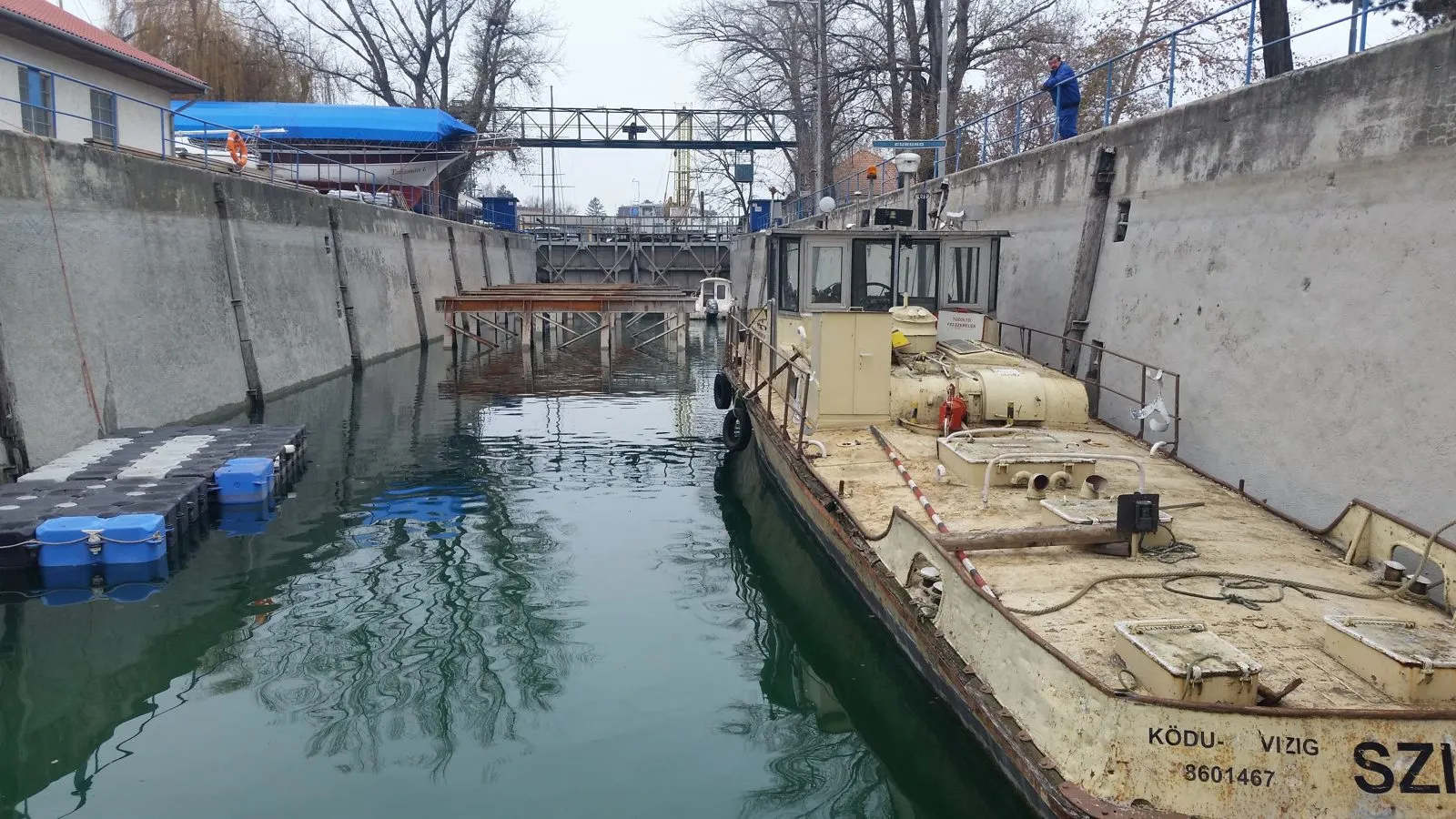
That moment arrived on 7 September, on Bazsi’s 50th birthday, of all days. Since mid-August he’d been listening to the Danube water-level reports with Argus eyes, waiting for the white smoke to rise – in the form of water. At noon he asked for the afternoon off work, rushed to the boat, and only just managed to get from the Danube up to the lock closing off the Sió. Luckily he’d observed earlier where the deepest part of the channel meanders in front of the lock, so the manoeuvre went off without a hitch – or a hang-up, literally.
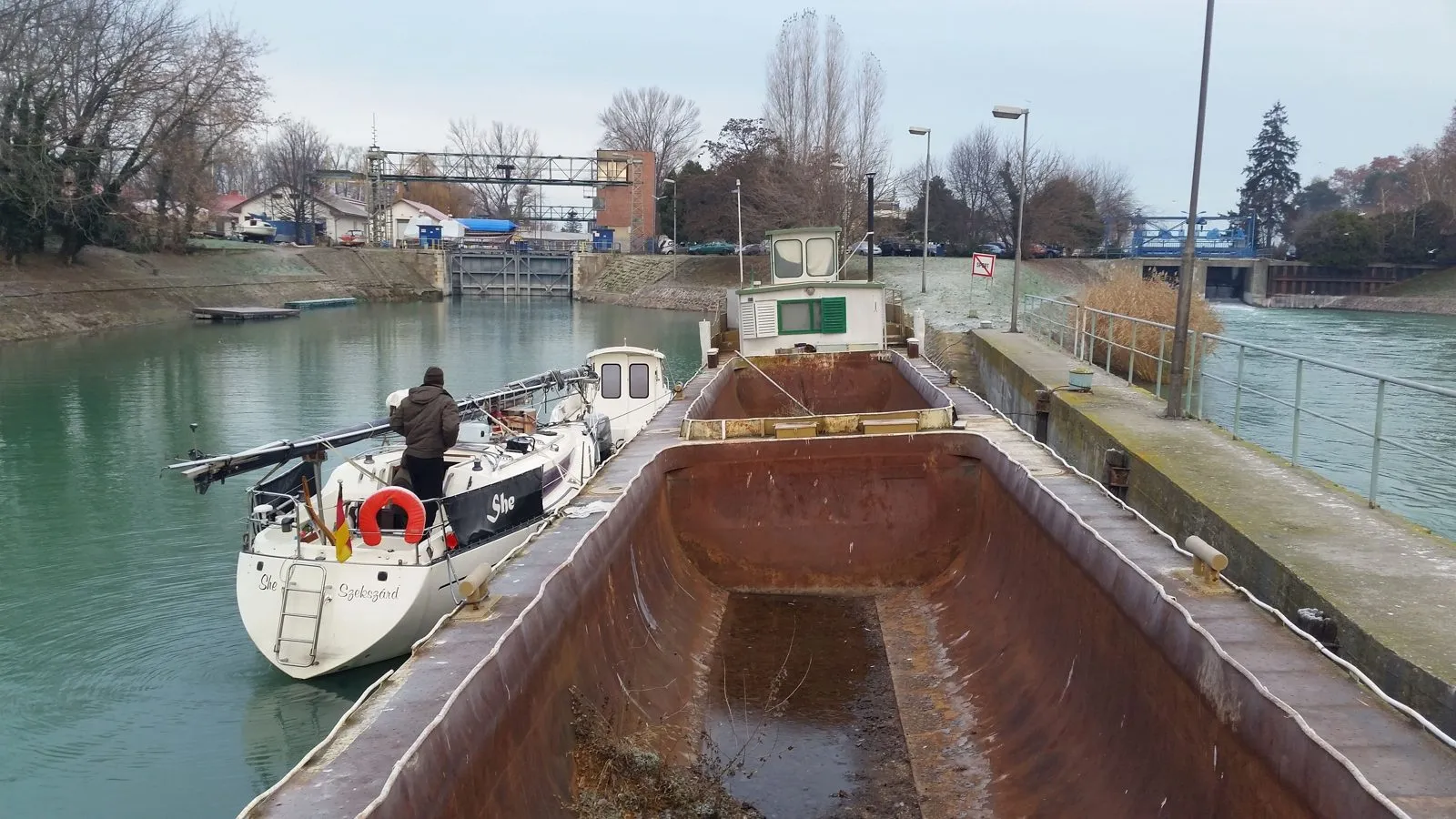
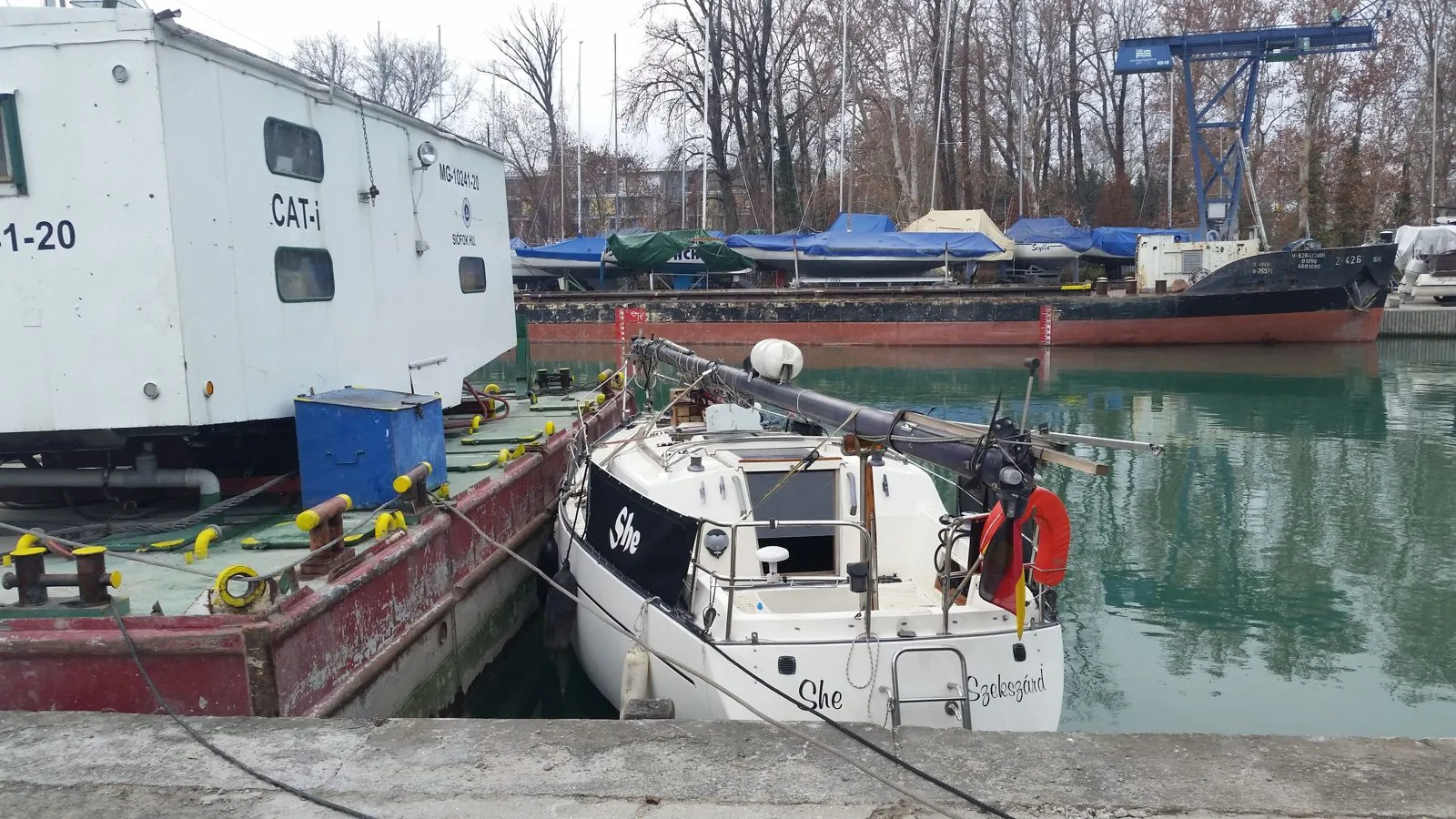
He locked straight through onto the Sió and, for lack of a better option, tied She up to the motor vessel Tenkes.
From then on, all he had to do was wait for them to start letting water out of Lake Balaton at some point, because only then does the Sió canal become navigable along its whole length – for a short while.
Bazsi and I agreed he’d let me know when that moment came, because I absolutely wanted to be there when he went up the Sió canal.
October
The water authority had this date – the start of lowering Lake Balaton – pencilled in for mid-October, but then for some reason it got pushed back. No harm done, I had plenty on my plate and would have struggled to find the time.
November
Then November slowly went by as well, and only towards the end of the month did they open the tap at Siófok. It takes at least a week for the Sió’s bed to fill up enough to become navigable, with a water depth of about 2 metres.
December
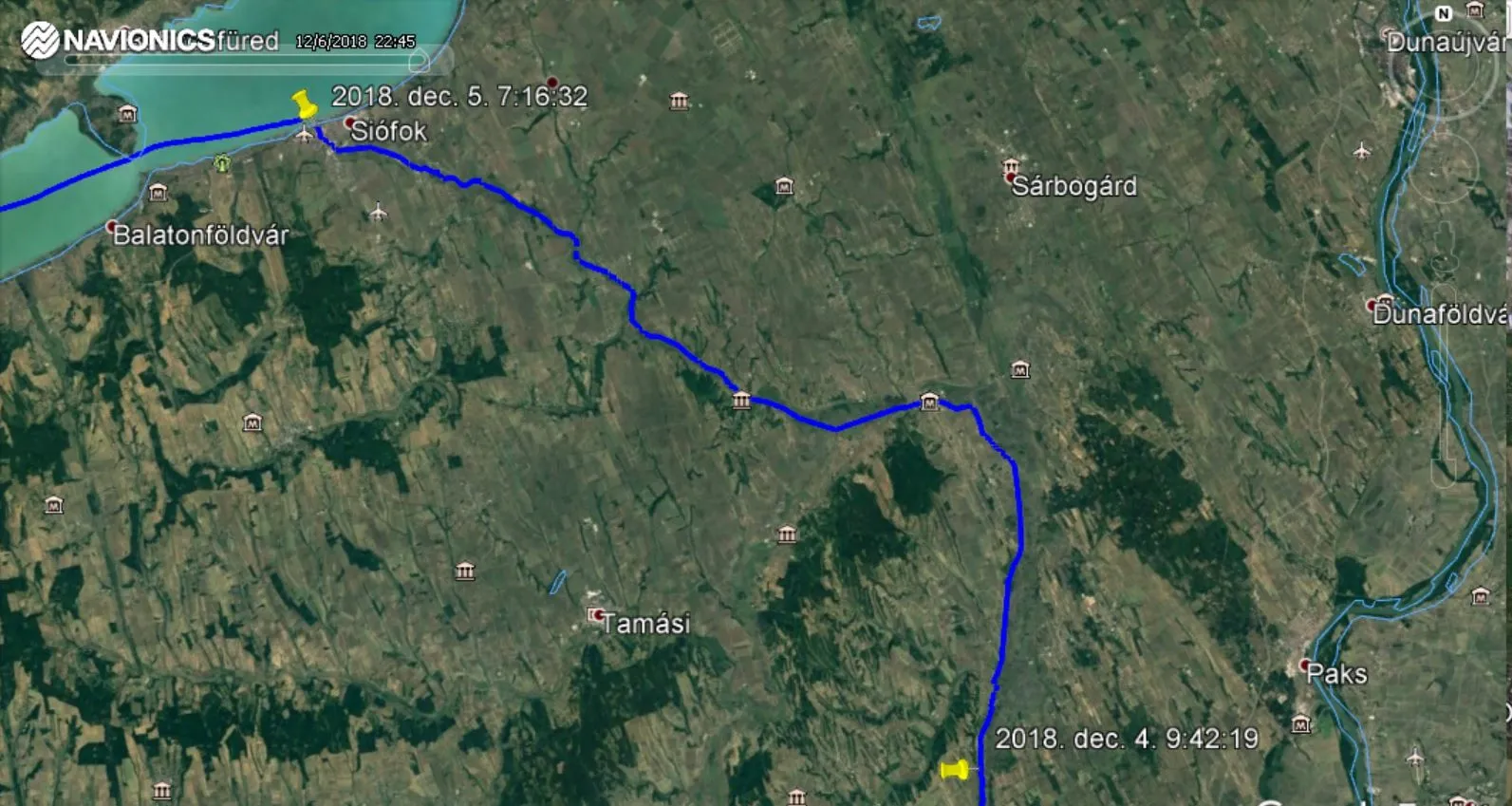
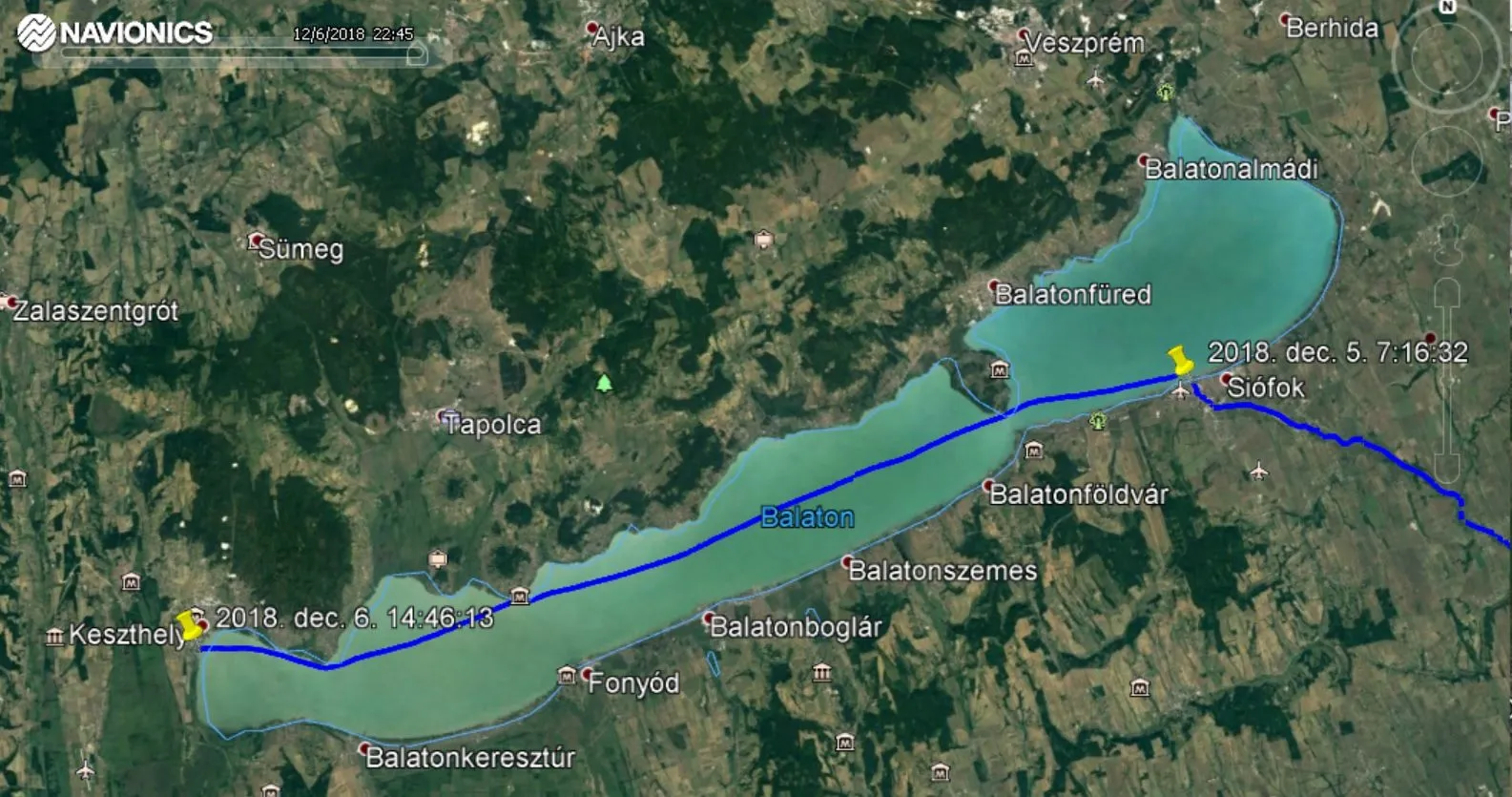
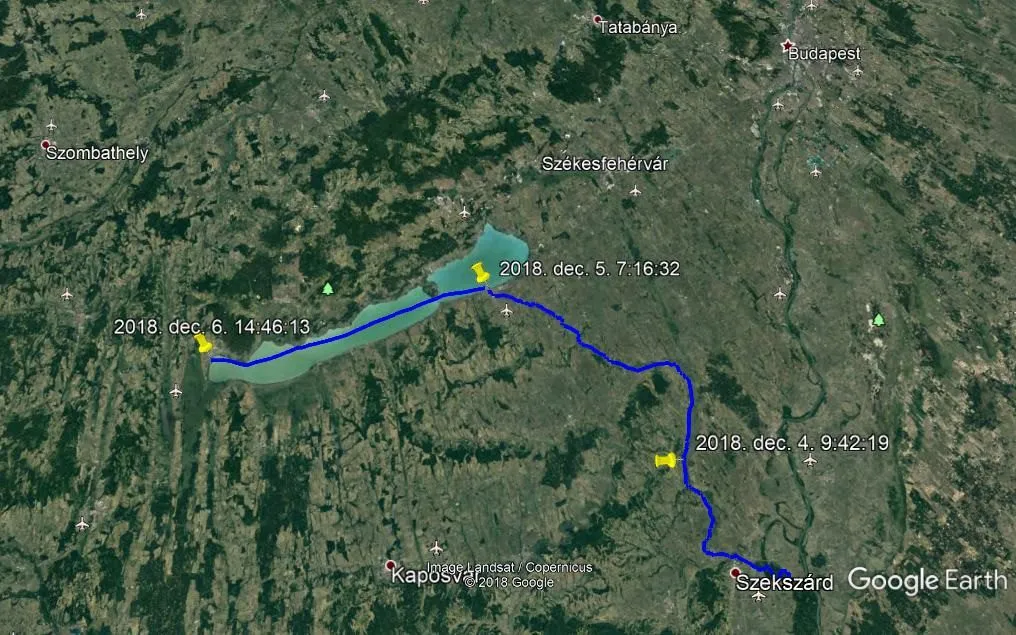
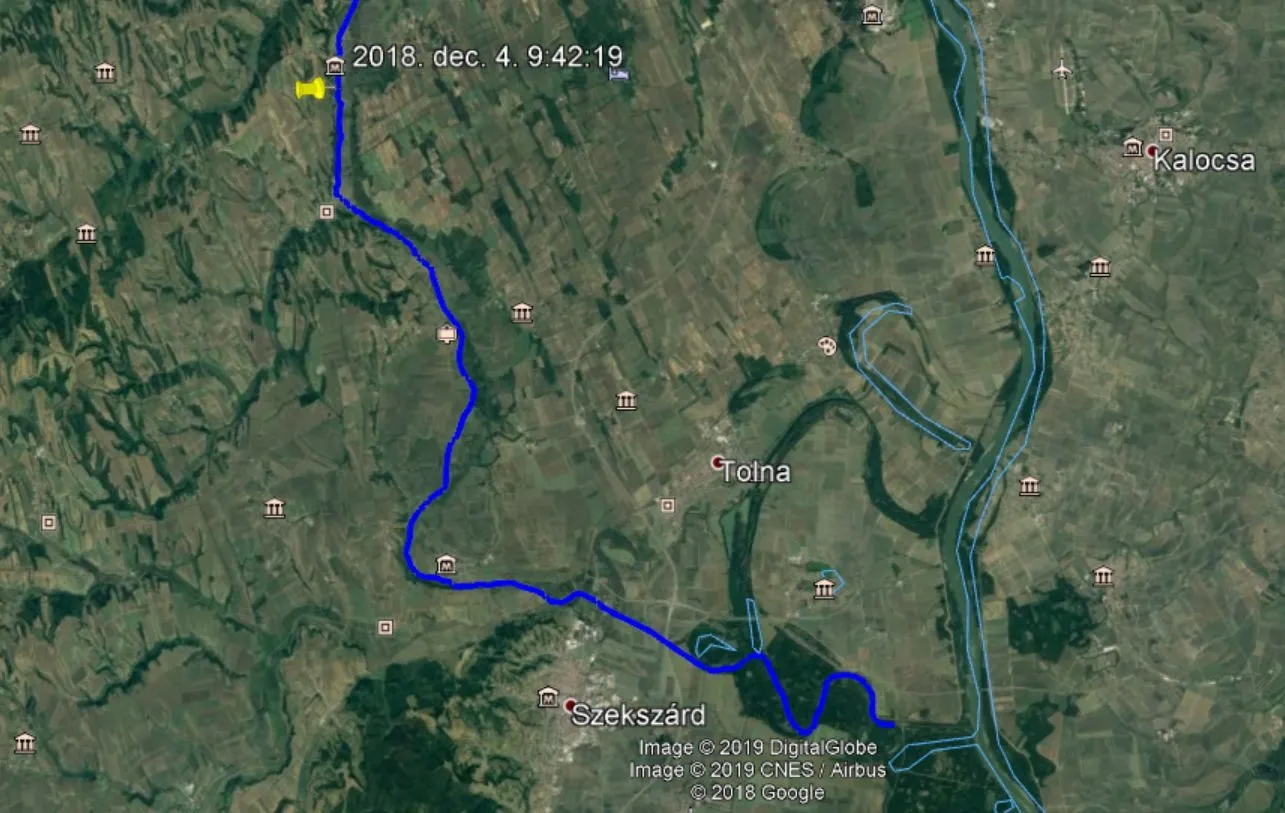
Finally on 3 December we got the green light from the competent water authority, after one of their motorboats had come all the way down the 120 km canal from Siófok to the Danube lock and declared the stretch navigable.
In the afternoon I drove down to Bazsi’s place so we could set off the next day on this once again far-from-everyday trip, which – given the calendar – promised to be a real St Nicholas cruise as well (in Hungary Mikulás, St Nicholas, brings the presents on 6 December).
Tuesday, 4 December 2018
Day 1, 45 km
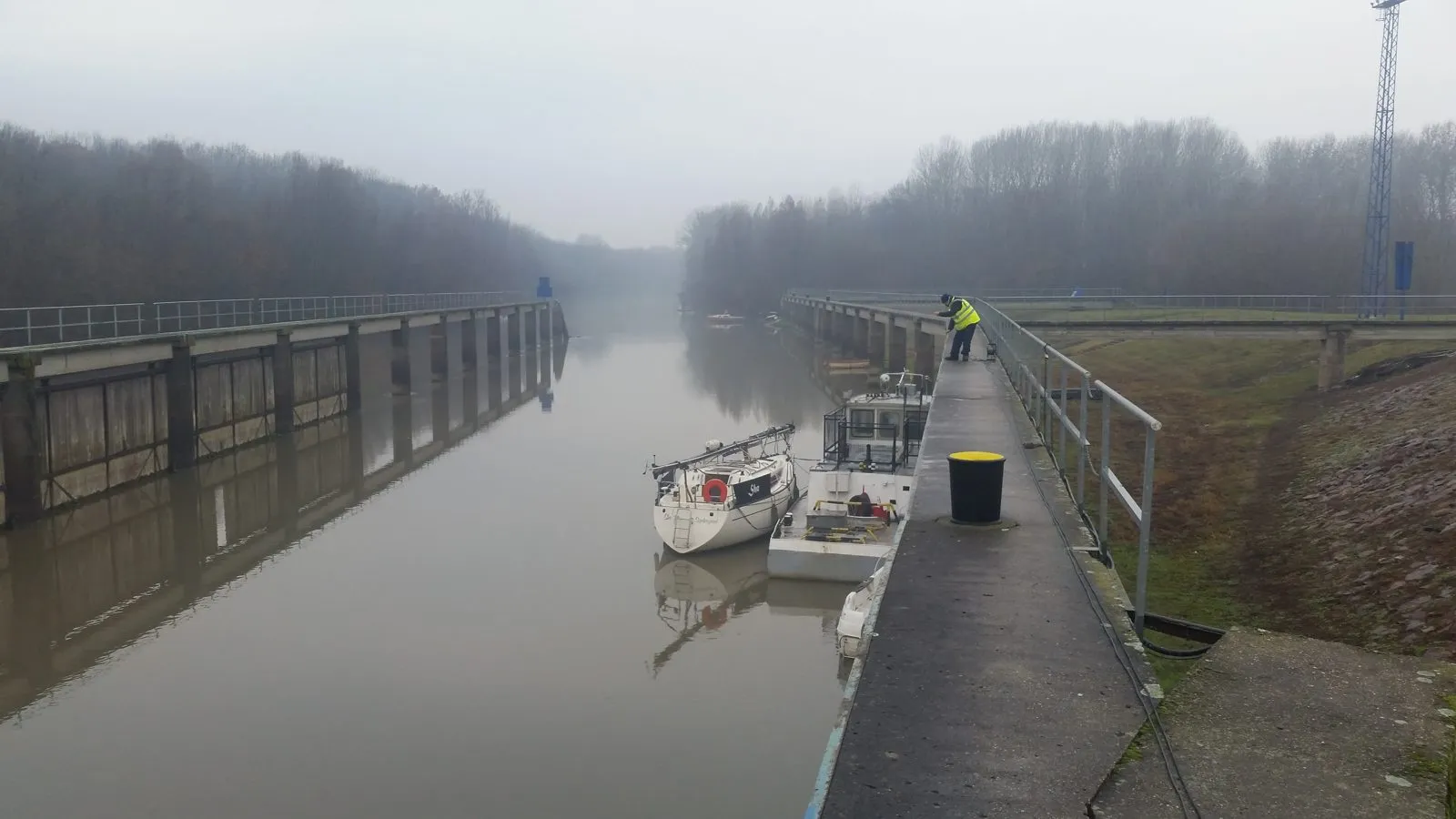
In the morning we arrived at the Sió lock a good half hour late.
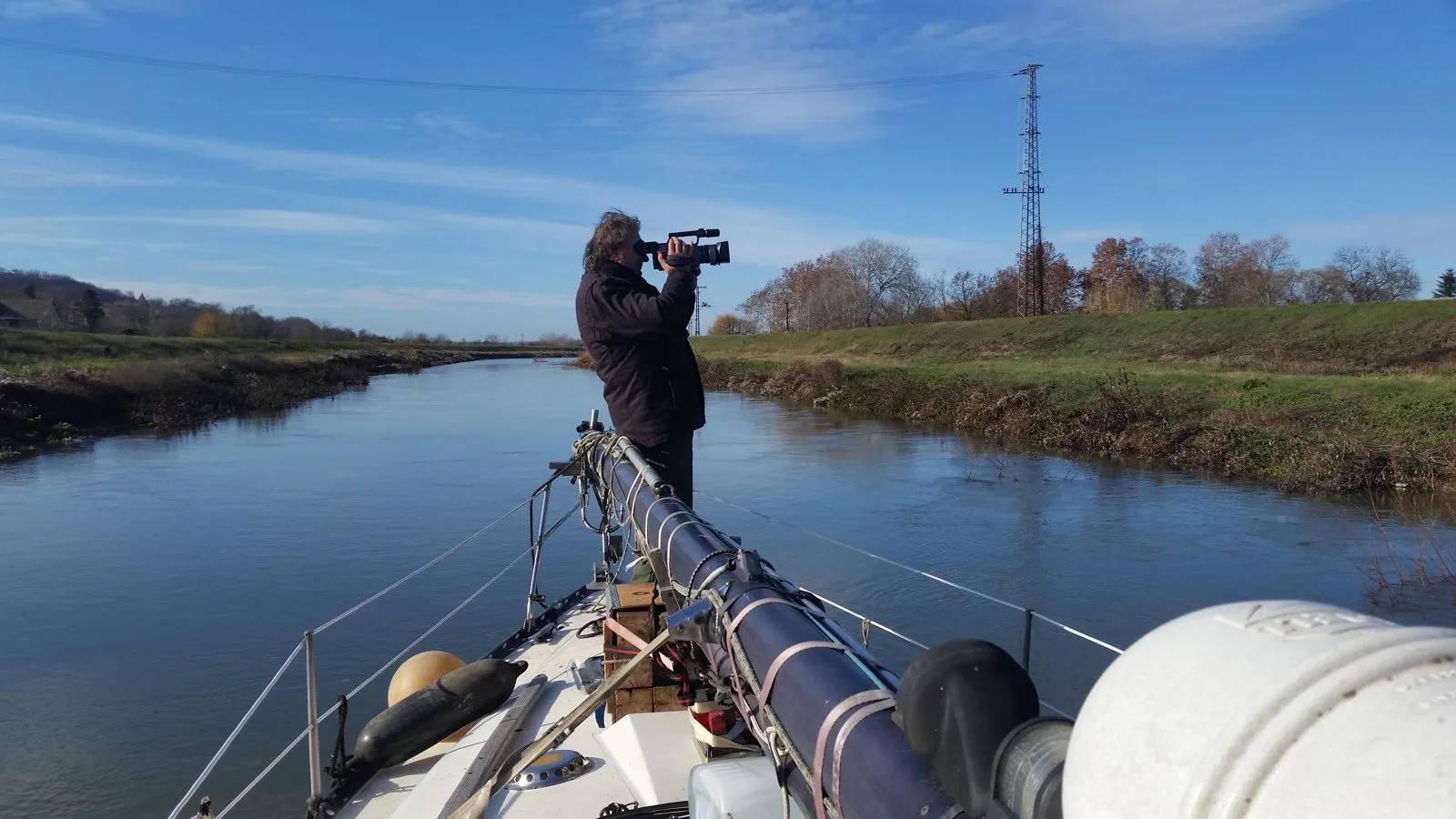
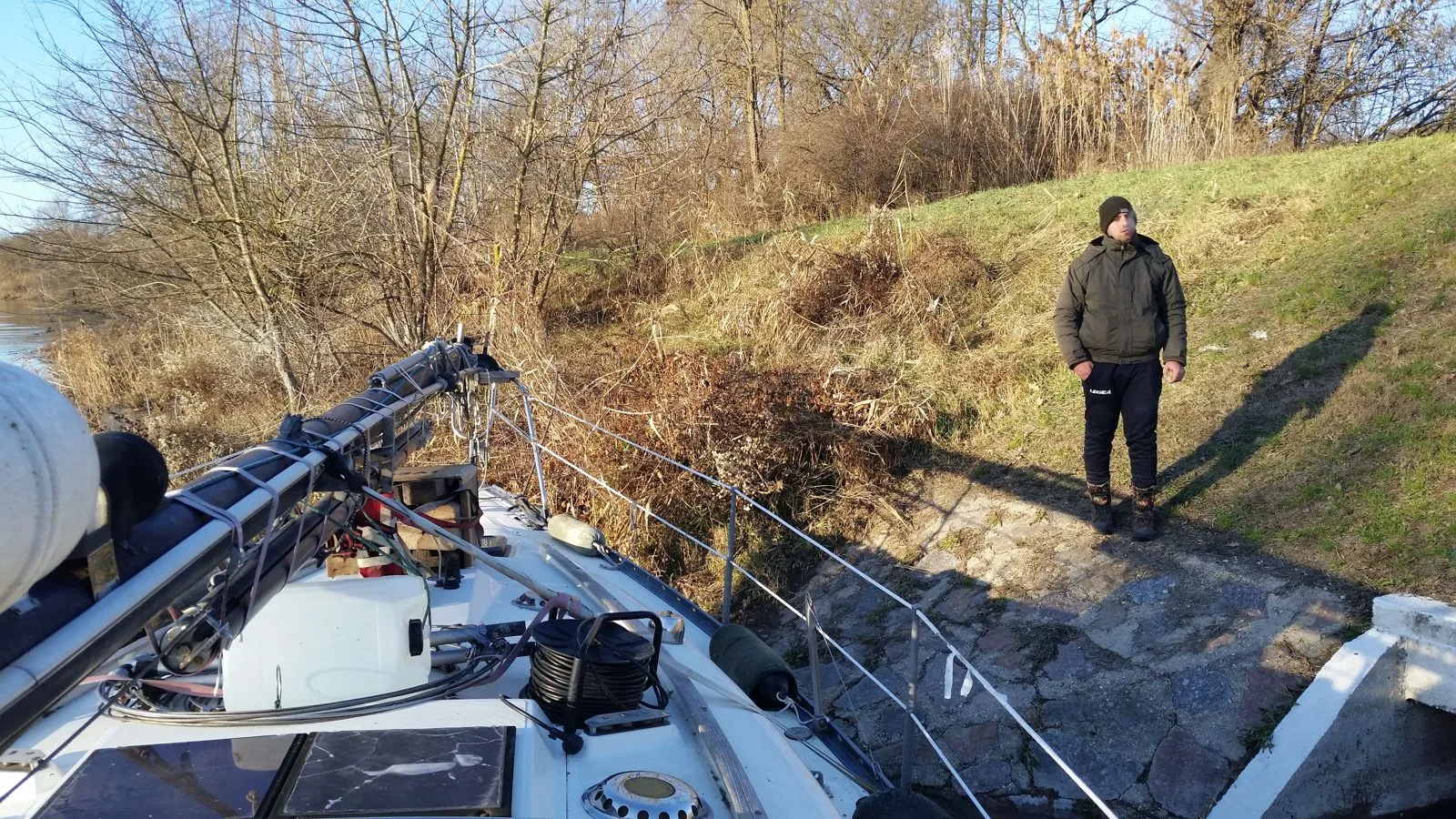
Our cameraman had been patiently waiting for us, slowly half freezing. He’ll be filming our departure and following us along the bank by car for a while too.
The water directorate’s little motorboat was also moored there; they’d come down from Siófok yesterday to check the canal was navigable.
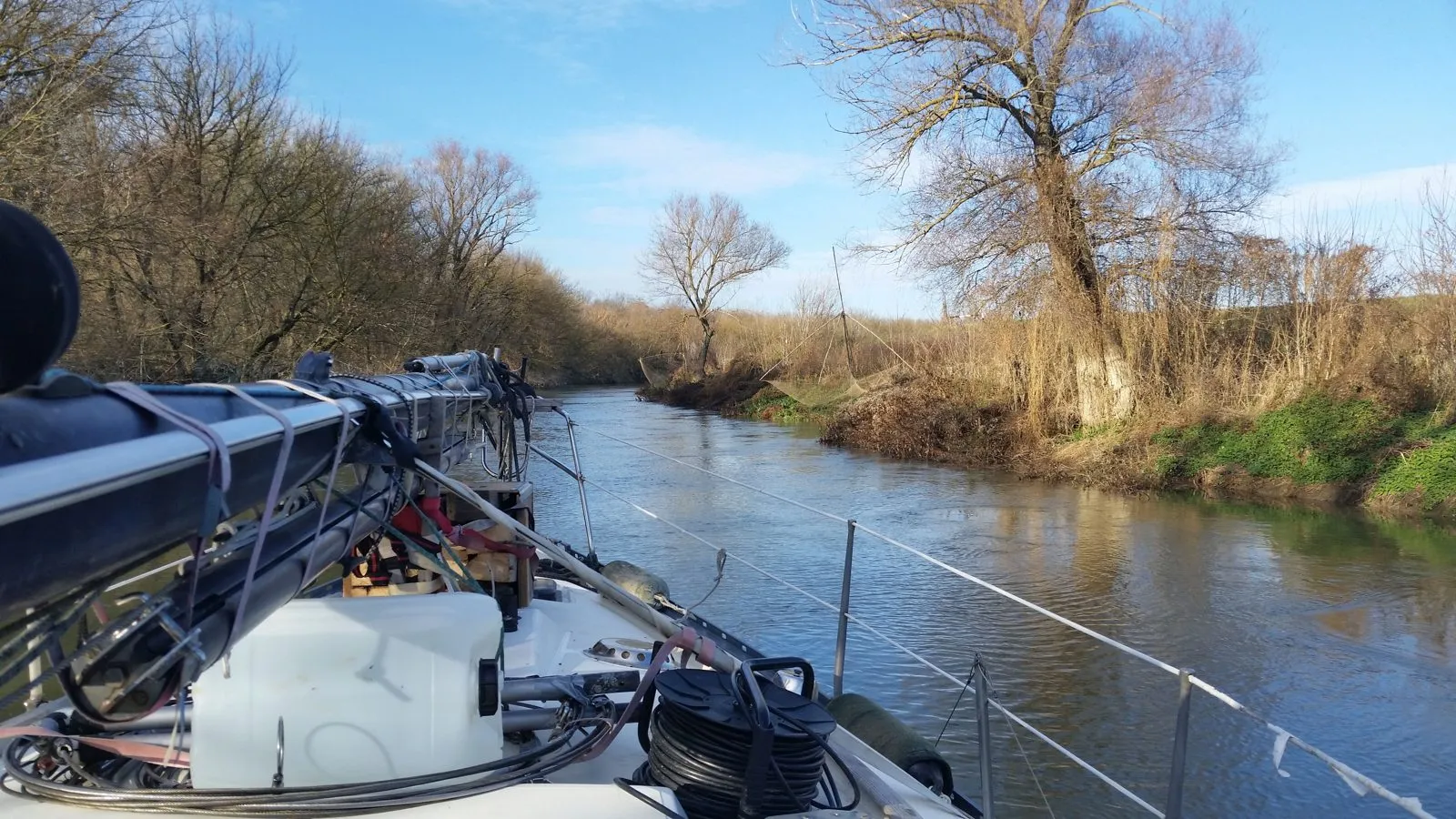
They said everything was fine, there were hardly any fallen trees this year, and they’d cut off the branches hanging in the worst. We saw the traces later.

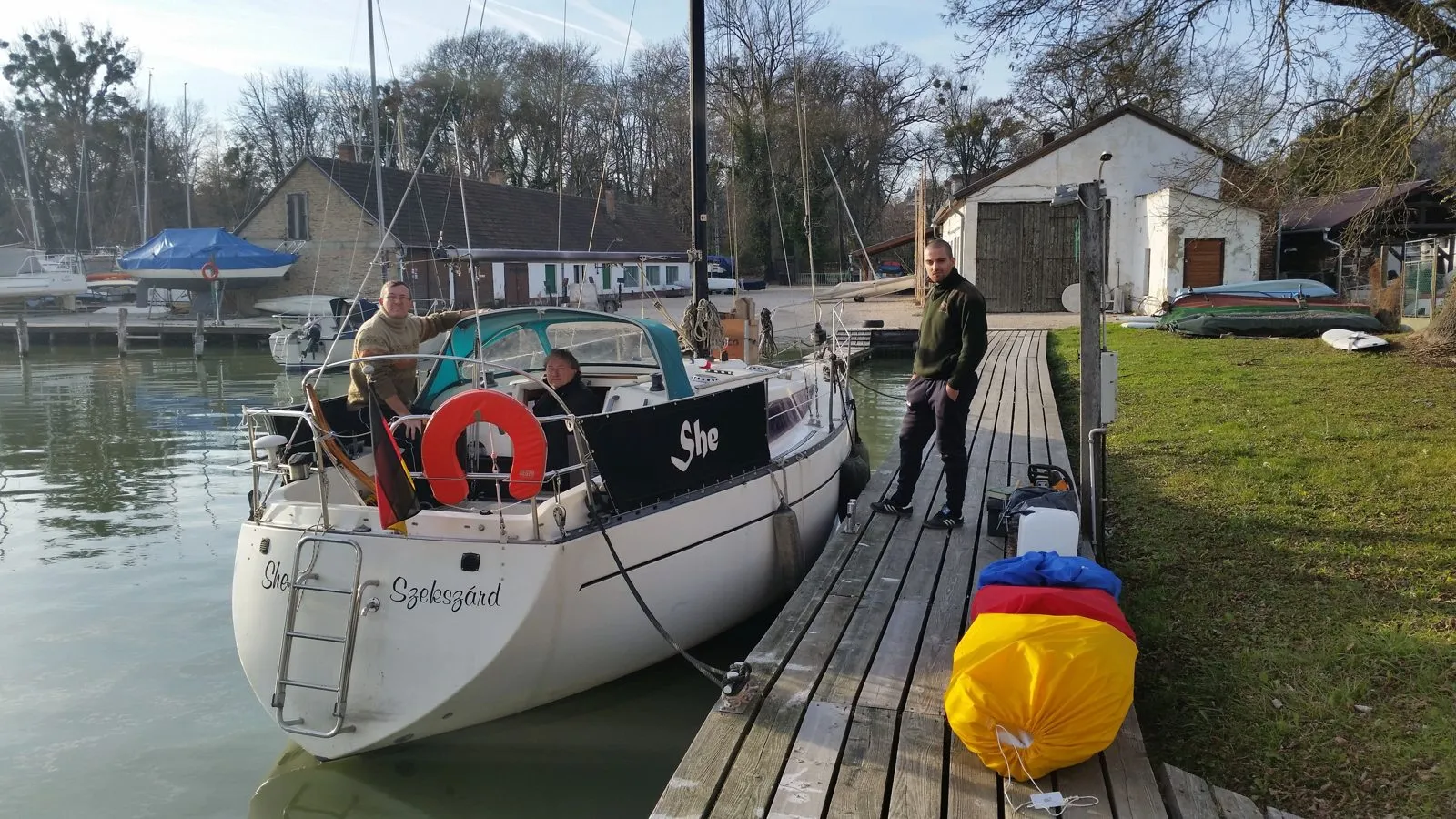
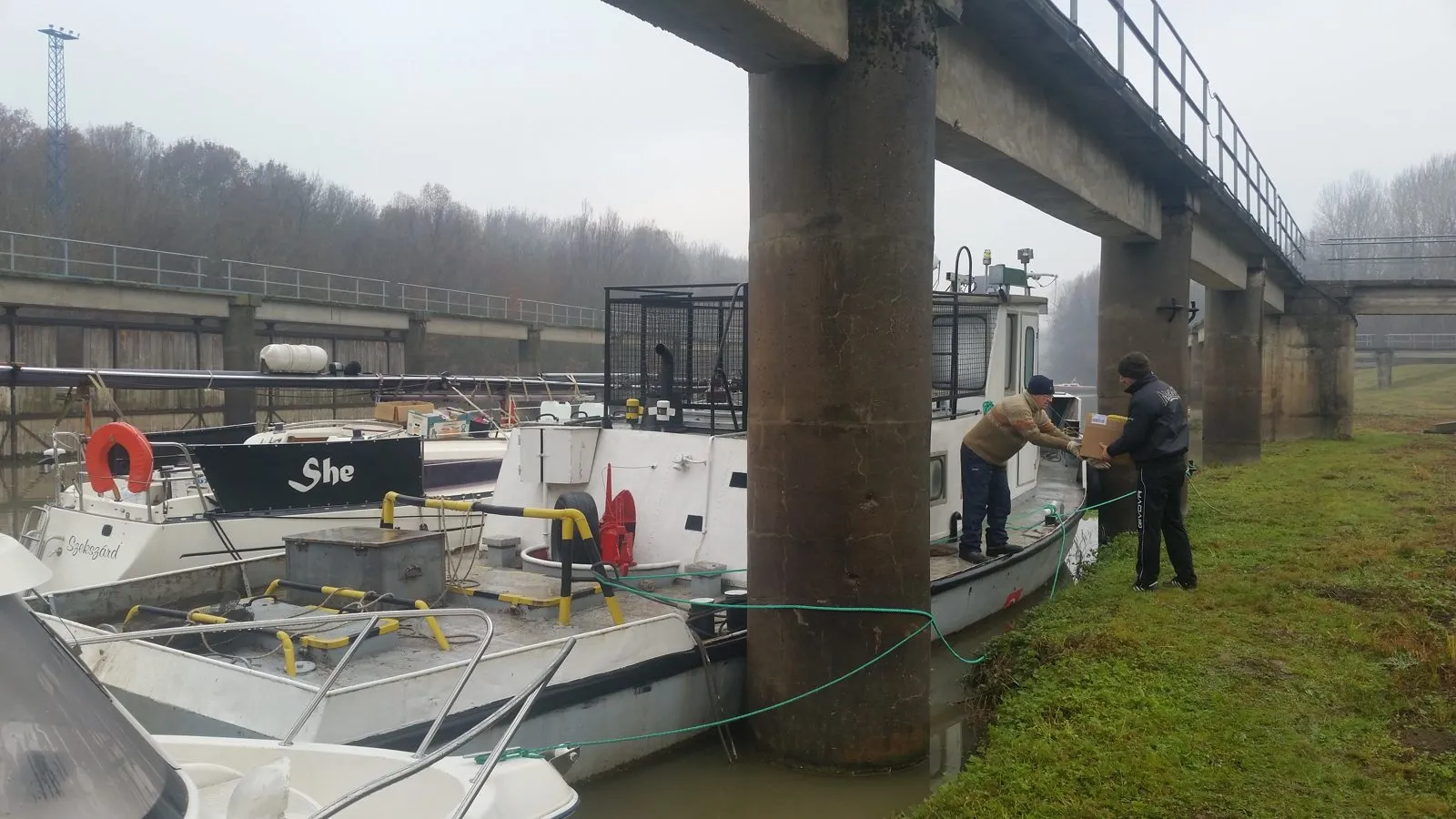
The She – for lack of a better option – is tied up to the motor vessel Tenkes, which has been lying here for a good few years.
In an extended human chain we passed our clobber across Tenkes on board, along with a week’s worth of food that Bazsi had bought in advance with Zsombor, who on top of it all managed to get himself a lumbago during the loading in one unlucky twist.
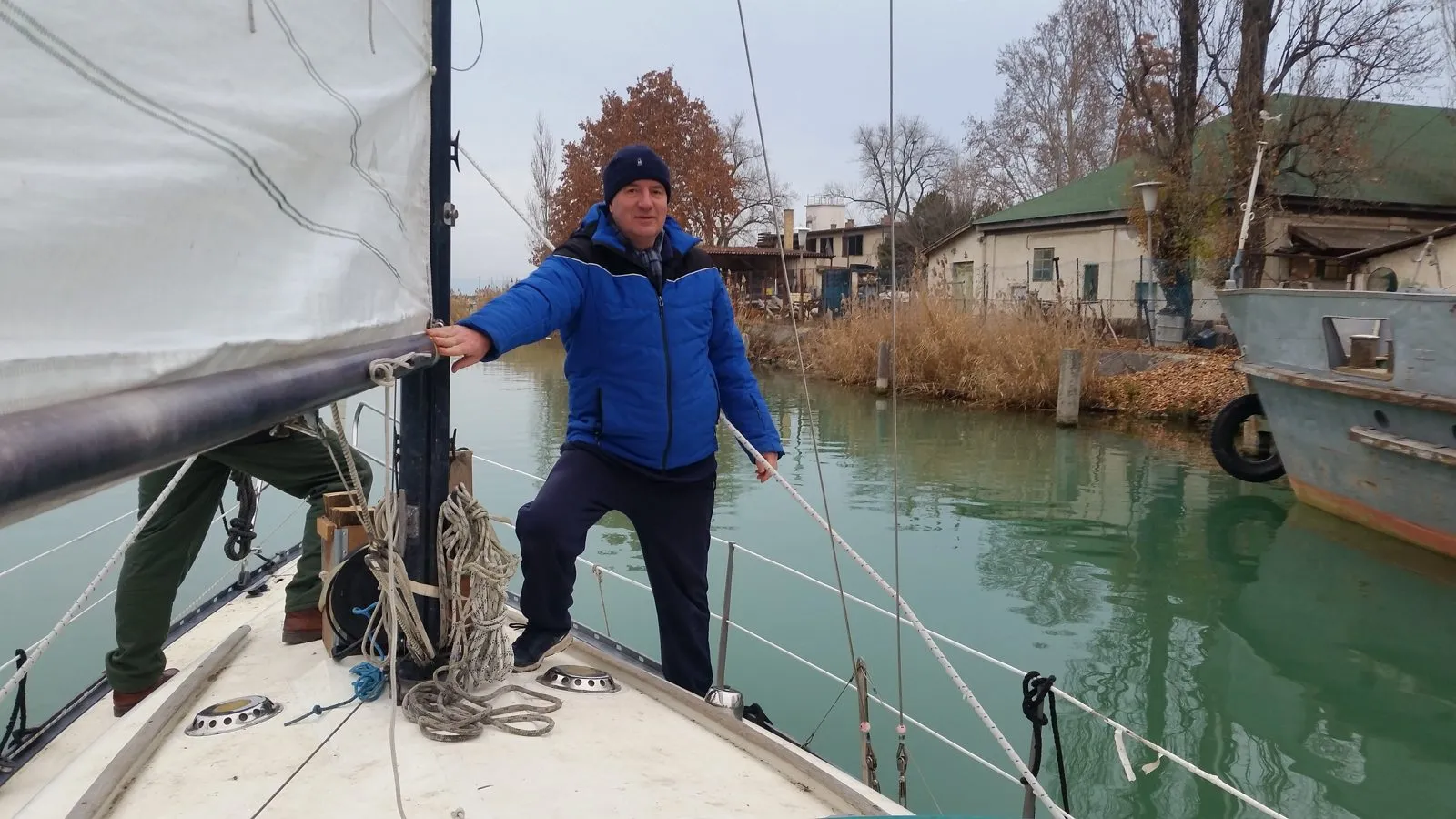
Once the lines were cleared, we signalled to the cameraman on the other bank that he could start shooting, we’re off. Bazsi blasted the canister foghorn and, looking anywhere but at the camera, we finally set off. Laci had impressed this on us – so the footage would look natural, documentary-style – and I think we did pretty well. Then it later turned out that nothing of the departure shot had worked, because the new cassette he’d put in wasn’t designed for this kind of thing and didn’t record the momentous event.
Never mind – well, pity, because we were so enthusiastically not waving, and so sincerely not smiling… And none of it is immortalised… :((
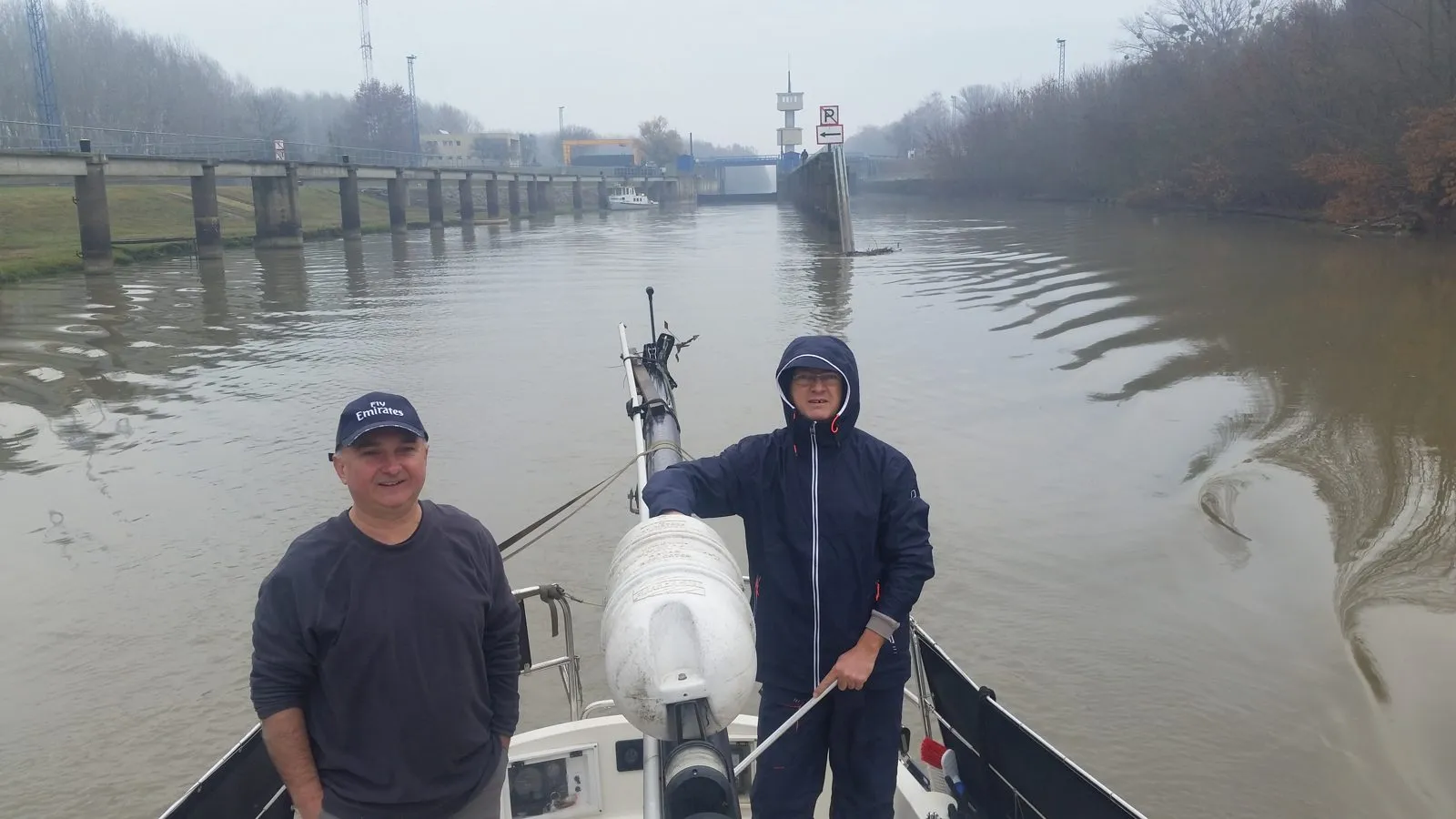
The first stretch of our route led through the Gemenc Forest.
Ah, the Gemenc Forest…
It’s simply gorgeous! Bleating fawns stroll among lush foliage, stags bellow when they’re thirsty or something else is bothering them, a gentle breeze rustles the green leaves…
In summer.
In SUMMER, I said!
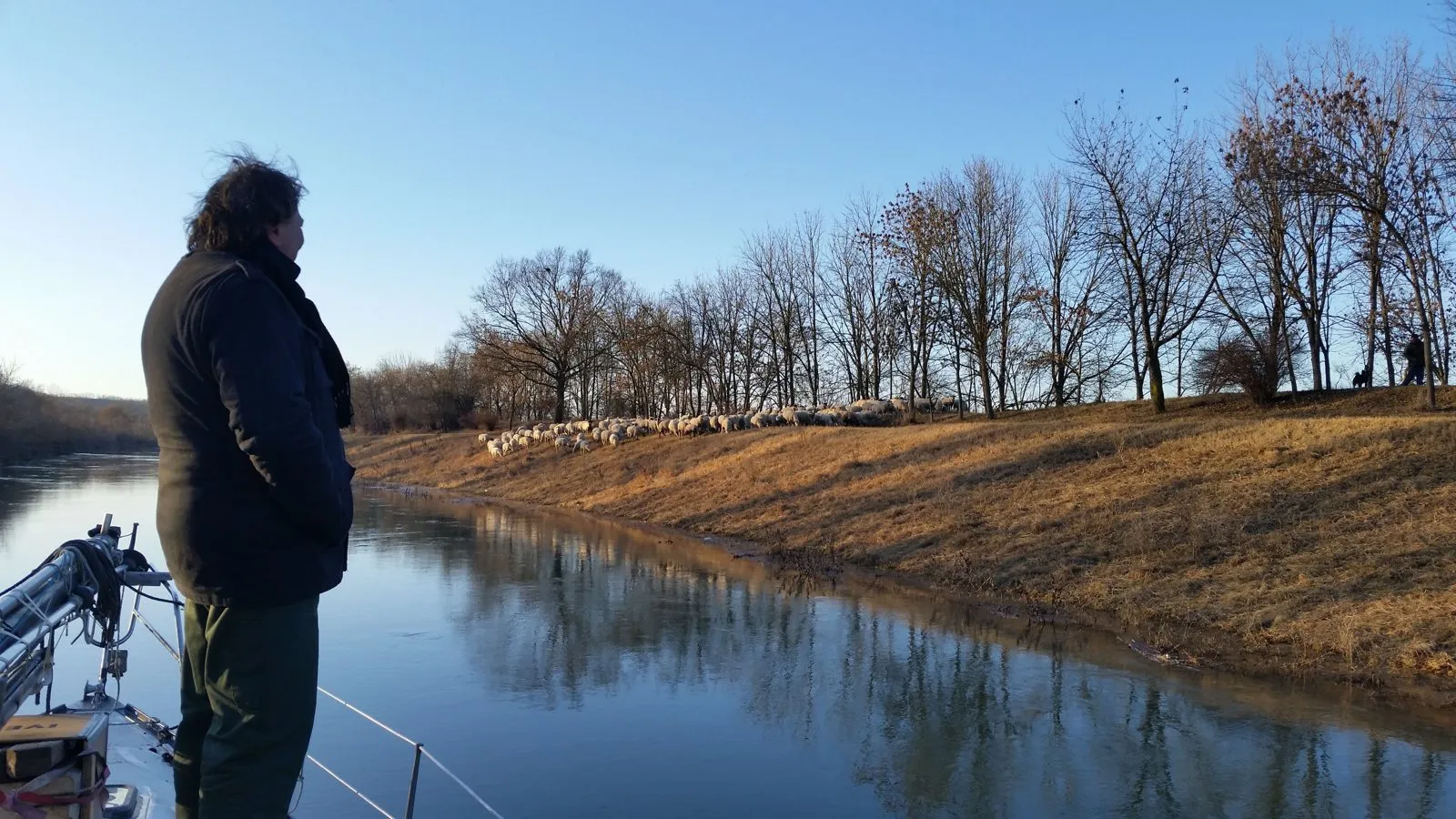
But now it’s winter. Only dried-out grey trees and bushes loom in the morning fog, tracks of wild boar rooting show in the mud, in the drizzling rain.
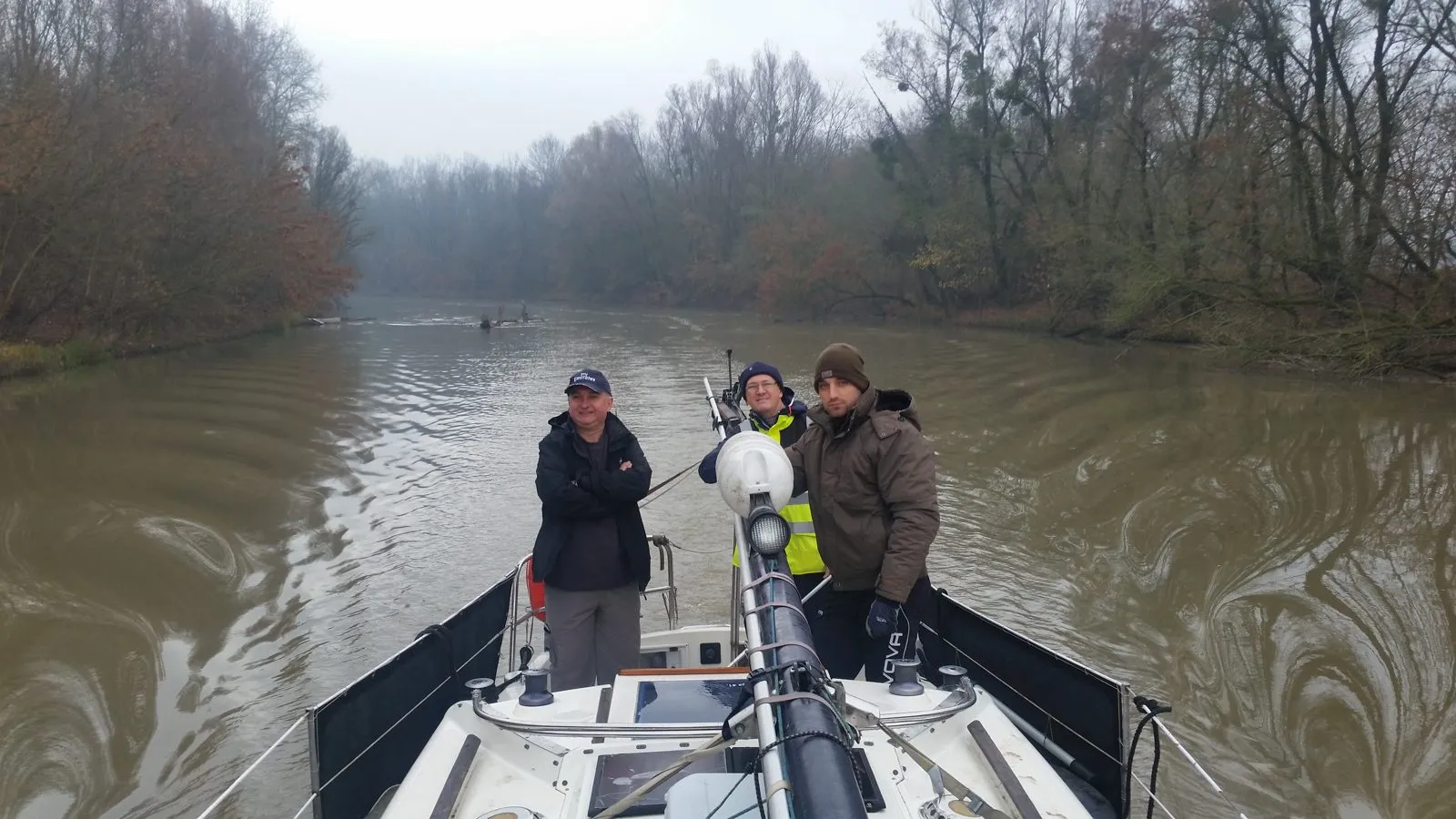
It takes a very sharp eye for someone out on the water to see the beauty of nature and the thick tree trunks gnawed by beavers in this gloomy weather…
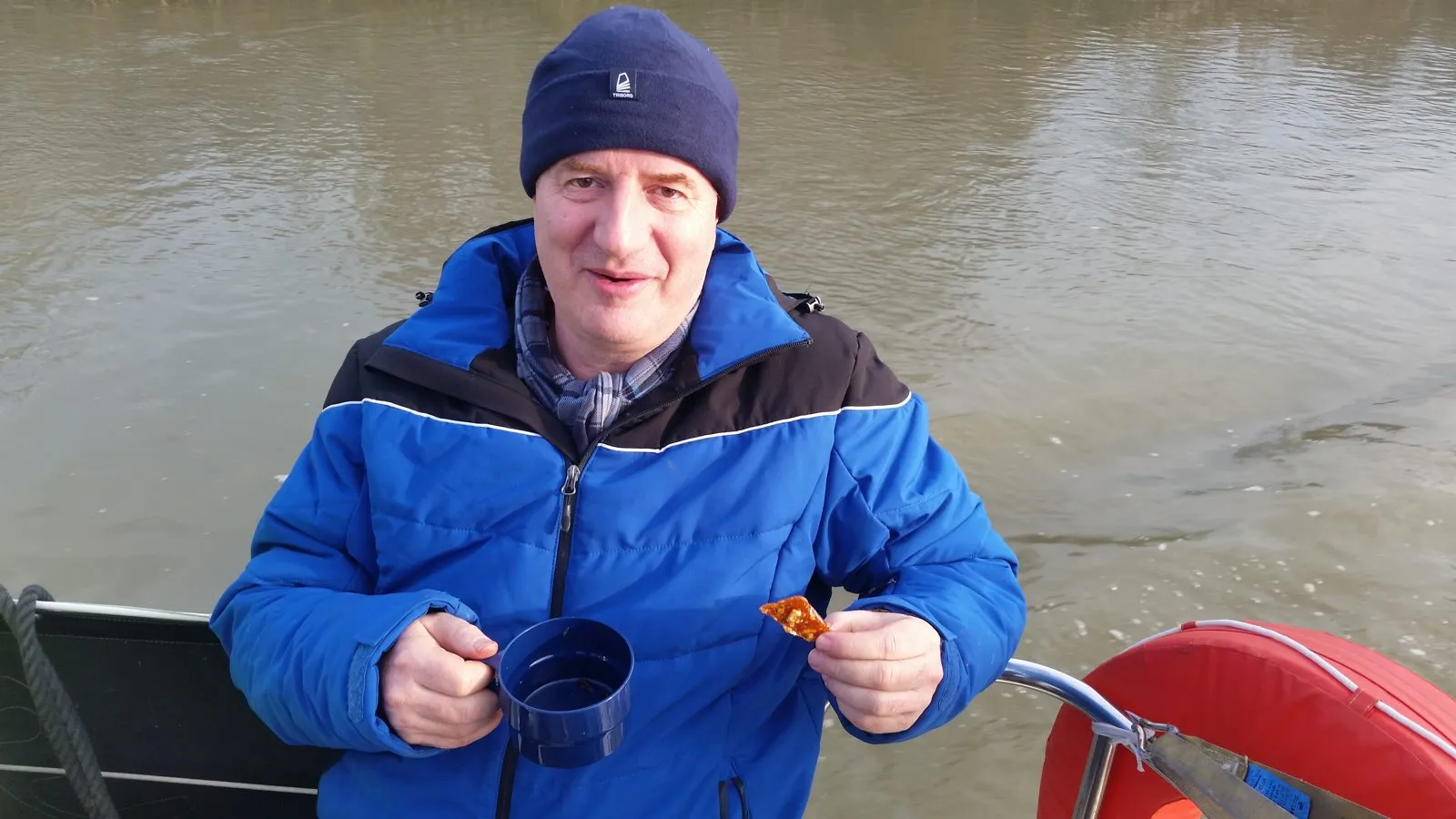
On the other hand, there’s mulled wine!
With orange and cloves, just as Gyula conjured it up for us.
Take a few sips and the world is instantly rosier as you look at it through the warm glass…
Thus recharged, we motor on between the dykes, reaching one bridge after another, where each time our cameraman was waiting for us, lying in pensive ambush. We stand around the wheel with our backs to him, just so the overall picture looks natural…
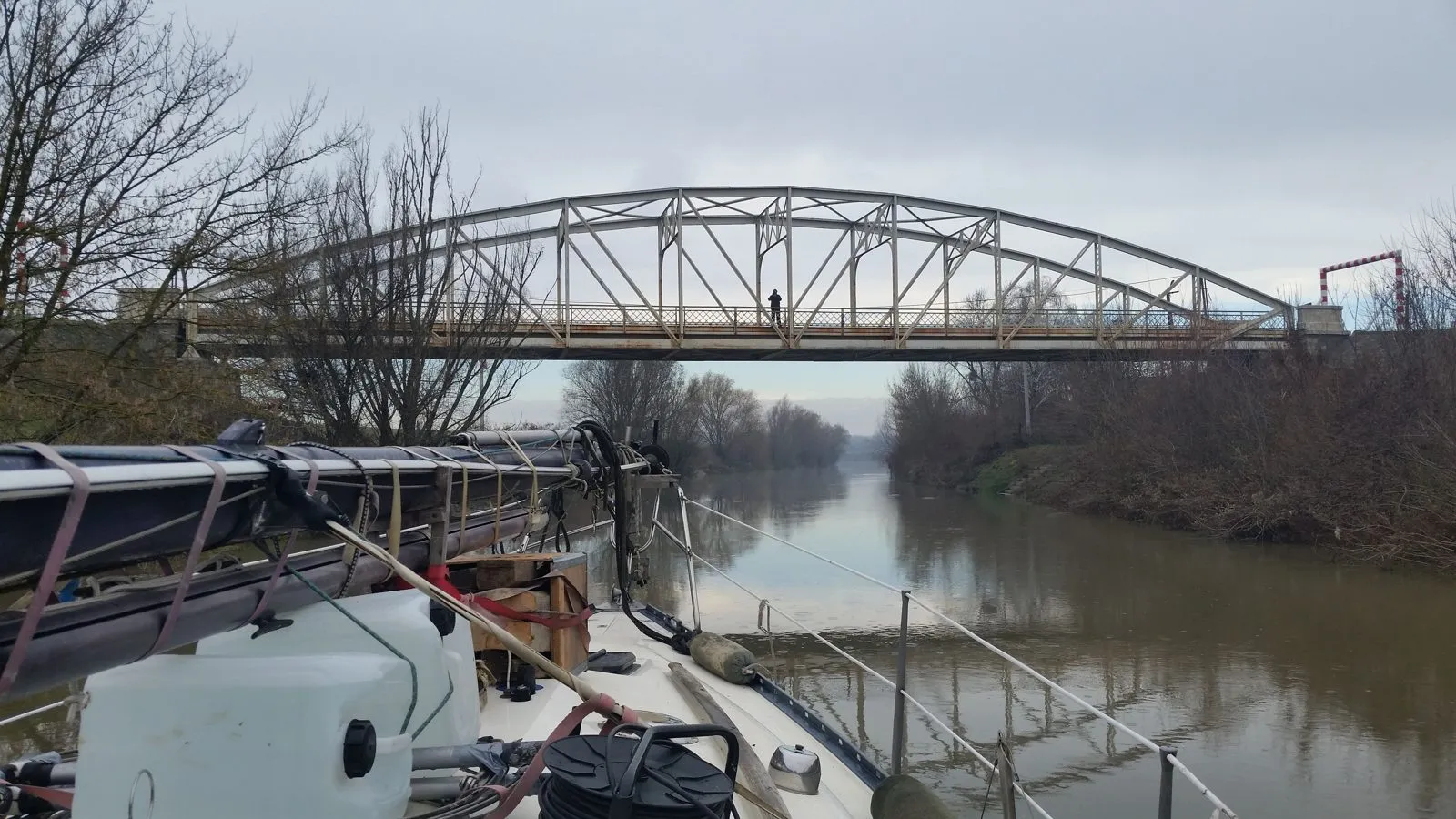
We pass the Szekszárd hills, looking at the holiday homes and the moored boats, and meanwhile I manage not to notice the two-masted boat built by our cameraman Laci with his own hands.
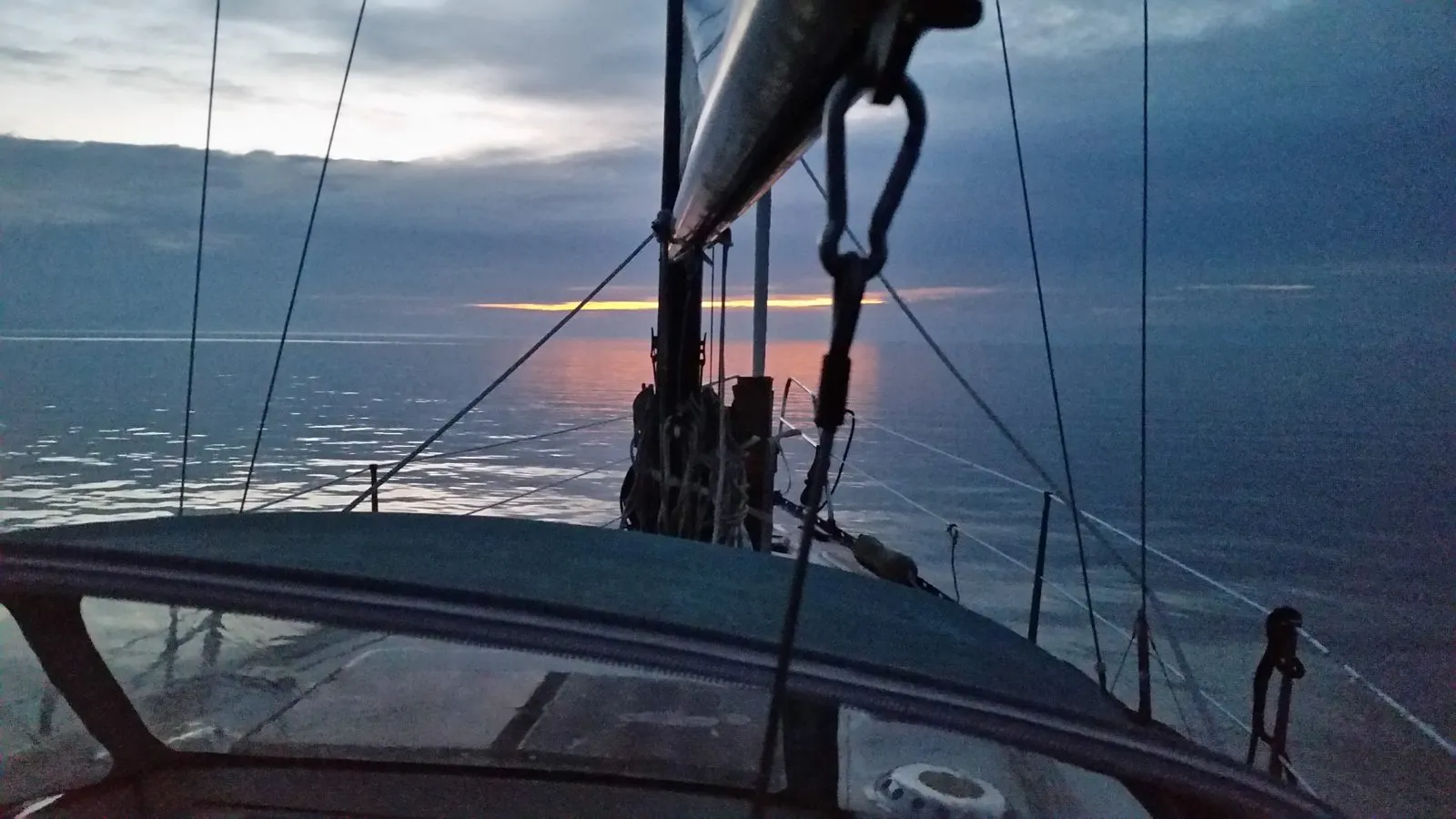
Around two in the afternoon the clouds finally break up, the sun comes out, with a good hour left in it. Now that’s quite different, it lifts your mood. Since 11 o’clock we’d been predicting that the hole in the clouds would get here, or we’d get there, but somehow, without us noticing, it always turned out otherwise…

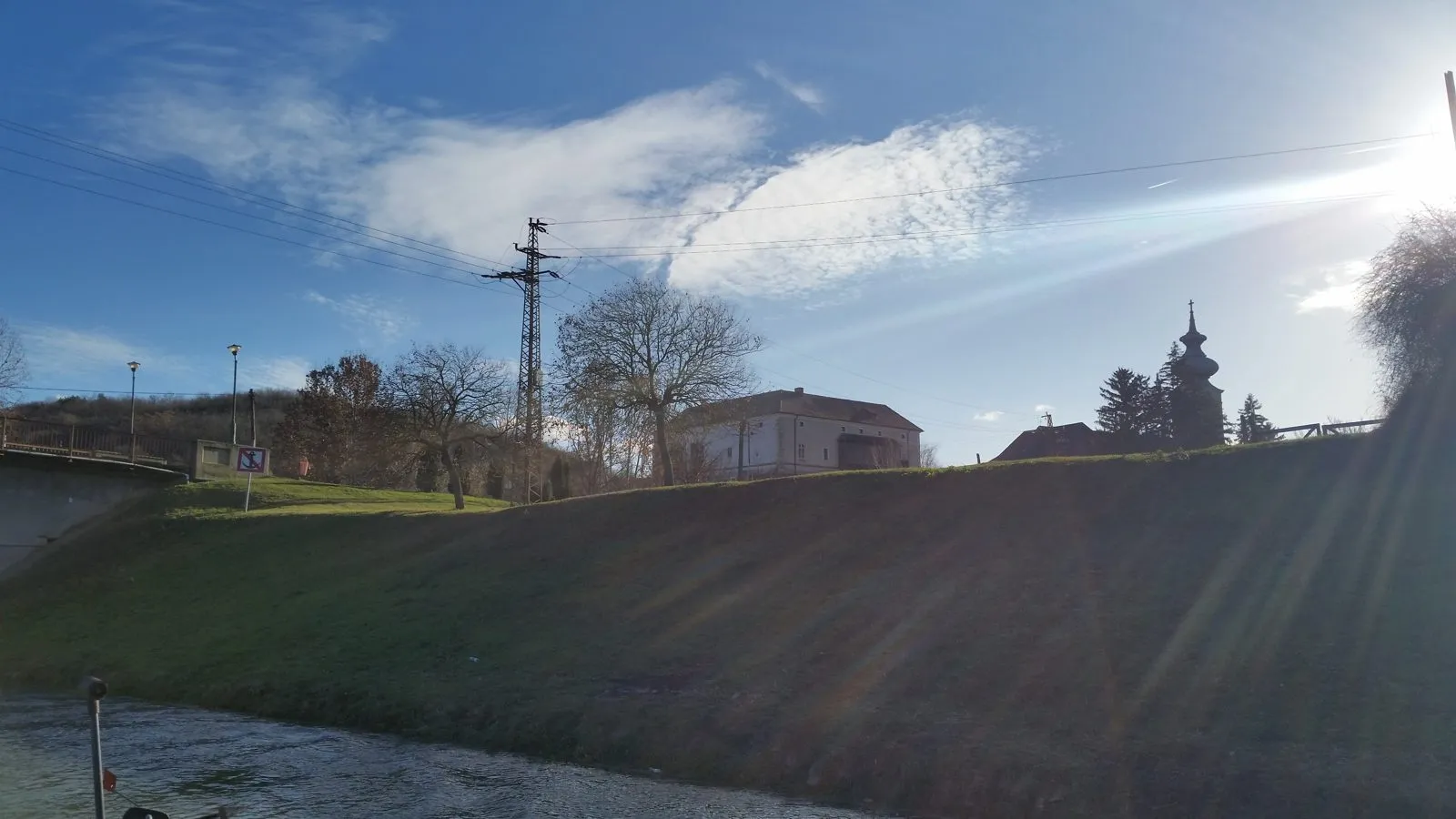
It’s slowly getting dark, and Bazsi decides we’ll sleep at Borjád, mooring by the dyke keeper’s house.
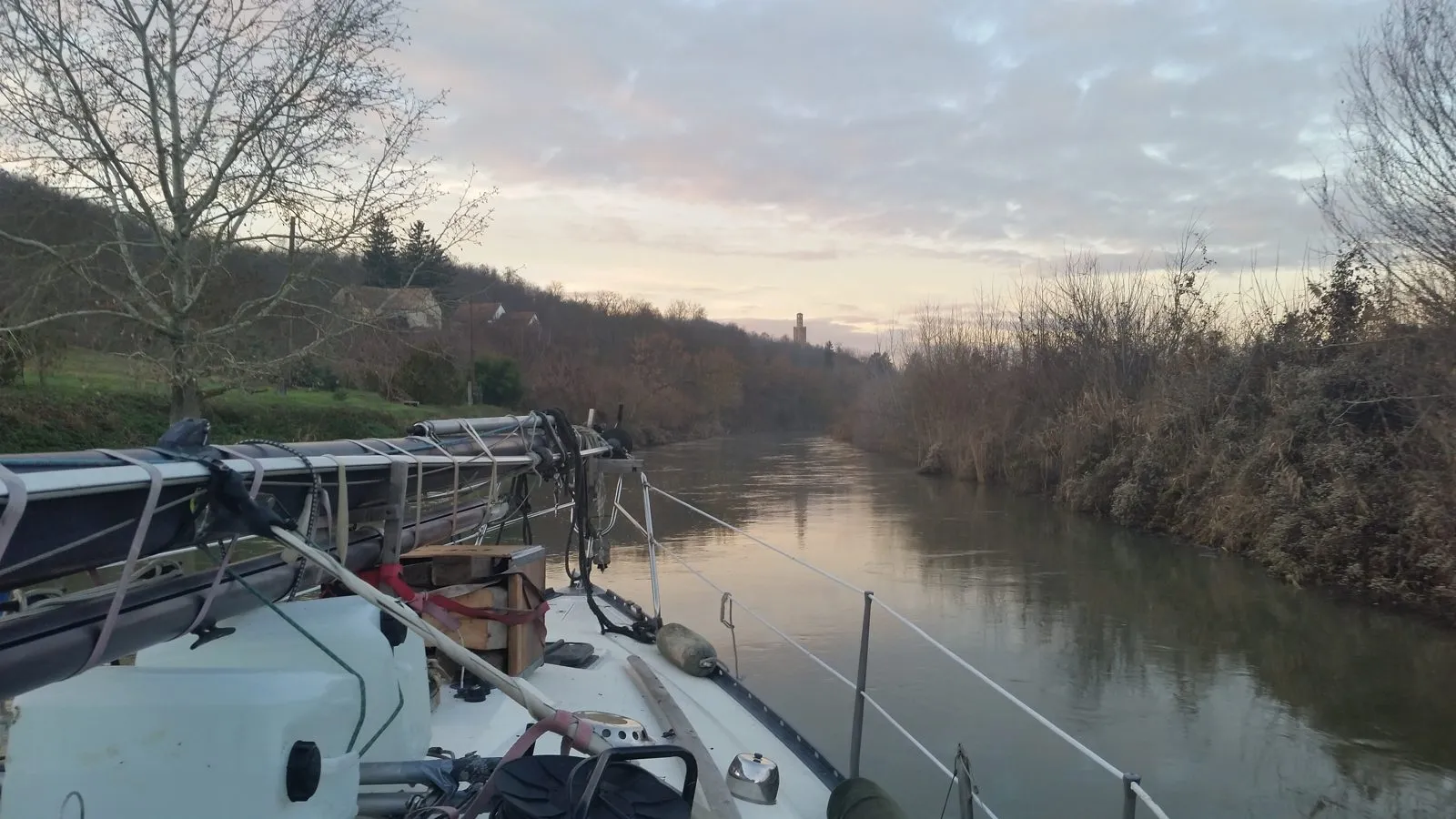
We found it. We tied the bow to the stair railing (here at the edge of the Sió the current isn’t so strong), and the stern to a tree on the bank.
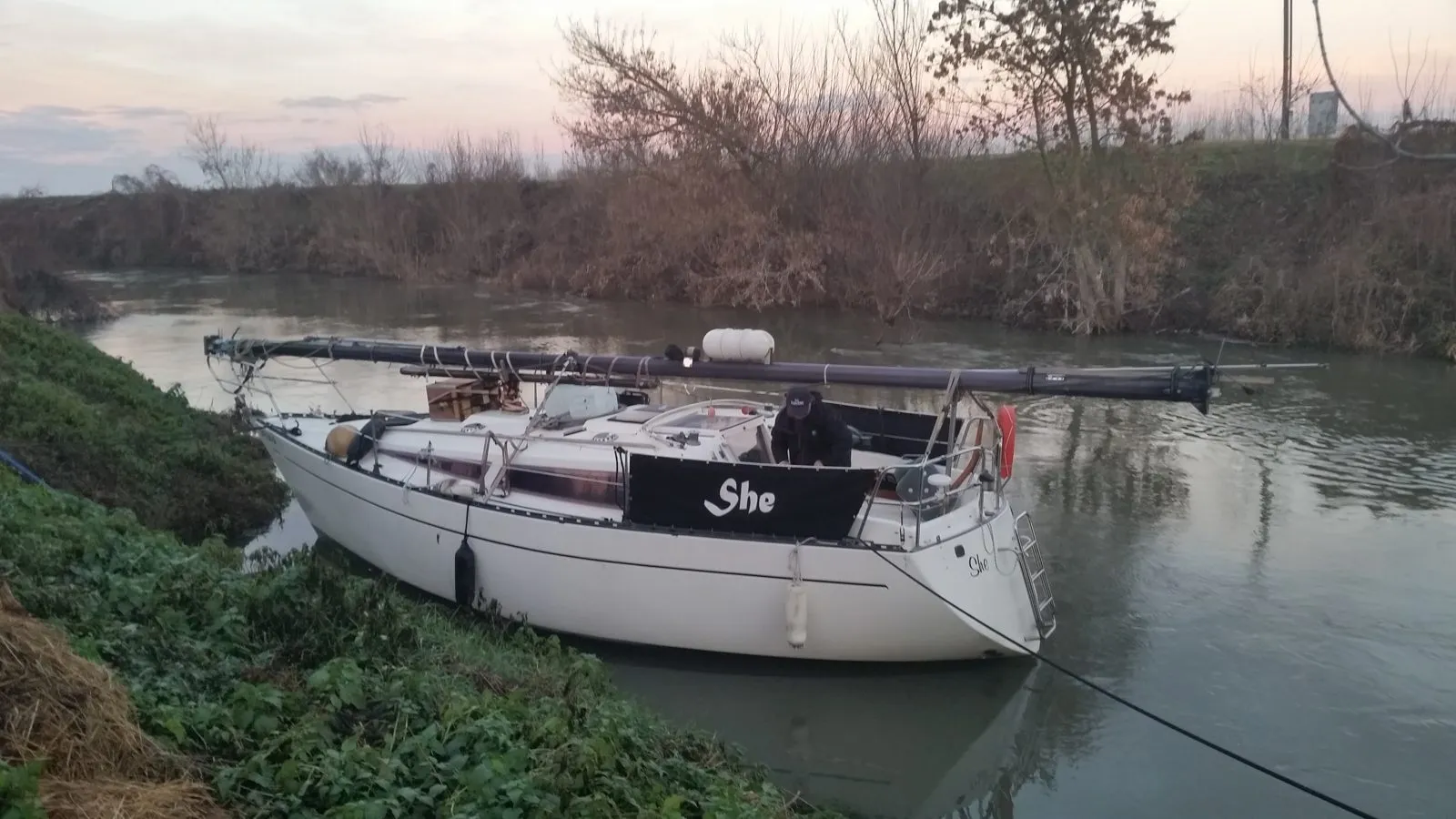
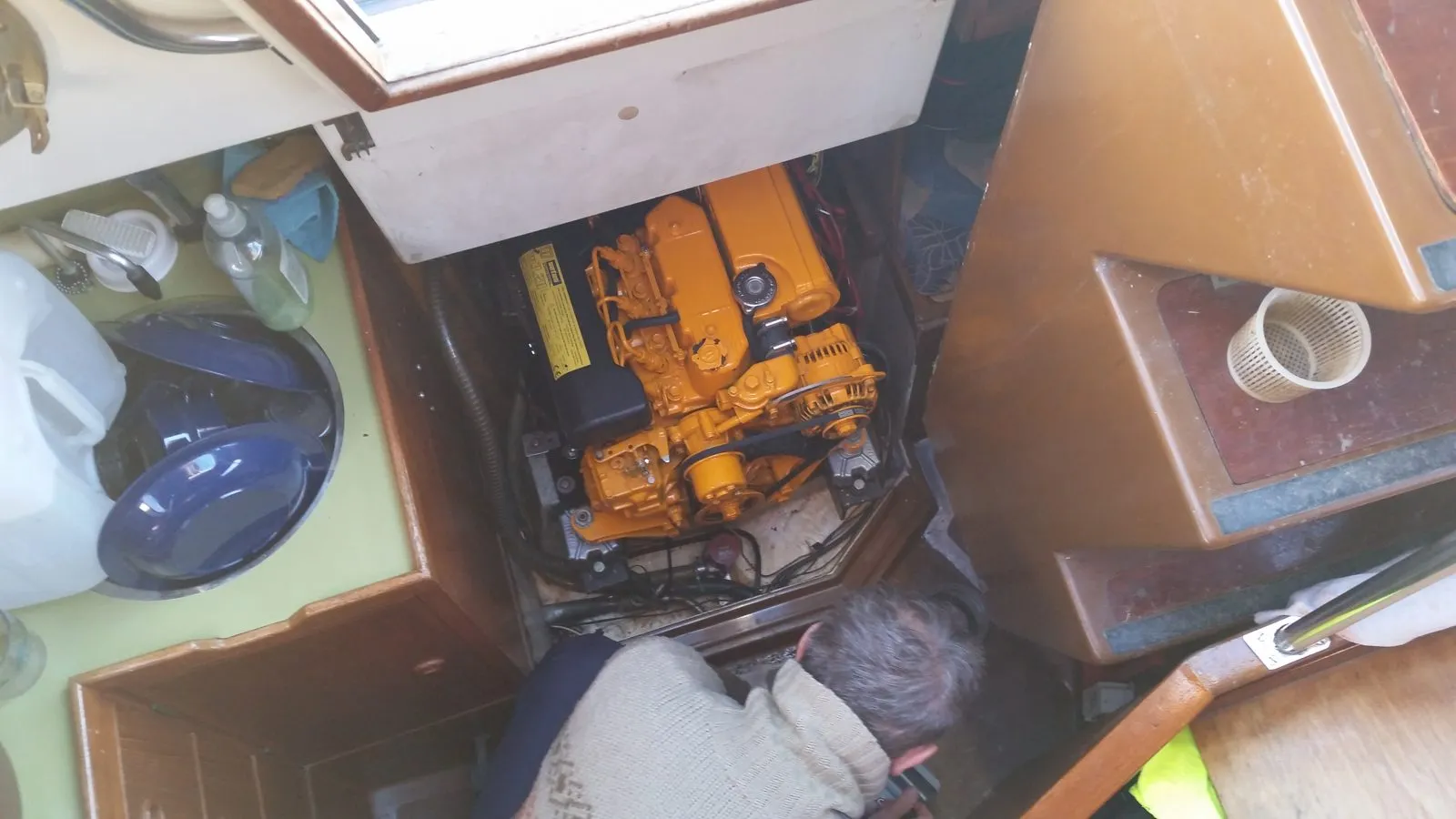
We couldn’t get shore power, but we hoped the battery would survive the heater fan running all evening. It did, I can vouch for it.
After this came the day’s cultural and nature-walk programme: we climb up to the Shot Tower standing on the nearby hill.
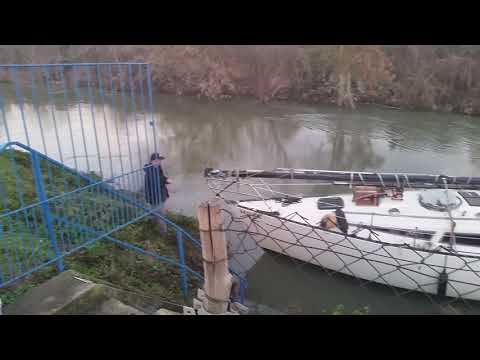
We weren’t surprised it was closed, but luckily the information board explained how lead shot was cast here in the 1930s. Do you have any idea?
I swear I’d have had sleepless nights if I hadn’t found out…
It’s a trick question like the ones HR people sometimes put to unsuspecting candidates at job interviews, namely how they might make the round little m&m chocolate balls coated in different coloured sugar shells…
So you don’t burst with curiosity, I’ll tell you. It’s very clever, maybe they came up with it as far back as the siege of Eger (the famous Hungarian castle siege of 1552)…:
The inside of the tower is hollow, with a pool at the bottom. At the top they pour hot, molten lead onto a fine sieve; it drips through in tiny drops, becomes spherical as it falls, then quickly cools in the water of the pool. And that’s it. You just have to fish it out, like coins from a fountain.
There was a nice view from the foot of the tower too, but since night was coming down like lead shot, we headed back to the boat. There we ran into the dyke keeper. A real dyke keeper!
We had a good chat about all sorts, but I was most interested in his profession. I learned that he, the dyke keeper of Borjád, has a service house and an 8.2 km stretch that he walks every day. Out along one side, back along the other. (that’s 16.4 km. – Ed.).
He also has a service bicycle, but he hasn’t seen it for 4 years. And what does he have to watch out for?
Where a tree has fallen, where something has weakened the dyke (what do I know, a ground-squirrel burrow, etc.). And if he sees something like that? Well, he reports it to the bosses by e-mail. And what do they do? Nothing. Or rather, he corrected himself, he doesn’t know, or rather doesn’t see… It doesn’t seem a stressful life, especially if you consider that they let Lake Balaton’s water out twice a year, in spring and in autumn. Sadly I didn’t ask about his salary, or whether there’s any illegal tree felling going on…
Then we managed to climb back aboard without falling in, grabbed a bite, and went to bed with the chickens, around 8.
Our Webasto heater warmed us nicely – I know this because all evening the heater fan blew oxygen-thin hot air straight into my face from the vent under the opposite bunk… A few hours later I woke up with my mouth completely dried out, unable to breathe, with a desert wind regularly howling into my face (as the thermostat switched on and off). One moment I pulled the blanket over my head – then my feet got cold and I still couldn’t breathe – the next I turned to face the wall until my right side went numb; so yes, this sailing business is hard stuff, no joke…
Machine translation (AI, Claude) of Balázs’s Hungarian original. Read the original →